Blog Details
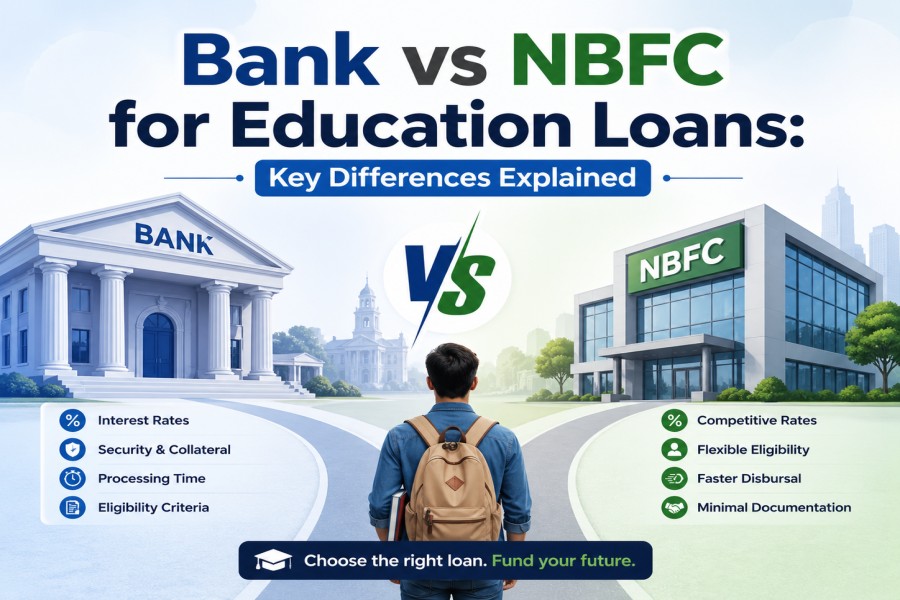
Bank vs NBFC for Education Loans: Key Differences Explained
Choosing the right lender for your education loan is not just about getting funds; it’s about managing your future financial stability. Many students and parents struggle with one key decision: should you opt for a bank education loan or an NBFC education loan?
At first glance, these solutions may appear the same. However, they differ significantly in interest rates, approval speed, flexibility, EMI calculation, and overall loan repayment experience. While banks are known for lower costs and structured processes, NBFCs stand out for faster approvals and flexible eligibility.
Understanding these differences in detail will help you make a smarter borrowing decision, especially when planning large educational expenses such as tuition, accommodation, and travel.
What is a Bank vs NBFC Education Loan?
Before diving into the comparison, it’s important to understand what each option offers and how it impacts your borrowing journey.
Public and private sector banks offer a bank education loan under strict regulatory guidelines. These loans are generally more affordable, with lower interest rates and structured repayment options. However, they often require strong eligibility and sometimes collateral, especially for higher loan amounts.
On the other hand, an NBFC education loan is provided by private financial institutions. These lenders focus more on flexibility and accessibility, making it easier for students with diverse profiles to secure funding. NBFCs are especially popular for study abroad loans due to their faster processing and broader coverage of expenses.
Key Takeaways:
- Banks focus on affordability and security
- NBFCs focus on flexibility and speed
- Your choice depends on your profile and financial needs
Related blog: Education loan tips for first-time borrowers in India
Key Differences Between NBFC and Bank Education Loans in India
When comparing lenders, it’s important to evaluate them across multiple factors, not just interest rates. Each option comes with its own advantages and trade-offs.
Banks are ideal for borrowers seeking lower interest rates and who can meet strict eligibility requirements. NBFCs, on the other hand, cater to students who prioritize quick lending decisions and flexible repayment options.
| Features | Bank Education Loan | NBFC Education Loan |
|---|---|---|
| Interest Rates | Banks offer lower interest rates for affordable borrowing. | NBFCs charge higher interest rates based on risk. |
| EMI Calculation | EMI remains fixed and predictable throughout tenure. | EMI options are flexible with step-up or partial plans. |
| Processing Time | Loan approval takes longer due to strict checks. | Loan approval is faster with minimal documentation. |
| Collateral | Collateral is usually required for higher loan amounts. | Loans are often available without collateral. |
| Eligibility | Eligibility criteria are strict and income-based. | Eligibility is flexible and future-income focused. |
| Expenses Covered | Covers essential academic expenses only. | Covers wider expenses including living costs. |
| Loan Repayment | Repayment is structured with limited flexibility. | Repayment is flexible based on borrower needs. |
| Hidden Costs | Charges are minimal and more transparent. | Charges may be higher with additional hidden costs. |
Bank vs NBFC Education Loans: Interest Rates, Hidden Charges & Repayment
Interest rates and repayment terms are the most important factors when choosing an education loan. Even a small difference in interest can significantly impact your total repayment amount over time.
Interest Rates and EMI Calculation
The interest rate directly affects your monthly EMI and long-term financial burden. This is where an education loan calculator becomes extremely useful, as it helps you estimate your EMI and compare options effectively.
Banks typically offer lower and more stable interest rates, making them a cost-effective choice. NBFCs, while slightly more expensive, provide repayment flexibility, which can ease financial pressure during your studies.
Key Points:
- Banks: Lower interest, predictable EMI calculation
- NBFCs: Higher interest, flexible EMI options
Use an education loan calculator to compare total repayment.
Read also: What is Education Loan Disbursement Process in India?
Hidden Costs You Must Consider in NBFC and Bank Education Loans
Many borrowers focus solely on EMI payments and ignore hidden costs, which can significantly increase the total loan burden. These charges are often mentioned in fine print, so it’s important to review them carefully.
Banks generally have fewer hidden charges, while NBFCs may include additional fees for processing, insurance, and prepayment.
Common Hidden Costs:
- Processing fees
- Loan insurance charges
- Late payment penalties
- Prepayment or foreclosure charges
Always calculate the total loan cost, not just the EMI.
Loan Repayment Flexibility in Banks and NBFCs
Repayment structure plays a crucial role in managing your finances after graduation. While banks offer structured repayment plans, NBFCs provide more flexibility to suit your cash flow.
Banks usually provide a moratorium period during which repayment is not required. NBFCs, however, offer options such as partial EMI payments during the study period, which can reduce the burden later.
Recent blog: How Do You Choose the Right Education Loan Provider?
Repayment Comparison:
Bank Education Loan:
- Fixed repayment schedule
- Moratorium period available
- Less flexibility
NBFC Education Loan:
- Flexible repayment options
- Partial or step-up EMI plans
- Better cash flow management
Eligibility Criteria & Documents for NBFC vs Bank Study Loans
Eligibility is one of the biggest deciding factors when choosing between banks and NBFCs. Banks tend to have stricter requirements, while NBFCs are more lenient. Banks evaluate academic performance, co-applicant income, and credit history. NBFCs, on the other hand, focus more on future earning potential and course value.
Bank Education Loan Eligibility
To qualify for a bank loan, students must meet strict criteria and provide detailed documentation.
Requirements:
- Strong academic record
- Admission to a recognized institution
- Co-applicant with stable income
- Good credit score
Documents Needed:
- Admission letter
- Academic transcripts
- Income proof
- Identity and address proof
- Collateral documents (if required)
NBFC Education Loan Eligibility
NBFCs simplify the process by offering flexible eligibility criteria and faster approvals.
Requirements:
- Basic academic qualification
- Confirmed admission
- Co-applicant (with relaxed criteria)
Documents Needed:
- KYC documents
- Admission proof
- Basic financial documents
Related blog: How to Get an Education Loan for an MBA in India
List of Banks & NBFCs Offering Education Loans
Choosing the right lender also depends on available options. India has several banks and NBFCs offering competitive education loan products.
Popular Banks:
- State Bank of India (SBI)
- Bank of Baroda
- Punjab National Bank
- HDFC Bank
- ICICI Bank
Leading NBFCs:
- HDFC Credila
- Avanse Financial Services
- Auxilo Finserve
- InCred Education Loans
Related blog: Smart Ways to Avoid Over-Borrowing in Your Education Loan
Conclusion: Bank vs NBFC — Which is Better?
There is no one-size-fits-all answer when choosing between a bank and an NBFC. Banks are ideal if you want lower interest rates, structured repayment, and long-term savings. NBFCs are better if you need a quick lending decision, flexible eligibility, and no collateral. The best approach is to compare both options carefully, use an education loan calculator, and evaluate your long-term loan repayment ability before making a decision.
Compare smarter and borrow better with Loan Quantum. Use our education loan calculator to find the lowest EMI, uncover hidden costs, and choose the best loan for your future today.
Frequently Asked Questions
Yes, bank education loans usually have lower interest rates compared to NBFC education loans.
A bank education loan has a fixed EMI, while an NBFC education loan offers flexible EMI options, such as partial or step-up repayments.
Yes, an NBFC education loan offers more flexible repayment options than a bank education loan.
Tax benefits under Section 80E are generally available on a bank education loan, not on an NBFC education loan.
Yes, you can refinance an NBFC education loan to a bank education loan if you meet eligibility requirements.