Blog Details
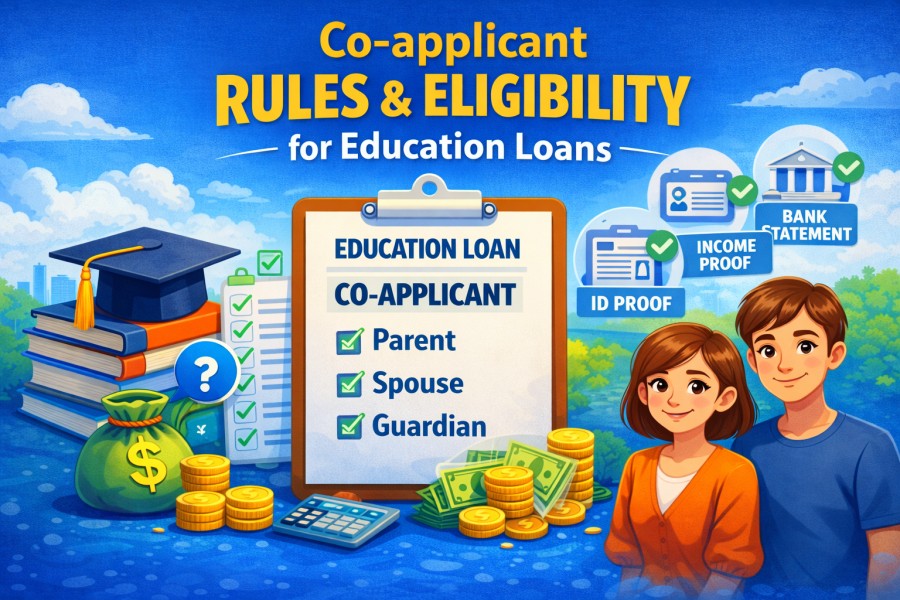
Co-applicant Rules & Eligibility for Education Loans
Applying for an education loan is one of the most important financial decisions for students planning higher studies in India or abroad. In most cases, lenders require a co applicant in education loan applications to reduce lending risk and improve approval chances. But many students are still confused about what a co-applicant is, who can qualify, and whether it is possible to get an education loan without a co-applicant.
This guide explains co-applicant rules, eligibility requirements, documentation, and important factors that affect approval. It also covers loan eligibility, hidden charges, loan EMI calculation, and loan repayment planning so borrowers can make informed decisions.
What Is a Co-Applicant in an Education Loan?
A co-applicant is a person who shares legal responsibility for repaying the education loan if the student borrower fails to make payments. In simple terms, the co-applicant acts as financial support for the student. Since most students do not have income or a credit history, lenders require a financially stable person to guarantee repayment.
Common co-applicants include:
- Father or mother
- Legal guardian
- Spouse
- Sibling (in some lender cases)
- Parent-in-law (rarely accepted)
The co-applicant becomes equally responsible under the co-applicant loan agreements.
Why is a Co-Applicant Required in Education Loans?
Lenders ask for co-applicants because students usually have no stable income source. A co-applicant gives confidence to lenders that repayment will continue even if the student faces financial difficulty after studies.
Main reasons lenders require co-applicants:
- Reduces repayment risk
- Improves loan approval probability
- Strengthens borrower profile
- Helps secure better interest rates
- Enables a higher sanction amount
Without a qualified co-applicant, many students may fail education loan eligibility checks.
Who Can Be a Co-Applicant for Education Loans?
Eligibility varies by lender, but most banks and NBFCs accept close family members.
Accepted Co-applicants Usually Include:
- Biological parents
- Adoptive parents
- Legal guardians
- Spouse
- Elder siblings (some lenders)
Co-applicant Must Meet These Conditions:
- Must be an Indian citizen (in most Indian lenders)
- Must meet minimum age criteria
- Must have a regular income source
- Must maintain an acceptable credit score
- Must provide valid income proof
Each lender has separate loan eligibility criteria, so comparing lenders is essential.
Related blog: How to Choose Between Secured and Unsecured Education Loans?
Co-applicant Eligibility Criteria for Education Loans
- Age Requirement: Most lenders require co-applicants to be between 21 and 65 years old.
- Income Stability: A stable monthly income is one of the biggest approval factors. Salaried employees, business owners, and self-employed professionals are preferred.
- Credit Score: A Low CIBIL score can reduce chances of approval. Many lenders prefer a 700+ credit score.
- Existing Debt Burden: If the co-applicant already has multiple loans, lenders may reject or reduce the sanction amount.
- Relationship with Student: Only approved family relationships are accepted.
Steps to Apply for a Student Loan with a Co-Applicant
Applying with a co-applicant for a student loan is a structured process. Proper preparation improves approval chances and reduces delays.
Step 1: Check Loan Eligibility
Before applying, evaluate:
- Student academic profile
- Admission confirmation letter
- Co-applicant income stability
- Credit score
- Existing debt burden
Use an education loan calculator to estimate EMI before applying.
Step 2: Choose the Right Lender
Conduct a loan comparison across:
- Public banks
- Private banks
- NBFCs
- International education lenders
Compare interest rates, hidden charges, repayment terms, and co-applicant requirements.
Step 3: Gather Required Documents
Student documents:
- Admission letter
- Academic records
- ID proof
- Address proof
Co-applicant documents:
- PAN card
- Aadhaar card
- Salary slips
- Bank statements
- Income tax returns
Step 4: Submit Application Form
Complete the application online or offline with accurate student and co-applicant details.
Step 5: Verification and Credit Assessment
The lender reviews:
- Co-applicant income proof
- Credit history
- Employment status
- Student admission credibility
Step 6: Loan Sanction and Agreement Signing
After approval, both the student and the co-applicant sign the loan agreement.
Documents Required for Co-Applicant in Education Loan
Typical documentation includes:
- PAN card
- Aadhaar card
- Address proof
- Salary slips (last 3 months)
- Bank statements
- Income tax returns
- Employment proof
- Passport-sized photographs
Incomplete documentation can delay processing.
Recent blog: When Does Education Loan Repayment Start?
Is It Possible to Get an Education Loan Without a Co-Applicant?
Many students ask whether getting an education loan without a co-applicant is possible.
Yes, But Only in Limited Cases:
Some lenders may approve an education loan without a co-applicant if:
- The student gets admission into a premium university
- The loan amount is small
- The student has scholarship support
- The student shows strong future earning potential
- Collateral is provided
However, such cases are less common in India. For most traditional banks, an education loan without a co-applicant approval is difficult.
How to Get an Education Loan Without a Co-Applicant for Abroad Studies
Certain international lenders and fintech lenders offer education loans without a co-applicant option, especially for overseas education.
These lenders evaluate:
- University ranking
- Course employability
- Future income potential
- Country of study
These loans may carry:
- Higher interest rates
- Stricter approval filters
- Lower flexibility in repayment
Always perform a loan comparison before choosing such products.
Related blog: Is an Education Loan Calculator Useful for Studying Abroad?
How Co-applicant Affects Loan Approval
A strong co-applicant can directly improve:
- Approval speed
- Interest rate offered
- Maximum loan amount
- Flexible repayment tenure
Example: A parent with a stable salary and a high credit score improves education loan eligibility significantly.
Common Co-Applicant Mistakes That Lead to Loan Rejection
Many education loan applications are rejected because of avoidable co-applicant errors.
- Low Credit Score: A poor credit score is one of the top rejection reasons. Missed EMIs or unpaid debts reduce approval chances.
- Inadequate Income Proof: If income documents are incomplete or inconsistent, lenders may reject the application.
- High Existing Loan Burden: Too many active loans lower repayment capacity in the lender assessment.
- Incorrect Documentation: Errors in PAN, Aadhaar, salary slips, or address proof create verification issues.
- Choosing Ineligible Co-Applicant: Selecting someone outside of lender-approved family relationships may lead to rejection.
- Hidden Financial Liabilities: Undisclosed debts or pending defaults uncovered during verification may jeopardize approval.
- Applying Without Loan EMI Calculation: Ignoring the loan EMI calculation may result in unrealistic borrowing requests.
- Not Comparing Lenders Properly: Skipping loan comparison may cause the application to be filed with lenders whose policies do not match the borrower's profiles.
A strong co-applicant profile improves approval speed, better interest rates, and smoother loan repayment planning. Before applying, always verify education loan eligibility, calculate EMI carefully, and review hidden charges to avoid future financial stress.
Conclusion
Choosing the right co applicant in education loan applications can make a major difference in your approval chances, loan amount, and repayment flexibility. Since lenders depend heavily on the co-applicant’s income stability, credit history, and financial background, selecting a financially strong and eligible co-applicant is essential for a smooth approval process. While options for education loans without a co-applicant do exist, they are limited and often come with stricter conditions or higher costs.
Before applying, students should carefully review education loan eligibility, compare lenders, use an education loan calculator for accurate loan EMI calculation, and understand hidden charges to avoid unexpected financial burdens later. Proper planning and the right co-applicant can make your education financing journey more secure and stress-free.
Take the smarter path to education financing with Loan Quantum. Compare lenders, calculate EMIs, and find the right education loan for your study goals today.
Frequently Asked Questions
Yes, some banks and NBFCs allow siblings as co-applicants if they meet income, age, and credit score requirements.
Yes, unsecured loans generally require higher co-applicant income and better credit score because there is no collateral backing the loan.
No, co-applicant rules vary by lender. Public banks, private banks, and NBFCs may have different policies on relationship eligibility, income criteria, and documentation.
Yes, retired parents can be co-applicants if they receive regular pension income or can provide collateral/assets. However, lenders may prefer working with co-applicants with active income.
Many lenders prefer co-applicants with a monthly income of at least ₹30,000 to ₹50,000, depending on the loan amount and lender policy. Stable income improves education loan eligibility.