Blog Details
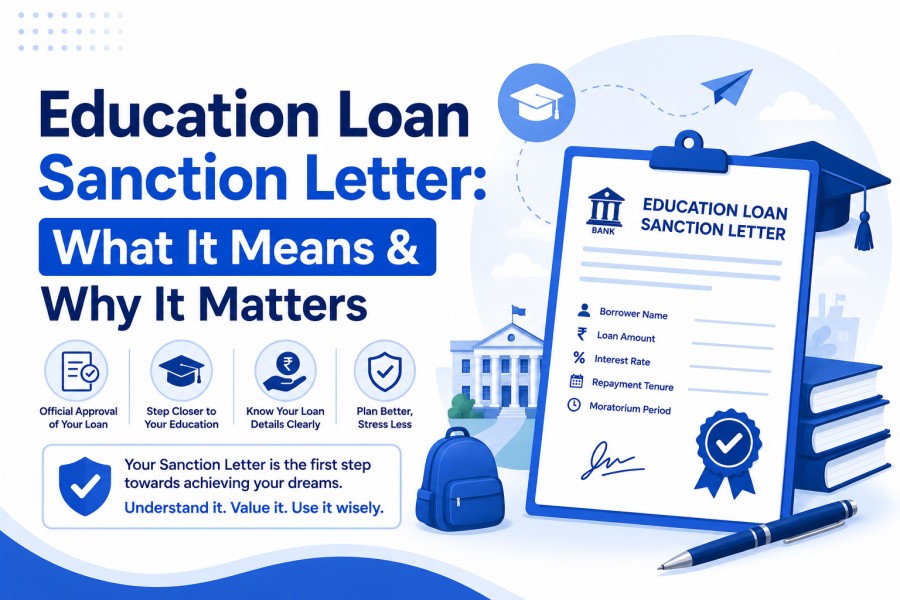
Education Loan Sanction Letter: What It Means & Why It Matters
Securing a place in higher education, especially abroad, involves more than just selecting the right university; it also requires strong financial planning. Among all the documents involved in an education loan process, the education loan sanction letter is one of the most important milestones. It is the official confirmation from an education loan provider that your loan application has been approved based on eligibility, documentation, and financial assessment.
In this blog, we will discuss everything you need to know about the education loan sanction letter, including its meaning, process, types, and importance in the education loan journey. You will also understand how it impacts your loan eligibility, EMI calculation, and overall financial planning when choosing the right education loan provider.
What Is an Education Loan Sanction Letter?
An education loan sanction letter means an official confirmation issued by an education loan provider after evaluating your application, financial background, and academic details. It states that your loan has been approved under specific terms, including the interest rate, repayment tenure, collateral requirement, and moratorium period. This document acts as the foundation of your education financing journey and is usually issued before the actual disbursement of funds.
It is important to understand that a sanction letter is not the final release of funds but a commitment from the lender. Students often use an education loan calculator at this stage to understand future repayment obligations and perform EMI calculations before accepting the offer. It also helps in financial planning and deciding whether to proceed with the loan or explore other options through loan comparison.
Key Points of Education Loan Sanction Letter:
- Official approval document from the education loan provider
- Contains loan amount, interest rate, and repayment details
- Issued after loan eligibility verification
- Not the final disbursement of funds
- Helps in EMI calculation and financial planning
When Do You Get an Education Loan Sanction Letter for Study Abroad?
Students planning to study abroad receive the sanction letter after completing the loan application process and document verification. Once the lender confirms your loan eligibility, checks the co-applicant's income, evaluates your academic records, and verifies university admission, the sanction letter is issued. This process may also involve collateral evaluation if required.
For study abroad purposes, the sanction letter is crucial for visa approval and university admission confirmation. Many countries require proof of funds, and this document serves as financial assurance. Students applying for secured or education loans on property (ELAP) may experience a slightly longer timeline due to property valuation and legal checks.
Why Is an Education Loan Sanction Letter Important for Students?
The sanction letter plays a crucial role in a student’s academic and financial journey. It acts as a legal confirmation of approved funding and is often required by universities and embassies. Without it, students may face delays in admission or visa processing, especially for international education.
It also helps students understand loan repayment structure, interest rates, and EMI obligations in advance. Using tools like an education loan calculator, students can assess their repayment capacity. It also supports financial planning, tax benefits under Section 80E, and helps compare multiple lenders through loan comparison.
Importance of a Loan Sanction Letter for Students
- Proof of financial support: The education loan sanction letter acts as official confirmation that funds are available to cover tuition fees, living expenses, and other study abroad costs required by immigration authorities.
- Visa application requirement: Many countries consider the student loan sanction letter a mandatory document during visa processing as evidence of sufficient financial backing.
- Clear loan structure: The education loan sanction letter format clearly defines loan amount, interest rate, repayment tenure, and EMI calculation, helping students plan finances.
- University admission support: Several universities request a sample education loan sanction letter to verify that the student has arranged funding before final enrolment.
- Better financial planning: Knowing the time required to sanction an education loan helps students align admission, fee payment, and visa timelines without last-minute delays.
- Budgeting with clarity: Students can use an education loan calculator to understand EMI calculation and plan monthly repayment after graduation.
- Loan comparison advantage: It helps in comparing multiple education loan providers based on interest rates, collateral requirements, and repayment flexibility.
- Reduces financial uncertainty: Assures approved loan terms before disbursement, ensuring smoother financial decision-making.
- Supports Section 80E benefits: Helps students plan tax benefits for interest repayments under Section 80E of the Income Tax Act.
- Improves application strength: Strengthens study abroad applications by proving financial readiness and credibility to universities and embassies.
Types of Education Loan Sanction Letters
Once an education loan is approved, the lender does not issue a single standard document for all applicants. Instead, different types of education loan sanction letters are provided depending on the stage of admission, documentation, and verification. Each letter serves a specific purpose in the student’s academic and financial journey.
- In-principle sanction letter: Issued at an early stage based on basic eligibility checks, this education loan letter gives an initial estimate of loan eligibility and helps students understand the expected education loan sanction time during the admission process.
- Pre-approved/Provisional sanction letter: Provided before final admission confirmation, this education loan sanction letter format is tentative and subject to further verification of academic, financial, and admission-related documents.
- Unconditional / Final sanction letter: Issued after complete document verification and approval, this student loan sanction letter follows a standard education loan sanction letter format and is widely accepted by universities and embassies for visa processing.
- Conditional sanction letter: Released when certain requirements are still pending, such as additional documents or collateral verification. Students often refer to a sample education loan sanction letter to understand the conditions clearly.
- Pre-Visa sanction letter: Specifically issued for study abroad applicants, this education loan letter acts as official proof of financial support and is commonly used during visa applications and interviews.
Key Benefits of an Education Loan Sanction Letter
The sanction letter provides clarity and transparency in the entire loan process. It helps students understand the exact financial commitment before accepting the loan. This includes repayment tenure, EMI structure, interest rate, and collateral requirements.
It also supports better financial planning by allowing students to calculate EMI using an education loan calculator. Additionally, it helps compare multiple education loan providers and choose the most suitable option based on interest rate, repayment flexibility, and total loan cost.
- Proof of financial readiness: Acts as official confirmation from an education loan provider that funds are approved to cover tuition fees, living expenses, and other study expenses.
- Essential for visa applications: Widely accepted as financial proof by embassies during student visa processing for study abroad destinations.
- Supports university admissions: Helps students meet admission requirements when institutions require a valid student loan sanction letter before enrolment.
- Clear repayment planning: Provides complete details of interest rate, tenure, and EMI calculation, helping students plan future repayments effectively.
- Better financial decision-making: Enables students to compare multiple lenders through loan comparison and choose the most suitable offer.
- Improves loan transparency: Clearly defines loan terms, collateral requirements, and conditions, reducing confusion and hidden surprises.
- Helps in financial budgeting: Allows students to use an education loan calculator to estimate EMIs and manage long-term expenses.
- Speeds up the study abroad process: Knowing the time required to sanction an education loan helps align admission deadlines and visa schedules smoothly.
- Tax benefits support: Assists in claiming deductions under Section 80E on interest repayment, reducing the overall financial burden.
- Builds application credibility: Strengthens the student’s profile by proving strong financial backing to universities and immigration authorities.
Difference Between an Education Loan Approval Letter and a Sanction Letter
An approval letter and a sanction letter are often confused, but they represent different stages of the loan process. Here are the comparisons:
| Basis | Education Loan Approval Letter | Education Loan Sanction Letter |
|---|---|---|
| Approval Stage | Initial approval after basic verification | Final approval after complete verification |
| Loan Details | Basic or estimated details | Complete loan amount, EMI calculation, interest rate, and tenure |
| Visa Importance | May not be accepted for visa processing | Accepted as proof of financial support for visas |
| University Requirement | Sometimes used for initial discussions | Required for admission confirmation in many universities |
| Disbursement | Does not confirm fund release | Basis for future loan disbursement |
| Legal Status | Not fully binding | Legally binding after acceptance |
| Financial Planning | Gives preliminary loan idea | Helps in detailed repayment and loan comparison planning |
Common Reasons Why an Education Loan Sanction Letter Gets Delayed or Rejected
The issuance of an education loan sanction letter depends on proper documentation, eligibility checks, and verification by the education loan provider. Even small errors or missing details can slow down the approval process or lead to rejection. Understanding these common issues helps students prepare better and avoid unnecessary delays.
- Incomplete documentation: Missing income proof, identity documents, admission letter, or bank statements can delay the verification process and hold back the education loan sanction letter.
- Low loan eligibility: If the applicant or co-applicant does not meet the required income level or academic criteria set by the education loan provider, approval may be delayed or rejected.
- Poor credit history: A low credit score or past repayment defaults reduce lender confidence and directly impact sanction approval.
- Unrecognized university or course: Loans may get rejected if the selected institution is not approved or listed by the lender for funding eligibility.
- Weak repayment capacity: If the EMI calculation shows a high burden compared to income, lenders may consider the loan risky and delay sanction.
- Collateral-related issues: For secured loans, disputes over property documents or a low valuation can delay approval or lead to rejection, including in cases such as an education loan against property.
- High existing debt burden: Multiple ongoing loans or financial liabilities reduce overall eligibility and affect sanction decisions.
- Mismatch in application details: Errors or inconsistencies in personal, academic, or financial information can trigger additional verification and delays.
- Delayed admission confirmation: A lack of the final admission letter from the university can delay the issuance of the sanction letter.
- Internal processing delays: Sometimes delays occur due to workload, verification backlog, or additional checks by the education loan provider.
Conclusion
An education loan sanction letter is more than just an approval document; it is the foundation of your entire education financing journey. From confirming your loan eligibility to supporting visa applications and university admissions, it plays a crucial role at every stage of studying abroad or in India. It also provides clarity on the repayment structure, interest rates, and EMI calculations, helping students plan their finances with confidence.
Before accepting any sanction, it is always wise to use an education loan calculator, compare different education loan providers, and carefully review terms such as collateral requirements, repayment tenure, and benefits like Section 80E. A clear understanding of the sanction letter ensures better financial planning, fewer surprises, and a smoother academic journey ahead.
Plan your higher education without financial stress, explore smarter loan options, compare lenders, and calculate your EMIs with ease using Loan Quantum for a confident study abroad journey.
Frequently Asked Questions
It is required as proof of financial support for university admissions and visa applications. Immigration authorities use it to verify that the student can cover tuition fees and living expenses.
Yes, if discrepancies are found later, such as fake documents, low credit score, or unrecognized universities, the sanction may be withdrawn before disbursement.
A provisional sanction letter is issued based on initial eligibility checks, while a final sanction letter is given after complete verification of documents, admission confirmation, and financial assessment.
Yes, in cases of secured loans like an education loan against property, a sanction letter is issued after property valuation and legal verification.
The tax benefit under Section 80E starts only after repayment begins and applies to the interest paid on the education loan.