Blog Details
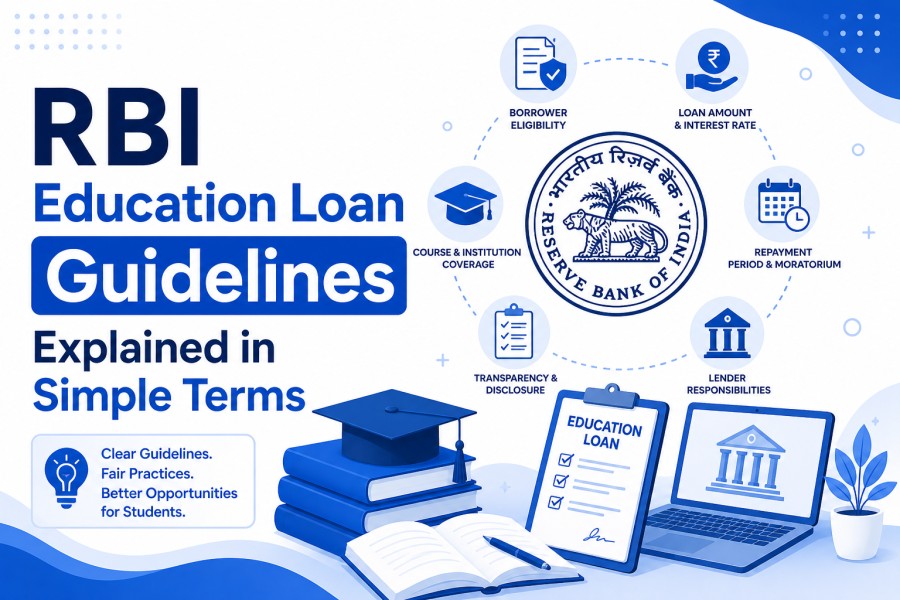
RBI Education Loan Guidelines Explained in Simple Terms
Education loans are no longer just an option; they are a necessity for many students planning higher education, especially those aiming to study abroad. With rising tuition fees and increasing living expenses, understanding how loans work becomes crucial before making a financial commitment.
The RBI education loan guidelines and broader Government Guidelines for education loans ensure that students are treated fairly by banks and financial institutions. These rules define everything from eligibility to repayment and even loan settlement. In this blog, we will discuss the RBI's rules on secured and unsecured education loans, with detailed explanations.
What are the RBI Guidelines for Education Loans?
The RBI education loan guidelines are a set of regulatory instructions issued to banks to standardize the processing and management of education loans. While RBI does not directly give loans, it ensures that lenders follow ethical and transparent practices. These guidelines aim to make education financing accessible while protecting both the borrower and the lender.
- Ensures a fair loan approval process across banks
- Promotes transparency in the education loan interest rate
- Standardizes repayment terms, including moratorium
- Prevents unfair recovery practices
- Encourages banks to support student borrowers
In simple terms, the RBI acts as a rule-maker to ensure students don’t face confusion or exploitation during the loan journey.
Related blog: How Does the Education Loan Moratorium Period Work in India?
Latest RBI Guidelines for Education Loans in India
The latest updates to the RBI education loan guidelines reflect a clear push to make student financing more accessible, transparent, and structured. With rising education expenses, especially for those planning to study abroad, the revised framework ensures that students from different financial backgrounds can secure funding without unnecessary barriers.
These updates, aligned with the Government Guidelines for education loans and the Model Education Loan Scheme (MELS), focus on simplifying loan access, defining clear rules for collateral, and ensuring repayment flexibility through structured EMI calculation and moratorium support. At the same time, banks are encouraged to adopt student-friendly policies while maintaining financial discipline.
List of the latest RBI Rules on student loans
- Simplified Application Process: Banks must keep the loan process simple and student-friendly so applicants can easily access funding. Online applications and reduced paperwork make it quicker and more convenient.
- Interest Rate Transparency: RBI ensures that lenders clearly disclose the education loan interest rate and related charges. This helps students better understand the real cost of borrowing and plan their repayments.
- Flexible Moratorium Period: Students get a repayment holiday covering the course duration plus 1 year (or 6 months after a job). This reduces pressure and allows time to stabilize financially before starting the study loan EMI.
- Transparent Repayment Schedule: Lenders must clearly explain when EMI starts and how much is payable each month. This improves clarity in EMI calculation and avoids confusion later.
- Collateral-Free Loans (Up to ₹4 Lakh): No Collateral or guarantor is required for loans up to ₹4 lakh. Only a parent or guardian acts as a co-applicant.
- Third-Party Guarantee (₹4–₹7.5 Lakh): Loans in this range may require a guarantor but not collateral. The co-applicant’s financial profile plays a key role in the approval process.
- Collateral Requirement (Above ₹7.5 Lakh): Tangible assets, such as property or FDs, are required for loans above ₹ 7.5 lakh. Providing collateral can also help reduce the interest rate.
- Margin Money Requirement: For loans above ₹4 lakh, students must contribute a portion of the cost. It is typically 5% for India and 15% for study abroad programs.
- Wide Coverage of Expenses: Loans cover tuition, travel, books, and living expenses. This ensures students can focus on education without financial interruptions.
- Long Repayment Tenure: Repayment tenure can go up to 15 years, making EMIs more manageable. A longer tenure reduces the monthly financial burden.
- Use of Education Loan Calculator: The RBI encourages the use of tools such as an education loan calculator. It helps estimate EMI and total repayment before applying.
- Support for Loan Restructuring: Banks may adjust repayment terms during financial difficulty. This can include extending tenure or temporarily reducing the EMI burden.
- Interest Concessions: Some lenders may offer lower interest rates in special cases. This reduces the overall repayment amount and makes loans more affordable.
- Technology-Driven Lending: RBI promotes digital loan processing to enable faster approvals and greater transparency. Students can easily apply, track, and manage loans online.
- Student-Friendly Lending Approach: Banks are encouraged to design repayment plans that do not create excessive financial stress. This ensures responsible borrowing and smoother repayment.
What are the RBI Rules for Secured Education Loans?
Secured education loans are available for amounts above ₹7.5 lakh. Under the RBI education loan guidelines, these loans require Collateral to reduce risk for lenders and to provide students with access to larger funding amounts, especially useful for those planning to study abroad, where total expenses can be significantly higher.
These loans follow the Model Education Loan Scheme (MELS), ensuring structured lending, fair treatment, and borrower protection. Since an asset backs the loan, banks are more comfortable offering lower interest rates, higher loan limits, and longer repayment terms. However, borrowers must also understand their responsibilities, including legal checks and repayment commitments.
Collateral Requirement
For secured loans, providing collateral is mandatory above a certain loan amount. This acts as a safety net for the bank and improves loan eligibility.
- Required for loans above ₹7.5 lakh
- Acceptable assets include property, fixed deposits, LIC policies, or government bonds.
- Helps in getting better loan terms and approval chances
- Must go through valuation and legal verification
Loan Amount & Coverage
Secured loans allow students to access larger funding amounts, making them ideal for expensive courses and international education.
- Loan amounts can exceed ₹1 crore, depending on lender policies.
- Suitable for high-cost programs and study abroad plans.
- Covers tuition fees, travel, accommodation, and other academic expenses.
- Flexible funding based on the course and institution.
Margin Money Requirement
Even with collateral, banks may require the borrower to contribute a portion of the total cost to ensure shared responsibility.
- Up to ₹4 lakh: No margin required
- Above ₹4 lakh: Margin may apply (typically 5–15%)
- Lower margin for studies in India, higher for abroad
- Helps reduce overall loan burden
Moratorium Period
RBI ensures that students are not burdened with repayment during their education period.
- The moratorium includes the course duration plus 1 year.
- Alternatively, 6 months after getting a job
- No compulsory EMI during this period
- Study loan EMI starts after the moratorium ends.
Interest Rates Advantage
Since secured loans involve lower risk, banks offer more favorable loans compared to unsecured loans.
- Lower education loan interest rate than non-collateral loans
- Better negotiation scope for borrowers
- Interest depends on the collateral value and the co-applicant's profile.
- Reduces overall repayment cost
Valuation and Legal Charges
Before approving a secured loan, banks must verify the value and ownership of the pledged asset.
- Property valuation is mandatory.
- Legal title verification is required.
- The borrower usually pays charges for these processes.
- Ensures transparency and avoids future disputes.
Related blog: Education Loan Against Property(ELAP) in India
Borrower Rights and Protection
RBI guidelines also protect borrowers from unfair treatment, even in secured loans.
- Right to fair and respectful recovery practices
- No harassment by lenders during repayment issues
- Option to restructure the loan if facing financial difficulty
- Access to the grievance redressal system
Complaint and Grievance Redressal
If a borrower faces issues with the lender, the RBI provides a structured complaint mechanism.
- Complaints can be raised with the bank first.
- If unresolved, escalate to RBI Ombudsman.
- Covered under the RBI Integrated Ombudsman Scheme
- Ensures accountability of lenders
What are the RBI guidelines for Unsecured Education Loans?
Unsecured education loans are designed for students who do not have assets to pledge as Collateral. Under the RBI education loan guidelines, these loans allow students to access funding based on academic merit and the financial strength of the co-applicant, rather than property or fixed assets.
These loans are especially popular among students planning to study abroad, where upfront expenses can be high but immediate access to funds is critical. Since there is no collateral involved, banks follow stricter evaluation criteria, including credit history, income stability, and future earning potential.
No Collateral Requirement (Up to ₹4 Lakh)
RBI clearly states that loans up to ₹4 lakh must be provided without collateral.
- No Collateral or security required
- Parent or guardian must act as co-applicant
- Ideal for smaller education needs
- Faster and simpler approval process
Guarantor Requirement (₹4 Lakh – ₹7.5 Lakh)
For loans between ₹4 lakh and ₹7.5 lakh, banks may require an additional layer of financial assurance.
- No collateral required
- The bank may ask for a third-party guarantor.
- A strong co-applicant profile becomes crucial.
- Common for mid-range education funding
Higher Loan Limits Without Collateral
Although RBI sets general norms, banks may extend higher unsecured loan amounts in select cases.
- Public sector banks typically offer up to ₹7.5 lakh without collateral.
- Private banks/NBFCs may offer up to ₹40 lakh for top-tier institutions.
- Approval depends on academic record and future earning potential.
- Mostly applicable for premium study abroad programs
Moratorium Period (Repayment Flexibility)
RBI mandates a repayment holiday to reduce pressure on students during their education phase.
- Moratorium = Course duration + 1 year
- Or 6 months after securing a job
- No mandatory EMI during this period
- Study loan EMI begins after the moratorium ends.
Focus on Co-applicant Evaluation
Since unsecured loans lack asset backing, banks rely heavily on the co-applicant’s financial strength.
- Income stability is a key factor.
- A good credit score improves approval chances.
- Determines the education loan interest rate
- Acts as repayment support in case of default
Recent blog: How Section 80E Helps You Save Tax on Education Loans
What Role Does RBI Play in Education Loans?
RBI plays a regulatory and supervisory role rather than a lending one. It establishes a framework for how banks operate when offering education loans. This role becomes especially important when dealing with large loan amounts for study abroad.
- Issue Government Guidelines for education loan policies
- Ensures fair EMI calculation practices
- Monitors transparency in loan terms
- Regulates how banks recover loans
- Promotes borrower-friendly repayment structures
At the same time:
- RBI does not approve individual loans
- RBI does not fix exact interest rates
- RBI does not interfere in bank-level decisions
Banks use the RBI’s framework to design their internal loan policies.
Conclusion
Understanding the RBI education loan guidelines is essential before choosing any student loan, whether secured or unsecured. These rules are designed to bring clarity, fairness, and structure to the borrowing process, helping students manage their academic journey without unnecessary financial stress. From collateral requirements and the role of a co-applicant to interest rates and repayment flexibility, every aspect is built to balance access to education with responsible lending.
For students planning higher studies or aiming to study abroad, the key lies in making informed decisions, evaluating total expenses, comparing lenders, and planning repayments through proper EMI calculation. A well-chosen loan not only supports your education but also ensures long-term financial stability without becoming a burden.
Make smarter borrowing decisions with Loan Quantum. Compare options, calculate your EMI, and find the right education loan tailored to your future goals.
Frequently Asked Questions
No, RBI does not fix interest rates. Banks set their own education loan interest rates, but they must keep them transparent and reasonable.
As per RBI guidelines, the moratorium period includes the course duration plus 1 year or 6 months after getting a job. During this time, a full Study loan EMI is usually not required.
Yes, under RBI guidelines, most banks allow prepayment of education loans. Many lenders do not charge prepayment penalties, helping borrowers reduce their interest burden early.
As per RBI guidelines, repayment tenure can go up to 15 years in most cases. This helps reduce the monthly Study loan EMI and makes repayment manageable.
RBI guidelines protect students by ensuring fair lending practices, transparent pricing, and structured repayment terms. They help borrowers make informed and secure financial decisions.