Blog Details
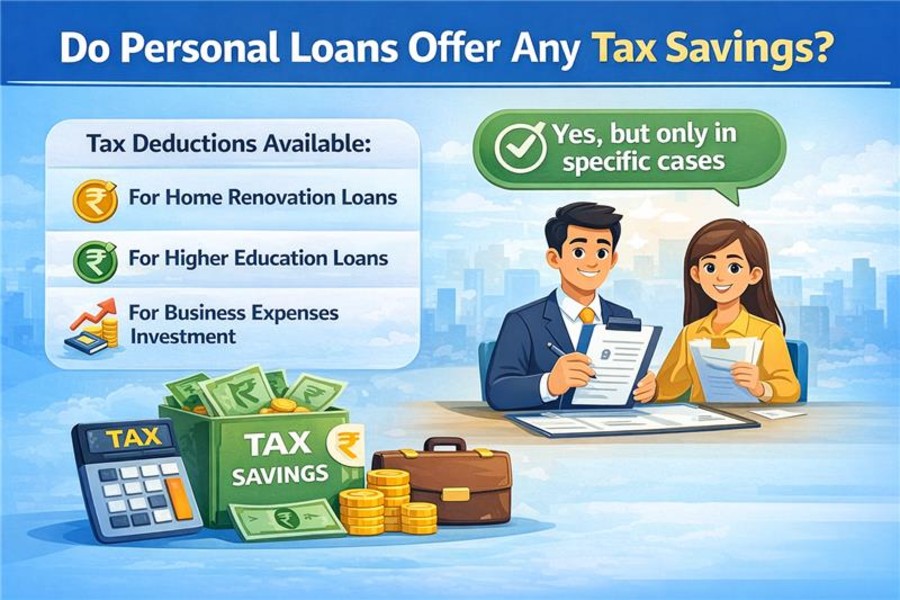
Do Personal Loans Offer Any Tax Savings?
A personal loan is a popular financing option for urgent expenses, such as medical emergencies, education, or home improvements. With a personal loan calculator, borrowers can estimate their monthly EMI, compare lenders, and select a suitable repayment plan. However, one of the most common questions borrowers ask is whether these loans provide any tax savings. Since this type of borrowing is unsecured and not tied to a specific asset, it does not offer the built-in tax advantages of secured loans.
In this blog, we will explore whether any tax benefits are available and under what conditions they may apply. We will also look at how the purpose of borrowing, such as home renovation, higher education, or business use, can influence eligibility for deductions. Additionally, tools like a personal loan calculator can support better financial planning by helping you understand repayment structure and interest outflow.
Are Personal Loans Taxable?
A personal loan is not considered taxable income in India because it is treated as a liability rather than earnings. The amount received must be repaid to the lender, which is why it is not taxed under the Income Tax Act. This applies to all borrowers, including salaried individuals and those opting for flexible repayment options.
However, while the loan amount itself is tax-free, it also does not provide automatic tax deductions. Any potential benefit depends on how the borrowed funds are used. In most cases, the interest paid does not qualify for deductions unless the loan is used for specific purposes defined by tax law.
Do Personal Loans Offer Tax Benefits?
In general, this type of borrowing does not offer direct tax benefits like home or education loans. There are no automatic deductions available on the loan amount or the EMI paid. Even when comparing lenders, checking eligibility, or opting for quick disbursal options, tax savings are not a built-in feature.
That said, indirect benefits may be available in certain situations. While principal repayment is not deductible, the interest component may qualify under specific conditions, such as when the funds are used for home-related expenses, education, or business activities. To claim these deductions, proper documentation and clear proof of usage are essential.
Related blog: Get an Instant Personal Loan with a Low CIBIL Score
Key Scenarios Where Personal Loan Tax Benefits Apply
1. Personal Loan for Home Renovation
If you use a personal loan for repairing or renovating your house:
- You can claim a deduction under Section 24(b)
- Maximum deduction: Up to ₹30,000 per year (for self-occupied property)
This is one of the most common ways to get a personal loan tax benefit in India.
2. Personal Loan for Home Purchase or Construction
If the loan is utilized to purchase or develop a home:
- Interest deduction under Section 24(b)
- Up to ₹2,00,000 for self-occupied property
- Full interest deduction for rented property
- Principal repayment may qualify under Section 80C (up to ₹1.5 lakh)
This makes personal loans comparable to home loans in specific cases.
3. Personal Loan for Higher Education
If you take a personal loan for education:
- Deduction available under Section 80E
- Only the interest component is eligible
- No upper limit
- Benefit available for up to 8 years
This is useful when you cannot qualify for a traditional education loan.
4. Personal Loan for Business Use
If the loan is used for business purposes:
- Interest paid might be considered a business expense.
- Deductible under applicable provisions (like Section 37)
This reduces your taxable income and improves cash flow for business owners.
5. Personal Loan for Asset Purchase
If you use a personal loan to invest in the following assets:
- Shares
- Gold
- Property
The interest paid is added to the cost of acquisition, which helps reduce capital gains tax when selling the asset.
Recent blog: Top Personal Loan Types in India for 2026
When Personal Loans Do NOT Offer Tax Benefits
In most everyday situations, no tax benefits apply. This is especially true when funds are used for personal or lifestyle expenses. The loan eligibility for deductions depends entirely on usage, not on the loan type or approval process.
Situations Where Tax Benefits Are Not Available
- Personal or Lifestyle Use: Expenses such as travel, weddings, shopping, or gadgets do not qualify for tax deductions. Interest paid in such cases cannot be claimed under tax laws.
- Lack of Proper Documentation: Even if the loan was used for a potentially eligible purpose, failing to maintain bills, receipts, or proof of usage can lead to rejection of tax claims.
- Borrowing from Informal Sources: Loans from friends, family, or unregistered lenders are not eligible for tax benefits because they lack proper financial documentation.
- Principal Repayment: The principal portion of the loan repayment is not eligible for any deduction. Only the interest component may qualify, and even then, only under specific conditions.
- Non-Eligible Financial Use: Using loan funds for purposes that do not fall within the defined tax-saving categories, such as non-business or non-asset-related spending, does not provide any tax advantage.
Might you have missed: Pay Off Your Personal Loan Early Foreclosure Charges, Steps & Benefits
Key Points to Remember
- Tax benefits apply only in clearly defined scenarios under the Income Tax Act.
- Proper documentation is essential to claim any deduction.
- Not all loan usage qualifies for tax savings.
- Understanding the purpose of borrowing is more important than the loan type.
In summary, while personal loans are a convenient financial tool, they do not offer tax benefits in most common situations. Meeting the loan eligibility criteria or getting quick approval does not guarantee any tax advantage. To claim deductions, the loan must be used for eligible purposes and supported with proper documentation.
Documents Required to Claim Tax Benefits
- Loan Agreement & Sanction Letter: These documents confirm that you obtained a personal loan from a reputable lender and include details such as the loan amount, term, and interest rate.
- Interest Certificate from Lender: A crucial document showing the interest component of your loan EMI is required to claim tax deductions.
- Bank Statements: These help track EMI payments and prove that repayments have been made regularly.
- Proof of End-Use of Funds: Documents such as invoices, bills, or receipts are required to demonstrate that the loan was used for eligible purposes (such as home improvement or education).
Additional Supporting Documents (Based on Usage)
- Property Documents (Home-Related Use): Required if the loan is used for purchase, construction, or renovation to claim deductions under the relevant sections.
- Education Expense Proof: Fee receipts, admission letters, or loan utilization proof for claiming education-related deductions.
- Business Expense Records: Bills, invoices, or financial statements showing that the loan was used for business purposes.
- Investment Proofs (if applicable): Documents related to asset purchase if you plan to adjust interest against capital gains.
Related blog: How to Save Money with a Personal Loan EMI Calculator
Ways a Personal Loan Calculator Helps in Tax Planning
- Identifies Interest Component for Tax Deduction: A personal loan calculator breaks down your EMI and shows the exact interest payable, helping you estimate potential tax deductions on interest for eligible uses.
- Supports Better Loan Comparison: During loan comparison, you can evaluate different lenders, tenures, and rates to see which option offers a higher or more manageable interest component for tax planning.
- Optimizes Loan Structure: By adjusting loan tenure and loan amount, you can use the loan EMI calculation to structure repayments in a way that aligns with your financial goals and possible tax benefits.
- Helps in Financial & Tax Planning: Knowing your EMI in advance helps you budget better and plan other tax-saving investments alongside your loan.
- Useful for Pre-Approved Loans: Even with a pre-approved personal loan, using a calculator helps you understand the total interest outflow and its impact on your tax-saving strategy.
Personal Loan vs Other Loans (Tax Comparison)
| Loan Types | Tax Benefit Availability | Interest Deduction | Principal Deduction |
|---|---|---|---|
| Personal Loan | Limited (conditional) | Yes (specific use) | No |
| Home Loan | High | Yes | Yes (80C) |
| Education Loan | Moderate | Yes (80E) | No |
| Business Loan | Yes | Yes | No |
| Car Loan | Limited | Yes (business use) | No |
Common Mistakes to Avoid When Claiming Tax Benefits
Claiming tax benefits on a personal loan or other deductions can help reduce your overall tax burden, but simple mistakes can lead to rejection, penalties, or missed savings. Many taxpayers focus solely on eligibility and ignore important factors such as documentation, limits, and accurate reporting. Whether you’re planning deductions on loan interest or other tax-saving investments, avoiding these common mistakes is essential for smooth filing and maximum benefits.
Common Mistakes to Avoid
- Claiming Deductions Without Proof: Not maintaining proper documents, like interest certificates, bills, or receipts, can lead to rejection of your tax claims.
- Using Loan for Ineligible Purposes: Tax benefits are not available if funds are used for personal expenses like travel, shopping, or weddings.
- Ignoring Deduction Limits: Exceeding limits under sections like 80C or claiming more than allowed can result in penalties or disallowed claims.
- Double Claiming Deductions: Claiming the same expense under multiple sections or twice in your return can trigger scrutiny.
- Not Reporting All Income Sources: Failing to include interest income, freelance income, or dividends can lead to mismatches and notices.
- Last-Minute Tax Planning: Rushing investments or loan decisions at the end of the financial year often leads to poor financial choices.
- Incorrect Personal Details: Errors in PAN, Aadhaar, or bank details can delay refunds or invalidate your return.
- Skipping ITR Verification: Not e-verifying your return within the deadline makes your filing invalid.
- Ignoring AIS/Form 26AS: Not matching your income and TDS details with official records can lead to discrepancies.
Final Thoughts
Personal loans can be a useful financial tool when you need quick access to funds, but they are not designed as tax-saving instruments. Any potential tax benefit depends entirely on how the borrowed amount is used and whether it falls under specific provisions of the Income Tax Act. In most cases, everyday expenses do not qualify, and only the interest component may be deductible in limited scenarios.
To make the most of any possible tax advantage, focus on proper planning, clear usage of funds, and accurate documentation. Always evaluate your financial needs, compare options carefully, and understand the long-term impact on your budget. When used wisely and for eligible purposes, a loan can support both your financial goals and limited tax savings, but relying on it purely for tax benefits is not a practical strategy.
Make smarter borrowing decisions with Loan Quantum. Compare options, check eligibility, and plan your finances with confidence today.
Frequently Asked Questions
Yes, but only if the loan is used for eligible purposes and proper documentation is maintained. Being salaried does not make the loan tax-deductible.
No, the tax treatment is the same for both regular and flexi options. Tax benefits depend on how the loan is used, not the loan type.
No, prepayment does not directly impact tax benefits. However, since deductions are based on interest paid, early repayment may reduce the total eligible deduction.
Yes, a personal loan calculator helps you understand the interest component of your EMI, which is useful for estimating potential tax deductions.
Yes, secured loans like home or education loans offer direct tax benefits, while unsecured loans offer only conditional tax benefits based on usage.