Blog Details
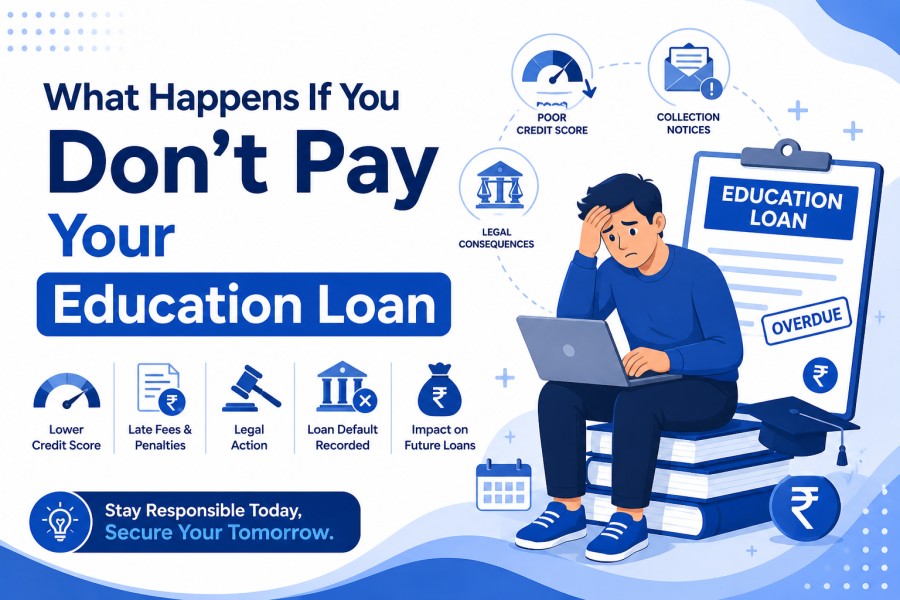
What Happens If You Don’t Pay Your Education Loan
Education loans make higher education accessible, but repayment is where the real responsibility begins. Many borrowers focus only on getting the loan approved and overlook how repayment will impact their finances later. Missing EMIs might seem like a minor delay at first, but over time, they can lead to serious financial and legal consequences.
This guide explains in detail what happens if you don’t pay your education loan, how it affects your future, and how tools like an Education loan calculator, proper EMI calculation, and smart loan comparison can help you avoid these risks.
What is an Education Loan Default, and the reasons why it happens?
An education loan default occurs when a borrower fails to repay their Study loan EMI for a continuous period, usually more than 90 days. At this stage, lenders classify the loan as a non-performing asset, indicating that repayments are no longer being made as agreed.
Default is rarely sudden. It builds over time due to poor planning, lack of awareness about repayment obligations, or unexpected financial challenges. Many borrowers fail to assess their loan eligibility correctly or underestimate the impact of interest rates and tenure.
Common reasons why borrowers default include:
- Lack of stable income after graduation
- Poor EMI calculation before taking the loan
- Misunderstanding of the Loan Moratorium terms
- Taking a higher loan than required (Over-Borrowing)
- Ignoring repayment planning during studies
The Immediate Impact of Missing Your Study Loan EMI in India
When you miss your first EMI, the consequences may not seem severe. However, lenders quickly begin adding penalties and late payment charges. Over time, these additional costs significantly increase your total repayment burden.
Your credit score is one of the first things to be affected. Even a few missed payments can reduce your creditworthiness. This becomes a serious problem when you plan to apply for future loans, credit cards, or even housing finance. A poor credit score signals risk to lenders, making it harder for you to access financial support when you need it most.
Another often overlooked impact is the loss of tax benefits under Section 80E. This section allows borrowers to claim deductions for interest paid on education loans. However, if you stop repayment, you lose this advantage, increasing your effective financial burden.
Recent blog: Biggest Mistakes Students Make While Taking a Loan
Legal Consequences of Not Paying an Education Loan in India
When you stop repaying your education loan in India, the situation gradually shifts from a financial issue to a legal one. Banks and NBFCs follow a structured recovery process, as mandated by the Reserve Bank of India (RBI). Once your Study loan EMI remains unpaid for more than 90 days, the account is classified as a Non-Performing Asset (NPA). From this point, lenders are legally empowered to initiate recovery actions to recover their dues.
It’s important to understand that lenders don’t immediately take legal action. They typically begin with reminders and restructuring options. However, continued non-payment signals default, and the lender is then forced to move towards formal legal recovery channels. The severity of the action depends on whether your loan is secured, the outstanding amount, and your response to the lender's communication. Proper planning using an Education loan calculator and realistic EMI calculation can help avoid reaching this stage altogether.
Read also: Co-applicant Rules & Eligibility for Education Loans
Key Legal Actions Banks Can Take Against Defaulters in India
- Loan Account Classified as NPA: If EMIs are unpaid for 90 days, your loan is marked as an NPA, triggering formal recovery procedures and regulatory reporting.
- Issuance of Legal Notices: Banks send official legal notices demanding repayment within a specified time. Ignoring these notices can escalate the matter further.
- Action Under SARFAESI Act (for Secured Loans): If your education loan is collateralized, lenders can take action under the SARFAESI Act, enabling them to seize and auction the pledged asset without court intervention.
- Recovery Through Debt Recovery Tribunal (DRT): For larger loan amounts, banks may approach the Debt Recovery Tribunal to obtain legal orders for the recovery of dues.
- Involvement of Recovery Agents: Lenders may appoint authorized recovery agents to follow up on repayments. These agents must follow RBI guidelines while contacting borrowers.
- Impact on Co-Applicant or Guarantor: The co-applicant (usually a parent) is equally liable. Legal action, notices, and credit score damage apply to them as well.
- Civil Legal Proceedings: Banks can file civil cases to recover outstanding amounts, which may result in court-ordered repayment orders.
- Seizure and Auction of Collateral: In secured loans, pledged assets, such as property, can be seized and auctioned to recover outstanding amounts.
- Credit Score and Financial Blocklisting: Default is reported to credit bureaus, significantly reducing your ability to access future loans or credit facilities.
Understanding these legal consequences underscores the importance of responsible borrowing, careful loan comparison, and avoiding Over-Borrowing. Staying proactive and communicating with your lender at the first sign of repayment difficulty can help you avoid escalation into legal territory.
Rights of Education Loan Defaulters in India
Defaulting on an education loan does not mean you lose all control or protection. In India, borrowers are protected by clear guidelines issued by the Reserve Bank of India (RBI) and other legal frameworks. Even if your Study loan EMI is overdue, lenders must follow a fair and transparent process while initiating recovery. This means you still have the right to be informed, treated with dignity, and offered reasonable solutions before strict action is taken.
Many borrowers are unaware of these protections and assume that default immediately leads to aggressive recovery or asset seizure. In reality, lenders are expected to provide opportunities such as restructuring or repayment support before escalating the matter. Understanding your rights can help you respond confidently, negotiate better, and avoid unnecessary stress. Planning using tools like an Education loan calculator and proper EMI calculation can reduce the risk of default, but even if you face difficulty, the law provides safeguards.
Recent blog: What is Education Loan Disbursement Process in India?
Key Rights of Education Loan Defaulters in India
- Right to Fair Treatment and Dignity: Recovery agents and bank representatives must follow RBI guidelines. Harassment, threats, or abusive behavior are strictly prohibited.
- Right to Receive Proper Notice: You must receive formal communication before any legal action is taken. Banks cannot take sudden enforcement steps without informing you.
- Right to Loan Restructuring Options: If you face genuine financial hardship, you can request restructuring, including lower EMI, extended tenure, or temporary relief.
- Right to Transparent Loan Information: You can request complete details of your outstanding loan, including interest, penalties, and an updated repayment schedule.
- Right to Protection for Co-Applicants: While co-applicants are liable, they also have the right to be informed and treated fairly throughout the recovery process.
- Right to Negotiate a One-Time Settlement: In extreme cases, borrowers can negotiate a settlement amount with the lender to close the loan, although this may impact credit scores.
- Right to Grievance Redressal: If you face unfair practices, you can file a complaint with the bank’s resentment cell or escalate it to the RBI Ombudsman.
- Right Against Unlawful Asset Seizure: In secured loans, lenders must follow the due legal process before seizing or auctioning any collateral.
- Right to Privacy and Limited Contact: Recovery agents cannot contact you at odd hours or disclose your loan details to unauthorized third parties.
- Right to Improve Credit After Default: Even after default, you have the opportunity to rebuild your credit profile through consistent repayments and financial discipline.
Being aware of these rights ensures that you are not taken advantage of during difficult times. While avoiding default through proper loan comparison, realistic loan eligibility, and controlled Over-Borrowing is always the best approach, knowing your rights gives you confidence to handle challenges responsibly and legally.
Smart Ways to Avoid Education Loan Default
Prevention is always better than dealing with default later. Careful planning can help you stay financially stable.
Key steps to avoid default include:
- Check your loan eligibility before applying
- Use an Education loan calculator to estimate EMIs
- Avoid unnecessary borrowing (Over-Borrowing)
- Understand the impact of the Loan Moratorium
- Track your Study loan EMI regularly
- Take advantage of Section 80E tax benefits
These small but important actions can make repayment smooth and stress-free.
Related blog: Bank vs NBFC for Education Loans: Key Differences Explained
Conclusion
Not paying an education loan in India is not just a temporary financial setback; it can lead to long-term consequences that affect your credit profile, legal standing, and overall financial stability. While lenders do have the right to recover their dues through structured legal processes, borrowers are also protected by clear regulations that ensure fair treatment and transparency. This balance underscores the importance of staying informed, acting early, and avoiding ignoring repayment issues.
The key to managing an education loan successfully lies in planning. Using tools like an Education loan calculator, understanding your Study loan EMI, and doing accurate EMI calculations can help you choose a loan that fits your future income. At the same time, avoiding Over-Borrowing, making informed decisions through loan comparison, and being aware of benefits like Section 80E can reduce your financial burden during repayment.
If you ever have difficulty paying your EMIs, taking proactive steps such as contacting your lender or exploring restructuring options can help prevent the situation from escalating into default. Education loans are meant to support your growth and career, and with responsible borrowing and timely repayment, they can remain a valuable financial tool rather than a long-term burden.
Make smarter borrowing decisions with Loan Quantum. Compare loans, calculate your EMI, and choose the right education loan with confidence.
Frequently Asked Questions
Typically, an education loan is considered in default after prolonged non-payment. In many cases, loans are marked as default after around 90 to 270 days of missed EMIs, depending on the lender and loan type.
If your loan has a co-applicant (usually a parent), they are equally responsible. Their credit score will also be affected, and lenders may demand repayment from them if you fail to pay.
Delinquency includes missing a payment on your Study loan EMI. Default happens after prolonged non-payment, typically after 90–270 days depending on the lender. Delinquency is an early warning stage, while default triggers serious financial and legal consequences.
Yes, the co-applicant is equally responsible for the loan. Their credit score will also be affected, and they may have difficulty obtaining loans or credit approvals.
A co-signer or co-applicant is equally responsible for repayment. If you fail to pay, the lender can demand the full amount from them, and their credit score will also be affected.