Blog Details
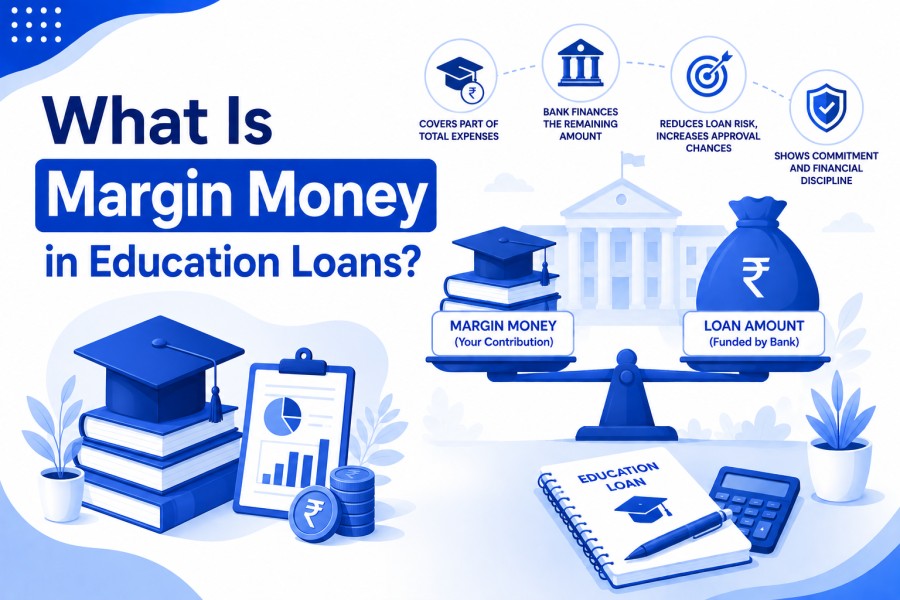
What Is Margin Money in Education Loans?
Higher education comes with rising tuition fees, accommodation costs, travel expenses, and other academic charges. For many students and parents, an education loan is an important source of financial support. However, when applying for an education loan, borrowers often encounter a term called margin money.
Many students focus only on the sanctioned loan amount and the education loan interest rate, but margin money is a hidden cost that can significantly affect financial planning. Understanding how it works can help students avoid confusion during loan disbursement and better prepare for future loan repayments.
This guide explains everything about margin money in education loans, including its meaning, calculation method, percentage, benefits, impact on EMI calculation, and ways to manage expenses effectively.
Understanding of Margin Money in an Education Loan
Margin money is the portion of educational expenses that the borrower must pay from their own funds, while the lender covers the remaining amount through the education loan.
In simple terms, banks and financial institutions usually do not finance 100% of the study expenses. The student or co-applicant must contribute a certain percentage of the total cost. This contribution is called margin money.
For example:
- Total course expenses: ₹20 lakh
- Loan sanctioned by lender: ₹18 lakh
- Student contribution: ₹2 lakh
Here, ₹2 lakh is the margin money.
The margin amount may vary depending on:
- Loan amount
- Study destination
- Loan Eligibility
- Type of lender
- Presence of collateral
- Applicant profile
Related blog: Education loan tips for first-time borrowers in India
Importance of Margin Money in Education Loans
Margin money plays an important role in the overall structure of an education loan. It is not just a financial contribution from the borrower, but also a factor that influences loan approval, repayment burden, and long-term financial planning. Understanding its importance helps students and parents make better borrowing decisions and avoid unexpected financial pressure throughout the semester.
- Shows Financial Responsibility: When students and co-applicants contribute a portion of the educational expenses from their own funds, lenders see it as a sign of financial commitment. It indicates that the borrower is serious about managing the cost of education responsibly.
- Reduces the Overall Loan Burden: A higher margin contribution lowers the amount borrowed from the lender. This helps reduce the total interest payable during the loan repayment period and makes the education loan more affordable in the long run.
- Helps Lower Monthly EMIs: As the sanctioned loan amount decreases, the EMI amount decreases as well. Lower EMIs can make repayment easier after course completion and reduce financial pressure during the early stages of a career. Students can use an Education loan calculator to accurately calculate EMIs and compare different borrowing scenarios before choosing a loan.
- Improves Loan Eligibility: Margin money can also influence Loan Eligibility. Borrowers who can contribute a reasonable share toward the course expenses are often considered financially stable by lenders. This may improve the chances of faster approval and better loan terms.
- Reduces Risk for Lenders: Lenders use margin money to reduce their lending risk. When the borrower shares part of the financial responsibility, the lender’s exposure decreases, making the loan structure more secure.
- May Help Secure Better Loan Terms: Applicants with strong financial support, a reliable co-applicant, and collateral may receive better education loan interest rate offers and lower borrowing costs. In some cases, lenders may also reduce the margin requirement for secured loans.
- Encourages Better Financial Planning: Margin money encourages families to plan educational expenses carefully before taking a loan. It helps borrowers understand the actual cost of education, avoid excessive borrowing, and create a practical loan repayment strategy for the future.
Why Do Lenders Charge Margin Money?
Lenders include margin money in education loans to ensure shared financial responsibility between the borrower and the institution financing the course. It decreases the lender's risk and demonstrates the borrower's financial commitment to finishing the school program.
Margin money also helps lenders assess:
- Repayment capability
- Financial discipline
- Stability of the co-applicant
- Overall loan repayment reliability
Borrowers who contribute a portion of their educational expenses are often considered lower-risk applicants.
Recent blog: Top Reasons to Choose an Education Loan
How Margin Money Works in Education Loans
Margin money is calculated as a percentage of the total educational expenses. The lender finances the remaining amount after deducting the margin requirement.
Formula for Margin Money
Margin Money=Total Course Cost−Loan Amount Sanctioned
Example Calculation
Suppose the total cost of education is ₹25 lakh and the lender offers 90% financing.
- Total expenses: ₹25 lakh
- Financing percentage: 90%
- Margin money: 10%
The student must contribute:
₹25 lakh × 10% = ₹2.5 lakh
The lender finances the remaining ₹22.5 lakh.
This amount may need to be paid semester by semester at the time of loan disbursement.
Margin Money Percentage in Education Loans
Margin money percentages vary by lender and loan type.
Common Margin Requirements
| Loan Types | Typical Margin Money |
|---|---|
| Education loan up to ₹4 lakh | Usually nil |
| Domestic education loan above ₹4 lakh | 5% to 10% |
| Study abroad education loan | 10% to 15% |
| Secured education loan with collateral | Lower margin |
| Unsecured education loan | Higher margin |
Is Margin Money Mandatory in Education Loans?
Yes, in most cases, margin money is mandatory for higher-value education loans. However, some lenders may offer:
- Zero margin schemes
- Full funding for premium institutes
- Special offers for top-ranked universities
- Government-backed student loan programs
Students with excellent academic records and strong co-applicant financial profiles may receive lower margin requirements.
Read also: Biggest Mistakes Students Make While Taking a Loan
Does Collateral Reduce Margin Money?
Yes, collateral can reduce the margin requirement in many cases. When borrowers provide collateral such as:
- Property
- Fixed deposits
- Insurance policies
- Non-agricultural land
Lenders may consider the loan less risky and offer:
- Lower education loan interest rate
- Better Loan Eligibility
- Reduced margin money
- Higher loan amount
Secured education loans are often more affordable over the long term because of a lower repayment burden.
Impact of Margin Money on EMI Calculation
Margin money directly affects the final loan amount, which influences monthly EMIs. If the borrower pays extra margin money, the sanctioned loan amount is reduced, resulting in:
- Reduced interest burden
- Lower monthly EMI
- Faster loan repayment
- Lower overall loan cost
EMI Calculation Example
Suppose:
| Scenario | Loan Amount | Interest Rate | EMI Burden |
|---|---|---|---|
| Lower margin contribution | ₹20 lakh | 11% | Higher EMI |
| Higher margin contribution | ₹16 lakh | 11% | Lower EMI |
Can Margin Money Be Paid Through Another Loan?
Some families attempt to fund margin money using personal loans or unsecured borrowing. While possible, this approach can increase the total debt burden because:
- Personal loan interest rates are usually higher
- Monthly repayment pressure increases
- Credit utilization may rise
It is better to use planned savings whenever possible.
Things to Check Before Accepting an Education Loan
Before finalizing the loan, students should carefully review:
- Margin money percentage
- Education loan interest rate
- Processing fees
- Moratorium period
- Loan repayment tenure
- Prepayment charges
- Collateral conditions
- Disbursement schedule
Small differences in loan structure can create a major long-term financial impact.
Read also: How Section 80E Helps You Save Tax on Education Loans
Final Thoughts
Margin money is one of the most important aspects of an education loan, yet many students overlook it when planning their finances. It represents the borrower’s contribution toward educational expenses and directly affects the total loan amount, EMI calculation, and long-term loan repayment burden.
Understanding margin money helps students prepare for hidden costs, manage expenses effectively, and choose the right financing option for their academic goals.
Before applying for any education loan, students should carefully compare lenders, evaluate Loan Eligibility, understand collateral requirements, and use an Education loan calculator to estimate future repayment obligations accurately.
Plan your education loan smarter with Loan Quantum. Compare lenders, calculate EMIs, and make confident borrowing decisions for your future.
Frequently Asked Questions
Banks ask for margin money to reduce lending risk and ensure shared financial responsibility. It also shows the borrower’s commitment toward funding higher education.
Yes. Margin money is the borrower's contribution to educational expenses, whereas processing fees are additional charges levied by the lender for loan processing.
Failure to arrange margin money may delay loan disbursement, university fee payments, or admission confirmation.
No. Margin money is usually calculated based on the total course cost and educational expenses, not just the sanctioned loan amount.
Yes. Margin money may apply to both domestic and study abroad education loans, although the percentage is often higher for overseas education.