Blog Details
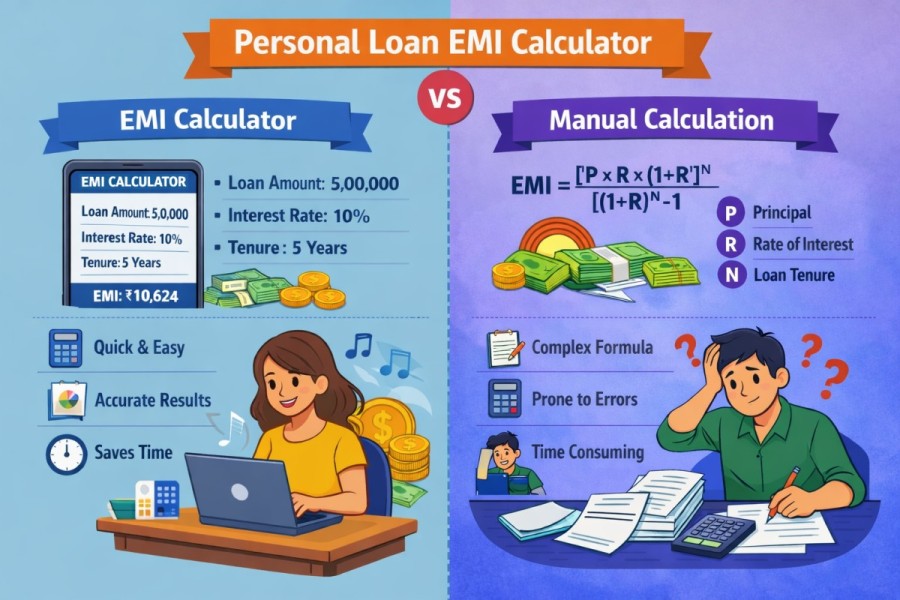
Personal Loan EMI Calculator vs Manual Calculation: Which is Better?
When applying for a personal loan, one of the most important factors to consider is your EMI. Whether you are checking your loan eligibility, doing a detailed loan comparison, or searching for low interest rates, accurate EMI calculation plays a crucial role in making the right financial decision.
However, many borrowers still face a common confusion:
Should you use a personal loan EMI calculator or rely on the Manual EMI Calculation?
In this guide, we will compare the two methods in detail, using examples. You’ll understand how a personal loan EMI calculator simplifies EMI calculation, and how Manual EMI Calculation works. We’ll also cover common mistakes, benefits for borrowers with a Low CIBIL Score, and how to choose the best option for smarter financial planning, including options like Flexi loan and pre-approved loan offers.
What Is a Manual EMI Calculation?
Manual EMI Calculation is the traditional method of calculating your loan EMI using a mathematical formula instead of a personal loan EMI calculator. In this method, borrowers manually compute their monthly instalment based on the loan amount, interest rate, and tenure.
It is commonly used to understand how EMI calculation works behind the scenes, especially when evaluating different personal loans or checking basic loan eligibility.
Manual EMI Calculation Formula
To perform a manual EMI Calculation, you need to use the standard formula:
EMI = [P × R × (1+R)^N] / [(1+R)^N – 1]
Where:
- P = Principal loan amount
- R = Monthly interest rate (annual rate ÷ 12 ÷ 100)
- N = Loan tenure in months
Example: When Manual EMI Calculation Is Needed
Suppose you take a ₹5,00,000 personal loan at 12% annual interest for 3 years (36 months).
Step 1: Convert annual interest to monthly
R =12/12*100 =0.01
Step 2: Apply the EMI formula
EMI = [P × R × (1+R)^N] / [(1+R)^N – 1] ≈₹16,610
Step 3: EMI split for the first month
- Interest = ₹5,00,000 × 0.01 = ₹5,000
- Principal = ₹16,610 – ₹5,000 = ₹11,610
Manual calculations help you understand interest vs principal, plan prepayments, and compare different tenures. While a personal loan EMI calculator is faster, manual calculation provides deeper insights for smarter financial planning.
Related blog: How to Save Money with a Personal Loan EMI Calculator
What is a Personal Loan EMI?
A personal loan EMI (Equated Monthly Installment) is the fixed amount you pay every month to repay your loan over a chosen tenure. It includes both the principal and interest, allowing you to repay the loan in a structured, manageable way.
Understanding your loan EMI is essential for checking your loan eligibility, planning your monthly budget, and making the right loan comparison before applying.
Related blog: What is an Instant Personal Loan and How Does it Work?
Benefits of Manual EMI Calculation
While a loan EMI calculator is widely used for quick, accurate results, Manual EMI Calculation still holds its importance, especially for borrowers who want to understand how their personal loan EMI is calculated in depth.
Instead of relying on automated tools, manual calculation allows you to explore the logic behind EMI calculation, including how interest rates, loan tenure, and principal amount interact. This deeper understanding can be useful when evaluating different personal loans, checking your loan eligibility, or performing a detailed loan comparison.
Below are the key benefits of using Manual EMI Calculation:
1. Clear Understanding of EMI Structure: Manual calculation helps you understand how your personal loan EMI is divided between the principal and interest. This makes it easier to evaluate different loans and repayment strategies.
2. Improves Financial Knowledge: By doing the loan EMI calculation manually, you learn how interest rates, tenure, and loan amount impact your EMI. This improves your ability to make better financial decisions during loan comparisons.
3. Helps in Loan Eligibility Planning: Manual calculations let you test different scenarios, such as changing the loan amount or tenure, to understand your loan eligibility better and meet specific loan eligibility criteria.
4. Useful Verifying Results: You can use Manual EMI Calculation to cross-check the results generated by a personal loan calculator, especially when dealing with large loan amounts.
5. Better Understanding of Interest Impact: Manual calculations show how low interest rates can reduce EMI and how higher rates can increase your repayment burden. This is useful when comparing lenders or evaluating offers, such as a pre-approved personal loan.
6. Helpful for Special Loan Types: It helps you understand repayment structures in options like a Flexi loan, where EMI and interest calculations may vary.
Benefits of the EMI Calculator for Personal Loans
When applying for a personal loan, understanding your EMI in advance is crucial for better financial planning. This is where a personal loan calculator becomes extremely useful. Instead of relying on complex formulas or Manual EMI calculations, borrowers can instantly perform accurate EMI calculations and make smarter decisions.
A personal loan calculator not only saves time but also helps evaluate different loan options, check loan eligibility, and perform effective loan comparisons. Whether you are looking for low interest rates, exploring a Flexi loan, or considering a pre-approved personal loan, this tool simplifies the entire process.
Below are the key benefits of using a personal loan EMI calculator:
1. Instant and Accurate Results: A loan calculator provides quick and precise personal loan EMI results. It eliminates calculation errors and ensures accuracy, which is crucial when planning your finances.
2. Easy Loan Comparison: You can easily compare loans by adjusting the loan amount, tenure, and interest rates. This helps you choose the best option with the lowest interest rate.
3. Helps Check Loan Eligibility: The calculator lets you test different scenarios and assess your loan eligibility based on your repayment capacity and income. It also helps you align with the required loan eligibility criteria.
4. Better Financial Planning: Knowing your EMI in advance helps you manage your monthly budget efficiently and avoid financial stress.
5. Saves Time and Effort: Unlike Manual EMI Calculation, a calculator delivers results instantly without complex steps, saving both time and effort.
6. Useful for All Credit Profiles: Whether you have a good credit score or a Low CIBIL Score, a personal loan calculator helps you find a suitable EMI and plan repayment accordingly.
7. Supports Advanced Loan Options: It helps you evaluate different loan types, such as a Flexi loan and a pre-approved personal loan, so that you can understand their impact on your EMI.
Recent blog: Top Benefits of Applying for a Personal Loan Online
Comparison: Personal Loan EMI Calculator vs Manual Calculation
| Feature | Personal Loan EMI Calculator | Manual EMI Calculation |
|---|---|---|
| Speed | Instant results with a few clicks | Time-consuming; requires multiple steps |
| Accuracy | Highly accurate; eliminates errors | Prone to human errors, especially with large loans |
| Ease of Use | User-friendly; no financial expertise needed | Complex; requires understanding of formulas |
| Loan Comparison | Easy to compare multiple personal loans with different amounts, rates, and tenures | Tedious; each scenario requires repeated calculations |
| Financial Planning | Helps plan monthly budget, manage repayments, and avoid over-borrowing | Limited; difficult to test multiple repayment scenarios |
| Loan Eligibility Check | Quick estimation of loan eligibility and affordability | Slower; requires manual adjustments and calculations |
| Advanced Loan Options | Supports evaluation of Flexi loan and pre approved personal loan options | Complex and error-prone for advanced loan types |
| Suitability for Low CIBIL Score | Helps find affordable EMI and plan repayment | Less practical; not ideal for immediate decision-making |
| Effort Required | Low; just input values and get results | High; involves step-by-step calculations |
Common Mistakes in Manual EMI Calculation
Manual EMI Calculation can be useful for understanding personal loan EMI, but it is prone to errors if done incorrectly. Borrowers often make mistakes that lead to inaccurate projections and poor financial planning. Avoiding these mistakes is essential for better loan comparison and repayment planning.
1. Using Annual Interest Rate Incorrectly: A common mistake is using the annual interest rate directly without converting it into a monthly rate. Remember to divide the annual rate by 12, then by 100, to get the correct monthly interest rate (R).
2. Incorrect Tenure Conversion: Many borrowers confuse loan tenure in years with months. For example, a 5-year loan should be converted to 60 months for proper EMI calculation. Failing to do so can significantly distort your personal loan EMI.
3. Ignoring Additional Costs: Processing fees, documentation charges, insurance premiums, and other extra costs are often overlooked. These fees either increase the principal or must be paid up front. Ignoring them leads to underestimating the actual EMI.
4. Assuming Fixed Rates for Floating Loans: If your personal loan has a floating interest rate, calculating EMI as if it were fixed is a mistake. Floating rates change over time, so assuming a static rate may give unrealistic repayment projections.
5. Miscalculating Principal: Some borrowers fail to subtract upfront fees or processing charges from the principal when calculating net cash inflow. This error affects the accuracy of your Manual EMI Calculation.
Recent blog: Top 10 Mistakes to Avoid When Applying for a Personal Loan
How to Choose Between a Loan EMI Calculator and Manual EMI Calculation
Choosing the right method depends on your goal, time, and accuracy needs:
- Quick Planning & Budgeting: Use a personal loan EMI calculator for instant, accurate results and easy loan comparison.
- Learning & Understanding: Use Manual EMI Calculation to understand EMI structure and interest-principal split.
Why EMI Calculators Are Better:
- Instant and error-free personal loan EMI
- Test multiple scenarios (tenure, interest rates, loan amount)
- Include extra costs like processing fees and insurance
- Helps plan the budget and check the loan eligibility
Manual Calculation Is Useful For:
- Learning EMI fundamentals
- Understand how each loan repayment affects principal and interest.
For practical financial planning, a loan EMI calculator is faster, more accurate, and easier to use. Manual calculations are mainly for learning and verification.
Recent blog: Overdraft (OD) vs Personal Loan: Interest, Eligibility & How It Works
Conclusion
Choosing between a personal loan EMI calculator and Manual EMI Calculation ultimately depends on your needs and purpose. If your goal is to estimate your loan EMI quickly, check your loan eligibility, and compare loans effectively. A personal loan calculator is the best choice.
On the other hand, Manual EMI Calculation is useful for understanding how EMI works behind the scenes. It gives you deeper insights into the interest and principal split, but it is time-consuming and prone to errors, making it less practical for real-world financial planning.
Use LoanQuantum to calculate your personal loan EMI instantly, compare loan options, check your loan eligibility, and choose the best deal with confidence.
Frequently Asked Questions
Yes, it can be accurate if it is calculated correctly. However, it is prone to human error, especially compared to a personal loan calculator, which provides instant, precise results.
Yes, it can help you estimate your loan eligibility by testing different loan amounts and tenures. However, using a personal loan calculator is faster and more practical.
No, for practical purposes, a personal loan calculator is better because it is faster, more accurate, and easier to use. Manual calculations are mainly useful for learning and understanding the concept.
Yes, the formula can be used for various types of loans, including personal, home, and car loans. However, calculations may become more complex for loans with variable interest rates or flexible repayment options, such as a Flexi loan.
No, Manual EMI Calculation usually does not include processing fees, insurance, or other charges unless you add them manually. This can lead to underestimating the actual loan cost.