Blogs

What Is Collateral in an Education Loan? Types, Requirements & Benefits
Collateral in an education loan is an asset, such as property or a fixed deposit, pledged as security against the loan. If the borrower defaults and the lender has the legal right to enforce the security, the pledged asset may be subject to enforcement. Not every education loan requires collateral; the requirement depends on the loan amount, lender, scheme and borrower profile. Quick Answer: What Is Collateral in an Education Loan? Collateral in an education loan is an asset pledged to the lender as security for the loan. The asset remains with the borrower in many arrangements, but the lender obtains a legal security interest over it according to the loan agreement. For example, a parent may offer a residential property as collateral when a student needs a higher education loan amount. The lender may evaluate the property's ownership, legal status, market value and other factors before deciding whether it can be accepted as security. Collateral is primarily relevant to secured education loans. In contrast, a collateral-free or unsecured education loan does not require the borrower to pledge an asset. The exact collateral requirement depends on factors such as: Loan amount Course and institution Study destination Lender's policy Applicant and co-applicant profile Repayment capacity Applicable government or credit-guarantee scheme Value and legal status of the proposed security Therefore, students should not assume that the same collateral rule applies to every education loan. Why Do Lenders Ask for Collateral for an Education Loan? Education loans are generally repaid over several years, and repayment may begin after the applicable moratorium period. From the lender's perspective, collateral provides additional security against the credit exposure. A secured education loan can be backed by an asset that has identifiable value. If the borrower does not repay the loan and the account eventually reaches the stage where enforcement action is permitted, the lender may have rights over the secured asset subject to the applicable agreement and law. Collateral can also be relevant when a student requires a relatively large loan amount. For example, the total cost of an overseas master's programme may include tuition, accommodation, insurance, travel and other expenses. A secured loan may be considered when the funding requirement is higher than what the borrower can obtain through an unsecured option. However, collateral is only one part of a lender's assessment. The lender may also consider academic details, admission to the institution, the co-applicant's income, credit history, existing liabilities and overall repayment capacity. Is Collateral Required for Every Education Loan? No. Collateral is not required for every education loan. The applicable requirement depends on the loan amount, lender, loan scheme and borrower profile. The Reserve Bank of India's education-loan FAQ states that banks must not mandatorily obtain collateral security for education loans up to ₹4 lakh under the referenced education-loan framework. Separately, the Credit Guarantee Fund Scheme for Education Loans (CGFSEL), managed by NCGTC, provides guarantee coverage for eligible education loans up to ₹7.5 lakh without collateral security and third-party guarantee through participating lending institutions. This does not mean that every loan above ₹7.5 lakh automatically has the same collateral requirement. Lender policies, loan schemes and borrower circumstances can differ. For a larger education loan, particularly for expensive professional programmes or study abroad, a lender may ask for collateral or may offer different secured and unsecured options. Students should therefore check the specific lender's education loan eligibility and security requirements before submitting an application. What Can Be Used as Collateral for an Education Loan? The types of assets accepted as education loan collateral vary between lenders. Common forms of security may include: 1. Residential Property The lender may examine: Ownership documents Property title Legal ownership Existing charges or loans Property location Market value Construction and approval records A property with unclear ownership or unresolved legal issues may not be accepted. 2. Commercial Property Some lenders may accept eligible commercial property as collateral. The lender generally conducts legal and valuation checks before accepting the property as security. 3. Land Certain types of land may be accepted, depending on the lender's policy, location, title, and legal status. Not every type of land automatically qualifies. Agricultural land, disputed land, or property with incomplete documentation may have different eligibility conditions. 4. Fixed Deposits In some cases, fixed deposits may be offered as security for borrowing. The lender's policy determines whether a particular FD and its ownership structure can be used. 5. Other Financial Assets Depending on the lender and loan structure, certain financial securities or eligible assets may be accepted. Because acceptable collateral differs between lenders, students should obtain the exact list of eligible securities before proceeding. How Is Collateral Valued for an Education Loan? The value of the asset is an important part of a secured education loan application. For property-based collateral, lenders may arrange valuation and legal verification. The property's market value does not necessarily mean that the borrower can receive an education loan equal to the entire property value. The lender may consider factors such as: Current property valuation Location Property type Legal title Existing liabilities Ownership structure Marketability of the asset Applicable loan-to-value requirements Borrower's repayment capacity For example, a property worth ₹1 crore does not automatically mean that a borrower can receive a ₹1 crore education loan against it. The final sanctioned amount depends on the lender's underwriting criteria and the overall application. Education Loan With Collateral vs Without Collateral Understanding the difference between secured and unsecured education loans is important before choosing a financing option. Features Education Loan with Collateral Education Loan Without Collateral Security Asset pledged No asset pledged Loan amount May support higher funding, subject to lender criteria Usually subject to lender and profile limits Interest rate May be lower in some cases May be higher depending on lender/profile Property verification Required when property is offered Not required Documentation Usually more extensive Generally simpler Processing May take longer due to legal/valuation checks May be faster in some cases Asset risk Pledged asset is exposed to enforcement risk in case of default No pledged asset Eligibility Depends on borrower and collateral Depends heavily on borrower, co-applicant and lender criteria Neither option is automatically suitable for every student. A borrower should compare the interest rate, total repayment, processing fees, repayment period, collateral requirement, co-applicant obligations, and other charges before accepting an offer. For a deeper comparison, see Secured vs Unsecured Education Loan: How to Choose? What Are the Benefits of an Education Loan with Collateral? A secured education loan can offer several potential benefits. Higher Funding Potential Students requiring substantial funding may consider secured education loans because the pledged asset can provide additional security to the lender. This can be particularly relevant for expensive professional courses and international education. Potentially Lower Interest Cost Secured loans may be priced more competitively than comparable unsecured loans because the lender has additional security. However, the actual interest rate depends on the lender, borrower profile, loan structure, and prevailing terms. Always compare the total cost of the loan, rather than choosing solely on the basis of the advertised interest rate. Longer Repayment Options Some secured education loans may provide longer repayment periods, which can make the monthly EMI more manageable. However, extending the tenure can increase the total interest paid. Using an education loan calculator before accepting the loan can help you compare different repayment scenarios. Access to Larger Education Budgets For students whose tuition and living expenses exceed the amount available through an unsecured loan, collateral-backed financing may provide another funding route. This can be especially relevant when planning study abroad expenses. What Are the Risks of Using Collateral for an Education Loan? Collateral can make higher education financing possible, but it also creates an important financial responsibility. The biggest consideration is the risk to the pledged asset. If the borrower fails to repay the loan and the account reaches the stage where the lender is legally entitled to enforce its security, the collateral may be subject to enforcement proceedings. Other considerations include: Property valuation charges Legal verification Documentation requirements Longer processing time Additional administrative costs Restrictions related to existing property charges Risk to family assets if repayment becomes unsustainable For this reason, borrowers should not pledge valuable property simply to maximise their sanctioned loan amount. The loan should be based on the actual education expenses and a realistic assessment of future repayment capacity. What Documents Are Required for Education Loan Collateral? The exact documents depend on the lender and the type of security offered. For property collateral, documents may include: Property title documents Ownership proof Previous title or sale documents Property tax receipts Approved building or property documents, where applicable Encumbrance-related documents Valuation documents Identity and address proof Income documents of the co-applicant Admission letter Course fee structure For a fixed deposit or another financial asset, the lender may require documents proving ownership and the value of the asset. Keeping documents ready can reduce avoidable delays during the education loan application and verification process. Can Parents' Property Be Used as Collateral for an Education Loan? In many education loan structures, a parent or guardian may participate as a co-borrower and may also provide the collateral. However, acceptance of a parent's property is subject to the lender's rules, property ownership, legal documentation, and other eligibility conditions. The property owner may need to sign the relevant security and loan documents. Before pledging the property, parents should understand: The total sanctioned loan amount Interest rate and repayment structure Loan tenure Moratorium period Processing and legal charges Prepayment conditions Consequences of default Conditions for release of the collateral after repayment Collateral for Study Abroad Education Loans Collateral becomes an important consideration for students planning to study abroad because international education can involve high tuition and living expenses. The total funding requirement may include: University tuition fees Hostel or accommodation Travel expenses Visa-related costs Insurance Books and study materials Laptop or other academic equipment Living expenses, where permitted by the lender Students should first estimate their total education budget and then determine how much funding is actually required. An education loan calculator can help estimate the EMI and overall repayment cost. A proper loan comparison can then be used to compare lenders based on education loan interest rates, loan amount, collateral requirements, processing fees, and repayment flexibility. Loan Quantum already provides related educational-finance content covering education loan eligibility, lender comparison, and EMI planning. Final Takeaway Collateral in an education loan is an asset pledged to provide security to the lender. Depending on the loan scheme and lender, collateral may be property, a fixed deposit, or another eligible asset. The important point is that not every education loan requires collateral. RBI's framework provides for collateral-free education loans up to ₹4 lakh under the applicable bank education-loan provisions. In comparison, the CGFSEL framework provides guarantee coverage for eligible education loans up to ₹7.5 lakh without collateral and third-party guarantee through participating lenders. For larger loans, students should compare secured and unsecured options carefully. Consider the loan amount, interest rate, repayment tenure, co-applicant requirements, processing costs, collateral value, and potential risks before making a decision. If you are planning higher education in India or abroad, start by calculating your expected expenses, checking education loan eligibility, comparing lenders, and estimating your future EMI. A structured approach can help you secure the required funding while keeping the long-term repayment obligation manageable. Frequently Asked Questions Can collateral be changed after taking an education loan? Yes, collateral may be changed in some cases, but the lender must approve the replacement asset. Fresh legal and valuation checks may also be required. Can I sell property given as education loan collateral? Usually, you need the lender’s approval before selling pledged property. The lender’s security interest must generally be addressed before the property can be transferred. What happens to collateral after the education loan is repaid? After the loan is fully repaid, the lender releases its claim over the collateral after completing the required formalities. Can property with an existing loan be used as collateral? It may be possible, depending on the lender’s policy and the property’s existing outstanding loan, ownership, and available value. Does collateral guarantee education loan approval? No. Collateral does not guarantee approval. Lenders also consider factors such as income, credit history, course details, loan amount, and repayment capacity.

Why LoanQuantum Is a Trusted Online Loan Calculator
Borrowing money is a significant financial decision, whether you are planning to purchase a home, finance a car, pay for higher education, expand a business, or manage a personal expense. Before applying for a loan, it is important to understand how much you may need to repay every month and how interest can affect the overall borrowing cost. A loan calculator can make this planning process easier. Instead of calculating EMI manually, you can enter the loan amount, interest rate and repayment tenure to estimate your monthly instalment and total repayment. Online calculators also allow you to compare different borrowing scenarios before making a decision. LoanQuantum offers a range of easy-to-use online calculators for different types of loans. From a home loan calculator and personal loan calculator to business, education, car and gold loan calculators, these tools can help borrowers understand potential EMI and repayment obligations before applying. What Makes LoanQuantum a Useful Online Loan Calculator? A good online loan calculator should make financial calculations simple, quick and understandable. LoanQuantum is designed to help users estimate loan costs without having to perform complicated mathematical calculations manually. By entering relevant loan details, users can explore estimated EMI, repayment amounts and interest costs. This makes the calculator useful during the early stages of loan planning, when borrowers are deciding how much they may want to borrow and what repayment period could suit their budget. The calculator can also be used repeatedly. For example, you can change the loan tenure or amount and compare how those changes may affect the estimated EMI. Why Should You Use a Loan Calculator Before Applying for a Loan? Have you considered how much a loan could actually cost before applying? A loan EMI calculator can provide an estimate before you submit a loan application. Understanding the potential EMI and total interest can help you evaluate whether the proposed borrowing amount fits your financial plans. It can also help you: Estimate monthly EMI Understand potential interest costs Compare different loan tenures Plan loan repayment Evaluate different borrowing amounts Prepare a realistic monthly budget Make more informed borrowing decisions A calculator does not approve a loan or guarantee a particular interest rate. Actual loan terms depend on the lender, applicant profile and applicable loan conditions. How Does a Loan EMI Calculator Help With EMI Calculation? An EMI calculation generally depends on three important inputs: the loan amount, interest rate and repayment tenure. For example, if you increase the loan amount while keeping the interest rate and tenure unchanged, the estimated EMI will generally increase. Similarly, choosing a longer tenure can reduce the monthly EMI but may result in paying more interest over the complete repayment period. Using a loan EMI calculator allows you to experiment with these variables and understand their potential impact before choosing a loan. Related blog: A beginners guide to using a loan calculator What Information Do You Need for Loan EMI Calculation? Most loan calculators require: Loan amount Interest rate Loan tenure Once these details are entered, the calculator can estimate the EMI and related repayment figures. This makes online EMI calculation considerably easier than repeatedly working through formulas manually. How Does Interest Calculation Affect Your Total Loan Cost? Have you looked beyond the monthly EMI? Even for a short-term loan, interest calculation can affect the total amount you repay. Understanding the interest cost before borrowing can help you compare loan options more effectively. For example, suppose you take a ₹50,000 loan for 7 days at an annual interest rate of 12%. The approximate simple interest can be calculated as: Interest = ₹50,000 × 12% × 7 ÷ 365 Interest ≈ ₹115 Therefore, the estimated repayment would be: ₹50,000 + ₹115 = ₹50,115 This example shows that the interest amount depends not only on the loan amount and interest rate but also on the loan tenure. A 7-day loan may have a relatively small interest amount at a 12% annual rate, but additional processing fees, platform charges, taxes or other applicable costs could increase the actual repayment amount. Note: The example uses simple interest for illustration. Actual interest calculation and charges may vary depending on the lender and loan product. Are Loan Apps Better When You Calculate Your EMI First? Many borrowers use loan apps to explore or apply for loans because digital applications can make the process convenient. However, convenience should not replace financial planning. Before using a loan app to apply for a loan, you can use a loan EMI calculator to estimate the potential monthly repayment. This gives you a better starting point for assessing whether the borrowing amount is appropriate for your circumstances. When comparing loan options, look beyond the speed of application and consider the interest rate, fees, tenure, repayment conditions and total borrowing cost. Related blog: The Hidden Costs of Loans: Processing Fees, Foreclosure Charges, and More Which Loan Calculators Does LoanQuantum Offer? Loan requirements differ from one borrower to another. A person purchasing a house has different financing needs from someone buying a car, funding education or expanding a business. LoanQuantum offers a range of online loan calculators covering several common loan categories. These tools can help you perform EMI calculations, understand potential loan repayments, estimate interest costs and compare different loan amounts and repayment tenures before applying. 1. Home Loan Calculator Buying a home is a long-term financial commitment, so understanding the potential repayment before borrowing can be useful. The home loan calculator from LoanQuantum helps you estimate your potential EMI based on factors such as the loan amount, interest rate and repayment tenure. You can adjust these inputs to explore different borrowing scenarios. Using a home loan calculator can also help you understand how changes in tenure or loan amount may affect your estimated monthly payment. This can make it easier to plan your home financing and evaluate the potential repayment commitment before approaching a lender. 2. Personal Loan Calculator A personal loan can be used for a variety of financial needs, making it important to understand the repayment commitment before borrowing. The personal loan calculator from LoanQuantum allows you to estimate your potential EMI by entering relevant loan details such as the amount, interest rate and tenure. You can use the calculator to compare different loan amounts and repayment periods. This can help you understand how your selected loan terms may influence the estimated EMI and total repayment, giving you useful information before applying for a personal loan or exploring options through online loan apps. 3. Car Loan Calculator A car loan can help spread the cost of purchasing a vehicle over a repayment period. However, it is useful to understand the potential EMI before deciding how much to borrow. The car loan calculator from LoanQuantum can help you estimate your potential monthly repayment based on the loan amount, interest rate and tenure. You can change the calculator inputs to compare different financing scenarios. For example, you can see how increasing the loan amount or changing the repayment tenure may affect the estimated EMI. This can help you include the potential car loan repayment in your monthly budget. 4. Auto Loan Calculator Vehicle financing can involve different borrowing requirements depending on the type of vehicle and loan arrangement. The auto loan calculator from LoanQuantum provides a convenient way to estimate potential repayment based on the information you enter. Using an auto loan calculator before financing a vehicle can help you compare loan amounts and repayment periods. By reviewing the estimated EMI and interest cost, you can get a clearer understanding of the potential financial commitment before proceeding with an auto loan. 5. Education Loan Calculator Education expenses can include tuition fees, accommodation, books, travel and other study-related costs. An education loan calculator can help students and families estimate the potential repayment associated with borrowing for higher education. LoanQuantum's calculator can be used to explore potential EMI based on the relevant loan details. Understanding the potential repayment amount before taking an education loan can help with financial planning. You can adjust the loan amount and repayment tenure to explore different scenarios and understand how the estimated EMI may change. This can be useful when planning a study loan alongside other household or educational expenses. 6. Business Loan Calculator Businesses may require financing for working capital, expansion, equipment, inventory or other operational needs. Before taking a business loan, it can be useful to estimate the potential monthly repayment and consider it alongside expected business cash flow. The business loan calculator from LoanQuantum helps estimate potential EMI based on the loan details entered. A business owner can use the calculator to explore different loan amounts and repayment tenures. Comparing these scenarios can provide a better understanding of how borrowing could affect monthly financial commitments. However, businesses should also consider revenue, operating expenses, existing debt and other financial obligations before taking a loan. 7. Gold Loan Calculator A gold loan allows borrowers to access funds by pledging eligible gold as security. Before choosing this type of borrowing, it is important to understand the potential repayment and associated borrowing costs. The gold loan calculator from LoanQuantum can help estimate potential repayment based on the relevant loan information. Using a gold loan calculator can help you explore different loan amounts and repayment periods before making a borrowing decision. It can also help you understand the potential interest cost and repayment commitment, allowing you to approach a gold loan with a clearer idea of the financial obligation. 8. Loan Comparison Calculator Choosing between different loan options can be difficult when interest rates, loan amounts, repayment periods and other terms vary. The loan comparison tool from LoanQuantum can help you evaluate different borrowing options side by side. Comparing key loan factors before applying can give you a clearer view of the potential cost and repayment commitment. A loan comparison can be particularly useful when you are considering offers from different lenders or deciding between different loan structures. Instead of looking only at the monthly EMI, you can consider the interest rate, repayment tenure and overall borrowing cost. This can help you make a more informed decision based on your financial requirements. 9. Loan Eligibility Calculator Before applying for a loan, it is useful to understand whether you may meet the general eligibility requirements. Loan eligibility from LoanQuantum can help you assess your potential eligibility based on relevant financial and personal information. This can provide a useful starting point when planning your borrowing requirements. Loan eligibility may depend on factors such as income, existing financial obligations, credit profile, age, employment or business details and the lender's individual criteria. Checking eligibility before applying can help you understand your borrowing position and prepare the required information. However, an eligibility estimate does not guarantee loan approval, as the final decision depends on the lender's assessment. Why Is Loan Planning Important Before Borrowing? Loan planning gives borrowers an opportunity to understand potential costs before submitting an application. A loan calculator can be particularly useful because you can change the loan amount, interest rate and tenure to explore different scenarios. Rather than selecting a loan only based on the advertised EMI, consider the complete picture, including total interest, fees, repayment period and your ability to manage the monthly commitment. LoanQuantum's calculators are designed to make these calculations easier and more accessible. Read also: Newest AI Product to Simplify Your Loans: Quantum Copilot Final Thoughts: Is LoanQuantum a Useful Online Loan Calculator? Planning before borrowing can make it easier to understand your potential financial commitment. A loan calculator provides a simple way to estimate EMI, explore interest costs and compare repayment scenarios. LoanQuantum brings together calculators for home loans, personal loans, car loans, auto loans, education loans, business loans and gold loans, allowing users to choose a calculator based on their borrowing needs. Before applying through loan apps or considering an instant loan, use an appropriate loan EMI calculator to understand the potential repayment. While calculator results are estimates and do not guarantee loan approval or final terms, they can be a useful starting point for informed loan planning. Frequently Asked Questions Can I use LoanQuantum for different types of loans? Yes. LoanQuantum offers calculators for home loans, personal loans, car loans, auto loans, education loans, business loans and gold loans. It also provides tools for loan comparison and loan eligibility. Can a loan calculator help me avoid over-borrowing? It can help with planning. By comparing different loan amounts and their estimated EMIs, you can better understand the potential repayment commitment and avoid choosing a loan amount without considering its monthly financial impact. Can I compare two loans using LoanQuantum? Yes. LoanQuantum's Loan Comparison tool can help you review different loan options and compare important borrowing factors. This can be useful when you have multiple financing options to consider. Can a loan calculator show how much interest I save with a shorter tenure? Yes. By comparing two or more repayment tenures, you can see how the estimated EMI and total interest may change. This can help you evaluate whether paying a higher EMI for a shorter period could reduce overall interest. Can LoanQuantum help me compare loans and check eligibility? Yes. In addition to its loan calculators, LoanQuantum provides Loan Comparison and Loan Eligibility tools. These can complement EMI calculations by helping you evaluate loan options and understand potential eligibility.

Home Loan EMI Reduction: Key Points, Factors, and Repayment Tips
Taking a home loan can make homeownership more accessible, but the monthly EMI can become a significant part of your budget. A well-planned repayment strategy can help you lower your home loan EMI, manage monthly cash flow, and potentially reduce the total interest paid over the loan period. The good news is that borrowers have several options to reduce their home loan monthly repayment burden. Loan amount, interest rate, repayment tenure, down payment, and prepayment decisions can all influence your EMI. Before choosing a loan, it is also important to understand the loan eligibility criteria, compare available loan options, and estimate repayments using a home loan calculator. How to Reduce Your Home Loan EMI Easily You can reduce your home loan EMI by making a higher down payment, opting for a longer tenure, or utilizing part-prepayments to lower the principal balance. Additionally, refinancing your loan to a lender offering a lower interest rate can significantly decrease monthly obligations and total interest costs over time. Managing a high home loan EMI is critical for maintaining financial stability. By balancing your principal, interest rate, and tenure, you can optimize your repayment structure to suit your monthly budget better. Related blog: How to Use a Home Loan Calculator to Plan Your EMI Efficiently Core Strategies to Lower Your Home Loan EMI To lower home loan EMI, borrowers can consider reducing the loan amount, making a higher down payment, choosing a competitive interest rate, selecting a suitable tenure, and making part-prepayments. The right strategy depends on your income, expenses, existing debt, and long-term repayment goals. 1. Borrow Only What You Can Comfortably Repay The loan amount has a direct impact on your monthly EMI. A higher loan amount usually means a higher EMI and greater interest cost. Before applying, consider your monthly income, existing EMIs, household expenses, savings, and future financial commitments. Borrowing an amount that fits your budget can make home loan repayment easier. 2. Make a Higher Down Payment A higher down payment reduces the amount you need to borrow. For example, if you contribute more toward the property purchase, your outstanding loan amount will be lower. A smaller principal can help reduce home loan EMI and lower the total interest payable over the loan tenure. However, do not use all your savings for the down payment. Keep enough money available for emergencies and other property-related expenses. 3. Compare Home Loan Interest Rates The interest rate is one of the main factors that determines your EMI and total repayment cost. Before selecting a lender, compare different loan offers based on interest rates, processing fees, repayment terms, and other applicable charges. A lower interest rate can help you reduce home loan costs, provided the overall loan terms are suitable. 4. Choose the Right Loan Tenure Loan tenure affects both your EMI and total interest cost. A longer tenure generally results in a lower monthly EMI because the repayment is spread over more months. However, you may pay more interest over the entire loan period. A shorter tenure can increase your EMI but may help you save on total interest. 5. Make Part-Prepayments When You Have Surplus Funds Part-prepayment means paying an additional amount toward your outstanding home loan principal before the scheduled repayment period ends. Using surplus funds for prepayment can reduce the outstanding principal and, consequently, the interest burden. Depending on the loan terms, you may choose to reduce your EMI or shorten the remaining tenure. 6. Increase Your EMI as Your Income Increases If your income increases over time, consider increasing your EMI gradually. Paying a higher amount each month can help reduce the principal faster. This can shorten the repayment period and potentially reduce the total interest cost. However, make sure the increased EMI remains comfortable after accounting for your regular expenses and other financial commitments. 7. Understand Your Loan Eligibility Before Applying Your loan eligibility criteria can help determine the amount you may be eligible to borrow. Factors such as income, age, employment profile, existing financial obligations, and credit history may influence eligibility. However, being eligible for a higher loan amount does not mean you need to borrow the maximum amount. Choose a loan based on what you can comfortably repay rather than borrowing based solely on your eligibility. 8. Review Your Existing Home Loan Regularly If you already have a home loan, periodically review your interest rate, outstanding principal, remaining tenure, and EMI. If your current loan terms are less favourable than available alternatives, you can compare refinancing or balance-transfer options. Consider the potential savings along with processing fees and other applicable costs before switching. 9. Use a Home Loan Calculator to Plan Your EMI A home loan calculator helps you estimate your EMI based on the loan amount, interest rate, and tenure. It can also help you compare different repayment scenarios. Before choosing a loan or making changes to an existing loan, use the calculator to understand how a higher down payment, shorter tenure, lower interest rate, or part-prepayment could affect your monthly EMI and overall interest cost. Recent blog: Home Loan EMI Calculator: Housing Finance Made Easy What are the Core Factors That Affect Your Home Loan EMI? Your home loan EMI primarily depends on three factors: the principal amount, interest rate, and loan tenure. Understanding these factors can help you make better borrowing decisions. 1. Loan Amount The amount you borrow directly affects your monthly EMI. A higher loan amount generally means a higher EMI and greater interest outgo over the repayment period. If your finances allow, making a larger down payment can reduce the amount you need to borrow. This can help you lower your home loan EMI from the beginning. 2. Interest Rate The interest rate has a direct impact on your EMI and overall borrowing cost. Even a small difference in the rate can affect the total interest payable over several years. This is why borrowers should compare loan options from different lenders instead of selecting a loan based only on convenience. 3. Loan Tenure Loan tenure determines how long you will repay the loan. A longer tenure generally reduces the monthly EMI because the repayment is spread over more months. However, it can increase the total interest paid. A shorter tenure can result in a higher EMI but may help reduce the overall interest cost. 4. Down Payment A larger down payment reduces the principal you need to finance. For example, if you purchase a property worth ₹30 lakh and contribute ₹10 lakh upfront, you need to borrow only ₹20 lakh. A lower principal can help reduce both the EMI and total interest burden. 5. Credit Profile Your credit history and repayment record can influence the terms a lender offers. A strong credit profile may improve your chances of receiving competitive loan terms, subject to the lender's policies. Before applying, check your credit profile and ensure existing repayments are managed responsibly. 6. Loan Eligibility Your income, existing financial commitments, credit history, age, employment or business profile, and other factors can influence your borrowing capacity. Understanding the loan eligibility criteria before applying can help you choose a realistic loan amount rather than borrowing more than your finances can comfortably support. What Does a ₹5 Lakh Home Loan EMI Look Like? Consider a hypothetical ₹5 lakh home loan at an annual interest rate of 8.5%. The approximate EMI could look like this: 5-year tenure: around ₹10,257 per month 10-year tenure: around ₹6,199 per month 15-year tenure: around ₹4,925 per month 20-year tenure: around ₹4,339 per month These figures are illustrative, and actual EMI amounts can vary depending on the lender, interest rate, loan structure, and other applicable terms. The example demonstrates an important point: extending the tenure can significantly reduce the monthly EMI, but it can also increase the overall interest paid. Therefore, do not select the longest tenure simply because it offers the lowest EMI. Use a home loan calculator to compare both monthly affordability and total repayment. What Are the Best Home Loan Repayment Tips? Reducing your home loan debt requires a proactive strategy that targets the principal amount. By leveraging annual income increases, making strategic prepayments, and utilizing balance transfers, borrowers can often reduce their total interest burden by 20% to 40% over the life of a loan. Always prioritize emergency liquidity before aggressively prepaying debt. 5 Key Strategies to Pay Off Your Home Loan Faster 1. Execute Strategic Partial Prepayments Direct your financial windfalls, such as tax refunds or performance bonuses, toward your loan principal. Pro Tip: Request that the bank reduce your loan tenure rather than your monthly EMI. This creates a compounding effect on interest savings. 2. Implement Annual EMI Increases Commit to a 5% to 10% increase in your EMI annually as your salary grows. According to financial experts, even a 5% annual boost can shave years off a 20-year mortgage. 3. Opt for a Shorter Loan Tenure While a shorter tenure increases your monthly commitment, it drastically cuts the total interest paid over time. Use a home loan calculator to model how a 15-year tenure compares to a 20-year term. 4. Leverage Home Loan Balance Transfers Monitor market rates. If a competing lender offers a significantly lower interest rate, initiate a balance transfer. 5. Prioritize Financial Flexibility Maintain an emergency fund equivalent to 6 months of living expenses before accelerating debt repayment. Financial health is about balance; do not sacrifice your safety net for minor interest savings. Read also: Home Loan Calculator: Features, Benefits & How to Use It Conclusion Learning how to lower home loan EMI is not simply about choosing a longer repayment period. A better approach is to evaluate the loan amount, interest rate, tenure, down payment, prepayment opportunities, and your overall financial capacity. Before taking a home loan, understand the loan eligibility criteria, compare different options, and use a home loan calculator to estimate repayment scenarios. For existing borrowers, strategies such as part-prepayment, periodic loan reviews, and gradually increasing EMI payments can help reduce the outstanding principal and manage the overall cost of borrowing. The ideal home loan is not necessarily the one with the lowest EMI. It is the one that fits comfortably within your financial plan while keeping the long-term repayment burden manageable. Frequently Asked Questions Does a home loan balance transfer reduce EMI? Yes, it can reduce home loan EMI. A home loan balance transfer can reduce your EMI if the new lender offers a lower interest rate. However, compare processing fees and other charges to ensure the overall savings are worthwhile. Should I reduce my EMI or home loan tenure after making a prepayment? The better choice depends on your financial priorities. Reducing the EMI can provide immediate relief to your monthly budget, while reducing the home loan tenure can help you repay the loan sooner and potentially save more on total interest. If your current EMI is affordable, shortening the tenure can be a more cost-effective approach. Does making a large prepayment always reduce the EMI? Not necessarily. A large principal prepayment reduces the outstanding loan balance, but the effect on your EMI depends on the repayment option agreed with the lender. You may have the choice of reducing the EMI while keeping the tenure unchanged or maintaining the EMI and shortening the tenure. What is the difference between reducing EMI and reducing home loan tenure? Reducing EMI lowers your monthly repayment and provides greater monthly cash-flow flexibility. Reducing tenure keeps the repayment amount relatively higher but allows you to close the loan sooner and can significantly reduce the total interest paid. The right option depends on your income stability and financial goals. What is the smartest way to reduce home loan repayment costs? A practical approach is to compare interest rates, maintain a strong credit profile, make suitable principal prepayments, review your loan periodically, and choose a repayment tenure that fits your finances. Using a home loan calculator before making changes can help you compare the EMI and total-interest impact of different strategies.

Home Loan Repayment Guide: How It Works, Schedule, and Ways to Pay Faster
Taking a home loan is a major long-term financial commitment. Before borrowing, it is important to understand your Home loan EMI, repayment schedule, eligibility requirements, approval process, and options for reducing the loan faster. A home loan is generally repaid through Equated Monthly Instalments (EMIs) over a selected tenure. Each EMI usually consists of two major components: principal and interest. During the initial years, a larger portion of the EMI generally goes toward interest. As the outstanding principal decreases, the interest component gradually reduces, and a greater portion of the EMI contributes toward principal repayment. Using a Home loan calculator can help you estimate your monthly EMI, compare different loan amounts and tenures, and understand the potential total cost of borrowing. Similarly, understanding home loan eligibility and the factors affecting home loan approval can help you prepare financially before applying For existing borrowers, understanding home loan prepayment, principal repayment, and early repayment strategies can help in planning how to reduce the loan burden. What Does Home Loan Repayment Actually Mean? Home loan repayment is the process of paying back the amount borrowed from a lender along with the applicable interest over the agreed loan tenure. After the loan is disbursed, the borrower generally makes scheduled monthly payments according to the lender's repayment terms. Every EMI covers the applicable interest and contributes toward reducing the outstanding principal. The total cost of your home loan repayments depends on several factors: Loan amount Interest rate Loan tenure Home loan EMI Outstanding principal Prepayments or part-payments Repayment terms Applicable lender charges For example, borrowing ₹40 lakh for 20 years at 8% interest will result in a different repayment cost compared with borrowing the same amount for 15 years. A shorter tenure generally means a higher EMI but can reduce the total interest paid. Therefore, borrowers should not evaluate a home loan only by looking at the monthly EMI. The total repayment amount and long-term interest cost are equally important. Related blog: Home Loan Calculator: Instantly Calculate Your EMI & Interest Why Is Principal Repayment Slower in the Beginning? Many borrowers expect the outstanding principal to fall significantly after making several EMIs. However, this may not happen quickly during the early years. The reason is that interest is calculated based on the outstanding principal. When the loan balance is high, the interest component can account for a substantial part of the EMI. What Is a Home Loan Repayment Schedule and Why Does It Matter? A home loan repayment schedule is a detailed representation of how your loan is expected to be repaid throughout the tenure. It typically provides information such as: EMI amount Payment date Principal component Interest component Outstanding principal Remaining loan balance Number of instalments Remaining tenure The repayment schedule allows borrowers to understand how their loan changes from one payment period to the next. For example, an early EMI may contain a relatively large interest component, while a loan EMI several years into the loan may contain a larger principal component. How Can You Use Your Repayment Schedule? Your repayment schedule can be useful when making financial decisions. You can use it to: Track outstanding debt: It shows how much principal remains to be repaid. Understand interest costs: You can see how much interest you are paying over the repayment period. Evaluate prepayment opportunities: If you are considering making an additional payment, the schedule can help you understand your current outstanding principal. Plan your finances: You can identify how long the loan is expected to continue and plan future financial commitments accordingly. Compare repayment strategies: You can evaluate whether increasing the EMI or making occasional part-payments could shorten the loan tenure. How Does a Home Loan Repayment Calculator Work? A home loan repayment calculator is a financial planning tool that estimates your repayment EMI and helps you understand the potential repayment cost of a home loan. A Home loan calculator can help answer important questions such as: How much will my monthly EMI be? How much interest could I pay over the loan tenure? Can I afford a particular loan amount? What happens if I select a shorter tenure? How much can I save by making additional payments? How does increasing the down payment affect the loan? A calculator does not replace the lender's final calculation because actual loan terms, interest rates, fees, and disbursement conditions can vary. However, it is useful for preliminary financial planning. The standard EMI formula is: EMI = P × r × (1+r)ⁿ / [(1+r)ⁿ – 1] Where: P = Principal loan amount r = Monthly interest rate n = Total number of monthly instalments You do not need to calculate this manually. A calculator can perform the calculation instantly. Read also: Home Loan EMI Calculation: Simple Step-by-Step Guide Why Should You Use a Home Loan Repayment Calculator Before Borrowing? A loan calculator allows you to experiment with different scenarios. For example, you can compare: ₹30 lakh vs ₹40 lakh loan 15-year vs 20-year tenure Different interest rates Different EMI amounts Higher vs lower down payment This can help you determine whether a proposed EMI fits comfortably within your monthly budget. It can also highlight an important trade-off: a lower EMI does not necessarily mean a cheaper loan. A longer tenure may reduce your monthly payment while increasing the total interest paid over the life of the loan. How Does Loan Tenure Change Your Total Home Loan Repayments? Loan tenure has a significant impact on both monthly EMI and total interest cost. A longer tenure generally lowers the EMI because the repayment is spread over more months. However, interest continues to accumulate over the longer period, potentially increasing the overall cost. A shorter tenure generally increases the EMI because the principal must be repaid faster. However, the total interest paid may be lower. How to Repay Home Loan Faster Without Creating Financial Stress? If you are wondering how to repay a home loan faster, there is no single strategy that works for every borrower. The right approach depends on your income, savings, interest rate, outstanding balance, and lender terms. Here are practical strategies to consider. 1. Make Regular Part-Payments One of the most direct ways to accelerate repayment is to make additional payments toward the principal. You might use surplus funds from: Annual bonuses Salary increases Business income Maturity proceeds Other non-essential surplus funds Before making a part-payment, check your lender's applicable terms and whether any charges or conditions apply. 2. Increase Your EMI When Income Rises Instead of allowing lifestyle expenses to increase whenever your income rises, you can allocate a portion of the additional income toward a higher EMI. For example, if your income increases by 10%, you might consider increasing your EMI by an amount that remains comfortable within your budget. This can help you repay principal faster without requiring a large one-time payment. 3. Choose a Shorter Tenure If Affordable Choosing a shorter loan tenure can reduce the total period over which interest is charged. However, a shorter tenure means a higher EMI. Therefore, do not select a short tenure to minimise interest if the resulting EMI puts excessive pressure on your monthly cash flow. 4. Use Windfalls Strategically Unexpected or occasional income can be used for partial loan repayment when appropriate. For example, instead of spending an entire annual bonus, a borrower could allocate part of it toward the outstanding principal while retaining sufficient savings for emergencies and other financial objectives. 5. Avoid Missed EMI Payments Making timely payments is fundamental to effective loan management. Missing scheduled payments can result in applicable charges and can disrupt your repayment record. Maintaining sufficient funds for your scheduled EMI can help keep repayments consistent. 6. Review Your Loan Periodically Do not treat your home loan as something you need to review only when you apply. At regular intervals, assess: Outstanding principal Current interest rate Remaining tenure EMI Total interest remaining Prepayment options Changes in your income Your financial circumstances may change significantly during a 15- or 20-year loan. What Is Home Loan Early Repayment? Home loan early repayment means paying part or all of your outstanding loan before the originally scheduled maturity date. Early repayment can potentially shorten the repayment period and reduce future interest costs because the principal is reduced sooner. However, early repayment is not automatically the best financial decision for every borrower. Before making a large payment, consider: Emergency savings Existing debts Future financial requirements Loan interest rate Applicable prepayment terms Alternative uses of your money Long-term financial goals Using all your savings to repay a home loan may leave you with insufficient liquidity for unexpected expenses. A balanced repayment strategy can therefore be more appropriate than focusing solely on becoming debt-free as quickly as possible. Recent blog: Is Prepayment of Your Home Loan a Good Idea? How Can You Monitor Your Home Loan Repayments? Monitoring your home loan repayments can help you identify whether your loan is progressing according to plan. Keep track of: Outstanding Principal: This tells you how much of the original borrowed amount remains unpaid. Interest Paid: Monitoring interest helps you understand the cost of borrowing. Remaining Tenure: Knowing how many instalments remain helps you plan your future cash flow. EMI Amount: Check that your scheduled EMI matches the applicable loan terms. Prepayments: Maintain records of any additional payments made toward the loan and confirm how the lender has adjusted the outstanding balance. Regular monitoring also makes it easier to identify discrepancies in statements and discuss them with the lender when necessary. Home Loan Repayment Mistakes Borrowers Should Avoid Effective repayment is not only about making the EMI every month. Several decisions made during the loan period can affect your overall financial position. Choosing a Loan Based Only on EMI: A low EMI can look attractive, but it may result from a longer tenure and therefore a higher total interest cost. Borrowing More Than You Can Comfortably Repay: Loan eligibility does not necessarily mean that you should borrow the maximum amount available. Your EMI should fit comfortably within your overall budget. Ignoring the Repayment Schedule: Without reviewing the repayment schedule, it can be difficult to understand how much principal you are actually repaying. Using All Savings for Prepayment: Reducing debt is valuable, but maintaining adequate liquidity is also important. Failing to Check Prepayment Terms: Always review the lender's applicable conditions before making an early repayment or large part-payment. Final Takeaways Home loan repayment is a long-term financial process that requires more than simply paying your EMI every month. Before applying, use a Home loan calculator to estimate your Home loan EMI and compare different loan amounts, interest rates, and tenures. Check your home loan eligibility to understand your potential borrowing capacity, but remember that eligibility does not automatically guarantee home loan approval. Once the loan begins, regularly review your home loan repayment schedule, outstanding principal, and total interest cost. Understanding home loan principal repayment can help you see how your debt is reducing over time. If your financial position permits, home loan prepayment, higher EMIs, and suitable part-payments can potentially accelerate repayment. Home loan early repayment may also help reduce the remaining loan period, but it should be considered only after evaluating your liquidity, financial goals and applicable lender conditions. Frequently Asked Questions How can a home loan calculator help with repayment planning? A home loan calculator helps estimate your monthly EMI based on the loan amount, interest rate, and tenure. It can also help you compare different loan amounts and repayment periods to choose an EMI that fits your budget. Does a higher down payment reduce home loan repayment? A higher down payment means you borrow less. This can reduce your home loan EMI and may also lower the total interest payable over the repayment period. Can home loan repayment affect my future borrowing capacity? Regularly managing your home loan repayments can help maintain a healthy financial profile. However, your outstanding home loan and EMI are also considered when assessing your ability to take on additional debt. What is the difference between regular repayment and home loan prepayment? Regular repayment involves paying the scheduled EMI throughout the loan tenure. Home loan prepayment involves paying an additional amount towards the outstanding loan before the scheduled repayment date. Does choosing a lower interest rate help reduce home loan repayment? A lower interest rate can reduce the interest component of your repayment, potentially lowering your EMI or total interest cost, depending on the loan amount and tenure.

Home Loan Eligibility Criteria: What Lenders Look For
Buying a home is a major financial decision, and understanding your borrowing capacity is an important step before applying for a loan. Home loan eligibility determines the approximate loan amount you may qualify for based on factors such as income, age, credit history, existing EMIs, employment stability, loan tenure, and repayment capacity. A home loan calculator can help you estimate your monthly EMI, total interest, and repayment amount. In contrast, a home loan eligibility calculator can help you estimate the loan amount you may qualify for. These tools are useful for financial planning, but the final eligibility and approval depend on the lender's assessment. What Is Home Loan Eligibility in Simple Terms? Home loan eligibility refers to the loan amount a lender may consider suitable for a borrower based on their financial profile and repayment capacity. Before approving a loan, lenders generally consider: Monthly income Age Employment or business stability Existing loans and EMIs Credit score and repayment history Loan tenure Property value Down payment Overall financial obligations Knowing these factors can help you check home loan eligibility before making a formal application. A home loan calculator can also help you understand whether the expected EMI fits within your monthly budget. Related blog: Home Loan EMI Calculator: Housing Finance Made Easy What Are the Key Home Loan Eligibility Criteria? The exact home loan eligibility criteria can differ between lenders. However, several financial and personal factors are commonly considered when assessing an applicant. 1. Monthly Income Monthly income is one of the most important factors affecting home loan eligibility. A stable income generally indicates a stronger ability to manage regular loan repayments. Lenders may consider salary, business income, professional income, and other acceptable sources of income according to their policies. Your income also affects the amount you can comfortably allocate toward your home loan EMI. A higher repayment capacity may support a higher eligible loan amount. Before applying, use a home loan calculator to assess different loan amounts and understand the resulting EMI. 2. Age of the Applicant Age can influence both loan eligibility and the available repayment tenure. A younger applicant may have access to a longer repayment period, while an applicant closer to retirement may receive a shorter tenure depending on the lender's policies. Since loan tenure affects the monthly EMI, age can indirectly influence the amount a borrower may qualify for. 3. Employment and Income Stability Stable employment or consistent business income can support a home loan application. For salaried applicants, lenders may review salary slips, bank statements, employment details, and other income-related documents. For self-employed applicants, lenders may assess business continuity, income tax returns, financial statements, bank statements, profitability, and repayment history. 4. Credit Score and Credit History Your credit history provides lenders with information about how you have managed previous borrowing. A strong repayment history may support your loan application, while missed payments, defaults, excessive outstanding balances, or frequent credit applications may negatively affect your financial profile. Before applying, review your credit report and ensure that the information is accurate. 5. Existing Loans and EMIs Existing financial commitments can reduce your borrowing capacity. If you already have personal loans, car loans, education loans, or other EMI obligations, lenders may consider these payments when determining your repayment capacity. For example, a borrower with substantial existing EMIs may have less income available for a new home loan EMI. Reducing unnecessary debt before applying may improve your financial position. 6. Loan Tenure Loan tenure is the period over which the home loan is repaid. A longer tenure generally results in a lower monthly EMI for the same loan amount. However, it can increase the total interest paid over the life of the loan. A home loan calculator can help you compare different tenures and understand how they affect your EMI and total repayment. Borrowers should consider both monthly affordability and the overall cost of borrowing before selecting a tenure. 7. Property Value and Down Payment Property value also plays an important role in determining the amount you need to finance. Borrowers generally contribute a portion of the property cost through their own funds. A larger down payment reduces the amount that needs to be borrowed and can lower the resulting EMI. Use a home loan calculator to assess how different loan amounts and down payment levels could affect your monthly repayment. What Is Home Loan Eligibility for Self-Employed Applicants? Home loan eligibility for self-employed applicants may involve a detailed review of income consistency and business stability. Lenders may consider: Business continuity Income tax returns Profit and loss statements Balance sheets Bank statements Business or professional documents Existing financial obligations Credit history Self-employed borrowers should maintain accurate financial records and demonstrate consistent income to support their loan application. Related blog: Home Loan for Self-Employed: Check EMI & Tenure, Calculator How to Calculate Home Loan Eligibility If you want to understand how to calculate home loan eligibility, start by considering your monthly income, existing EMIs, age, expected interest rate, and preferred loan tenure. The general process includes: Determine your monthly income. Calculate your existing EMI obligations. Assess your available repayment capacity. Select an expected interest rate. Choose a suitable loan tenure. Estimate your potential loan amount. Check the resulting home loan EMI against your monthly budget. A home loan eligibility calculator can simplify this process by providing an estimated eligible loan amount. The result should be treated as an estimate because lenders may use different eligibility formulas and underwriting criteria. How Does Home Loan EMI Affect Eligibility? Home loan EMI is an important part of assessing repayment capacity. If the proposed EMI is high compared with your income and existing obligations, your borrowing capacity may be lower. Choosing a longer tenure can reduce the monthly EMI, although it may increase the total interest payable. Calculation Example 1: Comparing Loan Tenures Suppose you take a ₹40 lakh home loan at an assumed interest rate of 8.5%. For a 20-year tenure, the estimated EMI is approximately ₹34,713 per month. For a 30-year tenure, the estimated EMI is approximately ₹30,755 per month. The longer tenure lowers the monthly EMI, which can make repayment more manageable. However, the borrower will pay interest for a longer period. A home loan calculator can help compare these scenarios before you select a repayment period. How to Check Home Loan Eligibility Online? You can check home loan eligibility online using a home loan eligibility calculator. You generally need to enter: Monthly income Existing EMIs Age Expected interest rate Loan tenure Employment or income category The calculator uses these details to estimate your potential borrowing capacity. An online home loan eligibility check is useful when planning your property budget because it allows you to estimate your potential loan amount before approaching a lender. Recent blog: Home Loan Calculator for Prepayment with EMI & Tenure Savings How Can You Improve Home Loan Eligibility? If your estimated eligibility is lower than the amount you need, consider these strategies: Reduce Existing Debt: Paying down existing loans can reduce your monthly financial obligations and potentially improve repayment capacity. Maintain a Strong Credit Profile: Pay EMIs and credit card dues on time and avoid unnecessary borrowing before applying. Increase Your Down Payment: A higher down payment reduces the loan amount required and may lower the resulting home loan EMI. Select the Tenure Carefully: A longer tenure can reduce the monthly EMI but may increase the total interest cost. Use a home loan calculator to compare different repayment periods. Consider an Eligible Co-Applicant: Adding a co-applicant with a stable income may increase combined repayment capacity, subject to the lender's eligibility policies. How Does Loan Compare Help Before Applying? Home loan eligibility is only one part of choosing the right borrowing option. A loan compare approach allows borrowers to assess different loan options based on factors such as: Interest rate Loan amount Home loan EMI Loan tenure Processing fees Other applicable charges Total repayment Prepayment conditions Using a home loan calculator while comparing loans can help you understand how differences in interest rates and tenure may affect your monthly repayment and total borrowing cost. Common Mistakes to Avoid When Checking Home Loan Eligibility Avoid these mistakes when estimating your borrowing capacity: Looking only at the maximum eligible amount Ignoring existing EMI obligations Choosing a longer tenure without considering total interest Forgetting the required down payment Ignoring additional home-buying expenses Applying without reviewing your credit profile Assuming calculator results guarantee approval Borrowing more than your monthly budget can comfortably support Your maximum eligibility is not necessarily the same as the loan amount you can comfortably afford. Final Thoughts Understanding home loan eligibility criteria can help you plan your property purchase and borrowing requirements more effectively. Income, age, credit history, existing EMIs, employment stability, loan tenure, property value, and repayment capacity can all influence the amount you may qualify for. A home loan calculator can help estimate your potential borrowing capacity, while a home loan calculator can help you understand EMI, interest, tenure, and total repayment. Before applying, check your eligibility, calculate your expected home loan EMI, review your down payment capacity, and use a loan comparison approach to evaluate available options. Most importantly, choose a loan amount that remains manageable within your overall financial budget rather than simply borrowing the maximum amount you may qualify for. Frequently Asked Questions Does monthly income affect home loan eligibility? Yes. Monthly income is an important factor in determining home loan eligibility. A higher and stable income may improve repayment capacity and can support eligibility for a higher loan amount, subject to other lender criteria. What documents are required to check home loan eligibility? Common documents include identity and address proof, income documents, bank statements, employment or business documents, tax records, and property-related documents. Exact requirements vary by lender and applicant profile. Can a higher down payment improve home loan eligibility? A higher down payment can reduce the amount you need to borrow. This may lower your home loan EMI and overall borrowing requirement, which can support better repayment planning. Can a self-employed person with irregular income get a home loan? Self-employed applicants with variable income may still qualify if they meet the lender's requirements. Lenders may review income records, tax returns, financial statements, business continuity, and repayment capacity. What happens if my home loan eligibility is lower than the property price? If your estimated eligibility is lower than the property price, you may need to increase your down payment, consider a lower-priced property, reduce existing debt, or reassess the loan tenure and repayment plan.

Home Loan Calculator for Prepayment with EMI & Tenure Savings
A home loan can make buying a property more affordable, but the interest paid over a long repayment period can significantly increase the overall borrowing cost. Making partial prepayments can help reduce the outstanding principal and potentially lower the total interest payable. A home loan prepayment calculator helps borrowers estimate how additional payments can affect their loan repayment. It can also help compare whether reducing the EMI or reducing the loan tenure may be more suitable for their financial situation. What Is a Home Loan Prepayment Calculator? A home loan prepayment calculator is an online financial tool that estimates the impact of making an additional payment toward your outstanding home loan principal. You can generally enter details such as: Current home loan amount Existing interest rate Remaining loan tenure Current EMI Prepayment amount Frequency of prepayment The calculator can then estimate the revised repayment schedule and show how much interest and time you could potentially save. A home loan calculator with prepayment is particularly useful for borrowers who receive bonuses, annual incentives, business income, or other surplus funds and want to use them toward their home loan. How Does Home Loan Prepayment Reduce Interest? Home loan interest is calculated based on the outstanding principal. When you make a prepayment, the principal balance decreases. For example, if you make a substantial partial payment during the early years of your loan, future interest calculations are based on a lower outstanding balance. This can reduce the total interest payable over the remaining tenure. The potential benefit is generally higher when prepayments are made earlier in the loan because a larger portion of the repayment period remains. Example Calculation Using the Home Loan Prepayment Calculator A home loan prepayment calculator helps estimate how a lump-sum or additional payment can affect your outstanding principal, total interest, EMI, and remaining loan tenure. For example, assume you have: Outstanding home loan: ₹40 lakh Interest rate: 8.5% per year Remaining tenure: 15 years Current EMI: approximately ₹39,400 Prepayment amount: ₹5 lakh After entering these details into a home loan EMI calculator with prepayment, you can compare the existing repayment schedule with the revised schedule after prepayment. If you choose the reduce tenure option and continue paying a similar EMI, the loan may be completed earlier, and the total interest payable may decrease. If you choose the reduce EMI option, the repayment period may remain broadly similar while your monthly financial obligation decreases. Related blog: How Much Home Loan Can I Get on ₹40,000 Salary in India? How Does a Home Loan Prepayment Calculator Reduce EMI or Tenure? Choosing between EMI reduction and tenure reduction depends on your financial objectives. If you want lower monthly obligations, reducing EMI may be preferable. If your primary goal is to become debt-free sooner and reduce overall interest, reducing tenure may be more beneficial. Before making a decision, use a home loan EMI calculator with a prepayment option to compare both scenarios. Depending on the lender and repayment arrangement, a prepayment can be structured in different ways. Two common approaches are: 1. Reduce EMI Under the EMI reduction approach, you continue with approximately the same remaining tenure, but your monthly repayment may decrease. This can be useful if your priority is to improve monthly cash flow. 2. Reduce Tenure With the home loan prepayment calculator reduce tenure option, you continue paying a similar EMI while reducing the remaining repayment period. This approach can potentially provide greater interest savings because the loan is paid off sooner. Read also: Home Loan and Insurance: What Borrowers Should Know Benefits of Prepaying Your Home Loan Guide What are the benefits of home loan prepayment? The main benefit is the potential reduction in future interest because an additional payment directly reduces the outstanding principal. Key benefits include: Reduce Total Interest Cost: A lower outstanding principal means future interest calculations are made on a smaller balance. This can reduce the overall interest payable during the remaining loan tenure. Reduce Home Loan Tenure: Using a home loan prepayment calculator, the tenure option can show how additional payments may help you become debt-free sooner while continuing with a similar EMI. Lower Monthly EMI: If you select the EMI reduction option, your monthly repayment may decrease after the prepayment. This can provide greater flexibility in your monthly budget. Become Debt-Free Faster: Regular or occasional prepayments can accelerate repayment and help you close your home loan earlier, depending on the repayment structure. Improve Financial Planning: A home loan EMI calculator prepayment feature allows you to compare different repayment scenarios and understand how surplus funds could affect your long-term financial commitments. How to Use a Home Loan Calculator for Prepayment? Using a prepayment home loan calculator is generally straightforward: Enter the outstanding home loan principal. Enter the current interest rate. Enter the remaining tenure. Enter your existing EMI. Add the planned prepayment amount. Select the preferred option, such as EMI reduction or tenure reduction. Compare the revised repayment schedule with your existing schedule. A home loan monthly prepayment calculator can also help borrowers evaluate the effect of making smaller additional payments regularly instead of making one large prepayment. Factors to Consider Before Prepaying Your Home Loan Should you prepay your home loan? Prepayment can be beneficial, but it is important to consider your overall financial position before using your savings for a loan repayment. Check Home Loan Prepayment Charges: Review the applicable home loan prepayment charges, if any, along with your lender's terms and conditions. Charges may depend on the loan type, interest-rate structure, and applicable rules. Maintain an Emergency Fund: Do not use all your available savings for prepayment. Maintain sufficient funds for emergencies, unexpected expenses, and other important financial requirements. Compare EMI and Tenure Reduction: Use a home loan EMI calculator with a prepayment option to compare both approaches. Reducing tenure can help shorten the loan period, while reducing EMI can improve monthly cash flow. Consider Your Existing Debts: If you have other high-cost debts, compare their interest rates and repayment priorities before committing a large amount toward your home loan. Consider Your Financial Goals: Prepayment should fit into your broader financial plan. Consider upcoming expenses, investments, retirement planning, and other long-term objectives. Check the Timing of Prepayment: The potential interest savings can be more significant when prepayments are made earlier in the loan tenure because more repayment months remain. Review the Lender's Rules: Before making a prepayment, check the latest home loan prepayment rules, minimum payment requirements, documentation, and any conditions applicable to your loan. Why Use a Prepayment Calculator for a Home Loan? A home loan prepayment calculator can help you: Estimate potential interest savings. Understand the effect of a lump-sum payment. Compare EMI and tenure reduction. Plan monthly prepayments Evaluate different repayment strategies. Decide how surplus funds could be allocated. Improve long-term home loan planning. You can also use a regular home loan calculator alongside a loan compare tool to evaluate different loan scenarios before making a borrowing or repayment decision. Final Thoughts Prepayment can be an effective way to reduce your outstanding home loan and potentially lower the total interest cost. However, the right strategy depends on your income, savings, financial goals, and other financial commitments. Using a home loan calculator, borrowers can compare different prepayment scenarios before making a decision. Whether you choose to reduce your EMI or shorten your tenure, understanding the numbers can help you create a more effective home loan repayment plan. Frequently Asked Questions Is it better to reduce EMI or tenure after home loan prepayment? If your primary goal is to save interest and repay the loan faster, reducing the tenure is generally more suitable. If you want to lower your monthly financial obligation, reducing the EMI may be preferable. A home loan prepayment calculator that reduces EMI and tenure can help you evaluate both options. What are home loan prepayment charges? Home loan prepayment charges are fees that a lender may apply when a borrower repays part or all of a home loan before the scheduled repayment period. Whether charges apply depends on factors such as the loan type, interest-rate structure, lender terms, and applicable regulations. Can I use an Excel sheet as a home loan prepayment calculator? Yes. A home loan prepayment calculator to reduce EMI or tenure can be created using loan balance, interest rate, EMI, tenure, and additional payment inputs. However, an online calculator can make scenario comparisons easier by automatically calculating revised repayment figures. Can I compare different home loan prepayment options? Yes. You can use a loan comparison approach to evaluate different prepayment amounts, EMI reduction, tenure reduction, and repayment frequencies. Comparing scenarios can help you select a repayment strategy that fits your financial objectives. Does making a lump-sum prepayment reduce home loan interest? Yes, a lump-sum prepayment reduces the outstanding principal. Since future interest is generally calculated on the outstanding balance, a lower principal can result in lower interest payable over the remaining tenure.

Personal Loan Pre-Closure Charges: How Much Do You Pay & How to Calculate?
Paying off a personal loan before the end of its tenure can help you reduce the interest payable on the remaining EMIs. However, lenders may impose a personal loan pre-closure charge, also known as a foreclosure fee, when you repay the outstanding loan amount before the scheduled maturity date. This charge is generally calculated as a percentage of the outstanding principal and can vary based on the lender, loan tenure, and the stage at which you decide to close the loan. How much does personal loan pre-closure cost? The overall amount payable for closing a personal loan early may include the applicable foreclosure charges, GST on the fee, and any other outstanding dues. For example, if your outstanding principal is ₹2,00,000 and the lender applies a 4% pre-closure charge, the foreclosure fee would be ₹8,000, excluding applicable GST. This guide explains personal loan pre-closure charges, how foreclosure fees are calculated, when these charges may apply, and how much you could save by repaying your loan before the end of its tenure. You’ll also learn which terms and charges to review in your loan agreement before making a personal loan pre-closure payment. What Are Personal Loan Pre-Closure Charges? Personal loan pre-closure charges, also called foreclosure fees, are costs that a lender may apply when you repay the entire outstanding loan amount before the agreed loan tenure ends. These charges can include a percentage of the remaining principal, along with applicable GST and other charges, depending on the lender and loan terms. Key Aspects of Personal Loan Pre-Closure Charges Percentage of Balance: Pre-closure charges are generally calculated as a fixed percentage of the outstanding principal at the time you close the loan. Applicable Goods and Services Tax (GST) may be charged separately on the fee. Lock-In Periods: Some lenders may restrict borrowers from closing their personal loan during an initial lock-in period, such as the first 6 or 12 months. The specific period depends on the lender's terms and conditions. Sliding Scale Rates: In many cases, the foreclosure fee decreases as the loan progresses. For example, a lender may charge 5% if you close the loan during the first year and reduce the charge to 3% in the third year. Floating vs. Fixed Rates: RBI rules can affect whether foreclosure or pre-closure charges can be levied. For eligible individual borrowers, regulated lenders generally cannot impose such charges on floating-rate loans taken for non-business purposes. Charges may still apply to fixed-rate personal loans, subject to the lender's applicable terms. Net Savings Check: Before pre-closing your personal loan, compare the interest you are likely to save with the total cost of foreclosure, including the pre-closure fee and applicable GST. Prepayment is financially beneficial when the savings from avoided future interest are higher than the charges you pay to close the loan early. Related Blog – Top Reasons Personal Loan Gets Rejected How Much Are Pre-Closure Charges for a Personal Loan? Personal loan pre-closure or foreclosure charges generally range from 0% to 5% of the outstanding principal, along with applicable Goods and Services Tax (GST). The actual pre-closure fee varies from one lender to another and may depend on factors such as the loan type, applicable terms, and the number of EMIs you have already paid. Typical Personal Loan Pre-Closure Fee Structure Fixed or Floating Interest Rates: Some lenders may charge a higher foreclosure fee, typically around 3% to 5%, when you close the loan during the initial period, such as within the first 12 or 24 months. Sliding Scale: Many lenders follow a declining fee structure, where the pre-closure charge becomes lower as you continue repaying the loan. For example, the fee may be 4% during the first year and reduce to 2% or 3% in later years. Zero Pre-Closure Charges: Some lenders may offer 0% foreclosure charges once you complete a specified lock-in period, such as 12 or 24 EMIs. Certain digital lending products and special loan offers may also provide zero pre-closure charges from the beginning of the loan. How Are Personal Loan Pre-Closure Charges Calculated? Personal loan pre-closure charges are usually calculated as a percentage of the outstanding principal amount when you decide to repay the loan early. Applicable Goods and Services Tax (GST) is then added to the pre-closure fee. The actual charge may vary depending on the lender's terms, the number of EMIs already paid, and whether the personal loan carries a fixed or floating interest rate. Formula: Pre-Closure Fee = Outstanding Principal × Pre-Closure Rate GST on Fee = Pre-Closure Fee × Applicable GST Rate Total Pre-Closure Charges = Pre-Closure Fee + GST Example of Personal Loan Pre-Closure Charges Calculation To calculate personal loan foreclosure charges, first multiply the outstanding principal balance by the lender's applicable pre-closure rate. The GST applicable to the foreclosure fee is then added to determine the total charge payable for closing the loan early. Consider the following example: Original Loan Amount: ₹5,00,000 Interest Rate: 12% per annum Loan Tenure: 3 years (36 months) Pre-Closure Timing: After 12 EMIs, with 24 months remaining Outstanding Principal: ₹3,50,000 Pre-Closure Charge: 3% of the outstanding principal GST on Pre-Closure Charges: 18% Step 1: Calculate the pre-closure fee ₹3,50,000 × 3% = ₹10,500 Step 2: Calculate GST ₹10,500 × 18% = ₹1,890 Step 3: Calculate the total pre-closure charges ₹10,500 + ₹1,890 = ₹12,390 What Are the RBI Rules for Personal Loan Pre-Closure? Under the RBI (Pre-payment Charges on Loans) Directions, 2025, regulated lenders covered by the directions cannot levy pre-payment charges on floating-rate loans granted to individual borrowers for purposes other than business. These directions apply to loans sanctioned or renewed on or after January 1, 2026. For loans outside these provisions, applicable pre-closure charges depend on the lender's policy and loan agreement. The directions also provide that the exemption for covered floating-rate loans applies without a minimum lock-in period. Key RBI Guidelines on Personal Loan Pre-Closure Charges Floating-Rate Personal Loans: Eligible individual borrowers generally cannot be charged foreclosure or pre-payment penalties on qualifying floating-rate term loans for non-business purposes, subject to the applicable RBI framework. Fixed-Rate Personal Loans: Pre-closure charges may apply to fixed-rate loans where permitted under the applicable rules and the lender's terms. Any applicable fees and pre-payment conditions should be clearly disclosed to the borrower. Mandatory Fee Disclosure: Lenders are required to provide borrowers with important information about applicable fees, charges, and pre-payment terms. The Key Facts Statement (KFS) is designed to help borrowers understand the key costs and terms of a loan before entering into the agreement. Check the Loan Documents: Before making a foreclosure payment, verify the pre-closure clause, applicable penalty rate, lock-in period, interest-rate type, and other charges mentioned in your KFS and loan agreement. Rules May Vary by Loan and Lender: RBI's pre-payment rules are not identical for every loan product or borrower. Therefore, do not assume that every personal loan is automatically exempt from foreclosure charges. Check whether your specific loan falls within the applicable RBI provisions before making an early repayment. When Can You Pre-Close a Personal Loan? You can generally pre-close a personal loan after completing the lender's required lock-in period. Depending on the lender and loan agreement, you may need to pay a minimum number of EMIs—often 6 to 12 installments or more, before you become eligible for loan foreclosure. Always check the applicable pre-closure conditions in your loan agreement before making an early repayment. Eligibility and Timing for Personal Loan Pre-Closure Lock-in Period: Many lenders do not permit personal loan foreclosure during the initial months of the loan. You may need to complete a specified number of EMIs, such as 6 or 12, before you can request pre-closure. The exact requirement varies by lender and loan terms. Best Time to Pre-Close: Pre-closing a loan during the early or middle part of the tenure can potentially result in greater interest savings. This is because interest generally forms a larger portion of the initial EMIs, while a greater share of later EMIs goes towards repaying the principal. Is It Beneficial to Pre-Close a Personal Loan? Yes, Pre-closing a personal loan can be financially beneficial, as it may reduce the interest you would pay over the remaining tenure and free up your monthly EMI obligation. However, pre-closure is not automatically the best option for every borrower. Before making the decision, compare the interest you can save with the foreclosure charges, applicable GST, and any potential returns you could have earned by using the money elsewhere. If the interest savings are higher than the total cost of pre-closing the loan, early repayment may help reduce your overall borrowing cost. What Documents Are Required for Personal Loan Pre-Closure? To pre-close a personal loan, you may need to submit a few basic loan and identity documents to your lender. The exact requirements can vary between banks and financial institutions, so it is advisable to confirm the document checklist with your lender before initiating the foreclosure process. Personal Loan account number: Keep your loan account number handy. You can usually find it on your loan account statement, sanction letter, or through your lender's online banking or NetBanking facility. Identity proof: Carry a valid government-issued identity document, such as a PAN card, Aadhaar card, passport, driving licence, or another accepted proof of identity. Loan-related documents: Depending on the lender's requirements, you may need your loan approval or sanction letter, latest loan account statement, repayment details, and other documents provided when the loan was sanctioned. Additional documents required for a Personal Loan pre-closure Pre-Closure Statement or Quote: Request a pre-closure statement from your lender before making the payment. It should specify the outstanding principal, applicable foreclosure charges, GST, and the total amount required to close the loan. Cheque or Demand Draft: If your lender requires payment through a cheque or demand draft, prepare it for the exact pre-closure amount mentioned in the statement. Avoid making a large cash payment unless the lender specifically permits it and provides an official receipt. After completing the payment, obtain a loan closure confirmation or No Dues Certificate (NDC) from the lender and check that the account is correctly reported as closed on your credit report. Related Blog – EMI For 12 Lakh Personal Loan Does Pre-Closing a Personal Loan Affect Your CIBIL Score? Yes, Pre-closing a personal loan can affect your CIBIL score, but the impact is not necessarily negative. When you repay the outstanding balance in full and the lender reports the account as closed, it reduces your outstanding debt. However, your CIBIL score is determined by multiple factors, so closing a personal loan does not automatically result in an increase or decrease in your score. Related Blog – Get an Instant Personal Loan with a Low CIBIL Score Potential Positive Effects Lower Debt Burden: Paying off the outstanding personal loan reduces your total debt and can improve your overall credit profile, particularly if you have other active credit obligations. Demonstrates Repayment Behaviour: Making your EMIs on time and subsequently clearing the loan in full reflects responsible credit management. A consistent repayment record can support a healthy credit profile. Reduced Financial Obligations: Once the loan is closed, the EMI obligation ends, which can improve your monthly cash flow and reduce your overall debt commitments. Keep in mind that pre-closing a personal loan does not guarantee a higher CIBIL score. The actual impact can vary based on your repayment history, credit utilisation, number and type of active accounts, length of credit history, and other factors in your credit report. Related Blog – What is Instant Personal Loan and How it Works Conclusion Pre-closing a personal loan can reduce your overall borrowing cost when the interest saved is greater than the applicable pre-closure charges, GST and other costs. Before making the decision, compare the remaining cost of your EMIs with the lender's final settlement amount and ensure that you retain sufficient funds for emergencies and other financial needs. Before making the final payment, request a pre-closure statement from your lender and verify the outstanding principal, applicable charges and total settlement amount. After payment, obtain a loan closure confirmation or No Dues Certificate and check that the account is reported as closed on your credit report. If you are planning to take a personal loan, choosing the right loan quantum based on your financial requirements and repayment capacity can help you manage your EMI and overall borrowing cost more effectively. Frequently Asked Questions Is it compulsory to pay foreclosure charges? No, foreclosure charges are not always compulsory. Under applicable financial regulations, lenders are prohibited from charging these fees for several common types of loans. Is pre-closing a loan good for my credit score? Yes, pre-closing a loan reduces your outstanding debt burden. However, the immediate improvement in your credit score may be limited compared with the positive effect of maintaining a consistent and timely repayment history. What are the RBI guidelines for preclosure of personal loans? Under RBI guidelines, lenders cannot impose prepayment or foreclosure charges on individual floating-rate personal loans taken for non-business purposes. For fixed-rate personal loans, however, lenders may charge foreclosure penalties, typically ranging from 2% to 6% of the outstanding principal, as long as these charges are clearly disclosed in the Key Fact Statement (KFS) and loan agreement. Why do banks charge pre-closure fees? Banks and other lenders may charge a foreclosure fee to recover some of the interest income they would otherwise lose when a borrower repays the loan before the scheduled maturity date. Does pre-closure of personal loan affect Cibil? No, pre-closing a personal loan does not automatically negatively affect your CIBIL score. In most cases, closing the loan can support better long-term credit health, provided your repayment history is maintained properly.
Home Loan for Self-Employed: Check EMI & Tenure Calculator
Getting a home loan as a self-employed individual is possible, but lenders generally assess income stability, business performance, repayment capacity, credit history, and financial documents before approving the loan. For business owners, freelancers, professionals, traders, and other self-employed borrowers, understanding home loan eligibility, home loan interest, EMI, and loan tenure can make the borrowing process easier. A home loan calculator can also help estimate your monthly loan repayment before you apply. By entering the loan amount, interest rate, and tenure, you can calculate your expected home loan EMI and compare different repayment options. Can Self-Employed Individuals Get a Home Loan in 2026? Yes, self-employed individuals can apply for a home loan in 2026 if they meet the lender's eligibility requirements. Self-employed applicants may include: Business owners and entrepreneurs Self-employed professionals Freelancers and consultants Traders and proprietors Partners in a business Individuals running small or medium-sized businesses Unlike salaried applicants, professionals and self-employed borrowers usually need to provide financial records that show the stability and continuity of their income. The lender may consider factors such as income, business vintage, credit history, existing financial obligations, age, property value, and repayment capacity. Before applying, it is useful to estimate your potential EMI using a home loan calculator. This can help you understand whether the expected monthly repayment fits your budget. Home Loan Eligibility Criteria for Self-Employed Applicants Home loan eligibility for self-employed borrowers depends on several factors rather than income alone. Key housing loan eligibility parameters include: Age: Lenders generally consider the applicant's age at the time of application and the expected age at loan maturity. Income: Stable and sufficient income helps demonstrate repayment capacity. Business or professional income may be assessed using income tax returns and financial statements. Business continuity: A consistent business or professional history can strengthen an application. Credit history: A healthy credit profile can improve the chances of approval and may help borrowers access more favourable loan terms. Existing liabilities: Existing EMIs, credit card obligations, and other debts can affect the amount you may be eligible to borrow. Property value: The property's value and the amount being borrowed are also considered when assessing the loan. Loan eligibility requirements can vary between lenders. Therefore, borrowers should review the applicable criteria before submitting an application. Documents Required for a Home Loan for Self-Employed Self-employed applicants generally need documents that establish their identity, income, business activity, and financial position. Commonly requested documents may include: Identity and address proof PAN and other applicable KYC documents Income tax returns Bank account statements Business registration or proof of business ownership Financial statements, where applicable Profit and loss statements, where applicable Property-related documents Proof of existing financial obligations The exact documentation depends on the applicant's profession, business structure, income source, and lender requirements. Keeping financial records organised before applying can make the application process more straightforward. Related blog: Home Loan and Insurance: What Borrowers Should Know How to Calculate Home Loan EMI for Self-Employed Borrowers Home loan EMI is the amount a borrower generally pays towards a home loan at regular intervals. The EMI depends mainly on the loan amount, home loan interest rate, and repayment tenure. To calculate home loan EMI, you can use a home loan EMI calculator. Follow these easy steps to calculate the EMI for a loan: The required loan amount The applicable home loan interest rate The preferred loan tenure The calculator then provides an estimated EMI based on these inputs. For example, increasing the loan tenure can reduce the monthly EMI, but it may increase the total interest paid over the life of the loan. A shorter tenure can increase the monthly EMI while potentially reducing the overall interest cost. This is why comparing different loan amounts and tenures before applying can be useful for self-employed borrowers. Home Loan Calculator: How It Works For Self-Employed Borrowers A home loan calculator is an online financial tool that helps estimate the monthly repayment for a home loan. The three primary inputs are: Loan amount: The amount you plan to borrow. Home loan interest rate: The rate applicable to the loan. Loan tenure: The period over which you plan to repay the loan. The calculator uses these inputs to estimate your monthly EMI and, depending on the tool, may also show the total interest payable and total repayment. A home loan calculator is useful when comparing different borrowing scenarios. For example, you can change the tenure or loan amount to see how your estimated EMI changes. It's vital to understand that a calculator only delivers an estimate. The actual EMI can depend on the final interest rate, loan terms, disbursement details, and other conditions set by the lender. Recent blog: Repo Rate Change: Effect on Loan EMI and Home Loans Factors That Affect Home Loan Eligibility for Self-Employed Applicants Several factors can influence how much a self-employed applicant may be able to borrow. Income and Repayment Capacity: Lenders assess whether your documented income can support the proposed EMI along with your existing financial commitments. Business Stability: A stable business or professional income history can provide stronger evidence of repayment capacity. Credit Profile: Your repayment history and outstanding credit obligations can influence the lender's assessment of your application. Existing Loans: Existing EMIs reduce the amount of income available for a new home loan and may affect your eligible loan amount. Age and Loan Tenure: The applicant's age can influence the maximum available repayment period. A longer tenure can lower the monthly EMI but may increase total interest costs. Property Value: The value and eligibility of the property can also influence the amount that can be financed. Understanding these factors before applying can help you set a realistic loan amount. How to Improve Your Home Loan Eligibility as a Self-Employed Borrower Self-employed loan applicants can take several practical steps to strengthen their home loan application, as follows. Maintain accurate financial records: Keep income tax returns, bank statements, business records, and other financial documents organised. Manage existing debt: Reducing unnecessary outstanding debt can improve your overall repayment capacity. Maintain a healthy credit history: Pay existing EMIs and credit obligations on time. Choose a suitable loan amount: Avoid borrowing more than you can comfortably repay. Consider the tenure carefully: Use a home loan calculator to compare EMI amounts across different repayment periods. Keep income documentation consistent: Clear and consistent financial records can make it easier for a lender to assess your income. Compare available loan terms: Don't focus only on the advertised interest rate. Consider the overall loan cost, tenure, fees, repayment flexibility, and other applicable terms. Home Loan Interest Rates for Self-Employed Borrowers Home loan interest is one of the most important factors affecting your total borrowing cost. The applicable rate may depend on factors such as the lender's pricing, applicant profile, credit history, loan amount, property, income profile, and other eligibility criteria. Self-employed borrowers should compare the new home loan interest rates available at the time of application rather than relying on an older rate quoted elsewhere. A small difference in the interest rate can affect both the monthly EMI and the total interest payable over a long repayment period. Before choosing a loan, compare the interest rate along with the complete loan terms. You can then use a home loan calculator to estimate how the rate affects your expected EMI. Read also: How Much Home Loan Can I Get on ₹40,000 Salary in India? Common Mistakes to Avoid When Self-Employed Applying for a Home Loan Self-employed borrowers should avoid common mistakes that can make borrowing more difficult or expensive. Applying Without Checking Eligibility: Check your approximate eligibility before deciding on the property budget or loan amount. Ignoring Existing EMIs: Existing loans can reduce your repayment capacity. Consider all current financial commitments before applying. Choosing a Tenure Only for a Lower EMI: A longer tenure may reduce the monthly EMI but can increase the total interest paid. Not Comparing Interest Rates: Compare the available home loan interest rates and loan terms before selecting a lender. Providing Inconsistent Financial Information: Income, bank statements, tax records, and business documents should present a clear and consistent financial picture. Borrowing More Than You Can Repay: Your eligible loan amount is not necessarily the same as the amount you should borrow. Choose an EMI that remains manageable alongside your regular expenses and financial goals. Not Using an EMI Calculator: Using an EMI home loan calculator before applying can help you understand the expected monthly repayment and evaluate different loan scenarios. Final Takeaway A home loan can be a practical financing option for self-employed individuals, provided the loan amount and repayment terms match their financial capacity. Before applying, check your eligibility, organise your income documents, compare home loan interest rates, and use an EMI home loan calculator to evaluate different loan amounts and tenures. A home loan calculator can help you estimate your home loan EMI, understand the effect of tenure and interest rates, and make a more informed borrowing decision. The final loan terms, however, depend on the lender's assessment and the terms offered at the time of application. Frequently Asked Questions Can a self-employed person get a home loan? Yes, self-employed individuals can get a home loan if they meet the lender’s eligibility requirements. Income stability, credit history, existing debts, business continuity, and financial documents are commonly considered. Can self-employed borrowers get competitive home loan interest rates? Yes, self-employed borrowers may be eligible for competitive rates depending on factors such as credit history, documented income, repayment capacity, loan amount, and the lender’s current pricing. Does credit score affect home loan eligibility for self-employed borrowers? Yes. Credit history can influence how a lender evaluates an applicant's repayment behaviour and overall credit risk. A stronger credit profile may improve the chances of favourable loan terms. Does age affect home loan eligibility for self-employed borrowers? Yes. Age can affect the available repayment tenure and therefore the loan amount a borrower may qualify for. Lenders generally consider the applicant's age at application and maturity. What can make a self-employed home loan application stronger? Stable documented income, organised financial records, a good credit history, manageable existing debt, and a realistic loan amount can help present a stronger application.

Home Loan and Insurance: What Borrowers Should Know
Buying a home is a major financial decision, and a home loan can help make homeownership more achievable. However, taking a home loan also involves a long-term financial commitment, making it important to understand your repayment capacity before borrowing. Factors such as the loan amount, interest rate, tenure, and home loan EMI can significantly affect your monthly budget and overall borrowing cost. Insurance is another important consideration when taking a home loan. Borrowers may have questions about whether home loan insurance is mandatory and how it differs from property or life insurance. Using a home loan calculator can help you estimate your monthly home loan EMI, check your loan eligibility, and compare different borrowing scenarios. This guide explains what home loan insurance is, whether insurance is compulsory for a home loan, how property insurance differs from loan protection, and how a home loan calculator can help you plan your borrowing. What Is Home Loan Insurance? Home loan insurance generally refers to insurance designed to provide financial protection related to a home loan. Depending on the policy, it may protect you if the insured borrower dies or if certain other insured events occur. Home loan insurance is different from property insurance. Loan protection is generally related to the outstanding loan liability, while property insurance is designed to protect the insured property against covered risks. The exact coverage depends on the policy, sum insured, exclusions, policy duration, and other terms. Therefore, borrowers should carefully read the policy loan documents before purchasing insurance. Is Home Loan Insurance Mandatory? There is no single answer that applies to every home loan. Some lenders may have specific insurance requirements as part of their lending terms, while other lenders may not require a separate home loan insurance policy. The terms home loan insurance and property insurance are sometimes used interchangeably, but they are not necessarily the same. Before accepting a loan offer, ask the lender: Is insurance required for loan approval or disbursement? What type of insurance is required? What risks does the policy cover? What is the insurance premium? Is the premium paid separately or added to the loan? Can I choose the insurer? What happens to the policy if I prepay or transfer the loan? Getting clear information before signing the loan agreement can help you understand your total financial commitment. Is Property Insurance Mandatory for Home Loan? Property insurance is not automatically required in every home loan situation. However, a lender may require insurance for the property under the terms of a particular housing loan. The purpose is generally to protect the property against specified risks while it remains connected to the loan. Property insurance can cover risks such as fire, natural events, accidental damage, and other insured risks, depending on the policy. Before buying a policy, check: Coverage Sum insured Exclusions Deductibles Policy duration Premium Claim conditions Related article: Applying for a Home Loan? Do This Before You Start Today Is General Insurance Mandatory for Home Loan? There is no universal requirement that every home loan borrower must purchase a general insurance policy. However, property-related insurance may be required by a lender depending on the loan agreement and the property being financed. If insurance is requested as part of your housing loan, find out exactly what type of policy is required and what level of coverage you need. Why Is Property Insurance Important? Even when insurance is not compulsory in a particular situation, property insurance can provide useful financial protection. A house is a significant financial asset. Damage caused by a covered event can result in substantial repair or rebuilding expenses. Depending on the policy, property insurance may provide coverage against risks such as fire, storm, flood, natural events, or other specified incidents. The actual protection depends on the policy terms, so borrowers should avoid choosing a policy based only on its name or premium. How Much Insurance to Choose for Home Loan? A common question among borrowers is "How Much Home Loan Insurance Coverage to Choose?" No fixed amount works for everyone. The appropriate coverage may depend on: Outstanding loan amount Property value Type of insurance Loan tenure Policy duration Lender requirements Financial circumstances Risks covered Policy exclusions For loan protection insurance, check whether the policy is designed to cover the outstanding loan amount or a specific insured amount. For property insurance, the appropriate coverage depends on the property, its insured value, and the risks covered by the policy. Read also: Home Loan Calculator: Features, Benefits & How to Use It Home Loan EMI and Insurance Costs When planning a home purchase, your Home loan EMI is only one part of your overall housing expenses. You may also need to consider: Down payment Registration expenses Processing fees Insurance premiums Property maintenance Property taxes Utility expenses Other household costs A home loan EMI calculator can help you estimate your potential monthly repayment before applying for a loan. If an insurance premium is added to the loan amount, understand how this could affect the total amount borrowed and repayment cost. How Does a Home Loan Calculator Help? A home loan calculator helps you estimate your potential EMI based on factors such as: Loan amount Interest rate Loan tenure You can change these values to explore different borrowing scenarios and compare loan options based on the loan amount, interest rate, and tenure. For example, you can compare the estimated EMI for a higher loan amount with a lower loan amount. You can also test different repayment periods to understand how tenure may affect your monthly payment. This makes a home loan calculator useful during the early stages of home-buying and loan planning. The result is an estimate and does not guarantee loan approval or the final interest rate offered by a lender. Home Loan EMI Calculator for Better Planning A home loan EMI calculator can help you understand how much you may need to pay every month toward your housing loan. Before applying, you can use a home loan calculator to determine whether a particular loan amount fits within your expected budget and support your loan eligibility assessment. You can also test different loan tenures. A longer tenure may reduce the estimated monthly EMI, while a shorter tenure may increase the monthly payment but potentially reduce the total interest paid over the repayment period. The result is an estimate and does not guarantee home loan approval or the final interest rate offered by a lender. Difference: Home Loan Insurance vs Property Insurance Home loan insurance and property insurance serve different purposes. Features Home Loan Insurance Property Insurance Purpose Protects against outstanding home loan liability Protects the property against covered risks Coverage May cover loan repayment under specified circumstances May cover damage from fire, flood, storm, and other insured events Coverage Amount Generally linked to the outstanding loan or selected sum insured Based on the insured value of the property Premium Depends on loan amount, tenure, age, and policy terms Depends on property value, coverage, location, and risks Main Benefit Helps protect the borrower or family from loan-related financial burden Helps cover the cost of repairing or replacing insured property Understanding this difference can help prevent confusion when discussing insurance with a lender or insurance provider. What Should You Check Before Buying Insurance With a Home Loan? Before purchasing insurance connected to your housing loan, carefully review the following: Coverage: Understand which situations and risks are covered by the policy. Exclusions: Read the exclusions carefully to know what is not covered. Sum Insured: Check how the insured amount is calculated and whether it changes during the policy period. Premium: Understand the total premium and whether it is paid separately or financed through the loan. Policy Term: Check how long the insurance coverage remains active. Claim Process: Understand the claim procedure and the documents required. Loan Prepayment: Ask what happens to the insurance if you repay the home loan early. Loan Transfer: If you later transfer your loan to another lender, check whether the existing insurance remains valid and what action may be required. Recent article: Is Prepayment of Your Home Loan a Good Idea? Can You Choose Your Home Loan Insurance Amount? When insurance is offered alongside a home loan, borrowers should understand whether it is required under the loan terms or simply an optional product. Ask the lender about the available options, coverage, premium, and insurer. Do not choose a policy based only on the premium. Compare the coverage, exclusions, policy term, claim conditions, and overall value. Final Thoughts Understanding insurance is an important part of responsible home loan planning. Home loan insurance, property insurance, and life insurance are different products, and each serves a different purpose. There is no single insurance requirement that applies to every borrower. Requirements can vary based on the lender, property, loan agreement, and type of insurance. Before taking a housing loan, carefully review the loan terms, insurance requirements, premium, coverage, exclusions, and policy duration. You can also use Loan Quantum's home loan calculator to estimate your monthly repayment and explore different borrowing scenarios. Frequently Asked Questions Can I choose the insurer for my home loan insurance? The available choice can depend on the lender and the insurance arrangement. Ask the lender whether you can select an insurer and compare the coverage, premium, exclusions, policy term, and claim conditions before purchasing. Can I prepay my home loan if I have insurance? Loan prepayment and insurance are separate considerations, although they may be connected through the policy terms. If you plan to repay the loan early, check whether the insurance continues, changes, or can be cancelled according to the policy conditions. Should I buy insurance based only on the lowest premium? No. A lower premium does not necessarily mean better protection. Compare the coverage, exclusions, sum insured, policy duration, claim conditions, and premium before making a decision. Can I use a home loan calculator before knowing the interest rate? Yes. You can use an estimated interest rate to explore different home loan EMI scenarios. Once you receive the lender's actual rate, you can update the calculator to get a more relevant estimate. Is insurance premium included in home loan EMI? Not always. The premium may be paid separately or, depending on the loan arrangement, may be financed as part of the borrowing. Ask the lender how the premium will be collected and whether it will affect your home loan EMI.
How Much Business Loan Can I Get Based on My Monthly Turnover? (2026 Guide)
If your business generates ₹1 lakh, ₹5 lakh or ₹10 lakh in monthly sales, one of the first questions you'll ask is: "How much business loan can I actually get?" While every lender uses its own underwriting model, most banks and NBFCs estimate eligibility using your average monthly turnover, GST history, credit score and existing loan obligations. This guide explains exactly how the calculation works, realistic loan ranges, and the factors that increase or reduce your approved amount. How Lenders Calculate Loan Eligibility Based on Turnover Lenders typically approve a business loan equal to 1x to 3x your average monthly turnover, or 20–30% of your annual turnover, depending on the lender's risk model, your industry, and repayment history. NBFCs tend to lend on the higher end of this range; banks are more conservative and weigh credit score more heavily. Check your loan eligibility instantly before you apply. The Standard Turnover-to-Loan Multiplier (Formula) The most common formula used across NBFCs and banks is: Eligible Loan Amount = Average Monthly Turnover × Multiplier (usually 1–3) For example, if your average monthly turnover is ₹5,00,000 and the lender applies a 2x multiplier, you could be eligible for up to ₹10,00,000. The exact multiplier depends on your business vintage, industry risk category, and banking relationship. Monthly vs Annual Turnover - Which One Lenders Actually Use Most lenders average your last 6–12 months of turnover rather than a single month's figure, to smooth out seasonal spikes or dips. If you're in a seasonal business (retail, agriculture-linked, event services), disclose annual turnover upfront - it usually results in a more accurate, often higher, eligibility estimate than a single strong month. For a full walkthrough, explore our Business Loan Calculator to model your own turnover. Business Loan Amount Calculator: Turnover-Based Estimate Here's a quick reference table showing estimated loan eligibility at different monthly turnover levels, based on a standard 1.5x–2.5x multiplier range: Monthly Turnover Estimated Loan Eligibility (Range) ₹ 1,00,000 ₹ 1,50,000 – ₹ 2,50,000 ₹ 3,00,000 ₹ 4,50,000 – ₹ 7,50,000 ₹ 5,00,000 ₹ 7,50,000 – ₹ 12,50,000 ₹ 10,00,000 ₹ 15,00,000 – ₹ 25,00,000 ₹ 25,00,000 ₹ 37,50,000 – ₹ 62,50,000 Actual loan quantum varies by lender, credit score, and business category. Use this table as a directional estimate, not a guarantee. Want an exact figure instead of a range? Use our free Business Loan Checklist to plug in your own turnover and get an instant estimate. Eligibility Criteria for a Turnover-Based Business Loan To qualify for a turnover-based business loan, you'll generally need a minimum monthly turnover (varies by lender, often ₹1–2 lakh+), 1–3 years of business vintage, consistent GST filings, and a credit score of 700 or above. Some NBFCs relax the credit score requirement if turnover and banking history are strong. Minimum Monthly Turnover Required Most lenders set a minimum monthly turnover threshold of ₹1,00,000 to ₹2,00,000 to consider a business loan application. Below this, you may still qualify for smaller working capital loans or a business line of credit, but the loan quantum will be significantly lower. GST Returns and Bank Statement Requirements Lenders typically ask for the last 6–12 months of GST returns and bank statements to verify turnover claims. Inconsistent filings, sudden turnover spikes, or large unexplained cash deposits can lower your eligible loan amount or trigger additional scrutiny during underwriting. Not sure which loan fits your documentation and turnover profile? Compare loan options side by side. Credit Score Impact on Loan Amount A credit score above 750 can increase your eligible loan quantum by 10–20% and secure a lower interest rate, even at the same turnover level. Scores below 650 often mean either rejection or approval at a reduced loan amount with tighter terms. Unfamiliar with any of these terms? Check our Loan Glossary for quick definitions. How Much Loan Can I Get for ₹1 Lakh, ₹5 Lakh, ₹10 Lakh Monthly Turnover ₹1 lakh monthly turnover: Eligible for approximately ₹1.5–2.5 lakh, mostly from NBFCs or fintech lenders focused on small businesses. ₹5 lakh monthly turnover: Eligible for approximately ₹7.5–12.5 lakh, with both banks and NBFCs competing for this segment. ₹10 lakh monthly turnover: Eligible for approximately ₹15–25 lakh, often unlocking better interest rates and unsecured loan options. Actual approved amounts depend on credit score, business vintage, and existing liabilities — use the table above as a starting benchmark. Read Blog – EMI Planning Tips for Small Business Loans Documents Required to Get a Business Loan Based on Turnover To apply, you'll typically need: PAN and Aadhaar of the business owner(s), GST registration certificate, 6–12 months of GST returns, 6–12 months of bank statements, business registration proof (Udyam/MSME certificate), and the last 2 years of ITR if applying for a higher loan quantum. Digital lenders often approve with just bank statement analysis and GST data no physical paperwork. Read More – How to Get a Business Loan with a Low Credit Score How to Increase Your Loan Eligibility Amount Improve GST Filing Consistency File GST returns on time every month for at least 6–12 months before applying. Lenders flag irregular or delayed filings as a risk signal, which can reduce your approved loan quantum even if turnover is strong. Maintain Higher Bank Account Balances Keeping a healthy average monthly balance (AMB) signals financial stability. Avoid letting your account balance dip to zero frequently, as underwriters review this pattern closely when calculating loan eligibility. Reduce Existing EMI Obligations Lenders calculate your Fixed Obligation to Income Ratio (FOIR) — if too much of your monthly turnover is already committed to existing loan EMIs, your new loan eligibility drops. Paying down or consolidating existing debt before applying can meaningfully increase your loan quantum. Also planning a personal purchase alongside your business loan? Check our Personal Loan Calculator. Business Loan Interest Rates in 2026 (Based on Turnover Slabs) Monthly Turnover Slab Indicative Interest Rate Range (2026) ₹1L – ₹3L 18% – 24% p.a. ₹3L – ₹10L 14% – 20% p.a. ₹10L+ 11% – 16% p.a. Higher turnover slabs typically unlock lower interest rates because they're perceived as lower-risk by lenders. Rates also vary based on secured vs unsecured loan type, credit score, and lender category (bank vs NBFC vs fintech). See how these rates stack up against other loan types using our Loan Comparison tool. Conclusion Loan quantum ultimately depends on more than just turnover — credit score, GST consistency, existing EMIs, and lender category all shape the number you're actually offered. As a general benchmark, expect an eligible loan quantum of 1.5x to 2.5x your average monthly turnover, with better multipliers and rates unlocked as your turnover, credit score, and filing consistency improve. Ready to know your exact eligible loan amount? Check Your Business Loan Eligibility Now Or get a precise, instant estimate with the Business Loan Calculator. Have more questions? Browse our full FAQ or explore more guides on the Loan Quantum Blog. Frequently Asked Questions Can I get a business loan with ₹50,000 monthly turnover? Yes, but options are limited. A few NBFCs and fintech lenders will consider ₹50,000 monthly turnover, though the eligible loan amount is usually under ₹1 lakh and interest rates are generally higher. Most traditional banks require a minimum monthly turnover of ₹1–2 lakh. How much business loan can I get on ₹5 lakh monthly turnover? With an average monthly turnover of ₹5 lakh, many lenders offer approximately ₹7.5 lakh to ₹12.5 lakh, depending on your credit score, business vintage, repayment history, and consistent GST filings. Does GST turnover or bank account turnover matter more for loan eligibility? Lenders review both. GST turnover validates your declared business revenue, while bank statements confirm your actual cash flow. Large differences between the two can reduce your loan eligibility or lead to additional verification. Can a startup get a business loan without turnover history? Yes, but it can be challenging. Most lenders require projected revenue supported by business contracts or purchase orders, collateral, or a co-applicant with a strong credit profile when there is little or no turnover history. How can I increase my business loan eligibility amount? You can improve your eligibility by filing GST returns on time for at least 6–12 months, maintaining a healthy average bank balance, reducing existing loan obligations to improve your FOIR, and keeping your credit score in good standing before applying.
Home Loan EMI Calculator: Housing Finance Made Easy
Buying a home is one of the biggest financial decisions most people make in their lifetime. Along with the excitement of owning a house comes the responsibility of managing a long-term loan. This is where a home loan EMI calculator becomes an indispensable tool. It takes the guesswork out of home financing and helps you plan your budget with complete clarity before you even approach a lender. In this guide, we'll break down everything you need to know about using a home loan calculator, understanding EMI calculation, checking your loan eligibility, and even planning prepayments so you can make informed, confident decisions about your housing finance journey. What Is a Home Loan EMI Calculator? A home loan EMI calculator is a free online tool that helps you estimate your Equated Monthly Installment (EMI) before you take a home loan. By simply entering three basic details: loan amount, interest rate, and tenure, the calculator instantly shows you how much you'll need to pay every month until the loan is fully repaid. Instead of manually working through complex formulas or waiting for a bank representative to share figures, an EMI calculator for home loans gives you real-time, accurate results in seconds. This makes it easier to compare offers from different lenders and choose the one that best fits your financial situation. Why Use a Home Loan Calculator Before Applying? Many first-time homebuyers make the mistake of applying for a loan without first understanding what their monthly commitment will look like. Using a home loan calculator in advance offers several advantages: Better financial planning: Know exactly how much you'll pay monthly so you can adjust your budget accordingly. Loan comparison made simple: Test different interest rates and loan tenures across multiple lenders to find the most cost-effective option. Avoid over-borrowing: Understand your repayment capacity so you don't end up with a loan amount that strains your finances. Time-saving: Get instant results without visiting a bank branch or waiting for a loan officer's callback. Transparency: See a clear breakdown of principal and interest components, so there are no surprises later. Related blog: Home Loan Calculator: Instantly Calculate Your EMI & Interest How Does EMI Calculation Work? Understanding the logic behind EMI calculation helps you make sense of the numbers the calculator generates. The standard formula used is: EMI = [P x R x (1+R)^N] / [(1+R)^N - 1] Where: P = Principal loan amount R = Monthly interest rate (annual rate divided by 12 and then by 100) N = Loan tenure in months While this formula might look intimidating, you don't need to calculate it manually. A home loan calculator does this instantly, saving you time and reducing the chance of errors. Example of Home EMI Calculation Let's say you take a home loan of ₹40,00,000 at an interest rate of 8.5% per annum for a tenure of 20 years (240 months). Using the formula above, your EMI would come out to approximately ₹34,713 per month. Over the loan tenure, you would pay a total interest amount in addition to the principal; information that's crucial for long-term financial planning. Understanding the Home Loan Interest Calculator Interest rates play a massive role in determining your overall loan cost. A home loan interest calculator allows you to see exactly how much of your EMI goes toward interest versus principal repayment, especially in the early years of the loan. Here's something many borrowers don't realize: in the initial years of a home loan, a larger portion of your EMI goes toward paying off interest rather than the principal amount. As the tenure progresses, this ratio gradually shifts in favor of principal repayment. A good home loan interest calculator typically provides an amortization schedule, showing this month-by-month breakdown so you can track your loan repayment journey with complete transparency. Factors That Affect Your Home Loan Interest Rates Credit score: A higher credit score (usually 750 and above) often qualifies you for lower interest rates. Loan tenure: Shorter tenures may come with slightly different rate structures compared to longer ones. Type of interest rate: Fixed rates remain constant throughout the tenure, while floating rates fluctuate based on market conditions. Lender policies: Different banks and NBFCs offer varying rates based on their internal risk assessment. Income and employment stability: Salaried individuals with stable jobs or established self-employed applicants may receive more favorable rates. Read also: How to Calculate Your Debt-to-Income Ratio Using a Home Loan Calculator How to Check Your Loan Eligibility Before you even start house-hunting, it's wise to check your loan eligibility. This tells you the maximum loan amount you can qualify for, based on factors like your income, existing liabilities, credit history, and repayment capacity. Most lenders use an eligibility calculator that considers: Monthly income: Higher income generally translates to higher eligibility. Age: Younger applicants may get longer tenure options, increasing eligibility. Existing EMIs and debts: Lenders assess your debt-to-income ratio to ensure you can comfortably manage a new loan. Credit score: A strong credit history improves your chances of a higher eligible amount and better interest rates. Employment type and stability: Salaried employees with consistent income and self-employed individuals with steady business income are both evaluated differently. Knowing your loan eligibility in advance prevents disappointment during the loan application process and helps you set a realistic property budget from the start. The Power of a Home Loan Prepayment Calculator Once your loan is up and running, you might want to pay off a portion of it earlier than scheduled, whether through a bonus, salary increment, or other windfall income. This is where a home loan prepayment calculator proves incredibly useful. Prepaying your loan, even partially, can significantly reduce your total interest outgo and shorten your loan tenure. A prepayment calculator helps you understand: How much interest you'll save by making a lump-sum prepayment How your EMI or tenure changes after the prepayment The ideal time to prepay for maximum interest savings Whether prepayment makes more financial sense than investing that surplus elsewhere Things to Keep in Mind Before Prepaying Check for prepayment charges: While most floating-rate home loans don't attract prepayment penalties, it's worth confirming with your lender. Prepay early in the tenure: Since interest is front-loaded in the EMI structure, prepaying during the initial years yields greater savings. Balance liquidity needs: Ensure you retain enough emergency funds before using surplus money for prepayment. Step-by-Step Guide to Using a Home Loan EMI Calculator Using an online EMI calculator for a home loan is straightforward. Here's how you can do it in under a minute: Enter the loan amount you wish to borrow. Input the interest rate offered by your lender (or an estimated rate if you're still comparing options). Select the loan tenure, usually ranging from 5 to 30 years. View instant results, including your monthly EMI, total interest payable, and total repayment amount. Adjust variables and try different tenures or amounts to see how your EMI changes, helping you find a comfortable repayment plan. Many loan calculators also display a visual amortization chart, giving you a clear picture of how your principal and interest components evolve over the years. Recent blog: How to Simplify Your Home Loan Planning with Our Free Calculator Benefits of Using an Online EMI Calculator for Home Loan Accuracy: Removes the risk of manual calculation errors. Instant results: No waiting time; get your EMI figures immediately. Free and accessible: Available anytime, anywhere, without any cost. Helps in negotiation: Armed with accurate numbers, you can negotiate better terms with lenders. Supports better decision-making: Compare multiple scenarios side by side before committing to a loan. Tips to Get the Best Home Loan EMI Improve your credit score before applying to access lower interest rates. Opt for a longer tenure if you want lower EMIs, keeping in mind it increases total interest paid. Make a larger down payment to reduce the loan amount and, consequently, your EMI. Compare multiple lenders using a home loan calculator to find the most competitive rates. Consider prepayments whenever possible to reduce your interest burden over time. Final Thoughts A home loan EMI calculator is more than just a convenience; it's an essential financial planning tool that empowers you to make smarter borrowing decisions. From understanding your loan eligibility and estimating EMIs to using a home loan prepayment calculator for long-term savings, these digital tools simplify what used to be a complicated and often confusing process. Before you sign on the dotted line for your dream home, take a few minutes to run the numbers. A clear understanding of your EMI calculation, interest outgo, and repayment capacity will not only help you choose the right loan but also ensure that your journey to homeownership remains financially stress-free. Whether you're a first-time homebuyer or looking to refinance an existing loan, make the home loan interest calculator and EMI calculator for home loan your first stop before making any major decisions. Smart planning today leads to a secure financial future tomorrow. Frequently Asked Questions Can I compare different home loan options using the calculator? Yes. You can change the loan amount, interest rate, or tenure to compare multiple loan scenarios and choose the option that best suits your budget. Is an online EMI calculator for home loan accurate? Yes, online EMI calculators use the standard mathematical formula for EMI calculation and provide highly accurate results, provided you enter the correct loan amount, interest rate, and tenure. However, actual EMI may vary slightly based on the lender's specific terms and processing methods. Can I calculate the impact of home loan prepayment? A standard Home Loan EMI Calculator estimates regular EMIs. To calculate how extra payments reduce your loan tenure or interest cost, use a Home Loan Prepayment Calculator. What is a pre-EMI in a home loan? A pre-EMI is the interest paid only on the amount disbursed by the lender before the full loan is released. Once the entire loan amount is disbursed, regular EMIs begin. Can I calculate EMI for a balance transfer home loan? Yes. If you know the outstanding loan amount, revised interest rate, and remaining tenure, you can estimate the new EMI using the calculator.
How to Get a Business Loan with a Low Credit Score
A low credit score can make borrowing more difficult, but it doesn't necessarily prevent you from getting a business loan. Today, lenders evaluate more than just your credit history. Your business income, repayment capacity, cash flow, and financial records all contribute to the decision-making process. Whether you own a small business or are launching one of many business startups, understanding how lenders assess applications can significantly improve your chances of approval. This guide explains practical strategies to qualify for a business loan with a low credit score while helping you choose the right lender and repayment plan. What is a low credit score for a business loan? A credit score is one of the first factors lenders review when assessing a business loan application. It represents your borrowing history, payback patterns, and overall credit management. While there is no universal minimum score required for every lender, a score below the preferred lending range is generally considered a low credit score. A lower score does not automatically disqualify you from getting a business loan. Many lenders evaluate your complete financial profile, including business performance, cash flow, and repayment capacity, before making a decision. This approach gives many small business owners and business startups an opportunity to secure funding despite having a lower credit score. Related blog: Key Mistakes to Avoid When Applying for a Business Loan Is it possible to get a business loan with a low credit score? Yes, you can possibly get a business loan with a low credit score. Many banks, NBFCs, and digital lending platforms understand that credit scores do not always represent the current financial health of a business. Instead of relying only on your credit score, lenders may also review: Monthly business revenue Cash flow consistency Existing loan obligations Business stability Industry experience Financial statements Tax filings If your company has a consistent income and the ability to repay the loan, your application may still be granted, even if your credit score is poor. How Lenders Determine Your Loan Eligibility Using Your Credit Score Your loan eligibility is determined by several financial and business-related factors, with your credit score being only one part of the evaluation. Lenders typically assess: Credit score and repayment history Business turnover and profitability Existing debts and liabilities Bank account transactions Business age and operational stability Income tax and GST returns Ability to repay the proposed loan Applicants with lower credit scores can improve their loan eligibility by reducing existing debt, maintaining healthy cash flow, filing financial returns on time, and avoiding missed EMI payments. A strong financial profile often strengthens the overall loan application. Why Digital Lending Is Helping Borrowers with Low Credit Scores The growth of digital lending has created more financing opportunities for businesses with limited or poor credit history. Unlike traditional lending, many digital lenders use advanced technology to evaluate multiple financial indicators instead of focusing only on credit scores. Some advantages of digital lending include: Faster online applications Minimal documentation Quick approval decisions Faster loan disbursement Flexible eligibility criteria Digital lending platforms often analyze business transactions, revenue trends, and repayment capacity, making them an attractive option for borrowers with lower credit scores. Recent blog: Startup Funding vs small Business Loans: What’s the Difference? Best Ways to Get a Business Loan with Poor Credit Although a low credit score presents challenges, several practical steps can improve your chances of approval. Some of the best strategies include: Paying off past-due bills can help you improve your credit score. Check your credit report for errors before applying. Apply only for the loan amount your business requires. Use a business loan calculator to estimate affordable repayments. Choose a business loan EMI that matches your monthly cash flow. Instead of accepting the initial offer, look into other lenders. Compare the loan based on interest rates, processing fees, repayment flexibility, and prepayment charges. Maintain complete financial records to demonstrate business stability. Consider offering collateral if required. Careful planning before applying helps lenders view your application more positively. Is it possible to get an unsecured business loan with a low credit score? Yes, some lenders offer unsecured business loans even to applicants with lower credit scores. However, approval depends on factors such as business income, turnover, repayment capacity, and financial stability. Since unsecured loans do not require collateral, lenders usually perform a more detailed assessment of your business finances. Businesses with consistent revenue and a strong repayment history generally have better approval chances. If your application is approved, the lender may offer a lower loan amount or charge a higher interest rate to offset the additional lending risk. Related blog: Business Loan Approval Process: Step-by-Step Guide Can Business Startups Get a Loan with a Low Credit Score? Yes. Many business startups can qualify for business loans even with a limited or low credit history. Since startups often lack extensive financial records, lenders may evaluate additional factors such as: Business plan Revenue projections Market opportunity Industry experience Founder expertise Future growth potential Preparing a detailed business plan, maintaining transparent financial records, and applying for an affordable loan amount can improve approval chances. Many startups also benefit from digital lending platforms that consider business potential alongside traditional credit assessments. Tips for Business Startups with Low Credit Scores Business startups often have limited borrowing history, making loan approval more difficult. To strengthen your application: Prepare a detailed business plan. Maintain accurate financial projections. Show stable business revenue where possible. Keep business and personal finances separate. Apply only for the amount your business needs. Many lenders are willing to finance startups when they demonstrate strong business potential and repayment capability. Read also: How Does Prepayment Affect Your Business Loan? Final Thoughts Getting a business loan with a low credit score is possible when you prepare your application carefully and understand what lenders evaluate beyond your credit history. Improving your loan eligibility, maintaining accurate financial records, using a business loan calculator, selecting an affordable business loan EMI, and taking time to compare the loan offers available can all improve your chances of approval. Whether you're operating a small business or building one of many promising business startups, responsible borrowing, smart repayment planning, and understanding prepayment options can help you secure financing while supporting long-term business growth. Make smarter borrowing decisions with Loan Quantum. Compare business loans and find the right financing for your business. Frequently Asked Questions Can I get a business loan if my credit score is below 650? Yes. You may still be eligible if your business has consistent revenue, sound financial records, and a high payback ability. Do banks approve business loans with poor credit? Some banks do, but approval depends on factors such as your business performance, existing debt, income, and repayment history. NBFCs and digital lending platforms may have more flexible eligibility criteria. Can I get a business loan without collateral if my credit score is low? Yes. Some lenders provide unsecured business loans to borrowers with low credit scores, but approval depends on your income, business performance, and overall loan eligibility. What documents are required for a business loan with a low credit score? Most lenders require identity proof, address proof, PAN, Aadhaar, business registration documents, bank statements, GST returns, and income tax returns. Will applying for multiple business loans affect my credit score? Yes. Multiple loan applications within a short period can negatively impact your credit score and reduce approval chances.

Business Loan Checklist: Prepare Before You Apply
Applying for a business loan is more than filling out an application form. Whether you run a growing company, a small business, or one of the many ambitious startups, preparation plays a major role in getting your application approved. Many business owners focus only on finding a lender. However, lenders evaluate your financial health, repayment ability, business performance, and documentation before making a decision. Missing even one important document or applying without understanding your repayment capacity can delay the approval process or even lead to rejection. This guide explains everything you should prepare before applying for a business loan. It also covers how to improve your loan eligibility, compare lenders, estimate your business loan EMI, and choose the financing option that supports your long-term growth. Why Preparing Before Applying for a Business Loan Matters A business loan can help you: Expand your operations Purchase machinery or equipment Increase inventory Hire employees Improve cash flow Launch a new product Manage seasonal business expenses However, lenders want confidence that you can repay the loan on time. A well-prepared application demonstrates professionalism and reduces unnecessary delays during verification. Preparing in advance also helps you understand whether borrowing is the right financial decision. Recent blog: Secured vs Unsecured Business Loans: Which Is Better? Step 1: Clearly Define Why You Need the Loan Before approaching any lender, identify the exact purpose of borrowing. Ask yourself: Are you expanding your business? Do you need working capital? Are you purchasing equipment? Are you renovating your office? Do you need additional inventory? Are you covering temporary cash flow shortages? A clear purpose helps you determine the right loan amount instead of borrowing more than necessary. Lenders also appreciate applicants who have a defined funding plan rather than vague borrowing requirements. Step 2: Check Your Loan Eligibility One of the biggest mistakes business owners make is applying without checking their loan eligibility. Although requirements differ across lenders, they usually evaluate: Business age Annual turnover Monthly revenue Profitability Existing debts Banking history Credit score Income Tax Returns GST records (where applicable) Knowing your eligibility beforehand prevents multiple rejected applications, which may negatively affect your credit profile. Step 3: Organize Every Required Document A complete application moves faster than one with missing paperwork. Keep these documents ready before applying. Business Documents Business registration certificate Partnership deed or incorporation certificate GST registration Udyam registration (if applicable) Business licenses Identity Documents PAN Card Aadhaar Card Passport or Driving Licence (if required) Financial Documents Income Tax Returns Profit and Loss Statement Balance Sheet Cash Flow Statement Bank statements for the last 6–12 months Additional Documents Business address proof Ownership documents Existing loan details Vendor invoices (if requested) Proper documentation often reduces repeated verification requests and speeds up approval. Related blog: Business Loan Eligibility Criteria and Documents Explained Step 4: Review Your Credit Score Your credit history is one of the first things lenders review. A solid credit profile may benefit you: Get faster approval Negotiate a lower interest rate Qualify for a larger loan amount Receive flexible repayment options If your score needs improvement, consider: Paying existing EMIs on time Clearing overdue balances Reducing outstanding debt Avoiding many loan applications within a short period Good financial discipline reflects positively on your business. Step 5: Understand Your Repayment Capacity Many businesses qualify for loans but later struggle with repayments because they borrowed more than they could comfortably manage. Before applying, calculate: Monthly business income Fixed expenses Existing EMIs Operating costs Emergency reserves Borrow only what your business can repay without affecting day-to-day operations. Step 6: Use a Business Loan Calculator Never apply without estimating your monthly repayments. A business loan calculator helps you estimate: Monthly EMI Total repayment amount Interest payable Loan affordability Different repayment scenarios Instead of guessing, you can experiment with different loan amounts and repayment periods to find a comfortable monthly commitment. Step 7: Calculate Your Business Loan EMI Your business loan EMI determines your monthly repayment commitment. Several factors influence EMI: Loan amount Interest rate Loan tenure Processing charges Repayment schedule Even a small reduction in interest rate or a slightly longer tenure can significantly change your monthly EMI. Always calculate your EMI before signing any loan agreement. Related blog: Collateral-Free Business Loans: Are They Worth It? Step 8: Compare Multiple Lenders Before Choosing One One common mistake is to accept the first loan offer. Instead, loan compare options from different lenders by evaluating: Interest rates Processing fees Loan tenure Prepayment charges Foreclosure charges Customer support Approval timelines Hidden fees Comparing multiple lenders helps you identify the most suitable financing option rather than simply choosing the quickest approval. Recent lending guides also underline comparing total borrowing costs instead of focusing only on interest rates. Step 9: Aim for a Lower Interest Rate Every business owner wants affordable financing. To increase your chances of receiving a lower interest rate: Maintain a strong credit score Keep business finances transparent Show consistent revenue Reduce existing liabilities Apply for a realistic loan amount Maintain healthy banking transactions Even a modest reduction in interest rate can lower your total borrowing cost over the life of the loan. Step 10: Consider Whether a Credit Line Is a Better Option Not every business requires a traditional term loan. A credit line offers flexible borrowing where you can withdraw funds as needed instead of receiving the entire loan amount upfront. It may be suitable if your business experiences: Seasonal cash flow gaps Inventory purchases Short-term operational expenses Unexpected business opportunities You generally pay interest only on the amount you use, making it a practical option for businesses with changing funding needs. Recent blog: Business Loan Against Property: Features, Benefits & Eligibility Business Loan Checklist for Small Business Owners If you operate a small business, ensure you have: Clear business goals Updated financial statements Organized tax records Strong banking history Good repayment record Realistic borrowing amount Business growth plan Backup repayment strategy Preparation improves both confidence and credibility during the application process. Business Loan Checklist for Startups Unlike established businesses, startups may have limited financial history. To strengthen your application: Prepare a detailed business plan Show projected cash flow Demonstrate market demand Highlight founder experience Maintain accurate financial records Build business credit where possible Some lenders also consider alternative funding assessments for newer businesses. Read also: How Does Prepayment Affect Your Business Loan? Common Mistakes to Avoid Before Applying Many loan applications face delays because of avoidable mistakes. Avoid these common errors: Borrowing more than required Applying with incomplete documents Ignoring your credit score Not checking loan eligibility Underestimating the monthly EMI Choosing the first lender without comparison Hiding existing liabilities Applying for multiple loans simultaneously A little preparation today can save weeks of unnecessary delays later. Final Thoughts Applying for a business loan should never be a rushed decision. Whether you own a growing enterprise, manage a small business, or are building one of many promising startups, preparing your finances before applying can make the process smoother and more predictable. Take time to review your loan eligibility, organize your documents, estimate your business loan EMI, use a business loan calculator, compare different lenders, and explore whether a credit line better fits your needs. Most importantly, focus on securing a lower interest rate that keeps borrowing affordable over the long term. Ready to finance your business growth? Use LoanQuantum to compare business loans, calculate EMIs, and make confident borrowing decisions. Frequently Asked Questions Why is a business loan checklist important? A business loan checklist helps you avoid missing documents, reduces delays during verification, improves your chances of approval, and allows you to identify any gaps in your financial information before submitting your application. How can a business loan checklist improve my loan eligibility? A well-prepared business loan checklist ensures that all required documents and financial records are ready before you apply. This helps lenders assess your loan eligibility more efficiently and reduces the chances of missing information. Should a business loan checklist include comparing lenders? Yes. A complete business loan checklist should include loan compare as an important step. Comparing lenders allows you to evaluate interest rates, processing fees, repayment terms, and loan features before making a decision. How often should I review my business loan checklist? You should review your business loan checklist before every new loan application. Lender requirements may change, and updating your documents ensures a smoother application process. Is a business loan checklist useful for first-time borrowers? Yes. A business loan checklist is especially useful for first-time borrowers because it provides a clear roadmap of what to prepare before applying, helping them avoid common mistakes and improve their chances of approval.

Business Loan Features You Should Never Ignore
Starting or expanding a business often requires financial support, and a business loan can help meet various funding needs, from purchasing equipment and managing working capital to hiring employees and expanding operations. However, choosing the right loan is about much more than securing the highest loan amount or the fastest approval. Many borrowers focus only on the interest rate and overlook other important features that directly affect the cost of borrowing, repayment flexibility, and long-term financial stability. Understanding these features before applying can help you avoid unnecessary expenses and select a loan that aligns with your business goals. Whether you are a startup looking for initial funding or a small business planning expansion, this guide explains the essential business loan features you should evaluate before making a borrowing decision. Why Understanding Business Loan Features Is Important Every lender has different lending policies, repayment options, eligibility requirements, and fee structures. Even if two lenders advertise similar business loan interest rates, the overall borrowing cost may differ because of processing fees, repayment terms, or prepayment charges. Instead of choosing the first available offer, take time to compare every aspect of the loan. A careful comparison helps you reduce financial risk, improve cash flow management, and make repayments more comfortably throughout the loan tenure. 1. Business Loan Interest Rate Should Never Be Your Only Focus The business loan interest rate is one of the first things borrowers compare, but it should never be the only deciding factor. Interest rates determine how much you pay in addition to the principal amount, making them a major factor in the total cost of borrowing. However, lenders may compensate for lower rates by charging higher processing fees or imposing restrictive repayment conditions. When evaluating loan offers, consider the complete borrowing cost instead of looking only at the advertised interest rate. A balanced evaluation helps you choose a loan that offers both affordability and flexibility. 2. Check Your Business Loan Eligibility Before Applying Understanding your business loan eligibility before submitting an application improves your chances of approval. Most lenders assess several factors, including: Business vintage Annual turnover Credit history Banking transactions Existing financial obligations Business stability Nature of business Reviewing your eligibility beforehand prevents unnecessary applications that may reduce your creditworthiness and waste valuable time. If your eligibility needs improvement, strengthening your financial profile before applying can increase your chances of receiving better loan terms. 3. Choose the Right Loan Amount Borrowing more than your actual requirement increases interest costs and repayment obligations. At the same time, borrowing too little may leave your business without adequate funds to complete planned projects or manage operational expenses. Evaluate your financing requirements carefully and select a loan amount that matches your current business objectives. Responsible borrowing reduces financial pressure and improves repayment efficiency. 4. Loan Tenure Directly Affects Repayment Loan tenure determines how long you will repay the borrowed amount. A longer repayment period generally results in a lower EMI, making monthly payments easier to manage. However, extending the repayment period may increase the total interest paid over the life of the loan. Shorter loan tenures reduce total interest costs but require higher monthly installments. Choosing an appropriate repayment period depends on your cash flow, projected revenue, and financial goals. 5. Understand Your Business Loan EMI Your business loan EMI affects your monthly operating budget. Before accepting any loan offer, calculate whether the monthly installment comfortably fits within your business income without affecting operational expenses. Selecting an affordable EMI helps maintain healthy cash flow while ensuring timely repayments. Missing repayments can result in penalties and may affect your future borrowing opportunities. 6. Use a Business Loan Calculator Before Applying One of the simplest ways to plan your borrowing is by using a business loan calculator. The calculator allows you to estimate: Monthly EMI Total repayment amount Overall interest payable Effect of changing loan tenure Impact of different interest rates Using a calculator before applying allows you to compare multiple borrowing scenarios and understand your financial commitment before making a final decision. It also helps you identify repayment options that fit your monthly budget. 7. Compare the Loan Instead of Choosing the First Offer Many businesses accept the first loan offer they receive without evaluating other options. Always compare the loan based on several important factors, including: Interest rate Processing fees Loan tenure EMI amount Repayment flexibility Prepayment conditions Eligibility requirements Customer support Comparing multiple lenders improves your chances of finding a loan that offers better value over the repayment period. 8. Understand Processing Fees and Other Charges Borrowers often focus only on the interest rate while overlooking additional charges. Common costs include: Processing fees Documentation charges Verification fees Late payment penalties Prepayment charges Foreclosure fees Reviewing every applicable charge provides a more accurate understanding of the overall borrowing cost. Transparent pricing helps prevent unexpected financial surprises after loan approval. 9. Check Prepayment and Foreclosure Options Business performance may improve over time, allowing you to repay your loan earlier than planned. Before applying, understand the lender's policies regarding: Partial prepayment Complete foreclosure Associated charges Minimum repayment requirements Flexible prepayment options can significantly reduce interest expenses over the loan tenure. 10. Repayment Flexibility Can Reduce Financial Pressure Businesses often experience fluctuations in revenue due to seasonal demand or market conditions. Choosing a lender that offers flexible repayment options allows businesses to manage changing cash flows more effectively. Repayment flexibility provides additional financial comfort during slower business periods without compromising loan obligations. 11. Documentation Requirements Matter Incomplete documentation is one of the common reasons for delayed loan approval. Before applying, ensure that all required business and financial documents are available and up to date. Well-prepared documentation speeds up verification and creates a smoother borrowing experience. Business Loan Features Every Startup Should Consider A startup typically has different financial requirements compared to an established business. Startups should prioritize lenders that offer: Flexible eligibility requirements Competitive business loan interest rates Faster approval process Reasonable repayment tenure Affordable business loan EMI Transparent fee structure Since new businesses often have limited operating history, selecting a lender with startup-friendly lending policies can improve approval chances. Proper financial planning before borrowing also helps startups maintain healthy cash flow during their initial growth phase. Important Business Loan Features for Small Businesses Every small business should carefully evaluate borrowing terms before making a financing decision. Important considerations include: Affordable EMI Flexible repayment options Suitable loan tenure Competitive interest rates Transparent processing fees Convenient digital loan management Clear eligibility requirements Selecting the right loan supports business growth without creating unnecessary repayment pressure. Tips to Get a Lower EMI on Your Business Loan Many businesses aim for a lower EMI to improve monthly cash flow. You can reduce your monthly repayment burden by: Borrowing only the required amount. Selecting an appropriate repayment tenure. Comparing multiple lenders before applying. Improving your eligibility through stronger financial records. Maintaining a healthy credit history. Using a business loan calculator to evaluate different repayment combinations. Lower monthly installments can make repayments easier while allowing your business to invest in future growth. Common Mistakes to Avoid When Choosing a Business Loan Many borrowers make avoidable mistakes during the loan selection process. Some of the most common mistakes include: Choosing a loan based only on the interest rate. Ignoring processing fees and additional charges. Borrowing more than required. Not checking business loan eligibility beforehand. Skipping the use of a business loan calculator. Failing to compare the loan offers from multiple lenders. Selecting an EMI that places pressure on monthly cash flow. Avoiding these mistakes helps create a smoother borrowing experience and improves financial stability. Final Thoughts Choosing the right business loan requires careful evaluation of multiple features rather than focusing only on the interest rate. Factors such as eligibility, repayment tenure, business loan EMI, processing charges, repayment flexibility, documentation requirements, and prepayment options all influence the overall cost and convenience of borrowing. Before submitting an application, use a business loan calculator to estimate repayments, review your business loan eligibility, compare the business loan interest rate offered by different lenders, and compare the loan features thoroughly. Whether you are a startup seeking initial funding or a small business planning expansion, making an informed borrowing decision can help improve cash flow, reduce financial stress, and support long-term business growth. Make smarter borrowing decisions with Loan Quantum. Explore expert loan guides, compare financing options, and use our free business loan calculator to plan your next move. Frequently Asked Questions What are the most important business loan features to compare? The most important features include the business loan interest rate, loan tenure, EMI, eligibility criteria, processing fees, repayment flexibility, prepayment options, and total borrowing cost. How can I get a lower EMI on a business loan? You can achieve a lower EMI by choosing an appropriate repayment tenure, borrowing only the required amount, improving your eligibility, maintaining a good credit profile, and comparing loan offers from multiple lenders. Does business loan eligibility differ for startups and small businesses? Yes. Eligibility requirements vary depending on the lender, business age, revenue, financial records, and credit profile. Startups and small businesses may qualify under different lending criteria. Are processing fees included in the total cost of a business loan? Yes. Processing fees are part of the overall borrowing cost. In addition to interest rates, borrowers should also review documentation fees, verification charges, prepayment penalties, and foreclosure charges before accepting a loan offer. What should I check before signing a business loan agreement? Before signing, review the interest rate, EMI amount, repayment tenure, processing fees, prepayment charges, foreclosure terms, late payment penalties, and all other loan conditions.

How Does Prepayment Affect Your Business Loan?
Taking a business loan is often a strategic decision to fuel growth, manage cash flow, or invest in new opportunities. But what happens when your business starts generating extra income? Should you continue paying regular EMIs, or should you consider business loan prepayment? Prepaying a loan can help reduce your debt faster, but it's not always the best financial move. Understanding how prepayment business loan options work can help you save on interest, improve cash flow, and make better borrowing decisions. In this guide, we'll explain how business loan prepayment affects your Business loan EMI, interest costs, loan tenure, and how using a Business loan calculator can help you decide whether prepaying is the right choice. What Is Business Loan Prepayment? Business loan prepayment means paying a part of or the entire outstanding loan amount before the scheduled repayment period ends. There are two types of prepayment: 1. Partial Prepayment: You pay a portion of the outstanding loan while continuing with the remaining EMIs. 2. Full Prepayment: You clear the entire outstanding balance before the loan tenure ends. Many lenders allow prepayment, although some may charge a prepayment fee depending on the loan agreement. How Does Business Loan Prepayment Work in 2026? When you make a prepayment of a business loan, the amount is adjusted against the principal balance instead of future interest payments. Since interest is calculated on the outstanding principal, reducing the principal early lowers the total interest payable over the remaining loan tenure. This means you can either: Reduce your monthly Business loan EMI Shorten your repayment tenure Lower the total interest cost How Does Prepayment Affect Your Business Loan EMI? One of the biggest advantages of business loan prepayment is the potential reduction in your monthly EMI. If your lender recalculates your repayment schedule after prepayment, your EMI may decrease because the outstanding principal becomes smaller. Lower EMIs help businesses improve monthly cash flow and free up funds for operations or expansion. How Business Loan Prepayment Reduces Interest Costs Interest is charged on the remaining principal amount. When you prepay early: Outstanding principal decreases Future interest charges reduce The total repayment amount becomes lower For businesses with long-term loans, even a single partial prepayment can lead to significant savings. Does Prepayment Reduce Loan Tenure? Yes. Instead of reducing EMI, many businesses choose to keep the same EMI after making a partial prepayment. This approach shortens the repayment period, allowing the loan to be closed earlier while saving even more on interest. If your business has a stable cash flow, reducing the loan tenure is often more beneficial than reducing EMI. Use a Business Loan Calculator Before Making a Prepayment Before making any prepayment, it's important to understand how it will affect your repayment schedule. A Business loan calculator allows you to estimate: Revised Business Loan EMI Interest savings Outstanding balance New repayment tenure Total repayment amount Using a calculator helps businesses make informed financial decisions instead of relying on estimates. Does Business Loan Interest Rate Affect Prepayment Benefits? Absolutely. The higher your Business loan interest rate, the more you can potentially save through early repayment. For example: High-interest loans generate larger interest costs over time. Prepaying these loans earlier reduces the amount on which interest is calculated. If your loan carries a relatively low interest rate, investing surplus funds back into business growth may sometimes provide better returns than prepaying the loan. How Business Loan Eligibility Impacts Prepayment Options Your business loan eligibility doesn't just affect loan approval—it can also influence the terms related to prepayment. Lenders may offer: Flexible repayment options Lower prepayment charges Better loan restructuring options Competitive interest rates Businesses with strong financial profiles often receive more borrower-friendly loan conditions. Should Startups Consider Business Loan Prepayment? For startups, preserving cash is often more important than paying off debt quickly. Prepayment may be beneficial if: Revenue has become stable Cash reserves are healthy Future expansion doesn't require immediate funding However, startups expecting rapid growth may prefer keeping extra capital available instead of using it for loan prepayment. Every startup should carefully compare the opportunity cost before making a decision. Is Business Loan Prepayment a Good Option for Small Businesses? For many small business owners, reducing debt improves financial flexibility. Prepayment can help: Lower monthly repayment burden Improve cash flow Reduce long-term borrowing costs Increase borrowing capacity for future loans However, businesses should avoid exhausting emergency funds solely to prepay a loan. Maintaining healthy working capital remains essential. Compare the Loan Before Choosing Prepayment Not every business loan is the same. Before making a prepayment, compare the loan based on: Business loan interest rate Remaining loan tenure Prepayment charges Outstanding balance Monthly Business loan EMI Total interest payable When you compare the loan, you can determine whether prepayment will actually save money. Advantages of Business Loan Prepayment Save on Interest: Reducing the principal lowers future interest payments. Improve Cash Flow: Lower EMIs can improve monthly business finances. Become Debt-Free Earlier: Prepayment helps close the loan sooner. Improve Future Loan Eligibility: A responsible repayment history may strengthen business loan eligibility for future borrowing. Better Financial Stability: Lower debt provides greater financial flexibility during uncertain business conditions. Things to Check Before Making a Business Loan Prepayment Before prepaying, review the following: Is there a prepayment penalty? How much interest will you actually save? Will your EMI be reduced, or only the loan tenure? Do you have enough emergency funds? Would investing the money in a business generate higher returns? Answering these questions ensures your decision supports long-term business growth. Common Mistakes Businesses Make Prepaying without checking penalty charges Using all available cash for loan repayment Ignoring business cash flow needs Not using a Business loan calculator Failing to compare the loan before prepaying Choosing prepayment without calculating interest savings Final Thoughts Business loan prepayment can be an excellent strategy for reducing interest costs and becoming debt-free sooner. Whether you're a startup or an established business, prepayment can lower your Business loan EMI, shorten your repayment period, and improve your overall financial health. However, the decision should always be based on your cash flow, business goals, and loan terms. Before making a prepayment, use a Business loan calculator to estimate savings, review your Business loan interest rate, evaluate your business loan eligibility, and compare the loan carefully. Thinking about making a business loan prepayment? Use the Business Loan Calculator by Loan Quantum to estimate your revised Business loan EMI, compare repayment options, calculate interest savings, and choose the best strategy for your business. Frequently Asked Questions Does business loan prepayment reduce EMI? Yes. Depending on your lender's policy, prepayment may reduce your monthly Business loan EMI or shorten your repayment tenure. Is business loan prepayment beneficial? Yes. It helps reduce total interest costs, lowers outstanding debt, and may improve financial flexibility. Should startups prepay their business loans? Startups should consider prepayment only if they have sufficient cash reserves and no immediate funding requirements for business expansion. Can small businesses save money through business loan prepayment? Yes. Small businesses can significantly reduce their total borrowing cost by making partial or full prepayments, especially on loans with higher interest rates. What should I check before making a prepayment business loan decision? Review your lender's prepayment charges, outstanding balance, Business loan interest rate, expected interest savings, business cash flow, and future funding needs before making a prepayment.

Business Loan Against Property: Features, Benefits & Eligibility
Every growing business eventually requires additional cash. Whether you need capital to expand operations, purchase equipment, hire employees, or improve your cash flow, choosing the right financing option is crucial. A Business Loan Against Property (LAP) is one of the most affordable financing solutions available for entrepreneurs, startups, and small businesses. By pledging a residential, commercial, or industrial property as collateral, borrowers can access higher loan amounts at low interest rates and enjoy flexible repayment options. Before applying, it's wise to use a business loan calculator to estimate your business loan EMI, understand repayment obligations, and compare multiple loan offers. In this guide, we'll explain the features, benefits, loan eligibility, documents required, and tips to compare the loan offers effectively. What Is a Business Loan Against Property? A Business Loan Against Property is a secured loan where you mortgage your owned property to obtain funds for business purposes. Since the lender has collateral, these loans generally offer lower interest rates than unsecured business loans. The property remains in your ownership while it is pledged as security, and once the loan is repaid, the mortgage is released. Related blog: How Digital Lending Is Changing Business Loans Features of a Business Loan Against Property 1. Higher Loan Amount Depending on the property's market value, lenders may finance up to 60–75% of its value, making it suitable for large business investments. Suitable for: Business expansion Machinery purchase Inventory financing Office renovation Working capital 2. Low Interest Rates One of the biggest advantages is the availability of low interest rates compared to unsecured business loans. Lower interest rates reduce your monthly business loan EMI, making repayments more manageable. 3. Flexible Repayment Tenure Repayment periods typically range from 5 to 15 years, depending on the lender and borrower profile. Longer repayment periods result in lower EMIs and improved cash flow management. 4. Continued Property Ownership Although the property is mortgaged, you continue to own and use it during the loan tenure. 5. Multiple Property Types Accepted Most lenders accept: Residential property Commercial property Industrial property Self-occupied property Rented property (subject to lender policies) Benefits of Business Loan Against Property Lower Monthly EMI Since these loans come with lower interest rates and longer tenures, your monthly business loan EMI remains affordable. Use a business loan calculator before applying to estimate monthly repayments accurately. Better Cash Flow Management Every business experiences seasonal fluctuations. A Business Loan Against Property helps maintain healthy cash flow by providing funds when needed without disrupting daily operations. Businesses can use the funds for: Salary payments Vendor payments Stock purchases Marketing campaigns Emergency expenses Large Funding for Business Growth Unlike unsecured loans, secured loans generally provide significantly higher borrowing limits. Tax Benefits Depending on the purpose of the loan and applicable tax laws, businesses may qualify for tax benefits on interest payments. Easier Approval for Eligible Borrowers Because the lender has collateral, approval is often easier than unsecured business loans, provided the borrower satisfies the required loan eligibility criteria. Recent blog: Business Loan Repayment Strategies For Entrepreneurs Business Loan Eligibility Against Property Every lender has different eligibility requirements, but the common factors include: Age: Usually between 21 and 65 years. Business Vintage: Most lenders require the business to have been operational for at least 2–3 years. Stable Income: A healthy business turnover improves approval chances. Property Ownership: The property offered as collateral should have a clear legal title. Credit Score: A higher credit score increases the likelihood of approval and may help secure lower interest rates. Documents Required Generally, lenders ask for: Identity proof Address proof PAN card Aadhaar card Business registration documents GST returns Income Tax Returns Bank statements Property documents Ownership proof Financial statements Why Use a Business Loan Calculator? A business loan calculator helps you make informed borrowing decisions before applying. It allows you to: Estimate your business loan EMI Calculate total interest payable Choose a suitable loan tenure Plan monthly budgets Avoid repayment stress A calculator also enables you to compare different loan scenarios by adjusting the loan amount, interest rate, and tenure. Business Loan Against Property vs Credit Line Many business owners wonder whether they should choose a Business Loan Against Property or a credit line. Business Loan Against Property Credit Line Secured loan Flexible borrowing facility Lower interest rates Usually higher interest rates Fixed EMI Pay interest only on utilized amount Ideal for long-term projects Ideal for short-term working capital Large loan amount Limited borrowing limit If you need substantial funding for expansion or major investments, a Business Loan Against Property is generally the better option. A credit line is more suitable for recurring operational expenses and temporary cash flow needs. Tips to Improve Loan Approval Against Property Increase your approval chances by following these best practices: Maintain a good credit score. Keep all business financial records updated. File Income Tax Returns on time. Reduce existing debt obligations. Ensure property documents are legally clear. Use a business loan calculator to borrow only what you can comfortably repay. Read also: Estimate Repayment Costs Accurately with Business Loan EMI Calculator Is a Business Loan Against Property Right for You? A Business Loan Against Property is an excellent financing solution for entrepreneurs and small businesses looking for affordable capital. It offers low interest rates, larger loan amounts, flexible repayment options, and better cash flow management. However, before making a decision, always check your loan eligibility, compare the loan offers from multiple lenders, and use a business loan calculator to estimate your business loan EMI. Careful planning will help you choose the right loan and support your business growth while keeping repayments manageable. Conclusion A Business Loan Against Property can provide the financial support your business needs without the high costs associated with unsecured borrowing. By understanding the features, checking your loan eligibility, comparing lenders, and planning repayments with a business loan calculator, you can make a well-informed decision that supports sustainable business growth. Ready to secure the right Business Loan Against Property? Compare lenders, calculate your EMI, and make informed borrowing decisions with Loan Quantum. Frequently Asked Questions What exactly is a Business Loan against Property? It is a secured loan where you pledge your property as collateral to obtain funds for business purposes. Who can apply for a business loan against property? Business owners, self-employed professionals, startups (subject to lender criteria), MSMEs, and small businesses that meet the lender's eligibility requirements. How do I calculate the EMI for my business loan? Use a business loan calculator by entering the loan amount, interest rate, and tenure to estimate your monthly EMI. What factors affect loan eligibility? Loan eligibility depends on your credit score, income, business stability, property value, repayment capacity, and financial history. Is a Business Loan Against Property better than a credit line? A Business Loan Against Property is generally better for long-term funding and larger loan amounts, while a credit line is more suitable for short-term working capital needs.
Overdraft vs Business Loan for Startups: Best Funding Solution in 2026
Securing the right funding is one of the most important decisions for startups. Whether you're launching a new venture, expanding operations, purchasing equipment, or managing daily expenses, access to capital can determine how quickly your business grows. Among the various financing options available, business loans and overdraft facilities remain two of the most popular choices for startups. While both provide access to funds, they are designed for different financial needs. Understanding how each option works can help founders make informed borrowing decisions and avoid unnecessary financial pressure. In this guide, we'll explore the differences between an overdraft and a business loan, discuss loan eligibility requirements, explain the role of a business loan calculator, and help you determine which financing solution is best suited for your startup in 2026. What Is a Business Loan? A business loan is a fixed amount of money borrowed from a bank, NBFC, or digital lender for business purposes. The loan is repaid over a specific tenure through monthly installments. Startups commonly use business loans to finance expansion projects, purchase machinery, invest in technology, hire employees, or improve working capital. Unlike a revolving credit facility, a business loan provides a lump-sum amount upfront, making it suitable for planned investments and long-term growth initiatives. Key Features of a Business Loan Fixed loan amount Predetermined repayment schedule Structured business loan EMI Flexible tenure options Available as secured or unsecured financing Suitable for long-term business investments Many lenders now offer digital loan solutions that allow startups to apply online and receive faster approvals compared to traditional lending processes. What Is an Overdraft Facility? An overdraft facility allows businesses to withdraw funds beyond the available balance in their current account up to a pre-approved limit. Unlike a traditional loan, borrowers only pay interest on the amount they actually use. This makes overdrafts a flexible funding option for startups facing short-term cash flow challenges. How an Overdraft Facility Works Suppose a startup has an overdraft limit of ₹10 lakh but only uses ₹3 lakh. Interest will be charged only on the ₹3 lakh utilized amount rather than the entire approved limit. Businesses can withdraw and repay funds multiple times within the approved limit, making overdrafts highly flexible for operational requirements. Related blog: How to Get a Business Loan with Low Interest Rates Benefits of an Overdraft for Startups Interest charged only on utilized funds Easy access to working capital Flexible borrowing and repayment Helps manage seasonal cash flow fluctuations Quick access to emergency funding For startups with unpredictable cash flow cycles, an overdraft facility can provide valuable financial flexibility. When Should Startups Use an Overdraft Facility? An overdraft is often suitable when: Managing short-term working capital requirements Covering payroll expenses Paying suppliers during delayed customer payments Handling seasonal inventory purchases Meeting unexpected business expenses If your business requires frequent access to smaller amounts of funding, an overdraft may be more practical than taking a full-term loan. Overdraft vs Business Loan: Key Differences Explained Factors Business Loan Overdraft Facility Funding Structure Lump-sum disbursement Revolving credit facility Repayment Fixed EMI Flexible repayment Interest Charged On Entire loan amount Utilized amount only Best For Long-term growth Short-term cash flow needs Loan Amount Generally higher Usually lower Cost Predictability High Depends on usage A business loan offers stability and predictable repayments, whereas an overdraft provides greater flexibility for day-to-day business operations. Why Startups Should Calculate EMIs Before Borrowing Before applying for financing, startups should evaluate repayment obligations carefully. A business loan calculator helps estimate: Monthly EMI amount Total interest payable Overall borrowing cost Affordable loan amount Suitable loan tenure Understanding your expected business loan EMI can help avoid repayment stress and improve financial planning. Loan Eligibility for Business Loans and Overdraft Facilities Lenders assess several factors before approving a financing application. Eligibility Criteria for Business Loans Typical loan eligibility requirements include: Registered business entity Stable revenue generation Good credit score Minimum business vintage Satisfactory banking history Meeting these criteria can improve approval chances and help secure better loan terms. Eligibility Criteria for Overdraft Facilities For overdraft approval, lenders often evaluate: Current account relationship Business turnover Banking transactions Creditworthiness Cash flow consistency Established businesses may receive higher overdraft limits based on their financial performance. Recent blog: Business Loan vs Working Capital Loan: What's the Difference? Documents Required for Approval Common documents include: PAN card Aadhaar card Business registration proof GST returns Bank statements Income tax returns Financial statements Many digital loan platforms now allow borrowers to upload these documents online for faster processing. Business Loan or Overdraft: Which Financing Option Is Better? The answer depends on your funding requirements. A business loan is generally better when: Expanding operations Purchasing machinery or equipment Investing in technology Funding long-term projects An overdraft is often better when: Managing working capital Handling cash flow gaps Paying operational expenses Managing seasonal business fluctuations Before making a decision, compare the loan options based on interest rates, fees, repayment flexibility, and funding requirements. Can Startups Use Both a Business Loan and an Overdraft? Yes. Many startups combine both financing solutions to achieve better financial management. For example, a startup may use a business loan to purchase equipment while using an overdraft facility to manage day-to-day cash flow requirements. This approach allows businesses to balance growth investments with operational flexibility. Related blog: Invoice Financing vs Business Loans: Which One Should You Choose? Common Mistakes Startups Make When Choosing Business Financing Some common mistakes include: Borrowing more than required Ignoring repayment capacity Not comparing multiple lenders Overlooking hidden charges Failing to use a business loan calculator Choosing financing based solely on interest rates Not reviewing loan eligibility requirements beforehand Avoiding these mistakes can help startups reduce borrowing costs and improve financial stability. Overdraft vs Business Loan: Which Is the Best Funding Solution in 2026? There is no one-size-fits-all answer. Choose a business loan if your startup requires significant funding for expansion, asset purchases, or strategic growth initiatives. Choose an overdraft facility if your primary goal is maintaining liquidity and managing short-term cash flow requirements. The best option depends on your business model, growth stage, and financial objectives. Conclusion Both overdrafts and business loans play an important role in startup financing. While a business loan offers structured funding for long-term growth, an overdraft facility provides flexibility for managing everyday business expenses. Before applying, review your funding needs, assess your loan eligibility, estimate repayments using a business loan calculator, compare the loan options available, and explore modern digital loan solutions. Choosing the right financing product can help your startup grow sustainably and achieve its long-term goals. Compare business loans, calculate your EMIs, and choose the best financing option for your startup with Loan Quantum. Start planning your business growth today. Frequently Asked Questions Is an overdraft better than a business loan for startups? An overdraft is better for short-term cash flow requirements, while a business loan is generally more suitable for long-term growth and expansion. What is the difference between an overdraft and a business loan? A business loan provides a fixed amount with structured repayments, whereas an overdraft offers flexible access to funds up to an approved limit. Can startups qualify for a business loan without a long operating history? Yes, some lenders offer business loans to startups with limited operating history. Approval typically depends on factors such as revenue potential, business plan, credit score, and overall loan eligibility. Can a startup get an overdraft facility without collateral? Some lenders offer unsecured overdraft facilities, although approval depends on business performance and creditworthiness. Which option has lower interest costs: overdraft or business loan? The answer depends on usage. Overdrafts may cost less when funds are used for short periods, while business loans can be more cost-effective for larger, long-term financing needs.

Estimate Repayment Costs Accurately with Business Loan EMI Calculator
Access to funding is essential for businesses looking to expand operations, purchase equipment, manage working capital, or launch a startup. However, taking a loan without understanding the repayment obligations can create financial pressure in the future. This is where a business loan EMI calculator becomes a valuable financial planning tool. A business loan calculator helps borrowers estimate monthly repayments, evaluate affordability, and compare different loan options before submitting an application. Whether you are an established business owner or planning a startup, calculating your EMI in advance can help you make informed borrowing decisions. What Is a Business Loan EMI Calculator? A business loan EMI calculator is an online financial tool that determines the Equated Monthly Installment (EMI) for a company loan. It uses three key inputs: Loan amount Interest rate Loan tenure Based on these details, the calculator instantly provides: Monthly EMI amount Total interest payable Total repayment amount Using a business loan calculator eliminates manual calculations and helps borrowers understand the long-term financial impact of a loan. Why Calculating Business Loan EMI Before Applying Matters Many business owners focus primarily on securing loan approval and overlook repayment planning. While obtaining financing is important, understanding future obligations is equally critical. Calculating your business loan EMI before applying helps you: Plan monthly cash flow efficiently Avoid borrowing beyond your repayment capacity Select an appropriate loan tenure Identify affordable loan options Reduce the risk of repayment defaults A well-calculated EMI ensures that loan repayments do not negatively impact daily business operations. How a Business Loan Calculator Helps Compare the Loan Options Different lenders offer varying loan terms, interest rates, and repayment periods. Comparing these options manually can be time-consuming. A business loan calculator allows you to compare the loan options quickly by adjusting: Loan Amount: You can evaluate how different borrowing amounts affect monthly repayments. Interest Rate: Even a small difference in interest rates can significantly impact the total repayment cost. Loan Tenure: A longer tenure may reduce monthly EMI but increase the total interest paid over the loan period. By comparing multiple plans, borrowers can choose the most suitable financing option for their business needs. Understanding the Relationship Between Loan Tenure and EMI Loan tenure plays a major role in determining your monthly repayment amount. Short-Term Business Loans Benefits include: Lower overall interest costs Faster debt repayment Better long-term savings Challenges include: Higher monthly EMI Long-Term Business Loans Benefits include: Lower monthly installments Improved cash flow flexibility Challenges include: Higher total interest payable Using a business loan EMI calculator allows you to find a balance between manageable monthly payments and overall borrowing costs. How Low Interest Rates Reduce Your Repayment Burden Interest rates directly affect the entire cost of borrowing. Businesses that secure low interest rates generally pay less over the life of the loan. For example: Lower interest rates reduce monthly EMI. Lower rates decrease the total interest payable. Businesses retain more capital for operational growth. Before finalizing a lender, use a business loan calculator to compare repayment costs at different interest rates. This helps identify the most cost-effective financing option. Business Loan Eligibility Factors That Affect Loan Approval Before using a calculator, it is important to understand the factors that influence loan eligibility and business loan approval. Lenders typically consider: Business Vintage: Businesses that have been in operation for a long time typically have a superior credit profile. Annual Turnover: Consistent revenue demonstrates repayment capability. Credit Score: A healthy credit score improves approval chances and may help secure lower interest rates. Bank Statements: Lenders review transaction history to assess financial stability. Profitability: Strong business performance can strengthen loan applications. Understanding these factors allows businesses to improve their loan eligibility before applying. Why Startups Should Use a Business Loan EMI Calculator Many startup founders focus on raising capital without fully evaluating repayment commitments. A business loan EMI calculator helps startups make realistic borrowing decisions. Benefits for startups include: Accurate budgeting Better cash flow management Improved financial forecasting Easier lender comparison Reduced risk of over-borrowing Startups often operate with limited resources. Knowing the exact EMI amount beforehand helps maintain financial stability during the growth phase. Common Mistakes Businesses Make While Choosing a Loan Many borrowers make decisions based solely on loan amount or approval speed. Common mistakes include: Ignoring Total Interest Costs: A lower EMI may result in higher overall interest payments if the tenure is too long. Not Comparing Multiple Lenders: Failing to compare the loan options can result in paying more than necessary. Borrowing More Than Required: Excess borrowing increases repayment obligations and financial stress. Overlooking Processing Fees: Additional charges can increase the total cost of borrowing. Skipping EMI Calculations: Without calculating business loan EMI, borrowers may struggle with repayment planning. Steps to Use a Business Loan EMI Calculator Effectively Follow these simple steps: Enter the required loan amount. Input the applicable interest rate. Select the preferred loan tenure. Review the monthly EMI. Check total interest payable. Compare multiple loan scenarios. Choose the option that aligns with your business cash flow. Repeating this process with different values allows you to find the most cost-effective financing plan. Benefits of Using a Business Loan Calculator Before Applying Using a calculator before applying has various benefits: Better financial planning Faster loan comparison Accurate repayment estimates Improved budgeting Greater borrowing confidence Reduced financial risk Enhanced decision-making It transforms loan planning from guesswork into a structured financial exercise. Final Thoughts A business loan can help with expansion, inventory purchases, equipment upgrades, and startup growth. However, understanding repayment obligations is essential before taking on debt. A business loan EMI calculator helps estimate monthly installments, compare the loan options, evaluate low interest rates, and understand the total borrowing cost. It also assists businesses in assessing affordability before submitting a loan application. Whether you are seeking funding for a growing company or a startup, using a business loan calculator can help you make informed borrowing decisions, improve loan eligibility planning, and increase the chances of successful business loan approval while maintaining healthy cash flow. Make smarter borrowing decisions with Loan Quantum. Compare, calculate, and choose the right loan today. Frequently Asked Questions What factors influence business loan EMI? Business loan EMI depends on the loan amount, interest rate, repayment tenure, and the lender's terms and conditions. What is the difference between EMI and total loan repayment? EMI is the fixed monthly installment you pay, while total loan repayment includes the principal amount plus the total interest charged over the loan tenure. Can I use a business loan EMI calculator to improve financial planning? Yes. It helps businesses forecast expenses, manage cash flow, assess affordability, and make informed borrowing decisions before applying for a loan. Does a higher credit score help secure lower interest rates? In many cases, lenders offer better loan terms and lower interest rates to borrowers with strong credit profiles and a positive repayment history. What should I consider besides EMI when choosing a business loan? Apart from EMI, consider interest rates, processing charges, prepayment fees, loan tenure, lender reputation, and overall borrowing costs.
How Digital Payments Increase Business Loan Approval Chances
Digital payments have transformed the way businesses operate in India. From UPI transactions and QR code payments to online banking and payment gateways, businesses are increasingly adopting digital methods to receive and make payments. Beyond convenience, digital transactions now play a significant role in improving business loan approval chances. Financial institutions are transitioning to data-driven lending models in which transaction history, cash flow patterns, and banking records affect loan decisions. Businesses with strong digital transaction records often find it easier to secure financing, access lower interest rates, and qualify for a digital business loan. What Is the Connection Between Digital Payments and Business Loan Approval? Lenders need confidence that a business can repay borrowed funds. Digital payment systems create a clear record of business income, expenses, and cash flow. This data helps lenders evaluate a company's financial health more accurately. When businesses conduct most transactions digitally, lenders can verify revenue and assess repayment capacity without relying solely on traditional paperwork. This increases the likelihood of business loan approval and streamlines the loan application process. Why Lenders Prefer Businesses with Digital Transaction Records Financial Transparency and Business Credibility Transparency is one of the most important factors lenders consider. Businesses that process payments digitally leave a secure financial trail that is difficult to change. Digital transaction records help lenders review: Sales revenue Customer payment history Business growth trends Banking activity A transparent financial profile improves business credibility and supports stronger loan eligibility. Real-Time Revenue Tracking for Loan Assessment Digital payments provide real-time visibility into a business's revenue stream. Instead of depending only on annual reports, lenders can analyze ongoing transaction activity. This enables lenders to: Evaluate current business performance Identify revenue consistency Assess financial stability Determine repayment capability As a result, businesses with active digital transactions often experience faster business loan approval decisions. Reduced Risk for Lenders Risk assessment is a key part of lending. Digital payment records reduce uncertainty because lenders can verify actual business activity. Businesses with established transaction histories are often seen as less risky borrowers. This can improve approval chances and may even help secure lower interest rates on financing products. How Digital Payments Improve Loan Eligibility for Businesses Consistent Cash Flow Demonstrates Repayment Capacity Cash flow is one of the most reliable predictors of repayment ability. Businesses that receive frequent digital payments can show consistent revenue patterns. A healthy cash flow reassures lenders that monthly repayments can be managed comfortably, improving overall loan eligibility. Digital Records Simplify Income Verification Traditional income verification often requires extensive paperwork. Digital transaction histories simplify this process significantly. Lenders can quickly review: Bank statements Payment gateway reports UPI transaction records GST-linked revenue data This streamlined verification process supports faster approvals for a digital business loan. Better Financial Management Improves Creditworthiness Businesses that adopt digital payments often maintain better financial records and accounting practices. Proper financial management helps: Track revenue accurately Monitor expenses Improve budgeting Reduce financial discrepancies Strong financial discipline contributes positively to creditworthiness and increases the chances of receiving business loan approval. The Role of Digital Banking in Modern Business Financing Digital banking has transformed how businesses access funding. Many financial institutions now offer online loan products that leverage transaction data and banking records. How a Digital Banking Loan Works A digital banking loan allows businesses to apply for financing through online platforms without extensive branch visits. The process typically includes: Online application submission Automated document verification Banking data analysis Credit assessment Loan approval and disbursement This approach reduces paperwork and speeds up financing decisions. Benefits of Online Loan Processing for MSMEs Small and medium enterprises often need quick access to working capital. Online loan processing offers several advantages: Faster approvals Reduced documentation Convenient application process Quick fund disbursement Improved accessibility These benefits make a digital banking loan an attractive financing option for modern businesses. Faster Verification Through Digital Financial Data Lenders can securely access financial records through digital systems, reducing manual verification requirements. Digital financial data enables: Faster credit evaluation Accurate revenue assessment Quick risk analysis Efficient loan processing This efficiency contributes directly to improved business loan approval rates. Using a Business Loan Calculator Before Applying for a Loan Before applying for financing, businesses should understand the financial commitment involved. A Business loan calculator helps estimate: Monthly repayment obligations Interest costs Loan tenure options Total borrowing expenses Using a Business loan calculator allows business owners to make informed borrowing decisions and select financing that aligns with their cash flow requirements. Businesses should also evaluate their expected business loan EMI before submitting an application. Understanding the business loan EMI helps avoid repayment difficulties and improves long-term financial planning. Digital Business Loan vs Traditional Business Loan Businesses today can choose between traditional lending and modern digital financing solutions. Features Digital Business Loan Traditional Business Loan Application Process Online Branch-based Documentation Minimal Extensive Verification Time Faster Slower Loan Approval Quick Lengthy Accessibility High Moderate Convenience Excellent Limited When comparing options, businesses should always compare the loan offers from multiple lenders. Factors such as interest rates, processing fees, repayment flexibility, and eligibility requirements should be carefully reviewed. It is important to compare the loan terms before making a final borrowing decision. Future of Digital Lending and Business Finance in India India's digital economy continues to expand rapidly, creating new opportunities for businesses seeking funding. Growth of Digital Business Loans The demand for digital business loan products is increasing as businesses seek faster and more convenient financing solutions. Digital lending platforms are enabling businesses to access capital with fewer barriers and shorter processing times. Technology-Driven Credit Assessment Modern lenders increasingly rely on technology to evaluate borrowers. Advanced credit assessment models use: Banking transactions Digital payment history GST filings Cash flow analytics This data-driven approach provides a more comprehensive understanding of business performance and improves lending accuracy. Opportunities for Small Businesses and Startups Digital lending is creating significant opportunities for startups and small businesses that may not have extensive credit histories. Startups can increase their chances of receiving funding by keeping reliable digital transaction records. Access to digital financing can help businesses: Expand operations Purchase inventory Hire employees Manage working capital Support long-term growth Conclusion Digital payments have become an important factor in modern lending decisions. Businesses that embrace digital transactions benefit from greater financial transparency, easier income verification, stronger cash flow documentation, and improved loan eligibility. Whether applying for a digital business loan or a digital banking loan, maintaining a consistent digital transaction history can significantly improve business loan approval chances. Businesses should also use a Business loan calculator, understand their business loan EMI, and compare the loan options available in the market to secure the most suitable financing solution. As digital lending continues to evolve, businesses that adopt digital financial practices today will be better positioned to access funding, obtain lower interest rates, and achieve sustainable growth in the future. Ready to grow your business? Explore smart financing solutions, compare loan options, and find the right business loan with Loan Quantum today. Frequently Asked Questions Can digital payments improve loan eligibility? Digital payments provide consistent proof of revenue and cash flow, which can strengthen a business's financial profile and improve loan eligibility. What types of digital payments help during the loan application process? UPI payments, QR code transactions, online banking transfers, card payments, and payment gateway transactions can all contribute to a verifiable financial history. Can startups benefit from digital transaction records when applying for loans? Yes. Startups often have limited credit history, and digital payment records can help demonstrate business activity, revenue generation, and repayment potential. What are the standard documents necessary for a digital company loan? Common requirements include bank statements, business registration documents, GST records, PAN details, and proof of business income, although requirements vary by lender. Are digital business loans good for SMEs and MSMEs? Yes. Digital business loans are designed to provide faster access to funding for small businesses, MSMEs, and startups with minimal paperwork and quick processing.
Invoice Financing vs Business Loans: Which One Should You Choose?
Access to capital is one of the biggest challenges businesses face, whether they are startups, growing SMEs, or established enterprises. When cash flow becomes tight, or expansion opportunities arise, business owners often compare two popular funding options: Invoice Financing and Business Loans. While both can provide much-needed capital, they serve different purposes and work in completely different ways. Understanding the difference can help you choose the right financing solution for your business needs. In this guide, we'll compare invoice financing and business loans, explain their benefits, discuss loan eligibility requirements, and help you determine which option best suits your business. What Is Invoice Financing? Invoice financing, also known as an invoice finance loan, allows businesses to unlock cash tied up in unpaid customer invoices. Instead of waiting 30, 60, or even 90 days for customers to pay, businesses can receive a large percentage of the invoice value upfront from a financing provider. Typically, lenders advance between 80% and 95% of the invoice amount, while the remaining balance is released after the customer pays the invoice, minus applicable fees. How Does Invoice Financing Work? Your business issues an invoice to a customer. The invoice is submitted to a financing provider. The lender provides a portion of the invoice value. The customer pays the bill by the due date. After deducting costs, the lender releases the remaining balance. This funding method helps businesses maintain healthy cash flow without waiting for customer payments. What Is a Business Loan? A business loan provides a lump sum amount that businesses can use for various purposes such as: Business expansion Purchasing equipment Hiring employees Marketing campaigns Inventory purchases Commercial property acquisition The borrowed amount is repaid through fixed monthly installments known as Business Loan EMI, over an agreed tenure. Many lenders offer flexible repayment terms and competitive low interest rates depending on the applicant's credit profile and business performance. Invoice Financing vs Business Loan: What's the Main Difference? The biggest difference is the source of funding. Invoice financing unlocks money already owed to your business, while a business loan provides entirely new capital that must be repaid over time. Feature Invoice Financing Business Loan Primary Use Working capital and cash flow management Expansion and long-term investments Funding Source Unpaid invoices Borrowed capital Approval Time 24–48 hours Several days to weeks Credit Assessment Based largely on customer creditworthiness Based on business and owner credit profile Repayment When customer pays invoice Fixed monthly EMIs Debt Impact Usually does not create long-term debt Creates liability on balance sheet Collateral Requirement Usually not required May require collateral Suitable For Businesses with outstanding invoices Businesses needing large upfront funding When Should You Choose Invoice Financing? Invoice financing can be ideal when your business faces temporary cash flow gaps due to delayed customer payments. Choose Invoice Financing If: Customers typically pay invoices within 30, 60, or 90 days. You need immediate working capital. Payroll expenses need to be covered. Supplier payments are due soon. Seasonal demand requires additional cash. Your customers have strong payment histories. For businesses operating in B2B industries, invoice financing provides a fast and flexible funding solution without increasing long-term debt obligations. When Should You Choose a Business Loan? A small business loan or traditional business loan is often the better option when you need a significant amount of capital for planned investments. Choose a Business Loan If: You are opening a new branch. You need expensive machinery or equipment. You plan to purchase commercial property. You want to fund long-term growth initiatives. Your startup requires substantial capital investment. You prefer predictable monthly repayments. Business loans provide larger funding amounts and longer repayment periods, making them suitable for strategic growth plans. Which Option Offers Faster Approval: Invoice Financing or Business Loans Invoice Financing Wins for Speed One of the biggest advantages of invoice financing is rapid approval. Since lenders focus heavily on the creditworthiness of your customers rather than your business's financial history, approvals often happen within 24 to 48 hours. Business Loans Require More Evaluation Traditional lenders evaluate: Business revenue Credit score Financial statements Bank records Existing debt Loan eligibility criteria As a result, approval can take several days or even weeks. Which Funding Option Has Easier Loan Eligibility Requirements? Invoice Financing Eligibility generally depends on: Valid unpaid invoices Creditworthy customers Established invoicing history Active business operations Business Loan Business loan eligibility often includes: Minimum business vintage Stable revenue Good credit score Income proof Bank statements Business registration documents For newer businesses and startups with limited credit history, invoice financing may be easier to obtain. How Do Repayment Structures Compare? Invoice Financing Repayment Repayment occurs automatically when the customer settles the invoice. There are no fixed monthly installments, which provides flexibility during fluctuating business cycles. Business Loan EMI Repayment Business loans require fixed monthly payments regardless of business performance. A Business Loan EMI includes both principal and interest and must be paid on schedule. Businesses can estimate repayment obligations using a Business Loan Calculator before applying. Which Option Has Lower Interest Rates? The answer depends on the business profile and financing structure. Business Loans Businesses with strong financials and excellent credit profiles may qualify for: Competitive interest rates Longer repayment terms Lower monthly EMI obligations Invoice Financing Instead of traditional interest charges, providers generally charge service fees or discount rates based on invoice value and collection periods. The total cost can sometimes be higher than traditional loans but offers quicker access to funds. Can Startups Benefit from Invoice Financing? Yes. Many startups struggle with cash flow despite generating sales because customers take time to pay invoices. Invoice financing can help startups: Improve liquidity Meet payroll obligations Fund operations Accept larger orders Grow without taking on significant debt However, startups without established invoicing histories may find it difficult to qualify. Is Invoice Financing Better Than a Small Business Loan? There is no one-size-fits-all answer. Invoice Financing May Be Better If: You have outstanding invoices. Cash flow is your primary concern. You need funding quickly. You want to avoid long-term debt. Small Business Loan May Be Better If: You need substantial capital. You are funding long-term projects. You want structured repayment. You qualify for low interest rates. The right choice depends on your business objectives and funding requirements. How Can a Business Loan Calculator Help Before Applying? A Business Loan Calculator helps businesses estimate: Monthly EMI Total interest payable Loan affordability Repayment schedules Total borrowing costs Using a calculator before applying allows you to compare multiple loan offers and select the most cost-effective alternative. Invoice Financing vs Business Loan: Which One Is Right for Your Business? If your business is waiting for customer payments and needs immediate cash flow support, invoice financing is often the smarter solution. If you're planning major investments such as expansion, equipment purchases, or property acquisition, a business loan may provide the larger funding amount and longer repayment period you need. Quick Decision Guide Choose Invoice Financing When: You need immediate working capital You have unpaid B2B invoices Fast approval is important You want to avoid additional debt Choose a Business Loan When: You need a large lump sum Funding is required for expansion You prefer predictable EMI payments You qualify for favorable interest rates Ultimately, comparing these funding options comes down to how your business generates revenue, manages cash flow, and plans for future growth. Conclusion Both invoice financing and business loans can support business growth, but they solve different financial challenges. Invoice financing is designed to unlock cash trapped in unpaid invoices and improve short-term liquidity. Business loans provide long-term funding for expansion, asset purchases, and strategic investments. Before making a decision, evaluate your funding goals, repayment capacity, loan eligibility, and overall business strategy. Comparing the loan structure, cost, and repayment obligations can help you select the financing option that aligns with your business objectives. Need funding for your business? Compare business loans and invoice financing with Loan Quantum and find the right solution for your growth goals. Frequently Asked Questions Which is better for managing cash flow: invoice financing or a business loan? Invoice financing is generally better for managing short-term cash flow gaps caused by delayed customer payments, whereas business loans are better suited for long-term investments and expansion. How are repayments different for invoice financing and business loans? Invoice financing is repaid when the customer settles the invoice, whereas business loans require regular EMI payments regardless of incoming cash flow. Can invoice financing help businesses avoid cash flow problems? Yes, invoice financing provides quick access to cash from outstanding invoices, helping businesses manage operational expenses and avoid cash flow shortages. What happens if a customer delays payment in invoice financing? The outcome depends on the financing agreement. Some lenders may extend the repayment period, while others may charge additional fees. What factors should influence my choice between invoice financing and a business loan? Your funding purpose, cash flow needs, repayment capacity, approval urgency, loan eligibility, and long-term business goals should all influence your decision.

Collateral-Free Business Loans: Are They Worth It?
Starting or expanding a business often requires additional funding. However, many entrepreneurs and small business owners hesitate to apply for loans because they do not have assets to pledge as security. This is where collateral-free business loans become an attractive option. But are collateral-free loans really worth it? How do they compare with collateral business loans? And which solution is better for your business objectives? This guide explores the advantages, limitations, eligibility requirements, and key factors to consider before applying. What Is a Collateral-Free Business Loan? A collateral-free business loan is financing provided without requiring the borrower to pledge property, equipment, inventory, or other assets as security. Lenders evaluate factors such as: Business revenue Credit history Cash flow stability Business vintage Repayment capacity These loans are commonly used by: Small business owners Startups Self-employed professionals Retail businesses Service providers Since no asset is pledged, approval is generally based on the financial strength of the business. What Is a Collateral Business Loan? A collateral business loan requires the borrower to provide security against the loan amount. Common collateral includes: Commercial property Residential property Fixed deposits Machinery Inventory The pledged asset reduces the lender's risk, often resulting in better loan terms and larger funding amounts. Collateral-Free Loans vs. Collateral Business Loans: What's the Difference? Features Collateral-Free Loans Collateral Business Loans Security Required No Yes Approval Speed Faster Slower Documentation Minimal Extensive Loan Amount Moderate Higher Risk to Borrower Assets None Assets may be at risk Interest Rates Usually Higher Usually Lower Suitable For Startups and Small Businesses Established Businesses Before choosing a loan, compare the loan options based on your funding needs and repayment capacity. Why Are Small Businesses Choosing Collateral-Free Loans? Many small business loan applicants prefer collateral-free financing because they do not own significant assets. Key benefits include: Quick Access to Funds: Loan approval and disbursement can be significantly faster than secured loans. No Risk to Personal Assets: Borrowers do not have to pledge property or valuable business assets. Suitable for New Businesses: Startups often struggle to provide collateral, making unsecured financing more accessible. Simple Documentation: Many lenders offer digital applications with reduced paperwork. Are Collateral-Free Business Loans Good for Startups? For many startups, collateral-free loans provide an opportunity to secure funding during the early stages of growth. These loans can be used for: Working capital Marketing expenses Hiring employees Equipment purchases Inventory management Business expansion However, startups should carefully assess repayment responsibilities before borrowing. Related blog: Business Loan Repayment Strategies For Entrepreneurs Why Do Collateral-Free Loans Have Higher Interest Rates? One of the biggest concerns for borrowers is the cost of borrowing. Since lenders take on more risk without collateral, they often charge higher interest rates compared to secured loans. Higher rates compensate lenders for: Increased default risk Lack of asset security Limited operating history of new businesses This makes it important to compare the loan offers available from multiple lenders before making a decision. How Can a Business Loan Calculator Help Before Applying? A business loan calculator is an essential planning tool. It helps estimate: Monthly EMI Total repayment amount Interest payable Loan affordability Using a calculator before applying allows business owners to understand how the loan will impact cash flow and profitability. A business loan calculator can also help compare different loan tenures and interest rates. Recent blog: Business Loan vs Business Credit Line: Key Differences Explained What Is the Loan Eligibility for a Collateral-Free Business Loan? Loan eligibility requirements vary by lender, but common criteria include: Business Vintage: Many lenders prefer businesses operating for at least 6 months to 2 years. Annual Turnover: Minimum turnover requirements may apply depending on the loan amount. Credit Score: A strong credit profile can improve approval chances and loan terms. Bank Statements: Lenders use cash flow and transaction history to determine repayment capacity. Business Registration: Registered businesses often have an advantage during the approval process. Checking loan eligibility before applying can help avoid unnecessary loan rejections. When Should You Choose a Collateral-Free Loan? A collateral-free loan may be suitable when: You need funding urgently You do not own assets for security Your funding requirement is moderate You want to avoid risking personal property You are operating a startup or small business When Is a Collateral Business Loan a Better Option? A secured loan may be a better choice if: You need a large loan amount You qualify for lower interest rates You own valuable assets You require longer repayment periods You want to reduce borrowing costs Businesses planning major expansion projects often prefer secured financing because of its affordability. Read also: How Digital Lending Is Changing Business Loans What Are the Risks of Collateral-Free Business Loans? While these loans offer convenience, borrowers should understand the potential drawbacks. Higher Borrowing Costs: Interest rates are generally higher than secured loans. Lower Loan Limits: Funding amounts may be restricted compared to collateral-backed financing. Strict Credit Evaluation: A poor credit profile can reduce approval chances. EMI Pressure: Higher EMIs can impact cash flow if revenue fluctuates. Careful financial planning is important before taking any business loan. How Should You Compare the Loan Options Available? Before applying, compare the loan based on: Interest rates Processing fees Loan tenure EMI amount Prepayment charges Approval timeline Eligibility requirements Even a small difference in interest rates can significantly impact total repayment costs. Are Collateral-Free Business Loans Worth It? The answer depends on your business needs. Collateral-free loans are often worth considering for startups and small businesses that need quick funding without risking assets. They provide flexibility and accessibility, especially for entrepreneurs who may not qualify for secured financing. Businesses looking for greater capital quantities or lower interest rates may find collateral business loans more cost-effective. The best approach is to assess your funding requirements, check loan eligibility, use a business loan calculator, and compare the loan options carefully before making a decision. Final Thoughts Collateral-free business loans have transformed access to funding for startups and small businesses. They eliminate the need for security, simplify the borrowing process, and provide faster access to capital. At the same time, borrowers should weigh the benefits against potentially higher interest rates and lower borrowing limits. By evaluating your financial position and comparing available options, you can choose the loan structure that supports your business growth while maintaining healthy cash flow. Looking for the best business loan? Let Loan Quantum help you find the right financing solution. Frequently Asked Questions Who can apply for a collateral-free business loan? Small business owners, startups, self-employed professionals, MSMEs, and registered businesses can apply, provided they meet the lender's loan eligibility criteria. What is the maximum loan amount available without collateral? The loan amount varies by lender and borrower profile. Businesses with strong financial records and higher turnover may qualify for larger loan amounts. Can self-employed professionals apply for collateral-free business loans? Yes. Self-employed professionals such as consultants, doctors, architects, and freelancers may qualify if they meet the lender's eligibility requirements. How long is the repayment tenure for collateral-free business loans? Repayment periods vary by lender and loan amount. Businesses can typically choose from short-term and long-term repayment options based on affordability. Is a collateral-free business loan suitable for seasonal businesses? Yes, provided the business can demonstrate sufficient cash flow and repayment capacity. Some lenders also offer flexible repayment structures for seasonal industries.
Business Loan Approval Process: Step-by-Step Guide
Securing a business loan can help entrepreneurs expand operations, manage working capital, purchase equipment, or improve cash flow. However, understanding the business loan approval process is essential to increase your chances of approval and secure favorable terms. In this guide, we explain the complete business loan process, key eligibility requirements, documents needed, and tips to improve approval chances while helping you secure lower interest rates. What is a Business Loan? A business loan is a financial product offered by banks and NBFCs to help businesses meet operational or growth-related expenses. Businesses use loans for: Working capital requirements Business expansion Purchasing machinery or equipment Inventory management Hiring employees Managing cash flow Most lenders today offer digital applications, making the loan approval process faster and more convenient. Related blog: Business Loan Myths That Every Small Business Owner Should Know Step-by-Step Business Loan Approval Process Step 1: Determine Your Funding Requirement Before applying for a loan for business, calculate: Total amount required Purpose of borrowing Expected return on investment Repayment capacity Borrow only what your business needs. Excess borrowing can increase your financial burden and affect future loan eligibility. Step 2: Check Your Loan Eligibility Every lender has specific business loan eligibility criteria. Common factors include: Business Vintage: Most lenders prefer businesses operational for at least 2–3 years. Credit Score: A credit score above 675–750 generally improves approval chances and may help secure lower interest rates. Annual Turnover: Lenders assess business revenue and profitability to determine repayment capacity. Existing Liabilities: Current EMIs and debts impact approval decisions. Cash Flow Stability: Consistent bank transactions and healthy financial statements strengthen your application. Step 3: Compare the Loan Options One of the most important steps is to compare the loan offerings from different lenders. When you compare loans, evaluate: Interest rates Processing fees Loan tenure Prepayment charges Maximum loan amount Disbursal time Collateral requirements Comparing lenders helps businesses secure better terms and lower overall borrowing costs. Step 4: Use a Business Loan Calculator Before applying, use a business loan calculator to estimate repayment obligations. A business loan calculator helps you: Calculate monthly EMIs Compare different tenures Estimate total interest payable Plan cash flow effectively Lenders also evaluate repayment capacity during the loan approval process, making EMI planning essential. Step 5: Calculate Your Business Loan EMI Your business loan EMI depends on: Loan amount Interest rate Loan tenure The standard EMI formula is: EMI = [P × R × (1+R)^N] / [(1+R)^N − 1] Where: P = Principal amount R = Monthly interest rate N = Loan tenure in months A longer tenure reduces monthly EMI but increases total interest paid over the loan's lifetime. Read also: Business Loan vs Working Capital Loan: What's the Difference? Documents Required for Business Loan Approval To ensure a smooth business loan process, lenders typically require documents to verify your identity, business operations, and financial health. Commonly requested documents include: Identity & Address Proof: PAN Card, Aadhaar Card, Passport, or Driving License. Business Proof: GST Registration, Business Registration Certificate, or Shop Establishment Certificate. Financial Documents: Recent bank statements, Income Tax Returns (ITR), Profit & Loss statements, and Balance Sheets. Business Constitution Documents: Partnership deed, incorporation certificate, or other relevant legal documents. Submitting complete and accurate documents can speed up the loan approval process and improve your chances of faster disbursal. How Lenders Evaluate Loan Applications During the loan approval process, lenders assess several factors: Creditworthiness: A strong credit history indicates responsible borrowing behavior. Debt-to-Income Ratio: High existing obligations may reduce loan approval chances. Business Performance: Revenue growth, profitability, and industry stability are evaluated. Cash Flow Analysis: Steady cash flow reassures lenders about repayment ability. Repayment Capacity: Lenders analyze whether the proposed business loan EMI fits within acceptable financial limits. Tips to Improve Loan Eligibility and Approval Chances Maintain a Good Credit Score: Pay EMIs and credit card bills on time. Reduce Existing Debt: Lower liabilities improve your debt-to-income ratio. Maintain Healthy Cash Flow: Consistent bank balances demonstrate financial stability. File Taxes Regularly: Updated tax returns strengthen credibility. Prepare a Strong Business Plan: Lenders prefer businesses with clear growth strategies. Recent blog: Business Loan vs Business Credit Line: Key Differences Explained How to Get Lower Interest Rates on Business Loans Businesses can secure lower interest rates by: Maintaining a high credit score Applying for a suitable loan amount Choosing shorter repayment tenures Demonstrating strong financial performance Comparing multiple lenders before applying Businesses with strong financial profiles are more likely to receive competitive rates. Common Reasons for Business Loan Rejection Understanding rejection factors can help avoid mistakes: Low credit score Inadequate business history Poor cash flow High existing EMIs Incomplete documentation Irregular tax filings Addressing these issues beforehand significantly improves approval chances. Final Thoughts Understanding the business loan approval process helps entrepreneurs prepare better and improve approval chances. Before applying, assess your loan eligibility, use a business loan calculator to estimate your business loan EMI, and compare the loan offerings from different lenders. Choosing the right lender and maintaining strong financial health can help your business secure financing at lower interest rates while supporting long-term growth. Whether you're looking for working capital or expansion funding, a well-planned business loan process can make all the difference in achieving your business goals. Need funds for your business growth? Loan Quantum helps you compare loan options, check eligibility, and secure financing with ease. Get started now! Frequently Asked Questions How long does it take to get a business loan approved? The approval timeline varies by lender. Online lenders may approve loans within 24–48 hours, while traditional banks can take 3–7 working days. What factors do lenders consider during the loan approval process? Lenders evaluate credit score, business turnover, profitability, cash flow, repayment history, and existing liabilities during the loan approval process. What happens after a business loan is approved? Once approved, the lender issues a sanction letter outlining the loan amount, interest rate, tenure, and other terms before disbursing the funds. Can I increase my chances of faster loan approval? Yes, maintaining proper documentation, a strong credit history, and stable cash flow can significantly improve approval chances. How does business turnover affect loan approval? Higher and consistent business turnover demonstrates financial stability, which can improve loan eligibility and approval chances.
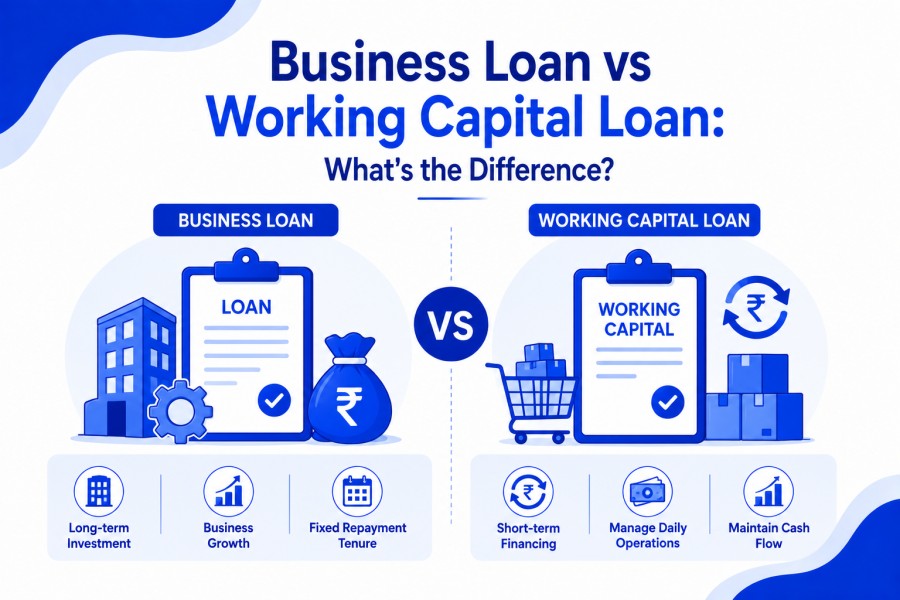
Business Loan vs Working Capital Loan: What's the Difference?
Businesses often require additional funds to support growth, purchase inventory, manage cash flow, or handle unexpected expenses. However, many business owners struggle to decide between a business loan and a working capital loan. While both financing options provide access to funds, they serve different purposes. Choosing the right one can help reduce borrowing costs, improve cash flow management, and support long-term business growth. In this guide, we'll compare business loans and working capital loans, explain their benefits, discuss loan eligibility requirements, and show how a business loan calculator can help you make a smarter borrowing decision. What Is a Business Loan? A business loan is a financing solution designed to help companies meet long-term financial requirements. Businesses typically use these funds for expansion, purchasing machinery, opening new branches, upgrading infrastructure, or making large investments. The loan amount is usually provided as a lump sum, which is repaid over a fixed tenure through monthly installments. Common Uses of a Business Loan Business expansion Purchasing machinery or equipment Opening a new office or branch Infrastructure development Technology upgrades Large inventory purchases Acquiring commercial property A business loan fund can provide substantial capital, making it suitable for projects that generate returns over time. What Is a Working Capital Loan? A working capital loan is specifically designed to finance a company's day-to-day operational expenses. Instead of funding long-term investments, it helps businesses maintain smooth operations during periods of fluctuating cash flow. These loans are particularly useful for seasonal businesses, retailers, manufacturers, and service providers that experience temporary cash shortages. Common Uses of Working Capital for Business Employee salaries and wages Rent and utility payments Inventory replenishment Supplier payments Marketing campaigns Short-term operational costs Managing seasonal demand A business working capital loan ensures that operations continue uninterrupted even when incoming revenue is delayed. Business Loan vs Working Capital Loan: Key Differences Features Business Loan Working Capital Loan Purpose Long-term business growth, expansion, and asset purchases Managing day-to-day operational expenses and cash flow Loan Amount Generally higher funding limits Usually lower funding amounts Repayment Tenure Longer repayment periods Shorter repayment periods Primary Usage Equipment purchases, expansion projects, and infrastructure development Payroll, inventory purchases, rent, and supplier payments Interest Cost May be lower due to longer tenure and structured repayment Can be comparatively higher depending on tenure and lender Funding Objective Business growth and long-term investments Short-term cash flow management Best Suitable For Businesses planning expansion or large investments Businesses facing temporary cash flow shortages What Are the Advantages of A Business Loan? Business loans offer several advantages for growing companies. Higher Loan Amounts: Lenders often provide higher loan limitations for expansion and investment objectives. Longer Repayment Terms: Extended repayment periods help businesses manage monthly obligations more comfortably. Predictable Business Loan EMI: Fixed monthly installments simplify budgeting and financial planning. Supports Business Growth: Business loans help companies invest in opportunities that can increase revenue and profitability. Improves Business Credit Profile: Timely repayments may strengthen future borrowing eligibility. What are the advantages of a working capital loan? Working capital loans are designed to solve short-term funding needs. Benefits include: Faster approval and disbursement Improved cash flow management Flexible fund usage Support during seasonal demand fluctuations Reduced operational disruptions For many small business owners, working capital financing acts as a financial safety net. When Should You Consider a Working Capital Loan? A business loan is the better choice when your company requires significant funding for strategic growth initiatives. Consider a Business Loan If: You want to expand operations. You need to purchase expensive equipment. You are opening additional locations. You require long-term financing. The investment will generate returns over several years. Before applying, use a business loan calculator to estimate repayment obligations and assess affordability. A calculator helps you determine: Monthly installments Total interest payable Overall borrowing cost Suitable loan tenure Understanding your business loan EMI in advance helps avoid repayment challenges later. When Should You Choose a Working Capital Loan? A working capital loan is ideal when your business is healthy but facing temporary cash flow gaps. Consider a Working Capital Loan If: Customer payments are delayed. You need funds to meet payroll obligations. Inventory needs increase during peak seasons. Operational expenses rise unexpectedly. Revenue fluctuates throughout the year. For many small business owners, working capital financing acts as a financial cushion during challenging periods. Which Loan Is Better for Small Businesses: Business Loan or Working Capital? The answer depends on the purpose of funding. Choose a Business Loan If: You need large capital. You are investing in long-term growth. You plan to purchase assets. Expansion is your primary goal. Choose a Working Capital Loan If: You need immediate operational funds. Cash flow is temporarily tight. Inventory purchases are urgent. Customer payments are delayed. Many successful businesses use both financing options at different stages of growth. A business loan promotes growth, whereas working capital funding maintains seamless day-to-day operations. Final Thoughts Understanding the difference between a business loan and a working capital loan can help business owners make smarter borrowing decisions. If your objective is growth, expansion, or major investments, a business loan may be the right solution. However, if your priority is managing operational expenses and maintaining cash flow, a working capital loan is often the better choice. Before applying, evaluate your funding needs, check your loan eligibility, and use a business loan calculator to estimate repayments. Taking these steps can help you select the most cost-effective financing option and support the long-term success of your business. Before applying for a business loan or working capital loan, calculate your EMI and repayment costs with Loan Quantum to choose the financing option that fits your business goals. Frequently Asked Questions Do business loans offer higher loan amounts than working capital loans? Generally, yes. Business loans often provide larger funding amounts because they are intended for significant investments and expansion plans, while working capital loans focus on short-term financing needs. Are working capital loans easier to get than business loans? In many cases, working capital loans may have faster approval processes because they are designed to address immediate cash flow requirements. However, eligibility criteria vary by lender. How do I choose between a business loan and a working capital loan? Start by identifying your funding objective. If you need funds for growth and long-term investments, a business loan may be suitable. If you need funds to manage everyday expenses and maintain cash flow, a working capital loan is often the better choice. Which industries commonly use working capital loans? Retail, manufacturing, wholesale, e-commerce, healthcare, logistics, hospitality, and service-based businesses frequently use working capital loans to manage daily expenses. Does a working capital loan affect business cash flow? A working capital loan is designed to improve cash flow by providing immediate funds for operational expenses, helping businesses maintain smooth operations.
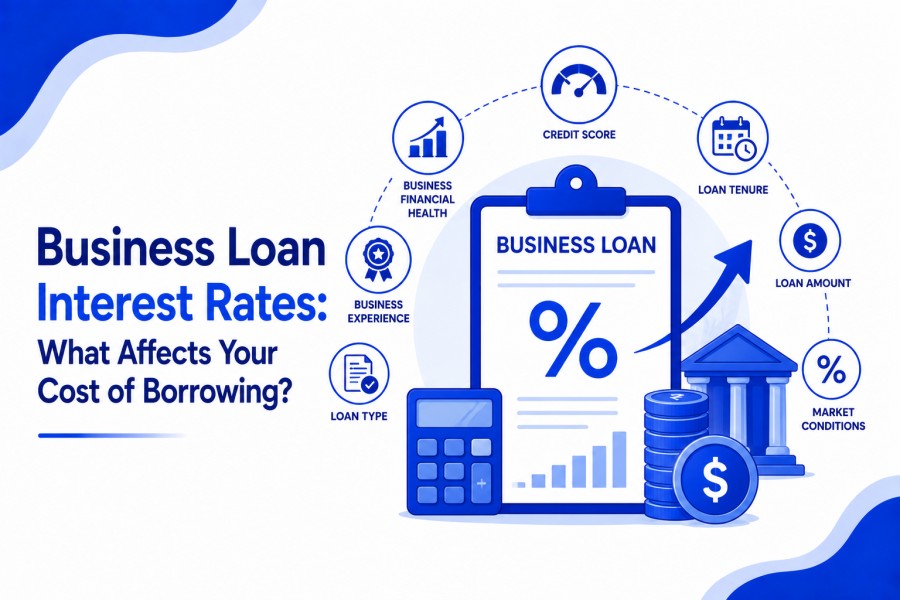
Business Loan Interest Rates: What Affects Your Cost of Borrowing?
Businesses often rely on external funding to manage working capital, expand operations, purchase equipment, hire staff, or invest in growth opportunities. While obtaining financing can help a company achieve its goals faster, understanding business loan interest rates is crucial because it directly impacts the total cost of borrowing. Whether you are applying for a small business loan or comparing multiple financing options, knowing what influences interest rates can help you secure better terms and manage repayment effectively. Business Loan Interest Rates in Simple Words A business loan interest rate is the percentage charged by a lender on the amount borrowed. This rate determines how much you will pay in addition to the principal loan amount over the loan tenure. Even a small difference in interest rates can significantly affect your monthly business loan EMI and the overall repayment amount. Therefore, understanding the factors that influence these rates is essential before signing a loan agreement. Why Business Loan Interest Rates Matter the Most Interest rates affect: Monthly business loan EMI Total repayment amount Cash flow management Business profitability Long-term financial planning A lower interest rate reduces borrowing costs, allowing businesses to allocate more funds toward growth and operations. Key Factors That Affect Business Loan Interest Rates in 2026 1. Business Credit Score Lenders evaluate your business credit profile before approving a loan. A strong credit history demonstrates responsible borrowing behavior and reduces the lender's risk. Businesses with higher credit scores often qualify for: Lower interest rates Higher loan amounts Better repayment terms Faster approvals Maintaining timely repayments on existing loans and credit facilities can help improve your creditworthiness. 2. Revenue and Cash Flow Stability Lenders want assurance that your business generates enough income to meet repayment obligations. Factors considered include: Monthly revenue Annual turnover Profit margins Cash flow consistency Existing liabilities Businesses with stable financial performance generally receive more favorable interest rates. 3. Loan Amount The amount borrowed can affect the interest rate offered. Lenders may provide competitive rates for larger loan amounts because the administrative cost per loan is lower. However, the final rate depends on multiple factors, including risk assessment and business performance. 4. Loan Tenure The repayment period plays a significant role in determining borrowing costs. Short-term loans often have: Higher monthly EMIs Lower total interest paid Long-term loans may offer: Lower monthly EMIs Higher overall interest costs Choosing the right tenure requires balancing affordability and total repayment expense. 5. Business Vintage Business vintage refers to how long your company has been operational. Established enterprises frequently get higher loan offers since they have: Proven revenue history Operational stability Lower perceived risk New businesses and startups may face slightly higher interest rates due to limited financial history. 6. Industry Type Certain industries are considered riskier than others. For example, businesses operating in highly volatile sectors may face stricter lending requirements compared to companies in stable industries. Lenders evaluate: Market conditions Industry growth trends Competition Economic risks 7. Collateral Availability Secured business loans require assets as collateral, such as: Commercial property Equipment Inventory Fixed deposits Because secured loans reduce lender risk, they often come with lower interest rates compared to unsecured business loans. 8. Existing Debt Obligations If your business already carries significant debt, lenders may view additional borrowing as a higher risk. They assess: Existing loan EMIs Debt-to-income ratio Debt service coverage ratio Reducing outstanding obligations can improve your chances of obtaining better rates. Related blog: How Digital Lending Is Changing Business Loans How Business Loan EMI Is Calculated Your business loan EMI depends on: Loan amount Interest rate Loan tenure A higher interest rate results in a higher EMI and increased repayment burden. Businesses should estimate their monthly obligations before applying for financing to ensure the loan fits within their budget. Benefits of Using a Business Loan EMI Calculator A business loan EMI calculator helps borrowers estimate monthly payments before applying for a loan. Advantages of a Business Loan EMI Calculator Calculates monthly EMIs instantly Helps compare multiple loan options Assists in financial planning Evaluates affordability Reduces repayment surprises By adjusting the loan amount, tenure, and interest rate, businesses can identify the most suitable financing structure. Small Business Loan Options Available Small businesses have access to various financing solutions depending on their needs. Working Capital Loans: Used to manage day-to-day operational expenses. Equipment Financing: Designed for purchasing machinery, tools, and equipment. Business Expansion Loans: Support growth initiatives such as opening new locations or increasing production capacity. Invoice Financing: Allows businesses to obtain funding for overdue invoices. Term Loans: Provide a lump sum amount repaid through fixed monthly installments. Choosing the right small business loan depends on your objectives and repayment capacity. Recent blog: Startup Funding vs Small Business Loans: What’s the Difference? Tips to Secure Lower Business Loan Interest Rates Improve Your Credit Score: Maintain timely repayments and reduce outstanding debts. Organize Financial Records: Accurate documentation helps lenders assess your business more confidently. Reduce Existing Liabilities: Lower debt levels can improve your financial profile. Demonstrate Stable Revenue: Consistent income strengthens your loan application. Compare Multiple Lenders: Always compare the loan offers available in the market before making a decision. Common EMI Mistakes Businesses Should Avoid in 2026 Borrowing more than necessary Ignoring hidden fees Choosing longer tenures without evaluating total interest costs Not using a business loan EMI calculator Failing to compare the loan options available Overlooking repayment obligations Avoiding these mistakes can help businesses reduce borrowing costs and maintain healthy cash flow. Managing Repayment Successfully Effective repayment management is essential for maintaining financial stability. Best practices include: Setting aside funds for EMI payments Monitoring cash flow regularly Maintaining emergency reserves Avoiding unnecessary borrowing Reviewing financial performance periodically Timely repayment also strengthens your credit profile and improves access to future financing. Read also: Business Loan Myths That Every Small Business Owner Should Know Final Thoughts Business loan interest rates play a major role in determining the overall cost of borrowing. Factors such as credit score, revenue, loan amount, tenure, collateral, and business history all influence the rates offered by lenders. Before applying for a small business loan, evaluate your loan eligibility, use a business loan EMI calculator to estimate monthly obligations, compare the loan options available, and carefully review repayment terms. Making informed borrowing decisions can help businesses secure affordable financing, maintain healthy cash flow, and support long-term growth. Compare business loan options, calculate your EMI, and find financing that fits your business goals with Loan Quantum. Frequently Asked Questions Does a higher credit score lower business loan interest rates? Yes. A higher credit score can improve loan eligibility and increase the likelihood of receiving a lower business loan interest rate because it indicates lower lending risk. Why is repayment history important for business loans? A strong repayment history demonstrates financial discipline and reliability. Lenders often use repayment records to assess risk and determine loan approval and interest rates. What are the hidden charges to check before taking a business loan? Borrowers should review processing fees, prepayment charges, foreclosure fees, late payment penalties, documentation fees, and other administrative charges. Can I increase my business loan amount after approval? Some lenders may allow top-up loans or additional financing if your repayment history and business performance meet their requirements. How do banks decide business loan interest rates? Banks assess creditworthiness, business income, industry risk, existing liabilities, loan tenure, and repayment capacity before determining the interest rate.
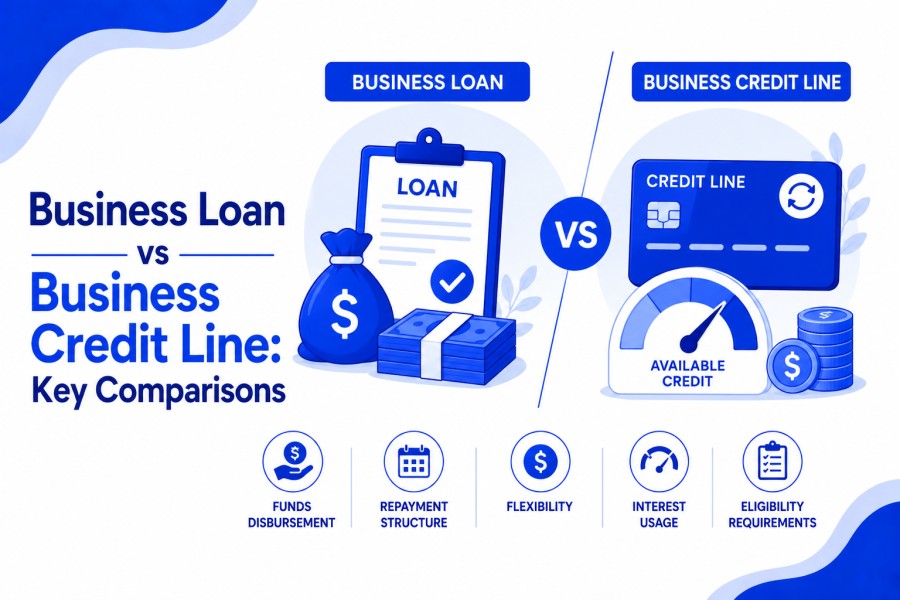
Business Loan vs Business Credit Line: Key Differences Explained
Access to funding plays a major role in helping enterprises manage operations, expand services, purchase equipment, and maintain healthy cash flow. Whether you are running a growing venture or launching a new startup, choosing between a business loan and a business credit line can significantly impact your financial planning. Many entrepreneurs compare these financing solutions before making a borrowing decision. Understanding how each option works can help determine which one aligns better with your business goals. What Is the Difference Between a Business Loan and a Business Credit Line? A business loan provides a lump-sum amount that is disbursed upfront and repaid through fixed installments over a specific tenure. It is commonly used for long-term investments, expansion projects, machinery purchases, or infrastructure development. A business credit line, on the other hand, offers flexible access to funds up to a pre-approved limit. Borrowers can withdraw money as needed and pay interest only on the utilized amount. While both financing methods support growth, their structure and repayment models differ considerably. When Should Small Businesses Choose a Business Loan? A business loan is often suitable when a company requires a large amount of capital for planned expenses. Common situations include: Business expansion Equipment purchases Office renovation Inventory stocking Franchise development Working capital requirements Using a business loan calculator helps estimate repayment schedules and understand overall borrowing costs before applying. Businesses that prefer predictable monthly obligations often choose term financing because the business loan EMI remains fixed throughout the repayment period. Why Do Startups Consider a Business Credit Line? Startups frequently face fluctuating operational expenses and uncertain revenue cycles. A business credit line provides flexibility by allowing owners to access capital as needed. Benefits for startups include: Better cash flow management Quick access to emergency funds Interest charged only on utilized credit Flexible withdrawals and repayments Improved liquidity during growth phases This financing model is particularly useful for seasonal businesses or enterprises experiencing irregular revenue patterns. How Does Repayment Work for Both Financing Options? Repayment structures vary significantly between the two choices. Business Loan Repayment With a business loan: Borrowers receive the entire sanctioned amount upfront. Monthly installments are fixed. Interest is calculated on the total borrowed amount. Loan tenure is predetermined. Many borrowers use a business loan calculator to evaluate monthly obligations and select a comfortable repayment period. Business Credit Line Repayment With a credit facility: Funds are withdrawn only when required. Interest applies to the amount utilized. Credit becomes available again after repayment. Borrowers enjoy revolving access to capital. This flexibility can be beneficial for managing short-term working capital needs. Which Option Offers Better Cash Flow Management? Cash flow is one of the most important factors of corporate sustainability. A business credit line generally provides greater flexibility because companies borrow only what they need. This helps reduce unnecessary interest expenses and supports day-to-day operations. However, if a business has a clearly defined project requiring significant investment, a business loan may be more efficient because it offers immediate access to a larger amount of capital. When comparing financing solutions, entrepreneurs should carefully compare the loan structure with their revenue patterns and operational requirements. Is a Business Loan More Cost-Effective Than a Credit Line? The answer depends on borrowing behavior and funding requirements. A business loan may prove more economical for: Large one-time investments Expansion projects Asset acquisition Long-term business planning A credit line may be advantageous for: Seasonal expenses Inventory purchases Payroll management Unexpected operational costs Evaluating interest rates, payback terms, and processing fees will help you choose the most cost-effective financing option. How Can Digital Lending Simplify Business Financing? The rise of digital lending has transformed how enterprises access capital. Modern lending platforms provide: Faster approvals Simplified documentation Online applications Quick disbursement Transparent eligibility assessment Many lenders now offer instant eligibility checks and financing comparisons, making it easier for entrepreneurs to identify suitable funding options. Digital lending solutions have become especially valuable for startups and small businesses seeking quick access to working capital. Which Financing Option Is Best for Small Businesses? For many small business owners, the right choice depends on operational needs. A business loan is generally suitable when: A fixed amount is needed Expansion plans are clearly defined Predictable repayment schedules are preferred A business credit line may be more suitable when: Cash flow fluctuates regularly Ongoing access to capital is required Funding needs are unpredictable The best financing strategy aligns with business objectives, revenue cycles, and future growth plans. Can a Business Loan Calculator Help Before Applying? Absolutely. A business loan calculator helps entrepreneurs: Estimate monthly installments Understand total repayment costs Compare borrowing scenarios Plan budgets more effectively Evaluate affordability before applying Using financial planning tools can reduce borrowing risks and improve decision-making. Conclusion Choosing between a business loan and a business credit line requires careful evaluation of funding requirements, repayment capacity, and business objectives. While a term loan offers structured financing with predictable business loan EMI, a credit line provides flexibility and ongoing access to funds. For startups, growing enterprises, and small business owners, understanding these differences can lead to better financial decisions and stronger long-term growth. With the increasing availability of digital lending solutions, comparing financing options has become easier than ever, helping businesses secure the right funding at the right time. Ready to choose the right financing solution for your business? Compare business loan and credit line options with LoanQuantum and find funding that supports your growth, cash flow, and long-term goals. Frequently Asked Questions Which is better for managing cash flow: a business loan or a credit line? A business credit line is generally better for cash flow management because businesses can access funds whenever needed and pay interest only on the borrowed amount. Is a business credit line cheaper than a business loan? The cost depends on usage. A credit line may be more cost-effective for short-term borrowing, while a business loan may offer better value for large, long-term financing needs. Does a business credit line have a fixed repayment schedule? Unlike a business loan, a credit line usually offers more flexible repayment terms, depending on the amount utilized and the lender's policies. Can a small business have both a business loan and a business credit line? Yes, many businesses use both financing options simultaneously. A business loan can fund expansion projects, while a credit line can help manage day-to-day operational expenses. Is a business credit line suitable for seasonal businesses? Yes, businesses with seasonal revenue patterns often benefit from flexible borrowing because they can access funds during slower periods and repay them during peak seasons.
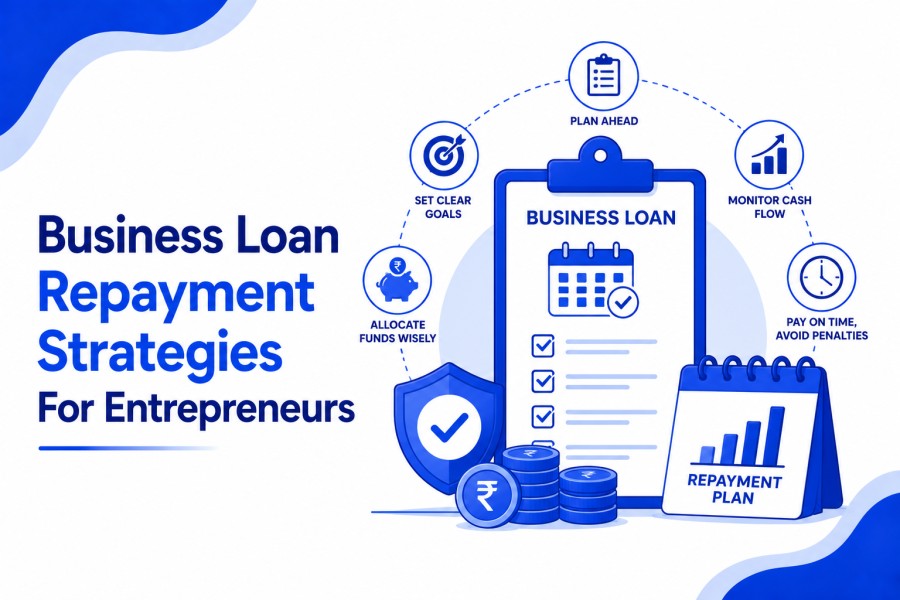
Business Loan Myths That Every Small Business Owner Should Know
Running a small business often requires additional funding to manage expansion, inventory purchases, equipment upgrades, or working capital needs. However, many entrepreneurs hesitate to apply for financing because of common business loan myths that create confusion and uncertainty. Believing inaccurate information can prevent business owners from accessing funds that could help their companies grow. Understanding the reality behind these misconceptions can help entrepreneurs make informed financial decisions. In this article, we will debunk popular loan misconceptions, explain the truth about loan eligibility, discuss business loan EMI planning, and show how tools like a business loan calculator and Loan EMI calculator can simplify borrowing decisions. Why Understanding Business Loans Matters in 2026 Business financing plays an important role in supporting growth, maintaining operations, and managing unexpected expenses. Whether you are a startup founder, retailer, manufacturer, or service provider, understanding loan terms and repayment structures helps improve financial planning. Many business owners avoid borrowing due to misinformation rather than actual lending requirements. That is why learning the facts behind these finance myths is essential. Key Takeaways Many entrepreneurs miss growth opportunities because they believe common business loan myths. Understanding the facts can help business owners make confident borrowing decisions. Remember these key myth takeaways: Small businesses can qualify for financing. Perfect credit is not always required. Loan approvals can be faster than expected. Proper planning helps maintain healthy cash flow. A business loan calculator simplifies repayment planning. A Business Loan EMI calculator helps estimate monthly obligations. Reviewing loan eligibility requirements improves approval chances. Conducting a thorough loan comparison supports smarter financial decisions. By separating facts from misconceptions, business owners can access funding opportunities that support sustainable growth and long-term success. Related blog: Startup Funding vs Small Business Loans: What’s the Difference? Myth 1: Only Large Businesses Can Get Business Loans One of the most common business loan myths is that lenders only approve loans for large corporations. Reality Many lenders provide financing options specifically designed for: Small businesses Startups Sole proprietorships Partnerships MSMEs Growing enterprises The approval process usually focuses on factors such as: Revenue stability Credit profile Business performance Repayment capability Existing financial obligations Business size alone does not decide approval. Myth 2: A Perfect Credit Score Is Required Many entrepreneurs believe they need an excellent credit score to qualify. Reality While credit history is important, lenders evaluate multiple factors beyond credit scores. These may include: Business income Cash reserves Profitability Business age Existing liabilities Future growth potential A moderate credit profile does not automatically result in rejection. Understanding loan eligibility requirements can help business owners identify financing opportunities that suit their situation. Myth 3: Business Loans Always Have High Interest Rates Many business owners assume all loans come with expensive repayment obligations. Reality Interest rates vary based on: Loan amount Repayment tenure Credit profile Business stability Lender policies Comparing multiple financing options through a proper loan comparison process helps borrowers identify suitable loan products. Before applying, use a business loan calculator to estimate borrowing costs and repayment commitments. Myth 4: Loan Approval Takes Several Months Some entrepreneurs delay funding plans because they think approvals are always lengthy. Reality Many lenders have simplified digital application processes that significantly reduce processing times. Depending on documentation and eligibility, approvals may be completed much faster than many business owners expect. Keeping financial records organized can improve approval efficiency. Myth 5: Taking a Business Loan Hurts Cash Flow Business owners often worry that loan repayments will damage daily operations. Reality Proper financial planning can help businesses manage repayments effectively. The key is borrowing an amount that aligns with revenue generation and operational needs. A well-structured repayment plan allows businesses to maintain healthy cash flow while meeting monthly obligations. Using a Business Loan EMI calculator before applying helps estimate future monthly payments and avoid overborrowing. Myth 6: Every Business Loan Requires Collateral Many entrepreneurs assume they must pledge valuable assets to secure financing. Reality Several financing options are available without requiring physical collateral. Eligibility depends on factors such as: Business turnover Credit profile Operational history Income stability Different lenders offer different products, making research and loan comparison extremely important. Recent blog: Secured vs Unsecured Business Loans: Which Is Better? Myth 7: Larger Loan Amounts are Always Better Some borrowers think securing the largest possible loan is beneficial. Reality Borrowing more than necessary can increase: Interest expenses Monthly obligations Financial pressure The ideal loan amount should match actual business requirements. Before applying, use a business loan calculator to estimate affordability and determine a practical borrowing amount. Myth 8: EMI Calculations Are Complicated Many business owners avoid financing because repayment calculations seem difficult. Reality Modern financial tools make repayment planning simple. A Business Loan EMI calculator helps estimate: Monthly EMI Total interest payable Total repayment amount Impact of tenure changes Understanding business loan EMI obligations before borrowing improves financial confidence and decision-making. How a Business Loan Calculator Helps A reliable business loan calculator is one of the most useful tools for entrepreneurs. Benefits include: Better Financial Planning: Estimate repayment commitments before applying. Improved Budgeting: Understand how EMI payments fit into monthly expenses. Smarter Loan Comparison: Compare different loan offers based on interest rates and tenure. Cash Flow Analysis: Assess whether repayments can be comfortably managed without affecting operations. Faster Decision Making: Evaluate financing options quickly and accurately. Related blog: Why Small Businesses Need Flexible Loan Solutions Conclusion Understanding the truth behind common business loan myths can help small business owners make smarter financial decisions and confidently explore funding opportunities. Business loans are not limited to large companies, and factors such as loan eligibility, repayment capacity, and business performance often matter more than many entrepreneurs realize. By using tools like a business loan calculator or Business Loan EMI calculator, borrowers can estimate business loan EMI, plan repayments effectively, and maintain healthy cash flow. Additionally, conducting a proper loan comparison before applying can help identify financing options that align with business goals and budget requirements. Making informed borrowing decisions today can support long-term business growth, financial stability, and future success. Looking for the right business loan? Compare loan options, calculate EMIs, and make informed borrowing decisions with LoanQuantum. Frequently Asked Questions Do business owners need to have very high profits to qualify for a business loan? Not necessarily. Lenders often assess overall financial health, cash flow, and repayment capacity rather than profits alone. Do seasonal businesses have no chance of getting a business loan? No. Lenders may consider seasonal revenue patterns and overall business performance when evaluating applications. Is it true that businesses with existing loans cannot obtain additional financing? No. Businesses may qualify for additional funding if they demonstrate sufficient income and the ability to manage repayments. Do online business loans have higher interest rates than traditional loans? Not always. Interest rates depend on multiple factors, including the lender, business profile, and loan terms. Do lenders ignore cash flow when evaluating a business loan application? No. Cash flow is one of the most important factors lenders consider because it indicates a business's ability to repay the loan.
Business Loan Repayment Strategies For Entrepreneurs
Entrepreneurship often requires financial support to turn ideas into profitable ventures. Whether you're launching a startup, expanding operations, purchasing equipment, or managing working capital, business loans can provide the funding needed to achieve your goals. However, securing financing is only one part of the journey. A well-planned repayment strategy is equally important. Without proper planning, loan repayments can impact cash flow, profitability, and future borrowing opportunities. This guide explores practical business loan repayment strategies for entrepreneurs and explains how tools such as a business loan calculator and EMI calculation can help you stay financially prepared. Why Should Entrepreneurs Focus On Loan Repayment Planning? Many business owners focus heavily on obtaining funding but spend less time preparing for repayment. Loan obligations become recurring financial commitments that can influence daily operations. Effective repayment planning helps entrepreneurs: Maintain healthy cash flow Avoid late payment penalties Improve creditworthiness Reduce overall borrowing costs Manage business finances more efficiently Prepare for future expansion opportunities A structured repayment plan allows businesses to grow while meeting financial commitments on time. How Can Entrepreneurs Use A Business Loan Calculator Before Borrowing? Before applying for financing, entrepreneurs should estimate their repayment obligations. A business loan calculator helps determine: Estimated monthly EMI Total interest payable Total repayment amount Loan affordability Impact of different loan tenures Using a business loan calculator before borrowing enables business owners to choose loan amounts that align with projected revenues and operational expenses. Rather than guessing repayment costs, entrepreneurs can make informed borrowing decisions based on realistic financial projections. Related blog: Key Mistakes to Avoid When Applying for a Business Loan Why Is Accurate EMI Calculation Important For Entrepreneurs? EMI calculation plays a crucial role in financial planning. Your EMI depends on: Loan amount Interest rate Repayment tenure Understanding EMI obligations helps entrepreneurs: Create realistic budgets Forecast monthly cash flow Avoid overborrowing Allocate resources effectively Businesses that perform EMI calculation before taking a loan often experience fewer repayment challenges because they understand their financial commitments from the beginning. Should Entrepreneurs Prioritize Low Interest Rates? Interest rates directly influence the total cost of borrowing. Even a small difference in rates can significantly impact long-term repayment costs. When comparing business loans, entrepreneurs should evaluate: Annual interest rate Processing fees Prepayment charges Loan tenure flexibility Hidden costs Choosing business loans with low interest rates can reduce monthly obligations and lower the total repayment burden over time. However, entrepreneurs should not focus solely on interest rates. Loan flexibility and repayment terms also matter. How Can Entrepreneurs Match Loan Tenure With Business Cash Flow? Loan tenure affects both EMI size and total interest payable. Shorter Tenure: Higher EMIs Lower total interest cost Faster debt clearance Longer Tenure: Lower EMIs Improved cash flow management Higher total interest cost Entrepreneurs should choose a repayment tenure based on their business revenue cycle rather than selecting the shortest or longest option available. Seasonal firms, for example, may benefit from lengthier payback terms in order to keep sufficient working capital during down periods. Read also: How Digital Lending Is Changing Business Loans Can Creating A Dedicated Repayment Fund Reduce Financial Stress? One of the most effective repayment strategies is maintaining a dedicated loan repayment reserve. Entrepreneurs can allocate a fixed percentage of monthly revenue toward: EMI payments Emergency financial needs Unexpected business expenses A separate repayment fund creates financial discipline and reduces the risk of missed payments during periods of fluctuating revenue. This strategy is particularly useful for startups and small businesses that experience irregular cash flow. How Can Entrepreneurs Improve Cash Flow To Support Loan Repayment? Strong cash flow management is essential for successful loan repayment. Entrepreneurs can improve cash flow by: Accelerating invoice collections Reducing unnecessary expenses Negotiating better supplier terms Monitoring operating costs Maintaining inventory efficiency Better cash flow ensures that EMI payments remain manageable without affecting daily operations. Businesses with strong liquidity are often better positioned to handle repayment obligations comfortably. Should Entrepreneurs Consider Partial Prepayments? When business revenues exceed expectations, partial prepayments can be a smart financial decision. Benefits of partial prepayment include: Reduced outstanding principal Lower interest burden Faster loan closure Improved financial flexibility Before making prepayments, entrepreneurs should review lender policies regarding prepayment charges and conditions. In many cases, strategic prepayments can lead to substantial savings over the life of the loan. How Can Entrepreneurs Avoid Missing EMI Payments? Late payments can affect business credit profiles and increase borrowing costs in the future. To avoid missed EMIs: Set automatic payment instructions Maintain sufficient account balance Track repayment schedules regularly Create financial reminders Monitor cash flow forecasts Consistent repayment behavior helps build a positive credit history and improves loan eligibility for future financing. What Role Does Credit Score Play In Future Business Loans? Loan repayment history directly influences a business owner's credit profile. Timely repayments help entrepreneurs: Improve credit scores Access larger loan amounts Qualify for low interest rates Strengthen lender confidence Businesses with strong repayment records often enjoy better financing opportunities compared to those with irregular payment histories. Responsible borrowing today can create financial advantages for future business expansion. Recent blog: How Business Loans Help Improve Cash Flow Management Can Entrepreneurs Refinance Existing Business Loans? Refinancing may be beneficial when market conditions improve. Entrepreneurs may consider refinancing if: Lower interest rates become available Business cash flow changes significantly Existing EMIs become difficult to manage Better repayment terms are offered Refinancing can reduce monthly obligations and improve overall financial efficiency when executed strategically. However, borrowers should carefully evaluate associated fees before making a decision. How Can Entrepreneurs Build A Sustainable Repayment Strategy? A sustainable loan repayment strategy combines careful planning, disciplined financial management, and regular monitoring. Successful entrepreneurs typically: Use a business loan calculator before borrowing Perform accurate EMI calculations Compare multiple lenders Seek business loans with low interest rates Maintain repayment reserves Monitor cash flow regularly Consider prepayments when possible These practices help businesses meet loan obligations while continuing to invest in growth opportunities. Related blog: Why Small Businesses Need Flexible Loan Solutions Final Thoughts Business loans can be powerful tools for expansion, innovation, and long-term success. However, repayment planning is just as important as securing funding. Entrepreneurs who use a business loan calculator, understand EMI calculation, compare business loans carefully, and prioritize low interest rates can significantly reduce financial pressure and improve business stability. A proactive repayment strategy not only protects cash flow but also strengthens future borrowing opportunities, helping entrepreneurs build a solid foundation for sustainable growth. Take control of your business finances with LoanQuantum. Calculate EMIs, explore loan affordability, and build a repayment strategy that supports long-term growth. Frequently Asked Questions What is the best way for entrepreneurs to repay a business loan? The best approach is to create a structured repayment plan, monitor cash flow regularly, use a business loan calculator before borrowing, and make EMI payments on time. Maintaining a dedicated repayment fund can also help avoid financial stress. How can entrepreneurs secure business loans with low interest rates? Entrepreneurs can improve their chances of obtaining low interest rates by maintaining a strong credit profile, comparing multiple lenders, providing accurate financial records, and demonstrating stable business performance. Can refinancing help entrepreneurs manage loan repayments? Refinancing may help if lower interest rates become available or if the business requires more flexible repayment terms. Entrepreneurs should compare the savings against any refinancing costs before making a decision. How can entrepreneurs improve cash flow while repaying a business loan? Entrepreneurs may enhance cash flow by cutting needless expenses, speeding up customer payments, streamlining inventory management, and analyzing operating costs on a regular basis to guarantee there are enough funds for EMI payments. What factors should entrepreneurs consider before applying for a business loan? Entrepreneurs should evaluate the loan amount, interest rate, repayment tenure, EMI affordability, processing fees, and their business's ability to generate sufficient cash flow for repayments.
How Business Loans Help Improve Cash Flow Management
Every business, whether new or established, depends on healthy cash flow to operate smoothly. Sales may be increasing, customers may be growing, and profits may look promising, but if money is not available when needed, daily operations can suffer. This is where business loans can play an important role. A well-planned business loan can help companies maintain working capital, manage expenses, handle seasonal fluctuations, and support growth opportunities without disrupting operations. In this article, we will explore what cash flow management is, why it matters, and how business loans can help businesses improve their financial stability. What Is Cash Flow Management? Cash flow management is the process of tracking, monitoring, and controlling the money coming into and going out of a business. Simply put, it ensures that a business has enough cash available to pay employees, suppliers, rent, utility bills, taxes, and other operating expenses on time. The cash flow management meaning is straightforward: managing business finances effectively so that cash is available whenever it is needed. Many business owners focus only on revenue and profit. However, managing cash flow is equally important because even profitable businesses can face financial difficulties if cash is not available at the right time. What Is Cash Flow Management in Business? Cash flow management in business involves: Monitoring income and expenses Forecasting future cash requirements Managing accounts receivable and payable Maintaining adequate working capital Planning for seasonal changes in revenue Ensuring smooth day-to-day operations Businesses that actively monitor their cash position are often better prepared to handle unexpected expenses and market fluctuations. Related blog: Startup Funding vs Small Business Loans: What’s the Difference? Understanding Business Cash Flow Business cash flow is the flow of money into and out of a company. Positive cash flow occurs when incoming funds exceed outgoing expenses. Negative cash flow occurs when expenses exceed available income. Several key factors can impact business cash flow: Delayed customer payments Seasonal sales patterns Inventory purchases Equipment investments Unexpected operating expenses Business expansion costs Without proper planning, these situations can create temporary cash shortages. The Role of Cash Flow Statements A cash flow statement in management accounting is an important financial report that shows how cash moves through a business over a specific period. The statement generally includes: Operating Activities: Cash created during normal business activities. Investing Activities: Cash used for purchasing equipment, property, or other assets. Financing Activities: Cash received from loans, investors, or financing arrangements. Reviewing a cash flow statement helps business owners understand where money is coming from and where it is being spent. Why Small Business Cash Flow Management Is Important Small businesses often operate with limited financial reserves. Even a short-term cash shortage can affect daily operations. Effective small business cash flow management helps: Pay suppliers on time Maintain inventory levels Meet payroll obligations Avoid payment delays Build stronger business relationships Reduce financial stress Businesses that maintain healthy cash flow are generally better positioned for long-term success. Read also: Why Small Businesses Need Flexible Loan Solutions How Business Loans Support Cash Flow Management A business loan can provide access to funds when cash flow becomes tight. Rather than delaying operations or missing opportunities, businesses can use financing to maintain stability. 1. Covering Working Capital Needs Working capital is required for daily business activities. A business loan can help cover: Employee salaries Supplier payments Utility bills Operational expenses Inventory purchases This allows businesses to continue operating smoothly while waiting for customer payments. 2. Managing Seasonal Revenue Fluctuations Many industries experience seasonal demand changes. For example: Retail businesses during festive seasons Tourism businesses during holiday periods Agricultural businesses during harvest cycles Financing cash flow through a business loan helps bridge revenue gaps during slower periods. 3. Supporting Business Expansion Growth often requires upfront investment. Businesses may need funds for: Opening new locations Purchasing equipment Hiring additional staff Increasing inventory Instead of using all available cash reserves, a business loan can provide funding while preserving operational liquidity. 4. Handling Unexpected Expenses Unexpected costs can arise at any time. Examples include: Equipment breakdowns Emergency repairs Supply chain disruptions Market changes Cash finance solutions help businesses respond quickly without affecting daily operations. 5. Improving Payment Cycles Some businesses wait 30, 60, or even 90 days to receive customer payments. A business loan can help maintain cash availability during these waiting periods and prevent operational disruptions. Recent blog: How to Get a Business Loan with Low Interest Rates How to Manage Cash Flow in Business Effectively Business loans can help, but they should be part of a broader financial strategy. Here are some practical tips on how to manage cash flow in business: Create Regular Cash Flow Forecasts: Forecast future income and expenses to identify potential shortages before they occur. Monitor Customer Payments: Encourage timely payments through clear invoicing and payment reminders. Control Operating Expenses: Review business expenses regularly and eliminate unnecessary costs. Maintain Emergency Reserves: Build a reserve fund to handle unexpected situations. Review Financial Reports: Analyze cash flow statements regularly to identify trends and make informed decisions. Use Financing Strategically: Borrow only when necessary and use funds for productive business purposes. How to Use Business Loan Calculator for Better Planning A business loan calculator helps businesses estimate borrowing costs before taking a loan. It can help calculate: Monthly EMI Total repayment amount Interest payable Loan affordability Using a calculator allows business owners to choose a repayment structure that fits their expected cash flow. A business loan calculator can also assist in comparing the loan offers and making informed financial decisions. Benefits of Business Loans for Cash Flow Management When used responsibly, business loans offer several advantages: Improved Liquidity: Provides immediate access to funds when required. Better Financial Stability: Helps maintain smooth operations during cash shortages. Business Growth Opportunities: Supports expansion without exhausting available reserves. Stronger Supplier Relationships: Enables timely payments and improves credibility. Enhanced Operational Efficiency: Ensures day-to-day activities continue without interruption. Greater Flexibility: Provides businesses with financial support during changing market conditions. These cash flow benefits can contribute significantly to long-term business sustainability. Related blog: Key Mistakes to Avoid When Applying for a Business Loan Key Mistakes to Avoid in Business Cash Flow While financing can support business cash flow, businesses should avoid: Borrowing more than necessary Ignoring repayment capacity Choosing loans based only on approval speed Failing to compare the loan options Overlooking hidden charges Not using a business loan calculator Proper planning helps maximize the value of financing while minimizing financial risk. Conclusion Effective cash flow management is essential for maintaining business stability and supporting growth. Understanding what cash flow management is and implementing strong financial practices can help businesses navigate challenges and seize new opportunities. Business loans can be a valuable tool for managing cash flow, covering operational expenses, funding growth initiatives, and handling temporary cash shortages. However, success depends on careful planning, checking loan eligibility, comparing loan options, evaluating low interest rates, and using a business loan calculator before making borrowing decisions. By combining smart financial management with the right financing strategy, businesses can strengthen cash flow, improve operational efficiency, and build a stronger foundation for future growth. Compare loan options smarter with LoanQuantum and find the financing solution that fits your business needs. Frequently Asked Questions How does financing cash flow support business growth? Financing cash flow through a business loan allows businesses to invest in expansion, purchase inventory, hire staff, or upgrade equipment without using all available cash reserves. What are the main cash flow benefits of a business loan? The main cash flow benefits include improved liquidity, uninterrupted operations, timely supplier payments, better working capital management, and increased flexibility to manage unexpected expenses. Can startups use business loans for cash flow management? Yes. Startups often use business loans to cover operational costs, purchase inventory, manage working capital, and support growth while building a stable revenue stream. How frequently should firms assess their cash flow? Businesses should review their cash flow regularly, preferably monthly or weekly, depending on the size and nature of operations. Frequent reviews help identify potential financial issues early. What industries benefit most from cash flow financing? Retail, manufacturing, construction, transportation, hospitality, healthcare, and seasonal businesses often benefit from financing solutions that help stabilize cash flow.
Startup Funding vs Small Business Loans: What’s the Difference?
Starting a business requires more than a great idea. Every entrepreneur eventually reaches a point where additional capital is needed to launch operations, purchase equipment, hire staff, or expand into new markets. This is where understanding the difference between startup funding and business loans becomes essential. Many business owners use the terms interchangeably, but they are two very different financing options. Choosing the right one can significantly impact your company's growth, ownership structure, and long-term financial health. In this guide, we'll explore how business start-up funding differs from business loans, their advantages and disadvantages, and how to determine which option is right for your venture. Understanding Startup Funding Startup funding refers to the capital raised by a new business to develop products, launch operations, and grow the company before it generates sufficient revenue. Unlike traditional lending, startup funding often comes from investors who provide money in exchange for ownership or future returns. Common Sources of Startup Funding Angel investors Venture capital firms Crowdfunding platforms Friends and family Government grants Incubator and accelerator programs Many entrepreneurs seek start-up funding because new businesses often lack the revenue history and financial records required by traditional lenders. Related blog: Easy EMI Planning Tips for Small Business Loans Why Businesses Seek Startup Funding? Businesses typically require funding for start-up businesses to cover: Product development Market research Website and technology development Hiring employees Inventory purchases Marketing campaigns Office setup and equipment For companies in their early stages, obtaining business start-up funds can provide the resources needed to establish a market presence and accelerate growth. What Is a Business Loan? A business loan is money borrowed from a bank, financial institution, or lender that must be repaid with interest over a specific period. Unlike startup funding, a business loan does not require giving up ownership in the company. Business loans are commonly used by: Established businesses Growing startups with revenue Small business owners Entrepreneurs seeking working capital Many lenders now offer small business start-up funding through specialized loan programs designed for new and growing businesses. Recent blog: Key Mistakes to Avoid When Applying for a Business Loan Startup Funding vs Business Loans: Key Differences Factor Startup Funding Business Loan Ownership May require equity sharing No ownership dilution Repayment Usually no monthly repayments Fixed repayment schedule Approval Basis Business idea and growth potential Credit profile and financial strength Risk Shared with investors Borrower assumes risk Control Investors may influence decisions Business owner retains control Funding Speed Can take months Often faster Long-Term Cost Equity can become expensive Interest is predictable Understanding these differences helps entrepreneurs choose the most suitable financing option. When Startup Funding Makes Sense You Have an Innovative Business Model: Investors often look for businesses with high growth potential. If your company has a unique product or scalable model, company start-up funding from investors may be easier to obtain. Revenue Has Not Started Yet: Traditional lenders generally prefer businesses with operating history. Startups with little or no revenue often rely on startup business funding from investors. Rapid Growth Is the Goal: If expansion is a priority, startup funding can provide larger amounts of capital than some loan programs. You Need Industry Expertise: Many investors bring valuable connections, mentoring, and strategic guidance in addition to funding. When a Business Loan Is a Better Choice You Want Full Ownership: A business loan allows entrepreneurs to retain complete control over their company. Revenue Is Already Flowing: Businesses generating steady income often qualify more easily for financing. Predictable Repayment Is Preferred: Business loans provide structured repayment schedules, making budgeting easier. Expansion Requires Additional Capital: Business loans are commonly used for: Equipment purchases Inventory financing Working capital Office expansion Technology upgrades How Loan Eligibility Affects Financing Options One of the biggest factors in obtaining financing is loan eligibility. Lenders typically evaluate: Credit Score: A stronger credit profile improves approval chances and may help secure lower interest rates. Business Revenue: Consistent revenue demonstrates repayment capacity. Time in Business: Some lenders require at least six months to two years of operational history. Existing Debt: Lower debt obligations often improve eligibility. Business Plan: A detailed business plan helps demonstrate future growth potential. Before applying, it is advisable to review loan eligibility requirements carefully to avoid unnecessary rejections. Related blog: How to Get a Business Loan with Low Interest Rates Using a Business Loan Calculator Before Applying Many entrepreneurs focus only on loan approval and overlook repayment planning. A business loan calculator helps estimate: Monthly EMI payments Total interest costs Loan affordability Repayment schedules Using a loan calculator before submitting an application allows business owners to understand the financial commitment involved. For example, increasing the loan tenure may reduce monthly payments, while a shorter tenure can lower total interest costs. A business loan calculator can help compare multiple borrowing scenarios and make informed decisions. What are the Advantages of Startup Funding? No Immediate Repayment Pressure: Businesses can focus on growth rather than monthly loan obligations. Access to Larger Capital: Investors may provide substantial funding for promising ventures. Strategic Guidance: Experienced investors often contribute valuable business insights. Improved Networking Opportunities: Investors frequently introduce founders to customers, partners, and future investors. Recent blog: How Digital Lending Is Changing Business Loans Advantages of Business Loans Retain Ownership: You remain the sole decision-maker. Predictable Costs: Repayment schedules are established from the beginning. Faster Access to Funds: Loan approvals can often be completed more quickly than investor negotiations. Flexible Usage: Funds can be used for various business purposes depending on the loan product. Challenges of Startup Funding Equity dilution Longer fundraising process Investor expectations Potential loss of decision-making control Challenges of Business Loans Interest expenses Regular repayment obligations Eligibility requirements Potential collateral requirements Can You Use Both Startup Funding and Business Loans? Yes. Many successful companies combine start-up funds and business loans at different growth stages. For example: Early Stage: A startup secures business start-up funding from angel investors to build its product and launch operations. Growth Stage: Once revenue becomes stable, the company obtains a business loan to finance expansion without giving away additional equity. This blended financing approach allows businesses to balance growth opportunities with ownership retention. How to Choose the Right Financing Option Consider the following questions: Do You Have Revenue? If not, startup funding may be easier to obtain. Are You Comfortable Sharing Ownership? If retaining control is important, a business loan may be preferable. How Quickly Do You Need Funds? Loans are often faster than investor fundraising. Can Your Business Support Monthly Payments? A business loan calculator can help determine affordability. What Are Your Long-Term Goals? Rapid scaling may benefit from investor funding, while loans may better support steady growth. Read also: Why Small Businesses Need Flexible Loan Solutions Final Thoughts Both startup funding and business loans play important roles in business growth. The right choice depends on your company's stage, financial position, growth plans, and willingness to share ownership. If your priority is launching an innovative venture with significant growth potential, start-up funding may provide the capital and expertise needed to move forward. If your business already generates revenue and you want to maintain full ownership, a business loan can offer a structured and predictable financing solution. Before deciding, evaluate your loan eligibility, compare financing options, and use a business loan calculator or loan calculator to understand repayment commitments. Careful planning today can help create a stronger financial foundation for future growth. Ready to fund your business journey? Compare funding options, check your loan eligibility, and make informed borrowing decisions with Loan Quantum today. Frequently Asked Questions Which is better for a new business: startup funding or a business loan? The right choice depends on your business goals, financial position, and growth plans. Startup funding may suit businesses with high growth potential, while business loans are often preferred by owners who want to retain full ownership. Can a startup get a business loan without revenue? Some lenders offer startup business loans without significant revenue, but approval often depends on factors such as credit score, business plan, and the financial stability of the founders. Does startup funding require monthly repayments? In most cases, startup funding does not require monthly repayments because investors earn returns through future business growth or equity appreciation rather than scheduled repayments. How do I choose between startup funding and a business loan? Consider factors such as funding needs, repayment capability, desired ownership control, business stage, and long-term financial goals before making a decision. Can a business receive both startup funding and a business loan? Yes. Many businesses use a combination of investor funding and business loans to support growth, manage cash flow, and finance expansion projects.

Why Small Businesses Need Flexible Loan Solutions
Small businesses are the backbone of economic growth. They create employment opportunities, support local communities, and drive innovation across industries. However, managing daily operations, handling unexpected expenses, and funding expansion plans often require access to reliable financing. Traditional borrowing options may not always meet the evolving needs of modern businesses. Fixed repayment schedules, lengthy approval processes, and strict requirements can create challenges for business owners. This is why flexible loan solutions have become increasingly important for small businesses, startups, and growing enterprises. Understanding Flexible Loan Solutions Flexible loan solutions are financing options designed to adapt to the changing needs of a business. Instead of rigid repayment structures, these business loans offer features such as adjustable repayment schedules, revolving credit facilities, quick approvals, and customized funding amounts. Businesses can access funds when needed, manage cash flow more effectively, and avoid unnecessary financial pressure during slower revenue periods. Flexible finance options have grown in popularity, thanks to digital lending platforms that make borrowing easier and enable speedier access to funds. Why Small Businesses Need Flexible Financing Managing Cash Flow Gaps One of the biggest challenges for small businesses is maintaining consistent cash flow. Expenses such as salaries, inventory purchases, rent, utilities, and supplier payments often occur before customer payments are received. Flexible financing helps businesses bridge these temporary cash flow gaps without disrupting daily operations. Options such as business lines of credit allow businesses to borrow only when required and pay interest only on the used amount. Related blog: How a Business Loan Can Help Grow Your Startup Supporting Business Growth Growth often requires upfront investment. Businesses require working capital for a variety of purposes, including equipment purchases, staff hires, inventory increases, and market expansion. A flexible loan structure allows business owners to invest confidently while maintaining healthy cash reserves. Instead of committing to large fixed repayments, businesses can align borrowing with actual growth requirements. Handling Seasonal Business Cycles Many industries experience seasonal fluctuations. Retail businesses may see higher sales during festivals, while other sectors experience slow periods during certain months. Flexible funding enables businesses to prepare for peak demand periods and manage expenses during slower seasons. This helps maintain operational stability throughout the year. Managing Unexpected Expenses Unexpected repairs, urgent inventory purchases, delayed client payments, and market shifts can all cause financial stress. Access to flexible financing ensures businesses can respond quickly without disrupting operations or compromising growth plans. Flexible loan facilities provide a financial cushion during unexpected situations. Recent blog: How to Get a Business Loan with Low Interest Rates The Role of Digital Lending in Modern Business Financing The rise of digital lending has transformed how small businesses access funds. Traditional loan applications often involve extensive paperwork and long approval timelines. Digital lending platforms have simplified the process through online applications, automated verification, and faster approvals. Key benefits of digital lending include: Faster loan approvals Minimal documentation requirements Convenient online applications Quick disbursement of funds Greater accessibility for startups and MSMEs This streamlined approach allows businesses to focus on growth instead of spending valuable time navigating complex financing procedures. Importance of Using a Business Loan Calculator Before applying for financing, it is important to understand the potential repayment obligation. A business loan calculator helps business owners estimate: Monthly repayment amounts Interest costs Loan tenure impact Overall borrowing expenses Using a small business loan calculator enables entrepreneurs to plan finances more effectively and choose a funding amount that aligns with business cash flow. Accurate financial planning reduces the risk of overborrowing and helps businesses maintain long-term financial stability. Why Loan Comparison Matters in Small Businesses Not all financing options are the same. Interest rates, repayment terms, processing fees, eligibility documents, and flexibility can vary significantly between lenders. Conducting a proper loan comparison helps businesses: Identify competitive interest rates Compare repayment structures Evaluate processing charges Understand flexibility features Choose the most suitable financing option A careful loan comparison ensures businesses select funding solutions that support both immediate requirements and long-term goals. Loan Eligibility: A Key Factor for Small Businesses Understanding loan eligibility is crucial before applying for financing. Lenders typically evaluate factors such as: Business age Revenue performance Credit profile Bank transaction history Existing liabilities Industry type Flexible lenders often consider broader business performance indicators rather than relying solely on traditional credit assessments. This improves financing access for startups and emerging businesses. Flexible Financing Options Available for Small Businesses Business Line of Credit: Provides ongoing access to funds with the flexibility to withdraw only when needed. Working Capital Loans: Designed to support daily operational expenses, inventory purchases, payroll management, and short-term cash flow requirements. Revenue-Based Financing: Repayment is linked to business revenue, making it easier to manage during slower business periods. Flexi Business Loans: Allow businesses to withdraw and repay funds within a pre-approved limit, offering greater control over borrowing costs and cash flow management. Recent blog: Secured vs Unsecured Business Loans: Which Is Better? Why Flexible Loan Solutions Are Essential for Startups Startups often face unique financial challenges. Revenue may be unpredictable, operational costs can be high, and business models are still evolving. Flexible loan solutions help startups by: Providing quick access to working capital Supporting product development and expansion Managing operational expenses Reducing financial pressure during early growth stages Offering scalable financing options as the business grows Access to adaptable funding can play a critical role in helping startups navigate uncertainty and seize growth opportunities. Conclusion Market conditions change rapidly, customer demands evolve, and growth opportunities often require immediate financial support. Flexible loan solutions provide businesses with the freedom to manage cash flow, handle unexpected expenses, support expansion plans, and maintain operational stability. By leveraging tools such as a business loan calculator, evaluating business loan EMI, conducting thorough loan comparison, and understanding loan eligibility, business owners can make informed financing decisions. As digital lending continues to improve accessibility and speed, flexible financing is becoming an important growth partner for small businesses and startups seeking sustainable success. Looking for the right business loan? Compare options, calculate your EMI, and find a financing solution that supports your business goals with Loan Quantum. Frequently Asked Questions Can startups apply for flexible business loans? Yes, many lenders offer flexible financing options for startups. Eligibility requirements may vary, but startups can often access funding based on business potential, projected revenue, and financial records. What are the benefits of digital lending for small businesses? Digital lending offers faster loan approvals, simplified documentation, online application processes, quick fund disbursement, and easier access to financing for small businesses and startups. What types of flexible loan solutions are available for small businesses? Small businesses can choose from working capital loans, business lines of credit, flexi loans, equipment financing, invoice financing, and term loans with customizable repayment options. Are online business loans safe for small businesses? Reputable digital lending platforms follow regulatory guidelines and secure verification processes. Businesses should always verify lender credibility, loan terms, and data security measures before applying. Are unsecured business loans available for small businesses? Yes, many lenders provide unsecured business loans that do not require collateral. Eligibility is usually based on business performance, revenue, and creditworthiness.
How Digital Lending Is Changing Business Loans
The lending sector has gone through a major shift in recent years. Traditional paperwork-heavy financing methods are gradually being replaced by faster and technology-driven systems. Today, businesses can apply for funding, verify documents, compare lenders, and receive approvals online without visiting a bank branch. The rise of digital lending has transformed the way startups, MSMEs, and growing enterprises access credit. From instant approvals to automated verification, modern lending technology is helping businesses secure funds with greater convenience and speed. What is a Digital Lending loan? The digital lending process refers to the process of offering business loans through online channels using technology-based systems. It includes online loan applications, digital verification, automated credit assessment, e-signatures, and electronic disbursement. Instead of depending completely on physical branches, financial institutions now use websites, mobile platforms, and AI-powered systems to process applications. This shift has improved loan accessibility for businesses across urban and semi-urban regions. In India, the adoption of digital lending India services has increased rapidly due to smartphone usage, internet access, UPI growth, and digital banking infrastructure. Why Businesses Are Choosing Digital Lending Business owners often require quick funding for inventory, expansion, machinery, salaries, or working capital. Traditional loan processing may take several days or even weeks. With digital business loans, the process becomes significantly faster. Key reasons businesses prefer digital lending include: Faster loan approvals Online documentation Reduced branch visits Simplified eligibility checks Real-time tracking Flexible repayment options Easy lender comparison Many companies now use digital lending platforms to compare interest rates, repayment tenure, and processing fees before selecting a lender. Growth of Online Lending in India The expansion of fintech companies and NBFCs has strengthened the Indian online lending ecosystem. Several banks and financial institutions now provide digital lending solutions specifically designed for small businesses and self-employed individuals. Government initiatives supporting digital payments and financial inclusion have also accelerated the growth of digital lending in India. Businesses in Tier-2 and Tier-3 cities are now accessing funding opportunities that were previously limited to larger urban markets. Related blog: Key Mistakes to Avoid When Applying for a Business Loan How Digital Lending Platforms Work Modern digital lending platforms use automated systems to evaluate borrowers. These systems analyze financial records, GST returns, bank statements, transaction history, and credit scores to determine loan eligibility. The online lending process usually includes: Online Application: Borrowers submit details through a website or digital loan app. Digital Verification: KYC, PAN, Aadhaar, GST, and banking details are verified electronically. Eligibility Assessment: The system checks Loan eligibility based on revenue, repayment history, and business performance. Loan Approval: Approved borrowers receive loan offers instantly or within a few hours. Disbursement: Funds are transferred directly to the bank account. This streamlined process helps businesses avoid long approval cycles associated with traditional financing. Role of Business Loan Calculators Before applying for funding, many borrowers use a Business loan calculator to estimate monthly repayments and interest costs. These calculators help businesses: Plan repayment schedules Understand EMI obligations Compare loan offers Avoid over-borrowing Manage cash flow effectively Using a Business loan calculator also allows borrowers to evaluate multiple tenure options before finalizing a loan. Digital Bank Loans vs Traditional Loans A digital bank loan offers several advantages over conventional financing methods. Traditional Loan Digital Bank Loan Manual paperwork Online application Longer processing time Faster approvals Physical verification Digital KYC Limited working hours 24/7 access Multiple branch visits Remote processing The convenience of a digital bank loan has made it a preferred financing option for many modern businesses. Related blog: Secured vs Unsecured Business Loans: Which Is Better? Importance of Loan Eligibility in Digital Lending One of the biggest advantages of online lending systems is quicker Loan eligibility evaluation. Digital lenders assess factors such as: Monthly revenue Credit history GST filings Business age Existing liabilities Banking transactions Since the process is automated, businesses can know their Loan eligibility within minutes instead of waiting several days. How Are Digital Loan Apps Transforming Business Borrowing? The popularity of the digital loan app market has increased significantly in India. Businesses and individuals can now apply for financing directly through smartphones. Most digital lending apps offer: Instant application processing Digital document upload EMI tracking Loan status monitoring Auto repayment setup For many small businesses, digital lending apps provide easier access to working capital without complicated procedures. Recent blog: How to Get a Business Loan with Low Interest Rates Instant Loan Services and Business Financing Several lending companies also offer instant digital personal loan products for self-employed professionals and entrepreneurs. These loans are commonly used for emergency business expenses, short-term cash flow gaps, and operational costs. The availability of instant digital personal loan services has reduced dependency on informal borrowing sources. Benefits of Loan Comparison Platforms Many borrowers now use online loan comparison tools before applying for financing. A proper loan comparison helps businesses evaluate: Interest rates Processing charges Repayment flexibility Loan tenure Hidden fees Approval timelines Comparing lenders online improves financial decision-making and reduces borrowing costs. Challenges in Digital Lending Despite rapid growth, the sector also faces several concerns. Some common challenges include: Data privacy risks Unauthorized lending apps Hidden charges Fraudulent platforms Misleading repayment terms Because of these concerns, regulations have become more important in the lending ecosystem. How Do RBI Digital Lending Guidelines Impact Online Business Loans? The introduction of RBI Digital Lending Guidelines has improved transparency and borrower protection in India’s online lending sector. The Key Guidelines for RBI Digital Lending focus on: Transparent fee disclosure Direct disbursement to borrower accounts Borrower consent requirements Data privacy standards Recovery practice regulations These rules help strengthen trust between lenders and borrowers while improving accountability among fintech companies. Is Digital Lending the Future of Business Loans in India? Yes, the future of digital lending in India looks strong as technology adoption continues to expand across industries in India. Key trends shaping the future include: AI-based credit assessment Paperless verification systems Embedded finance Alternative credit scoring Faster loan approvals API-based banking integration As fintech innovation grows, digital lending solutions are expected to become more personalized and accessible for businesses of all sizes. Conclusion The growth of digital lending has completely changed the business financing landscape. From faster approvals to simplified documentation, online lending systems are helping businesses access funds with greater efficiency. The rise of digital lending in India, advanced digital lending platforms, and secure digital lending apps continues to improve borrowing experiences for MSMEs and startups. Businesses that understand Loan eligibility, use a Business loan calculator, and perform proper loan comparison can make smarter borrowing decisions while reducing financial risks. With stronger regulations under the RBI Digital Lending Guidelines, the future of online lending is becoming more transparent, reliable, and business-friendly. Simplify your loan journey with practical insights, calculators, and comparisons from Loan Quantum. Frequently Asked Questions How is Loan eligibility checked in digital lending? In online lending systems, Loan eligibility is evaluated using credit score, business revenue, GST filings, banking history, repayment records, and digital financial data. How quickly are digital business loans approved? Approval timelines for digital business loans may range from a few minutes to 48 hours, depending on documentation, lender policies, and borrower profile. How does a digital loan app simplify borrowing? A digital loan app allows users to upload documents, complete KYC, track applications, calculate EMIs, and manage repayments directly from smartphones. What is the digital lending meaning in banking? The digital lending meaning in banking refers to technology-driven loan processing using online applications, automated underwriting, digital verification, and electronic disbursement systems. What are digital lending solutions for businesses? Digital lending solutions include online loan applications, automated approvals, paperless KYC, EMI tracking, and AI-based credit assessment for faster business financing.
Business Loan Eligibility Criteria and Documents Explained
Getting a business loan is often the first major financial step for entrepreneurs planning expansion, inventory purchases, machinery upgrades, working capital management, or launching a new business. However, many applications get delayed or rejected because borrowers do not fully understand the eligibility requirements or the documentation process. Before applying, it is important to check whether your business meets lender expectations, calculate repayment affordability, and compare available loan options carefully. This guide explains business loan eligibility criteria, required documents, EMI calculation, startup requirements, and practical tips to improve approval chances. It also includes commonly searched topics like business loan eligibility calculator, business loan EMI, business loan comparison, business loan lower EMI, and business loan eligibility criteria for startups. Industry lenders generally evaluate factors such as business stability, turnover, repayment history, profitability, and credit profile before approving loans. What is Business Loan Eligibility? Business loan eligibility refers to the specific conditions that banks and financial institutions use to determine whether a borrower qualifies for a loan. These conditions help lenders evaluate the applicant’s repayment capacity, business stability, financial health, and overall creditworthiness before approving funding. When applying for a business loan, lenders typically assess factors such as the applicant’s age, business experience, annual turnover, profitability, and credit score. Businesses that meet these requirements usually have a higher chance of approval and may also qualify for better interest rates and lower EMI business loan options. Using a business loan eligibility calculator can help borrowers estimate their loan eligibility, monthly EMI, and repayment affordability before applying. Key Business Loan Eligibility Criteria Most lenders follow a standard set of checks while considering applications. Although policies vary, the following business loan eligibility criteria are commonly considered. Age Criteria Most lenders require applicants to be between 21 and 65 years old at the time of loan application and loan maturity. This ensures that borrowers remain financially active throughout the repayment period. Business Experience The business should generally be operational for at least 2 to 3 years. A stable operational history helps lenders assess business continuity and repayment reliability. For startups and new business owners, some lenders may offer specialized financing options with separate loan eligibility requirements. Credit Score Requirements A healthy credit profile is one of the most important factors in loan approval. Most lenders prefer a minimum CIBIL score between 675 and 700. A strong credit score demonstrates responsible repayment behaviour and increases the chances of securing better interest rates. Businesses with higher scores may also qualify for larger loan amounts and easier approvals. Revenue and Profitability Lenders usually check the company’s annual turnover and profitability before approving funding. Typical requirements include: Minimum annual turnover ranging from ₹15 lakh to ₹40 lakh Consistent business income Profitability for at least the last 2 financial years Higher turnover and stable profits improve business loan eligibility and repayment confidence. Key Documents List for Faster Business Loan Eligibility Keeping all required documents ready in advance can speed up the business loan approval process and improve your chances of eligibility verification. Most lenders check identity proof, financial records, business registration, and banking history before approving a loan. Here is a proper checklist of the key documents commonly required for business loan eligibility. 1. KYC Documents (Identity & Address Proof) These documents help lenders verify the applicant’s identity and residential address. Accepted Identity Proofs PAN Card Aadhaar Card Passport Voter ID Driving Licence Accepted Address Proofs Aadhaar Card Utility Bills Passport Rental Agreement Property Documents 2. Business Registration Documents These documents confirm the legal existence of your business. GST Registration Certificate Udyam Registration Certificate Shop & Establishment Licence Partnership Deed Incorporation Certificate Trade Licence Memorandum & Articles of Association (for companies) 3. Financial Documents Financial records help lenders assess repayment capacity, profitability, and business performance. Commonly Required Financial Proofs Income Tax Returns (ITR) for the last 2 years Audited Balance Sheets Profit & Loss Statements GST Returns Audit Reports (if applicable) Businesses with strong financial records generally qualify for better interest rates and lower EMI options for business loans. 4. Bank Statements Most lenders require business bank statements to review transaction history and cash flow consistency. Usually Required Last 6 months to 1 year of bank statements Statements from primary business accounts Healthy banking activity improves business loan eligibility. 5. Proof of Business Continuity Lenders may request documents showing operational stability and business vintage. Examples Include Business invoices GST filings Existing client contracts Vendor agreements Office ownership or rental proof 6. Additional Documents for Startups or New Business Loans Startups and new business owners may need to provide extra documents because of limited financial history. Additional Startup Documents Detailed business plan Revenue projections Founder profile Investment details Project report Pitch deck These documents help lenders evaluate future business potential and repayment capability. Business Loan Eligibility Criteria for Startups Startups usually face challenges because they may not have long financial histories. However, many lenders now offer funding options specifically designed for startups and new business owners. The business loan eligibility criteria for startups may include: Business registration proof Founder profile and experience Business plan Revenue projections Bank statements Investor support details GST registration, if available Some lenders may also evaluate market opportunity and scalability instead of only past profits. Government-backed schemes for MSMEs and startups can also improve access to funding. How to Get Higher Business Loan Eligibility Improving your business loan eligibility can help you secure a higher loan amount, better interest rates, and a lower EMI option. Here are some simple ways to improve eligibility: Maintain a strong credit score by paying EMIs and bills on time Increase business turnover and maintain steady profits Keep financial documents and GST records updated Reduce existing loan liabilities before applying Maintain healthy business bank transactions Use a business loan eligibility calculator to estimate affordability Compare lenders through proper business loan comparison Apply for a loan amount that matches your repayment capacity For startups and new business owners, maintaining proper business registration, comparing loans, and organizing financial planning can also improve approval chances. Conclusion A business loan can support expansion, improve operations, and help businesses handle financial challenges effectively. However, understanding eligibility requirements before applying is essential for smoother approval. Whether you are running an established company or planning a new business, preparing documents, checking repayment ability, and comparing lenders can make a major difference. Using tools like a business loan eligibility calculator, understanding business loan EMI, and performing a detailed business loan comparison can help you select the right funding option with confidence. Businesses that maintain strong financial discipline often qualify for better interest rates and lower EMI business loan options, making repayment easier over time. Compare lenders, calculate your business loan EMI, and find the right funding solution for your business growth with Loan Quantum. Frequently Asked Questions Do digital lenders have easier business loan eligibility criteria? Many digital lenders offer simplified application processes and faster approvals. However, they still check credit score, turnover, and repayment capacity before approval. Does GST registration affect business loan eligibility? Yes, GST registration and regular GST filing can improve business loan eligibility because they help lenders verify business income and transaction consistency. Does existing debt affect business loan eligibility? Yes, lenders review your current EMIs and outstanding liabilities before approving a loan. High existing debt can reduce repayment capacity and affect eligibility. How does annual turnover impact business loan eligibility? Higher annual turnover indicates stronger business performance and repayment ability. Businesses with stable revenue often qualify for higher loan amounts. Does repayment history affect future business loan eligibility? Yes, timely repayment of existing loans improves credit score and increases future business loan approval chances.

How to Get a Business Loan with Low Interest Rates
Getting a business loan at a lower interest rate can make a major difference in the growth and stability of your business. Whether you are expanding operations, managing working capital, purchasing equipment, or launching a startup, choosing the right financing option helps reduce repayment pressure and improve profitability. Today, many banks and financial institutions offer small business loans, unsecured business loans, and instant business loan options with competitive rates. However, not every borrower qualifies for the lowest rates. Lenders evaluate your financial profile, business performance, repayment history, and eligibility before approving a loan. In this guide, you will learn how business loan interest rates work, what affects them, and how to improve your chances of getting a bank business loan at lower interest rates. What is Business Loan Interest Rates? A business loan interest rate is the percentage charged by a lender on the borrowed amount. It represents the cost of borrowing and directly impacts your monthly EMI and total repayment amount. For example, if you borrow ₹10 lakh for business expansion, the final repayment amount depends heavily on the business loan interest applied by the lender. Even a small difference in interest rates can significantly increase or reduce the overall loan cost. Business loan rates in India vary based on several factors, including: Type of business Credit score Annual turnover Business stability Loan amount Repayment tenure Collateral availability Most lenders offer both secured and unsecured business loans. Secured loans usually come with lower interest rates because they are backed by collateral. Unsecured business loans, on the other hand, are approved without security but may carry slightly higher rates. Related blog: Business Loan Calculator: How It Works, Benefits & Smart Usage Guide What are the Current Business Loan Interest Rates in India Business loan, lowest interest rate bank offers generally start from around 9% to 12% per annum for highly eligible borrowers. However, the final rate depends on the lender and borrower profile. Public sector banks often provide lower rates for established businesses with strong financial records. Private banks and NBFCs may offer faster approvals and instant business loan options, but the interest rates can be comparatively higher. Some lenders also provide special startup loans for new business schemes under government-backed programs. These loans may include subsidized interest rates and relaxed eligibility requirements. Before applying for a business loan, it is important to compare: Interest rates Processing fees Prepayment charges EMI structure Loan tenure Approval speed A proper loan comparison helps identify the most affordable financing option for your business needs. How to Calculate Business Loan Interest Understanding how lenders calculate interest rates helps you estimate repayment obligations more accurately. Most lenders calculate EMIs based on: Loan amount Interest rate Repayment tenure Using a business loan calculator or a business loan interest rate calculator can help you estimate: Monthly EMI Total repayment amount Total interest payable Suitable tenure A business loan calculator is useful because it allows you to adjust tenure and loan amount before applying. This helps businesses choose an EMI that fits their monthly cash flow. For example, a longer repayment tenure may reduce the monthly loan EMI but increase the total interest paid over time. A shorter tenure may increase EMI but lower the total borrowing cost. Businesses should always calculate repayment affordability before selecting a loan offer. Different Types of Business Loan Interest Rates Business loans in India generally come with two types of interest structures. There are two types of online business loan interest types, Fixed Interest Rates In a fixed-rate loan, the interest remains unchanged throughout the tenure. This provides stable EMIs and predictable repayments. Fixed-rate loans are suitable for businesses that prefer consistent monthly expenses and better budgeting control. Floating Interest Rates Floating rates change according to market conditions and benchmark lending rates. EMIs may increase or decrease during the tenure. Floating rates can be beneficial when market interest rates decline, but they also carry uncertainty. Businesses should evaluate market conditions and financial flexibility before choosing between fixed and floating rates. Business Loan Eligibility Criteria in India Meeting business loan eligibility requirements is one of the most important steps toward securing low-interest financing. Although eligibility varies across lenders, most banks consider the following factors: Business Vintage: Lenders usually prefer businesses operating for at least 1 to 3 years. Established businesses are considered lower risk compared to newly launched firms. Credit Score: A high credit score improves your chances of approval and helps secure lower business loan interest rates. Most lenders prefer a credit score above 700. Annual Turnover: Higher business turnover indicates stronger repayment capability. Banks assess revenue trends before sanctioning a bank loan for business. Profitability: Consistent profits increase lender confidence. Businesses with stable income and healthy financial records are more likely to receive favorable rates. Existing Debt: If your business already has multiple active loans, lenders may consider you a higher-risk borrower. Industry Type: Some industries are considered more stable and may qualify for better loan terms. Understanding loan eligibility before applying helps businesses avoid unnecessary rejections and improve approval chances. Recent blog: Secured vs Unsecured Business Loans: Which Is Better? How Startups Can Get Business Loans at Lower Interest Rates Getting a business loan for startups can be challenging because new businesses often lack financial history. However, startups can still improve their chances of getting affordable funding. Maintain a Strong Personal Credit Score: For startup loans for new business applications, lenders often evaluate the founder’s personal credit profile. Prepare a Detailed Business Plan: A strong business plan with revenue projections and market analysis increases lender confidence. Apply Under Government Schemes: Several government initiatives support startup financing and small business loan programs with lower interest rates. Add a Co-Applicant or Guarantor: A financially strong co-applicant can improve loan approval chances and reduce lending risk. Choose Smaller Initial Loan Amounts: Startups applying for moderate funding amounts often receive quicker approvals. Tips to Get Business Loans at Low Interest Rates Securing the lowest possible business loan interest requires preparation and careful financial planning. Improve Your Credit Score: A strong repayment history and low credit utilization improve your credit profile. Paying Loan EMIs and credit card bills on time can help increase your score. Compare Multiple Lenders: Never accept the first loan offer immediately. Conduct proper loan comparison between banks, NBFCs, and digital lenders. Maintain Healthy Financial Records: Accurate GST filings, ITRs, bank statements, and audited financials improve lender confidence. Opt for Secured Loans When Possible: Providing collateral often helps secure lower business loan rates compared to unsecured business loans. Reduce Existing Debt: Lower debt obligations improve your debt-to-income ratio and repayment capability. Select the Right Loan Tenure: Choosing the right tenure balances EMI affordability and total interest cost. Apply for the Correct Loan Amount: Borrowing more than required may increase financial pressure and affect approval chances. Build a Relationship with Your Bank: Existing banking relationships sometimes help businesses negotiate better rates and faster approvals. Read also: Key Mistakes to Avoid When Applying for a Business Loan Final Thoughts Getting a business loan at low interest rates requires more than simply applying to multiple banks. Businesses need strong financial discipline, proper documentation, healthy credit scores, and a clear repayment strategy. Whether you need a small business loan, startup funding, an instant business loan, or a long-term bank loan for business expansion, comparing lenders carefully can help reduce borrowing costs significantly. Before applying, evaluate your loan eligibility, calculate your EMIs using a business loan interest rate calculator, and compare repayment terms from multiple lenders. The right loan structure not only supports business growth but also protects long-term financial stability. Businesses that prepare in advance and maintain strong financial records are more likely to secure affordable financing with better repayment flexibility. Compare business loan offers, calculate EMIs, and find the right financing solution for your business growth with LoanQuantum. Frequently Asked Questions Is it possible to negotiate business loan interest rates? Businesses with strong credit profiles, stable revenue, and existing lender relationships may be able to negotiate lower business loan rates or reduced processing fees. What is considered a low interest rate for a business loan in India? A low business loan interest rate usually starts from around 9% to 12% per annum for eligible borrowers. The actual rate depends on the lender, credit profile, business performance, and collateral availability. Do government schemes offer lower business loan interest rates? Yes, government-backed schemes for MSMEs and startups often provide lower interest rates, flexible repayment terms, and reduced collateral requirements for eligible businesses. Can existing customers get lower business loan rates? Many banks offer preferential business loan interest rates to existing customers with strong banking relationships, regular transactions, and healthy account history. How can small businesses improve chances of getting low-interest loans? Small businesses can improve approval chances by maintaining proper financial records, filing taxes regularly, reducing existing debt, and improving their credit score.

Secured vs Unsecured Business Loans: Which Is Better?
Running a business often requires timely financial support. Whether you are expanding operations, managing working capital, purchasing equipment, or launching a new venture, choosing the right financing option is critical. One of the biggest decisions borrowers face is choosing between a secured and an unsecured business loan. Both loan types come with their own advantages, risks, eligibility requirements, and repayment structures. Understanding the differences can help business owners make smarter borrowing decisions and choose the most suitable financing option for long-term growth. In this detailed guide, we will compare secured and unsecured business loans, explain their benefits, discuss eligibility criteria, interest rates, EMI calculations, and help you determine which option is better for your business. What Is a Secured Business Loan? A secured business loan is a loan backed by collateral. The borrower pledges an asset such as property, machinery, inventory, fixed deposits, or commercial equipment as security against the loan amount. If the borrower fails to repay the loan, the lender has the right to recover dues by selling the pledged asset. Secured loans are commonly preferred by businesses looking for larger loan amounts and lower interest rates. Common Collateral Used for Secured Business Loans Commercial property Residential property Machinery and equipment Inventory or stock Fixed deposits Vehicles Business assets Secured loans are often suitable for selected businesses with valuable assets and stable revenue. What Is an Unsecured Business Loan? An unsecured business loan does not require any collateral or security. Lenders approve the loan based on factors such as: Business revenue Credit score Bank statements Income tax returns Business vintage Financial stability These loans are ideal for businesses that need quick funding but do not want to pledge assets. Today, several lenders provide online business loans with quick approvals and low documentation. Unsecured loans are especially popular among: Startups Small businesses Freelancers MSMEs Service-based businesses Many lenders now provide instant business loan approvals through digital applications. Secured vs Unsecured Business Loans: Key Differences Features Secured Business Loan Unsecured Business Loan Collateral Requirement Requires collateral such as property or machinery No collateral required Business Loan Interest Rate Usually lower Usually Higher Loan Amount Higher loan amounts available Lower borrowing limits Approval Speed Slower due to asset verification Faster approvals and quick disbursal Eligibility Criteria Based on collateral and financials Based on credit score and cash flow Repayment Tenure Longer repayment tenure Shorter repayment tenure Best Suitable For Business expansion and large investments Working capital and urgent funding Benefits of Secured Business Loans for Small Businesses A secured business loan can be a smart financing option for businesses looking for larger funding amounts at affordable repayment terms. Since the loan is backed by collateral, lenders usually offer better terms compared to unsecured financing. Many businesses use this type of small business loan for expansion, equipment purchases, or working capital needs. Lower Business Loan Interest Rate: One of the biggest advantages of a secured business loan is the lower business loan interest rate. Since the lender’s risk is reduced through collateral, borrowers can access more affordable financing and reduce their total repayment burden. Higher Loan Amount Eligibility: Businesses can usually secure larger funding amounts with a secured loan. This is beneficial for companies planning expansion, purchasing machinery, or managing operational costs. Flexible Repayment Tenure: Secured loans often come with longer repayment periods, making the monthly Business loan EMI more manageable. Businesses can use a business loan EMI calculator or a small business loan calculator to plan repayments effectively. Better Approval Chances: Businesses with collateral may have improved approval chances, even if their credit score is average. This makes secured financing useful for growing businesses seeking reliable funding. Suitable for Business Expansion: A secured small business loan is commonly used for opening new branches, increasing inventory, upgrading infrastructure, or purchasing commercial property. Read also: Business Loan Calculator: How It Works, Benefits & Smart Usage Guide Disadvantages of Secured Business Loans You Must Know Although secured loans offer lower interest rates and higher loan amounts, they also come with certain risks. Businesses should carefully evaluate these factors before choosing a secured financing option. Risk of Losing Collateral: The biggest disadvantage of a secured business loan is the risk associated with pledged assets. If the borrower does not return the loan, the lender may confiscate the collateral. Lengthy Approval Process: Secured loans usually require property verification and legal checks, which can increase processing time compared to an instant business loan. Extensive Documentation: Borrowers often need to submit multiple financial and property-related documents while applying for a secured online business loan. Asset Valuation Requirements: Lenders evaluate the market value of collateral before approving the loan amount. This process may delay funding. Limited Flexibility for Startups: Many Startups may not own sufficient collateral, making secured financing difficult to access during the early stages of business growth. Best Reasons to Choose an Unsecured Business Loan An unsecured business loan is ideal for businesses that need quick funding without pledging assets. These loans are becoming increasingly popular among startups, MSMEs, and service-based businesses. No Collateral Requirement: The biggest benefit of the best unsecured business loans is that businesses do not need to mortgage property or assets to access funding. Faster Loan Approval: Many lenders now offer fast unsecured business loans with quick approvals and minimal paperwork. Some digital lenders even provide same-day disbursal. Easy Online Application: Applying for an online business loan is simple and convenient. Businesses can upload documents digitally and track application status online. Ideal for Startups and Small Businesses: Many startup business loans are unsecured, making them suitable for businesses that may not have assets for collateral. Flexible Usage of Funds: An unsecured small business loan can be used for inventory purchases, marketing campaigns, payroll management, equipment upgrades, and operational expenses. Quick Financial Support: Businesses with urgent cash flow needs frequently prefer speedy business loans since they provide quick access to funding. Related blog: Key Mistakes to Avoid When Applying for a Business Loan Hidden Disadvantages of Unsecured Business Financing While unsecured loans offer speed and convenience, businesses should also understand the potential drawbacks before borrowing. Higher Business Loan Interest Rate: Since there is no collateral involved, lenders usually charge a higher business loan interest rate on unsecured financing. Lower Loan Amounts: Compared to secured loans, unsecured financing may offer limited borrowing capacity depending on the borrower’s financial profile. Strict Credit Evaluation: Lenders carefully review credit score, business turnover, and bank statements before approving unsecured funding. Higher EMI Burden: Due to shorter repayment tenures and higher interest rates, Business loan EMI for unsecured loans may be comparatively higher. Impact on Credit Score: Missing EMI payments on an unsecured business loan can negatively affect the borrower’s credit profile and future loan eligibility. Limited Options for New Businesses: Some lenders may hesitate to provide unsecured financing to newly established Startups with unstable cash flow. Eligibility Conditions for Secured Loans in India Before you apply for a business loan, lenders evaluate several loan eligibility factors for secured financing. Meeting these requirements can improve approval chances and help businesses access better loan terms. Ownership of Collateral: Applicants must own eligible collateral such as property, machinery, vehicles, or fixed deposits. Stable Business Operations: Lenders usually prefer businesses with a stable operational history and consistent income generation. Good Financial Records: Businesses should maintain healthy financial statements, GST returns, and bank transaction history. Acceptable Credit Score: Although collateral reduces lender risk, a decent credit score still improves approval chances for a secured business loan. Business Vintage Requirement: Most lenders require businesses to operate for a minimum number of years before applying for secured financing. EMI Repayment Capacity: Lenders assess repayment ability using income and cash flow analysis. Using a business loan calculator or a business loan EMI calculator helps businesses estimate affordability before borrowing. Business Loan Eligibility for Unsecured Loans Eligibility for unsecured financing mainly depends on the financial strength and repayment capacity of the business. Since there is no collateral involved, lenders follow stricter assessment criteria. 1. Strong Credit Score: A good credit score significantly improves approval chances for the best unsecured business loans. 2. Consistent Bank Transactions: Lenders evaluate banking history and cash flow stability before approving an unsecured business loan. 3. Minimum Business Turnover: Businesses must meet the lender’s minimum turnover requirement to qualify for financing. 4. Operational Stability: Most lenders prefer businesses with a proven operational track record and stable revenue generation. 5. Proper Documentation: Applicants usually need to submit: Bank statements GST returns PAN and Aadhaar details Income tax returns Business registration proof 6. Digital Eligibility Verification: Many lenders offering online business loan services perform instant digital verification for faster approvals. 7. Repayment Capacity Assessment: Lenders calculate affordability based on existing obligations and projected cash flow. Businesses should use a small business loan calculator to understand estimated EMI obligations before applying. Read also: Easy EMI Planning Tips for Small Business Loans Conclusion Choosing between secured and unsecured financing is one of the most important borrowing decisions for any business owner. While secured loans offer lower interest rates and higher funding limits, unsecured loans provide convenience, speed, and flexibility. Businesses should carefully assess their financial goals, repayment capacity, and operational needs before selecting a loan type. Whether you are looking for a small business loan, an instant business loan, or exploring the best unsecured business loans, understanding the differences between these financing options can help you make smarter financial decisions and support long-term business growth. If you plan to apply for a business loan, make sure to compare lenders, review eligibility requirements, and calculate EMIs carefully to choose the best financing solution for your business. Turn your business plans into reality with the right loan support from Loan Quantum. Frequently Asked Questions Which loan is best for working capital requirements? An unsecured business loan is generally better for urgent working capital requirements because approvals are faster, and no collateral is needed. Do unsecured business loans require a good credit score? Yes, lenders usually check credit score, business turnover, and bank statements before approving unsecured financing. A strong repayment history improves eligibility for larger loan amounts. What is the repayment tenure for secured business loans? Secured loans usually offer longer repayment tenures compared to unsecured loans. This helps businesses manage monthly Business loan EMI more comfortably. Can startups apply for unsecured business loans? Yes, many lenders now provide startup business loans without collateral. These financing options are especially useful for Startups that may not own valuable assets but require working capital or operational funding. Which loan is suitable for urgent funding requirements? An unsecured instant business loan is more suitable for urgent financial requirements because approvals and disbursals are much faster than secured loans.
Key Mistakes to Avoid When Applying for a Business Loan
Running a business often requires timely financial support for expansion, inventory management, equipment purchases, or working capital needs. A business loan can help companies maintain smooth operations and achieve long-term growth. However, many business owners make avoidable mistakes during the loan application process, leading to delays, rejection, higher repayment burdens, or unfavorable loan terms. Understanding these common mistakes can improve your chances of fast business loan approval and help you secure the right financing option for your business needs. Proper planning, financial discipline, and careful loan comparison are essential before applying. This detailed guide explains the key mistakes businesses should avoid when applying for a business loan and how to make smarter borrowing decisions. Mistakes to Consider While Applying for a Business Loan 1. Not Checking Business Loan Eligibility Before Applying One of the most common mistakes business owners make is applying for a business loan without fully understanding the lender's eligibility criteria. Every lender has different eligibility criteria based on factors such as: Business vintage Annual turnover Profitability Credit score Existing liabilities Industry type GST and ITR records Submitting applications without meeting these conditions often results in rejection. Multiple rejected applications may also negatively impact your credit profile. Before applying, businesses should carefully review the lender’s eligibility guidelines and prepare all required documents. This increases the chances of smooth business loan approval. 2. Ignoring Credit Score and Credit History Your credit score plays a crucial role in determining loan approval and repayment terms. Many applicants underestimate the importance of maintaining a healthy credit profile. Lenders usually evaluate: Personal credit score of the business owner Business credit history Existing loan repayment track record Credit utilization ratio Poor repayment behavior, loan defaults, or delayed EMIs can significantly reduce approval chances. A strong credit score may help businesses obtain: Lower business loan interest rate Higher loan amounts Faster approvals Flexible repayment options Before applying, review your credit report and correct any inaccuracies. Improving your score before submitting the application can make a significant difference. 3. Borrowing More Than Required Some business owners apply for the maximum loan amount available rather than the amount actually needed. This creates unnecessary financial pressure and increases repayment obligations. A larger loan amount means: Higher EMIs Increased interest costs Greater financial stress Reduced cash flow flexibility Instead of overborrowing, businesses should calculate realistic funding requirements based on operational needs and repayment capability. Using a Business loan calculator helps borrowers estimate monthly installments and total repayment costs in advance. It also helps businesses select affordable repayment tenures. Related blog: Business Loan Calculator vs. Business Property Loan Calculator: Which One is Right for You? 4. Not Calculating Business Loan EMI Properly Failing to evaluate the monthly repayment burden is another common mistake. Businesses often focus only on obtaining funds and ignore long-term repayment planning. Understanding your business loan EMI is essential because it directly impacts monthly cash flow and operational stability. A high EMI can: Disrupt working capital Affect supplier payments Reduce profit margins Create repayment stress Using a Business loan calculator allows businesses to calculate: Monthly EMI amount Interest payable Total repayment amount Suitable loan tenure This helps businesses plan finances more efficiently and avoid future repayment difficulties. 5. Submitting Incomplete Documentation Incomplete or inaccurate documentation is a leading cause of loan processing delays and rejections. Commonly required documents include: PAN card Aadhaar card GST registration Bank statements Income tax returns Profit and loss statements Balance sheets Business proof Missing documents raise doubts about the business's credibility and financial health. Businesses should properly organize their financial records before applying. Updated and accurate documentation improves lender confidence and speeds up the business loan approval process. 6. Not Comparing Multiple Loan Offers Many borrowers accept the first loan offer they receive without evaluating alternatives. This can lead to higher interest costs and unfavorable terms. Proper Loan comparison helps businesses evaluate: Interest rates Processing fees Loan tenure EMI structure Prepayment charges Hidden costs Flexibility of repayment A small difference in the business loan interest rate can significantly impact the total repayment amount over time. Comparing different lenders allows businesses to choose the most affordable and suitable financing option. Read also: Business Loan EMI Calculator: Calculate Your EMI in Minutes 7. Ignoring Hidden Charges and Loan Terms Some borrowers focus only on interest rates, ignoring additional charges and terms in the loan agreement. Important business loan factors to review include: Processing fees Foreclosure charges Late payment penalties Prepayment penalties Documentation fees Insurance costs Failure to understand these costs may increase the overall borrowing expense. Understanding the complete cost structure ensures better financial planning. 8. Applying to Multiple Lenders Simultaneously Submitting applications to several lenders at the same time may seem like a smart strategy, but it can negatively affect your credit score. Each lender performs a hard inquiry on your credit report. Multiple inquiries within a short period may signal financial distress to lenders. Instead of applying everywhere, businesses should shortlist lenders after a thorough loan comparison and apply selectively to institutions that match their profile and loan eligibility. This improves approval chances while protecting your credit score. 9. Overstating Revenue and Financial Performance Some businesses exaggerate income or future revenue projections to qualify for higher loan amounts. Lenders usually verify financial records thoroughly, and unrealistic claims can reduce trust. Inconsistent information between: GST returns Bank statements Income tax returns Financial statements may result in rejection. Businesses should provide transparent and realistic financial information during the application process. Honest reporting builds lender confidence and supports faster business loan approval. 10. Ignoring Cash Flow Management Lenders evaluate cash flow stability before approving loans. Businesses with inconsistent cash flow often struggle to secure financing. Poor cash flow management may indicate: Weak financial planning Irregular revenue Repayment risks Before applying for a loan, businesses should improve financial discipline by: Reducing unnecessary expenses Improving receivable collection Maintaining emergency reserves Monitoring monthly cash flow Stable cash flow improves repayment capacity and increases approval chances. Recent blog: How a Business Loan Can Help Grow Your Startup 11. Choosing the Wrong Loan Tenure Loan tenure directly affects EMI affordability and total interest cost. Many businesses make the mistake of selecting either: Very short tenures with high EMIs Very long tenures with excessive interest payments The ideal repayment tenure should balance affordability and total borrowing cost. A Business loan calculator can help compare different tenure options and identify the most suitable repayment structure based on business cash flow. 12. Not Having a Clear Purpose for the Loan Lenders prefer businesses with clear funding objectives. Applying for loans without explaining how the funds will be utilized may reduce lender confidence. Businesses should clearly define whether the Loan is required for: Expansion Equipment purchase Inventory management Working capital Technology upgrades Hiring staff A well-defined purpose demonstrates financial planning and improves approval chances. 13. Neglecting Existing Debt Obligations Many businesses ignore current liabilities when applying for new financing. Lenders evaluate existing debts to determine repayment capacity. High outstanding obligations may reduce eligibility for additional loans. Before applying: Review current EMIs Reduce unnecessary debt Improve debt-to-income ratio Maintain timely repayments Properly managing existing obligations increases business loan eligibility. 14. Failing to Maintain Proper Financial Records Accurate bookkeeping is essential for successful loan applications. Businesses with disorganized financial records may appear risky to lenders. Proper accounting practices help businesses: Track profitability Monitor cash flow Maintain tax compliance Prepare loan documents quickly Professional financial management improves lender confidence and speeds up approvals. Recent blog: Easy EMI Planning Tips for Small Business Loans 15. Ignoring the Impact of Interest Rates Businesses sometimes focus only on loan availability and ignore the long-term impact of the business loan interest rate. Even a slightly higher rate can increase the total repayment burden significantly over time. Before accepting any offer, businesses should calculate: Total interest payable Effective annual cost EMI affordability Overall repayment amount Proper Loan comparison ensures businesses secure competitive rates and manageable repayment terms. 16. Depending Entirely on Loans for Growth While loans can support expansion, excessive dependency on borrowed funds can create financial stress. Businesses should maintain a balanced approach by combining: Internal profits Investments Strategic borrowing Responsible borrowing improves financial stability and reduces long-term risk. Tips for Successful Business Loan Approval Read the tips below to improve your chances of successful business loan approval. Businesses should: Maintain a strong credit score Use a Business loan calculator before applying Evaluate an affordable business loan EMI Check business loan eligibility carefully Compare lenders through proper Loan comparison Organize financial documents properly Maintain stable cash flow Borrow only what is necessary Review the business loan interest rate carefully Conclusion Applying for a business loan is an important financial decision that requires careful planning and financial discipline. Many applications are delayed or rejected due to avoidable mistakes, such as poor documentation, failure to meet eligibility criteria, overborrowing, or improper comparison of loan options. Businesses that understand their repayment capacity, maintain strong financial records, and use tools like a Business loan calculator can make smarter borrowing decisions. Evaluating business loan EMI, understanding the business loan interest rate, and conducting a detailed Loan comparison can help businesses secure affordable financing with better repayment flexibility. By avoiding these common mistakes and preparing thoroughly, businesses can improve their chances of smooth business loan approval and use financing effectively to support long-term growth and stability. Take the smarter route to business financing with Loan Quantum. Compare loan options, calculate EMIs, and find the right business loan for your needs today. Frequently Asked Questions Why is cash flow important when applying for a business loan? Lenders want to ensure your business generates enough revenue to repay the loan on time. Weak cash flow may indicate repayment risk and reduce approval chances. What happens if I overstate my business revenue during the application process? Providing unrealistic income figures can reduce lender trust and may lead to rejection if the information does not match bank statements or tax records. Should businesses consider alternative financing options? Yes, businesses can explore alternatives such as MSME loans, business lines of credit, merchant cash advances, or Small Finance Bank lending programs, depending on their requirements. What should businesses check before accepting a loan offer? Businesses should carefully review the business loan interest rate, EMI amount, repayment tenure, processing fees, prepayment charges, and all terms and conditions before signing the agreement. Can GST returns improve business loan eligibility? Yes, regular GST filings help lenders verify business turnover and financial stability, which may improve business loan eligibility.
Easy EMI Planning Tips for Small Business Loans
Running a business requires smart financial decisions, especially when taking a loan for expansion, inventory, equipment, or working capital. While borrowing can help your business grow, poor repayment planning can create financial pressure. That is why understanding your Business loan EMI, repayment capacity, and loan terms is essential before applying. With proper Business loan planning, you can manage monthly payments smoothly without affecting your daily operations. In this guide, you will learn practical EMI planning tips, how to use a business loan calculator, ways to compare lenders, and methods to improve your loan eligibility. Understanding Business Loan EMI in Simple Terms A Business Loan EMI (Equated Monthly Installment) is the fixed amount you pay monthly to repay your loan to the lender. It includes: Principal amount Interest amount Loan tenure charges Your EMI depends on several factors: Loan amount Repayment tenure Business loan interest rate Type of loan Higher loan amounts and higher interest rates usually increase the EMI burden. Similarly, choosing a shorter repayment period may reduce total interest but increase monthly payments. Before applying for small Business loans, it is important to calculate your expected EMI and ensure it fits within your monthly cash flow. Why EMI Planning Matters for Small Entrepreneurs Many businesses focus only on loan approval and ignore repayment planning. This often leads to: Cash flow shortages Delayed EMI payments Penalty charges Lower credit scores Difficulty getting future loans Proper EMI planning helps businesses: Maintain healthy cash flow Avoid repayment stress Improve financial stability Build a strong credit history Manage growth effectively Good repayment planning is especially important for startups and small businesses with irregular income patterns. Related blog: Business Loan Calculator vs Business Property Loan Calculator Why should you use the Business Loan Calculator Before Applying One of the smartest ways to plan your repayments is by using a business loan calculator before applying. A loan calculator helps you estimate: Monthly EMI Total interest payable Overall repayment amount Best loan tenure option A calculator lets you compare the loan amounts and repayment terms before making a final decision. Key Benefits of Using a Business Loan Calculator A business loan calculator is an essential financial tool that helps businesses plan borrowing more effectively. Before applying for small Business loans, it is important to understand how much you can afford to borrow and repay comfortably. A loan calculator simplifies this process by providing accurate EMI estimates based on loan amount, tenure, and Business loan interest rate. Using a calculator helps businesses make informed borrowing decisions and avoid future financial stress. Accurate EMI Calculation: A business loan calculator provides accurate EMI estimates for business loans based on loan amount, interest rate, and repayment tenure. Better Loan Planning: It helps businesses plan repayments effectively and choose a loan structure that aligns with their monthly cash flow. Easy Loan Comparison: The calculator simplifies Loan comparison by allowing businesses to compare different lenders, tenures, and interest rates. Saves Time: Instead of manual calculations, businesses can instantly calculate EMI and repayment details within seconds. Prevents Over-Borrowing: A calculator helps businesses borrow only what they can comfortably repay without financial stress. Understands Interest Costs: It clearly shows how the Business loan interest rate affects total repayment and overall borrowing cost. Improves Financial Decisions: Businesses can evaluate multiple loan scenarios and select the most affordable financing option. Helps Manage Cash Flow: Businesses can better align monthly EMI payments with expected income and operational expenses. Reduces Repayment Risks: Knowing repayment obligations in advance helps businesses avoid missed EMIs and financial pressure. Read also: Top Myths About Loans Debunked How to Improve Business Loan Eligibility in 2026? Getting approved for a business loan in 2026 depends on several financial factors beyond just business income. Lenders now evaluate credit history, cash flow management, repayment behavior, digital banking activity, and overall financial stability before approving small Business loans. Improving your loan eligibility can help you secure better loan offers, lower Business loan interest rates, and higher borrowing limits. Maintain a Strong Credit Score: Your credit score plays a major role in determining your loan eligibility. A high score reflects responsible financial behavior and improves lender confidence. Businesses that regularly pay EMIs, credit card dues, and existing liabilities on time usually receive better loan offers and lower interest rates. Use a Business Loan Calculator: A business loan calculator helps estimate your monthly Business loan EMI, total repayment amount, and interest costs before applying. It allows businesses to plan borrowing more effectively and avoid taking loans that may become difficult to repay later. Using a calculator also helps you select the right loan tenure based on your business cash flow. Maintain Proper Financial Records: Lenders prefer businesses with organized financial documentation. Updated income tax returns, GST filings, bank statements, and profit and loss reports help demonstrate financial stability and improve the chances of approval for small Business loans. Well-maintained records also speed up the verification and loan approval process. Improve Business Cash Flow: Stable cash flow indicates that your business can comfortably manage monthly Business loan EMI payments. Businesses with healthy revenue patterns and regular banking activity are generally considered lower-risk borrowers. Managing expenses properly and ensuring timely customer payments can improve overall financial health and strengthen Business loan planning. Reduce Existing Debts: Too many active loans can negatively affect your loan eligibility. Lenders carefully review existing liabilities before approving new loans. Reducing current debts and maintaining a balanced debt-to-income ratio can improve repayment capacity and increase approval chances. Compare Different Loan Offers: Proper Loan comparison is essential before applying for any loan. Different lenders offer different interest rates, repayment terms, processing fees, and eligibility conditions. Comparing multiple loan offers helps businesses choose affordable financing options with lower Business loan interest rates and manageable EMI structures. Choose the Right Loan Amount: Applying for a loan amount beyond your repayment capacity may increase your chances of rejection. Businesses should borrow only in line with actual operational requirements and their financial capability. Smart Business loan planning always focuses on balancing loan amount, EMI affordability, and long-term repayment stability. Maintain Healthy Banking Activity: In 2026, lenders increasingly evaluate digital transaction history and banking behavior. Businesses with regular transactions, stable account balances, and transparent financial activity are more likely to receive faster approvals. Strong banking activity improves overall financial credibility and supports better loan eligibility. File Taxes on Time: Timely filing of GST returns and income tax returns demonstrates financial discipline and legal compliance. Businesses with updated tax records are generally viewed as more reliable borrowers during the loan approval process. Avoid Multiple Loan Applications: Submitting several loan applications within a short period can negatively affect your credit profile. Instead, businesses should first check eligibility, compare lenders, and apply only with suitable financial institutions after proper Loan comparison. Recent blog: How a Business Loan Can Help Grow Your Startup Common Mistakes to Avoid in Business Loan EMI Planning Many businesses face repayment stress because of poor EMI planning. Avoiding these common mistakes can help maintain financial stability and ensure smoother loan management. Borrowing More Than Required: Taking a higher loan amount increases your Business loan EMI and total repayment burden. Always borrow based on actual business needs. Ignoring Loan Comparison: Skipping proper Loan comparison may result in higher interest rates and hidden charges. Always compare lenders before selecting a loan. Not Using a Business Loan Calculator: Without using a business loan calculator, businesses may underestimate repayment costs and struggle with monthly EMIs later. Choosing Very Short Repayment Tenure: Short tenures reduce total interest but significantly increase monthly EMI pressure. Select a repayment period that balances affordability and interest savings. Missing EMI Payments: Delayed EMI payments hurt your credit score and reduce future loan eligibility. Timely repayment is essential for healthy financial management. Ignoring Business Cash Flow: Many businesses fail to align EMI obligations with monthly income patterns. Proper Business loan planning requires analyzing cash flow before finalizing any loan. Overlooking Business Loan Interest Rate: Even a small increase in the Business loan interest rate can raise total repayment costs substantially over time. Always review the complete loan cost carefully. Conclusion Proper Business loan planning plays a major role in maintaining financial stability and supporting long-term business growth. Before applying for small Business loans, businesses should carefully evaluate repayment capacity, compare lenders, and calculate expected EMIs using a business loan calculator. Understanding your Business loan EMI, checking your loan eligibility, and comparing the Business loan interest rate across lenders can help you make smarter borrowing decisions. A detailed Loan comparison not only reduces repayment stress but also helps secure better loan terms for your business. With careful planning and responsible repayment habits, businesses can use loans effectively to expand operations, manage working capital, and achieve sustainable growth in 2026. Start your smart loan comparison journey with Loan Quantum today. Frequently Asked Questions How can I reduce my Business loan EMI? You can reduce your Business loan EMI by choosing a longer repayment tenure, negotiating a lower interest rate, or borrowing a smaller amount. What factors affect Business loan EMI? Loan amount, repayment tenure, and Business loan interest rate are the main factors affecting EMI calculations. How can businesses avoid EMI repayment problems? Businesses can avoid repayment issues by planning business loans, maintaining emergency funds, and borrowing in line with repayment capacity. What documents are required for business loan approval? Common documents include bank statements, GST returns, income tax returns, business registration proof, and financial statements. Why is Loan comparison important before taking a business loan? Proper Loan comparison helps businesses identify lower interest rates, flexible repayment options, and affordable EMI structures.

How a Business Loan Can Help Grow Your Startup
Starting a business requires more than a strong idea. Every startup needs funds to manage operations, hire employees, buy equipment, build inventory, and market products or services. Many entrepreneurs struggle in the early stages because personal savings are often insufficient to support long-term growth. This is where a business loan becomes an important financial tool. A small business loan can provide the support needed to turn a startup into a stable and growing company. Whether you want to expand operations, purchase machinery, launch a marketing campaign, or maintain working capital, the right funding solution can make a major difference. In this article, we will explain how startup business loans work, how to apply for business loan approval, the factors that influence business loan interest rates, and how tools such as a business loan EMI calculator and a business loan calculator help borrowers make smarter financial decisions. Why Startups Need Business Loans in 2026? Most startups face financial stress during the first few years. Expenses begin immediately, while profits may take time to arrive. A business loan helps bridge this gap and keeps operations running smoothly. Here are some common reasons business startups look for funding: Purchasing equipment or machinery Managing day-to-day operational costs Hiring skilled employees Expanding inventory Opening a new office or store Investing in digital marketing Improving cash flow Launching new products or services For many business owners, an instant business loan becomes a practical solution during urgent financial situations. How Small Business Loans Support Growth A small business loan provides working capital without forcing founders to give away ownership in the company. Unlike investors, lenders do not take equity in exchange for funding. 1. Helps Manage Cash Flow Cash flow problems are common for startups. Payments from customers may take weeks or months, while salaries, rent, and utility bills must be paid on time. A business loan helps maintain smooth operations without interrupting business activities. 2. Supports Expansion Plans Growth often requires investment. A startup may want to open another branch, purchase advanced equipment, or increase production capacity. New business loans can provide the required funding for expansion without exhausting business reserves. 3. Builds Business Credit Timely repayment of startup business loans improves the company’s financial profile. A strong repayment record increases future loan eligibility and helps businesses secure better financing options later. 4. Enables Faster Decision-Making Business opportunities often require immediate action. An instant business loan allows entrepreneurs to respond quickly to market demand, seasonal trends, or bulk purchase discounts. Related blog: Business Loan Calculator vs Business Property Loan Calculator Understanding Business Loan Interest Rate in Detail Before applying for financing, entrepreneurs should understand how the business loan interest rate affects repayment costs. The business loan interest rate depends on several factors, including: Credit score Annual business turnover Profitability Loan amount Repayment tenure Existing debts Business stability A lower business loan interest rate reduces monthly EMI obligations and overall borrowing costs. Comparing lenders through a proper loan comparison process helps businesses identify affordable financing options. Importance of Using a Business Loan EMI Calculator Many borrowers make the mistake of concentrating just on loan approval. However, repayment planning is equally important. A business loan EMI calculator helps estimate monthly instalment amounts based on: Loan amount Interest rate Repayment period Using a business loan EMI calculator helps startups: Plan monthly budgets Avoid over-borrowing Compare loan options Understand total repayment obligations Select a suitable tenure Entrepreneurs should always use a business loan calculator before finalising any borrowing decision. How a Business Loan Calculator Helps Smart Borrowers A business loan calculator is useful during financial planning. Instead of guessing repayment costs, borrowers can calculate exact EMI amounts within seconds. Advantages of using a business loan calculator include: Quick financial planning Better loan comparison Accurate EMI estimation Understanding interest costs Improved repayment management Startups with uncertain revenue should carefully evaluate repayment capacity before choosing a loan amount. Read also: Business Loan Calculator: How It Works, Benefits & Smart Usage Guide How Startups Can Get Business Loans? Many first-time entrepreneurs ask, “How can I get a business loan?” or “How can I get a business loan with easy approval?” The business loan process is usually simple if the business meets the lender's requirements. Step 1: Check Business Loan Eligibility Before submitting an application, businesses should review the eligibility criteria for business loans. Common business loan eligibility factors include: Business vintage Monthly revenue Credit score Bank statements GST registration Income tax returns Business registration documents Different lenders may have slightly different loan eligibility conditions. Step 2: Compare Lenders Never apply without proper loan comparison. Compare multiple business loan lenders based on: Interest rates Processing fees Repayment flexibility Approval speed Customer support Loan tenure A proper loan comparison can significantly reduce borrowing costs. Step 3: Prepare Documents Most lenders require: PAN card Aadhaar card Business proof Bank statements GST returns Income proof Keeping documents ready speeds up the business loan application process. Step 4: Apply Online Today, many lenders allow borrowers to apply for business loans online within minutes. The online process usually includes: Filling out the application form Uploading documents Verification Approval review Loan disbursement Many startups prefer online business loan application services because they save time and reduce paperwork. Step 5: Wait for Approval Approval time depends on the lender and applicant profile. Some lenders offer rapid business loan approval within a few hours. What is an Instant Business Loan for Startups? An instant business loan is suitable for urgent funding needs. These loans are typically processed digitally and need minimal documentation. Advantages include: Fast approval Quick disbursement Minimal paperwork Online application process Convenient repayment options However, borrowers should carefully review the business loan interest rate before accepting an offer. Read also: How to Compare the Loan Rates and Save Money Tips to Improve Business Loan Eligibility Improving business loan eligibility increases approval chances and may help secure better terms. Here are key tips for improving business loan eligibility: Maintain a Good Credit Score: A strong credit score reflects responsible financial behaviour. File Taxes on Time: Proper tax records improve lender confidence. Maintain Healthy Bank Transactions: Consistent cash flow and stable balances support loan approval. Reduce Existing Debt: Too many active loans can negatively affect loan eligibility. Keep Financial Records Organised: Updated records simplify the approval process. New Business Loans for First-Time Entrepreneurs Some lenders offer new-business loans specifically designed for startups and first-time business owners. These loans may include: Flexible repayment options Lower documentation requirements Smaller ticket sizes Faster approval processes New entrepreneurs should carefully evaluate repayment capacity before borrowing. Final Thoughts A business loan can become a valuable growth tool for startups when used wisely. From managing working capital to funding expansion, the right financing solution helps businesses move forward with confidence. Before making any decision, entrepreneurs should carefully review business loan eligibility, compare lenders, calculate EMIs, and understand repayment responsibilities. Tools like a business loan EMI calculator and business loan calculator make financial planning more accurate and manageable. Whether you are looking for a small business loan, an instant business loan, or startup business loans for expansion, proper planning plays a major role in long-term success. If you are wondering how can I get a business loan or how to get a business loan with smooth approval, start by checking your eligibility, comparing offers, and selecting a lender that matches your business needs. A smart borrowing decision today can help build a stronger business tomorrow. Grow your business smarter with Loan Quantum. Compare, calculate, and choose the right loan with confidence. Frequently Asked Questions Is a small business loan better than raising investor funding? A small business loan allows founders to retain full ownership and control over decision-making. Unlike investors or venture capital funding, lenders do not take equity in the company. Can startups get collateral-free business loans? Yes, many lenders and government-backed schemes offer collateral-free startup business loans for eligible businesses, especially MSMEs and registered startups. What is a good business loan interest rate for startups? The ideal business loan interest rate varies depending on credit score, lender policies, business profile, and repayment capacity. Comparing multiple lenders helps startups find better rates. Are new business loans available for first-time entrepreneurs? Yes, many banks and NBFCs offer new business loans specially designed for first-time entrepreneurs and startups with flexible eligibility requirements. Do startup business loans help build business credit? Yes, timely repayment of startup business loans improves the company’s credit profile and increases future borrowing opportunities.

How to Decide Between Scholarships and Education Loans
Higher education is one of the biggest investments a student and family can make. Whether you are planning to study in India or abroad, the costs of tuition, accommodation, books, travel, and other expenses can quickly become overwhelming. This is where students often face a common question: Should you choose an education scholarship or an education loan? The answer is not always simple. Scholarships help you study without debt, while education loans provide financial support when scholarships are not enough. Choosing the right option depends on your academic profile, financial condition, career goals, and repayment capacity. In this guide, we will compare scholarships and education loans in detail, explain key factors such as loan eligibility, collateral requirements, co-applicant requirements, bank vs. NBFC loans, and help you make a smart financial decision for your future. Understanding Education Scholarships An education scholarship is financial assistance provided by governments, universities, private organizations, or institutions to help students continue their studies. Scholarships are usually awarded based on: Academic performance Sports achievements Financial need Community background Leadership skills Extracurricular activities Recent blog: How Female Students Can Benefit From Lower Education Loan Rates Benefits of Education Scholarships No Repayment Burden: The biggest advantage of a scholarship is that students graduate without debt. There is no EMI or interest payment after completing the course. Reduces Financial Stress: Scholarships reduce financial pressure on students and families, allowing them to focus more on academics and career growth. Improves Resume Value: Winning a merit-based scholarship strengthens your academic profile and can improve future opportunities. Less Dependence on Borrowing: Experimenters can avoid large loan amounts and reduce long-term financial commitments. Limitations of Educational Scholarships Despite their benefits, student scholarships also come with challenges. Highly competitive application process Limited seats and funding Strict eligibility criteria Some scholarships cover only tuition fees. Renewal may depend on maintaining academic performance. Many students discover that scholarships alone are not enough to cover all study-related expenses. Everything You Need to Know About Education Loans An education loan helps students finance higher education when personal savings or scholarships are insufficient. Banks and NBFCs provide loans for tuition fees, hostel charges, travel costs, books, laptops, and other educational expenses. An education loan becomes especially useful for expensive professional courses or overseas education. Related blog: Top Reasons to Choose an Education Loan List of Expenses Covered in Education Loan? An education loan is not limited to tuition fees alone. Most lenders provide funding for several expenses related to the student’s academic journey. Understanding what is included helps students plan their finances better and avoid unexpected costs later. Most lenders cover the following study expenses: Tuition Fees: Education loans mainly cover college or university tuition fees, including semester and academic charges. This helps students continue their studies without having to make large upfront payments. Living Expenses: Many lenders also finance daily expenses such as food, transportation, and utilities. This is especially useful for students studying in another city or abroad. Hostel Fees: Hostel accommodation charges, including room rent and maintenance costs, are usually included in the loan amount. This reduces the financial burden on families during the study period. Examination Fees: Education loans may cover exam-related costs such as semester examination fees and certification charges. Professional courses often involve multiple exams throughout the program. Study Material: Expenses for books, journals, project materials, and online learning resources are commonly covered. Students can access the required academic resources without financial stress. Travel Expenses for Overseas Education: For international students, lenders often include airfare, visa costs, and travel-related expenses. These costs are important for students planning to study abroad. Laptop and Equipment Costs: Many education loans also cover laptops, software, and technical equipment required for academic work. This is especially beneficial for engineering, design, and technology courses. Read also: What Are the Hidden Charges in Education Loans? Key Advantages of Education Loans for Students Education loans have become one of the most reliable financing options for students pursuing higher education in India and abroad. Whether you are applying through a bank or NBFC, an education loan can help cover major academic expenses while offering flexible loan repayment options. Understanding the key benefits of education loans can help students and parents make smarter financial decisions for the future. Immediate Financial Support for Higher Education: An education loan helps students secure admission without waiting for savings or an education scholarship. Quick funding support ensures students do not miss important academic opportunities because of financial constraints. Covers Tuition Fees and Other Educational Expenses: Unlike many education scholarship programs, an education loan can cover tuition fees, hostel charges, travel costs, study materials, and laptop expenses. Both banks and NBFCs offer loan options based on course requirements and loan eligibility. Flexible Loan Repayment Options: Most lenders provide flexible loan repayment plans with a moratorium period after course completion. Students can also use an education loan calculator to estimate future EMI amounts and choose a comfortable repayment tenure. Easy Access Through Bank vs NBFC Loan Options: Students can compare the loan offers based on interest rates, approval speed, collateral requirements, and processing flexibility. This helps borrowers choose the most suitable financing option for their studies. Improves Loan Eligibility With a Strong Co-applicant: Having a financially stable co-applicant improves the chances of education loan approval and may help students secure better interest rates. Parents usually act as co-applicants during the loan process. Higher Loan Amounts With Collateral Support: Students applying for expensive professional or overseas courses can get larger loan amounts by providing collateral. Collateral education loans often come with lower interest rates and better repayment terms. Helps Build a Strong Credit History: Timely loan repayment helps students build a positive credit profile early in life. A strong credit history can improve future eligibility for home loans, personal loans, and credit cards. Scholarships vs Education Loans: Key Differences Features Education Scholarship Education Loan Repayment No repayment required Loan repayment with interest Eligibility Merit or need-based Based on loan eligibility and co-applicant profile Coverage Usually partial expenses Covers most education-related expenses Competition Highly competitive Easier approval if eligible Collateral Not required May be required for higher loan amounts Interest No interest charges Interest applicable Availability Limited opportunities Widely available through banks and NBFCs When Should You Choose Study Scholarships? Scholarships should always be your first option because they reduce your future educational financial burden. You should focus on scholarships if: You have excellent academic scores. You qualify for merit-based grants. Your family income matches the need-based scholarship criteria. Your university offers strong financial aid. You are applying early. Students applying for study abroad programs should research university-specific grants, government schemes, and private scholarships well in advance. When Should You Choose an Education Loan? Education loans become necessary when scholarships and family savings cannot fully cover educational expenses. You may need an education loan if: Your course fees are high You are studying abroad Scholarships cover only partial expenses You want immediate admission confirmation You are pursuing a high ROI course Courses like MBA, engineering, medicine, aviation, and international degrees often require additional funding support. Smart Strategy to Combine Education Scholarships and Education Loans For many students, choosing only an education scholarship or only an education loan may not always be the best financial decision. In reality, a smart combination of both options often creates a more balanced and manageable education funding plan. Scholarships help reduce the financial burden because they do not require loan repayment, while education loans help cover the remaining expenses that scholarships or family savings cannot manage. This hybrid strategy allows students to pursue a high-quality education without unnecessary financial pressure. Many students studying in India or abroad use this approach to reduce EMI payments on future obligations and avoid borrowing more than necessary. Instead of depending entirely on loans, students can first secure an education scholarship and then apply for an education loan only for the remaining amount. Related blog: How Do You Choose the Right Education Loan Provider? Conclusion Choosing between an education scholarship and an education loan is a major financial decision that can shape your future. Scholarships provide debt-free education, while education loans help bridge financial gaps when immediate funding is needed. The smartest approach is usually to maximize scholarship opportunities first and then use an education loan only for the remaining expenses. Before borrowing, understand loan eligibility, compare bank vs NBFC lenders, evaluate collateral requirements, choose the right co-applicant, and calculate future EMIs using an education loan calculator. A well-planned financial strategy can help you achieve your educational goals without creating unnecessary financial pressure later. If planned wisely, both scholarships and education loans can become stepping stones toward a successful career and long-term financial stability. Explore smarter education loan solutions, compare lenders, and make confident financial decisions with Loan Quantum. Frequently Asked Questions What is the main difference between a scholarship and an education loan? A scholarship provides financial support without repayment, while an education loan must be repaid with interest after course completion. Scholarships are merit or need-based, whereas education loans depend on loan eligibility and financial documents. Can I apply for both an education scholarship and an education loan? Yes, students can apply for both at the same time. Many students use scholarships to reduce tuition fees and take an education loan only for remaining expenses like travel, accommodation, and study materials. Is it smart to combine scholarships and education loans? Yes, combining scholarships and education loans is often the best strategy. Scholarships reduce debt, while education loans help cover remaining educational expenses efficiently. Which is less risky: a scholarship or an education loan? Scholarships carry almost no financial risk because they do not require repayment. Education loans involve long-term EMI commitments and interest payments. Can I take an education loan even after getting a scholarship? Yes, many students take an education loan after receiving a scholarship to cover additional expenses such as hostel fees, living costs, books, and travel.
Education Loan Balance Transfer: Benefits & Process
Managing an education loan can become stressful when interest rates or monthly repayments are high. Many students and parents today explore student loan transfer options to reduce financial pressure and improve repayment conditions. A well-planned education loan transfer can help reduce overall cost and make repayment smoother over time. Below is a complete guide covering eligibility, process, benefits, and important considerations before choosing the right loan provider. What is an Education Loan Balance Transfer? An Education Loan Balance Transfer is a financial process in which an existing education loan is transferred from one bank or lender to another to obtain better repayment terms. This is also known as student loan transfer or refinancing. The main purpose is to reduce financial burden by securing a lower interest rate, better repayment structure, or improved loan features. In simple terms, your old loan is closed, and a new lender takes over the remaining outstanding amount. This process is often used to reduce education loan EMI or improve repayment flexibility. Many students use tools like an education loan calculator before taking a loan to understand how much they can save in interest and reduced EMIs over the remaining tenure. A smart loan comparison between banks or NBFCs is the first step before starting any loan transfer decision. Why Borrowers Choose Education Loan Transfer Borrowers choose an education loan transfer (refinancing) mainly to secure lower interest rates, reduce monthly EMI payments, and improve overall repayment terms, thereby achieving significant savings over the life of the loan. It also allows them to move from high-interest private lenders to public sector banks, where they may benefit from longer repayment tenures of up to 15 years, possible loan subsidy eligibility, and even higher loan amounts depending on their profile. To switch to a lower interest rate and save on total repayment To reduce the monthly EMI pressure after starting a job To improve repayment structure and loan flexibility To shift to a more reliable or service-friendly lender (right loan provider) To optimise the repayment strategy using better financial conditions Key Eligibility Criteria for Education Loan Balance Transfer To qualify for an education loan balance transfer, borrowers must meet certain financial, academic, and repayment-related conditions. Lenders carefully assess these factors to ensure repayment capability and loan stability before approving a student loan transfer. A strong loan eligibility profile increases the chances of approval and may also help in securing better interest rates and repayment terms. Core Eligibility Requirements for Loan Transfer The borrower must have an existing, fully disbursed education loan (no pending disbursements allowed) A clean repayment record with timely education loan EMI payments for at least 6–12 months No history of loan defaults, missed EMIs, or overdue payments. A good credit score, usually 700–720 or higher, is required for approval. Stable income source of borrower or co-applicant (salary slips, ITR, or employment proof) The borrower must generally be an Indian citizen. Age criteria usually range between 18 and 35 years, depending on lender policies. Loan must be a first-time takeover from a recognised bank or financial institution. Recent blog: Fixed vs Floating Interest Rate in Education Loans Key Documentation Required for Study Loan Transfer Below is the list of key documents that are needed to transfer your education loan: No Objection Certificate (NOC): Issued by the existing lender approving the transfer. Loan Sanction Letter: Original agreement from the current bank. Bank Account Statement: Proof of regular EMI payments from the borrower’s account. KYC Documents: Identity and address proof of both the student and the co-applicant. Income Documents: Salary slips, ITR, or proof of stable income for co-borrower. Existing Loan Statement: Showing outstanding balance and repayment history. Step-by-Step Process of Education Loan Balance Transfer An education loan balance transfer helps borrowers switch their existing education loan to another lender to get lower interest rates, reduced education loan EMI, and better repayment terms. This process, also known as student loan transfer or refinancing, can significantly reduce the total repayment burden when done correctly. The entire process involves careful loan comparison, document verification, and approval from both the old and new lenders. Step 1: Research and Loan Comparison The first step in an education loan transfer is to compare multiple lenders to find the best interest rates and repayment terms. A detailed loan comparison ensures you choose the most cost-effective option. Compare interest rates from banks and NBFCs Check EMI reduction using an education loan calculator. Evaluate processing fees and hidden charges. Compare repayment tenure options. Identify the right loan provider based on total savings. Step 2: Verify Loan Eligibility Before applying, you must confirm whether you meet the new lender’s loan eligibility criteria. Most lenders prefer borrowers with a repayment history. Existing education loans must be fully disbursed. Minimum 6 months of timely education loan EMI payments No defaults or missed payments Strong credit score (generally 700+) Stable income or co-applicant support Step 3: Obtain No Objection Certificate (NOC) The next step is to request a No Objection Certificate (NOC) and foreclosure letter from your current lender. This is a mandatory document for the transfer of an education loan. Confirms lender’s approval for loan takeover Shows outstanding loan balance Required for initiating student loan transfer Helps smooth transition between lenders Step 4: Submit Application to New Lender Once documents are ready, submit your education loan transfer application to the new bank or NBFC. Fill out the loan transfer application form. Submit NOC and foreclosure letter. Provide KYC documents (Aadhaar, PAN, Passport) Submit income proof of the borrower/co-applicant Share the existing loan sanction letter. Attach the last 6–12 months' education loan EMI statements. Provide collateral documents (if applicable) Step 5: Verification and Loan Approval The new lender carefully verifies all documents and checks your financial profile before approving the student loan transfer. Creditworthiness and repayment history analysis Verification of academic and financial documents Assessment of loan eligibility and risk profile Approval of revised interest rate and terms Final confirmation for the loan takeover Step 6: Loan Takeover and Settlement After approval, the new lender settles the outstanding loan with your old bank. The new lender pays the remaining balance on the education loan. The old loan account has been officially closed. The loan is transferred under new terms. New education loan EMI structure begins. Step 7: New Repayment Structure Begins Once the transfer is completed, you start repayment with the new lender under revised conditions. restructured or Lower education loan EMI Updated repayment tenure New interest rate applicable Improved repayment flexibility Related blog: RBI Education Loan Guidelines Explained in Simple Terms Factors to Consider Before Education Loan Transfer Before choosing an education loan transfer, borrowers should carefully evaluate multiple financial and repayment-related factors. A proper decision can reduce the education loan EMI burden and improve repayment flexibility, while a wrong decision may increase overall costs. Interest Rate Difference: A lower interest rate is the biggest reason for an education loan transfer. Even a small reduction can lower your total repayment and significantly reduce your education loan EMI. Total Transfer Cost: Check processing fees, legal charges, and foreclosure penalties before switching lenders. The savings from the student loan transfer should exceed the transfer costs. Loan Tenure: A longer tenure lowers the monthly EMI but increases the overall interest paid. A shorter tenure increases EMI but helps close the education loan faster. Credit Score and Loan Eligibility: Most lenders prefer borrowers with a strong repayment record and a high credit score. Better loan eligibility increases approval chances and helps secure lower interest rates. Repayment Flexibility: Compare repayment options offered by the new lender. Flexible EMI structures and prepayment options can improve long-term financial management. Hidden Charges: Do not focus solely on low interest rates when comparing loans. Always check additional costs and the total repayment amount carefully. Service Quality of the New Lender: Choosing the right loan provider is important for smooth loan management. Good customer support and transparent policies make repayment easier. Use of Education Loan Calculator: An education loan calculator helps estimate EMI savings, repayment tenure, and total interest before finalising the transfer decision. Related blog: Proven Strategies to Repay Your Education Loan Faster in 2026 Key Benefits of Balance Transfer in Education Loan Understanding the advantages of an education loan transfer can help borrowers make smarter repayment decisions. A well-planned student loan transfer not only reduces financial pressure but also improves repayment flexibility and long-term savings. Lower Interest Rates: An education loan transfer helps borrowers move to a lender offering lower interest rates. This reduces the overall repayment burden and saves a significant amount over the loan tenure. Reduced Education Loan EMI: Lower interest rates directly lower the monthly education loan EMI. This improves monthly cash flow and makes repayment more manageable. Better Repayment Flexibility: Borrowers can negotiate improved repayment terms during a student loan transfer. Flexible tenure options help align EMI payments with current income levels. Extended Loan Tenure: A longer repayment period reduces EMI pressure and gives borrowers more financial breathing space. This is especially helpful during the early career stage. Top-Up Loan Facility: Some lenders offer additional funding along with the education loan transfer. These top-up loans can support further studies or educational expenses. Improved Financial Planning: Using an education loan calculator before transfer helps estimate EMI savings and future repayment obligations. It supports smarter financial decision-making. Debt Consolidation: Multiple student loans can sometimes be merged into a single education loan. Access to Better Services: Choosing the right loan provider can offer better customer support, digital banking features, and a smoother loan management experience. Option to Release Co-Applicant: In certain cases, lenders may allow the removal of the original co-applicant if the borrower has achieved financial stability after graduation. Lower Long-Term Financial Burden: A well-planned loan comparison can help borrowers reduce total interest costs and make the entire repayment journey more affordable. Read also: How Female Students Can Benefit From Lower Education Loan Rates Conclusion An education loan balance transfer can be a smart financial decision for borrowers looking to reduce repayment stress and improve loan management. By switching to the right loan provider, students and parents can benefit from lower interest rates, reduced education loan EMI, flexible repayment options, and better long-term savings. However, before choosing an education loan transfer, it is important to carefully evaluate all factors, including processing charges, repayment tenure, and overall savings. Using an education loan calculator and doing a proper loan comparison can help borrowers make informed decisions based on their financial goals. A well-planned student loan transfer not only lowers financial burden but also makes repayment more manageable during the early stages of a career. Choosing the right lender at the right time can make a significant difference in the total cost of your education loan. Compare lenders, calculate your savings, and find the right education loan transfer option with Loan Quantum. Frequently Asked Questions Does an education loan transfer reduce EMI? Yes, if the new lender offers a lower interest rate or longer tenure, your education loan EMI may be reduced significantly. Is there any processing fee for an education loan transfer? Yes, most lenders charge processing fees, legal charges, or documentation costs during the transfer process. What is a No Objection Certificate (NOC) in an education loan transfer? An NOC is a document issued by the current lender confirming approval for transferring the education loan to another bank. Why should I choose an education loan transfer? An education loan transfer can help reduce interest costs, lower monthly EMI, improve repayment flexibility, and provide better loan features. Can I transfer my education loan multiple times? Yes, some borrowers transfer loans more than once if they find significantly better interest rates and repayment terms.

How Female Students Can Benefit From Lower Education Loan Rates
Higher education is becoming more expensive every year, especially for students planning to study abroad or pursue professional courses in India. For many families, an education loan is no longer an option—it is a necessity. The good news is that female students in India often receive special benefits from banks and NBFCs, including lower interest rates on study loans, flexible repayment options, and concessions on processing fees. Many lenders now encourage women’s education by offering interest rate discounts, more flexible loan eligibility terms, and easier repayment terms. Public sector banks, private banks, and bank and NBFC institutions have introduced schemes specifically designed to support female students pursuing higher studies. According to several leading lenders, girl students may receive interest concessions of around 0.50% on eligible education loans. Understanding how these benefits work can help students reduce their overall repayment burden and make smarter financial decisions. Why Female Students Get Lower Education Loan Rates Financial institutions and policymakers have increasingly focused on improving women's access to higher education. To support this goal, many banks offer concessional interest rates on education loans for female students. These concessions are designed to: Encourage higher education among women Increase participation in professional and international courses Support financial independence Reduce long-term repayment pressure Several banks in India provide special interest concessions for girl students. For example, some SBI education loan schemes offer a 0.50% interest rate concession to female applicants. Even a small reduction in the student loan interest rate can significantly lower the total repayment amount over a long tenure. Education Loans for Female Students in India 2026 Education loans for girls in India are becoming increasingly important as more female students pursue higher education in India and study abroad. To support women’s education and encourage academic growth, the government, banks, and financial institutions now offer multiple education loan schemes, scholarships, and financial assistance programmes designed specifically for female students. These initiatives help reduce the financial burden of tuition, hostel fees, travel costs, study materials, and other education-related expenses. Many lenders also provide special concessions on Education loan interest rates for female students, making higher education more affordable and accessible. Female students can use an Education loan calculator to estimate their study loan EMI, compare lenders, and plan repayment effectively before applying for a loan. Proper EMI calculation also helps students understand the total repayment amount and choose a suitable loan tenure. Below are some important schemes and platforms supporting education loans for female students in India: 1. Pragati Scholarship Scheme The Pragati Scholarship Scheme was launched by the All India Council for Technical Education to support girls pursuing technical education in India. This scheme mainly benefits female students enrolled in diploma and degree programmes in fields such as engineering, technology, architecture, pharmacy, and management. Under this scheme, eligible students receive financial assistance to cover academic expenses, including tuition, books, equipment, and other educational costs. The initiative aims to increase female participation in technical and professional education while reducing financial barriers for economically weaker families. For many students, combining scholarship support with education loans for girls in India can significantly lower the total borrowing amount and reduce future EMI burdens. 2. Beti Bachao, Beti Padhao Yojana The Beti Bachao Beti Padhao initiative was introduced to improve the overall welfare and educational opportunities available to girls in India. Although it is not a direct education loan programme, it strongly promotes female education through awareness campaigns, financial support initiatives, and government-backed welfare programmes. The scheme encourages families to invest in girls' higher education and helps improve female literacy rates nationwide. In many cases, families exploring education loans for female students also benefit from the awareness and support generated through this initiative. This programme plays an important role in encouraging parents to support their daughters' higher education, especially in rural and economically disadvantaged regions. 3. Vidya Lakshmi Portal The Vidya Lakshmi Portal is a government-supported online platform developed in collaboration with Indian banks to simplify the education loan application process for students. This portal allows students to: Compare the loan interest rates Apply to multiple banks through a single platform Track loan application status Access loan information easily Explore loan eligibility criteria The Vidya Lakshmi Portal is especially useful for students from low-income families seeking education loans for girls in India for undergraduate or postgraduate studies in India or abroad. By comparing lenders, students can identify lower interest rates on education loans, flexible repayment options, and affordable EMI structures. Using an Education loan calculator before applying can further help students make informed financial decisions and select the most suitable loan option for their academic goals. Related blog: What is the Education Loan Disbursement Process in India? Costs and Expenses Covered Under Education Loans for Girls in India Education loans for girls in India help female students manage various academic and living expenses related to higher education. These loans reduce the financial burden on families and make quality education more accessible. Most banks and financial institutions cover the following expenses under education loans for female students: Tuition fees for undergraduate, postgraduate, and professional courses Hostel and accommodation expenses Examination, laboratory, and library fees Books, study materials, and academic equipment Laptop or computer expenses for online learning Travel and visa expenses for overseas education Insurance premiums related to the education loan Project work, thesis, and internship expenses Students should carefully compare lenders and review the Education loan interest rate before applying. Using an Education loan calculator can also help estimate the study loan EMI, the total repayment amount, and the suitable loan tenure through proper EMI calculation. Eligibility Requirements for Girl Students Applying for Education Loans in India Female students applying for Education Loans for Girls in India must meet certain eligibility criteria set by banks and financial institutions. These requirements may vary slightly between lenders, but the basic criteria remain similar. The common eligibility requirements include: The applicant must be an Indian citizen The student should have secured admission to a recognised college, university, or institution in India or abroad Loans are usually available for undergraduate, postgraduate, professional, technical, and vocational courses A parent, guardian, or spouse is generally required as a co-applicant The co-applicant should have a stable income and good repayment capacity Students must submit valid academic records, identity proof, address proof, and admission documents For higher loan amounts, collateral security may be required, depending on lender policies Many banks also offer concessional interest rates on education loans for female students, helping reduce the overall repayment burden. Before applying, students should compare the loan, check loan eligibility, and use an Education loan calculator to calculate accurate EMIs and plan their finances better. Interest Rate Benefits and Special Concessions Offered by Banks for Female Students Many banks and financial institutions provide special benefits under Education Loans for Girls in India to encourage higher education among female students. One of the biggest advantages is the lower Education loan interest rate offered specifically for women applicants. Female students can receive interest rate concessions ranging from 0.25% to 1% compared to standard loan rates. These reduced rates help lower the overall repayment amount and make higher education more affordable. Some common benefits offered by lenders include: Lower Education loan interest rate for female students Flexible repayment options and longer loan tenure Reduced the monthly EMI burden through easier EMI calculation Moratorium period during the course duration Higher loan amounts for eligible students Faster processing for selected institutions and courses Special schemes for technical and professional education Banks may offer these concessions for both domestic and international education programmes. Students should always compare loans carefully to identify the most affordable option. Using an Education loan calculator helps female students estimate the EMI for a study loan, the total interest payable, and repayment schedules before applying. Proper loan comparison allows students to choose better repayment terms and reduce future financial stress. By taking advantage of lower interest rates and special concessions, female students can pursue higher education with improved financial support and manageable repayment plans. Recent blog: Education Loan Against Property in India: Process, Benefits & Risks Conclusion Education Loans for Girls in India help female students access quality education without placing excessive financial pressure on their families. With lower Education loan interest rates, flexible repayment options, and government-supported schemes, female students now have better opportunities to pursue higher education in India and abroad. Before applying, students should carefully compare lenders, understand loan eligibility requirements, and use an Education loan calculator to calculate accurate EMIs and plan repayments. Choosing the right loan with suitable interest rates and repayment terms can make higher education more affordable and financially manageable in the long run. By taking advantage of special concessions and financial assistance programmes, female students can confidently invest in their academic and career goals while building a stronger financial future. Compare education loan interest rates, calculate your study loan EMI, and find the right loan option for your future with Loan Quantum. Frequently Asked Questions Do female students get lower interest rates on education loans in India? Yes, many banks and financial institutions offer special interest rate concessions for female students. The concession usually ranges from 0.25% to 1% below the standard Education loan interest rate. What is the maximum loan amount available for girl students? The maximum loan amount varies by lender and study destination. Banks may offer loans ranging from a few lakhs to over ₹1 crore for higher education in India or abroad. Are there any government subsidies for education loans for girls? Yes, certain government schemes provide interest subsidies for eligible students from economically weaker sections. Subsidies may apply during the moratorium period. Are NBFC education loan rates for girls different from those of banks? Bank and NBFC institutions may offer flexible loan terms and faster approvals, while banks often offer lower interest rates on education loans for female students. Do all banks provide special education loan rates for girls? No, concession policies vary by lender. Some banks and NBFCs offer exclusive benefits for female students, while others follow the standard Education loan interest rate.

What Is Margin Money in Education Loans?
Higher education comes with rising tuition fees, accommodation costs, travel expenses, and other academic charges. For many students and parents, an education loan is an important source of financial support. However, when applying for an education loan, borrowers often encounter a term called margin money. Many students focus only on the sanctioned loan amount and the education loan interest rate, but margin money is a hidden cost that can significantly affect financial planning. Understanding how it works can help students avoid confusion during loan disbursement and better prepare for future loan repayments. This guide explains everything about margin money in education loans, including its meaning, calculation method, percentage, benefits, impact on EMI calculation, and ways to manage expenses effectively. Understanding of Margin Money in an Education Loan Margin money is the portion of educational expenses that the borrower must pay from their own funds, while the lender covers the remaining amount through the education loan. In simple terms, banks and financial institutions usually do not finance 100% of the study expenses. The student or co-applicant must contribute a certain percentage of the total cost. This contribution is called margin money. For example: Total course expenses: ₹20 lakh Loan sanctioned by lender: ₹18 lakh Student contribution: ₹2 lakh Here, ₹2 lakh is the margin money. The margin amount may vary depending on: Loan amount Study destination Loan Eligibility Type of lender Presence of collateral Applicant profile Related blog: Education loan tips for first-time borrowers in India Importance of Margin Money in Education Loans Margin money plays an important role in the overall structure of an education loan. It is not just a financial contribution from the borrower, but also a factor that influences loan approval, repayment burden, and long-term financial planning. Understanding its importance helps students and parents make better borrowing decisions and avoid unexpected financial pressure throughout the semester. Shows Financial Responsibility: When students and co-applicants contribute a portion of the educational expenses from their own funds, lenders see it as a sign of financial commitment. It indicates that the borrower is serious about managing the cost of education responsibly. Reduces the Overall Loan Burden: A higher margin contribution lowers the amount borrowed from the lender. This helps reduce the total interest payable during the loan repayment period and makes the education loan more affordable in the long run. Helps Lower Monthly EMIs: As the sanctioned loan amount decreases, the EMI amount decreases as well. Lower EMIs can make repayment easier after course completion and reduce financial pressure during the early stages of a career. Students can use an Education loan calculator to accurately calculate EMIs and compare different borrowing scenarios before choosing a loan. Improves Loan Eligibility: Margin money can also influence Loan Eligibility. Borrowers who can contribute a reasonable share toward the course expenses are often considered financially stable by lenders. This may improve the chances of faster approval and better loan terms. Reduces Risk for Lenders: Lenders use margin money to reduce their lending risk. When the borrower shares part of the financial responsibility, the lender’s exposure decreases, making the loan structure more secure. May Help Secure Better Loan Terms: Applicants with strong financial support, a reliable co-applicant, and collateral may receive better education loan interest rate offers and lower borrowing costs. In some cases, lenders may also reduce the margin requirement for secured loans. Encourages Better Financial Planning: Margin money encourages families to plan educational expenses carefully before taking a loan. It helps borrowers understand the actual cost of education, avoid excessive borrowing, and create a practical loan repayment strategy for the future. Why Do Lenders Charge Margin Money? Lenders include margin money in education loans to ensure shared financial responsibility between the borrower and the institution financing the course. It decreases the lender's risk and demonstrates the borrower's financial commitment to finishing the school program. Margin money also helps lenders assess: Repayment capability Financial discipline Stability of the co-applicant Overall loan repayment reliability Borrowers who contribute a portion of their educational expenses are often considered lower-risk applicants. Recent blog: Top Reasons to Choose an Education Loan How Margin Money Works in Education Loans Margin money is calculated as a percentage of the total educational expenses. The lender finances the remaining amount after deducting the margin requirement. Formula for Margin Money Margin Money=Total Course Cost−Loan Amount Sanctioned Example Calculation Suppose the total cost of education is ₹25 lakh and the lender offers 90% financing. Total expenses: ₹25 lakh Financing percentage: 90% Margin money: 10% The student must contribute: ₹25 lakh × 10% = ₹2.5 lakh The lender finances the remaining ₹22.5 lakh. This amount may need to be paid semester by semester at the time of loan disbursement. Margin Money Percentage in Education Loans Margin money percentages vary by lender and loan type. Common Margin Requirements Loan Types Typical Margin Money Education loan up to ₹4 lakh Usually nil Domestic education loan above ₹4 lakh 5% to 10% Study abroad education loan 10% to 15% Secured education loan with collateral Lower margin Unsecured education loan Higher margin Is Margin Money Mandatory in Education Loans? Yes, in most cases, margin money is mandatory for higher-value education loans. However, some lenders may offer: Zero margin schemes Full funding for premium institutes Special offers for top-ranked universities Government-backed student loan programs Students with excellent academic records and strong co-applicant financial profiles may receive lower margin requirements. Read also: Biggest Mistakes Students Make While Taking a Loan Does Collateral Reduce Margin Money? Yes, collateral can reduce the margin requirement in many cases. When borrowers provide collateral such as: Property Fixed deposits Insurance policies Non-agricultural land Lenders may consider the loan less risky and offer: Lower education loan interest rate Better Loan Eligibility Reduced margin money Higher loan amount Secured education loans are often more affordable over the long term because of a lower repayment burden. Impact of Margin Money on EMI Calculation Margin money directly affects the final loan amount, which influences monthly EMIs. If the borrower pays extra margin money, the sanctioned loan amount is reduced, resulting in: Reduced interest burden Lower monthly EMI Faster loan repayment Lower overall loan cost EMI Calculation Example Suppose: Scenario Loan Amount Interest Rate EMI Burden Lower margin contribution ₹20 lakh 11% Higher EMI Higher margin contribution ₹16 lakh 11% Lower EMI Can Margin Money Be Paid Through Another Loan? Some families attempt to fund margin money using personal loans or unsecured borrowing. While possible, this approach can increase the total debt burden because: Personal loan interest rates are usually higher Monthly repayment pressure increases Credit utilization may rise It is better to use planned savings whenever possible. Things to Check Before Accepting an Education Loan Before finalizing the loan, students should carefully review: Margin money percentage Education loan interest rate Processing fees Moratorium period Loan repayment tenure Prepayment charges Collateral conditions Disbursement schedule Small differences in loan structure can create a major long-term financial impact. Read also: How Section 80E Helps You Save Tax on Education Loans Final Thoughts Margin money is one of the most important aspects of an education loan, yet many students overlook it when planning their finances. It represents the borrower’s contribution toward educational expenses and directly affects the total loan amount, EMI calculation, and long-term loan repayment burden. Understanding margin money helps students prepare for hidden costs, manage expenses effectively, and choose the right financing option for their academic goals. Before applying for any education loan, students should carefully compare lenders, evaluate Loan Eligibility, understand collateral requirements, and use an Education loan calculator to estimate future repayment obligations accurately. Plan your education loan smarter with Loan Quantum. Compare lenders, calculate EMIs, and make confident borrowing decisions for your future. Frequently Asked Questions Why do banks ask for margin money in education loans? Banks ask for margin money to reduce lending risk and ensure shared financial responsibility. It also shows the borrower’s commitment toward funding higher education. Is margin money different from loan processing fees? Yes. Margin money is the borrower's contribution to educational expenses, whereas processing fees are additional charges levied by the lender for loan processing. What happens if the margin money is not arranged on time? Failure to arrange margin money may delay loan disbursement, university fee payments, or admission confirmation. Is margin money applicable to the total sanctioned loan amount? No. Margin money is usually calculated based on the total course cost and educational expenses, not just the sanctioned loan amount. Is margin money applicable for both domestic and international education loans? Yes. Margin money may apply to both domestic and study abroad education loans, although the percentage is often higher for overseas education.

Fixed vs Floating Interest Rate in Education Loans
Pursuing higher education often requires financial support, and choosing the right education loan can make a major difference in your future repayment burden. While many students focus on loan eligibility, collateral requirements, or approval speed, understanding the difference between fixed and floating interest rates is equally important. The type of interest rate you choose directly affects your study loan EMI, total repayment amount, and long-term financial planning. Before accepting a sanction letter, students and parents should carefully compare lenders, evaluate hidden costs, and use an education loan calculator to accurately estimate monthly repayments. Whether you are planning to calculate EMI for studies in India or abroad, knowing how fixed and floating interest rates work can help you manage expenses more effectively. Factors such as co-applicant income, repayment tenure, and loan comparisons across banks also play a key role in selecting the best education loan option. In this guide, we will explain the differences between fixed and floating interest rates in education loans, their advantages and disadvantages, and how to choose the right option based on your financial goals and repayment capacity. What Is a Fixed Interest Rate in an Education Loan? A fixed interest rate in an education loan means the interest remains constant throughout the repayment period. Once the bank finalises the rate at the time of loan approval, your study loan EMI usually remains unchanged until the loan is fully repaid. This provides borrowers with greater clarity about their monthly repayment obligations and overall loan expenses. For example, if a lender offers an education loan at a 10% fixed interest rate, your EMI will remain the same even if market interest rates increase or decrease in the future. This stability helps students and parents plan finances more effectively without worrying about sudden changes in repayment amounts. Fixed interest rates are often preferred by borrowers who want predictable monthly payments and easier budgeting after completing their studies. It can also be helpful for families managing multiple financial responsibilities alongside education expenses. However, fixed-rate loans may sometimes have slightly higher interest rates compared to floating-rate loans. Before choosing a fixed-rate education loan, students should use an education loan calculator to estimate the total repayment amount, carefully compare lenders, review hidden costs, and check loan eligibility requirements. Factors such as collateral, co-applicant income, and repayment tenure can also influence the final loan terms outlined in the sanction letter. Related blog: Education Loan EMI Calculator Guide for Students Benefits of Fixed Interest Rates Stable EMI Payments: Your study loan EMI remains constant, making budgeting easier for students and parents. Protection Against Rising Interest Rates: If market interest rates rise, your loan costs remain unaffected. Easier Financial Planning: Since the repayment amount stays fixed, managing post-study expenses becomes simpler. Better for Conservative Borrowers: Students who prefer certainty over risk often choose fixed rates. Drawbacks of Fixed Interest Rates Higher Initial Interest Rates: Banks usually set fixed rates slightly above floating rates because they bear market risk. Limited Savings Opportunity: If market rates fall later, you will continue paying the higher fixed rate unless refinancing is allowed. Prepayment Charges in Some Cases: Certain lenders may apply fees for early repayment or loan closure. What Is a Floating Interest Rate in Education Loans? A floating interest rate in an education loan fluctuates over time in line with market conditions and the lending rates set by financial institutions. Unlike fixed interest rates, floating rates are not constant throughout the repayment period. Your interest rate may increase or decrease in response to changes in RBI policies, repo rates, and overall economic conditions. This means your study loan EMI or repayment tenure can change during the loan period. For example, if market interest rates rise, your monthly EMI may increase, or the repayment period may lengthen. Similarly, if interest rates fall, borrowers may benefit from lower EMIs and reduced overall repayment costs. Floating interest rates are generally lower than fixed rates at the start of the loan tenure, making them attractive to students seeking affordable initial repayments. Before choosing a floating-rate education loan, students should use an education loan calculator to calculate possible repayment scenarios under different interest rates. It is also important to carefully compare the loan, understand hidden costs, review collateral requirements, and evaluate the co-applicant's financial strength. Loan eligibility, repayment flexibility, and terms mentioned in the sanction letter should also be checked before finalising the loan. Recent blog: How Does the Education Loan Moratorium Period Work in India? Benefits of Floating Interest Rates Lower Starting Interest Rates: Floating-rate loans are usually cheaper than fixed-rate loans at the outset. Potential Savings Over Time: If market rates decrease, your interest burden decreases as well. Better for Long-Term Loans: For larger education loans with longer tenure, floating rates may reduce total repayment cost. Flexible Repayment Options: Many banks allow partial prepayment without penalties on floating-rate loans. Drawbacks of Floating Interest Rates EMI Uncertainty: Your EMI calculation process becomes less predictable because monthly payments may change. Higher Risk During Rate Hikes: If the RBI increases lending rates, your loan repayment cost can rise significantly. Difficult Long-Term Budgeting: Students starting their careers may struggle if EMIs suddenly increase. Fixed vs Floating Interest Rate: Key Differences Features Fixed Interest Rate Floating Interest Rate EMI Stability Constant EMI EMI may change Risk Level Low Moderate to High Initial Interest Rate Usually higher Usually lower Benefit During Rate Cuts No Yes Financial Planning Easier Less predictable Suitable For Risk-averse borrowers Flexible borrowers Related blog: Bank vs NBFC for Education Loans: Key Differences Explained Role of Collateral in Education Loan Interest Rates Collateral plays an important role in deciding education loan interest rates. Banks consider collateral as security, which reduces their lending risk. As a result, students who provide collateral frequently receive lower interest rates and more favourable loan terms. Secured Education Loans Secured education loans require collateral such as: Property Fixed deposits Insurance policies Since the lender’s risk is lower, secured loans usually offer better interest rates, higher loan eligibility, and lower study loan EMI options. Unsecured Education Loans Unsecured education loans do not require collateral, but interest rates are generally higher because the lender takes more risk. Approval mainly depends on academic profile, co-applicant income, and credit history. Students applying without collateral should carefully compare lenders, review hidden costs, and use an education loan calculator to calculate the EMI and total repayment expenses before accepting the sanction letter. Read also: Proven Strategies to Repay Your Education Loan Faster in 2026 How RBI Policies Impact Floating Interest Rates Floating interest rates on education loans are linked to market benchmark rates, which are influenced by the RBI’s monetary policy. Changes in the RBI repo rate can directly affect your loan repayment amount. When the RBI increases repo rates: Education loan interest rates may rise Studying loan EMI can increase Total repayment expenses may become higher When the RBI reduces repo rates: Borrowers may benefit from lower interest rates EMI payments can reduce Overall repayment costs may decrease This is why students choosing floating-rate education loans should regularly monitor market conditions and use an education loan calculator to calculate possible repayment changes. Can You Switch Between Fixed and Floating Rates? Some banks allow conversion between fixed and floating interest rates during the loan tenure. However, conversion fees may apply. Before switching: Compare revised repayment amounts Check processing charges Review future rate trends Sometimes refinancing with another lender may offer better savings. Recent blog: What Happens If You Don’t Pay Your Education Loan Conclusion Choosing between fixed and floating interest rates in education loans is an important financial decision. Fixed rates provide repayment stability and predictable EMIs, while floating rates offer flexibility and possible savings when market rates fall. Students should not focus only on advertised interest rates. Proper loan comparison, understanding hidden costs, checking collateral requirements, reviewing co-applicant strength, and calculating future study loan EMI are equally important. Before accepting any sanction letter, carefully analyse the total loan cost using an education loan calculator and evaluate how repayment will affect your future finances. The right education loan should support your career goals without creating unnecessary financial pressure later. Plan your education loan smarter with Loan Quantum. Compare lenders, calculate study loan EMI, check loan eligibility, and make confident borrowing decisions for your future. Frequently Asked Questions Can I change from a floating to a fixed interest rate later? Some banks allow borrowers to switch between floating and fixed interest rates during the loan period. Conversion charges or revised terms may apply depending on the lender. How can I compare fixed and floating education loans? Students should compare interest rates, hidden costs, repayment flexibility, collateral requirements, processing fees, and total repayment amount using an education loan calculator. Can early repayment reduce interest burden in floating-rate loans? Yes, early repayment or partial payment can significantly reduce total interest expenses on floating-rate education loans. Can a poor credit history affect education loan interest rates? Yes, a poor credit history for the student or co-applicant may result in higher interest rates or lower chances of loan approval. Can a co-applicant help get lower floating interest rates? Yes, a co-applicant with strong income stability and good credit history can improve approval chances and help secure better interest rates.

Education Loan Sanction Letter: What It Means & Why It Matters
Securing a place in higher education, especially abroad, involves more than just selecting the right university; it also requires strong financial planning. Among all the documents involved in an education loan process, the education loan sanction letter is one of the most important milestones. It is the official confirmation from an education loan provider that your loan application has been approved based on eligibility, documentation, and financial assessment. In this blog, we will discuss everything you need to know about the education loan sanction letter, including its meaning, process, types, and importance in the education loan journey. You will also understand how it impacts your loan eligibility, EMI calculation, and overall financial planning when choosing the right education loan provider. What Is an Education Loan Sanction Letter? An education loan sanction letter means an official confirmation issued by an education loan provider after evaluating your application, financial background, and academic details. It states that your loan has been approved under specific terms, including the interest rate, repayment tenure, collateral requirement, and moratorium period. This document acts as the foundation of your education financing journey and is usually issued before the actual disbursement of funds. It is important to understand that a sanction letter is not the final release of funds but a commitment from the lender. Students often use an education loan calculator at this stage to understand future repayment obligations and perform EMI calculations before accepting the offer. It also helps in financial planning and deciding whether to proceed with the loan or explore other options through loan comparison. Key Points of Education Loan Sanction Letter: Official approval document from the education loan provider Contains loan amount, interest rate, and repayment details Issued after loan eligibility verification Not the final disbursement of funds Helps in EMI calculation and financial planning When Do You Get an Education Loan Sanction Letter for Study Abroad? Students planning to study abroad receive the sanction letter after completing the loan application process and document verification. Once the lender confirms your loan eligibility, checks the co-applicant's income, evaluates your academic records, and verifies university admission, the sanction letter is issued. This process may also involve collateral evaluation if required. For study abroad purposes, the sanction letter is crucial for visa approval and university admission confirmation. Many countries require proof of funds, and this document serves as financial assurance. Students applying for secured or education loans on property (ELAP) may experience a slightly longer timeline due to property valuation and legal checks. Why Is an Education Loan Sanction Letter Important for Students? The sanction letter plays a crucial role in a student’s academic and financial journey. It acts as a legal confirmation of approved funding and is often required by universities and embassies. Without it, students may face delays in admission or visa processing, especially for international education. It also helps students understand loan repayment structure, interest rates, and EMI obligations in advance. Using tools like an education loan calculator, students can assess their repayment capacity. It also supports financial planning, tax benefits under Section 80E, and helps compare multiple lenders through loan comparison. Importance of a Loan Sanction Letter for Students Proof of financial support: The education loan sanction letter acts as official confirmation that funds are available to cover tuition fees, living expenses, and other study abroad costs required by immigration authorities. Visa application requirement: Many countries consider the student loan sanction letter a mandatory document during visa processing as evidence of sufficient financial backing. Clear loan structure: The education loan sanction letter format clearly defines loan amount, interest rate, repayment tenure, and EMI calculation, helping students plan finances. University admission support: Several universities request a sample education loan sanction letter to verify that the student has arranged funding before final enrolment. Better financial planning: Knowing the time required to sanction an education loan helps students align admission, fee payment, and visa timelines without last-minute delays. Budgeting with clarity: Students can use an education loan calculator to understand EMI calculation and plan monthly repayment after graduation. Loan comparison advantage: It helps in comparing multiple education loan providers based on interest rates, collateral requirements, and repayment flexibility. Reduces financial uncertainty: Assures approved loan terms before disbursement, ensuring smoother financial decision-making. Supports Section 80E benefits: Helps students plan tax benefits for interest repayments under Section 80E of the Income Tax Act. Improves application strength: Strengthens study abroad applications by proving financial readiness and credibility to universities and embassies. Types of Education Loan Sanction Letters Once an education loan is approved, the lender does not issue a single standard document for all applicants. Instead, different types of education loan sanction letters are provided depending on the stage of admission, documentation, and verification. Each letter serves a specific purpose in the student’s academic and financial journey. In-principle sanction letter: Issued at an early stage based on basic eligibility checks, this education loan letter gives an initial estimate of loan eligibility and helps students understand the expected education loan sanction time during the admission process. Pre-approved/Provisional sanction letter: Provided before final admission confirmation, this education loan sanction letter format is tentative and subject to further verification of academic, financial, and admission-related documents. Unconditional / Final sanction letter: Issued after complete document verification and approval, this student loan sanction letter follows a standard education loan sanction letter format and is widely accepted by universities and embassies for visa processing. Conditional sanction letter: Released when certain requirements are still pending, such as additional documents or collateral verification. Students often refer to a sample education loan sanction letter to understand the conditions clearly. Pre-Visa sanction letter: Specifically issued for study abroad applicants, this education loan letter acts as official proof of financial support and is commonly used during visa applications and interviews. Key Benefits of an Education Loan Sanction Letter The sanction letter provides clarity and transparency in the entire loan process. It helps students understand the exact financial commitment before accepting the loan. This includes repayment tenure, EMI structure, interest rate, and collateral requirements. It also supports better financial planning by allowing students to calculate EMI using an education loan calculator. Additionally, it helps compare multiple education loan providers and choose the most suitable option based on interest rate, repayment flexibility, and total loan cost. Proof of financial readiness: Acts as official confirmation from an education loan provider that funds are approved to cover tuition fees, living expenses, and other study expenses. Essential for visa applications: Widely accepted as financial proof by embassies during student visa processing for study abroad destinations. Supports university admissions: Helps students meet admission requirements when institutions require a valid student loan sanction letter before enrolment. Clear repayment planning: Provides complete details of interest rate, tenure, and EMI calculation, helping students plan future repayments effectively. Better financial decision-making: Enables students to compare multiple lenders through loan comparison and choose the most suitable offer. Improves loan transparency: Clearly defines loan terms, collateral requirements, and conditions, reducing confusion and hidden surprises. Helps in financial budgeting: Allows students to use an education loan calculator to estimate EMIs and manage long-term expenses. Speeds up the study abroad process: Knowing the time required to sanction an education loan helps align admission deadlines and visa schedules smoothly. Tax benefits support: Assists in claiming deductions under Section 80E on interest repayment, reducing the overall financial burden. Builds application credibility: Strengthens the student’s profile by proving strong financial backing to universities and immigration authorities. Difference Between an Education Loan Approval Letter and a Sanction Letter An approval letter and a sanction letter are often confused, but they represent different stages of the loan process. Here are the comparisons: Basis Education Loan Approval Letter Education Loan Sanction Letter Approval Stage Initial approval after basic verification Final approval after complete verification Loan Details Basic or estimated details Complete loan amount, EMI calculation, interest rate, and tenure Visa Importance May not be accepted for visa processing Accepted as proof of financial support for visas University Requirement Sometimes used for initial discussions Required for admission confirmation in many universities Disbursement Does not confirm fund release Basis for future loan disbursement Legal Status Not fully binding Legally binding after acceptance Financial Planning Gives preliminary loan idea Helps in detailed repayment and loan comparison planning Common Reasons Why an Education Loan Sanction Letter Gets Delayed or Rejected The issuance of an education loan sanction letter depends on proper documentation, eligibility checks, and verification by the education loan provider. Even small errors or missing details can slow down the approval process or lead to rejection. Understanding these common issues helps students prepare better and avoid unnecessary delays. Incomplete documentation: Missing income proof, identity documents, admission letter, or bank statements can delay the verification process and hold back the education loan sanction letter. Low loan eligibility: If the applicant or co-applicant does not meet the required income level or academic criteria set by the education loan provider, approval may be delayed or rejected. Poor credit history: A low credit score or past repayment defaults reduce lender confidence and directly impact sanction approval. Unrecognized university or course: Loans may get rejected if the selected institution is not approved or listed by the lender for funding eligibility. Weak repayment capacity: If the EMI calculation shows a high burden compared to income, lenders may consider the loan risky and delay sanction. Collateral-related issues: For secured loans, disputes over property documents or a low valuation can delay approval or lead to rejection, including in cases such as an education loan against property. High existing debt burden: Multiple ongoing loans or financial liabilities reduce overall eligibility and affect sanction decisions. Mismatch in application details: Errors or inconsistencies in personal, academic, or financial information can trigger additional verification and delays. Delayed admission confirmation: A lack of the final admission letter from the university can delay the issuance of the sanction letter. Internal processing delays: Sometimes delays occur due to workload, verification backlog, or additional checks by the education loan provider. Conclusion An education loan sanction letter is more than just an approval document; it is the foundation of your entire education financing journey. From confirming your loan eligibility to supporting visa applications and university admissions, it plays a crucial role at every stage of studying abroad or in India. It also provides clarity on the repayment structure, interest rates, and EMI calculations, helping students plan their finances with confidence. Before accepting any sanction, it is always wise to use an education loan calculator, compare different education loan providers, and carefully review terms such as collateral requirements, repayment tenure, and benefits like Section 80E. A clear understanding of the sanction letter ensures better financial planning, fewer surprises, and a smoother academic journey ahead. Plan your higher education without financial stress, explore smarter loan options, compare lenders, and calculate your EMIs with ease using Loan Quantum for a confident study abroad journey. Frequently Asked Questions Why is an education loan sanction letter required for study abroad? It is required as proof of financial support for university admissions and visa applications. Immigration authorities use it to verify that the student can cover tuition fees and living expenses. Can a sanction letter be rejected after approval? Yes, if discrepancies are found later, such as fake documents, low credit score, or unrecognized universities, the sanction may be withdrawn before disbursement. What is the difference between a provisional and a final sanction letter? A provisional sanction letter is issued based on initial eligibility checks, while a final sanction letter is given after complete verification of documents, admission confirmation, and financial assessment. Can a sanction letter be issued for an education loan against property? Yes, in cases of secured loans like an education loan against property, a sanction letter is issued after property valuation and legal verification. Does the Section 80E benefit start after the sanction or the repayment? The tax benefit under Section 80E starts only after repayment begins and applies to the interest paid on the education loan.

Proven Strategies to Repay Your Education Loan Faster in 2026
Education loans have become an important financial tool for students pursuing higher education in India and abroad. Whether you are planning for a professional degree, a technical course, or international education, an education loan can help cover tuition fees, hostel charges, travel expenses, books, and other academic costs. However, loan repayment becomes a major concern once the moratorium period ends. In 2026, increasing education costs and increasing education loan interest rates make smart repayment planning more important than ever. A well-structured education loan repayment strategy can reduce financial stress, lower interest burden, and help borrowers become debt-free earlier. This guide explains practical and proven ways to repay your education loan faster while managing your monthly budget effectively. Why Early Education Loan Repayment Matters Early loan repayment is important because many students delay repayment, assuming the repayment term will be long enough to manage later. But delaying repayment often increases the total interest amount paid over time. The benefits of Faster loan repayments: Reduces overall interest costs Improves credit score and repayment history Increases future loan eligibility Helps achieve financial freedom sooner Reduces long-term financial pressure If you are planning higher studies, a career switch, or major investments later, closing your education loan early can significantly improve your financial stability. Related blog: Bank vs NBFC for Education Loans: Key Differences Explained What are the Proven Strategies to Pay Off Student Loans Faster? Before starting repayment, students should understand their loan terms clearly, including the interest rate, moratorium period, repayment tenure, and any applicable hidden charges. Many borrowers also fail to calculate the long-term cost of borrowing and end up struggling financially later. Using an Education loan calculator can help estimate monthly EMI obligations and total repayment costs in advance. It also allows borrowers to understand how extra payments or shorter tenures can reduce total interest. Another important factor is avoiding over-borrowing during college. Many students take larger loans than required for lifestyle expenses, gadgets, or unnecessary accommodation upgrades. Borrowing only what is genuinely needed makes repayment after graduation more manageable. A responsible co-applicant, such as a parent or guardian with stable income and strong credit history, can also help secure better loan terms and lower interest rates. Below are some of the most effective, proven strategies to help borrowers pay off student loans faster while maintaining financial stability. 1. Make Biweekly Payments Instead of paying one full EMI every month, divide your payment into two smaller payments every two weeks. This creates one additional EMI payment each year, helping reduce the principal balance faster and lowering total interest costs during study loan repayment. 2. Use an Education Loan Calculator An Education loan calculator helps borrowers estimate monthly EMI, interest payable, and repayment tenure before making financial decisions. It also helps compare repayment plans and understand how extra payments can reduce total loan costs. 3. Avoid Over-Borrowing Many students borrow more than required for lifestyle expenses, gadgets, or luxury accommodation. Avoiding over-borrowing keeps your EMI manageable after graduation and reduces long-term financial pressure during repayment. 4. Pay Extra Towards the Principal Whenever you receive bonuses, incentives, or extra income, use a portion to reduce the principal amount directly. A lower principal means lower interest accruals, helping you clear the loan faster. 5. Refinance to a Lower Interest Rate Refinancing allows borrowers to transfer their loan to another lender offering lower interest rates or better repayment terms. This strategy can reduce the EMI burden and significantly lower the total repayment amount. 6. Sign Up for Auto-Pay When consumers enable automatic EMI deductions, many lenders provide modest interest rate reductions. Auto-pay also helps avoid missed payments and improves repayment discipline. 7. Use Windfalls and Bonuses Wisely Tax refunds, annual bonuses, freelance income, or side-hustle earnings can be used to prepay a loan. Occasional lump-sum payments can shorten the repayment tenure and reduce overall interest payable. 8. Pay Interest During the Moratorium Period Even small payments during the study or grace period can prevent interest capitalization. This helps reduce future EMI amounts and lowers the total repayment burden after graduation. 9. Choose a Strong Co-Applicant A financially stable co-applicant with good credit history can improve loan approval chances and help secure better interest rates. This can reduce overall borrowing costs over the repayment period. 10. Watch Out for Hidden Charges Before finalizing any loan, carefully check for hidden charges such as processing fees, late payment penalties, foreclosure charges, or documentation fees. Understanding the complete loan cost helps avoid financial surprises later. 11. Follow the Debt Avalanche Method If you have multiple loans, allocate extra payments to the loan with the highest interest rate first, while continuing minimum payments on the others. This strategy helps reduce overall interest costs faster. 12. Increase EMI with Salary Growth As your salary increases over time, gradually increase your EMI amount instead of maintaining the same payment for years. Even small EMI increases can significantly shorten the repayment period. 13. Create a Budget for Study Loan Repayment A proper monthly budget helps borrowers manage expenses and maintain regular EMI payments. Tracking spending habits also helps identify areas where money can be saved and redirected toward faster repayment. 14. Explore Employer Repayment Assistance Some companies offer student loan repayment support as part of employee benefits. Checking with your employer about repayment assistance programs can significantly reduce your financial burden. Recent blog: Education Loan Against Property in India: Process, Benefits & Risks What Are the Education Loan Repayment Plans? Education loan repayment plans are designed to help students repay borrowed amounts in a structured and manageable way after completing their studies. Most lenders offer a moratorium period that covers the course duration and an additional 6 to 12 months after graduation, giving students time to secure employment before starting repayment. Depending on the lender, borrowers can choose from different repayment options based on income, career growth, loan amount, and financial stability. Selecting the right repayment plan can help reduce financial pressure, improve repayment discipline, and lower the total interest burden over time. Common Education Loan Repayment Plans for Students Moratorium Period (Grace Period): Borrowers are not required to pay the full EMI during the study period and for a few months after graduation. However, interest may continue to accumulate during this time. Standard Repayment Plan: This plan includes fixed monthly EMIs throughout the loan tenure, typically 5 to 10 years, making budgeting easier for salaried professionals. Graduated Repayment Plan: EMI payments start at a lower amount and gradually increase over time as the borrower’s income grows after starting a career. Flexible or Partial Repayment Plan: Some lenders allow borrowers to pay only simple interest or partial EMI during studies to reduce future repayment burden. Income-Driven Repayment Plan: Common in some international loan systems, this plan adjusts monthly payments based on the borrower’s income. Extended Repayment Plan: Borrowers can choose a longer repayment tenure, sometimes up to 15 years, to reduce monthly EMI amounts. Related blog: Is an Education Loan Calculator Useful for Studying Abroad? Things to Consider While Repaying an Education Loan Repaying an education loan is a long-term financial responsibility that requires careful planning and disciplined money management. Many borrowers face repayment difficulties because they do not fully understand their loan structure, repayment timeline, or interest accumulation. Proper repayment planning can help reduce the overall loan burden, save money on interest, and improve financial stability after graduation. Borrowers should focus on managing EMIs smartly, making timely payments, and reducing the principal amount whenever possible to avoid long-term debt stress. Important Points to Consider During Education Loan Repayment Understand the Moratorium Period Properly: Most lenders provide a moratorium period covering the course duration plus 6–12 months after graduation. Although EMI payments may not start immediately, interest usually continues to accumulate during this period. Paying interest early can prevent the total loan amount from increasing significantly later. Choose Higher EMI Amounts if Financially Possible: Paying slightly higher EMIs can reduce the loan tenure and lower the total interest payable over time. Borrowers with stable income should consider gradually increasing their EMI amounts after salary hikes or promotions. Make Regular Partial Prepayments: Use bonuses, incentives, freelance income, or savings to prepay directly, reducing the principal balance. Lower principal means lower interest accumulation and faster loan closure. Use Tax Benefits Under Section 80E: Education loan borrowers in India can claim deductions on interest paid under Section 80E of the Income Tax Act. This benefit can reduce taxable income for up to 8 years and provide financial relief during repayment. Avoid Missing EMI Payments: Timely EMI payments are extremely important for maintaining a healthy credit score. Missed or delayed payments can attract penalties, increase financial stress, and negatively affect future loan approvals. Track Loan Statements and Interest Rates: Borrowers should regularly monitor loan statements, outstanding balance, EMI deductions, and interest rate changes. This helps identify unexpected expenses or repayment errors quickly. Use an Education Loan Calculator for Planning: An education loan calculator helps estimate EMI amounts, repayment schedules, and total interest payable. It also allows borrowers to compare different tenure options and repayment strategies. Maintain a Proper Monthly Budget: Creating a monthly financial plan helps prioritize EMI payments and manage daily expenses effectively. Reducing unnecessary spending can free up extra funds for faster loan repayment. Consider Refinancing if Interest Rates Are High: If another lender offers lower interest rates or better repayment terms, refinancing may help reduce EMI burden and overall repayment costs. Keep Emergency Savings Available: An emergency fund helps borrowers continue EMI payments in the event of unexpected situations such as job loss, medical emergencies, or financial instability. Related blog: RBI Education Loan Guidelines Explained in Simple Terms Conclusion Repaying an education loan successfully requires proper planning, financial discipline, and a clear understanding of repayment terms. Borrowers who actively manage their loans through timely EMI payments, partial prepayments, and smart budgeting can significantly reduce their overall interest burden and become debt-free faster. Understanding factors such as the moratorium period, interest accumulation, tax benefits, and repayment tenure helps avoid financial stress later. Using tools such as an education loan calculator and regularly reviewing repayment progress can also improve financial decision-making. With the right repayment strategy and consistent financial habits, borrowers can manage their student loan debt effectively while building a stronger financial future. Plan your education loan repayment smarter with Loan Quantum. Compare loan options, calculate EMIs, explore repayment strategies, and make informed financial decisions for a stress-free future. Frequently Asked Questions Can I pay off my education loan early without penalties? Many banks and NBFCs allow early repayment or foreclosure without penalties, but borrowers should always check the lender’s terms and conditions before making prepayments. Should I make lump sum payments toward my education loan? Yes, using bonuses, tax refunds, or side income to make lump-sum prepayments directly reduces the principal amount and speeds up loan repayment. How can I avoid repayment stress during education loan repayment? Maintaining a monthly budget, tracking expenses, avoiding unnecessary spending, and keeping emergency savings can help manage repayment smoothly. What is the fastest way to repay an education loan? The fastest way to repay an education loan is to pay higher EMIs, make regular prepayments, and reduce the loan principal whenever possible using bonuses or extra income. Can I repay my education loan while studying? Yes, paying partial interest or small amounts during studies can reduce future EMI burden and lower total interest accumulation.

RBI Education Loan Guidelines Explained in Simple Terms
Education loans are no longer just an option; they are a necessity for many students planning higher education, especially those aiming to study abroad. With rising tuition fees and increasing living expenses, understanding how loans work becomes crucial before making a financial commitment. The RBI education loan guidelines and broader Government Guidelines for education loans ensure that students are treated fairly by banks and financial institutions. These rules define everything from eligibility to repayment and even loan settlement. In this blog, we will discuss the RBI's rules on secured and unsecured education loans, with detailed explanations. What are the RBI Guidelines for Education Loans? The RBI education loan guidelines are a set of regulatory instructions issued to banks to standardize the processing and management of education loans. While RBI does not directly give loans, it ensures that lenders follow ethical and transparent practices. These guidelines aim to make education financing accessible while protecting both the borrower and the lender. Ensures a fair loan approval process across banks Promotes transparency in the education loan interest rate Standardizes repayment terms, including moratorium Prevents unfair recovery practices Encourages banks to support student borrowers In simple terms, the RBI acts as a rule-maker to ensure students don’t face confusion or exploitation during the loan journey. Related blog: How Does the Education Loan Moratorium Period Work in India? Latest RBI Guidelines for Education Loans in India The latest updates to the RBI education loan guidelines reflect a clear push to make student financing more accessible, transparent, and structured. With rising education expenses, especially for those planning to study abroad, the revised framework ensures that students from different financial backgrounds can secure funding without unnecessary barriers. These updates, aligned with the Government Guidelines for education loans and the Model Education Loan Scheme (MELS), focus on simplifying loan access, defining clear rules for collateral, and ensuring repayment flexibility through structured EMI calculation and moratorium support. At the same time, banks are encouraged to adopt student-friendly policies while maintaining financial discipline. List of the latest RBI Rules on student loans Simplified Application Process: Banks must keep the loan process simple and student-friendly so applicants can easily access funding. Online applications and reduced paperwork make it quicker and more convenient. Interest Rate Transparency: RBI ensures that lenders clearly disclose the education loan interest rate and related charges. This helps students better understand the real cost of borrowing and plan their repayments. Flexible Moratorium Period: Students get a repayment holiday covering the course duration plus 1 year (or 6 months after a job). This reduces pressure and allows time to stabilize financially before starting the study loan EMI. Transparent Repayment Schedule: Lenders must clearly explain when EMI starts and how much is payable each month. This improves clarity in EMI calculation and avoids confusion later. Collateral-Free Loans (Up to ₹4 Lakh): No Collateral or guarantor is required for loans up to ₹4 lakh. Only a parent or guardian acts as a co-applicant. Third-Party Guarantee (₹4–₹7.5 Lakh): Loans in this range may require a guarantor but not collateral. The co-applicant’s financial profile plays a key role in the approval process. Collateral Requirement (Above ₹7.5 Lakh): Tangible assets, such as property or FDs, are required for loans above ₹ 7.5 lakh. Providing collateral can also help reduce the interest rate. Margin Money Requirement: For loans above ₹4 lakh, students must contribute a portion of the cost. It is typically 5% for India and 15% for study abroad programs. Wide Coverage of Expenses: Loans cover tuition, travel, books, and living expenses. This ensures students can focus on education without financial interruptions. Long Repayment Tenure: Repayment tenure can go up to 15 years, making EMIs more manageable. A longer tenure reduces the monthly financial burden. Use of Education Loan Calculator: The RBI encourages the use of tools such as an education loan calculator. It helps estimate EMI and total repayment before applying. Support for Loan Restructuring: Banks may adjust repayment terms during financial difficulty. This can include extending tenure or temporarily reducing the EMI burden. Interest Concessions: Some lenders may offer lower interest rates in special cases. This reduces the overall repayment amount and makes loans more affordable. Technology-Driven Lending: RBI promotes digital loan processing to enable faster approvals and greater transparency. Students can easily apply, track, and manage loans online. Student-Friendly Lending Approach: Banks are encouraged to design repayment plans that do not create excessive financial stress. This ensures responsible borrowing and smoother repayment. What are the RBI Rules for Secured Education Loans? Secured education loans are available for amounts above ₹7.5 lakh. Under the RBI education loan guidelines, these loans require Collateral to reduce risk for lenders and to provide students with access to larger funding amounts, especially useful for those planning to study abroad, where total expenses can be significantly higher. These loans follow the Model Education Loan Scheme (MELS), ensuring structured lending, fair treatment, and borrower protection. Since an asset backs the loan, banks are more comfortable offering lower interest rates, higher loan limits, and longer repayment terms. However, borrowers must also understand their responsibilities, including legal checks and repayment commitments. Collateral Requirement For secured loans, providing collateral is mandatory above a certain loan amount. This acts as a safety net for the bank and improves loan eligibility. Required for loans above ₹7.5 lakh Acceptable assets include property, fixed deposits, LIC policies, or government bonds. Helps in getting better loan terms and approval chances Must go through valuation and legal verification Loan Amount & Coverage Secured loans allow students to access larger funding amounts, making them ideal for expensive courses and international education. Loan amounts can exceed ₹1 crore, depending on lender policies. Suitable for high-cost programs and study abroad plans. Covers tuition fees, travel, accommodation, and other academic expenses. Flexible funding based on the course and institution. Margin Money Requirement Even with collateral, banks may require the borrower to contribute a portion of the total cost to ensure shared responsibility. Up to ₹4 lakh: No margin required Above ₹4 lakh: Margin may apply (typically 5–15%) Lower margin for studies in India, higher for abroad Helps reduce overall loan burden Moratorium Period RBI ensures that students are not burdened with repayment during their education period. The moratorium includes the course duration plus 1 year. Alternatively, 6 months after getting a job No compulsory EMI during this period Study loan EMI starts after the moratorium ends. Interest Rates Advantage Since secured loans involve lower risk, banks offer more favorable loans compared to unsecured loans. Lower education loan interest rate than non-collateral loans Better negotiation scope for borrowers Interest depends on the collateral value and the co-applicant's profile. Reduces overall repayment cost Valuation and Legal Charges Before approving a secured loan, banks must verify the value and ownership of the pledged asset. Property valuation is mandatory. Legal title verification is required. The borrower usually pays charges for these processes. Ensures transparency and avoids future disputes. Related blog: Education Loan Against Property(ELAP) in India Borrower Rights and Protection RBI guidelines also protect borrowers from unfair treatment, even in secured loans. Right to fair and respectful recovery practices No harassment by lenders during repayment issues Option to restructure the loan if facing financial difficulty Access to the grievance redressal system Complaint and Grievance Redressal If a borrower faces issues with the lender, the RBI provides a structured complaint mechanism. Complaints can be raised with the bank first. If unresolved, escalate to RBI Ombudsman. Covered under the RBI Integrated Ombudsman Scheme Ensures accountability of lenders What are the RBI guidelines for Unsecured Education Loans? Unsecured education loans are designed for students who do not have assets to pledge as Collateral. Under the RBI education loan guidelines, these loans allow students to access funding based on academic merit and the financial strength of the co-applicant, rather than property or fixed assets. These loans are especially popular among students planning to study abroad, where upfront expenses can be high but immediate access to funds is critical. Since there is no collateral involved, banks follow stricter evaluation criteria, including credit history, income stability, and future earning potential. No Collateral Requirement (Up to ₹4 Lakh) RBI clearly states that loans up to ₹4 lakh must be provided without collateral. No Collateral or security required Parent or guardian must act as co-applicant Ideal for smaller education needs Faster and simpler approval process Guarantor Requirement (₹4 Lakh – ₹7.5 Lakh) For loans between ₹4 lakh and ₹7.5 lakh, banks may require an additional layer of financial assurance. No collateral required The bank may ask for a third-party guarantor. A strong co-applicant profile becomes crucial. Common for mid-range education funding Higher Loan Limits Without Collateral Although RBI sets general norms, banks may extend higher unsecured loan amounts in select cases. Public sector banks typically offer up to ₹7.5 lakh without collateral. Private banks/NBFCs may offer up to ₹40 lakh for top-tier institutions. Approval depends on academic record and future earning potential. Mostly applicable for premium study abroad programs Moratorium Period (Repayment Flexibility) RBI mandates a repayment holiday to reduce pressure on students during their education phase. Moratorium = Course duration + 1 year Or 6 months after securing a job No mandatory EMI during this period Study loan EMI begins after the moratorium ends. Focus on Co-applicant Evaluation Since unsecured loans lack asset backing, banks rely heavily on the co-applicant’s financial strength. Income stability is a key factor. A good credit score improves approval chances. Determines the education loan interest rate Acts as repayment support in case of default Recent blog: How Section 80E Helps You Save Tax on Education Loans What Role Does RBI Play in Education Loans? RBI plays a regulatory and supervisory role rather than a lending one. It establishes a framework for how banks operate when offering education loans. This role becomes especially important when dealing with large loan amounts for study abroad. Issue Government Guidelines for education loan policies Ensures fair EMI calculation practices Monitors transparency in loan terms Regulates how banks recover loans Promotes borrower-friendly repayment structures At the same time: RBI does not approve individual loans RBI does not fix exact interest rates RBI does not interfere in bank-level decisions Banks use the RBI’s framework to design their internal loan policies. Conclusion Understanding the RBI education loan guidelines is essential before choosing any student loan, whether secured or unsecured. These rules are designed to bring clarity, fairness, and structure to the borrowing process, helping students manage their academic journey without unnecessary financial stress. From collateral requirements and the role of a co-applicant to interest rates and repayment flexibility, every aspect is built to balance access to education with responsible lending. For students planning higher studies or aiming to study abroad, the key lies in making informed decisions, evaluating total expenses, comparing lenders, and planning repayments through proper EMI calculation. A well-chosen loan not only supports your education but also ensures long-term financial stability without becoming a burden. Make smarter borrowing decisions with Loan Quantum. Compare options, calculate your EMI, and find the right education loan tailored to your future goals. Frequently Asked Questions Do RBI guidelines fix the interest rate for education loans? No, RBI does not fix interest rates. Banks set their own education loan interest rates, but they must keep them transparent and reasonable. What is the moratorium period in RBI guidelines? As per RBI guidelines, the moratorium period includes the course duration plus 1 year or 6 months after getting a job. During this time, a full Study loan EMI is usually not required. Do RBI guidelines allow prepayment of education loans? Yes, under RBI guidelines, most banks allow prepayment of education loans. Many lenders do not charge prepayment penalties, helping borrowers reduce their interest burden early. What is the maximum repayment tenure under RBI guidelines? As per RBI guidelines, repayment tenure can go up to 15 years in most cases. This helps reduce the monthly Study loan EMI and makes repayment manageable. Why are RBI guidelines important for students? RBI guidelines protect students by ensuring fair lending practices, transparent pricing, and structured repayment terms. They help borrowers make informed and secure financial decisions.

What Happens If You Don’t Pay Your Education Loan
Education loans make higher education accessible, but repayment is where the real responsibility begins. Many borrowers focus only on getting the loan approved and overlook how repayment will impact their finances later. Missing EMIs might seem like a minor delay at first, but over time, they can lead to serious financial and legal consequences. This guide explains in detail what happens if you don’t pay your education loan, how it affects your future, and how tools like an Education loan calculator, proper EMI calculation, and smart loan comparison can help you avoid these risks. What is an Education Loan Default, and the reasons why it happens? An education loan default occurs when a borrower fails to repay their Study loan EMI for a continuous period, usually more than 90 days. At this stage, lenders classify the loan as a non-performing asset, indicating that repayments are no longer being made as agreed. Default is rarely sudden. It builds over time due to poor planning, lack of awareness about repayment obligations, or unexpected financial challenges. Many borrowers fail to assess their loan eligibility correctly or underestimate the impact of interest rates and tenure. Common reasons why borrowers default include: Lack of stable income after graduation Poor EMI calculation before taking the loan Misunderstanding of the Loan Moratorium terms Taking a higher loan than required (Over-Borrowing) Ignoring repayment planning during studies The Immediate Impact of Missing Your Study Loan EMI in India When you miss your first EMI, the consequences may not seem severe. However, lenders quickly begin adding penalties and late payment charges. Over time, these additional costs significantly increase your total repayment burden. Your credit score is one of the first things to be affected. Even a few missed payments can reduce your creditworthiness. This becomes a serious problem when you plan to apply for future loans, credit cards, or even housing finance. A poor credit score signals risk to lenders, making it harder for you to access financial support when you need it most. Another often overlooked impact is the loss of tax benefits under Section 80E. This section allows borrowers to claim deductions for interest paid on education loans. However, if you stop repayment, you lose this advantage, increasing your effective financial burden. Recent blog: Biggest Mistakes Students Make While Taking a Loan Legal Consequences of Not Paying an Education Loan in India When you stop repaying your education loan in India, the situation gradually shifts from a financial issue to a legal one. Banks and NBFCs follow a structured recovery process, as mandated by the Reserve Bank of India (RBI). Once your Study loan EMI remains unpaid for more than 90 days, the account is classified as a Non-Performing Asset (NPA). From this point, lenders are legally empowered to initiate recovery actions to recover their dues. It’s important to understand that lenders don’t immediately take legal action. They typically begin with reminders and restructuring options. However, continued non-payment signals default, and the lender is then forced to move towards formal legal recovery channels. The severity of the action depends on whether your loan is secured, the outstanding amount, and your response to the lender's communication. Proper planning using an Education loan calculator and realistic EMI calculation can help avoid reaching this stage altogether. Read also: Co-applicant Rules & Eligibility for Education Loans Key Legal Actions Banks Can Take Against Defaulters in India Loan Account Classified as NPA: If EMIs are unpaid for 90 days, your loan is marked as an NPA, triggering formal recovery procedures and regulatory reporting. Issuance of Legal Notices: Banks send official legal notices demanding repayment within a specified time. Ignoring these notices can escalate the matter further. Action Under SARFAESI Act (for Secured Loans): If your education loan is collateralized, lenders can take action under the SARFAESI Act, enabling them to seize and auction the pledged asset without court intervention. Recovery Through Debt Recovery Tribunal (DRT): For larger loan amounts, banks may approach the Debt Recovery Tribunal to obtain legal orders for the recovery of dues. Involvement of Recovery Agents: Lenders may appoint authorized recovery agents to follow up on repayments. These agents must follow RBI guidelines while contacting borrowers. Impact on Co-Applicant or Guarantor: The co-applicant (usually a parent) is equally liable. Legal action, notices, and credit score damage apply to them as well. Civil Legal Proceedings: Banks can file civil cases to recover outstanding amounts, which may result in court-ordered repayment orders. Seizure and Auction of Collateral: In secured loans, pledged assets, such as property, can be seized and auctioned to recover outstanding amounts. Credit Score and Financial Blocklisting: Default is reported to credit bureaus, significantly reducing your ability to access future loans or credit facilities. Understanding these legal consequences underscores the importance of responsible borrowing, careful loan comparison, and avoiding Over-Borrowing. Staying proactive and communicating with your lender at the first sign of repayment difficulty can help you avoid escalation into legal territory. Rights of Education Loan Defaulters in India Defaulting on an education loan does not mean you lose all control or protection. In India, borrowers are protected by clear guidelines issued by the Reserve Bank of India (RBI) and other legal frameworks. Even if your Study loan EMI is overdue, lenders must follow a fair and transparent process while initiating recovery. This means you still have the right to be informed, treated with dignity, and offered reasonable solutions before strict action is taken. Many borrowers are unaware of these protections and assume that default immediately leads to aggressive recovery or asset seizure. In reality, lenders are expected to provide opportunities such as restructuring or repayment support before escalating the matter. Understanding your rights can help you respond confidently, negotiate better, and avoid unnecessary stress. Planning using tools like an Education loan calculator and proper EMI calculation can reduce the risk of default, but even if you face difficulty, the law provides safeguards. Recent blog: What is Education Loan Disbursement Process in India? Key Rights of Education Loan Defaulters in India Right to Fair Treatment and Dignity: Recovery agents and bank representatives must follow RBI guidelines. Harassment, threats, or abusive behavior are strictly prohibited. Right to Receive Proper Notice: You must receive formal communication before any legal action is taken. Banks cannot take sudden enforcement steps without informing you. Right to Loan Restructuring Options: If you face genuine financial hardship, you can request restructuring, including lower EMI, extended tenure, or temporary relief. Right to Transparent Loan Information: You can request complete details of your outstanding loan, including interest, penalties, and an updated repayment schedule. Right to Protection for Co-Applicants: While co-applicants are liable, they also have the right to be informed and treated fairly throughout the recovery process. Right to Negotiate a One-Time Settlement: In extreme cases, borrowers can negotiate a settlement amount with the lender to close the loan, although this may impact credit scores. Right to Grievance Redressal: If you face unfair practices, you can file a complaint with the bank’s resentment cell or escalate it to the RBI Ombudsman. Right Against Unlawful Asset Seizure: In secured loans, lenders must follow the due legal process before seizing or auctioning any collateral. Right to Privacy and Limited Contact: Recovery agents cannot contact you at odd hours or disclose your loan details to unauthorized third parties. Right to Improve Credit After Default: Even after default, you have the opportunity to rebuild your credit profile through consistent repayments and financial discipline. Being aware of these rights ensures that you are not taken advantage of during difficult times. While avoiding default through proper loan comparison, realistic loan eligibility, and controlled Over-Borrowing is always the best approach, knowing your rights gives you confidence to handle challenges responsibly and legally. Smart Ways to Avoid Education Loan Default Prevention is always better than dealing with default later. Careful planning can help you stay financially stable. Key steps to avoid default include: Check your loan eligibility before applying Use an Education loan calculator to estimate EMIs Avoid unnecessary borrowing (Over-Borrowing) Understand the impact of the Loan Moratorium Track your Study loan EMI regularly Take advantage of Section 80E tax benefits These small but important actions can make repayment smooth and stress-free. Related blog: Bank vs NBFC for Education Loans: Key Differences Explained Conclusion Not paying an education loan in India is not just a temporary financial setback; it can lead to long-term consequences that affect your credit profile, legal standing, and overall financial stability. While lenders do have the right to recover their dues through structured legal processes, borrowers are also protected by clear regulations that ensure fair treatment and transparency. This balance underscores the importance of staying informed, acting early, and avoiding ignoring repayment issues. The key to managing an education loan successfully lies in planning. Using tools like an Education loan calculator, understanding your Study loan EMI, and doing accurate EMI calculations can help you choose a loan that fits your future income. At the same time, avoiding Over-Borrowing, making informed decisions through loan comparison, and being aware of benefits like Section 80E can reduce your financial burden during repayment. If you ever have difficulty paying your EMIs, taking proactive steps such as contacting your lender or exploring restructuring options can help prevent the situation from escalating into default. Education loans are meant to support your growth and career, and with responsible borrowing and timely repayment, they can remain a valuable financial tool rather than a long-term burden. Make smarter borrowing decisions with Loan Quantum. Compare loans, calculate your EMI, and choose the right education loan with confidence. Frequently Asked Questions After how many days does an education loan go into default? Typically, an education loan is considered in default after prolonged non-payment. In many cases, loans are marked as default after around 90 to 270 days of missed EMIs, depending on the lender and loan type. What happens to my co-applicant if I don’t pay the loan? If your loan has a co-applicant (usually a parent), they are equally responsible. Their credit score will also be affected, and lenders may demand repayment from them if you fail to pay. What is the difference between delinquency and default in education loans? Delinquency includes missing a payment on your Study loan EMI. Default happens after prolonged non-payment, typically after 90–270 days depending on the lender. Delinquency is an early warning stage, while default triggers serious financial and legal consequences. Can default affect my co-applicant’s financial future? Yes, the co-applicant is equally responsible for the loan. Their credit score will also be affected, and they may have difficulty obtaining loans or credit approvals. What is the role of a co-signer in loan default? A co-signer or co-applicant is equally responsible for repayment. If you fail to pay, the lender can demand the full amount from them, and their credit score will also be affected.

Education Loan Against Property in India: Process, Benefits & Risks
Financing higher education is becoming increasingly expensive, especially for students aiming to study in India or abroad. While traditional study loan options are widely available, many borrowers today are exploring Education Loan Against Property as a smarter financing alternative. This approach allows you to leverage your assets to access higher loan amounts at competitive interest rates. In this detailed guide, we’ll break down everything you need to know from the education loan process and eligibility to benefits, risks, and smart loan repayment strategies. Whether you're a first-time borrower or comparing options, this blog will help you make an informed decision. What is an Education Loan Against Property? An Education Loan Against Property is a secured loan where you pledge your residential, commercial, or land property as Collateral to finance educational expenses. Unlike unsecured loans, lenders offer better terms because a tangible asset backs the loan. This type of financing is especially useful for students pursuing expensive degrees, such as MBAs or medical courses, or for studying abroad. Key Features: Loan is secured using Collateral (property) Higher loan amount compared to an unsecured study loan Lower interest rates due to reduced lender risk Longer repayment tenure for flexible loan repayment Typically, lenders provide: 50% to 70% of the property value as the loan amount Flexible tenure up to 15–20 years For better planning, borrowers should use an education loan calculator to estimate their monthly EMI and total repayment burden before applying. Related blog: What Are the Hidden Charges in Education Loans? How Does Student Loan Against Property Work? Understanding how a student loan on property works is essential before applying, especially for a first-time borrower. Since this is a secured study loan, the process involves both financial evaluation and property verification. Lenders rely on the value of your collateral, along with your repayment capacity, to approve the loan. Here’s a clear, step-by-step breakdown of how an Education Loan Against Property works: 1. Property Appraisal The process begins with evaluating the property you pledge as collateral. The lender assesses its market value, location, condition, and legal ownership status. This valuation determines how much loan you can receive. Lenders typically offer 50% to 70% of the property value Higher property value = higher loan eligibility Property must have a clear and dispute-free title 2. Loan Application Once the property value has been assessed, you need to submit your loan application with a co-applicant (usually a parent or property owner). The co-applicant’s financial stability plays a key role in the approval process. Co-applicant income is crucial for loan eligibility Credit score and repayment capacity are evaluated The application includes academic and financial details 3. Documentation At this stage, both the applicant and co-applicant must provide all required documents. This step ensures that the lender has complete clarity on your financial and legal standing. Property documents (ownership proof, title deed) Identity and address proof Admission letter and course fee structure Income proof (salary slips, ITR) Accurate documentation helps speed up approval and avoids delays. 4. Loan Approval After reviewing all documents and verifying property and financial details, the lender proceeds with loan approval. Compared to unsecured loans, this step may take slightly longer due to legal checks. Approval based on property value + repayment capacity Interest rate and tenure are finalized EMI is determined through the EMI Calculation Using an education loan calculator at this stage can help you understand your monthly commitment and plan your loan repayment efficiently. 5. Loan Disbursal Once approved, the loan amount is disbursed. The funds are released based on the structure of your course and lender policies. Direct payment to the educational institution Disbursement in phases (semester-wise or yearly) Covers tuition, living, and related expenses By understanding this process, borrowers can make smarter decisions and prepare better for approval. A well-planned approach, supported by tools such as an education loan calculator and proper loan comparison, ensures that your Education Loan Against Property remains manageable and beneficial in the long run. Recent blog: What is Education Loan Disbursement Process in India? Education Loan Against Property: Step-by-Step Application Process Guide Applying for an Education Loan Against Property involves a structured process. Here’s a properly formatted step-by-step process: Step 1 – Assess eligibility and education needs: Confirm admission to a recognised institution and estimate total expenses, including tuition fees, accommodation, and other academic costs. Step 2 – Evaluate the property to be pledged: Identify a self-owned residential or commercial property with a clear legal title, as it will be used as collateral. Step 3 – Choose the right lender: Compare lenders based on interest rates, repayment tenure, processing time, and flexibility to make the best choice. Step 4 – Submit the loan application: Fill out the application form with accurate personal, academic, and property details to begin the process. Step 5 – Provide required documents: Submit identity proof, admission letter, fee structure, income proof of co-applicant, and property documents. Step 6 – Property valuation and verification: The lender evaluates the property’s market value and verifies all documents before approval. Step 7 – Loan sanction and disbursal: After approval, the loan is sanctioned, and funds are disbursed either directly to the institution or in accordance with the agreed terms. This step-by-step process helps ensure a smooth approval and better planning for your loan repayment, especially for first-time borrowers. Read also: How Does the Education Loan Moratorium Period Work in India? Advantages of an Education Loan Against Property An Education Loan Against Property offers several financial benefits, especially for borrowers planning a high-value education. Here are the key advantages explained in a clear format: High loan amounts: You can borrow a larger amount compared to a regular study loan, usually up to 50%–70% of the property value. Lower interest rates: Since the loan is secured with collateral, lenders offer more affordable interest rates. Longer repayment tenure: Repayment period can extend up to 15–20 years, reducing the monthly EMI burden. Flexible usage of funds: The loan amount can be used for tuition, accommodation, travel, and other education-related expenses. Smaller EMIs: Lower interest rates and longer tenure result in manageable EMIs through proper EMI Calculation. Higher approval chances: Even a first-time borrower has better chances due to collateral backing. Tax benefits: Interest paid on the loan may be eligible for deductions under Section 80E. Better financial planning: Using an education loan calculator helps in effective loan comparison and structured loan repayment. These benefits make a student loan on property a strong option for borrowers seeking higher funding with flexible repayment terms. Eligibility for Education Loan Against Property To qualify for an Education Loan Against Property, applicants must meet certain loan eligibility criteria set by lenders. Since this is a secured study loan, both the borrower’s profile and the pledged Collateral are carefully evaluated. Below are the key factors considered: Age: The applicant’s age should generally be 18–35 years. Co-applicant: A co-applicant is mandatory and should be a parent, guardian, or spouse, usually the property owner with a stable income. Type of property: The property used as collateral should be free from disputes and have clear legal ownership. Proof of academic admission: Admission to a recognized institution is required to apply for a student loan for property. Income stability: The co-applicant must have a consistent income to demonstrate strong loan repayment capacity. Credit score: A good credit history improves approval chances and helps secure better interest rates. Loan eligibility assessment: Lenders evaluate income, property value, and liabilities before final approval. Using an education loan calculator before applying can help you understand your EMI obligations and plan better with an accurate EMI Calculation. Documents Required for Education Loan Against Property (ELAP) Proper documentation is essential for smooth processing and faster loan approval. Since this loan involves property verification, the document requirements are more detailed than for a standard study loan. Identity proof: Aadhaar card, PAN card, or passport. Address proof: Utility bills, rental agreement, or valid government-issued address proof. Income proof: Salary slips, Income Tax Returns (ITR), or business income statements of the co-applicant. Property documents: Title deed, property tax receipts, approved plans, and valuation report of the collateral. Academic proof: Admission letter and detailed fee structure from the educational institution. Related blog: Smart Ways to Avoid Over-Borrowing in Your Education Loan Risks of Education Loan Against Property While an Education Loan Against Property offers strong financial benefits, it also comes with certain risks due to the involvement of Collateral. Understanding these risks in advance helps borrowers, especially first-time borrowers, plan better and ensure smooth loan repayment. Here are the key risks: Foreclosure risk: Defaulting on loan repayment can lead to the lender repossessing your pledged property, so always assess your repayment capacity using proper EMI Calculation before borrowing. Lengthy processing and hidden costs: Property valuation, legal verification, and documentation may delay approval, and additional charges such as processing fees or legal costs can increase the total loan cost. Always ask for a complete fee breakdown up front. Market value fluctuations: Property value may change over time, which can affect refinancing or resale opportunities, so consider long-term financial planning before taking out a student loan on property. Credit impact of missed payments: Missing or delaying EMIs can negatively affect your credit score, making it difficult to obtain future loans. Set up auto-debit and maintain a disciplined repayment schedule. Conclusion An Education Loan Against Property can be a powerful solution for students and families looking to fund higher education without financial limitations. By using Collateral, borrowers can access larger loan amounts, benefit from lower interest rates, and enjoy flexible repayment options compared to traditional student loans. However, this convenience comes with responsibility. Using tools like an education loan calculator for accurate EMI Calculation, conducting a proper loan comparison, and building a clear loan repayment strategy can help you manage your finances effectively. For a first-time borrower, the key is to strike the right balance between opportunity and risk. Borrow only what you need, understand all terms clearly, and ensure consistent repayment discipline. When used wisely, a student loan on property can not only support your educational goals but also set a strong foundation for your financial future. Make smarter borrowing decisions with Loan Quantum. Use our education loan calculator, compare lenders, and plan your loan repayment with confidence. Frequently Asked Questions How much education loan can I get against my property? Most lenders offer around 50% to 70% of the property’s market value, depending on your loan eligibility and repayment capacity. Who can apply for a student loan for a property? Students with confirmed admission to a recognized institution can apply, along with a co-applicant (usually a parent or property owner) who has a stable income. What types of properties are accepted as collateral? Residential, commercial, or land properties with clear legal ownership and no disputes are generally accepted. Is prepayment allowed on Education Loan Against Property? Most lenders allow prepayment, but some may charge a prepayment or foreclosure fee. Can I get an education loan against property for studying abroad? Yes, you can use an Education Loan Against Property to fund international education, including tuition, travel, and living expenses.

How Section 80E Helps You Save Tax on Education Loans
Education loans have become a crucial financial tool for students aiming to pursue higher education without immediate financial stress. However, beyond funding your education, they also offer a powerful tax-saving opportunity under Section 80E of the Income Tax Act. If you’re repaying a study loan EMI, understanding how Section 80E works can significantly reduce your tax burden while making your loan repayment more manageable. This detailed guide explains everything about Section 80E in education, from eligibility to hidden benefits, and covers tools such as an education loan calculator, EMI calculation, and loan comparison strategies. What is the Section 80E Deduction in an Education Loan? Section 80E allows individuals to claim a deduction for interest paid on an education loan. This benefit is designed to encourage higher education by reducing borrowers' financial burden. The deduction applies only to the interest portion of your study loan EMI, not the principal amount. This means that during your Loan repayment period, especially in the early years when interest is higher, you can claim substantial tax deductions. Using an Education loan calculator helps you estimate how much interest you will pay annually and how much tax benefit you can claim. Key highlights of Section 80E: Deduction is available only on the interest paid No upper limit on the claim amount Benefit can be claimed for up to 8 years Starts from the year you begin repayment Loan must be from a recognized Education Loan Provider Why Section 80E Matters in an Education Loan? When you take an education loan, your focus is usually on funding your studies. However, Section 80E adds long-term value by reducing the effective cost of borrowing. It allows you to optimize your Loan repayment strategy while keeping your finances balanced. The benefit becomes even more important when your study loan EMI is high in the initial years. Since the interest portion is higher at the beginning, your tax savings are also greater during this period. Proper EMI calculation can help you understand this breakdown clearly. Related blog: Biggest Mistakes Students Make While Taking a Loan Why is the Section 80E deduction important? Reduces overall tax liability Improves monthly cash flow during repayment Makes higher education more affordable Encourages borrowing from formal lenders What are the Eligibility Criteria for Section 80E Deduction? Before planning your tax savings, you must understand the Loan eligibility requirements under Section 80E. Not every loan qualifies for this deduction, so it’s important to ensure your loan meets the criteria. This deduction is available only to individual taxpayers and applies to loans taken out for higher education. The loan should be obtained from a bank or a recognized financial institution to qualify. Eligibility conditions for Section 80E Deduction include: The borrower must be an individual taxpayer The loan must be for higher education The loan must be taken from a valid Education Loan Provider The borrower must be responsible for the loan repayment The loan can be for self, spouse, children, or a legal ward Read also: Education Loan EMI Calculator Guide for Students How Loan Tenure Impacts Your Tax Benefits Loan tenure is one of the most important factors that affect both your EMI and total interest payable. Since Section 80E applies only to interest, your tenure directly influences how much tax benefit you can claim. A longer tenure reduces your study loan EMI, making repayment easier in the short term. However, it increases the total interest paid, potentially leading to higher deductions. On the other hand, a shorter tenure increases EMI but reduces total interest. Using an Education loan calculator can help you analyze different tenure options and make better decisions based on your financial goals. Impact of loan tenure: Longer tenure → Lower EMI but higher interest Shorter tenure → Higher EMI but lower interest Interest paid determines the tax deduction amount Balance affordability with overall cost Importance of Loan Comparison Before Tax Application Many borrowers focus only on tax benefits and ignore the importance of choosing the right lender. A proper Loan comparison ensures that you don’t end up paying more than necessary. Different lenders offer different interest rates, repayment options, and processing terms. Even small differences can significantly impact your Loan repayment amount over time. Also, ignoring Hidden charges can increase your total cost without offering any tax benefit. Before finalizing your loan, carefully evaluate all aspects, including Loan Disbursement terms and repayment flexibility. Factors to compare before choosing a loan: Interest rates offered by lenders Processing and administrative fees Flexibility in repayment options Terms of Loan Disbursement Presence of Hidden charges How to Claim Section 80E Deductions? Claiming your deduction under Section 80E is straightforward, but it requires proper documentation and awareness. You need to ensure that only the interest portion of your study loan EMI is deductible. The process starts once your Loan repayment begins. You must collect the necessary documents from your lender and report the interest amount while filing your income tax return. Steps to claim deduction: Obtain an interest certificate from your lender Calculate total interest paid during the year Mention it under Section 80E in your ITR Keep documents ready for verification Read also: Bank vs NBFC for Education Loans: Key Differences Explained Conclusion Section 80E offers a valuable opportunity to reduce the financial burden of education loans by allowing deductions on the interest paid during your Loan repayment period. By understanding how your study loan EMI is structured and using tools like an Education loan calculator for accurate EMI calculation, you can plan your finances more efficiently. However, tax savings should be balanced with smart decision-making, choosing the right Education Loan Provider, doing proper Loan comparison, and being aware of hidden charges and Loan Disbursement terms. When approached strategically, Section 80E not only helps you save tax but also ensures a more manageable and cost-effective loan journey. Take control of your education loan journey with smarter decisions. Use Loan Quantum to compare lenders, simplify your EMI calculation, and plan efficient Loan repayment with confidence. Frequently Asked Questions Is there any limit on the deduction under Section 80E? No, there is no upper limit on the amount of interest you can claim. The entire interest paid during your Loan repayment period is eligible for deduction. For how many years can I claim Section 80E benefits? You can claim the deduction for a maximum of 8 consecutive years starting from the year your Loan repayment begins or until the interest is fully paid, whichever is earlier. Can I claim a deduction on the loan principal? No, Section 80E allows deduction only on the interest portion of your study loan EMI. Principal repayments are not eligible for tax benefits under this section. Is the moratorium period included in the 8-year deduction limit? No, the 8-year limit starts only after repayment begins. The moratorium period (course duration + grace period) is not counted. Can I claim Section 80E for multiple education loans? Yes, you can claim deductions for multiple loans as long as all loans meet the Loan eligibility criteria and are taken from recognized Education Loan Providers.

Bank vs NBFC for Education Loans: Key Differences Explained
Choosing the right lender for your education loan is not just about getting funds; it’s about managing your future financial stability. Many students and parents struggle with one key decision: should you opt for a bank education loan or an NBFC education loan? At first glance, these solutions may appear the same. However, they differ significantly in interest rates, approval speed, flexibility, EMI calculation, and overall loan repayment experience. While banks are known for lower costs and structured processes, NBFCs stand out for faster approvals and flexible eligibility. Understanding these differences in detail will help you make a smarter borrowing decision, especially when planning large educational expenses such as tuition, accommodation, and travel. What is a Bank vs NBFC Education Loan? Before diving into the comparison, it’s important to understand what each option offers and how it impacts your borrowing journey. Public and private sector banks offer a bank education loan under strict regulatory guidelines. These loans are generally more affordable, with lower interest rates and structured repayment options. However, they often require strong eligibility and sometimes collateral, especially for higher loan amounts. On the other hand, an NBFC education loan is provided by private financial institutions. These lenders focus more on flexibility and accessibility, making it easier for students with diverse profiles to secure funding. NBFCs are especially popular for study abroad loans due to their faster processing and broader coverage of expenses. Key Takeaways: Banks focus on affordability and security NBFCs focus on flexibility and speed Your choice depends on your profile and financial needs Related blog: Education loan tips for first-time borrowers in India Key Differences Between NBFC and Bank Education Loans in India When comparing lenders, it’s important to evaluate them across multiple factors, not just interest rates. Each option comes with its own advantages and trade-offs. Banks are ideal for borrowers seeking lower interest rates and who can meet strict eligibility requirements. NBFCs, on the other hand, cater to students who prioritize quick approvals and flexible repayment options. Features Bank Education Loan NBFC Education Loan Interest Rates Banks offer lower interest rates for affordable borrowing. NBFCs charge higher interest rates based on risk. EMI Calculation EMI remains fixed and predictable throughout tenure. EMI options are flexible with step-up or partial plans. Processing Time Loan approval takes longer due to strict checks. Loan approval is faster with minimal documentation. Collateral Collateral is usually required for higher loan amounts. Loans are often available without collateral. Eligibility Eligibility criteria are strict and income-based. Eligibility is flexible and future-income focused. Expenses Covered Covers essential academic expenses only. Covers wider expenses including living costs. Loan Repayment Repayment is structured with limited flexibility. Repayment is flexible based on borrower needs. Hidden Costs Charges are minimal and more transparent. Charges may be higher with additional hidden costs. Bank vs NBFC Education Loans: Interest Rates, Hidden Charges & Repayment Interest rates and repayment terms are the most important factors when choosing an education loan. Even a small difference in interest can significantly impact your total repayment amount over time. Interest Rates and EMI Calculation The interest rate directly affects your monthly EMI and long-term financial burden. This is where an education loan calculator becomes extremely useful, as it helps you estimate your EMI and compare options effectively. Banks typically offer lower and more stable interest rates, making them a cost-effective choice. NBFCs, while slightly more expensive, provide repayment flexibility, which can ease financial pressure during your studies. Key Points: Banks: Lower interest, predictable EMI calculation NBFCs: Higher interest, flexible EMI options Use an education loan calculator to compare total repayment. Read also: What is Education Loan Disbursement Process in India? Hidden Costs You Must Consider in NBFC and Bank Education Loans Many borrowers focus solely on EMI payments and ignore hidden costs, which can significantly increase the total loan burden. These charges are often mentioned in fine print, so it’s important to review them carefully. Banks generally have fewer hidden charges, while NBFCs may include additional fees for processing, insurance, and prepayment. Common Hidden Costs: Processing fees Loan insurance charges Late payment penalties Prepayment or foreclosure charges Always calculate the total loan cost, not just the EMI. Loan Repayment Flexibility in Banks and NBFCs Repayment structure plays a crucial role in managing your finances after graduation. While banks offer structured repayment plans, NBFCs provide more flexibility to suit your cash flow. Banks usually provide a moratorium period during which repayment is not required. NBFCs, however, offer options such as partial EMI payments during the study period, which can reduce the burden later. Recent blog: How Do You Choose the Right Education Loan Provider? Repayment Comparison: Bank Education Loan: Fixed repayment schedule Moratorium period available Less flexibility NBFC Education Loan: Flexible repayment options Partial or step-up EMI plans Better cash flow management Eligibility Criteria & Documents for NBFC vs Bank Study Loans Eligibility is one of the biggest deciding factors when choosing between banks and NBFCs. Banks tend to have stricter requirements, while NBFCs are more lenient. Banks evaluate academic performance, co-applicant income, and credit history. NBFCs, on the other hand, focus more on future earning potential and course value. Bank Education Loan Eligibility To qualify for a bank loan, students must meet strict criteria and provide detailed documentation. Requirements: Strong academic record Admission to a recognized institution Co-applicant with stable income Good credit score Documents Needed: Admission letter Academic transcripts Income proof Identity and address proof Collateral documents (if required) NBFC Education Loan Eligibility NBFCs simplify the process by offering flexible eligibility criteria and faster approvals. Requirements: Basic academic qualification Confirmed admission Co-applicant (with relaxed criteria) Documents Needed: KYC documents Admission proof Basic financial documents Related blog: How to Get an Education Loan for an MBA in India List of Banks & NBFCs Offering Education Loans Choosing the right lender also depends on available options. India has several banks and NBFCs offering competitive education loan products. Popular Banks: State Bank of India (SBI) Bank of Baroda Punjab National Bank HDFC Bank ICICI Bank Leading NBFCs: HDFC Credila Avanse Financial Services Auxilo Finserve InCred Education Loans Related blog: Smart Ways to Avoid Over-Borrowing in Your Education Loan Conclusion: Bank vs NBFC — Which is Better? There is no one-size-fits-all answer when choosing between a bank and an NBFC. Banks are ideal if you want lower interest rates, structured repayment, and long-term savings. NBFCs are better if you need quick approval, flexible eligibility, and no collateral. The best approach is to compare both options carefully, use an education loan calculator, and evaluate your long-term loan repayment ability before making a decision. Compare smarter and borrow better with Loan Quantum. Use our education loan calculator to find the lowest EMI, uncover hidden costs, and choose the best loan for your future today. Frequently Asked Questions Do bank education loans have lower interest rates than NBFC education loans? Yes, bank education loans usually have lower interest rates compared to NBFC education loans. How does EMI calculation differ in bank education loans vs NBFC education loans? A bank education loan has a fixed EMI, while an NBFC education loan offers flexible EMI options, such as partial or step-up repayments. Is loan repayment more flexible in an NBFC education loan than a bank education loan? Yes, an NBFC education loan offers more flexible repayment options than a bank education loan. Are tax benefits available on an NBFC education loan? Tax benefits under Section 80E are generally available on a bank education loan, not on an NBFC education loan. Can I switch from an NBFC education loan to a bank education loan? Yes, you can refinance an NBFC education loan to a bank education loan if you meet eligibility requirements.

Smart Ways to Avoid Over-Borrowing in Your Education Loan
Education loans can open doors to quality education, but borrowing more than necessary can lead to long-term financial stress. Many students tend to accept the maximum loan amount offered without carefully evaluating their actual needs, which increases both EMI and total repayment due to accumulating interest. To avoid this, it is important to create a strict budget that covers only essential tuition and living expenses, while also exploring scholarships, grants, and part-time work to reduce reliance on loans. In this blog, we will discuss smart ways to avoid over-borrowing in your education loan, including how to borrow only the required amount, use tools like an education loan calculator to calculate EMI, understand hidden charges, and plan effective loan repayment strategies. We will also cover practical steps such as choosing the right loan provider, opting for a shorter tenure, and making interest payments during the moratorium period to minimize your overall loan burden. Why Over-Borrowing in Education Loans is a Problem? Over-borrowing in an education loan may seem harmless at first, but it can significantly increase your financial burden in the long run. When you take more than what you actually need, you are not just increasing the principal amount; you are also increasing the total interest payable over the entire loan tenure. This can make repayment more difficult after graduation, especially when you are just starting your career. Interest is charged on the entire borrowed amount, including money spent on unnecessary expenses A higher loan amount directly leads to higher EMI, increasing your monthly financial burden Longer repayment tenure may reduce EMI, but significantly increases the total interest paid Over-borrowing can limit your financial flexibility and delay other life goals It can create financial stress after graduation, especially if income is uncertain Even a small increase in the loan amount can lead to a much higher repayment due to compounding interest over time. What may seem like a manageable extra amount today can turn into a significant financial obligation tomorrow. Read also: Top Reasons to Choose an Education Loan Key Points to Understand Before Over-Borrowing an Education Loan Before taking an education loan, it’s important to clearly understand the key factors that can lead to over-borrowing and increase your financial burden. Careful planning, realistic budgeting, and awareness of loan terms can help you make smarter borrowing decisions. The following points will guide you in identifying what to consider so you can avoid unnecessary debt and manage your education loan more effectively. 1. Understand Your Actual Education Expenses Before applying for a study loan, you must understand your total education expenses. Many students underestimate or overestimate their needs, leading to incorrect borrowing decisions. What to include in education expenses: Tuition fees (year-wise breakdown) Accommodation (hostel, rent, utilities) Food and daily expenses Travel (international or domestic) Books, a laptop, and study materials Health insurance According to financial experts, universities provide a “cost of attendance,” but you should customize it to your lifestyle to avoid borrowing more than you need. Why it matters: Reduce unnecessary lifestyle costs Choose affordable accommodation Avoid luxury spending 2. Separate Essential vs Non-Essential Expenses Not all expenses are necessary for your education. Differentiating between essential and non-essential costs can help reduce the amount of your study loan requirement. Essential expenses: Tuition fees Basic living costs Mandatory insurance Non-essential expenses: Travel and vacations Gadgets and electronics Premium housing Avoid including non-essential items in your study loan. Borrowing for “wants” increases your financial burden without adding real value. Related blog: Co-applicant Rules & Eligibility for Education Loans 3. Use an Education Loan Calculator Before Borrowing An education loan calculator is a powerful financial tool that helps you plan your finances effectively before taking an education loan. It helps you: Calculate loan EMI Estimate total loan repayment Compare loan scenarios What a loan EMI includes: Principal amount Interest component Benefits of using a Study Loan calculator: Understand affordability Avoid over-borrowing Plan repayment in advance 4. Always Calculate EMI Before Taking a Loan Calculating your EMI before finalizing a loan is crucial to ensure affordability after graduation. Factors affecting EMI: Loan amount Interest rate Loan tenure Example insight: Longer tenure = lower EMI but higher total interest Shorter tenure = higher EMI but lower total cost Using EMI calculations helps you avoid taking a loan that becomes unmanageable later. 5. Check Hidden Charges and Loan Terms Carefully Many borrowers focus only on interest rates and overlook hidden charges that increase the loan's total cost. Common hidden charges: Processing fees Prepayment penalties Late payment charges Administrative fees Choose a loan provider that offers: Transparent pricing No hidden fees Flexible repayment options Experts recommend comparing the total cost of borrowing, not just interest rates. 6. Borrow Only What You Need Just because a lender offers a higher loan amount doesn’t mean you should take it. Borrowing only what is necessary reduces your financial burden. Smart borrowing tips: Take a loan in phases (year-wise if possible) Recalculate needs annually Avoid taking a lump sum unnecessarily Flexible borrowing helps you stay in control and reduces excess debt. Related blog: What is a Collateral Free Education Loan? 7. Explore Scholarships and Part-Time Work Reducing your dependence on loans is one of the smartest financial strategies for students. Alternatives to reduce over-borrowing: Scholarships and grants Assistantships Part-time jobs Even small financial support can significantly reduce your loan amount and interest burden over time. 8. Track Your Spending During Studies Over-borrowing doesn’t stop after loan approval; it continues through poor spending habits. Tips to manage expenses: Create a monthly budget Use expense tracking apps Set weekly spending limits Tracking helps you avoid unnecessary loan expenses and reduces the need for additional borrowing. 9. Plan Your Loan Repayment Early Planning your loan repayment strategy early can help you reduce financial stress after graduation. Key repayment tips: Understand the grace period (moratorium) Start saving early Make partial payments if possible Remember: Interest continues during the moratorium period Early repayment reduces total cost Read also: Education loan tips for first-time borrowers in India 10. Choose the Right Loan Provider Selecting the right loan provider is key to minimizing borrowing costs. What to look for: Transparent interest rates Flexible repayment options No hidden charges Good customer support Compare multiple lenders before making a decision. 11. Avoid Common Borrowing Mistakes Many students make avoidable mistakes that unnecessarily increase their loan burden. Mistakes to avoid: Borrowing for lifestyle expenses Ignoring interest rates Not using a loan calculator Choosing long tenure unthinkingly Not reading the loan terms These mistakes can significantly increase your total loan burden. Final Thoughts Avoiding over-borrowing in an education loan is not about limiting your dreams, but about making smarter financial choices that support your future. By clearly understanding your actual expenses, using tools like an education loan calculator to calculate EMI, and carefully reviewing hidden charges, you can ensure that you borrow only what is truly necessary. Thoughtful planning today helps you stay in control of your finances and prevents unnecessary debt from becoming a long-term burden. In the long run, disciplined borrowing, early loan repayment planning, and controlled spending can significantly improve your financial stability. Choosing the right loan provider, exploring scholarships, and regularly reviewing your financial needs will further reduce your dependency on loans. A well-planned approach ensures your education investment pays off without added stress, allowing you to focus on building a successful, financially secure future. Make smarter borrowing decisions today. Use the education loan calculator at LoanQuantum to plan your EMI, compare loan options, and avoid over-borrowing with confidence. Frequently Asked Questions Why is over-borrowing a problem for students? Over-Borrowing increases both EMI and total interest payable, making loan repayment difficult and creating financial stress after graduation. Does Over-Borrowing affect my Study loan repayment? Yes, over-borrowing directly increases your study loan EMI and total repayment amount, making it harder to manage your finances in the future. What does overborrowing mean in education financing? Overborrowing in education financing means taking a loan amount that exceeds your academic and essential living expenses, leading to increased repayment pressure. Can proper planning reduce overborrowing loans in education? Yes, proper financial planning, expense tracking, and understanding education costs can significantly reduce the risk of overborrowing on a loan. Why should students avoid borrowing loans for non-essential education expenses? Students should avoid overborrowing loans for non-essential expenses, as this adds unnecessary debt without improving educational outcomes.

Biggest Mistakes Students Make While Taking a Loan
Education loans have made higher education more accessible than ever before. Whether you're planning to study in India or abroad, taking a loan can help you achieve your academic goals without immediate financial pressure. However, many students make critical mistakes when applying for and managing their loans, which can lead to long-term financial stress. Understanding concepts like education loan EMI, loan repayment, and EMI calculation is essential before you sign any agreement. In this article, we’ll explore the most common mistakes students make and how to avoid them with smart financial planning tools, such as an education loan calculator. Why Proper Planning Matters Before Taking an Education Loan Taking an education loan is not just about funding your studies; it’s about committing to a financial responsibility that may last for years. Without proper planning, students may struggle with repayment, fall into debt traps, or face unnecessary financial burdens. A well-informed approach helps you: Avoid unnecessary borrowing Plan your monthly EMI effectively Reduce total interest costs Stay financially stable after graduation 1. Not Using an Education Loan Calculator One of the biggest mistakes students make is skipping the use of an education loan calculator before applying for a loan. Many students rely only on bank representatives or rough estimates, which can be misleading. Without proper calculations, you may underestimate your repayment burden. Why this is a problem: You don’t know your exact EMI You can’t estimate the total interest payable Financial planning becomes unclear What you should do: Use an education loan calculator before applying Check different loan amounts and tenures Understand your monthly and total repayment Related blog: What Expenses Are Covered in Student Loans? 2. Ignoring Proper EMI Calculation Knowing how to calculate EMI is critical before taking out a loan. EMI is the fixed monthly payment you must make to repay your loan. Students often assume they will “manage somehow” after graduation without calculating affordability. Risks of ignoring Loan EMI calculation: High monthly financial burden Difficulty managing expenses after getting a job Increased chances of missed payments Smart approach: Estimate your future income realistically Ensure your education loan EMI stays within 30–40% of your expected salary Always calculate EMI before finalizing the loan 3. Overlooking Hidden Charges Many students focus only on interest rates and ignore the hidden charges associated with loans. This can greatly increase the total cost. Common hidden charges include: Processing fees Prepayment or foreclosure charges Late payment penalties Documentation and administrative fees Insurance premiums Why it matters: Even a small fee can add up over time and impact your total repayment. What to do: Read the loan agreement carefully Ask the lender about all applicable charges Compare lenders based on total cost, not just interest rate 4. Misunderstanding the Loan Moratorium Period Students often misunderstand the loan moratorium period. It usually covers the duration of your course plus a grace period after completion. Many students assume that no payments or interest apply during this period. The reality: Interest continues to accrue during the moratorium Your total loan amount increases if it is unpaid Common mistake: Ignoring interest payments during this phase. Better strategy: Pay simple interest during the moratorium period if possible Start partial payments early to reduce the total burden Read also: What is the Education Loan Disbursement Process in India? 5. Borrowing Loan More Than Required Students sometimes take a higher loan amount than necessary, thinking it will cover future uncertainties. Why is this risky? A higher loan amount leads to a higher EMI Increased interest over time Longer repayment duration Smart borrowing tips: Calculate your exact education expenses Avoid unnecessary lifestyle expenses Borrow only what you truly need 6. Not Planning Loan Repayment in Advance Many students focus only on getting loan approval and ignore loan repayment planning. Without a clear repayment strategy, managing EMIs after graduation becomes difficult. Consequences of poor planning: Missed EMIs Financial stress Negative impact on credit score What you should do: Plan repayment before taking the loan Consider your career prospects and expected salary Keep a buffer for emergencies 7. Not Comparing Loan Options Accepting the first loan offer without loan comparison is another common mistake. Different lenders offer different interest rates, repayment options, and benefits. What students often miss: Lower interest rates from other lenders Flexible repayment options Better loan terms Smart move: Compare multiple lenders Evaluate both banks and NBFCs Look beyond interest rates, consider the total loan cost Recent blog: Co-applicant Rules & Eligibility for Education Loans 8. Choosing a Longer Tenure Without Strategy A longer loan tenure reduces your EMI but increases the total interest you pay. Mistake: Choosing a longer tenure just to make EMI look affordable. Impact: You pay significantly more interest over time. Better approach: Choose a balanced tenure Opt for a shorter tenure if possible Make prepayments to reduce interest 9. Ignoring the Impact on Credit Score Your education loan plays a major role in building your credit history. Mistakes students make: Missing EMI payments Delaying repayments Consequences: Poor credit score Difficulty getting future loans (home loan, car loan, etc.) Solution: Always pay EMIs on time Track your credit score regularly Maintain financial discipline 10. Depending on the Moratorium Period Some students rely entirely on the moratorium period and postpone all payments. Why is this risky? Interest keeps adding up Total repayment amount increases Smart strategy: Pay interest during the study period Start early repayments if possible 11. Ignoring Currency Risks (For Studying Abroad) For students going abroad, exchange rate fluctuations can affect repayment. Risk: Increase in repayment cost due to currency changes. What to do: Understand currency risks before borrowing Keep a financial buffer Choose the loan type wisely Related blog: Is an Education Loan Calculator Useful for Studying Abroad? What are the Smart Tips to Avoid Student Loan Mistakes? To efficiently manage your educational loan, follow these crucial tips for an education loan: Use an education loan calculator before applying Understand EMI calculation clearly Keep your education loan EMI within a manageable range Be aware of all hidden charges Understand the loan moratorium period properly Plan your loan repayment strategy in advance Compare multiple loan options before finalizing Borrow responsibly and avoid unnecessary debt Conclusion Taking an education loan is a major financial decision that requires careful planning and awareness. While loans can help you achieve your academic goals, poor decisions can lead to long-term financial challenges. By understanding key concepts like education loan EMI, EMI calculation, loan repayment, hidden charges, and the loan moratorium period, you can make smarter choices and avoid costly mistakes. Make smarter borrowing decisions with LoanQuantum. Compare loans, calculate your EMI, and plan your repayment with confidence. Frequently Asked Questions What are the biggest mistakes students make while taking an education loan? The most common mistakes include overborrowing, failing to compare lenders, misunderstanding the loan moratorium period, ignoring interest rates and hidden charges, and failing to plan loan repayments. What is the impact of ignoring interest rates while taking a loan? Ignoring interest rates can lead to significantly higher total repayment, as even a small difference in rates can greatly increase the overall cost of the loan over time. What role does an education loan calculator play? An education loan calculator helps you estimate your EMI, total interest, and repayment amount, allowing you to make informed borrowing decisions. What are the best tips to avoid student loan mistakes? The best way to avoid mistakes is to borrow only what you need, compare lenders carefully, understand all loan terms, plan your repayment early, and stay disciplined with your EMI payments. How does misunderstanding the loan moratorium period affect students? Many students assume no cost during the loan moratorium period, but interest continues to accrue. This increases the total loan amount and results in higher EMIs later.

How to Get an Education Loan for an MBA in India
Pursuing a Master of Business Administration (MBA) is a major step toward career growth, leadership roles, and higher earning potential. However, the cost of an MBA, whether in India or abroad, can be high. This is why many students explore how to get education loan for an MBA to finance their studies without putting immediate financial pressure on their families. An education loan for an MBA in India is designed to cover tuition fees, accommodation, books, travel, and other academic expenses. With flexible repayment options and moratorium periods, these loans make it easier for students to focus on their studies and repay later once they start earning. What is an Education Loan for MBA? An MBA education loan is a financial product offered by banks and NBFCs to support students pursuing postgraduate management programs. These loans are structured to cover most educational expenses and provide repayment flexibility. For domestic programs, the loan amount typically ranges from ₹5 lakh to ₹40 lakh, while for an MBA abroad, the amount can go up to ₹1 crore or more, depending on the institution and country. How to Get an Education Loan for an MBA? Understanding how to take an MBA education loan involves a step-by-step approach that begins with thorough research and planning. The first step is securing admission to a recognized MBA program, as lenders prioritize candidates from reputed institutions. Once admission is confirmed, the next step is conducting a detailed loan comparison. Comparing lenders based on education loans for MBA interest rate, processing fees, repayment flexibility, and customer service helps you make a better decision. After choosing a lender, you need to check your loan eligibility. Eligibility depends on academic performance, entrance exam scores, the co-applicant’s income, and the reputation of the institution. A strong profile improves your chances of approval and better loan terms. The final steps include submitting the application, completing verification, and receiving loan approval. Once sanctioned, the loan amount is usually disbursed directly to the institution. Education Loan for MBA Interest Rate with Example The MBA education loan interest rate is one of the most important factors to consider when planning your higher education financing. It directly affects not only your monthly EMI but also the total amount you will repay over the loan tenure. In India, interest rates for MBA education loans typically range between 8% and 14%, depending on whether the loan is secured or unsecured. Generally, public sector banks offer lower interest rates, especially for secured loans, because the risk for the lender is reduced. On the other hand, private banks and NBFCs may charge slightly higher interest rates but often provide faster processing, flexible repayment options, and easier documentation. Several key factors influence the final interest rate offered to a borrower: Credit Score: A higher credit score of the co-applicant can help secure a lower interest rate. Co-applicant Income: Stable and higher income improves credibility and reduces lending risk. Type of Loan: Secured loans usually have lower rates compared to unsecured loans. Institute Ranking: Admission to a top-tier MBA college can lead to better loan terms. Loan Amount and Tenure: Larger loan amounts and longer tenures may impact the rate offered. Even a small difference in interest rate can significantly increase your overall repayment burden, which is why proper loan comparison is essential before making a decision. Example: 20 Lakh Education loan for MBA Let’s understand this with a simple example: Suppose you take an education loan of ₹20 lakh for an MBA with a repayment tenure of 10 years. At an interest rate of 9%, your EMI would be approximately ₹25,300, and the total repayment would be around ₹30.4 lakh. At an interest rate of 11%, your EMI increases to about ₹27,500, and the total repayment becomes nearly ₹33 lakh. This means that just a 2% increase in interest rate can cost you an additional ₹2.5 lakh or more over the loan tenure. This example clearly shows why understanding interest rates and using tools like an education loan calculator is crucial before finalizing your MBA loan. Loan Eligibility for MBA Education Loan Understanding education loan eligibility is important before applying for an MBA education loan. Most lenders require the applicant to be an Indian citizen with confirmed admission to a recognized MBA program. The institute's reputation also plays a key role in approval. A co-applicant, usually a parent or guardian, is mandatory. Their income stability and credit profile significantly impact the loan decision. Students admitted to top-tier institutions often get better terms and may even qualify for collateral-free loans. Eligibility also depends on the course cost and future earning potential, especially for an MBA education loan abroad. Key Factors Affecting Loan Eligibility Admission Status: Confirmed admission to a recognized MBA program. Academic Performance: Strong academic record and entrance scores. Co-applicant Profile: Stable income and good credit score. Institute Reputation: Better colleges improve approval chances. Course Cost: Higher fees may require stronger financial backing. Type of Loan: Secured loans are easier to get than unsecured loans. Future Earning Potential: Important for loan approval, especially for an MBA abroad. Understanding these factors helps you prepare better and improve your chances of loan approval. Documents Required for Education Loan for an MBA Submitting the required documents for an MBA education loan is crucial for a smooth, quick approval process. Lenders verify your identity, academic background, and financial stability before sanctioning the loan. Keeping all documents ready in advance helps avoid delays and speeds up disbursement. Document Checklist Identity Proof: Aadhaar Card, PAN Card, Passport Address Proof: Utility bills, Aadhaar, Passport Academic Documents: 10th, 12th, graduation mark sheets Entrance Exam Scores: CAT, GMAT, or other relevant exams Admission Letter: Confirmation from the MBA institute Photographs: Recent passport-size photos Co-applicant Documents: Income proof (salary slips or business income) Bank statements (last 6 months) Income Tax Returns (ITR) For Secured Loans (if applicable): Property papers Fixed deposit receipts Other collateral documents Having all documents ready in advance can significantly speed up the approval process. Education Loan for MBA Abroad The demand for education loans for MBA abroad has increased as more students seek global exposure and international career opportunities. These loans are structured to cover tuition, travel, living costs, and insurance. Loan amounts are higher than for domestic loans, and lenders carefully evaluate the university's ranking and course ROI before approval. Interest rates may also be slightly higher, especially for unsecured loans. Despite the higher cost, studying abroad often offers better career prospects, making it a worthwhile investment when planned properly. EMI Calculation for MBA Loan Understanding EMI calculation is crucial before taking any loan. It helps you estimate your monthly repayment and plan your finances effectively. EMI = [P × R × (1+R)^N] / [(1+R)^N − 1] In this formula, the EMI depends on the loan amount, interest rate, and tenure. Using an education loan calculator, you can easily determine how much you will need to pay every month. For example, a higher loan amount or interest rate increases your EMI, while a longer tenure reduces the monthly burden but increases the total interest paid over time. Importance of Education Loan Calculator An education loan calculator is an essential tool for financial planning. It allows you to experiment with different loan amounts, interest rates, and tenures to find a loan repayment plan that suits your budget. By using a calculator, you can avoid over-borrowing and ensure that your EMI remains manageable even after completing your MBA. Loan Repayment Options for MBA Education Loan Loan repayment typically begins after the moratorium period, which includes the course duration and an additional grace period of 6 to 12 months. This allows students to find employment before starting repayments. Repayment tenure usually ranges from 5 to 15 years. Borrowers can choose a tenure based on their financial capacity. While longer tenures reduce EMI, they increase the overall interest paid. Making early repayments or prepayments can significantly reduce the loan burden. Conclusion Getting an education loan for an MBA is a crucial step toward achieving your career goals, but it requires careful planning. Understanding how to get an MBA education loan, comparing lenders through proper loan comparison, and evaluating the MBA education loan interest rate can help you make a smart financial decision. A clear understanding of loan eligibility and keeping all required documents for an MBA education loan ready will also ensure a smooth application process. Using tools like an education loan calculator makes EMI calculation easier and helps you plan your monthly budget effectively. Whether you are applying for an education loan for an MBA in India or abroad, knowing your repayment capacity in advance can help prevent financial stress later. Small differences in interest rates and tenure can significantly impact your overall repayment. Finally, focusing on a structured loan repayment plan is essential for long-term financial stability. Choosing the right loan, managing EMIs responsibly, and making prepayments when possible can reduce your overall burden. With the right strategy, an MBA loan becomes a valuable investment in your future rather than a financial challenge. Make smarter MBA financing decisions with LoanQuantum. Compare lenders, calculate your EMI instantly, and choose the best education loan with confidence. Frequently Asked Questions Who is eligible for an education loan for an MBA in India? To qualify, you must be an Indian citizen with confirmed admission to a recognized MBA institution. Lenders also require a co-applicant with a stable income and a good credit score. Can I get an interest subsidy on my MBA education loan? Yes, students from economically weaker sections (family income up to ₹4.5 lakh annually) may qualify for interest subsidies under government schemes during the moratorium period. Can I get a 100% education loan for an MBA in India? Yes, many lenders offer up to 100% financing for top-tier institutes. However, this depends on your loan eligibility, your co-applicant's profile, and the institute'sthe institute's reputation. Is it possible to get an MBA loan without income proof? No, income proof of the co-applicant is generally mandatory, as lenders assess repayment capacity before approving the loan. Can I apply for a loan before getting MBA admission? Generally, lenders require a confirmed admission letter. However, some may provide in-principle approval based on your academic profile.

What is a Collateral Free Education Loan?
Higher education is one of the most important investments you can make in your future, but it often comes with a high financial cost. For many students and families, arranging large funds without affecting their savings or assets can be a major challenge. This is where a collateral free education loan becomes a practical and accessible solution. Unlike traditional loans that require you to pledge property, gold, or other assets as security, a collateral free education loan allows you to finance your studies based on your academic potential and future earning capacity. Whether you're planning to study in India or looking for a collateral free education loan for abroad, this option makes quality education more achievable without putting your family’s assets at risk. In this blog, we’ll explore everything you need to know about collateral free education loans in India, including their benefits, eligibility, EMI calculation, and key factors to consider so you can make informed and confident financial decisions for your academic journey. What is a Collateral Free student Loan? A collateral free education loan (also known as a non collateral education loan) is a type of student loan that does not require the borrower to pledge any asset, such as property, fixed deposits, or gold, as security. Unlike secured loans, these loans are granted based on: Academic performance Future earning potential Creditworthiness of the co-applicant Reputation of the educational institution This makes an education loan without collateral an ideal option for students who do not have assets to pledge but still want to pursue quality education. Related blog: How Does the Education Loan Moratorium Period Work in India? Key Features of Collateral Free Education Loans Understanding the features can help you make better financial decisions: No Asset Requirement: You don’t need to provide any tangible security measures, making it accessible to a wider group of students. Flexible Loan Amounts: Depending on the lender, students can get funding ranging from ₹4 lakhs to ₹75 lakhs or more, especially for international studies. Co-Applicant Requirement: Most lenders require a co-applicant (parent/guardian). However, options for education loans without collateral and co applicant are emerging, though limited. Moratorium Period: Students usually get a grace period (the course duration plus 6–12 months) before starting EMI repayments. Competitive Interest Rates: Interest rates may be slightly higher than secured loans, but still competitive depending on your profile. Types of Non-Collateral Education Loans Domestic Education Loans: These are designed for students pursuing higher education within India. Collateral Free Education Loan for Abroad: These loans cover tuition, travel, living expenses, and insurance for students studying internationally. Government-backed Loans: Some schemes in India support collateral-free loans up to a certain limit (e.g., under priority sector lending). Recent blog: Education Loan EMI Calculator Guide for Students Collateral Free Education Loan India: How It Works In India, lenders evaluate your profile rather than your assets. Here's what they typically consider: Academic records (10th, 12th, graduation) Entrance exam scores (IELTS, GRE, GMAT, etc.) Admission to recognized institutions Co-applicant’s income and credit score Banks and NBFCs use these parameters to determine loan eligibility and loan amount. Benefits of Collateral Free Education Loans A collateral-free education loan offers several advantages, especially for students who want to pursue higher education without risking family assets. Here are the key benefits explained clearly and practically: Easy Access to Funding: One of the biggest advantages is that students can secure funding without having to pledge property, gold, or other assets. This makes education loans without collateral accessible to a broader group of applicants, particularly middle-income families. Faster Loan Approval Process: Since there is no need for asset valuation or collateral verification, the approval process is generally quicker. This is especially beneficial for students with tight admission deadlines. Financial Security for Families: By opting for a non-collateral education loan, families don’t risk losing valuable assets if repayment becomes challenging. This reduces financial stress and provides peace of mind. Ideal for Studying Abroad: A collateral-free education loan for abroad allows students to cover high costs such as tuition, travel, and living expenses without requiring large financial backing. Many lenders offer tailored solutions for international education. Flexible Repayment Options: Most lenders offer a moratorium period (the course duration plus a few months), allowing students to start repayment only after completing their studies. This flexibility helps in better financial planning. Encourages Independent Financial Planning: Using tools like an education loan calculator to calculate loan EMIs helps students understand their repayment obligations early and manage their finances responsibly. Related blog: Education loan tips for first-time borrowers in India Loan Eligibility Criteria for Collateral Free Education Loan To qualify for a non collateral education loan in India, you must meet certain criteria: Student Eligibility: Indian citizen Confirmed admission to a recognized university Strong academic background Co-Applicant Eligibility: Stable income source Good credit score Financial capability to support repayment Some lenders may offer loans without co-applicants for top-tier universities or high-potential courses. Things to Consider While Choosing a Collateral Free Education Loan While these loans are convenient, choosing the right one requires careful evaluation. Here are some essential factors to consider: Interest Rates and Total Cost: Collateral-free loans often carry slightly higher interest rates than secured loans. Always compare rates and calculate the total repayment amount using an education loan calculator to avoid surprises. Loan Eligibility Criteria: Each lender has different loan eligibility requirements based on academic performance, institution, and co-applicant profile. Make sure you meet these criteria before applying to avoid rejection. Loan Amount and Coverage: Check whether the loan covers all your expenses, including tuition, accommodation, travel (for abroad), and other costs. A proper loan comparison will help you identify lenders offering comprehensive coverage. Co-Applicant Requirement: Most lenders require a co-applicant with a stable income. If you are looking for an education loan without collateral and a co-applicant, verify availability, as such options are limited and may have stricter conditions. Repayment Terms and Flexibility: Evaluate repayment tenure, moratorium period, and prepayment options. Flexible repayment terms can significantly reduce financial pressure after graduation. Processing Fees and Hidden Charges: Look beyond interest rates. Some lenders charge high processing fees, insurance costs, or penalties. A detailed loan comparison helps uncover these hidden costs. Loan Disbursement Process: Understand how the loan disbursement works, whether funds are released in installments or a lump sum, and how quickly the lender processes payments to the institution. Lender Reputation and Support: Choose a lender with a strong track record, transparent policies, and good customer support. This ensures a smoother borrowing experience throughout your education journey. Conclusion A collateral free education loan has become a game-changer for students who want to pursue higher education without the burden of pledging assets. It opens doors to quality education in India and abroad, making dreams achievable even without strong financial backing. However, while these loans offer convenience and accessibility, they also require careful planning and informed decision-making. Understanding key aspects such as loan eligibility, interest rates, loan EMI calculations, and the loan disbursement process is essential to avoid future financial stress. Using tools like an education loan calculator and doing a thorough loan comparison can help you choose a loan that truly fits your needs and repayment capacity. Ultimately, the right approach is to borrow smartly only what you need, from a reliable lender, and with a clear repayment strategy in mind. A well-chosen education loan without collateral can not only support your academic journey but also set the foundation for a financially secure future. Make smarter borrowing decisions with accurate insights. Explore and compare education loans easily at Loan Quantum. Frequently Asked Questions Can I get a collateral free education loan for abroad? Yes, many lenders offer collateral-free education loans for abroad, especially for top-ranked universities and professional courses. What is the highest loan amount accessible without collateral? Typically, banks offer up to ₹7.5 lakhs without collateral. However, NBFCs and private lenders may provide higher amounts based on the student’s profile and university ranking. Are there any tax benefits on education loans without collateral? Yes, under Section 80E of the Income Tax Act in India, the interest paid on education loans is eligible for tax deduction, subject to conditions. What documents are required for a collateral free education loan? Common documents include an admission letter, academic records, KYC documents, proof of income for the co-applicant, bank statements, and entrance exam scores, if applicable. What is the processing time for collateral free education loans? Processing time typically ranges from 3 days to 15 days, depending on the lender and the completeness of documents.

How Does the Education Loan Moratorium Period Work in India?
Understanding the moratorium period of education loan offers is essential for every student planning higher education in India. While it provides short-term relief from repayment, it also impacts your total loan cost, EMI, and long-term financial planning. This detailed guide explains what a moratorium period in a loan is, how it works, how interest is calculated, and how tools like an education loan calculator with moratorium period can help you make smarter decisions. What Is the Moratorium Period in an Education Loan? The moratorium period in an education loan is a specific time during which the borrower is not required to pay EMIs (Equated Monthly Installments). This period is designed mainly for students so they can focus on their studies without the pressure of immediate loan repayment. In most cases, the moratorium period includes the entire course duration plus an additional grace period of 6 to 12 months after completing the course. This extra time allows students to find a job and become financially stable before starting repayment. However, it’s important to understand that while EMI payments are paused, interest continues to accrue on the loan amount. If this interest is not paid during the moratorium, it gets added to the principal, increasing the total loan amount and resulting in higher EMIs later. In simple terms, the moratorium period acts as a repayment break, not an interest-free period. It provides short-term financial flexibility but can increase the overall cost of the loan if not managed carefully. Recent blog: How Do You Choose the Right Education Loan Provider? How Does the Moratorium Period Education Loan Work? Understanding how a moratorium period education loan works is essential for planning your finances and managing loan repayment effectively. The entire process can be divided into three key phases, each playing an important role in how your loan grows and how your EMI is calculated. 1. Study Period This is the phase when your education loan is actively being used. The loan amount is usually disbursed in installments directly to your college or university based on fee requirements. During this time, you are not required to pay any EMIs, allowing you to focus entirely on your studies. 2. Moratorium Period After completing your course, the loan enters the official moratorium period for education loans, which usually lasts an additional 6 to 12 months. This grace period is provided so you have enough time to secure a job and stabilize your income before starting repayment. During this phase, you are still not required to pay EMIs. However, interest continues to accrue on the loan amount, increasing your total outstanding balance. If you do not make any payments during this time, the accumulated interest may be added to the principal, which directly impacts your future EMI calculation. 3. Loan Repayment Phase Once the loan moratorium period ends, the repayment phase begins. At this stage, you are required to start paying full EMIs, including principal and interest. The repayment tenure generally ranges from 5 to 15 years, depending on the lender and your loan eligibility. Since interest has already accumulated during the study and moratorium phases, your EMI is calculated on a higher loan amount. This makes early planning extremely important. If you had paid interest during the moratorium, your EMI would be lower compared to someone who opted for a full payment break. What Happens to Interest During the Loan Moratorium Period? One of the most important aspects of the loan moratorium period is how interest is handled. Even though you are not required to pay EMIs, interest continues to accrue on the outstanding loan amount, which increases your overall loan repayment burden. Two Common Scenarios: 1. Simple Interest Payment You pay only the interest during the moratorium period. The principal amount remains unchanged. Helps in reducing the total interest cost Leads to lower EMI calculation after the moratorium ends Makes repayment more manageable in the long run 2. No Payment (Full Moratorium) You do not pay anything during the moratorium period. Interest continues to accumulate on the loan amount. Accrued interest is added to the principal (capitalization) Increases the total loan amount significantly Results in higher EMIs during the repayment phase Key Point to Remember: Interest is always added to the outstanding loan amount if it is unpaid. The longer you avoid payments, the higher your total repayment cost. Using an education loan EMI calculator with moratorium period can help you clearly understand this impact and plan better. In short, the loan moratorium period offers flexibility, but managing interest wisely is crucial to avoid a heavy financial burden later. Recent blog: Top Reasons to Choose an Education Loan Why Use an Education Loan Calculator with a Moratorium Period? A standard education loan calculator may not account for the impact of a moratorium. An advanced education loan calculator with moratorium period helps you: Calculate interest during the study period Compare EMI with and without interest payment Plan a better loan repayment strategy It’s an essential tool for accurate loan comparison. What Are the Loan Repayment Options During the Moratorium Period? Even though EMIs are not compulsory during the loan moratorium period, borrowers still have multiple repayment options. Choosing the right approach can significantly impact your total interest cost and future EMI burden. 1. Full Moratorium (No Payment) You don’t make any payments during the moratorium period Provides maximum financial flexibility while studying Interest continues to accumulate on the loan amount Accrued interest is added to the principal Results in higher total repayment and increased EMIs later 2. Pay Interest Only You pay only the interest during the moratorium period Keeps the principal amount unchanged Prevents interest from getting added to the loan Leads to lower EMI calculation after the moratorium ends Considered the best option for long-term savings 3. Partial Payments You make small or occasional payments during the moratorium Offers a flexible repayment approach Helps reduce both interest and principal gradually Lowers the overall loan burden over time Loan Moratorium Extension: Is It Available? Yes, in certain situations, lenders may allow an extension of the loan moratorium on your education loan. This means you can extend the loan repayment holiday beyond the original loan moratorium period, giving you additional time before EMIs begin. When Can You Get a Moratorium Extension? A moratorium period, education loan extension is usually considered under specific circumstances, such as: Delay in securing a job after course completion Planning for higher studies or additional courses Medical emergencies or personal challenges Unforeseen financial difficulties Lenders evaluate these cases individually before approving any extension. Read also: What Are the Hidden Charges in Education Loans? Important Points to Consider in Moratorium Extension Before opting for a loan moratorium extension, keep these key factors in mind: Approval depends on lender policies: Not all lenders offer extensions, and approval is not guaranteed. Documentation is required: You may need to provide proof, such as job search status, admission for further studies, or medical records. Interest continues to accrue: Just like the original moratorium period, interest keeps adding to your loan amount. Increases total loan repayment: A longer moratorium means more accumulated interest, leading to higher EMIs later. What Are the Benefits of the Moratorium Period in an Education Loan? Financial relief during studies – No EMI payments are required, allowing students to focus completely on education. Time to secure employment – Provides a grace period after course completion to find a stable job before starting loan repayment. Better financial planning – Gives time to plan future EMIs and use tools like an education loan calculator effectively. Reduced burden on family – Minimizes immediate financial pressure on parents or co-applicants. Flexible repayment start – Ensures repayment begins only when the borrower is financially ready. Related blog: Education loan tips for first-time borrowers in India What Are the Common Mistakes to Avoid During Loan Moratorium Period? Ignoring interest accumulation – Not tracking interest during the loan moratorium period can significantly increase your total repayment cost. Not using an education loan calculator – Skipping tools like an education loan calculator with moratorium period leads to poor financial planning. Choosing a full moratorium without planning – Avoiding all payments may feel easy now, but it results in higher EMIs later. Not comparing lenders – Failing to do proper loan comparisons can leave you missing better interest rates and repayment terms. These mistakes may seem small, but they can significantly increase your overall loan costs, making repayment more difficult in the future. Conclusion The moratorium period on education loan offers is a powerful feature that provides flexibility during your academic journey, allowing you to focus on your studies without the immediate pressure of repayment. However, it is important to understand that this benefit comes with a trade-off, as interest continues to accumulate during the moratorium period and can increase your total loan cost if not managed properly. By understanding EMI calculation and using tools like an education loan calculator with moratorium period, you can get a clear picture of your future repayment obligations. This helps you avoid financial surprises and plan your finances more effectively. Making informed decisions, such as paying interest during the moratorium or comparing different loan options, can significantly reduce your overall burden. In the end, managing your loan wisely comes down to early planning and smart decision-making. If used correctly, the moratorium period can be a helpful advantage rather than a financial setback. Make smarter loan decisions with Loan Quantum compare, calculate, and choose the best education loan for your future today. Frequently Asked Questions Do I have to pay anything during the moratorium period? No, payments are not mandatory. However, you can choose to pay interest or partial amounts to reduce your future loan burden. When does loan repayment start after the moratorium period? Loan repayment begins after the moratorium period ends, which is typically after your course duration plus the grace period. Is the moratorium period beneficial for students? Yes, it provides financial relief during studies and time to find a job, but it should be managed wisely to avoid higher repayment costs. How long is the moratorium period in an education loan? It usually lasts for the entire course duration plus 6–12 months after completion, depending on the lender. Can I prepay my education loan during the moratorium period? Yes, most lenders allow prepayment during the moratorium period without penalties, helping reduce overall interest.

How Do You Choose the Right Education Loan Provider?
Financing higher education is a major step, and selecting the right education loan provider can make a significant difference in your financial future. With rising tuition fees and living expenses, students and parents increasingly rely on education loans, but not all loans are created equal. A well-informed decision can save you thousands in interest and ensure stress-free loan repayment, while a poor choice can lead to financial strain for years. This guide will help you understand how to evaluate lenders using key factors like education loan eligibility, EMI calculation, loan comparison, and more. Types of Education Loan Providers 1. Public Sector Banks Government-owned banks are among the most trusted sources for education loans. In India, institutions like the State Bank of India and the Bank of Baroda offer education loans with relatively lower interest rates and flexible repayment options. These banks often follow government-backed schemes, making them a popular choice for domestic and international studies. Pros: Lower study loan interest rates Transparent policies Government subsidies available (in some cases) Cons: Lengthy approval process Strict eligibility criteria 2. Private Banks Private institutions such as HDFC Bank and ICICI Bank provide faster processing and more flexible loan structures. They often cater to students seeking quick approvals or funding for premium institutions. Pros: Faster loan processing Higher loan amounts available Better customer service experience Cons: Slightly higher interest rates Strict credit checks 3. Non-Banking Financial Companies (NBFCs) NBFCs like Avanse Financial Services and Credila Financial Services specialize in education financing. They are particularly useful for students who may not meet traditional bank criteria. Pros: Flexible education loan eligibility requirements Customized loan products Useful for international education Cons: Higher interest rates compared to banks Limited regulatory protections 4. International Lenders For students planning to study abroad, global lenders like Prodigy Finance and MPOWER Financing offer loans that do not require collateral or a co-signer in some cases. Pros: No collateral required (in many cases) Designed for global students Covers international expenses Cons: Higher interest rates Limited course and university eligibility Read also: Education Loan EMI Calculator Guide for Students. Why Choosing the Right Education Loan Provider Is Important An educational loan is a long-term financial obligation. The provider you choose determines: Your interest rate and total borrowing costs Your monthly study loan EMI Flexibility during repayment Transparency in charges Even a small mistake in selecting a lender can lead to higher costs due to unfavorable terms or hidden charges. Step 1: Understand Your Loan Eligibility Before approaching lenders, it’s important to evaluate your loan eligibility. This determines whether your application will be approved and how much loan you can get. Factors That Influence Eligibility: Academic performance and course selection Admission to a recognized institution Co-applicant’s income and financial stability Credit score of the co-borrower Type of course (domestic or international) Why This Matters: Knowing your eligibility helps you target the right lenders and improves your chances of approval. It also prevents unnecessary application rejections. Step 2: Compare Interest Rates Carefully Interest rate is one of the most critical aspects of any loan. It directly impacts your EMI and total repayment amount. Types of Interest Rates: Fixed Interest Rate: Remains constant throughout the loan tenure Floating Interest Rate: Changes based on market conditions Smart Approach: Always perform a detailed loan comparison. Don’t settle for the first offer. Compare multiple lenders to find the lowest rate with the best terms. Related blog: Education loan tips for first-time borrowers in India Step 3: Understand EMI Calculation Your EMI (Equated Monthly Installment) is the amount you pay every month toward your loan. EMI Calculation Formula: EMI = (P × r × (1 + r)^n) / ((1 + r)^n – 1) Where: P = Loan amount r = Monthly interest rate n = Loan tenure in months While the formula looks complex, you don’t need to calculate EMI manually. Use an Education Loan Calculator An education loan calculator simplifies the process by instantly showing: Your monthly study loan EMI Total interest payable Overall loan cost It also helps you experiment with different loan amounts and tenures to find a comfortable repayment plan. Step 4: Evaluate Loan Repayment Options A flexible loan repayment structure is crucial, especially for students who may not start earning immediately. Key Features to Look For: Moratorium period (course duration + grace period) Option to pay simple interest during study Flexible repayment tenure (5 to 15 years) No or low prepayment penalties Why It Matters: Flexible repayment reduces financial pressure and allows you to manage your finances better after graduation. Step 5: Watch Out for Hidden Charges Many borrowers only consider interest rates, ignoring other expenses. Common Hidden Charges Include: Processing fees Late payment penalties Prepayment or foreclosure charges Administrative fees Insurance costs Pro Tip: Always ask for a detailed cost breakdown. Transparency is a sign of a reliable education loan provider. Recent blog: Top Reasons to Choose an Education Loan Step 6: Use Loan Comparison Tools Comparing loans manually can be confusing and time-consuming. Using a loan comparison tool can simplify the process. Benefits: Side-by-side comparison of lenders Quick evaluation of EMIs and interest rates Helps identify the most cost-effective option Saves time and reduces decision errors A smart loan comparison ensures you don’t overpay in the long term. Step 7: Check Collateral Requirements Education loans can be secured or unsecured. Types of Loans: Secured Loans: Require collateral, such as property or fixed deposits. Unsecured Loans: No collateral required, but may have higher interest rates. What to Consider: If you don’t have collateral, look for lenders offering unsecured loans, but compare rates carefully. Read also: How to Choose Between Secured and Unsecured Education Loans? Step 8: Assess Lender Reputation and Support Choosing a lender with good customer service is just as important as choosing one with low interest rates. Evaluate: Customer reviews and ratings Loan processing time Support during repayment Digital access and ease of management A supportive lender can make your loan journey smooth and stress-free. Step 9: Consider Tax Benefits Education loans in India offer tax benefits under Section 80E. Key Tax Benefits: Deduction on interest paid No upper limit on deduction Available for up to 8 years This reduces your overall financial burden and makes loans more affordable. Step 10: Plan Your Study Loan EMI in Advance Before taking a loan, ensure your future income can comfortably cover the EMI. Ask Yourself before borrowing: What will my expected salary be after graduation? Can I manage the EMI along with other expenses? Do I have a backup plan in case of employment delays? Using an education loan calculator helps you plan realistically and avoid financial stress later. Conclusion Choosing the right education loan provider is not just about securing funds; it’s about making a smart financial decision that supports your future. From understanding loan eligibility to performing accurate EMI calculation and detailed loan comparison, every step plays a crucial role. Using tools like an education loan calculator, checking hidden charges, and planning your loan repayment can help you avoid financial stress and stay in control of your finances. Take your time, compare wisely, and choose a lender that aligns with your academic goals and financial capacity. A well-planned education loan today can open doors to opportunities without becoming a burden tomorrow. Explore, compare, and choose the right loan with Loan Quantum, your trusted partner for smarter education loan decisions. Frequently Asked Questions How do I choose the best education loan provider? You should compare lenders based on interest rates, repayment flexibility, eligibility criteria, and overall loan cost using proper loan comparison methods. Can I switch my education loan provider later? Yes, you can switch to another lender by refinancing or transferring your balance. Can I apply to multiple education loan providers at once? Yes, but applying to too many lenders at once can affect your credit profile. It’s better to shortlist after proper loan comparison. Do education loan providers charge processing fees? Yes, most lenders charge a one-time processing fee, which is part of the overall hidden charges. Do education loan providers offer flexible repayment plans? Yes, many lenders provide flexible loan repayment options, including step-up EMIs or income-linked repayment plans.

Education Loan EMI Calculator Guide for Students
Planning higher education often begins with one major question: how will you manage the cost? For many students, an education loan becomes the bridge between ambition and opportunity. But borrowing without a clear repayment plan can lead to long-term financial strain. This is where an education loan calculator becomes essential. This guide explains how an education loan calculator works, how to plan loan repayment, and what factors like loan eligibility, hidden charges, and loan disbursement you must consider before applying. What is an Education Loan EMI Calculator? An education loan EMI calculator is a tool that helps estimate your monthly repayment amount before you take a loan. It calculates the Equated Monthly Installment (EMI) based on: Loan amount Interest rate Repayment tenure Instead of guessing your future financial burden, you get a clear picture of how much you will need to pay every month. Using a study loan calculator early in your planning stage helps avoid borrowing more than necessary and keeps repayment manageable. Read Also: Top Reasons to Choose an Education Loan Why Students Should Use a Study Loan Calculator A study loan calculator helps students estimate their monthly EMI in seconds, giving a clear idea of repayment commitments before taking a loan. It also shows the total interest payable over time, making it easier to understand the actual cost of borrowing. More importantly, it prevents financial pressure by helping assess affordability in advance. Instead of relying on rough estimates, students can plan their budget with accurate figures and avoid repayment difficulties later. A loan EMI calculation tool helps you: 1. Plan Your Monthly Budget: Knowing your EMI in advance allows you to align it with expected income after graduation. 2. Compare Loan Options: Different lenders offer different interest rates and terms. A loan EMI calculator helps you quickly compare loans. 3. Avoid Over-Borrowing: Seeing the EMI for a higher loan amount often helps students choose a more practical borrowing limit. 4. Understand Total Cost: The EMI may look manageable, but the total interest paid over time can be significant. A calculator highlights this clearly. How Student Loan EMI Calculation Works The EMI is calculated using a standard formula that considers principal, interest rate, and tenure. While you don’t need to calculate it manually, understanding the logic helps. Higher loan amount = higher EMI Higher interest rate = higher EMI Longer tenure = lower EMI but higher total interest A loan EMI calculation balances affordability and total repayment cost. Related blog: How to Reduce Your Education Loan EMI? Key Factors That Affect Your Education Loan EMI Loan Amount: The total amount borrowed directly impacts your EMI. Borrow only what is necessary after considering scholarships or savings. Interest Rate: Even a small difference in the interest rate can significantly change your EMI and the total repayment amount. Repayment Tenure: A longer tenure reduces the monthly burden but increases the overall interest paid. Moratorium Period: Most education loans offer a grace period during study and a few months after graduation. Interest may still accumulate during this period. Understanding Loan Eligibility Before Applying Before using a calculator, you should know your loan eligibility. Lenders evaluate several factors: Academic record Admission to a recognized institution Course type and future earning potential Co-applicant income (parent or guardian) Credit history of the co-applicant Your eligibility determines how much loan you can get and at what interest rate. A lower risk profile often leads to better loan terms. Study Loan Disbursement Process Explained Once your loan is approved, the funds may not be disbursed in a lump sum. The loan disbursement process usually happens in stages. How It Works: Fees are paid directly to the college or university Living expenses may be disbursed in installments Disbursement aligns with academic timelines (semester or yearly) Understanding loan disbursement is important because interest may start accruing from the time the funds are released, not when you begin repayment. Education Loan Charges Every Student Must Check Many students focus only on EMI and interest rate but overlook hidden charges. These can increase the total cost of your loan. Common Charges Include: Processing fees Prepayment or foreclosure charges Late payment penalties Loan insurance costs Documentation charges Before finalizing a loan, always read the terms carefully and include these costs in your planning. Study Loan Repayment Strategies for Students Managing repayment smartly can reduce financial pressure and save money over time. Start Early if Possible: If you can pay interest during the moratorium period, it reduces your overall burden. Choose a Practical Tenure: Don’t choose a long tenure just to reduce EMI. It increases total interest significantly. Make Partial Prepayments: Whenever you have extra funds, prepay a portion of the loan to reduce principal. Avoid Missed Payments: Late payments affect your credit score and incur penalties. Track Your Loan Regularly: Check your outstanding balance and repayment schedule regularly. Related blog: How to Choose Between Secured and Unsecured Education Loans? Benefits of Using an Education Loan Calculator Regularly A one-time calculation is not enough. Use the calculator at different stages: Before applying for a loan While comparing lenders After loan approval, plan repayment When considering prepayment An education loan calculator becomes a long-term planning tool, not just a one-time check. Biggest Mistakes Students Make with Education Loans Ignoring Total Interest Cost: Focusing solely on EMI without accounting for total loan repayment costs leads to poor decisions. Borrowing Maximum Eligible Amount: Just because you are eligible doesn’t mean you should borrow that much. Not Accounting for Hidden Charges: Ignoring extra costs can disrupt your financial planning later. Skipping EMI Planning: Many students take loans without calculating repayment, leading to stress after graduation. How to Choose the Right Loan Using a Loan Calculator When using an education loan calculator, try different combinations: Adjust the loan amount. Compare interest rates Change repayment tenure This helps you find the most balanced option between affordability and total cost. Recent blog: Co-applicant Rules & Eligibility for Education Loans Conclusion An education loan is not just a short-term solution to fund your studies; it is a long-term financial responsibility that continues well after your course is completed. This makes careful planning essential from the very beginning. Using an education loan calculator allows you to understand your monthly EMI, total repayment amount, and interest burden before making any commitment. It clarifies your decision and helps you choose a loan structure that aligns with your future income. Responsible loan planning means balancing affordability with long-term financial stability. When you take the time to calculate, compare, and evaluate every aspect of the loan, you reduce risks and gain better control over your finances. An education loan, when managed wisely, becomes an investment in your future, not a source of stress. Make smarter borrowing decisions with Loan Quantum. Calculate your education loan EMI, compare options, and plan your repayment with confidence. Frequently Asked Questions Can students compare different loan options using an EMI calculator? Yes, students can compare multiple loan options by varying interest rates and loan terms. This helps in choosing a loan that is easier to repay and more cost-effective. Why should students use a study loan calculator before taking a loan? Students should use a study loan calculator to understand their future financial commitment. It helps plan repayments, avoid excessive borrowing, and ensure the EMI fits their expected income after graduation. Are hidden charges included in the EMI calculation for students? No, most calculators do not include hidden charges such as processing fees or penalties. Students should review these costs separately before finalizing the loan. Is EMI planning important for students with no income? Yes, even without current income, students should plan EMI based on expected future earnings. This ensures the loan remains manageable after graduation. How does the interest rate type affect student loan EMI? Education loans may have fixed or floating interest rates. A change in interest rate can increase or decrease your EMI, so students should consider this while planning repayment.

What is the Education Loan Disbursement Process in India?
Getting an education loan approved is only half the journey. The real action begins when the funds are actually released. This stage is known as loan disbursement. For many students and parents, understanding the education loan disbursement process is essential to avoid delays, plan expenses, and manage loan repayment effectively. In this guide, we will discuss everything you need to know, from loan disbursement meaning to timelines, documents, and smart planning tips. What is Loan Disbursement? Before diving into education loans specifically, let’s clarify a basic question: what is loan disbursement? Loan disbursement is the process by which the lender releases the approved loan amount to the borrower or to a designated third party, such as a university, builder, or service provider. This step takes place only after the loan has been approved and all required formalities have been completed. In simple terms, the loan disbursement refers to the actual transfer of funds from the lender to the end recipient. However, it is not just a simple transaction. It is a structured process that ensures all conditions set by the lender are met before the money is released. Why Loan Disbursement Matters for Education Loans Unlike personal loans, which offer instant disbursement, education loans are designed with controlled fund release. This structured loan disbursement process ensures: Funds are used strictly for educational purposes Tuition fees are paid directly to institutions Students receive financial support throughout the course duration Misuse of funds is minimized Because of this, education loan disbursements are phased rather than made in a single disbursement. Related blog: Top Reasons to Choose an Education Loan Education Loan Disbursement Process in India (Step-by-Step) Understanding the loan disbursement process helps you stay prepared and avoid last-minute issues. 1. Loan Approval Once your application passes eligibility checks based on education loan eligibility, income, and academic profile, the lender sanctions the loan. After checking your profile, lenders evaluate: Academic background Admission confirmation Co-applicant income Credit history Once approved, you receive a sanction letter mentioning: Loan amount Interest rate Moratorium period Repayment terms Your loan and education loan eligibility directly impact how smoothly this step goes. 2. Submission of Documents Before education loan disbursement, you must submit the required documents, such as: Admission letter from the institution Fee structure Identity and address proof Co-applicant income documents Academic records Incomplete documentation is one of the biggest reasons for delays in the loan disbursement process. 3. Signing the Agreement Once documents are verified, you and your co-applicant sign the agreement. This document includes: Terms of loan repayment EMI structure Interest calculation Disbursement conditions Carefully reviewing this step is crucial before moving forward. 4. Issuance of Loan Disbursement Letter After signing, the lender issues a loan disbursement letter. An education loan disbursement letter includes: Approved loan amount Disbursement schedule Payment instructions Conditions for release Colleges often require this document as proof of financial support. For education loans, universities often require a disbursement letter as proof of funding. 5. Disbursement Request Submission Disbursement doesn’t always happen automatically. You may need to submit: Disbursement request form Fee demand letter from the institution Bank details of the college This step ensures funds are released at the right time. 6. Fund Transfer The lender releases funds: Directly to the institution (most common) To your account (for expenses like accommodation, books, travel) This completes the education loan disbursement cycle for that installment. Read also: Education loan tips for first-time borrowers in India Types of Education Loan Disbursement Direct Disbursement to Institution: Tuition fees are paid directly to the college. Reimbursement: If you’ve already paid the fees, the lender may reimburse you. Staggered Disbursement: Funds are released semester-wise or year-wise. How Long Does Loan Disbursement Take? The Loan Disbursement usually takes 3-7 days. Also, the timeline varies depending on the lender and documentation. Standard loans: 3–7 working days after request Faster lenders: 24–72 hours Instant loan disbursement options are rare for education loans, but may apply to small-ticket loans. If all documents are ready, you may even experience immediate loan disbursement in some cases. Related blog: How to Reduce Your Education Loan EMI? Factors Affecting Loan Disbursement Several factors influence how quickly your loan is disbursed: Documentation Accuracy: Incomplete documents delay the process. Loan Eligibility: Your profile and co-applicant strength affect approval and disbursement speed. Institution Requirements: Some colleges have strict payment formats for fees. Lender Policies: Different lenders follow different timelines. Education Loan Eligibility and Its Impact on Disbursement Your education loan eligibility plays a major role in the smooth disbursement of your loan. Key factors include: Academic performance Course and university ranking Co-applicant income Credit score A strong profile ensures faster approval and fewer hurdles in the loan disbursement process. Loan Repayment After Disbursement Repayment does not always begin immediately. Moratorium Period Most education loans offer a break during: Course duration Plus 6–12 months after completion EMI Starts Later After the moratorium, you begin loan repayment through EMIs. Planning using tools to calculate loan EMI ensures you’re financially prepared. Instant Loan Disbursement vs Education Loans Many borrowers search for instant loan disbursal online, expecting quick funds. Here’s the difference: Features Instant Loan Disbursement Education Loans Purpose Quick financial needs or emergencies Higher education expenses Approval & Disbursement Instant approval and fast payout (minutes to hours) Slower approval with phased disbursement Loan Amount Small to medium amounts High loan amounts based on course Interest Rate Higher interest rates Lower interest rates Repayment Immediate repayment starts Repayment after moratorium period Common Mistakes to Avoid Ignoring the Disbursement Timeline: Always request funds early to avoid late fee penalties. Ignoring the Loan Disbursement Letter: This document contains critical terms; don’t skip it. Poor Expense Planning: Use an education loan calculator to plan effectively. Choosing the Wrong Lender: Do a proper loan comparison before applying. Weak Eligibility Profile: Low education loan eligibility can delay the process. Tips for Faster Education Loan Disbursement Keep all documents ready Maintain clear communication with your lender Submit disbursement requests early Ensure your loan eligibility is strong Track your application regularly How to Ensure Smooth Education Loan Disbursement A smooth process requires preparation and awareness. Here’s what works: Understand the complete loan disbursement process Keep your documents organized Use tools to calculate loan EMI Check your loan eligibility before applying Compare lenders carefully Final Thoughts The education loan disbursement process in India is designed to ensure that funds are used responsibly and efficiently throughout a student’s academic journey. From understanding the meaning of loan disbursement to managing timelines and documentation, every step plays a role in ensuring a hassle-free experience. While instant loan disbursement may sound attractive, education loans require a structured approach that ultimately benefits the borrower. The key lies in preparing, evaluating your education loan eligibility, comparing loans properly, and using an education loan calculator to plan your loan repayments wisely. When done right, education loan disbursement becomes a seamless process that supports your education without creating future financial stress. Make smarter borrowing decisions with Loan Quantum. Compare options, check eligibility, and plan your loan journey with confidence. Frequently Asked Questions What is an education loan disbursement letter? An education loan disbursement letter specifically confirms that the loan will be disbursed for educational purposes and is often required by institutions as proof of funding. What is immediate loan disbursement? Immediate loan disbursement refers to the quick release of funds, typically within 24–48 hours. This is more common in personal loans than in education loans. Can I get instant loan disbursement for an education loan? Education loans usually do not offer instant loan disbursement like personal loans. However, some lenders may provide faster processing in urgent cases. Is disbursement different for domestic and international education loans? Yes, international education loans may involve additional verification and forex-related processes, which can affect disbursement timelines. How can I speed up my education loan disbursement? Ensure all documents are ready, maintain clear communication with the lender, submit requests early, and verify your eligibility beforehand.

Top Reasons to Choose an Education Loan
Pursuing higher education is one of the most important financial decisions you’ll ever make. Whether you're planning to study in India or abroad, the cost of education has steadily increased over the years. This is where an education loan becomes a powerful financial tool not just to fund your studies, but to help you build a strong financial future. In this detailed guide, we’ll break down the top reasons to choose an education loan, while also helping you understand key aspects like loan eligibility, education loan expenses, loan comparison, calculating EMI, hidden charges, and loan repayment strategies. Why Education Loans Are a Smart Financial Choice for Students 1. Access to Quality Education Without Financial Burden One of the biggest advantages of an education loan is that it allows students to pursue their dream course without immediate financial pressure. Instead of depending entirely on family savings or selling assets, students can spread the cost over time. This is especially useful when education costs include not just tuition, but also accommodation, travel, books, and living expenses. 2. Covers Comprehensive Education Loan Expenses Education loans are not limited to tuition fees. Most lenders cover a wide range of education loan expenses, including: Tuition fees Hostel fees and accommodation charges Travel expenses (especially for abroad studies) Books, a laptop, and study materials Exam and lab fees This makes education loans a complete funding solution rather than a partial one. 3. Flexible Repayment Options Unlike other types of loans, education loans come with a moratorium period. This means you don’t have to start full repayment immediately. Typically: Repayment starts after course completion An additional grace period (6–12 months) may be available This structure allows students to secure a job before beginning repayment, making loan repayment more manageable. 4. Lower Interest Rates Compared to Personal Loans Education loans generally offer lower interest rates than personal loans because they are considered an investment in your future earning potential. However, it’s important to compare loans carefully before applying. Compare: Interest rates Processing fees Repayment tenure Moratorium benefits A slight difference in interest rates might have a huge impact on your overall payments. Read also: Education loan tips for first-time borrowers in India 5. Easy EMI Planning with an Education Loan Calculator Before applying for a loan, it’s crucial to understand how much you’ll need to repay every month. This is where an education loan calculator comes in handy. A study loan calculator helps you: Calculate EMI based on loan amount, interest rate, and tenure Plan your future finances Avoid over-borrowing When you calculate an education loan EMI in advance, you gain clarity and confidence in your financial decision. 6. Improves Financial Discipline and Credit Score Taking an education loan and repaying it on time helps build your credit history. This is beneficial for your future financial goals, like: Home loans Car loans Business loans Timely loan repayment improves your credit score, making it easier to access better financial products later in life. 7. Tax Benefits Under Section 80E Education loans come with tax advantages. Under Section 80E of the Income Tax Act: Interest paid on education loans is tax-deductible There is no upper limit on the deduction Benefits can be claimed for up to 8 years This reduces your overall financial burden and makes education loans even more attractive. Understanding Education Loan Eligibility Education loan eligibility is one of the most important factors lenders evaluate before approving your application. To qualify, the applicant must be an Indian resident, typically aged 18 to 35, and have secured admission to a recognized institution. The course should be merit-based and approved by authorities such as UGC or AICTE, whether in India or abroad. In most cases, lenders require a co-applicant, usually a parent, guardian, or spouse, who has a stable source of income. This ensures there is a reliable backup for repayment. Additionally, a strong academic record significantly improves approval chances, as it reflects the student’s dedication and future earning potential. A good credit score, particularly for the co-applicant, further strengthens the application and can help secure better loan terms. Read also: Co-applicant Rules & Eligibility for Education Loans Lenders typically evaluate several key factors during the approval process, including academic performance, confirmation of admission to a recognized institution, and the type of course chosen, with professional or technical programs often preferred. They also closely assess the co-applicant’s income stability and credit profile. Having a financially stable co-applicant with a strong credit history not only increases your chances of loan approval but may also help you access lower interest rates and more favorable repayment conditions. Importance of Comparing Loans Before Applying Many borrowers make the mistake of choosing the first loan offer they receive. This can lead to higher long-term costs. A proper loan comparison helps you: Identify the lowest interest rates Understand the total payable amount Compare benefits like moratorium and tenure Avoid unnecessary fees Always compare multiple lenders before finalizing your loan. Watch Out for Hidden Charges While education loans are helpful, it’s important to review the terms carefully to avoid hidden charges. Common charges include: Processing fees Prepayment penalties (in some cases) Late payment charges Insurance costs These charges can increase the total cost of loans. Before signing any agreement, always read the fine print. Read also: Is an Education Loan Calculator Useful for Studying Abroad? Smart Loan Repayment Strategies Repayment is where your financial discipline truly matters. Here are some effective loan repayment strategies: Start Early if Possible: Even during the moratorium period, pay simple interest if you can. This reduces your overall burden. Make Prepayments: If your lender allows it without penalties, make partial prepayments whenever possible. Choose the Right Tenure: Don’t just go for the longest tenure. Balance EMI affordability against total interest expense. Avoid Missed Payments: Late payments can damage your credit score and increase penalties. When Should You Choose an Education Loan? An education loan is ideal when: You want to study at a reputed institution, but lack immediate funds. You want to avoid financial strain on your family. You are confident about your future earning potential. You want to build a credit profile early. It is not just a loan, it is an investment in your career. Might you have missed: How to Calculate Education Loan Interest: Step-by-Step Guide Conclusion Choosing an education loan is more than just a financial decision; it’s a strategic step toward building your future. When planned correctly, it allows you to access quality education without immediate financial stress while giving you the flexibility to manage repayment over time. By understanding key aspects like education loan eligibility, carefully evaluating education loan expenses, using an education loan calculator to calculate EMI, and comparing lenders to avoid hidden charges, you can make a well-informed choice. A disciplined approach to loan repayment not only reduces financial burden but also strengthens your credit profile, opening doors to better opportunities ahead. Take control of your education financing today. Compare options, calculate EMI, and make smarter borrowing decisions with Loan Quantum. Frequently Asked Questions Can an education loan improve financial independence? Absolutely. By funding your own education through a loan, you become financially responsible early in life. Managing repayment builds discipline and independence, which are valuable for long-term financial success. Are education loans cheaper than personal loans? In most cases, education loans have lower interest rates compared to personal loans. Since they are considered an investment in your future earning potential, lenders offer more favorable terms and repayment flexibility. Are education loans safer than borrowing from informal sources? Yes, education loans from banks and financial institutions are regulated, transparent, and come with defined terms. Borrowing from informal sources can involve high interest rates and financial risks. Are there any government schemes for education loans in India? Yes, the government offers schemes like interest subsidies for eligible students, especially those from economically weaker sections. These schemes reduce the overall cost of borrowing. Do education loans offer higher loan amounts compared to other loans? Yes, depending on your eligibility and course, education loans can offer high funding limits, especially for professional or international courses. This ensures that financial constraints don’t limit your academic goals.

Education loan tips for first-time borrowers in India
An education loan plays a major role in helping students achieve their dream of higher studies in India and abroad. With rising tuition fees, accommodation costs, and living expenses, many families depend on student loans to bridge the financial gap. However, for first-time loan applicants, the process can feel confusing. Banks ask for documents, credit history, co-applicants, and repayment plans. This guide explains everything you need to know before applying for your first education loan, including smart tips, eligibility factors, and how to use an Education Loan EMI calculator effectively. How do Student Loans Work in India? Education loans in India are financial support offered by banks and NBFCs to help students cover higher education costs such as tuition, accommodation, and other related expenses. These loans are designed to make education accessible without immediate financial pressure on students or parents. A key feature is the moratorium period, which includes the study duration plus an additional 6–12 months after completion. During this time, repayment of the principal is deferred, although interest may continue to accrue. Study loans are available in two forms: Secured loans: Require collateral such as property, fixed-income securities, or insurance policies Unsecured loans: Do not require collateral but may have higher interest rates and stricter eligibility criteria The education loan typically covers tuition fees, hostel charges, exam fees, books, laptops, and travel expenses, depending on the lender’s policy. Funds are typically sent directly to the educational institution in installments. Interest rates are generally linked to RBI benchmark rates, and repayment starts after the moratorium period in the form of EMIs. The repayment tenure can extend up to 15 years, making it easier to manage monthly payments. A co-applicant (usually a parent or guardian) is required, and eligibility depends on admission to a recognized institution, financial background, and credit profile. Related blog: How to Choose Between Secured and Unsecured Education Loans? Study Loan Tips & Guide for First-Time Applicants in India Getting an education loan for the first time can feel overwhelming, especially with rising student expenses, multiple lenders, and complex repayment rules. A smart approach helps you avoid financial stress and choose the right study loan with confidence. 1. Plan Total Student Expenses Before Applying One of the most important steps is to calculate your complete student expenses, not just tuition fees. Many students make the mistake of borrowing without full cost planning. Total Student Expenses Includes: Tuition fees Hostel and accommodation Books and academic materials Travel (especially for abroad studies) Living expenses and daily costs Exam and miscellaneous charges A clear budget ensures you don’t under-borrow or over-borrow your education loan. Always match the loan amount with the real academic cost to avoid a repayment burden later. 2. Use Education EMI Calculation for Smart Planning Before finalizing your loan, always perform proper EMI calculations. This helps you understand how much monthly repayment you will need after completing your studies. Your EMI depends on: Loan amount Interest rate (usually 8%–16%) Tenure (repayment period) Using an Education Loan EMI calculator gives clarity on: Monthly EMI amount Total interest payable Long-term repayment impact This step helps you avoid financial surprises after graduation. Related blog: How to Use an Education Loan Calculator to Plan Your Student Loan EMIs 3. Compare Loans Before Final Decision (Loan Comparison) Never accept the first offer you receive. Proper loan comparison is crucial for saving money in the long term. Compare before borrowing: Interest rates (fixed vs floating) Processing fees and hidden charges Moratorium benefits Repayment flexibility Prepayment options Different banks and NBFCs offer different terms, so comparing helps you get the best deal on your study loan. 4. Check Study Loan Eligibility Before Applying Understanding study loan eligibility improves your chances of approval. Most lenders check: Admission to a recognized institution Academic performance Co-applicant income stability Credit score (preferably 750+) Course type and country of study A strong co-applicant (usually a parent/guardian) significantly improves approval chances. First-time borrowers should ensure all eligibility conditions are met before applying. 5. Be Aware of Hidden Charges in Education Loan Many borrowers focus only on interest rates and ignore hidden charges, which can increase the total cost of the loan. Watch out for: Processing fees Insurance charges Documentation fees Late payment penalties Conversion or restructuring fees Always ask for a full cost breakdown before signing the loan agreement. 6. Understand Moratorium and Interest Accumulation Most education loans come with a moratorium period (course duration + 6–12 months). During this period: EMI repayment is not required immediately But interest may still accumulate Some lenders allow interest-only payments during studies, which reduces the total repayment burden. Understanding this early helps you better manage your loan repayments. 7. Choose the Right Co-Applicant For first-time loan applicants, co-applicant strength is critical. Banks prefer: Stable income Strong credit history Credit score of 750+ A strong co-applicant increases approval chances and may also help secure lower interest rates. 8. Apply Early to Avoid Delays One of the most important tips from lenders is to apply early. Benefits of early application: Faster approval process Time to correct documentation errors Better chance of securing funding before admission deadlines Late applications often lead to stress and rushed decisions. Related blog: How to Reduce Your Education Loan EMI? 9. Understand Loan Repayment Strategy in Advance Proper loan repayment planning is essential before taking the loan. Consider: Expected salary after graduation EMI affordability Emergency savings Job placement chances Use an Education Loan EMI calculator to estimate post-study repayment capacity. A well-planned repayment strategy avoids financial pressure after graduation. 10. Use Tax Benefits Under Section 80E An added advantage of education loans is tax savings. Under Section 80E: Interest paid on a student loan is tax-deductible No upper limit on deduction Available for up to 8 years This significantly reduces your overall financial burden. Might you have missed: How to Calculate Education Loan Interest: Step-by-Step Guide Final Thoughts A smart education loan decision is not just about approval; it’s about long-term financial planning. First-time borrowers should focus on proper education, EMI calculation, comparing lenders, understanding hidden charges, and checking study loan eligibility before applying. With careful planning, your study loan becomes a powerful tool that supports your education without creating financial stress later. Plan your education smarter with Loan Quantum. Compare loans, calculate EMIs, and make informed borrowing decisions in just a few clicks. Start your journey today at Loan Quantum. Frequently Asked Questions What should first-time borrowers check before applying for an education loan? First-time borrowers should check total student expenses, eligibility, interest rates, repayment terms, and required documents. It is also important to compare loans before selecting a lender. What is the study loan eligibility for first-time applicants? Study loan eligibility includes admission to a recognized institution, a co-applicant with stable income, a good credit score (usually 750+), and valid academic records. What is the biggest mistake first-time borrowers make? The most common mistake is failing to calculate full student expenses and to borrow without comparing lenders or understanding repayment terms properly. How does loan comparison help first-time borrowers? Proper loan comparison helps you identify lower interest rates, better repayment flexibility, and fewer hidden charges, ensuring you choose the most affordable education loan. Can I transfer my education loan to another bank? Yes, loan balance transfer is possible for better interest rates, but check for hidden charges and processing fees before switching.

What Expenses Are Covered in Education Loans?
When students and parents think about student loans, the first thing that comes to mind is tuition. But in reality, an education loan is designed to cover much more than just classroom costs. From accommodation to travel, and even daily living expenses, lenders consider the total cost of education before approving funding. If you’re planning higher studies, whether in India or abroad, understanding the expenses covered under an education loan can help you plan smarter, calculate your budget correctly, and avoid financial surprises later. Understanding the Scope of a Student Loan A student loan is structured around the total cost of attendance. This includes every necessary expense required to complete your course successfully. Banks and NBFCs evaluate your loan eligibility based on: Course type and institution Total estimated expenses Repayment capacity (co-applicant income) Future earning potential Using an education loan calculator helps you estimate how much you’ll actually need and what your loan repayment will look like. 1. Tuition Fees and Academic Charges The biggest share of any student loan is usually reserved for tuition and core academic expenses. This is the foundation of your education, and lenders treat it as the most essential component while assessing your loan eligibility. When you apply for a loan, the bank carefully reviews the official fee structure provided by your college or university. Based on that, they approve an amount that typically covers: Course or tuition fees charged by the institution Admission and enrollment charges Registration and semester fees Examination fees for each term Library and laboratory charges For courses like MBA, engineering, medicine, or international programs, tuition fees can be quite high. In such cases, lenders often disburse the approved amount directly to the institution. This ensures that fees are paid on time and reduces the financial burden on students and families. Another important aspect is transparency. Every charge must be backed by official documentation from the institution. This is why having a clear fee breakup is crucial during the loan approval process. Read also: How to Choose Between Secured and Unsecured Education Loans? 2. Accommodation and Living Expenses A common question students ask is: "Does an education loan cover living expenses?" The answer is yes—most lenders include living costs as a key part of the loan, especially when you are studying away from home or abroad. In fact, living costs in student loan EMI calculations can take up a significant portion of the total amount, depending on the location and duration of your course. These expenses usually include: Hostel fees or rented accommodation Food, groceries, and daily meals Electricity, water, and internet bills Basic daily essentials like toiletries and supplies Many students also wonder whether the hostel fee is included in the education loan. Yes, in most cases, hostel charges are fully covered. Whether you choose on-campus housing or rent a place outside, these hostel expenses are considered necessary for completing your education. For students going abroad, lenders estimate average monthly living costs based on the country and city. For example, living in cities like London, New York, or Sydney will require a higher budget compared to smaller cities. These estimated loan costs are added to your total loan requirement during approval. Another important point is that lenders don’t assign these figures at random. They follow standard cost-of-living benchmarks and university guidelines to ensure your expenses are realistically covered. 3. Books, Study Materials, and Equipment A quality education goes far beyond classroom lectures. Most lenders understand that academic success depends on access to proper resources. That’s why they include essential expenses such as textbooks, digital tools, and course-related equipment while evaluating your loan eligibility. Typically, the following costs are covered: Prescribed textbooks and reference books Notebooks, stationery, and academic supplies Laptops or computers are required for coursework Course-specific tools, software, or technical equipment For students pursuing fields like engineering, architecture, design, or IT, these expenses can add up quickly. Specialized software, drafting tools, or lab equipment are often mandatory, and without financial support, managing these costs can become difficult. While planning your budget, using a student loan calculator can help you see how these additional costs affect your overall borrowing and future loan repayment. It also allows you to make smarter decisions during loan comparisons, especially when different lenders offer varying equipment funding limits. 4. Travel and Transportation Costs Travel is an unavoidable part of student life, whether it’s your daily commute or a one-time journey to another country. Recognizing this, education loans also factor in transportation-related expenses as part of the overall funding. These costs usually include: Daily commuting expenses between home or hostel and campus Public transport passes or fuel costs Occasional academic travel related to your course One-time airfare for students going abroad Many students wonder if travel is considered a valid academic expense. The answer is yes, especially when it directly supports your ability to attend classes and complete your course. 5. Insurance and Medical Expenses When you plan your education, especially abroad, health and safety become just as important as academics. That’s why many lenders include insurance-related costs as part of a student loan, ensuring that you’re protected financially during your studies. Most universities, particularly international institutions, require health insurance. Without valid coverage, students may not even be allowed to enroll or continue their course. To support this requirement, education loans often cover: Health insurance premiums required by the university Travel insurance for international journeys Basic emergency medical coverage during the course period This is not just a formal requirement; it’s a practical necessity. Medical treatment in countries like the US, UK, or Australia can be extremely expensive. Even a minor health issue can lead to high costs if you’re uninsured. Related blog: Co-applicant Rules & Eligibility for Education Loans 6. Examination, Project, and Thesis Costs Academic life doesn’t end with attending classes. Many courses, especially professional and postgraduate programs, involve additional academic responsibilities that come with their own costs. These are also considered under a student loan, provided they are part of the official curriculum. Such expenses are typically included in student loans: Final year project costs, including materials and research work Thesis or dissertation expenses for postgraduate programs Certification fees and professional exam charges Costs related to academic submissions or evaluations These expenses are not optional; they are essential for completing your course successfully. That’s why lenders are willing to include them during loan approval, as long as they are clearly mentioned in the course structure or supported by the institution. 7. Visa Fees and Study Abroad Costs When you plan to study overseas, your expenses go beyond tuition and living costs. There are several formalities involved before you even step into your university, and these come with their own financial requirements. A well-structured student loan takes these into account and includes them in your total funding. Education loans for international studies usually cover: Visa application and processing fees Immigration-related charges and documentation costs Pre-departure expenses, such as mandatory orientations or initial setup costs These are not optional expenses; they are essential for securing your admission and legal entry into the country. Without a valid visa and proper documentation, your admission cannot be completed, no matter how strong your academic profile is. Recent blog: Is an Education Loan Calculator Useful for Studying Abroad? 8. Caution Deposits and Miscellaneous Charges Apart from major expenses, there are several smaller but mandatory charges that students need to pay during admission and as they settle into campus life. These are often grouped under miscellaneous costs, and a student loan often covers many of them. Common examples included in student loans: Caution deposits required by colleges or universities Security deposits for hostel or rented accommodation Mandatory campus charges such as ID cards, facility usage fees, or student services Caution deposits are usually refundable, but they are still an upfront cost that students must pay at the time of admission. This is why lenders may include them in the loan amount to ease the initial financial burden. However, it’s important to note that not all lenders treat these expenses the same way. Since caution deposits are refundable, banks may place a limit on how much they are willing to finance under this category. Some lenders might fund only a portion, while others may require you to pay it out of pocket. This makes loan comparison extremely important. Understanding what each lender covers and to what extent can help you avoid unexpected expenses later. What Expenses Are Usually NOT Covered in Indian Education Loans? While a student loan covers most academic and essential costs, there are clear limits on what lenders will finance. These loans are intended solely for educational purposes, so personal or non-essential expenses are usually excluded. Understanding this helps you plan your budget better and avoid last-minute financial gaps. Most Indian lenders do not cover expenses that are not directly linked to your course or are considered avoidable. For example, personal travel and leisure activities are not included, even if you are studying abroad. Similarly, luxury lifestyle choices are excluded, as student loans are designed to support basic living costs rather than premium upgrades. Expenses Usually Not Covered: Personal travel, vacations, or weekend trips Luxury accommodation or lifestyle upgrades beyond basic hostel expenses Non-academic purchases like expensive gadgets or personal shopping Entrance exam fees, such as GRE, GMAT, TOEFL, and coaching costs Application or pre-admission expenses before loan approval Fees for repeated subjects, failed exams, or extended course duration Penalties, late payment charges, or fines Expenses after course completion It’s important to remember that while lenders do support essential needs, they draw a clear line at non-educational spending. During loan comparison, always check these exclusions carefully so you know exactly what you’ll need to fund on your own. In short, a student loan supports your education, not your lifestyle. Knowing what’s not covered helps you borrow wisely and manage your loan repayment without unnecessary stress. Might you have missed: How to Calculate Education Loan Interest: Step-by-Step Guide Conclusion A student loan is not just about paying tuition; it’s a complete financial support system designed to cover every essential part of your education journey. From academic fees and accommodation to daily living costs, travel, and even insurance, lenders aim to fund the total cost of attendance so you can focus on your studies without constant financial pressure. At the same time, knowing the limits is equally important. Not every expense is covered, and understanding these boundaries helps you avoid surprises and plan your finances more effectively. Whether it’s estimating your budget, checking your education loan eligibility, or preparing for future loan repayment, informed decisions make a big difference. Before choosing a lender, always take time to compare loans, review all inclusions and exclusions, and use tools like an education loan calculator to get a clear picture of your EMI and total cost. A well-planned loan today can set the foundation for a stress-free academic journey and a stronger financial future. Make smarter education financing decisions with Loan Quantum. Compare top lenders, calculate your EMIs, and find the best student loan tailored to your needs. Frequently Asked Questions Are there limits on certain expenses in a student loan? Yes, some expenses, such as laptops, travel, and miscellaneous costs, may have caps. Lenders approve reasonable amounts based on course requirements and overall fees. Do student loans cover personal expenses? Student loans only cover essential education-related expenses. Non-academic or personal spending is generally not included, even if it falls under daily lifestyle costs. Is there any limitation on how loan money can be used? Yes, lenders may impose conditions or caps on certain categories, such as travel or equipment. The funds must be used only for approved educational purposes and may require documentation. Does a student loan cover day-to-day student needs? Yes, basic day-to-day needs such as food, rent, and utilities are included. However, these are limited to essential spending and do not extend to personal lifestyle choices. Is it important to track how I use my loan funds? Yes, absolutely. Since loans are meant for education, proper usage is important. Misusing funds can create financial stress during loan repayment and may also affect future borrowing.

Co-applicant Rules & Eligibility for Education Loans
Applying for an education loan is one of the most important financial decisions for students planning higher studies in India or abroad. In most cases, lenders require a co applicant in education loan applications to reduce lending risk and improve approval chances. But many students are still confused about what a co-applicant is, who can qualify, and whether it is possible to get an education loan without a co-applicant. This guide explains co-applicant rules, eligibility requirements, documentation, and important factors that affect approval. It also covers loan eligibility, hidden charges, loan EMI calculation, and loan repayment planning so borrowers can make informed decisions. What Is a Co-Applicant in an Education Loan? A co-applicant is a person who shares legal responsibility for repaying the education loan if the student borrower fails to make payments. In simple terms, the co-applicant acts as financial support for the student. Since most students do not have income or a credit history, lenders require a financially stable person to guarantee repayment. Common co-applicants include: Father or mother Legal guardian Spouse Sibling (in some lender cases) Parent-in-law (rarely accepted) The co-applicant becomes equally responsible under the co-applicant loan agreements. Why is a Co-Applicant Required in Education Loans? Lenders ask for co-applicants because students usually have no stable income source. A co-applicant gives confidence to lenders that repayment will continue even if the student faces financial difficulty after studies. Main reasons lenders require co-applicants: Reduces repayment risk Improves loan approval probability Strengthens borrower profile Helps secure better interest rates Enables a higher sanction amount Without a qualified co-applicant, many students may fail education loan eligibility checks. Who Can Be a Co-Applicant for Education Loans? Eligibility varies by lender, but most banks and NBFCs accept close family members. Accepted Co-applicants Usually Include: Biological parents Adoptive parents Legal guardians Spouse Elder siblings (some lenders) Co-applicant Must Meet These Conditions: Must be an Indian citizen (in most Indian lenders) Must meet minimum age criteria Must have a regular income source Must maintain an acceptable credit score Must provide valid income proof Each lender has separate loan eligibility criteria, so comparing lenders is essential. Related blog: How to Choose Between Secured and Unsecured Education Loans? Co-applicant Eligibility Criteria for Education Loans Age Requirement: Most lenders require co-applicants to be between 21 and 65 years old. Income Stability: A stable monthly income is one of the biggest approval factors. Salaried employees, business owners, and self-employed professionals are preferred. Credit Score: A Low CIBIL score can reduce chances of approval. Many lenders prefer a 700+ credit score. Existing Debt Burden: If the co-applicant already has multiple loans, lenders may reject or reduce the sanction amount. Relationship with Student: Only approved family relationships are accepted. Steps to Apply for a Student Loan with a Co-Applicant Applying with a co-applicant for a student loan is a structured process. Proper preparation improves approval chances and reduces delays. Step 1: Check Loan Eligibility Before applying, evaluate: Student academic profile Admission confirmation letter Co-applicant income stability Credit score Existing debt burden Use an education loan calculator to estimate EMI before applying. Step 2: Choose the Right Lender Conduct a loan comparison across: Public banks Private banks NBFCs International education lenders Compare interest rates, hidden charges, repayment terms, and co-applicant requirements. Step 3: Gather Required Documents Student documents: Admission letter Academic records ID proof Address proof Co-applicant documents: PAN card Aadhaar card Salary slips Bank statements Income tax returns Step 4: Submit Application Form Complete the application online or offline with accurate student and co-applicant details. Step 5: Verification and Credit Assessment The lender reviews: Co-applicant income proof Credit history Employment status Student admission credibility Step 6: Loan Sanction and Agreement Signing After approval, both the student and the co-applicant sign the loan agreement. Documents Required for Co-Applicant in Education Loan Typical documentation includes: PAN card Aadhaar card Address proof Salary slips (last 3 months) Bank statements Income tax returns Employment proof Passport-sized photographs Incomplete documentation can delay processing. Recent blog: When Does Education Loan Repayment Start? Is It Possible to Get an Education Loan Without a Co-Applicant? Many students ask whether getting an education loan without a co-applicant is possible. Yes, But Only in Limited Cases: Some lenders may approve an education loan without a co-applicant if: The student gets admission into a premium university The loan amount is small The student has scholarship support The student shows strong future earning potential Collateral is provided However, such cases are less common in India. For most traditional banks, an education loan without a co-applicant approval is difficult. How to Get an Education Loan Without a Co-Applicant for Abroad Studies Certain international lenders and fintech lenders offer education loans without a co-applicant option, especially for overseas education. These lenders evaluate: University ranking Course employability Future income potential Country of study These loans may carry: Higher interest rates Stricter approval filters Lower flexibility in repayment Always perform a loan comparison before choosing such products. Related blog: Is an Education Loan Calculator Useful for Studying Abroad? How Co-applicant Affects Loan Approval A strong co-applicant can directly improve: Approval speed Interest rate offered Maximum loan amount Flexible repayment tenure Example: A parent with a stable salary and a high credit score improves education loan eligibility significantly. Common Co-Applicant Mistakes That Lead to Loan Rejection Many education loan applications are rejected because of avoidable co-applicant errors. Low Credit Score: A poor credit score is one of the top rejection reasons. Missed EMIs or unpaid debts reduce approval chances. Inadequate Income Proof: If income documents are incomplete or inconsistent, lenders may reject the application. High Existing Loan Burden: Too many active loans lower repayment capacity in the lender assessment. Incorrect Documentation: Errors in PAN, Aadhaar, salary slips, or address proof create verification issues. Choosing Ineligible Co-Applicant: Selecting someone outside of lender-approved family relationships may lead to rejection. Hidden Financial Liabilities: Undisclosed debts or pending defaults uncovered during verification may jeopardize approval. Applying Without Loan EMI Calculation: Ignoring the loan EMI calculation may result in unrealistic borrowing requests. Not Comparing Lenders Properly: Skipping loan comparison may cause the application to be filed with lenders whose policies do not match the borrower's profiles. A strong co-applicant profile improves approval speed, better interest rates, and smoother loan repayment planning. Before applying, always verify education loan eligibility, calculate EMI carefully, and review hidden charges to avoid future financial stress. Conclusion Choosing the right co applicant in education loan applications can make a major difference in your approval chances, loan amount, and repayment flexibility. Since lenders depend heavily on the co-applicant’s income stability, credit history, and financial background, selecting a financially strong and eligible co-applicant is essential for a smooth approval process. While options for education loans without a co-applicant do exist, they are limited and often come with stricter conditions or higher costs. Before applying, students should carefully review education loan eligibility, compare lenders, use an education loan calculator for accurate loan EMI calculation, and understand hidden charges to avoid unexpected financial burdens later. Proper planning and the right co-applicant can make your education financing journey more secure and stress-free. Take the smarter path to education financing with Loan Quantum. Compare lenders, calculate EMIs, and find the right education loan for your study goals today. Frequently Asked Questions Can siblings become co-applicants in education loans? Yes, some banks and NBFCs allow siblings as co-applicants if they meet income, age, and credit score requirements. Are co-applicant rules different for secured and unsecured education loans? Yes, unsecured loans generally require higher co-applicant income and better credit score because there is no collateral backing the loan. Do all banks have the same co-applicant eligibility rules? No, co-applicant rules vary by lender. Public banks, private banks, and NBFCs may have different policies on relationship eligibility, income criteria, and documentation. Can retired parents become co-applicants for an education loan? Yes, retired parents can be co-applicants if they receive regular pension income or can provide collateral/assets. However, lenders may prefer working with co-applicants with active income. What is the minimum income required for a co-applicant? Many lenders prefer co-applicants with a monthly income of at least ₹30,000 to ₹50,000, depending on the loan amount and lender policy. Stable income improves education loan eligibility.

What Are the Hidden Charges in Education Loans?
Education loans help thousands of students finance higher studies in India and abroad. Whether you are planning for domestic higher education or preparing to study abroad, a student loan can make academic dreams possible without an immediate financial burden. However, many borrowers focus only on interest rates and monthly EMIs, overlooking several hidden charges that can significantly increase the total loan cost. Understanding these hidden charges before signing the loan agreement is essential. In this guide, we explain the lesser-known fees associated with loans, how they affect Education Loan EMI Calculation, and what students should check before borrowing. Why Hidden Charges Matter in an Education Loan When applying for a study loan, many students focus only on interest rates and EMI amounts, overlooking hidden charges that can significantly increase borrowing costs. Fees such as processing charges, insurance premiums, legal costs, forex conversion fees for study abroad loans, and late payment penalties can make a low-interest loan far more expensive than expected. These charges may also reduce the actual loan amount disbursed, creating funding gaps for tuition and living expenses. Hidden charges also affect the Education Loan EMI Calculation because costs like insurance premiums and moratorium interest are often added to the principal amount, increasing monthly EMI payments. If ignored, these extra expenses can disrupt financial planning and create repayment stress later. Key Reasons Hidden Charges are Matters in Student loan Reduce Actual Loan Disbursement Amount: Processing fees and GST may be deducted before loan disbursement, leaving students with less money than expected. Increase Total Cost of Borrowing: Hidden fees raise the effective Annual Percentage Rate (APR), making the loan costlier than the advertised interest rate suggests. Raise Monthly EMI Burden: Insurance premiums and added charges included in the principal can increase EMI payments over the repayment period. Affect Study Abroad Budget Planning: Forex conversion fees, remittance charges, and international transfer costs can add substantial expenses for overseas students. Create Unexpected Financial Stress: Unplanned legal fees, documentation charges, and collateral-related expenses may disrupt family budgets. Lead to Higher Penalties for Delays: Late EMI payments may attract penalty charges of 2%–3% monthly, increasing debt quickly. Impact StudyLoan Eligibility and Affordability: High upfront charges may force borrowers to arrange extra funds beyond the approved loan amount. Before choosing any study loan, always ask the lender for a complete fee structure and review every charge carefully. A transparent understanding of hidden costs helps borrowers make informed financial decisions and avoid unpleasant surprises later. Common Hidden Charges in Education Loans When applying for a loan, many students focus mainly on the interest rate and EMI amount, but hidden charges can significantly increase the real cost of borrowing. These additional fees are often mentioned in fine print and may go unnoticed until after the loan is approved. Understanding these charges in advance helps borrowers make better financial decisions, avoid repayment surprises, and plan their education expenses more accurately. Below are the most common hidden charges you should always check before accepting a student loan offer. 1. Processing Fees Processing fees are one of the first hidden costs borrowers face when applying for an education loan. Lenders collect these charges for reviewing, verifying, and approving the loan application, and they are usually non-refundable. Most lenders charge a percentage of the loan amount, which may seem small initially, but becomes significant for larger loans. Usually, it ranges from 0.5% to 2% of the loan amount GST is charged additionally May be deducted before loan disbursement Can reduce the actual amount received by the borrower Before applying, always confirm whether the fee is refundable if the loan is rejected or canceled. 2. Loan Origination or Administrative Charges Apart from processing fees, some lenders impose separate administrative or origination charges. These are additional service costs related to evaluating and managing your loan documentation. Because these charges are often not highlighted upfront, many borrowers only notice them when reviewing the final sanction letter. Loan application review costs Credit assessment charges Administrative handling fees Documentation processing expenses Always read the detailed fee schedule carefully to identify these hidden administrative expenses. 3. Loan Insurance Premium Banks and NBFCs commonly require loan insurance as a protective measure against repayment default in unforeseen situations. While this insurance provides security, it can increase the total cost of your loan. In many cases, the insurance premium is added directly to the loan principal, which increases both total debt and EMI burden. Covers death or permanent disability risk Often mandatory for student borrowers Premium may be financed into the loan amount Raises monthly EMI obligations Borrowers should ask whether insurance is optional and compare the loan premium costs across lenders. 4. Moratorium Period Interest Many students believe no repayment-related cost occurs during the study period, but interest often continues accumulating during this time. This is known as moratorium interest and can substantially increase total repayment. Even if EMIs are not required immediately, the unpaid accrued interest is usually added to the principal after graduation. Interest accumulates during the course duration Continues through post-study grace period Increases the final repayment amount Raises future EMI calculations This is one of the biggest overlooked factors affecting the Education Loan EMI Calculation. 5. Prepayment or Foreclosure Charges Repaying your study loan early may seem financially smart, but some lenders charge penalties for early closure. These fees can reduce the benefits of faster repayment. Not all lenders apply foreclosure penalties, so it is important to verify terms before signing the agreement. May range from 1% to 3% of the outstanding amount Some lenders charge fixed foreclosure fees Partial prepayment may also attract penalties Terms vary widely across lenders Choose lenders offering zero foreclosure charges whenever possible. Related blog: Top 5 Tips to Improve Your Loan Eligibility 6. Late Payment Penalty Charges Missing EMI deadlines can result in penalty fees that quickly increase your repayment burden. These charges are imposed monthly until overdue payments are cleared. Late payment penalties also negatively affect your credit score and future loan eligibility. Usually, 2%–3% penalty on overdue EMI Charged monthly until payment is cleared Can damage credit history May affect future borrowing capacity Timely EMI payments are essential to avoid unnecessary financial stress. 7. Disbursement Charges Some lenders charge fees each time loan funds are released, especially when tuition is paid in multiple installments. These repeated charges may go unnoticed at first, but can add up over time. This is common in semester-based tuition payment systems. Charged per disbursement installment Common in semester-wise fee payments Applies to multiple tuition transfers Increases total loan servicing cost Students should clarify how many disbursement charges apply before accepting the loan. Recent blog: How to Use an Education Loan Calculator to Plan Your Student Loan EMIs 8. Currency Conversion Fees for Study Abroad Loans Students planning to study abroad often overlook forex-related charges, which can significantly affect total education financing costs. These fees are especially important for overseas tuition payments. Currency fluctuations and bank remittance fees may create unexpected expenses every semester. Currency exchange markup fees Foreign remittance transfer charges International wire transfer fees Repeated charges across semesters These costs are critical when budgeting for study abroad education loans. 9. Legal and Mortgage Charges For secured loans requiring collateral, lenders often charge legal and property-related fees. These are mandatory in collateral-backed loan approvals. Such costs are generally non-refundable and payable regardless of the loan disbursement outcome. Property valuation fees Legal verification charges Mortgage registration costs Collateral documentation expenses Always ask for an estimate of these costs before applying for secured loans. 10. Documentation and Stamp Duty Charges Documentation-related fees may seem minor individually, but together they increase the total cost of borrowing. These charges are often ignored because they appear as miscellaneous expenses. They usually apply during the loan agreement preparation and execution stages. Stamp paper charges Agreement execution fees Duplicate NOC fees Statement reissue costs Even small paperwork fees should be included in your total loan cost calculation. Recent blog: Why Every Student Should Use a Study Loan Calculator Before Borrowing Hidden Charges That Affect Study Loan Eligibility Many students assume that study loan eligibility depends only on academic scores, admission confirmation, and co-applicant income. However, hidden charges can indirectly affect how much loan support is practically affordable. If upfront charges are too high, borrowers may need to arrange additional funds independently, reducing overall affordability. High processing fees increase the upfront burden Insurance premiums reduce the effective loan value Margin money requirements raise personal contribution The net sanctioned amount may decrease after deductions Always calculate the actual usable loan amount before accepting approval. How Hidden Charges Affect Study Loan EMI Calculation Education Loan EMI Calculation becomes inaccurate when borrowers ignore the hidden charges included in the financed amount. Extra fees added to the principal increase monthly repayments over time. This leads many students to underestimate their future repayment burden. Insurance premiums may be added to the principal Moratorium interest increases the loan balance Admin charges raise the financed amount EMI becomes higher than expected Use an education loan EMI calculator based on the total financed cost, not just the sanctioned amount. Might you have missed: Is an Education Loan Calculator Useful for Studying Abroad? Questions to Ask Before Taking an Education Loan Before signing any loan agreement, borrowers should ask detailed questions about all applicable charges. Transparency from the lender helps prevent costly surprises later. A trustworthy lender will always provide a full written fee schedule. What is the total processing fee, including GST? Is insurance mandatory? Are foreclosure penalties applicable? Does interest accrue during a moratorium? Are forex charges extra for study abroad loans? Are legal fees charged separately? Are there hidden admin charges? Never finalize a loan without written confirmation of these details. How to Avoid Hidden Charges in Education Loans Avoiding hidden charges requires careful comparison and complete fee transparency. Smart borrowers evaluate the total cost, not just interest rates, before choosing a lender. A little research beforehand can save significant money over the repayment period. Compare fee structures across lenders Read the complete schedule of charges Negotiate processing and admin fees Check insurance terms carefully Use EMI calculators before borrowing Always review the complete repayment picture before committing. Read also: How to Choose Between Secured and Unsecured Education Loans? Final Thoughts Education loans help students fund higher education, but hidden charges can greatly increase borrowing costs if ignored. Fees like processing charges, insurance premiums, moratorium interest, forex conversion costs, and legal expenses may seem small individually, but together they can make repayment much more expensive. Before choosing a loan, always review the complete fee structure, compare lenders carefully, and use a loan EMI calculator to estimate actual repayment costs. Understanding these charges helps you avoid surprises and make smarter financial decisions. Plan your education loan smartly with Loan Quantum. Compare lenders, calculate EMIs accurately, and uncover hidden charges before you borrow to make confident financial decisions for your future. Frequently Asked Questions Do hidden charges in student loans include processing fees? Yes, processing fees are one of the most common hidden charges in student loans and are often charged as a percentage of the loan amount. Can hidden charges in student loans increase total repayment cost? Yes, hidden charges in student loans can significantly increase the overall repayment amount if not reviewed before approval. Do hidden charges in student loans apply during the moratorium period? Yes, some hidden charges in student loans may include interest accrual or service fees during the moratorium period. Can hidden charges in student loans include documentation fees? Yes, lenders may add document verification, legal review, and paperwork handling costs as hidden charges in student loans. Why is comparing hidden charges in student loans important before borrowing? Comparing hidden charges in student loans helps borrowers choose cost-effective lenders and avoid unexpected financial burdens later.
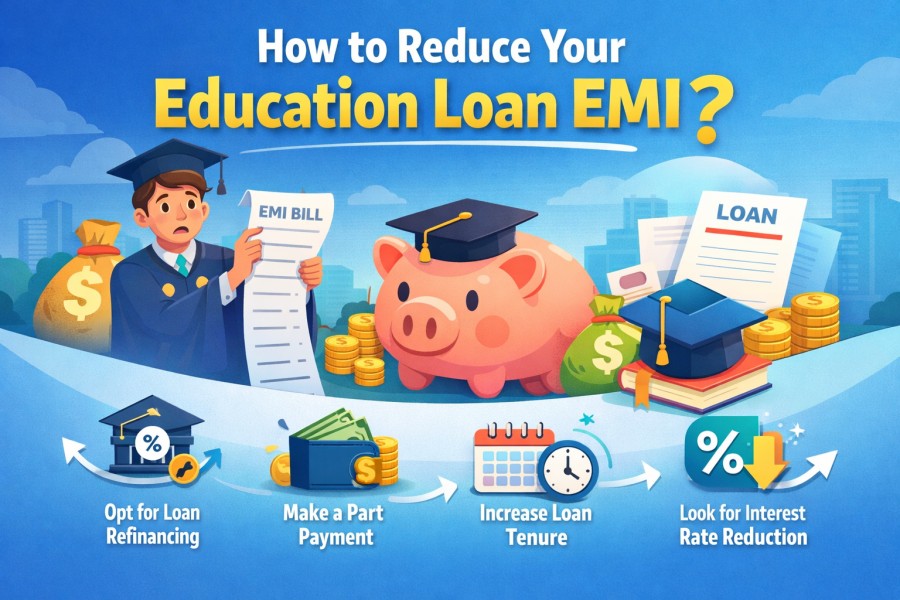
How to Reduce Your Education Loan EMI - Smart strategies
Taking an education loan is a major financial step that helps students achieve their academic and career goals. However, once the repayment phase begins, managing your monthly EMI can feel overwhelming, especially when interest costs start adding up. If you're wondering how to reduce your EMI burden while maintaining financial stability, this guide covers everything you need. From understanding how a student loan works to smart repayment strategies, this blog will help you make informed decisions. How does a study loan work for students? Before exploring ways to reduce EMIs, it’s important to understand how an education loan works. A study loan covers expenses such as tuition fees, accommodation, books, and travel. The repayment begins after the moratorium period of the loan, which includes the course duration plus an additional 6–12 months. During this time: Some lenders allow you to defer payments Interest may still accrue Early payments can reduce your burden later Once repayment begins, your EMI depends on: Loan amount Education loan interest rate Repayment tenure Using an education loan EMI calculator helps you calculate your EMI in advance and plan your finances better. Education Loan Eligibility and Its Impact on Study EMI Your education loan eligibility plays a crucial role in determining your loan terms. Lenders evaluate: Academic performance Course and institution Financial background Co-applicant profile (if applicable) A strong eligibility profile can help you secure: Lower interest rates Better repayment terms Flexible EMI options This directly reduces your overall EMI burden. Related blog: How to Use an Education Loan Calculator to Plan Your Student Loan EMIs Key Factors That Affect Education Loan EMI Understanding these factors helps you manage repayment effectively: Higher loan amount = Higher EMI Higher Study loan interest rate = Increased cost Short tenure = High EMI, low total interest Long tenure = Low EMI, higher total interest This is why using a study loan EMI calculator for loan comparison is essential before choosing a lender. Top 10 Smart Ways to Reduce Your Education Loan EMI Managing your study loan EMI effectively is essential for maintaining financial stability after completing your studies. While loan repayment may seem overwhelming at first, there are several smart and practical strategies you can use to reduce your EMI burden without compromising your long-term financial health. Below are detailed and actionable ways to make your education loan repayment more manageable. 1. Opt for a Longer Repayment Tenure One of the simplest ways to reduce your EMI is by increasing the repayment tenure of your education loan. When you extend the tenure, the total loan amount is spread over a longer period, which lowers your monthly installment. However, it’s important to understand the trade-off. While your EMI becomes more affordable, the total interest paid over time increases. This strategy works best for individuals who want immediate relief in monthly cash flow and are comfortable paying slightly more interest in the long run. 2. Start Paying Interest During the Moratorium Period The moratorium period on an education loan is a phase during which repayment is not mandatory, typically covering your course duration plus an additional 6–12 months. Many borrowers take full advantage of this break and delay all payments. But here’s the catch: interest continues to accumulate during this period. If you start paying at least the interest component early, you can significantly reduce your overall loan burden. This approach helps in: Preventing interest from being added to the principal Reducing EMI after the moratorium ends Lowering total repayment cost Even small payments during this phase can make a big difference later. 3. Choose a Loan with Lower Interest Rates The education loan interest rate directly impacts your EMI amount. Even a slight reduction in the interest rate can lead to noticeable savings over time. Before finalizing your loan, conduct a thorough loan comparison. Evaluate different lenders based on: Interest rates offered Processing fees Repayment flexibility Hidden charges Using a study loan EMI calculator can help you calculate EMIs across different scenarios and choose the most cost-effective option. 4. Make Partial Prepayments Regularly Partial prepayment is one of the most effective ways to reduce your EMI and overall interest burden. Whenever you receive extra income, such as bonuses, freelance earnings, or savings, you can use it to pay off a portion of your loan. Benefits of prepayment include: Reduction in principal amount Lower EMI or shorter tenure Significant savings on interest Most lenders allow prepayments with minimal or no charges, making this a highly recommended strategy. 5. Refinance Your Loan at a Lower Interest Rate If you already have an existing education loan with a high interest rate, refinancing or balance transfer can be a smart move. This involves transferring your loan to another lender offering better terms. Refinancing can help you: Secure a lower interest rate Reduce your EMI Improve repayment flexibility Before opting for this option, ensure you check for processing fees and other loan costs to confirm that the overall benefit outweighs the cost. 6. Choose Collateral-Free Loans Carefully A collateral free education loan is ideal for students who do not have assets to pledge. However, these loans often come with higher interest rates compared to secured loans. If you opt for such loans: Carefully review terms and conditions Compare multiple lenders Check eligibility for a loan without collateral and co applicant Choosing the right lender can still help you manage EMI efficiently, even without collateral. Read also: Is an Education Loan Calculator Useful for Studying Abroad? 7. Take Advantage of Subsidies and Special Schemes In India, several government-backed schemes are designed to reduce the financial burden of students. These may include: Interest subsidies Deferred repayment options Support for economically weaker sections In some cases, these benefits can reduce the effective interest cost, making your loan closer to a student loan without interest for a certain period. Checking your education loan eligibility for such schemes can help you save significantly. 8. Improve Your Credit Profile Your credit score plays a crucial role in determining your loan terms. A strong credit profile can help you secure: Lower interest rates Better repayment options Easier approval process To maintain a good credit score: Pay EMIs on time Avoid defaults Manage other debts responsibly A better credit profile can also help you during refinancing or future borrowing. 9. Use an Education Loan EMI Calculator for Better Planning An education loan calculator is an essential tool for financial planning. It allows you to: EMI calculates accurately Compare different loan options Adjust tenure and interest rates Plan prepayments Regular use of this tool ensures that you stay informed and make smarter repayment decisions. 10. Increase EMI Gradually as Income Grows When you start your career, your income may be limited, making it difficult to pay higher EMIs. However, as your salary increases over time, you can gradually increase your EMI amount. This approach helps: Reduce loan tenure Lower total interest paid Achieve faster loan closure Even a small increase in EMI can significantly reduce your financial burden in the long term. Related blog: How to Choose Between Secured and Unsecured Education Loans? 11. Avoid Missing EMI Payments Missing EMI payments can result in penalties and lower your credit score. This can increase your financial burden in the future. To avoid this: Set up auto-debit instructions Maintain sufficient balance in your account Track due dates regularly Consistent repayment ensures smoother loan management and financial discipline. Smart Education Loan Repayment Tips Explore practical tips for Indian students to repay education loans efficiently to ensure financial stability. Pay EMIs on time Increase EMI when income grows Avoid missed payments Use bonuses for prepayment Track your outstanding balance Final Thoughts Reducing your education loan EMI requires a combination of smart planning, informed decisions, and disciplined repayment. By understanding student loan details, checking your loan eligibility, and using tools like an education loan EMI calculator, you can take full control of your finances. Whether you choose a collateral free education loan, explore refinancing options, or make early payments, every step contributes to reducing your financial burden. The key is to stay proactive and make strategic decisions that align with your long-term goals. Take control of your financial future with Loan Quantum. Compare loans, check your eligibility, and calculate your EMI smartly in minutes. Frequently Asked Questions How does loan comparison help in reducing EMI? Doing a proper loan comparison helps you identify lenders offering the best interest rates and repayment terms. Even a small difference in interest rates can lead to noticeable EMI savings over the loan tenure. How does prepayment help in reducing EMI? Prepayment directly reduces the principal amount of your education loan, which in turn lowers the interest charged. This can either reduce your EMI or shorten your loan tenure, depending on your lender’s terms. Using bonuses, savings, or extra income for lump-sum payments is one of the most effective ways to manage repayment. Do government schemes help in reducing EMI? Yes, certain government schemes provide interest subsidies for eligible borrowers, especially those from economically weaker sections. These subsidies can reduce the effective interest cost and make your EMI more manageable. Is it possible to reduce the education loan EMI without collateral? Yes, even if you have an education loan without collateral, you can still reduce your EMI by refinancing, prepaying, or choosing better repayment strategies. However, such loans may have slightly higher interest rates, so careful planning is essential. Can budgeting help in reducing EMI burden? Yes, creating a proper budget helps you identify unnecessary expenses and allocate more funds toward loan repayment. This allows you to make extra payments or prepayments, which can reduce your EMI or loan tenure.
When Does Education Loan Repayment Start?
Education loans have made higher education more accessible for millions of students in India. Whether you’re pursuing studies in India or abroad, an education loan helps you focus on your academics without immediate financial pressure. However, one of the most important aspects borrowers often overlook is education loan repayment. Understanding when repayment begins, how it works, and how to manage it smartly can save you money and reduce financial stress in the long run. This detailed guide explains everything you need to know about repayment timelines, rules, tenure, and strategies to repay efficiently. What is Education Loan Repayment? In simple terms, loan repayment means paying back the borrowed amount (principal) along with interest over a specified period. In the case of student loans, repayment is structured in a way that gives borrowers enough time to complete their education and find a job. Unlike other types of loans, education loan repayment comes with a built-in flexibility known as the moratorium period, which delays the start of EMI payments. When Does Study Loan Repayment Start? The most common question borrowers ask is: when to repay education loan? In India, repayment does not begin immediately after the loan is disbursed. Instead, lenders provide a loan repayment moratorium, which includes: The entire course duration, plus an additional 6 to 12 months after course completion. When does repayment actually start? Education loan repayment starts after: Completion of your course + 6–12 months, OR When you secure a job (whichever comes earlier) This time is designed to help you transition from student life to professional life without financial pressure. Related blog: How to Calculate Education Loan Interest: Step-by-Step Guide What Happens During the Moratorium Period? Although EMIs are not mandatory during this period, it’s important to understand what happens behind the scenes. Key Points: Interest continues to accumulate on the loan Some lenders charge simple interest, others compound interest You may have the option to pay only interest during this time Paying interest early can significantly reduce your overall loan repayment burden. How Does Education Loan Repayment Work in India? To fully understand how education loan repayment works in India, let’s break it down step by step: 1. Loan Disbursement: The lender pays the tuition fees directly to the educational institution in installments. 2. Moratorium Period: You are not required to pay EMIs, but interest accrues. 3. EMI Calculation: Once repayment begins, your EMI is calculated based on: Loan amount Interest rate Education loan repayment tenure Using an education loan repayment calculator or an education EMI calculation tool can help you estimate your monthly payments accurately. 4. Monthly Repayment: You start paying fixed EMIs every month as per your education loan repayment schedule. Recent blog: Calculate Your Loan Amount Easily Online What is the Education Loan Repayment Duration & Tenure? The education loan repayment period refers to the total time a borrower gets to repay the loan after the moratorium period ends. Choosing the right tenure is crucial, as it directly impacts your monthly EMI and the total interest you pay over time. Typical Repayment Duration in India The repayment tenure varies based on the loan amount: Up to ₹7.5 lakh → 5 to 10 years Above ₹7.5 lakh → 10 to 15 years This duration is also known as the education loan repayment tenure or education loan repayment duration. Choosing the Right Tenure Your loan tenure plays a major role in shaping your financial commitments. Here’s how it affects your repayment: Short Tenure: Higher EMI Lower overall interest Faster loan closure Long Tenure: Lower EMI Higher overall interest Longer repayment period A balanced decision is key, and tools like a loan repayment calculator or student loan repayment calculator can help you decide wisely. Understanding the Education Loan Repayment Schedule An education loan repayment schedule gives a complete breakdown of your payments. It includes: Monthly EMI amount Interest vs principal split Outstanding loan balance Total interest payable This schedule helps you track your progress and plan prepayments effectively. You can generate it using an education loan calculator or any loan repayment calculator online. Education Loan Repayment Rules in India Knowing the education loan repayment rules in India ensures you stay compliant and avoid penalties. Important Rules: Moratorium Benefit: Repayment starts after the grace period ends. Interest Accrual: Interest is charged even during the study abroad period. Co-applicant Responsibility: Parents or guardians (co-borrowers) are equally responsible for repayment. Prepayment Option: Most lenders allow early repayment, sometimes without penalties. Tax Benefits: Interest paid on education loans qualifies for tax deduction under Section 80E. Education Loan Repayment Schemes To make repayment easier, lenders offer flexible education loan repayment schemes. Common Types: 1. Step-Up Repayment EMIs start low and increase gradually Ideal for fresh graduates expecting salary growth 2. Flexible Repayment Lower EMIs in the beginning Helps manage initial career challenges 3. Income-Based Repayment EMI linked to your income Ensures affordability These schemes make student loan repayment more manageable and reduce the risk of default. Related blog: How to Use an Education Loan Calculator to Plan Your Student Loan EMIs How to Repay an Education Loan Smartly If you’re wondering how to repay education loan efficiently, here are proven strategies: 1. Pay Interest During Moratorium: This reduces your principal burden significantly. 2. Use Calculators for Planning Leverage tools like: Education loan repayment calculator Student loan repayment calculator Loan repayment calculator These tools help you plan your EMI and repayment timeline. 3. Make Prepayments Regularly: Even small extra payments can reduce your tenure and interest. 4. Opt for Online Loan Repayment: Automate your EMIs using online loan repayment options to avoid missing payments. 5. Increase EMI with Salary Growth: As your income grows, increase your EMI to close the loan faster. Role of Education Loan Eligibility Your education loan eligibility plays a crucial role in determining repayment terms. Factors Affecting Eligibility: Academic performance Course and university Co-applicant’s income Credit score Better eligibility can result in: Lower interest rates Flexible repayment tenure Easier repayment process Importance of Using an Education Loan Calculator An education loan calculator is an essential financial tool for borrowers. Why You Should Use It: Instantly calculate EMI Compare loan options Understand total interest payable Plan repayment strategy effectively It also helps in accurate education EMI calculation, ensuring you are financially prepared before repayment begins. Might you have missed: How to Choose Between Secured and Unsecured Education Loans? Common Mistakes to Avoid in Loan Repayment Managing your loan repayment efficiently requires avoiding these common mistakes: Ignoring interest during the moratorium Choosing a very long tenure without planning Missing EMI payments Not reviewing your repayment schedule Avoiding prepayments despite having surplus funds Final Thoughts Understanding education loan repayment time and planning ahead is crucial for financial stability. Repayment typically begins after the moratorium period, giving you enough time to complete your education and secure a job. By using tools like an education loan repayment calculator, understanding your education loan repayment tenure, and following smart repayment strategies, you can manage your loan efficiently and reduce your financial burden. Take charge of your financial future with Loan Quantum. Use smart tools like the education loan calculator and repayment planner to reduce your EMI burden and repay faster. Frequently Asked Questions Do I have to pay interest during the moratorium? Yes, interest is usually charged during the moratorium period. However, you can choose to pay the interest during this time to prevent it from being added to your principal amount later. Are there any tax benefits to education loan repayment? Yes, under Section 80E of the Income Tax Act, you can claim a deduction on the interest paid on your education loan for up to 8 years. Is there any government support for education loan repayment? The government offers support schemes such as interest subsidies for students from economically weaker sections and special assistance programs for certain categories of borrowers, making repayment more manageable. Why is planning education loan repayment important? Planning your repayment helps reduce financial stress, lowers the total interest burden, maintains a healthy credit score, and ensures long-term financial stability. Can I reduce my EMI amount during repayment? Yes, EMI can be reduced by extending the loan tenure or restructuring the loan, subject to lender approval. However, this may increase the total interest payable.
Smart Way to Calculate Education Loan EMI Easily
Pursuing higher education is a dream for many students, whether in India or abroad. However, with rising tuition fees and living expenses, funding education often requires financial support. This is where an education loan becomes essential. Today, with the rise of fintech platforms and digital banking, getting a loan has become easier than ever. But before applying, one crucial question every borrower must answer is: how to calculate an education loan EMI? Understanding your EMI in advance helps you plan your finances better, compare lenders, and avoid repayment stress in the future. In this guide, we’ll break down everything from education loan calculator usage to loan eligibility, loan comparison, and loan costs to help you make smarter financial decisions. Understanding Education Loan EMI in Simple Terms When you take an education loan, the lender provides you with a certain amount to cover your tuition fees, accommodation, and other academic expenses. This borrowed amount is not repaid immediately. Instead, repayment begins after a moratorium period, which includes: Your course duration An additional grace period (usually 6–12 months) Once this period ends, you start repaying the loan through EMIs. Each EMI consists of: Principal repayment (portion of the loan amount) Interest payment (cost charged by the lender) Related blog: Understanding EMI: How It's Calculated and Why It Matters How to Calculate Education Loan EMI Easily? Calculating your Education Loan EMI (Equated Monthly Installment) is one of the most important steps before taking a study loan. It not only helps you understand your monthly repayment obligation but also allows you to evaluate your loan eligibility, compare loan options, and avoid future financial stress. Method 1: Use an Education Loan Calculator The smartest, fastest, and most reliable way to calculate your EMI is by using an education loan calculator. Instead of manually solving complex formulas, this tool gives you instant and accurate results within seconds. Whether you’re a student planning your future or a parent evaluating loan options, using a calculator simplifies the entire process and helps you make better financial decisions. How to Use a Study Loan Calculator (Step-by-Step) Using an education loan calculator is extremely simple. You need to follow these steps: Step 1: Enter Loan Details Provide basic inputs such as: Loan Amount (e.g., ₹20,00,000) Interest Rate (e.g., 7%) Loan Tenure (e.g., 8 years) Moratorium Period (if applicable) Step 2: Get Instant Results The calculator will show: Monthly EMI Total interest payable Total repayment amount Why Using an Education Loan Calculator is Important Using a study loan EMI calculator is not just about convenience; it helps you make smarter, well-informed financial decisions before taking a loan. Instant and Accurate Calculation: Get precise EMI results within seconds without doing complex manual calculations. Eliminates errors and gives you reliable numbers for better planning. Easy Loan Comparison: Quickly compare loan options by adjusting interest rates, tenure, and loan amount. Helps you identify the most affordable and suitable loan for your needs. Better Financial Planning: Knowing your EMI in advance allows you to plan your monthly expenses effectively. It ensures your repayments align with your future income and financial goals. Flexibility to Experiment: Test different scenarios, such as changing tenure, loan amount, or loan type. This helps you find the perfect balance between EMI affordability and total cost. Saves Time and Effort: Avoid lengthy calculations and get instant results with just a few inputs. Makes the entire loan planning process quick, simple, and hassle-free. Recent blog: Why Every Student Should Use a Study Loan Calculator Before Borrowing Method 2: Manual EMI Calculation (Formula Method) If you want to understand the logic behind EMI, you can use this formula: EMI = [P × R × (1+R)^N] / [(1+R)^N – 1] Where: P = Loan amount R = Monthly interest rate (Annual ÷ 12 ÷ 100) N = Number of monthly installments This method is accurate but slightly complex, which is why calculators are preferred. Example: EMI on ₹25 Lakh Education Loan Suppose you borrow ₹25 lakh at an annual interest rate of 9% for a repayment tenure of 7 years. Estimated repayment: Monthly EMI: Approx. ₹40,338 Total Interest: Approx. ₹8,84,000 Total Repayment: Approx. ₹33,84,000 This example highlights how a larger loan amount increases both your monthly EMI and the total interest payable over time, making careful repayment planning even more important before choosing your education loan. Related blog: What is the Education Loan Eligibility & How to Apply? Why Manual EMI Calculation is Less Preferred Although the EMI formula provides accurate results, relying on manual calculation is not always practical, especially when planning an education loan. Here are the key reasons why most borrowers prefer using an education loan calculator instead: Complex and Time-Consuming: Manual EMI calculation involves a complex formula with multiple variables, such as principal, interest rate, and tenure. For most students and parents, repeatedly solving this across different scenarios can be confusing and time-consuming. Higher Chances of Errors: Even a small calculation error s, such as an incorrect interest rate conversion or an incorrect tenure input, can lead to inaccurate EMI results. These errors can mislead your financial planning and lead you to choose an unsuitable loan option. Not Practical for Loan Comparison: When comparing different lenders, you need to calculate EMI multiple times with varying interest rates and tenures. Doing this manually is inefficient and makes it difficult to identify the best loan option quickly. Difficult to Adjust Variables Quickly: Manual calculation does not allow for instant changes to inputs such as loan amount, tenure, or interest rate. Each change requires recalculating from scratch, which slows and complicates the process. No Insight into Total Loan Costs: The formula mainly gives you the EMI amount, but doesn’t easily show the total interest payable or total repayment. This makes it harder to understand the overall loan costs and long-term financial impact fully. Not Beginner-Friendly: Most borrowers, especially students, may not be comfortable with financial formulas and calculations. This makes manual EMI calculation less accessible and increases dependency on external help. Related blog: How to Use an Education Loan Calculator to Plan Your Student Loan EMIs Conclusion Calculating your Education Loan EMI is a crucial step in planning your higher education finances. It not only helps you understand your monthly repayment commitment but also gives clarity on your overall loan costs, repayment timeline, and affordability. By using an education loan calculator, you can quickly evaluate different scenarios, improve your loan eligibility planning, and choose the most suitable loan option without confusion. While manual calculations help you understand the concept, they are not practical for real-life decision-making. A smart borrower always relies on tools that offer accuracy, speed, and flexibility. Whether you are opting for a secured or unsecured study loan, proper EMI planning ensures that your education journey remains financially stress-free. Calculate your education loan EMI instantly with Loan Quantum and make smarter financial decisions today! Frequently Asked Questions What factors affect education loan EMI? EMI depends on the loan amount, interest rate, tenure, and moratorium period. Even small changes in these factors can significantly affect your EMI. Does the moratorium period affect EMI? Yes, interest accrues during the moratorium period, which can increase your EMI if not paid early. Can I reduce my education loan EMI? Yes, you can reduce EMI by choosing a longer tenure, getting a lower interest rate, or opting for a secured education loan. Is it better to choose a longer tenure to get a lower EMI? A longer tenure reduces EMI while increasing total interest. It is critical to strike a balance between affordability and total loan costs. Are there any hidden charges in education loans? Yes, some loans may include processing fees, insurance charges, or late payment penalties. Always check total loan costs.
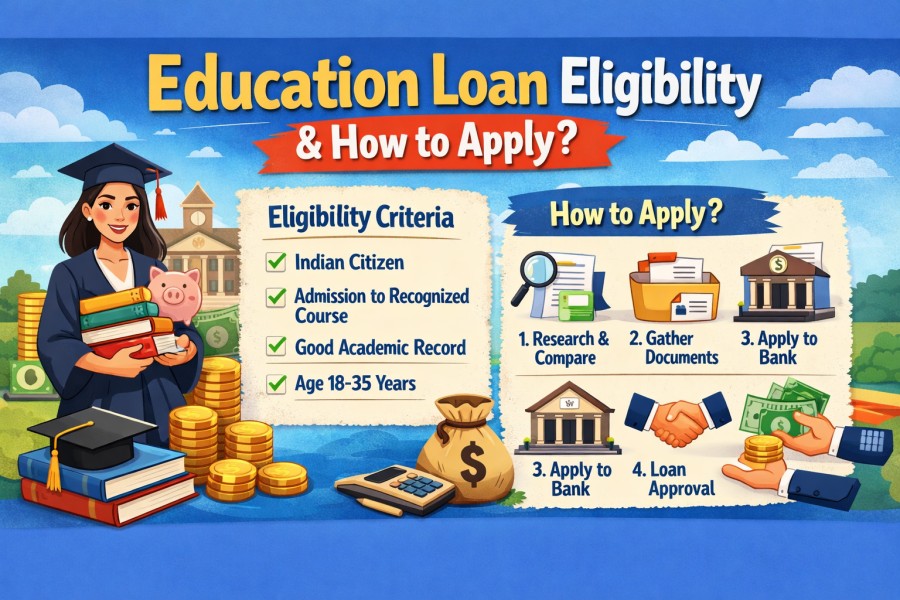
What is the Education Loan Eligibility & How to Apply?
Higher education is one of the most important investments in your future, but rising tuition fees and living costs can make it financially challenging. This is where an education loan plays a crucial role, helping students fund their studies in India or abroad without immediate financial stress. However, before applying, it’s essential to understand the education loan eligibility criteria, required documentation, and the correct application process. From choosing between a secured and an unsecured education loan to estimating your education loan EMI using an education loan calculator, proper planning can make the entire process smooth and hassle-free. In this guide, we’ll discuss everything you need to know about eligibility requirements, study loan documents, and a step-by-step process for applying for a loan for abroad study or domestic education. What is an Education Loan? An education loan, also known as a student loan, is a financial solution that helps students cover the cost of higher education. It supports expenses such as tuition fees, accommodation, travel (especially for overseas study), books, and other academic needs. Instead of paying the entire cost upfront, students can rely on an education loan and repay it in easy EMIs after completing their course. The repayment typically begins after a grace period, giving students time to secure a job. Many lenders offer both secured (collateralized) and unsecured education loans, depending on the loan amount and applicant profile. Before applying, students can use a study loan calculator to estimate their education loan EMI and plan repayment efficiently. In simple terms, an education loan makes quality education accessible by reducing the immediate financial burden while offering flexible repayment options. Related blog: Is an Education Loan Calculator Useful for Studying Abroad? What are the Education Loan Eligibility Criteria in 2026? Understanding the education loan eligibility criteria in 2026 is the first step toward securing funding for your higher education. Lenders evaluate multiple factors, such as your academic background, admission status, and your co-applicant's financial stability, before approving a loan. Whether you're applying for a domestic course or a loan for abroad study, meeting these criteria improves your chances of approval and helps you get better education loan interest rates and flexible student loan EMIs. Before applying, check if you meet the basic education loan eligibility conditions: 1. Nationality: The applicant must be an Indian citizen to apply for an education loan from Indian banks or financial institutions. 2. Age Limit: Applicants are generally required to be between 16 and 35 years at the time of application. 3. Academic Qualification: A strong academic record in 10th, 12th, and graduation is preferred, as it increases the chances of loan approval. 4. Admission Status: You must have secured a confirmed admission to a recognized university or college, either in India or abroad, or have a loan for overseas study. 5. Course Eligibility: Loans are typically approved for graduation, post-graduation, and professional courses such as Engineering, Medical, MBA, and other technical programs. 6. Co-applicant Requirement: A co-borrower (parent, guardian, or spouse) is mandatory. The co-applicant should have a stable income and a good credit score to support the application. 7. Collateral Requirement Up to ₹7.5 lakh → Usually no collateral required Above ₹7.5 lakh → Collateral is required, making it a secured education loan What are the documents required for a study loan? To apply for an education loan, you must submit a set of important study loan documents for verification. These documents help lenders assess your academic background, admission status, and your co-applicant's financial capability. Additionally, doing a proper loan comparison before applying can help you choose the best lender with lower interest rates and better repayment options. 1. Student Documents (Applicant) These documents confirm your identity and academic eligibility: Application Form: Duly filled and signed application form with passport-size photographs KYC Documents: PAN Card (mandatory), Aadhaar Card, Passport, Voter ID, or Driving License Academic Documents: Mark sheets and passing certificates of 10th, 12th, and graduation (if applicable) Proof of Admission: Admission/Offer Letter from the university, along with the detailed fee structure Entrance Exam Scores (if required): GRE, GMAT, TOEFL, IELTS, etc. (mainly for abroad studies) Course Expense Details: Breakdown of tuition fees, accommodation, and other living expenses 2. Co-applicant / Guarantor Documents A co-applicant (parent/guardian/spouse) is mandatory for most education loans: KYC Documents: PAN Card and address proof (Aadhaar, Passport, utility bill, etc.). Income Proof (Salaried): Last 3 months’ salary slips, Form 16, and 6 months’ bank statements. Income Proof (Self-Employed): Last 2 years’ ITR, 6 months’ bank statements, and business proof. 3. Additional Documents (If Applicable) Passport: Mandatory for students applying for a loan for overseas study. Collateral Documents: Required for a secured education loan (property papers, FD receipts, etc.). Scholarship Letter: Proof of any scholarship or financial assistance received. Final Tip Always ensure your study loan documents are complete and accurate before submission. Proper documentation not only speeds up approval but also improves your chances of getting better education loan interest rates and manageable student loan EMIs. Related blog: How to Calculate Education Loan Interest: Step-by-Step Guide How to Apply for an Education Loan (Step-by-Step) Applying for an education loan in 2026 is simple and largely digital, but following the right process is crucial for quick approval. From checking education loan eligibility to final disbursement, each step plays an important role. Doing proper loan comparison, preparing study loan documents, and understanding your education loan EMI in advance can significantly improve your chances of approval. Step 1: Check Eligibility & Course Details Start by verifying your education loan eligibility: Must be an Indian citizen (usually 16–35 years) Confirmed admission to a recognized college/university The course should be graduation, post-graduation, or professional Co-applicant (parent/guardian) required This step ensures you meet basic criteria before applying. Step 2: Compare Lenders (Loan Comparison) Do a detailed loan comparison between: Public sector banks (SBI, etc.) Private banks (HDFC, ICICI) NBFCs Compare key factors: Education loan interest rates (fixed vs floating) Processing fees Loan amount limits Repayment tenure & flexibility Choosing the right lender can reduce your total repayment burden. Step 3: Calculate EMI in Advance Use a study loan calculator to estimate your: Monthly student loan EMIs Total interest payable This helps you plan repayment and avoid financial stress later. Step 4: Prepare All Required Documents Keep all study loan documents ready: KYC documents (PAN, Aadhaar, Passport) Academic records & admission letter Co-applicant income proof Collateral documents (for secured education loan) Complete documentation speeds up approval. Step 5: Fill the Application Form You can apply through: Bank/NBFC official website (online mode) Visiting the nearest branch (offline mode) Government Vidyalakshmi Portal Fill in accurate details and upload all documents carefully. Step 6: Application Review & Verification The lender evaluates your application based on: Academic performance Course & university credibility Co-applicant’s income and credit score Collateral (if applicable) Some lenders may also conduct a verification call or personal discussion. Step 7: Loan Sanction & Offer Letter Once approved: You receive a sanction letter It includes the loan amount, the education loan interest, tenure, and terms Review all terms carefully before accepting. Step 8: Loan Agreement & Disbursement Sign the loan agreement Submit any pending documents Loan amount is disbursed: Directly to the institution (most common) Or in installments based on the fee schedule Important Things to Remember Secured vs Unsecured Loan: Secured loans have lower interest but require collateral; unsecured loans are faster but costlier Co-applicant is Mandatory: A financially stable co-borrower improves approval chances Moratorium Period: Repayment of education loan EMI usually starts after course completion + 6–12 months Final Tip Always do proper loan comparison, calculate your student loan EMIs, and keep your study loan documents ready before applying. A well-planned application increases approval chances and ensures you get the best deal on your education loan. Conclusion An education loan is one of the most effective ways to finance your higher education without putting immediate pressure on your finances. Whether you are planning to study in India or applying for a loan for abroad study, understanding the complete process from education loan eligibility to documentation and application is essential for a smooth experience. By comparing loans, checking your eligibility in advance, and using an education loan calculator to estimate your EMI, you can make informed financial decisions. Choosing between a secured education loan and an unsecured option, along with preparing the right study loan documents, will significantly improve your chances of approval. With the right planning and approach, you can not only secure funding easily but also manage your student loan EMIs efficiently, making your education journey stress-free and financially smart. Compare the best lenders, calculate your education loan EMI, and get expert guidance with Loan Quantum, your smart partner for hassle-free student loans. Frequently Asked Questions Is collateral required for an education loan? No, Collateral is not required for smaller loans (usually up to ₹7.5 lakh). For higher amounts, lenders may require security, making the loan a secured one. Is a co-applicant mandatory for a student loan? Yes, most lenders require a co-applicant (parent/guardian/spouse) with a stable income and good credit score. How to choose the best education loan? Do a proper loan comparison by checking interest rates, processing fees, repayment terms, and lender credibility before applying. Does education loan interest accrue during the study period? Yes, education loan interest starts accruing from the time of disbursement. However, repayment begins after the moratorium period. How long does it take to get an education loan approved? Approval typically takes 7–15 working days, depending on the lender, loan type, and completeness of your study loan documents.

How to Choose Between Secured and Unsecured Education Loans?
Higher education is one of the most significant expenditures you'll ever make. From tuition fees to accommodation, travel, and living expenses, the costs quickly add up. This is where an education loan becomes a crucial financial tool for students and families. However, one of the biggest decisions borrowers' faces is choosing between a secured education loan and an unsecured education loan. Making the wrong choice can lead to higher interest costs, financial stress, or even risk to your assets. That’s why it’s essential to understand both options in depth and use tools like an education loan calculator to make a well-informed decision. In this guide, we’ll discuss everything you need to know, from differences and benefits to practical tips, so you can choose the right loan and manage your study loan EMI effectively. What is an Education Loan? An education loan is designed to help students finance their academic journey. It typically covers: Tuition fees Hostel and accommodation costs Travel expenses (for international education) Books, laptops, and study materials Miscellaneous academic expenses Most lenders also offer a moratorium period, which means you start repaying your loan after completing your course (plus 6–12 months). What is a Secured Education Loan? A secured education loan requires you to pledge an asset as collateral, such as property, fixed deposits, or insurance policies. Key Benefits: 1. Lower Interest Rates: Since the loan is backed by collateral, lenders offer lower interest rates compared to unsecured loans. 2. Higher Loan Amounts: You can secure large amounts, often ₹50 lakh to ₹1 crore or more, making it ideal for studying abroad. 3. Longer Repayment Tenure: Repayment periods can extend up to 15 years, reducing your study loan EMI burden. Drawbacks of Secured Study Loans Risk of losing the pledged asset in case of default Longer processing and approval time Documentation can be complex What is an Unsecured Education Loan? Unsecured study loans do not require collateral. Instead, approval depends on: Academic performance Co-applicant income Credit score (CIBIL) Key Benefits: 1. No Collateral Required: You don’t need to risk property or assets. 2. Faster Approval: Processing is quicker since there is no collateral verification. 3. Simpler Documentation: Less paperwork compared to secured loans. Drawbacks of Unsecured Study Loans Higher interest rates Lower loan limits Stricter eligibility criteria Comparison: Secured vs Unsecured Education Loan Factors Secured Education Loan Unsecured Education Loan Collateral Required Not required Interest Rate Lower Higher Loan Amount High (₹1 Cr+) Moderate Processing Time Longer Faster Risk High (asset risk) Low EMI Lower Higher Secured and Unsecured student Loans: How to Choose? Choosing the right option depends on your financial situation, the cost of the course, and your risk of tolerance. 1. Evaluate Your Loan Requirement If your course costs ₹50 lakh+ → secured loan is better If your requirement is smaller → unsecured loan works Tip: Use a study loan EMI calculator to estimate your required EMI before choosing. 2. Check Availability of Collateral Before choosing an education loan, check whether you have assets such as property or fixed deposits to pledge. If yes, a secured loan offers lower interest on education loans; if not, an unsecured loan is the better option. 3. Compare Interest Rates Using an Education Loan Calculator The interest rate directly impacts your study loan EMI. Example: ₹30 lakh loan 10% vs 13% interest The EMI difference can be thousands per month Using a loan calculator helps you: Compare loan options Estimate total repayment Avoid over-borrowing 4. Consider Your Repayment Capacity Before finalizing your loan: Calculate the expected salary after graduation Estimate EMI using a study loan calculator Ensure EMI < 30–40% of expected income 5. Understand Risk vs Convenience Factors Secured Loan Unsecured Loan Risk High (asset loss possible) Low Convenience Moderate High If you default on a secured loan, the lender can take your collateral. 6. Look at the Approval Timeline Need urgent funds? → Unsecured loan Planning early? → A secured loan is better When Should You Choose a Secured Study Loan? A secured study loan makes sense when your financial needs are higher, and you’re looking for long-term affordability. You should consider this option if: You require a large loan amount, especially if your total education cost is ₹50 lakh or more. You or your family have assets like property, fixed deposits, or insurance policies that can be pledged as collateral. You want lower education loan interest, which helps reduce the overall price of borrowing. You prefer smaller and more manageable student loan EMIs after completing your studies. You are planning for a longer repayment period and want flexibility in tenure. You want to improve your chances of approval with stronger loan eligibility. In simple terms, a secured loan is a good choice if you are focused on saving money in the long run and are comfortable pledging an asset. When Should You Choose an Unsecured Education Loan? An unsecured education loan is a better option when convenience and speed are your priorities. You should go for this type of loan if: You don’t have a collateral or prefer not to risk your assets. You need quick approval because of tight admission deadlines. Your loan requirement is moderate and doesn’t exceed ₹40–50 lakh. You have a strong academic background and a financially stable co-applicant. You meet the lender’s loan eligibility criteria, including a good credit score. You value faster processing and simpler documentation, even if it means paying slightly higher education loan interest rates. In short, an unsecured loan works best when you need flexibility and quick access to funds without involving collateral. Role of the Study Loan Calculator & Benefits Before applying, always use a study loan calculator for informed decisions. Benefits: Calculate the monthly student loan EMI Compare secured vs unsecured loans Understand total interest payable Plan repayment strategy Tax Savings on Education Loans One of the most underrated advantages of taking an education loan is the opportunity to benefit from significant tax savings. While most borrowers focus only on interest rates and loan EMIs, understanding tax benefits can help you reduce the overall cost of borrowing. Tax Benefits Under Section 80E Under Section 80E of the Income Tax Act, borrowers can claim deductions on the interest paid on an education loan. This applies whether the loan is taken for higher education in India or abroad. Key Features of Section 80E: 1. Deduction on Interest Paid Only: You can claim a deduction on the interest portion of your EMI, not the principal amount. This is important when calculating your repayment using a loan calculator, as it helps you understand the tax-adjusted cost. 2. No Upper Limit on Deduction: Unlike other sections, there is no maximum cap on the amount you can claim as a deduction. Whether your interest outgo is ₹50,000 or ₹5 lakh annually, the entire interest component is eligible. 3. Benefit Available for 8 Years: The deduction can be claimed for a maximum of 8 consecutive years starting from the year you begin repayment, or until the interest is fully repaid, whichever comes first. Key Factors to Consider Before Choosing 1. Total Cost of Education: If your total study cost exceeds ₹40–50 lakh, a secured education loan is usually more suitable due to higher limits and lower education loan interest. For smaller amounts, an unsecured option can be sufficient and easier to access. 2. Availability of Collateral: If your family has assets like property or fixed deposits, a secured loan can reduce your overall repayment burden and improve loan eligibility. If not, an unsecured loan is the more practical and accessible choice. 3. Repayment Capacity: You should evaluate your future income and ensure you can comfortably manage your student loan EMIs after graduation. Using a study loan calculator or an education loan calculator helps you plan repayment realistically. 4. Loan Approval Timeline: If you need funds urgently, an unsecured loan is better due to faster processing and minimal documentation. If you have time to plan, a secured loan can offer better long-term benefits with lower interest rates. 5. Risk Tolerance: A secured loan involves pledging an asset, which carries the risk of losing it in case of default. If you want to avoid this risk, an unsecured loan offers greater peace of mind, even with higher interest rates. Conclusion Choosing between a secured and an unsecured education loan is a decision that goes beyond eligibility; it directly impacts your financial future. A secured loan offers clear advantages, including lower interest rates on education loans, higher loan amounts, and more affordable student loan EMIs, making it ideal for students planning an expensive education, especially abroad. However, it entails pledging an asset, which adds a level of risk. On the other hand, an unsecured loan offers convenience, faster approval, and no collateral requirement. While the loan interest may be higher, it offers flexibility and peace of mind for those who do not want to risk their assets. The right choice ultimately depends on your financial situation, loan eligibility, repayment capacity, and risk tolerance. Before making a decision, it is always wise to use a study loan calculator to compare options and plan your student loan EMIs effectively. Make smarter borrowing decisions with Loan Quantum. Compare, calculate, and choose the right education loan today. Frequently Asked Questions Which loan has a lower interest rate for an education loan? Secured education loans generally have lower interest rates because they are backed by collateral, reducing the lender’s risk. What factors affect loan eligibility for education loans? Loan eligibility depends on factors such as academic performance, chosen course and university, co-applicant income, and credit score. For secured loans, the value of collateral also plays an important role. Do secured education loans take longer to process? Yes, secured loans usually take more time because lenders need to verify and evaluate the collateral. Unsecured loans are faster since they rely mainly on your academic and financial background. Can I prepay my education loan early? Yes, you can. Most lenders allow prepayment of education loans either partially or fully. Prepaying your loan can reduce your overall education loan interest and lower your future student loan EMIs. Is a co-applicant mandatory for education loans? Yes, most lenders require a co-applicant (usually a parent or guardian). Their income and credit score play a key role in determining your loan eligibility, especially for unsecured loans.

Is an Education Loan Calculator Useful for Studying Abroad?
Studying abroad is a dream for many students, offering global exposure, better career opportunities, and access to world-class education. However, this dream often comes with a significant financial commitment. From tuition fees to accommodation, travel, insurance, and daily expenses, the total cost can be overwhelming. Before applying for a loan, one of the smartest steps you can take is using an education loan calculator. But how useful is it, especially for international education? Can it really help you plan your finances effectively? Let’s explore in detail how a study loan EMI calculator can simplify your study abroad journey and help you make well-informed financial decisions. Understanding an Education Loan Calculator An education loan calculator is an online financial tool that helps you estimate your monthly repayment amount, also known as EMI (Equated Monthly Instalment). It uses three key inputs: Loan amount Loan tenure Education loan interest rate Based on these inputs, the calculator gives you a clear idea of your education loan EMI, making it easier to plan your finances. Whether referred to as a student loan EMI calculator, the purpose remains the same to help you understand your repayment obligations before committing to a loan. Why Is It Important to Use an Education Loan Calculator? 1. High Cost of International Education Studying abroad is significantly more expensive than studying in your home country. Tuition fees alone can range from lakhs to crores, depending on the country and course. When you add living expenses, travel, and other costs, the total loan amount becomes substantial. Using a study loan EMI calculator helps you estimate how much you will need to repay monthly once your course is completed. Also, you can check loan eligibility. This clarity is essential for long-term financial planning. 2. Better Financial Planning It allows you to plan your finances. Instead of guessing your repayment amount, you get a structured estimate of your monthly commitments. This helps you: Plan your budget after graduation Align your expected salary with EMI payments Avoid financial stress in the future By understanding your education loan EMI, you can make informed decisions about how much loan to take. 3. Understanding the Impact of Interest Rates Interest rates play a crucial role in determining your total repayment amount. Even a slight difference in the student loan interest rates can significantly impact your EMI and overall loan cost. A study loan interest rate calculator helps you: Compare loans Understand how interest affects your loan Choose the most cost-effective option It also gives insight into how study loan interest accumulates over time, helping you plan better repayment strategies. 4. Compare Multiple Loan Options Easily There are many banks and financial institutions offering student loans for studying abroad. Each lender has different terms, including varying student loan interest rates, processing fees, and repayment options. With a student loan EMI calculator, you can: Compare loan offers from multiple lenders Identify the most affordable EMI Choose the best loan based on your financial capacity This comparison ensures that you don’t end up paying more than necessary. 5. Helps Avoid Over-Borrowing One common mistake students make is borrowing more than they actually need. Without proper planning, this can lead to high EMIs and a financial burden later. A loan calculator helps you: Determine a comfortable EMI range Adjust the loan amount accordingly Borrow only what is necessary By doing so, you reduce your dependency on large loans and manage repayment more efficiently. 6. Plan Loan Tenure Smartly Loan tenure directly affects your EMI and total interest paid. A longer tenure reduces your monthly EMI but increases the total interest, while a shorter tenure increases EMI but reduces overall cost. Using an education loan EMI calculator, you can: Experiment with different tenures Find a balance between affordability and cost Optimise your repayment strategy This flexibility is especially important when planning for international education expenses. 7. Prepayment and Savings Strategy Many students aim to repay their loans early once they secure a job. A good education loan interest rate calculator helps you understand how prepayments can reduce your interest burden. You can: Calculate savings on early repayment Plan lump sum payments Reduce overall education loan interest This helps you become debt-free faster and save money in the long run. Related blog: How to Use an Education Loan Calculator to Plan Your Student Loan EMIs How to Use an Education Loan Calculator Effectively Using an education loan calculator is simple, but to get the most accurate results, you should follow these steps: Step 1: Enter Loan Amount: Include tuition fees, living expenses, and other costs. Step 2: Add Interest Rate: Use the expected education loan interest rate offered by lenders. Step 3: Select Loan Tenure: Choose a repayment period based on your financial comfort. Step 4: Calculate EMI: The calculator will instantly show your education loan EMI. Step 5: Compare Scenarios: Try different combinations of loan amount, tenure, and student loan interest rates to find the best option. Read also: Why Every Student Should Use a Study Loan Calculator Before Borrowing Common Mistakes to Avoid While Applying for an Education Loan While using an education loan EMI calculator, students often make these mistakes: 1. Ignoring Interest Variations: Interest rates may change over time, especially for floating rate loans. Always consider possible fluctuations in student loan interest. 2. Choosing Unrealistic Tenure: Selecting a very long tenure may reduce EMI but increase total repayment significantly. 3. Not Considering Currency Fluctuations: For international education, currency exchange rates can affect your expenses and repayment. 4. Overestimating Future Income: Be realistic about your expected salary after graduation to avoid financial stress. Why Every Student Should Use It Before Applying Before applying for student loans, using an education loan calculator should be your first step. It gives you a clear financial roadmap and prevents costly mistakes. It helps you: Understand your repayment capacity Compare loan options Reduce financial risks Make confident borrowing decisions In today’s digital world, not using a student loan EMI calculator before taking a loan is like making a financial decision unthinkingly. Recent blog: Top 5 Tips to Improve Your Loan Eligibility Final Thoughts So, is an education loan calculator useful for studying abroad? The answer is a definite yes. From estimating your education loan EMI to understanding student loan interest rates, comparing lenders, and planning repayment strategies, this tool plays a vital role in your financial journey. Studying abroad is a life-changing decision, and managing finances wisely is just as important as choosing the right university. By using tools like an education loan interest rate calculator, you can ensure that your dream of international education does not turn into a financial burden. Don’t guess your EMI—calculate it instantly with Loan Quantum! Frequently Asked Questions Can I use an education loan calculator for abroad studies? Yes, an abroad education loan EMI calculator is specifically designed to help students estimate loan repayment for international education. Can an education loan interest rate calculator help reduce loan costs? Yes, an education loan interest rate calculator helps you compare different interest rates and choose a loan with a lower interest rate, ultimately reducing your total repayment. Is it safe to rely on an online education loan calculator? Yes, most online education loan calculators provide accurate estimates. However, the final EMI may vary slightly based on lender policies and additional charges. Do all banks offer the same education loan interest rate? No, student loan interest rates vary across banks and financial institutions, which is why using an education loan interest rate calculator is important. How does loan tenure impact student loan interest? Longer tenure reduces EMI but increases total student loan interest, while shorter tenure increases EMI but reduces overall cost.
What Happens When You Miss a Personal Loan EMI?
Life doesn’t always go as planned. A sudden expense, a delayed salary, or an emergency, and before you know it, you’ve missed your personal loan EMI. Whether you are a first-time borrower, a salaried employee, or someone using a personal loan calculator for planning, understanding the impact of missed EMIs is crucial for maintaining financial health. Let’s break it down in a simple, practical way so you know exactly what happens and how to stay in control. What is Personal Loan EMI in simple terms? A personal loan's EMI is the exact amount you repay each month. It includes: A portion of your loan principal The interest charged by the lender Your EMI is calculated based on: Loan amount Interest rate Tenure This is where a personal loan calculator becomes extremely useful. It helps you estimate your EMI in advance and choose a repayment plan that actually fits your monthly budget, especially important for salaried employees managing fixed income. Why Proper EMI Planning Matters? Taking a personal loan is easy today, but managing it responsibly is what truly matters. Many borrowers focus only on getting quick approval and overlook whether the EMI actually fits their monthly budget. This is where proper EMI planning becomes essential. When you calculate your personal loan EMI in advance using a personal loan calculator, you get a clear picture of how much you’ll need to pay every month. This helps you avoid over-borrowing and ensures your loan remains affordable throughout the tenure. For salaried employees, this is especially important because income is fixed and expenses are often predictable. If your EMI takes up too much of your salary, even a small financial disruption, like a medical emergency or delayed salary, can lead to missed payments. Proper planning also improves your chances of meeting loan eligibility criteria in the future. Lenders prefer borrowers who show financial discipline and manage their EMIs smoothly. On the other hand, poor planning can lead to: Higher financial stress Increased dependence on credit Difficulty in managing other expenses or savings Another important factor is choosing the right option among different loan types. For example, a flexi personal loan may offer flexibility in repayment, but it still requires careful planning to avoid unnecessary interest costs. In simple terms, EMI planning is not just about calculation; it’s about ensuring your loan fits comfortably into your life without affecting your financial stability or long-term goals like investments and tax savings. Related blog: Top Reasons Why Your Personal Loan Gets Rejected What Really Happens When You Miss an EMI? Missing an EMI isn’t just about one payment; it triggers a chain reaction. Here’s what typically happens: 1. Immediate Penalty Charges The moment your EMI is missed: The bank adds a late payment fee Penal interest starts accumulating on the overdue amount Even if the amount seems small, these charges build up quickly if not cleared. Think of it like a snowball, small at first, but it grows faster than expected. 2. EMI Bounce Charges (If Auto-Debit Fails) If your EMI is set on auto-debit and your account has insufficient funds: The transaction fails You are charged a bounce fee This is very common among salaried employees, especially when expenses and salary dates don’t align properly. 3. Your Credit Score Takes a Hit This is where the real impact begins. Your repayment history plays a major role in your credit score. Missing even one EMI: Sends a negative signal to credit bureaus Lowers your score If you already have a low CIBIL score, this can make things worse and limit your financial options. 4. Future Loan Approvals Become Difficult Lenders look at your past behaviour before approving new loans. A missed EMI can: Reduce your chances of getting approved Affect your loan eligibility criteria Lead to higher interest rates Even if you were eligible for a pre-approved loan, that offer might disappear after a missed payment. 5. Increased Financial Burden Here’s something many borrowers don’t realise: Missing an EMI doesn’t pause your loan; it makes it more expensive. Interest keeps adding up Penalties increase your total cost Your repayment period may feel heavier Over time, this affects your ability to manage other financial goals like savings or tax savings planning. 6. Constant Follow-Ups from Lenders If the payment is not cleared quickly: You’ll start receiving reminder calls, SMS, and emails Lenders may follow up regularly While this is standard procedure, it can become stressful if delays continue. 7. Serious Consequences After 90 Days If you miss EMIs for a longer period (usually 90 days): Your loan may be categorised as a default Your credit profile is severely impacted At this stage, rebuilding your financial reputation becomes much harder. Related blog: Pay Off Your Personal Loan Early Foreclosure Charges, Steps & Benefits How to Avoid Missing Your EMI? Missing an EMI usually doesn’t happen intentionally; it’s often the result of poor planning or timing issues. The good news is that with a few smart habits, you can easily avoid it. Start by using a personal loan calculator before taking a loan. This allows you to choose an EMI amount that aligns with your income and expenses. Avoid the temptation to borrow the maximum amount you’re eligible for; just because you qualify doesn’t mean you should take it. Maintaining a buffer in your bank account is another simple but powerful strategy. Always keep enough balance to cover at least one EMI, especially if you rely on auto-debit. This is crucial for salaried employees, where timing mismatches between salary credits and EMI dates are common. Automation also helps. Set up auto-debit instructions and add calendar reminders as a backup. Even though payments are automatic, reminders ensure you’re always aware of upcoming deductions. Choosing the right tenure plays a big role, too. A longer tenure reduces your EMI burden but increases overall interest, while a shorter tenure does the opposite. Finding the right balance is key to avoiding repayment pressure. You should also understand the terms of your loan, especially if you’re using options like a pre-approved loan or a flexi personal loan. These may offer convenience and flexibility, but they still require disciplined repayment. Finally, always keep track of your financial health. If you already have a low CIBIL score, missing EMIs will worsen your situation and reduce future borrowing opportunities. Recent blog: How to Decide the Best Tenure for Your Instant Personal Loan What Should You Do If You Have Already Missed an EMI? If you’ve missed an EMI, the worst thing you can do is ignore it. But the good news is, if you act quickly, you can limit the damage and regain control of your finances. The first step is to pay the missed personal loan EMI as soon as possible. The longer you delay, the more penalties and interest will accumulate. Even a short delay can increase your total repayment cost and put unnecessary pressure on your finances. Next, inform your lender. Many borrowers hesitate to do this, but early communication can actually work in your favour. Lenders may offer temporary solutions like adjusting your EMI date or giving short-term relief, especially if you have a good repayment history. You should also review your finances immediately. Try to understand why the EMI was missed. Was it due to poor planning, unexpected expenses, or insufficient funds? Once you identify the cause, you can take corrective steps to avoid repeating the mistake. This is also a good time to do a quick loan comparison. Evaluate whether your current loan terms, interest rate, tenure, or EMI amount are still suitable for your financial situation. Sometimes, switching to better terms or refinancing can ease your repayment burden. If you’re facing genuine financial stress, speak to your lender about restructuring options. This could include extending your tenure or reducing your EMI amount to make repayment more manageable. Some borrowers consider short-term solutions like payday loans to cover missed EMIs. While these may offer quick cash, they often come with very high interest rates and should be used cautiously. Relying on such options repeatedly can worsen your financial situation instead of solving it. It’s also important to check your credit report after a missed EMI. This helps you understand how much your score has been impacted, especially if you already have a low CIBIL score or are planning to apply for loans in the future. Most importantly, avoid repeating the mistake. One missed EMI can be managed, but repeated delays can seriously affect your loan eligibility criteria, reduce your chances of getting a pre-approved loan, and limit access to better loan types. Might you have missed: NBFC vs Bank Personal Loan: Which Is Better for Quick Approval? Conclusion Missing a personal loan EMI may seem like a small mistake at first, but it can quickly turn into a bigger financial issue if not handled properly. From penalty charges and credit score impact to reduced loan eligibility and higher borrowing costs, the consequences can affect your overall financial stability. The key is to stay proactive. With the help of a personal loan calculator, proper planning, and disciplined repayment, you can avoid most EMI-related issues. And even if you do miss a payment, acting quickly by paying dues, communicating with your lender, and reviewing your finances can significantly reduce the damage. Whether you’re a salaried employee, a first-time borrower, or exploring different loan options like pre-approved loans, responsible repayment should always be your priority. Smart borrowing today ensures better financial opportunities tomorrow. Don’t let EMIs surprise you. Calculate, compare, and choose the best loan with Loan Quantum. Frequently Asked Questions How many days can I delay my EMI without penalty? Most lenders charge penalties immediately after the due date is missed. There is usually no grace period, so it’s best to pay as soon as possible. What should I do immediately after missing an EMI? Pay the overdue amount as soon as possible, inform your lender, and ensure you don’t miss the next payment to avoid further penalties. Are payday loans a good option to pay missed EMIs? Payday loans provide quick cash but come with very high interest rates. They should only be used as a last resort, as they can increase your financial burden. Does missing EMI increase total loan cost? Yes, due to penalties and additional interest, your overall repayment amount increases if you miss EMIs. What is the difference between EMI delay and EMI default? An EMI delay is when you miss a payment but clear it within a short time. A default happens when EMIs remain unpaid for a longer period (usually 90 days), severely impacting your credit profile.

Why Is My Personal Loan Rejected? 10 Common Reasons & What to Do
Personal loan rejected? Here are the 10 most common reasons banks and NBFCs may reject a personal loan application and what you can do before applying again. Getting a personal loan rejected can be frustrating, especially when you need funds for an emergency, medical expense, education, wedding, home renovation, debt consolidation or another important financial requirement. But a rejection does not necessarily mean you can never get a personal loan. Banks and NBFCs assess several factors before approving an unsecured loan, including your credit score, income, employment stability, existing EMIs, repayment history, age, documentation and overall repayment capacity. Understanding the personal loan rejection reasons can help you identify the problem, correct it and make a more informed application next time. Quick answer: Why was my personal loan rejected? A personal loan may be rejected because of your credit history, existing debt, income, employment stability, documentation, recent credit applications, loan amount or the lender's eligibility criteria. The most common loan rejection reasons include: Low or weak credit score High existing debt or FOIR Unstable income or employment Incomplete or incorrect documents Too many recent loan applications Previous loan defaults or missed EMIs High credit-card utilisation Not meeting the lender's age or eligibility criteria Insufficient income for the requested loan amount Incorrect information in the loan application The exact criteria vary between lenders. A borrower who qualifies with one lender may not qualify with another. What Are the Main Personal Loan Rejection Reasons? If your personal loan was rejected, you may be wondering why it happened. The answer is usually connected to one or more aspects of your financial profile. Let's examine the most important reasons for personal loan rejection. 1. Low Credit Score One of the first things lenders may examine is your credit history and credit score. A lower credit score can indicate a higher perceived lending risk, particularly when it is accompanied by missed payments, defaults or high outstanding balances. However, there is no single universal CIBIL score that guarantees personal loan approval. Each lender can apply its own credit policy. Why can a low CIBIL score lead to rejection? A lender may become concerned if your credit report shows: Missed EMI payments Credit-card payment delays Loan defaults Written-off accounts High credit utilisation Numerous recent credit enquiries Large outstanding balances Before submitting another application, review your credit report for errors and understand what is affecting your score. Related reading: Get an Instant Personal Loan with a Low CIBIL Score 2. High Debt-to-Income Ratio or FOIR Another major personal loan rejection reason is excessive existing debt. Lenders want to know whether you can comfortably repay another EMI after accounting for your current financial commitments. This is often assessed through measures such as FOIR (Fixed Obligation to Income Ratio) or debt-to-income calculations. Example Suppose your monthly income is ₹60,000 and your existing EMIs and fixed obligations already consume a substantial portion of that income. Adding another large personal-loan EMI could place considerable pressure on your cash flow. As a result, a lender may: Reject the application Approve a lower loan amount Offer different terms Ask for additional information Before applying, use a personal loan calculator to check whether the proposed EMI fits comfortably within your budget. 3. Unstable Employment or Irregular Income Employment stability is another important factor in loan eligibility. A lender may look at your: Current employment duration Overall employment history Monthly income Salary consistency Bank-account transactions Business income, if self-employed For self-employed applicants, lenders may additionally examine business continuity, ITRs, financial statements and banking activity. If income is irregular or difficult to verify, the lender may consider the application higher risk. 4. Incomplete or Incorrect Documentation Sometimes the reason for a personal loan rejected application is surprisingly simple: documentation problems. Common issues include: Incorrect name Incorrect date of birth Mismatch between application and KYC documents Missing income proof Incomplete bank statements Incorrect employment information Incomplete KYC Documents that cannot be verified Even if your income and credit profile are strong, inconsistent information can delay or prevent approval. Before applying, check: Identity: PAN, Aadhaar or other accepted KYC Income: Salary slips, ITRs or other acceptable income documents Banking: Recent bank statements Employment/business: Relevant employment or business documentation Always enter information exactly as it appears on your supporting documents. 5. Too Many Recent Loan Applications Have you applied for several loans or credit cards recently? Multiple hard credit enquiries within a short period can make your credit profile look more risky to some lenders. For example, applying to several lenders simultaneously may signal that you urgently need credit. This does not mean one credit enquiry automatically causes rejection. Rather, lenders consider the overall credit profile and recent borrowing behaviour. What should you do? Instead of submitting applications everywhere: Check your eligibility first. Estimate your affordable EMI. Compare suitable loan options. Apply only when your financial profile is ready. This is where loan comparison and a personal loan calculator can help with planning. 6. Previous Loan Defaults or Missed EMIs A history of missed payments can be a significant warning sign for lenders. If your credit report contains: Loan defaults Repeated late payments Credit-card overdue amounts Settled accounts Written-off accounts A lender may consider your application higher risk. If you have previously missed an EMI Don't immediately apply for another loan. Instead: Clear overdue amounts. Check your credit report. Ensure future EMIs are paid on time. Avoid unnecessary new credit applications. Reduce outstanding debt where possible. Give your financial profile time to recover. Consistent repayment behaviour is generally more valuable than repeatedly applying for new credit. Related reading: What Happens If You Miss a Personal Loan EMI? 7. High Credit-Card Utilisation Your credit-card utilisation can also affect how lenders view your financial profile. For example, if your credit-card limit is ₹2,00,000 and your outstanding balance is ₹1,80,000, your utilisation is high. High utilisation can indicate that a significant portion of your available revolving credit is already being used. Before applying for a personal loan: Pay down unnecessary credit-card balances. Avoid maxing out cards. Continue making payments on time. Don't take additional credit simply to improve your profile. 8. Your Income Is Too Low for the Requested Loan Amount A borrower can have a good credit score and still face loan rejection. Why? Because lenders don't look only at your credit score. They also consider whether your income supports the requested loan amount and EMI. For example, requesting a very large loan relative to your monthly income may result in: Rejection Lower sanctioned amount Different repayment terms The smarter approach is to determine your repayment capacity first and then choose a realistic loan amount. A personal loan EMI calculator can help you compare different loan amounts, interest rates and tenures. 9. You Don't Meet the Lender's Eligibility Criteria Every lender can have its own eligibility requirements. These may include: Minimum and maximum age Minimum income Employment duration Business vintage Residence/location Credit profile Existing liabilities Loan amount limits Therefore, Why do banks reject personal loans? isn't always about poor credit. Sometimes the applicant simply doesn't fit the lender's eligibility criteria. This is why checking personal loan eligibility before applying can reduce unnecessary applications. Related reading: What Are the Eligibility Criteria for a Personal Loan? 10. Incorrect Information in Your Application Small errors can create major verification problems. Examples include: Wrong mobile number Incorrect employer name Incorrect salary Wrong address Name mismatch Incorrect date of birth Incorrect loan amount Incorrect employment status Before submitting your application, compare every important field with your official documents. Why Do Banks Reject Personal Loans Even With a Good CIBIL Score? This is one of the most important questions borrowers ask. A good CIBIL score does not guarantee personal-loan approval. A lender may still reject an application because of: High existing EMIs High FOIR/DTI Insufficient income Unstable employment Too many recent enquiries Incomplete documents Age-related eligibility issues Internal lender policy Inconsistent application information Requested loan amount being too high In other words, credit score is one part of the lending decision, not the entire decision. What Happens After a Personal Loan Is Rejected? A rejection itself isn't necessarily the end of your borrowing journey. The important question is: What caused the rejection? Check the communication received from the lender and identify whether the issue was related to: Credit score Income Existing debt Documentation Eligibility Employment Recent credit applications Once you know the reason, address the underlying issue before applying again. How to Improve Your Chances After a Personal Loan Rejection If your personal loan rejected status has left you wondering what to do next, follow this checklist. Step 1: Check Your Credit Report - Look for; Missed payments, Incorrect accounts, Unknown enquiries, Incorrect personal information, Outstanding balances. If you find an error, follow the appropriate dispute process with the credit bureau/lender. Step 2: Reduce Existing Debt - If your existing EMIs are already high, reducing outstanding obligations can improve your overall repayment capacity. Step 3: Avoid Multiple Applications - Don't respond to a rejection by immediately applying to five more lenders. First understand the reason for rejection. Step 4: Choose a Realistic Loan Amount - A smaller loan amount may produce a more manageable EMI and improve affordability. Use a personal loan calculator to test different scenarios before applying. Step 5: Prepare Your Documents - Keep your KYC, income documents, bank statements and employment/business records ready. Step 6: Demonstrate Stable Income - Maintain consistent banking activity and accurate income documentation. Step 7: Compare Loan Options - Don't automatically choose the first available loan. Compare: Interest rate, EMI, Processing fee, Tenure, Prepayment conditions, Other applicable charges, Eligibility criteria. LoanQuantum's calculators can help you evaluate the financial side of different borrowing scenarios before you apply. What Should You Do Based on the Reason for Rejection? Rejection reason What it means What you can do Low CIBIL score Your credit history may indicate higher risk Check your credit report and correct errors High FOIR Existing obligations are high relative to income Reduce obligations or consider a lower loan amount High credit utilisation A large portion of available credit is being used Pay down balances Insufficient income Income may not support the requested EMI Consider a smaller loan amount Documentation issue Information cannot be verified Correct mismatches and submit complete documents How Long Should You Wait After a Personal Loan Rejection? There is no universal waiting period after a personal loan rejection. The right time to reapply depends on why your application was rejected. Before applying again, make sure you have addressed the underlying issue: Reason for rejection What to address before reapplying Low credit score Improve repayment behaviour and correct credit-report errors High existing debt Reduce outstanding obligations where possible High FOIR Lower monthly commitments or request a smaller loan amount Documentation issue Correct mismatches and prepare complete documents Unstable income Build consistent and verifiable income documentation Too many recent enquiries Avoid unnecessary credit applications for a while Eligibility mismatch Check whether you meet another lender's criteria Don't apply to multiple lenders immediately after a rejection. First identify the reason, improve your profile where possible, and then check your eligibility before submitting another application. Can You Get a Personal Loan After Rejection? Yes, potentially. A previous rejection does not automatically mean that every future personal-loan application will be rejected. Your eligibility can change when your financial circumstances change. For example, your position may improve after: Reducing existing debt Building a stronger repayment history Correcting credit-report errors Increasing or stabilising income Reducing credit utilisation Choosing a more appropriate loan amount Meeting a lender's eligibility requirements However, approval always depends on the lender's assessment and applicable policies. Personal Loan Rejection vs Personal Loan Eligibility These two concepts are closely connected but not identical. Loan eligibility asks: "Based on my financial profile, what loan amount and terms might I qualify for?" Loan rejection occurs when the lender decides that the application does not meet its approval criteria. This is why checking your loan eligibility before applying is important. LoanQuantum provides tools for estimating loan affordability and eligibility, helping borrowers make more informed decisions before submitting an application. Should You Apply for an Instant Personal Loan After Rejection? An instant personal loan may offer a faster digital application experience, but "instant" does not mean guaranteed approval. The lender still needs to evaluate factors such as: Credit profile Income Existing obligations Eligibility Documents Repayment capacity Therefore, don't apply for multiple instant personal loans simply because the application process is quick. First, determine whether your profile is likely to meet the relevant lender's criteria. Related reading: What Is an Instant Personal Loan & How Does It Work? Personal Loan Rejection Reasons: Quick Checklist Before your next application, ask yourself: Credit profile Is my credit report accurate? Have I missed any recent payments? Is my credit utilisation high? Income Is my income stable? Can I document my income? Is the requested loan amount realistic? Existing debt How much do I currently pay in EMIs? Is my FOIR/DTI already high? Application Are my personal details accurate? Are all documents complete? Does my information match my KYC records? Recent applications Have I applied for several loans recently? Do I really need to apply again immediately? Planning Have I calculated my EMI? Have I compared loan options? Have I checked my eligibility first? How LoanQuantum Can Help You Plan Before Applying Getting rejected can often be avoided by doing more preparation before submitting the application. Loan Quantum provides financial planning tools including a Personal Loan Calculator, Home Loan Calculator, Car Loan Calculator, Educational Loan Calculator, Business Loan Calculator and Gold Loan Calculator. For someone considering a personal loan, the LoanQuantum Personal Loan Calculator can help estimate EMI, interest and repayment scenarios. The goal isn't simply to find the biggest loan available. The goal is to understand: How much can I reasonably borrow?, What EMI can I comfortably afford?, How will the interest rate and tenure affect my total repayment?, Am I financially ready to apply? That preparation can help you make a more informed borrowing decision. Final Takeaway Understanding personal loan rejection reasons can help you avoid repeating the same mistake. The most common reasons for personal loan rejection include weak credit history, high existing debt, insufficient or unstable income, documentation errors, excessive recent credit enquiries, previous defaults and failure to meet lender-specific eligibility criteria. If your personal loan is rejected, don't immediately submit applications to multiple lenders. Instead: Find the reason → fix the issue → check eligibility → calculate your EMI → compare suitable options → apply carefully. A personal loan rejection is a setback, not necessarily a permanent barrier. With better financial preparation and responsible borrowing, you can improve your position for a future application. Before applying, use LoanQuantum to calculate your EMI, review your borrowing capacity and make a more informed loan decision. Frequently Asked Questions Will a personal loan rejection affect my future loan applications? A previous rejection does not automatically prevent you from getting a loan in the future. However, lenders may review your current credit profile, repayment history, income, existing obligations and recent credit activity when assessing a new application. Addressing the underlying issue before applying again can help strengthen your profile. Can a bank reject a personal loan application without giving a specific reason? It can sometimes help with affordability. A longer tenure generally reduces the monthly EMI for the same principal and interest rate, although it can increase the total interest paid over the life of the loan. Whether this changes the approval decision depends on the lender's assessment of your overall repayment capacity. Can changing the loan tenure help avoid personal loan rejection? It can sometimes help with affordability. A longer tenure generally reduces the monthly EMI for the same principal and interest rate, although it can increase the total interest paid over the life of the loan. Whether this changes the approval decision depends on the lender's assessment of your overall repayment capacity. Can a personal loan be rejected because of an existing loan? Yes. Having an existing loan does not automatically lead to rejection, but the lender may consider your current loan obligations when assessing your repayment capacity. If your existing EMIs leave limited room for another obligation, the lender may decide that the additional loan is not affordable. Does being a first-time borrower increase the chances of personal loan rejection? It can make assessment different because a first-time borrower may have limited credit history for the lender to evaluate. However, being new to borrowing does not automatically mean that a personal loan application will be rejected. Lenders can consider factors such as income, employment, banking history and their applicable eligibility criteria.

Short-Term vs Long-Term Personal Loans: Which Is Better?
When it comes to borrowing money, choosing the right type of personal loan can make a significant difference in your finances. Short-term and long-term personal loans each serve unique purposes, but understanding which option best fits your needs requires careful consideration. Factors such as loan eligibility, repayment capacity, and interest rates play a crucial role in determining the best choice. Using a personal loan calculator can help you estimate your loan EMI and compare different scenarios, making it easier to plan your repayments. In this guide, we’ll explore the pros and cons of short-term and long-term personal loans to help you make an informed decision. What Are Personal Loans and Why Tenure Matters A personal loan is an unsecured loan you can use for almost anything, such as medical emergencies, travel, home renovations, weddings, or debt consolidation. Lenders approve loans based on your cibil score rather than collateral. The loan tenure for the personal loan you choose affects your loan EMI calculation, total interest, and how quickly you can become debt-free. Short-term loans have higher EMIs but lower overall interest, while long-term loans have lower monthly payments but increase the total interest over time. Related blog: What is the EMI for a 12 Lakh Personal Loan for 5 Years? What Is a Short‑Term Personal Loan? Short‑term personal loans are designed to be repaid quickly, often within a few months to around two years. They are ideal when you need fast cash for immediate or unplanned expenses like emergency medical bills, urgent travel, vehicle repairs, or small one‑off costs. Pros of Short-term Personal Loans Shorter Loan Tenure: Personal loan terms are typically 3 to 24 months, helping borrowers repay faster and reduce long-term debt. Quick Approval and Disbursal: These loans often feature fast, digital processes, with approvals and fund transfers completed within 24–48 hours, making them ideal for emergencies. Lower Total Interest Cost: Even if interest rates may vary, short-term loans can help you secure relatively lower interest rates overall in terms of total interest paid, since the repayment period is shorter. Unsecured and No Collateral: These loans do not require collateral, making them accessible to both salaried employees and self-employed individuals. Flexible Usage: You can use the funds for various needs such as medical emergencies, travel, or temporary cash flow gaps. Some lenders also offer a flexi personal loan, allowing you to withdraw funds as needed and pay interest only on the amount you use. Minimal Documentation: The application process is simple and requires only basic documents such as ID, proof of address, and income details, ensuring quick access to funds. Faster Debt Freedom: With a shorter tenure, you can become debt-free quickly and focus on other financial goals. Helpful for Loan Comparison: During loan comparison, short-term personal loans stand out for faster repayment and lower overall interest, though they require the ability to manage higher EMIs. Cons of Short‑Term Personal Loans While short-term loans offer quick access to funds, they also come with certain drawbacks that borrowers should carefully consider before applying: Higher Loan EMI: Due to the shorter loan tenure, the loan EMI is significantly higher. This can put pressure on your monthly budget and affect your overall loan EMI calculation. Higher Interest Rates and Charges: Short-term loans may come with relatively higher interest rates, along with processing fees and other charges, increasing the overall cost of borrowing. Risk of Cash Flow Strain: The high EMI and quick repayment cycle can create financial stress, especially if your income fluctuates or unexpected expenses arise. Limited Loan Amount: These loans are generally suitable for smaller financial needs, as lenders may restrict the loan amount compared to long-term options. Higher Risk of Default: If you miss EMIs due to the high repayment burden, it can lead to penalties, additional charges, and negatively impact your credit score and loan eligibility. Debt Trap Possibility: Under high repayment pressure, some borrowers may take another loan to repay the existing one, creating a cycle of debt. Less Repayment Flexibility: Unlike a flexi personal loan, standard short-term loans offer limited repayment flexibility, as their tenures are fixed and short. Not Ideal for Large Expenses: Short-term personal loans are better suited for urgent or small needs and may not be practical for large financial requirements. Related blog: Top 10 Mistakes to Avoid When Applying for a Personal Loan What Is a Long‑Term Personal Loan? Long‑term personal loans extend repayment over several years, usually more than two and often up to 5–7 years, depending on the lender. These are suitable when you need larger funds and prefer smaller monthly payments that fit comfortably into your budget. Pros of Long‑Term Personal Loans Long-term personal loans are a suitable option for borrowers seeking manageable repayments and long-term financial flexibility. With easy online access, these loans have become even more convenient to apply for and manage. Here are the key benefits: Lower Loan EMI: One of the biggest advantages is the lower EMI, as the repayment is spread over a longer loan tenure. Better Cash Flow Management: Smaller EMIs improve monthly cash flow, allowing you to handle other expenses, savings, or investments more comfortably. This also makes the loan EMI calculation more practical for monthly budgeting. Higher Loan Eligibility: A longer tenure reduces the monthly repayment burden, which can increase your loan eligibility and allow you to borrow a higher loan amount. Suitable for Large Expenses: Long-term loans are ideal for major financial needs such as home renovations, weddings, or debt consolidation, where a larger loan amount is required. Easy Access with Online Loan: Many lenders offer quick approval and disbursement through online personal loan platforms, making the process fast and convenient for borrowers. Improves Financial Stability: Lower EMIs reduce financial stress and help maintain a stable budget over time, especially for salaried employees managing multiple expenses. Flexible Repayment Options: Many lenders offer features such as step-up plans, giving borrowers more control over their repayments. Helps Build Credit Score: Regular, timely EMIs over a longer period demonstrate financial discipline and can improve your credit profile. Potential Tax Savings (in Specific Cases): While personal loans usually don’t offer direct tax savings, you may claim deductions if the loan is used for specific purposes like home renovation or business expenses, subject to applicable tax rules. Useful for Loan Comparison: Long-term loans stand out for affordability and flexibility, making them a practical choice for borrowers with limited monthly surplus income. Cons of Long‑Term Personal Loans While long-term personal loans offer lower EMIs and flexibility, they also come with certain drawbacks that borrowers should evaluate carefully before applying for a loan: Higher Total Interest Cost: One of the biggest disadvantages is the significantly higher total interest paid. A longer loan tenure for a personal loan increases the overall loan costs, even if the EMI is lower. This directly impacts your loan EMI calculation over time. Long-Term Debt Commitment: With extended tenures, you remain in debt for several years, which can limit financial freedom and delay other financial goals. Reduced Loan Eligibility in Future: A long-term loan keeps your debt-to-income ratio high for a longer period, which can affect your future loan eligibility when applying for other loans. Higher Overall Borrowing Cost: Even if monthly payments seem affordable, the total repayment amount is much higher than with short-term options, increasing the overall cost of the loan. Increased Risk of Default: Over a longer period, unexpected financial challenges such as job loss or emergencies can increase the risk of missed EMIs, which can affect your credit score. Prepayment Charges: Some lenders may charge penalties if you try to close your loan early, limiting your ability to reduce loan costs and save on interest. Overborrowing Risk: Lower EMIs may encourage borrowers—especially salaried employees to take on higher loan amounts than necessary, leading to excessive debt. Limited Tax Benefits: Unlike home loans, personal loans generally offer minimal tax benefits, unless used for specific purposes such as business or home improvement, under applicable conditions. Recent blog: Payday Loans vs Personal Loans in India: EMI, Eligibility & Risks Comparison: Short‑Term and Long‑Term Personal Loans Features Short‑Term Personal Loan Long‑Term Personal Loan Tenure Up to ~2 years Several years (up to 5–7+) Monthly EMI Higher Lower Total Interest Paid Lower Higher Cash Flow Impact More strain Easier to manage Best For Urgent, small expenses Larger costs with longer planning Debt Freedom Fast Slow How to Decide: Choosing the Best Loan Tenure There’s no specific answer; it ultimately depends on your financial situation, goals, and repayment capacity. Here’s how you can decide: 1. Evaluate Your Monthly Budget: Start by calculating your monthly income versus essential expenses. Use a personal loan calculator to simulate different tenure options and see how the loan EMI changes as the tenure grows or shrinks. 2. Assess Your Financial Goals: If you want to be debt‑free quickly and save on interest, a short‑term loan could be right for you. But if you prefer to balance debt with savings or investments, a long‑term loan might make more sense. 3. Check Your Loan Eligibility: Your loan eligibility, based on your income, credit score, age, and existing obligations, also affects what tenure you can safely choose. Sometimes a borrower qualifies only for a particular tenure range. 4. Plan for Emergencies: A longer tenure often gives breathing room if you face unexpected expenses later. However, prepayment options can let you close the loan early if your finances improve, helping you save interest without the high initial EMI burden. Related blog: NBFC vs Bank Personal Loan: Which Is Better for Quick Approval? When Each Option Works Best Choose Short‑Term If: You have a steady income and can handle a higher personal loan EMI. You want to minimize interest and get out of debt quickly. You’re borrowing for a short‑lived need like medical bills or repairs. Choose Long‑Term If: Your monthly cash flow is tight, or you have multiple financial goals. The loan is for a larger expense, like wedding costs or extensive renovations. You want lower monthly EMIs to balance your budget. Conclusion Both short‑term and long‑term personal loans have a place in financial planning, and the “better” option depends on your personal circumstances. Short‑term personal loans let you pay less interest and clear debt quickly, while long‑term personal loans make monthly payments more affordable and help preserve cash flow. Using a personal loan calculator, evaluating your loan eligibility, and understanding your monthly budget will make your decision clearer and more financially sound. Ultimately, the smartest choice is the one that aligns with your goals, repayment capacity, and long‑term financial well‑being. Make smarter borrowing decisions with LoanQuantum. Use our advanced tools to compare options, calculate EMIs, and find the best personal loan for your needs in minutes. Frequently Asked Questions Are long-term personal loans suitable for large expenses? Yes, long-term loans are ideal for larger financial needs such as home renovation, weddings, or debt consolidation. The extended tenure lowers monthly EMIs, making it easier to manage your monthly budget. Can I switch from a long-term to a short-term loan later? Some lenders allow refinancing or prepayment, which lets you reduce the tenure of a long-term personal loan. This can help save interest if your financial situation improves. How do I decide between short-term and long-term personal loans? Use a loan calculator to compare EMIs for different tenures. Consider your cash flow, financial goals, urgency of the expense, and total interest cost. Choose short-term for faster repayment and lower interest, and long-term for manageable EMIs and larger loan amounts. Can I prepay a long-term personal loan to save interest? Yes, most lenders allow partial or full prepayment. Paying off a long-term loan early reduces the total interest, effectively combining the benefits of both short-term and long-term loans. How does tenure impact total interest paid? The longer the tenure, the more interest accrues. A short-term personal loan may have higher EMIs but lower total interest, whereas a long-term loan has lower EMIs but higher total interest costs.
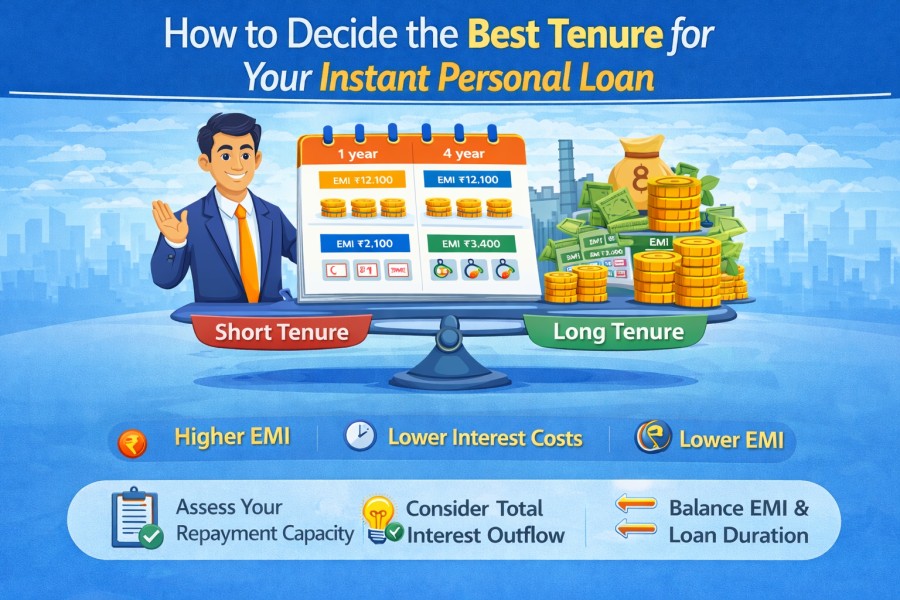
How to Decide the Best Tenure for Your Instant Personal Loan
When applying for an instant personal loan, most borrowers focus on getting the lowest interest rate or quick approval. However, one factor that plays an even bigger role in your overall borrowing experience is the loan tenure you choose. The repayment duration you select directly affects your monthly EMI, total interest cost, and long-term financial stability. A poorly chosen tenure can either put pressure on your monthly budget or significantly increase the total amount you repay over time. That’s why understanding how to choose the right personal loan tenure is essential. With the help of a personal loan calculator, you can compare different options and choose a repayment period that fits your income, lifestyle, and financial goals. In this guide, you’ll learn how to evaluate different tenure options, use smart strategies, and make a decision that fits your financial goals without stress. What is Loan Tenure? Loan tenure is the fixed period of time agreed between a borrower and a lender to repay a loan, including both the principal amount and interest, through regular installments. It is usually expressed in months or years and plays a crucial role in determining your Personal loan EMI calculation, total interest payable, and overall repayment strategy. Loan Tenure Meaning in Simple Words The loan tenure is the repayment period for your loan. It defines how long you will continue paying EMIs until the loan is fully closed. For example: A 12-month tenure means you repay the loan in 1 year A 60-month tenure means repayment over 5 years This is why loan tenure is also commonly referred to as: Loan duration Repayment term Loan period All these terms are used interchangeably in financial discussions. Recent blog: NBFC vs Bank Personal Loan: Which Is Better for Quick Approval? Personal Loan Tenure in India Understanding personal loan tenure in India is crucial before applying for any loan. The tenure you choose directly impacts your Personal loan EMI, total interest payable, and overall financial comfort. In India, banks and NBFCs offer flexible repayment options based on your profile. However, along with tenure, it’s equally important to evaluate your loan eligibility and compare loans properly. Comparing lenders, interest rates, and tenure options helps you choose a plan that fits your repayment capacity and financial goals, ensuring a smarter, more cost-effective borrowing decision. What is a Personal Loan's Minimum and Maximum Tenure? Understanding the minimum and maximum tenures for personal loans is essential before applying. Your chosen personal loan tenure directly affects your loan EMI, repayment comfort, and total interest cost. Along with tenure, it’s important to compare options to find the lowest interest rates, as even a small difference in rates can significantly impact your total repayment. Evaluating both tenure and interest rates together helps you choose a more affordable and cost-effective loan. Personal Loan Minimum Tenure The personal loan minimum tenure is the shortest time period within which you must repay your loan. In India, most lenders offer a minimum tenure of 12 months (1 year). However, some banks and NBFCs offer more flexible options, with tenures as low as 3 to 6 months. When is Minimum Tenure Suitable? Choosing a shorter loan tenure is ideal if: You have a high and stable income You want to close your loan quickly You want to save on total interest Impact of Minimum Tenure A shorter tenure means: Higher Personal loan EMI Lower total interest paid Faster debt clearance For example, if you take a 12-month loan, your EMI will be significantly higher than with a longer tenure, but you will pay much less interest overall. Recent blog: Pay Off Your Personal Loan Early Foreclosure Charges, Steps & Benefits Personal Loan Maximum Tenure The maximum tenure for a personal loan refers to the longest repayment period offered by lenders. In India, the maximum tenure for a personal loan typically ranges from 60 to 84 months (5 to 7 years). In some cases, lenders may extend this up to 8 years (96 months), especially for borrowers with strong profiles or those opting for a pre-approved personal loan, where better terms and flexible repayment options are often available. When is Maximum Tenure Suitable? A longer personal loan tenure works best if: You want lower monthly EMIs You have a limited monthly income You need better cash flow management Impact of Maximum Tenure A longer tenure results in: Lower EMI Higher total interest paid Longer repayment commitment While it reduces short-term financial pressure, it increases the overall cost of borrowing. Why Loan Tenure Matters the most in a Personal loan When applying for an instant personal loan, many borrowers focus only on interest rates. However, the tenure is equally, if not more, important. It directly impacts your Personal loan EMI, total interest paid, repayment comfort, and overall financial stability. If you clearly understand what tenure is and how it affects your loan, you can make smarter borrowing decisions, choose the right repayment period, and avoid long-term financial stress. Importance of Loan Tenure in Personal Loan Determines Personal loan EMI: The loan tenure determines how much EMI you pay each month. Affects Total Interest Cost: A max loan tenure increases total interest, while a shorter tenure reduces it. Impacts Monthly Budget: The right personal loan tenure ensures your EMI fits comfortably within your income. Controls Repayment Duration: It defines how quickly you can become debt-free. Influences Cash Flow: This improves cash flow by lowering EMI, helping manage expenses more effectively. Impact Financial Planning: Choosing the right tenure helps balance savings, expenses, and liabilities. Affects Credit Score Risk: Incorrect tenure choice may lead to missed EMIs and impact your credit score. Determines Loan Affordability: It plays a key role in how affordable your loan feels over time. Impact of Debt-to-Income Ratio: Your loan tenure based on EMI affects your future loan eligibility. Guides Loan Strategy: Using a loan tenure calculator helps choose the most cost-effective repayment plan. Related blog: Top 10 Mistakes to Avoid When Applying for a Personal Loan Key Factors to Decide the Best Loan Tenure Monthly Budget and Cash Flow Your monthly income and expenses should be the first thing you analyze. Before finalizing a tenure, calculate how much EMI you can comfortably afford without affecting your lifestyle. A widely accepted rule is that your total EMI should not exceed 30-40% of your monthly income. If your budget allows, go for a shorter tenure. If not, a longer tenure can provide breathing room. Use a Loan Tenure Calculator A loan tenure calculator is one of the most effective tools for making the right decision. Instead of guessing, you can instantly compare different tenure options and see how they impact your EMI and total interest. Using a personal loan EMI calculator helps you visualize different scenarios and choose a tenure that fits your financial comfort. Total Interest Outgo One of the biggest mistakes borrowers make is focusing only on EMI and ignoring the total repayment amount. A longer tenure may reduce your monthly burden, but it significantly increases the overall interest you pay. Always look at the bigger picture and evaluate the total cost of the loan. Loan Purpose Your reason for taking the loan plays an important role in deciding the right tenure. For short-term needs like travel or shopping, a shorter tenure is more suitable as it helps you close the loan quickly. For larger expenses such as medical emergencies or weddings, a longer tenure can offer better flexibility and manageable EMIs. Even if you have a low CIBIL score, choosing the right tenure becomes more important, as it can help you manage repayments smoothly and improve your credit profile over time. Income Stability If you have a stable and predictable income, you can confidently choose a shorter tenure and save on interest. However, if your income fluctuates or you are self-employed, a longer tenure can reduce risk by keeping EMIs manageable. Age and Financial Planning Your age is another important factor when deciding the right tenure. If you are closer to retirement, it is advisable to avoid long tenures and clear your debts as early as possible. Younger borrowers, on the other hand, have greater flexibility to choose longer tenures or opt for a flexi personal loan, which offers adaptable repayment options tailored to their financial needs. Prepayment and Foreclosure Options A smart strategy is to choose a slightly longer tenure for safety, but make loan prepayments whenever possible. This way, you keep your EMI low while reducing interest over time. However, always check whether your lender charges any prepayment or foreclosure penalties. How Loan Tenure Affects EMI & Interest Understanding how loan tenure affects EMI & interest is crucial before taking any loan. Your loan tenure not only determines your Personal loan EMI but also determines the total interest you will pay over time. EMI changes with tenure: a longer tenure lowers EMI, while a shorter tenure increases it. Total interest: It depends on the repayment period; a longer repayment period increases interest, while a shorter one reduces it. Monthly installment flexibility: Increasing the duration of EMIs makes EMIs more affordable. Overall loan cost impact: Shorter duration helps reduce the total repayment amount. Repayment speed: A shorter duration clears debt faster; a longer duration extends repayment. Interest accumulation: Paying over more months leads to higher total interest. EMI vs interest balance: Lower EMI results in higher interest, and vice versa. Cash flow management: Longer duration improves monthly cash flow planning. Financial stability: Choosing the right duration avoids repayment stress. Smart planning tool: Using a loan calculator helps choose the best repayment period. Related blog: How Loan Tenure Affects Your EMI – A Complete Guide Conclusion Choosing the right loan tenure is one of the most important decisions when taking an instant personal loan. It directly impacts your Personal loan EMI, total interest outgo, and overall financial stability. While a shorter tenure helps you save on interest and become debt-free faster, a longer tenure offers flexibility with lower EMIs and better cash flow management. The key is to strike the right balance between affordability and total cost. Instead of focusing solely on low EMI or quick repayment, carefully evaluate your income, expenses, and financial goals. Using a loan tenure calculator can help you compare options and make a smarter, data-driven decision. Make smarter borrowing decisions with Loan Quantum. Use our advanced personal loan calculator to compare EMIs, optimize interest costs, and choose the perfect repayment plan for your needs. Frequently Asked Questions Which is better: short or long loan tenure? A short tenure is better for saving interest, while a long tenure is better for lower EMIs and easier monthly repayment. Can I change my personal loan tenure later? Some lenders allow tenure changes through restructuring or refinancing, but charges may apply. Is a longer tenure good for low-income borrowers? Yes, a longer tenure can help low-income borrowers manage EMIs more easily, but it increases total interest cost. Can I prepay my loan to reduce tenure? Yes, most lenders allow prepayment or foreclosure, which can shorten your loan tenure and reduce your total interest paid. Can I choose my loan tenure while applying? Yes, most lenders allow you to select your preferred loan tenure based on your repayment capacity and eligibility.

Do Personal Loans Offer Any Tax Savings?
A personal loan is a popular financing option for urgent expenses, such as medical emergencies, education, or home improvements. With a personal loan calculator, borrowers can estimate their monthly EMI, compare lenders, and select a suitable repayment plan. However, one of the most common questions borrowers ask is whether these loans provide any tax savings. Since this type of borrowing is unsecured and not tied to a specific asset, it does not offer the built-in tax advantages of secured loans. In this blog, we will explore whether any tax benefits are available and under what conditions they may apply. We will also look at how the purpose of borrowing, such as home renovation, higher education, or business use, can influence eligibility for deductions. Additionally, tools like a personal loan calculator can support better financial planning by helping you understand repayment structure and interest outflow. Are Personal Loans Taxable? A personal loan is not considered taxable income in India because it is treated as a liability rather than earnings. The amount received must be repaid to the lender, which is why it is not taxed under the Income Tax Act. This applies to all borrowers, including salaried individuals and those opting for flexible repayment options. However, while the loan amount itself is tax-free, it also does not provide automatic tax deductions. Any potential benefit depends on how the borrowed funds are used. In most cases, the interest paid does not qualify for deductions unless the loan is used for specific purposes defined by tax law. Do Personal Loans Offer Tax Benefits? In general, this type of borrowing does not offer direct tax benefits like home or education loans. There are no automatic deductions available on the loan amount or the EMI paid. Even when comparing lenders, checking eligibility, or opting for quick disbursal options, tax savings are not a built-in feature. That said, indirect benefits may be available in certain situations. While principal repayment is not deductible, the interest component may qualify under specific conditions, such as when the funds are used for home-related expenses, education, or business activities. To claim these deductions, proper documentation and clear proof of usage are essential. Related blog: Get an Instant Personal Loan with a Low CIBIL Score Key Scenarios Where Personal Loan Tax Benefits Apply 1. Personal Loan for Home Renovation If you use a personal loan for repairing or renovating your house: You can claim a deduction under Section 24(b) Maximum deduction: Up to ₹30,000 per year (for self-occupied property) This is one of the most common ways to get a personal loan tax benefit in India. 2. Personal Loan for Home Purchase or Construction If the loan is utilized to purchase or develop a home: Interest deduction under Section 24(b) Up to ₹2,00,000 for self-occupied property Full interest deduction for rented property Principal repayment may qualify under Section 80C (up to ₹1.5 lakh) This makes personal loans comparable to home loans in specific cases. 3. Personal Loan for Higher Education If you take a personal loan for education: Deduction available under Section 80E Only the interest component is eligible No upper limit Benefit available for up to 8 years This is useful when you cannot qualify for a traditional education loan. 4. Personal Loan for Business Use If the loan is used for business purposes: Interest paid might be considered a business expense. Deductible under applicable provisions (like Section 37) This reduces your taxable income and improves cash flow for business owners. 5. Personal Loan for Asset Purchase If you use a personal loan to invest in the following assets: Shares Gold Property The interest paid is added to the cost of acquisition, which helps reduce capital gains tax when selling the asset. Recent blog: Top Personal Loan Types in India for 2026 When Personal Loans Do NOT Offer Tax Benefits In most everyday situations, no tax benefits apply. This is especially true when funds are used for personal or lifestyle expenses. The loan eligibility for deductions depends entirely on usage, not on the loan type or approval process. Situations Where Tax Benefits Are Not Available Personal or Lifestyle Use: Expenses such as travel, weddings, shopping, or gadgets do not qualify for tax deductions. Interest paid in such cases cannot be claimed under tax laws. Lack of Proper Documentation: Even if the loan was used for a potentially eligible purpose, failing to maintain bills, receipts, or proof of usage can lead to rejection of tax claims. Borrowing from Informal Sources: Loans from friends, family, or unregistered lenders are not eligible for tax benefits because they lack proper financial documentation. Principal Repayment: The principal portion of the loan repayment is not eligible for any deduction. Only the interest component may qualify, and even then, only under specific conditions. Non-Eligible Financial Use: Using loan funds for purposes that do not fall within the defined tax-saving categories, such as non-business or non-asset-related spending, does not provide any tax advantage. Might you have missed: Pay Off Your Personal Loan Early Foreclosure Charges, Steps & Benefits Key Points to Remember Tax benefits apply only in clearly defined scenarios under the Income Tax Act. Proper documentation is essential to claim any deduction. Not all loan usage qualifies for tax savings. Understanding the purpose of borrowing is more important than the loan type. In summary, while personal loans are a convenient financial tool, they do not offer tax benefits in most common situations. Meeting the loan eligibility criteria or getting quick approval does not guarantee any tax advantage. To claim deductions, the loan must be used for eligible purposes and supported with proper documentation. Documents Required to Claim Tax Benefits Loan Agreement & Sanction Letter: These documents confirm that you obtained a personal loan from a reputable lender and include details such as the loan amount, term, and interest rate. Interest Certificate from Lender: A crucial document showing the interest component of your loan EMI is required to claim tax deductions. Bank Statements: These help track EMI payments and prove that repayments have been made regularly. Proof of End-Use of Funds: Documents such as invoices, bills, or receipts are required to demonstrate that the loan was used for eligible purposes (such as home improvement or education). Additional Supporting Documents (Based on Usage) Property Documents (Home-Related Use): Required if the loan is used for purchase, construction, or renovation to claim deductions under the relevant sections. Education Expense Proof: Fee receipts, admission letters, or loan utilization proof for claiming education-related deductions. Business Expense Records: Bills, invoices, or financial statements showing that the loan was used for business purposes. Investment Proofs (if applicable): Documents related to asset purchase if you plan to adjust interest against capital gains. Related blog: How to Save Money with a Personal Loan EMI Calculator Ways a Personal Loan Calculator Helps in Tax Planning Identifies Interest Component for Tax Deduction: A personal loan calculator breaks down your EMI and shows the exact interest payable, helping you estimate potential tax deductions on interest for eligible uses. Supports Better Loan Comparison: During loan comparison, you can evaluate different lenders, tenures, and rates to see which option offers a higher or more manageable interest component for tax planning. Optimizes Loan Structure: By adjusting loan tenure and loan amount, you can use the loan EMI calculation to structure repayments in a way that aligns with your financial goals and possible tax benefits. Helps in Financial & Tax Planning: Knowing your EMI in advance helps you budget better and plan other tax-saving investments alongside your loan. Useful for Pre-Approved Loans: Even with a pre-approved personal loan, using a calculator helps you understand the total interest outflow and its impact on your tax-saving strategy. Personal Loan vs Other Loans (Tax Comparison) Loan Types Tax Benefit Availability Interest Deduction Principal Deduction Personal Loan Limited (conditional) Yes (specific use) No Home Loan High Yes Yes (80C) Education Loan Moderate Yes (80E) No Business Loan Yes Yes No Car Loan Limited Yes (business use) No Common Mistakes to Avoid When Claiming Tax Benefits Claiming tax benefits on a personal loan or other deductions can help reduce your overall tax burden, but simple mistakes can lead to rejection, penalties, or missed savings. Many taxpayers focus solely on eligibility and ignore important factors such as documentation, limits, and accurate reporting. Whether you’re planning deductions on loan interest or other tax-saving investments, avoiding these common mistakes is essential for smooth filing and maximum benefits. Common Mistakes to Avoid Claiming Deductions Without Proof: Not maintaining proper documents, like interest certificates, bills, or receipts, can lead to rejection of your tax claims. Using Loan for Ineligible Purposes: Tax benefits are not available if funds are used for personal expenses like travel, shopping, or weddings. Ignoring Deduction Limits: Exceeding limits under sections like 80C or claiming more than allowed can result in penalties or disallowed claims. Double Claiming Deductions: Claiming the same expense under multiple sections or twice in your return can trigger scrutiny. Not Reporting All Income Sources: Failing to include interest income, freelance income, or dividends can lead to mismatches and notices. Last-Minute Tax Planning: Rushing investments or loan decisions at the end of the financial year often leads to poor financial choices. Incorrect Personal Details: Errors in PAN, Aadhaar, or bank details can delay refunds or invalidate your return. Skipping ITR Verification: Not e-verifying your return within the deadline makes your filing invalid. Ignoring AIS/Form 26AS: Not matching your income and TDS details with official records can lead to discrepancies. Final Thoughts Personal loans can be a useful financial tool when you need quick access to funds, but they are not designed as tax-saving instruments. Any potential tax benefit depends entirely on how the borrowed amount is used and whether it falls under specific provisions of the Income Tax Act. In most cases, everyday expenses do not qualify, and only the interest component may be deductible in limited scenarios. To make the most of any possible tax advantage, focus on proper planning, clear usage of funds, and accurate documentation. Always evaluate your financial needs, compare options carefully, and understand the long-term impact on your budget. When used wisely and for eligible purposes, a loan can support both your financial goals and limited tax savings, but relying on it purely for tax benefits is not a practical strategy. Make smarter borrowing decisions with Loan Quantum. Compare options, check eligibility, and plan your finances with confidence today. Frequently Asked Questions Can salaried employees claim tax benefits on personal loans? Yes, but only if the loan is used for eligible purposes and proper documentation is maintained. Being salaried does not make the loan tax-deductible. Do flexi personal loans offer different tax benefits? No, the tax treatment is the same for both regular and flexi options. Tax benefits depend on how the loan is used, not the loan type. Does prepayment or foreclosure affect tax benefits? No, prepayment does not directly impact tax benefits. However, since deductions are based on interest paid, early repayment may reduce the total eligible deduction. Can I use a personal loan calculator for tax planning? Yes, a personal loan calculator helps you understand the interest component of your EMI, which is useful for estimating potential tax deductions. Are tax benefits different for secured and unsecured loans? Yes, secured loans like home or education loans offer direct tax benefits, while unsecured loans offer only conditional tax benefits based on usage.
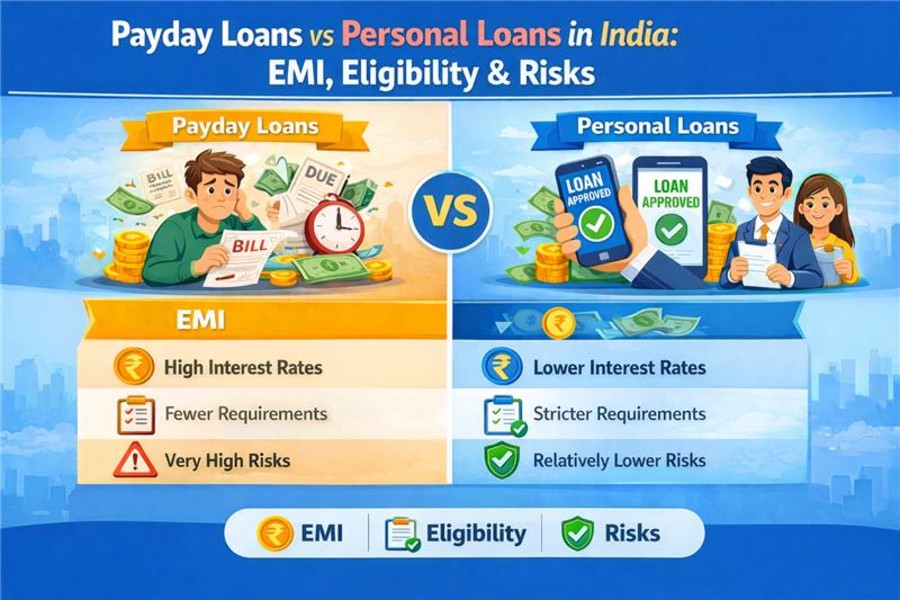
Payday Loans vs Personal Loans in India: EMI, Eligibility & Risks
When you need urgent cash, choosing between payday loans and personal loans in India can feel overwhelming. Both options promise quick access to funds, especially with the rise of online payday loans, instant payday loans, and easy-to-apply personal loans. However, they differ significantly in terms of EMI structure, loan eligibility criteria, interest rates, and overall financial risk. In this blog, we will take a detailed look at payday loans in India, including instant payday loan eligibility, quick options for payday loans in India, and compare them with structured borrowing options like personal loans. We will also explore how financial tools, such as a personal loan calculator and an EMI calculator, can help you plan repayments effectively. Additionally, if you are struggling with a low CIBIL score or searching for payday loans in India without a credit check or payday loan apps, this guide will help you understand the risks, loan comparison, and better alternatives available in the Indian market. What is Payday Loans? A payday loan is a short-term, high-interest, unsecured loan designed to provide immediate cash until your next salary. In India, payday loans are usually small-ticket loans (₹5,000 to ₹50,000) that must be repaid within a few days or by your next payday. These loans are widely available as online payday loans, making it easy for borrowers to access funds quickly through payday loan apps or digital lenders. Because of their fast approval process, they are often promoted as instant payday loans or quick payday loans, especially for urgent financial needs. What is a Personal Loan? A personal loan is an unsecured loan offered by banks and NBFCs that allows you to borrow money without pledging any collateral. Unlike payday loans, personal loans are designed for larger financial needs and are repaid over time through fixed monthly instalments using a personal loan calculator. In India, personal loans are widely used for expenses such as medical emergencies, weddings, travel, education, or debt consolidation. Many lenders now offer pre approved personal loan options, making the process faster and more convenient. Related blog: What is an Instant Personal Loan and How Does it Work? How does Payday Loans Work? Understanding how payday loans work is essential before you apply, especially if you are exploring options such as online, instant, or quick payday loans in India. A payday loan is designed to provide instant cash for short-term financial needs, but its structure, repayment terms, and costs differ significantly from those of traditional personal loans. While they offer speed and convenience, they also come with higher risks. Step-by-Step Process of Payday Loans in India Understanding the procedure of payday loans in India helps you make informed decisions, especially if you're considering instant, online, or popular payday loan apps. While the process is fast and convenient, it’s important to check loan eligibility and compare it with a personal loan to understand the cost and repayment differences. 1. Check Basic Eligibility Before applying, lenders offering instant payday loans in India check basic criteria such as: Age (usually 18–60 years) Indian residency Regular source of income (salaried preferred) Unlike a personal loan, many lenders approve applications even with a low CIBIL score, making payday loans accessible to a wider audience. 2. Choose a Lender or Payday Loan App Next, you need to select a trusted platform: Payday loan apps NBFC websites Digital lending platforms offering payday loans online Since many platforms offer instant payday loans, it’s important to compare interest rates, fees, and terms before choosing. 3. Apply for a Payday Loan Online The application process is quick and fully digital: Fill out an online form Enter personal, employment, and bank details Select the loan amount and tenure 4. Submit Documents You’ll need to upload minimal documents, such as: PAN card Aadhaar card Salary slips or bank statements Compared to a personal loan, documentation is minimal, and approval is faster, especially for borrowers with a low CIBIL score. 5. Instant Verification & Approval Once submitted, lenders verify your details: Automated digital verification Income-based assessment (not heavy credit checks) Most payday loans in India are approved within minutes to a few hours, making them ideal for urgent financial needs. 6. Loan Agreement & E-Mandate Setup After approval: You accept the loan terms digitally Set up an auto-debit (e-mandate) for repayment Unlike personal loans, there is no EMI calculation involved, as payday loans do not follow an instalment-based repayment structure. 7. Instant Loan Disbursal Once everything is confirmed: Loan amount (₹5,000 to ₹50,000) is transferred instantly Funds are credited directly to your bank account This fast disbursal is why they are called instant payday loans. 8. Repayment on Next Payday The final step is repayment: Full amount + interest is deducted automatically Usually within 7–30 days (next salary date) There is no option for structured EMI calculation like in a personal loan, which increases the repayment burden. Quick Comparison: Payday Loans vs Personal Loans Features Payday Loan in India Personal Loan in India Loan Amount Small amount (₹1,000–₹1 lakh) Higher amount (₹50,000–₹25 lakh+) Interest Rates Very high in instant payday loans Lower and regulated compared to payday loans Loan Tenure 7–30 days (short term) 6 months to 5 years (long term) Repayment Method Full repayment without EMI calculation Monthly EMIs with proper EMI calculation Approval Time Instant via payday loan apps 1–3 days (faster if pre-approved) Credit Score Available for low CIBIL score borrowers Requires good credit score Application Mode Fully digital (payday loans online) Online and offline both available Documentation Minimal KYC required Detailed income and KYC documents required Disbursal Speed Instant (instant payday loan India) Same day to a few days Risk Level High risk due to high cost Lower risk with planned repayment Best Use Emergency short-term needs Planned expenses and large funding Flexibility Limited flexibility Flexible tenure and EMI options Basic Eligibility Criteria for Payday Loans in India Before applying for a payday loan in India, it’s important to understand the basic loan eligibility requirements. One of the main reasons why payday loans online are popular is that they have simpler, more flexible criteria than traditional personal loans. Eligibility Criteria of Payday Loans Age Requirement: Applicant must be at least 18–21 years old Income Source: Must have a steady monthly income (salaried or regular earnings) Bank Account: An active bank account is required for disbursal and repayment KYC Documents: Valid PAN card, Aadhaar card, and basic identity proof Employment: Most lenders prefer Employment Status, Salaried employees Residency: Must be an Indian resident applying for payday loans in India Credit Score: Not mandatory; available even for low CIBIL score borrowers Mobile & Bank Access: Required for applying via payday loan apps or payday loans online Related blog: Top 10 Mistakes to Avoid When Applying for a Personal Loan Important Note While eligibility for payday loans in India is easy, it’s important to remember: Higher approval does not mean lower risk Interest rates are significantly higher than those of a personal loan Always check repayment ability before applying Features of personal loans Personal loans are among the most popular borrowing options in India due to their flexibility, quick approval, and structured repayment terms. Compared to payday loans in India or instant payday loans, a personal loan offers better control over finances with planned EMI calculation and lower risk. Unsecured Loan: A personal loan does not require any collateral or security Loan Amount: Offers higher borrowing limits compared to payday loans in India Interest Rates: More affordable with lower interest rates than instant payday loans Repayment Method: Fixed monthly instalments with proper EMI calculation Loan Tenure: Flexible tenure ranging from 6 months to 5 years Approval Speed: Faster processing, especially for pre-approved personal loans Flexibility: Flexi personal loan allows withdrawal as per requirement Usage: Can be used for medical, travel, wedding, or personal expenses Credit Score Impact: Timely repayment helps improve credit score Transparency: Clear terms and charges compared to payday loans online Related blog: Pay Off Your Personal Loan Early Foreclosure Charges, Steps & Benefits Risks of Payday Loans in India While payday loans offer quick access to cash, they come with severe financial and personal risks. Compared to personal loans, these loans are much more expensive and less regulated, especially when obtained through payday loan apps or online platforms. Key Risks of Payday Loans High Interest Rates: Instant payday loan options in India often come with extremely high interest rates, sometimes exceeding 30%–300% annually. Hidden Charges: Many payday loans online include processing fees, penalties, and hidden costs that increase the total repayment amount. Short Repayment Tenure: Payday loans in India must be repaid within 7–30 days, creating high financial pressure. Debt Trap Risk: Borrowers often take multiple instant payday loans to repay existing ones, leading to a continuous debt cycle. No EMI Flexibility: Unlike a personal loan, there is no structured EMI calculation, so the loan must be repaid in one go. Data Privacy Risks: Unregulated apps may access personal data, such as contacts and photos, leading to misuse or blackmail. Low Regulation: Many lenders offering instant payday loans in India operate outside the RBI's strict guidelines, increasing the risk. Negative Credit Impact: Defaulting on payday loans in India can damage your credit profile and affect future personal loan approvals. Over-Borrowing Risk: Easy approval for users with low CIBIL scores can lead to excessive borrowing and financial instability. Recent blog: Top Personal Loan Types in India for 2026 Conclusion Choosing between payday loans in India and a personal loan depends on your financial needs, urgency, and repayment capacity. While instant and online payday loans may seem like a quick solution for emergencies, they come up with high interest rates, short repayment periods, and significant risks, including debt traps and financial stress. On the other hand, a personal loan online offers a more structured and reliable borrowing option with lower interest rates, flexible tenure, and planned EMI calculation, making it suitable for both short-term and long-term financial needs. Especially if you have a stable income and meet the eligibility criteria, options such as a flexi personal loan or a pre-approved personal loan can offer better financial control and peace of mind. Make smarter borrowing decisions with LoanQuantum. Compare loans, check eligibility, and calculate your EMI instantly to find the best option for your needs. Frequently Asked Questions Are payday loans in India legal? Yes, payday loans in India are legal when offered by RBI-registered lenders or NBFCs. However, many unregulated paydays loan apps operate illegally, so borrowers should be cautious. Can payday loans affect my credit score? Yes, if you default on repayment, it can negatively impact your credit score and reduce your future loan eligibility for products like a personal loan online. Which loan is safer for long-term financial planning? A personal loan is safer because it allows planned repayment through EMI calculation, unlike payday loans, which can create financial stress. What happens if I cannot repay a payday loan vs a personal loan? Defaulting on payday loans in India can lead to high penalties and harassment, while missing a personal loan EMI result in penalties and a drop in credit score. Are payday loan apps safer than banks for personal loans? No, banks and NBFCs offering personal loans online are more regulated, while some payday loan apps may pose risks related to data privacy and unfair practices.
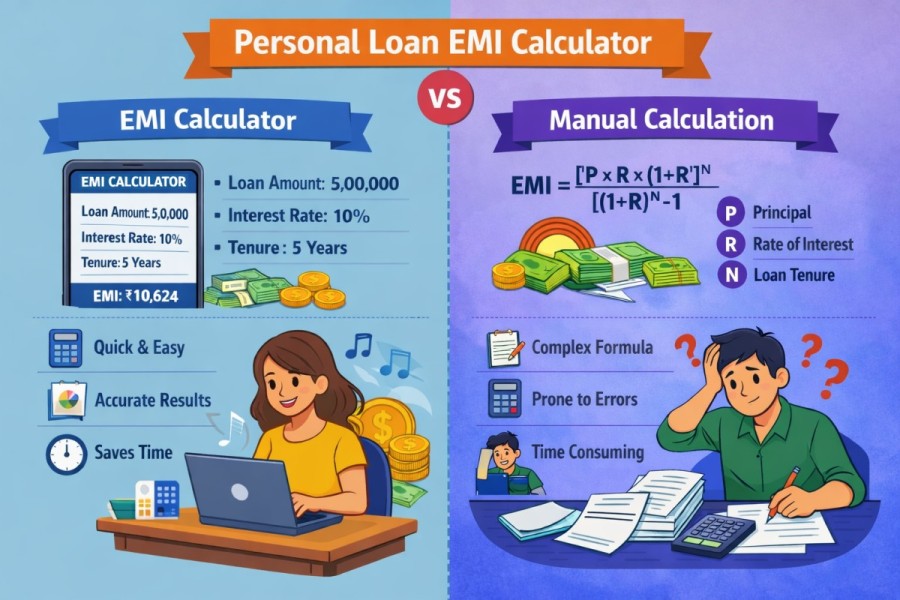
Personal Loan EMI Calculator vs Manual Calculation: Which is Better?
When applying for a personal loan, one of the most important factors to consider is your EMI. Whether you are checking your loan eligibility, doing a detailed loan comparison, or searching for low interest rates, accurate EMI calculation plays a crucial role in making the right financial decision. However, many borrowers still face a common confusion: Should you use a personal loan EMI calculator or rely on the Manual EMI Calculation? In this guide, we will compare the two methods in detail, using examples. You’ll understand how a personal loan EMI calculator simplifies EMI calculation, and how Manual EMI Calculation works. We’ll also cover common mistakes, benefits for borrowers with a Low CIBIL Score, and how to choose the best option for smarter financial planning, including options like Flexi loan and pre-approved loan offers. What Is a Manual EMI Calculation? Manual EMI Calculation is the traditional method of calculating your loan EMI using a mathematical formula instead of a personal loan EMI calculator. In this method, borrowers manually compute their monthly instalment based on the loan amount, interest rate, and tenure. It is commonly used to understand how EMI calculation works behind the scenes, especially when evaluating different personal loans or checking basic loan eligibility. Manual EMI Calculation Formula To perform a manual EMI Calculation, you need to use the standard formula: EMI = [P × R × (1+R)^N] / [(1+R)^N – 1] Where: P = Principal loan amount R = Monthly interest rate (annual rate ÷ 12 ÷ 100) N = Loan tenure in months Example: When Manual EMI Calculation Is Needed Suppose you take a ₹5,00,000 personal loan at 12% annual interest for 3 years (36 months). Step 1: Convert annual interest to monthly R =12/12*100 =0.01 Step 2: Apply the EMI formula EMI = [P × R × (1+R)^N] / [(1+R)^N – 1] ≈₹16,610 Step 3: EMI split for the first month Interest = ₹5,00,000 × 0.01 = ₹5,000 Principal = ₹16,610 – ₹5,000 = ₹11,610 Manual calculations help you understand interest vs principal, plan prepayments, and compare different tenures. While a personal loan EMI calculator is faster, manual calculation provides deeper insights for smarter financial planning. Related blog: How to Save Money with a Personal Loan EMI Calculator What is a Personal Loan EMI? A personal loan EMI (Equated Monthly Installment) is the fixed amount you pay every month to repay your loan over a chosen tenure. It includes both the principal and interest, allowing you to repay the loan in a structured, manageable way. Understanding your loan EMI is essential for checking your loan eligibility, planning your monthly budget, and making the right loan comparison before applying. Related blog: What is an Instant Personal Loan and How Does it Work? Benefits of Manual EMI Calculation While a loan EMI calculator is widely used for quick, accurate results, Manual EMI Calculation still holds its importance, especially for borrowers who want to understand how their personal loan EMI is calculated in depth. Instead of relying on automated tools, manual calculation allows you to explore the logic behind EMI calculation, including how interest rates, loan tenure, and principal amount interact. This deeper understanding can be useful when evaluating different personal loans, checking your loan eligibility, or performing a detailed loan comparison. Below are the key benefits of using Manual EMI Calculation: 1. Clear Understanding of EMI Structure: Manual calculation helps you understand how your personal loan EMI is divided between the principal and interest. This makes it easier to evaluate different loans and repayment strategies. 2. Improves Financial Knowledge: By doing the loan EMI calculation manually, you learn how interest rates, tenure, and loan amount impact your EMI. This improves your ability to make better financial decisions during loan comparisons. 3. Helps in Loan Eligibility Planning: Manual calculations let you test different scenarios, such as changing the loan amount or tenure, to understand your loan eligibility better and meet specific loan eligibility criteria. 4. Useful Verifying Results: You can use Manual EMI Calculation to cross-check the results generated by a personal loan calculator, especially when dealing with large loan amounts. 5. Better Understanding of Interest Impact: Manual calculations show how low interest rates can reduce EMI and how higher rates can increase your repayment burden. This is useful when comparing lenders or evaluating offers, such as a pre-approved personal loan. 6. Helpful for Special Loan Types: It helps you understand repayment structures in options like a Flexi loan, where EMI and interest calculations may vary. Benefits of the EMI Calculator for Personal Loans When applying for a personal loan, understanding your EMI in advance is crucial for better financial planning. This is where a personal loan calculator becomes extremely useful. Instead of relying on complex formulas or Manual EMI calculations, borrowers can instantly perform accurate EMI calculations and make smarter decisions. A personal loan calculator not only saves time but also helps evaluate different loan options, check loan eligibility, and perform effective loan comparisons. Whether you are looking for low interest rates, exploring a Flexi loan, or considering a pre-approved personal loan, this tool simplifies the entire process. Below are the key benefits of using a personal loan EMI calculator: 1. Instant and Accurate Results: A loan calculator provides quick and precise personal loan EMI results. It eliminates calculation errors and ensures accuracy, which is crucial when planning your finances. 2. Easy Loan Comparison: You can easily compare loans by adjusting the loan amount, tenure, and interest rates. This helps you choose the best option with the lowest interest rate. 3. Helps Check Loan Eligibility: The calculator lets you test different scenarios and assess your loan eligibility based on your repayment capacity and income. It also helps you align with the required loan eligibility criteria. 4. Better Financial Planning: Knowing your EMI in advance helps you manage your monthly budget efficiently and avoid financial stress. 5. Saves Time and Effort: Unlike Manual EMI Calculation, a calculator delivers results instantly without complex steps, saving both time and effort. 6. Useful for All Credit Profiles: Whether you have a good credit score or a Low CIBIL Score, a personal loan calculator helps you find a suitable EMI and plan repayment accordingly. 7. Supports Advanced Loan Options: It helps you evaluate different loan types, such as a Flexi loan and a pre-approved personal loan, so that you can understand their impact on your EMI. Recent blog: Top Benefits of Applying for a Personal Loan Online Comparison: Personal Loan EMI Calculator vs Manual Calculation Feature Personal Loan EMI Calculator Manual EMI Calculation Speed Instant results with a few clicks Time-consuming; requires multiple steps Accuracy Highly accurate; eliminates errors Prone to human errors, especially with large loans Ease of Use User-friendly; no financial expertise needed Complex; requires understanding of formulas Loan Comparison Easy to compare multiple personal loans with different amounts, rates, and tenures Tedious; each scenario requires repeated calculations Financial Planning Helps plan monthly budget, manage repayments, and avoid over-borrowing Limited; difficult to test multiple repayment scenarios Loan Eligibility Check Quick estimation of loan eligibility and affordability Slower; requires manual adjustments and calculations Advanced Loan Options Supports evaluation of Flexi loan and pre approved personal loan options Complex and error-prone for advanced loan types Suitability for Low CIBIL Score Helps find affordable EMI and plan repayment Less practical; not ideal for immediate decision-making Effort Required Low; just input values and get results High; involves step-by-step calculations Common Mistakes in Manual EMI Calculation Manual EMI Calculation can be useful for understanding personal loan EMI, but it is prone to errors if done incorrectly. Borrowers often make mistakes that lead to inaccurate projections and poor financial planning. Avoiding these mistakes is essential for better loan comparison and repayment planning. 1. Using Annual Interest Rate Incorrectly: A common mistake is using the annual interest rate directly without converting it into a monthly rate. Remember to divide the annual rate by 12, then by 100, to get the correct monthly interest rate (R). 2. Incorrect Tenure Conversion: Many borrowers confuse loan tenure in years with months. For example, a 5-year loan should be converted to 60 months for proper EMI calculation. Failing to do so can significantly distort your personal loan EMI. 3. Ignoring Additional Costs: Processing fees, documentation charges, insurance premiums, and other extra costs are often overlooked. These fees either increase the principal or must be paid up front. Ignoring them leads to underestimating the actual EMI. 4. Assuming Fixed Rates for Floating Loans: If your personal loan has a floating interest rate, calculating EMI as if it were fixed is a mistake. Floating rates change over time, so assuming a static rate may give unrealistic repayment projections. 5. Miscalculating Principal: Some borrowers fail to subtract upfront fees or processing charges from the principal when calculating net cash inflow. This error affects the accuracy of your Manual EMI Calculation. Recent blog: Top 10 Mistakes to Avoid When Applying for a Personal Loan How to Choose Between a Loan EMI Calculator and Manual EMI Calculation Choosing the right method depends on your goal, time, and accuracy needs: Quick Planning & Budgeting: Use a personal loan EMI calculator for instant, accurate results and easy loan comparison. Learning & Understanding: Use Manual EMI Calculation to understand EMI structure and interest-principal split. Why EMI Calculators Are Better: Instant and error-free personal loan EMI Test multiple scenarios (tenure, interest rates, loan amount) Include extra costs like processing fees and insurance Helps plan the budget and check the loan eligibility Manual Calculation Is Useful For: Learning EMI fundamentals Understand how each loan repayment affects principal and interest. For practical financial planning, a loan EMI calculator is faster, more accurate, and easier to use. Manual calculations are mainly for learning and verification. Recent blog: Overdraft (OD) vs Personal Loan: Interest, Eligibility & How It Works Conclusion Choosing between a personal loan EMI calculator and Manual EMI Calculation ultimately depends on your needs and purpose. If your goal is to estimate your loan EMI quickly, check your loan eligibility, and compare loans effectively. A personal loan calculator is the best choice. On the other hand, Manual EMI Calculation is useful for understanding how EMI works behind the scenes. It gives you deeper insights into the interest and principal split, but it is time-consuming and prone to errors, making it less practical for real-world financial planning. Use LoanQuantum to calculate your personal loan EMI instantly, compare loan options, check your loan eligibility, and choose the best deal with confidence. Frequently Asked Questions Is the Manual EMI Calculation accurate? Yes, it can be accurate if it is calculated correctly. However, it is prone to human error, especially compared to a personal loan calculator, which provides instant, precise results. Can Manual EMI Calculation help with loan eligibility? Yes, it can help you estimate your loan eligibility by testing different loan amounts and tenures. However, using a personal loan calculator is faster and more practical. Is Manual EMI Calculation better than a personal loan calculator? No, for practical purposes, a personal loan calculator is better because it is faster, more accurate, and easier to use. Manual calculations are mainly useful for learning and understanding the concept. Can the manual EMI Calculation be used for all loan types? Yes, the formula can be used for various types of loans, including personal, home, and car loans. However, calculations may become more complex for loans with variable interest rates or flexible repayment options, such as a Flexi loan. Does Manual EMI Calculation include processing fees? No, Manual EMI Calculation usually does not include processing fees, insurance, or other charges unless you add them manually. This can lead to underestimating the actual loan cost.
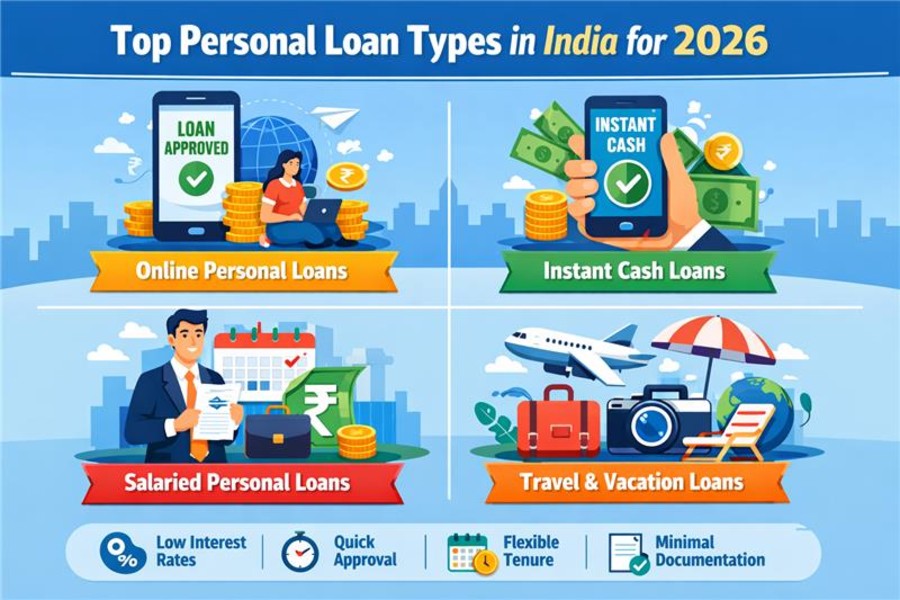
Top Personal Loan Types in India for 2026
Personal loans in 2026 have become one of the most convenient and flexible financing options in India, thanks to instant approvals, minimal documentation, and fully digital processes. Whether it’s for a wedding, medical emergency, travel, or debt consolidation, personal loans help individuals manage both planned and unexpected expenses without needing collateral. However, choosing the right type of personal loan is crucial for maintaining financial stability. Understanding different loan options, EMI calculation, loan eligibility, and interest rates can help you make informed decisions. This guide will give you a clear overview so you can compare options and select the best personal loan for your needs. What is a Personal Loan? A personal loan is an unsecured loan offered by banks and NBFCs that can be used for a variety of purposes, such as travel, medical emergencies, weddings, education, or other personal expenses. Since no collateral is required, lenders evaluate your loan eligibility based on: Income Credit score (CIBIL) Employment stability Existing financial obligations The repayment is made through fixed monthly installments, known as personal loan EMIs, making budgeting easier. Why Personal Loans Are in High Demand in 2026 Personal loans are seeing massive growth in 2026 due to digital lending, changing consumer behavior, and rising financial needs. They have become a preferred borrowing option because of their speed, flexibility, and ease of access. Key Reasons for High Demand Instant approvals & digital process: online apps, instant verification, and immediate disbursement within hours No collateral required: Unsecured loans with zero asset risk Flexible usage: Ideal for medical emergencies, travel, weddings, or debt consolidation Changing lifestyle trends: Millennials and Gen Z prefer quick access to funds and “buy now, pay later” options. Rising expenses & inflation: Higher costs of living drive borrowing needs. Competitive interest rates: Lower rates for eligible users with easy EMI planning tools Wider accessibility: Fintech and AI-based credit scoring are expanding loans to more people Recent blog: Flexi Personal Loan: Meaning, Benefits, and How It Works Types of Personal Loans for Indian Citizens for 2026 Understanding different types of personal loan options helps you make smarter financial decisions. Whether you're planning a big expense or managing existing debt, choosing the right loan for personal expenses ensures better affordability, easier EMI calculations, and improved loan comparisons. Below is a detailed breakdown of the most popular types of personal loan options in India for 2026. 1. Wedding Personal Loan A wedding personal loan is specifically designed to fund one of the most expensive life events—marriage. From booking venues to catering, photography, jewelry, and travel, expenses can quickly add up. Instead of exhausting your savings or liquidating investments, a wedding personal loan allows you to spread the cost through manageable personal loan EMI payments. Best for: High-value, one-time loan for personal expenses Key Benefits: No need to disturb long-term investments or savings Fixed personal loan EMI makes budgeting easier. Flexible tenure from 1 to 5 years Quick disbursal to meet urgent booking deadlines 2. Travel Personal Loan A travel personal loan is ideal for individuals who want to explore destinations without delaying plans due to financial constraints. Whether it's a domestic holiday or an international vacation, this type of personal loan covers all travel-related costs. With proper EMI calculation, borrowers can plan trips without financial stress. Best for: Vacation, honeymoon, and leisure travel Key Features: Covers flights, hotel bookings, visa, and activities Flexible tenure options for easy repayment Helps maintain liquidity instead of using savings Simple loan EMI structure for planning This type of personal loan is especially popular among salaried professionals and millennials. Related blog: Salary-Based Personal Loans: Benefits, EMI Tips & Approval 3. Medical Emergency Loan Medical emergencies require immediate financial support, and a medical personal loan ensures you get funds without delay. It is one of the fastest-approved loan types and can be a financial lifesaver. Even individuals with a low CIBIL score may qualify, depending on the lender. Best for: Emergency healthcare expenses Advantages: Instant approval and quick disbursal Minimal documentation Can be accessed even with lower loan eligibility in some cases Reduces dependency on high-interest credit cards This type of personal loan plays a critical role in financial planning for unexpected events. 4. Home Renovation Loan A home renovation personal loan helps homeowners upgrade their living space without financial strain. Whether it's painting, structural repairs, or interior design, this loan offers flexibility. Best for: Home improvement and upgrades Benefits: Higher loan amounts compared to other small-ticket loans Longer repayment tenure for reduced personal loan EMI Improves property value while maintaining liquidity Easy EMI calculation for long-term planning This is a practical loan for personal expenses that combines lifestyle improvement with structured repayment. 5. Debt Consolidation Loan A personal debt consolidation loan is designed to simplify your finances by combining multiple loans or credit card balances into a single loan. Instead of managing multiple EMIs, you pay a single personal loan EMI, which is often at a lower interest rate. Best for: Managing multiple debts Why Choose It: Reduces overall interest burden (if low interest rates are secured) Improves financial discipline Simplifies repayment tracking Enhances credit score over time if managed properly This option is essential for effective loan comparison and financial restructuring. 6. Consumer Durable Loan A consumer durable personal loan is used for purchasing electronics such as smartphones, laptops, TVs, or home appliances. These loans are widely available at retail stores and e-commerce platforms. Best for: Small-ticket purchases Features: No-cost EMI options (in many cases) Instant approval at the point of sale Minimal or zero down payment Quick and easy EMI calculation This type of loan for personal expenses is ideal for short-term financial needs. 7. Festival Personal Loan Festival personal loan options are offered during festive seasons such as Diwali, Navratri, and the New Year, when expenses tend to rise. Lenders provide attractive deals to encourage borrowing. Best for: Seasonal expenses Highlights: Special discounts and cashback offers Lower processing fees Faster approval and disbursal Flexible personal loan EMI options This type is useful for planned expenses without disrupting your financial balance. Recent blog: Need Money Urgently? Here’s How a Personal Loan Can Help 8. Top-Up Personal Loan A top-up personal loan is an additional loan offered to existing borrowers who already have an active loan. Instead of applying for a new loan, you can increase your loan amount under the same account. Best for: Existing borrowers needing extra funds Advantages: Lower interest compared to fresh loans Minimal documentation and faster processing No need for a separate loan application Convenient EMI calculation adjustment It is one of the most efficient ways to access funds while maintaining better loan comparison advantages. 9. NRI Personal Loan NRI personal loan options are tailored for Non-Resident Indians who want to manage financial commitments in India. These loans are structured to accommodate overseas income and documentation. Best for: NRIs managing expenses in India Features: Simple documentation process Flexible repayment options Competitive low-interest rates based on profile Can be used for any loan for personal expenses This type of personal loan is ideal for global Indians looking to support family or invest in India. Loan Eligibility Criteria in India Your loan eligibility determines whether your application gets approved. Common Eligibility Factors to consider: Credit score (700+ preferred) Monthly income Employment type (salaried or self-employed) Existing EMIs Age and work stability Meeting these loan eligibility criteria increases your chances of getting low interest rates. Conclusion Choosing the right personal loan in 2026 is not just about quick approval; it’s about making a smart financial decision that aligns with your needs and repayment capacity. With multiple options available for personal expenses, understanding each type helps you make an informed loan comparison. Before applying, always check your loan eligibility, compare lenders for low interest rates, and plan your repayment using an accurate EMI calculation. A well-planned personal loan EMI ensures that you stay financially stable while meeting your goals. Use the personal loan EMI calculator on LoanQuantum to compare options, check your loan eligibility, and find the best personal loan with low interest rates—all in one place. Frequently Asked Questions Can I use a personal loan for any reason? Yes, most personal loans are flexible and can be used for various personal expenses. However, some lenders may offer specialized loans with better terms for specific purposes, such as travel or weddings. Do different types of personal loans have different interest rates? Yes, interest rates may vary depending on the loan type, lender policies, borrower profile, and loan amount. Specialized loans or pre-approved offers may come with better rates. Which personal loan type has the fastest approval? Medical emergency loans, consumer durable loans, and pre-approved personal loans usually have the fastest approval and disbursal process. Can non-resident Indians (NRIs) get personal loans in India? Yes, NRIs can apply for personal loans in India with proper documentation, including income proof, employment details, and KYC documents. Which personal loan type offers the lowest interest rates? Debt consolidation loans and top-up personal loans often offer lower interest rates compared to fresh personal loans, especially if you have a strong credit profile.
Overdraft (OD) vs Personal Loan: Interest, Eligibility & How It Works
When managing short-term or emergency finances, many individuals face a choice between an overdraft loan and a personal loan. Understanding what an overdraft loan is, how an OD facility works, and the difference between a personal loan and overdraft can help you decide which option suits your needs. In this blog, we will discuss overdraft vs personal loan, covering key aspects such as OD account interest rates, the meaning of an overdraft facility, and overdraft loan eligibility. We will also explain practical points such as how an overdraft facility works, the meaning of a bank overdraft account, and the steps to close an overdraft account. Whether you are considering an overdraft loan for salaried employees or a regular personal loan, this guide will help you understand the benefits, limitations, and costs of each option so you can make an informed financial decision. What is an Overdraft (OD)? An overdraft loan, often called an OD facility, is a flexible credit option provided by banks that allows you to withdraw more money than your current account balance, up to a pre-approved limit. Unlike a traditional personal loan, where you receive a fixed lump sum, an overdraft is a revolving line of credit, meaning you only pay interest on the amount you use, not the total sanctioned limit. How Does an Overdraft Work? An overdraft loan facility gives you access to funds even when your account balance is low or zero. It works like a pre-approved credit limit linked to your bank account, allowing you to withdraw beyond your balance when needed. In simple terms, how an overdraft facility works is that the bank automatically covers any shortfall in your account, ensuring your transactions don’t fail. The borrowed amount is adjusted once you deposit money back into the account. A key advantage of an OD facility is that the OD account interest rate is charged only on the amount used, not the total limit. This flexible structure makes it different from traditional loans. Overall, a bank overdraft facility is useful for short-term needs, but it should be used carefully, given the varying interest rates on overdrafts. What is a Personal Loan and How Does It Work? A personal loan is an unsecured loan where you receive a fixed amount and repay it in monthly instalments over a set period. Unlike an overdraft loan facility, which allows flexible withdrawals as needed, a personal loan provides a lump sum with a structured repayment plan. This makes it easier to manage planned expenses and highlights a key difference between overdrafts and personal loans. How It Works Once approved, you repay it through fixed EMIs that include both principal and interest over a defined tenure. In contrast to an OD facility, where interest is charged only on the utilized amount, and repayment is flexible, a personal loan follows a fixed schedule, making it more predictable but less flexible than an OD facility. Related blog: What is an Instant Personal Loan and How Does it Work? Overdraft vs Personal Loan: Key Differences Basis Overdraft (OD Facility) Personal Loan Nature of Credit A revolving overdraft loan facility linked to your bank account, allowing multiple withdrawals within a limit. A one-time loan where a fixed amount is disbursed upfront with no option to reuse. Usage of Funds You can use funds as needed, making it ideal for flexible and short-term expenses. The full amount is credited at once, even if you don’t use it completely. Interest Structure Interest is charged only on the utilized amount based on the OD account interest rate. Interest is charged on the entire loan amount from the start. Repayment Method No fixed EMIs; repayment is flexible and adjusted with deposits in your account. Fixed EMIs must be paid monthly over a defined tenure. Flexibility High flexibility to withdraw, repay, and reuse funds anytime within the limit. Limited flexibility as terms is fixed once the loan is disbursed. Eligibility Depends on income, account history, or collateral; overdraft loans for salaried are common. Based on credit score, income stability, and repayment capacity. Type of Facility Can be secured or unsecured OD depending on bank policies. Usually unsecured with no collateral required. Best Use Case Suitable for short-term needs, emergencies, and managing cash flow gaps. Ideal for planned expenses like travel, medical, or large purchases. Cost Consideration Cost-effective for short-term use but can become expensive if used for longer periods. More suitable for long-term borrowing with predictable repayment structure. Overdraft vs Personal Loan: Interest Rates When comparing an overdraft to a personal loan, the biggest difference lies in how interest is charged and calculated. While both are popular borrowing options, the cost structure varies significantly depending on usage, loan tenure, and flexibility. Understanding this helps clarify the difference between loan and overdraft and choose the right option for your needs. Overdraft (OD Facility) Interest Rates An overdraft loan facility offers a flexible interest structure, making it suitable for short-term borrowing. The OD account interest rate is charged only on the amount you actually use, not the total approved limit. The overdraft facility's interest rate is usually higher than that of personal loans, but you pay only for what you use. Interest is often calculated daily, which makes it cost-effective if repaid quickly. The OD limit of interest rate may vary depending on whether the OD is secured or unsecured. Bank overdraft interest rates depend on your profile, your relationship with the bank, and the type of facility. This structure explains how the overdraft facility works, offering flexibility without fixed repayment pressure. Overall, an OD facility is beneficial for managing short-term cash flow gaps, especially when you don’t need the full amount at once. Recent blog: How to Estimate Your EMI and Interest Rates Personal Loan Interest Rates In an OD vs personal loan comparison, personal loans follow a more structured and predictable interest model. Interest is charged on the entire loan amount from the time of disbursement. They typically offer lower interest rates than overdraft loans, making them more suitable for long-term borrowing. Interest is calculated on a reduced balance basis and included in fixed EMIs. The rate depends on your credit score, income, and overdraft loan eligibility-like factors such as repayment capacity. Unlike a bank overdraft facility, there is no flexibility in the interest calculation; you pay the full amount, even if it is unused. Personal loans are ideal when you need a fixed amount for planned expenses and want a predictable repayment schedule. Which One is Better for Interest? In an overdraft vs loan comparison, overdrafts are more cost-effective for short-term use because they charge interest only on the funds used. Personal loans are better for long-term needs because of lower and more stable interest rates. Choosing multiple personal loan options depends on how long you plan to use the funds and how much flexibility you need. In simple terms, if you need quick and flexible access to money, an overdraft works well. But if you are looking for lower rates and structured repayment, a personal loan is usually the better choice. Eligibility Criteria for Overdraft and Personal Loan When comparing an overdraft vs a personal loan, eligibility plays a crucial role in deciding which option you can access easily. While both options require basic financial stability, the criteria for an overdraft loan facility and a personal loan differ in terms of bank relationship, flexibility, and approval requirements. Overdraft (OD Facility) Eligibility An overdraft loan is usually offered to customers who already have a relationship with the bank, making it slightly different from a regular loan. To access a bank overdraft facility, you typically need an active savings or current account with the lender. Overdraft loan eligibility often depends on your account history, income flow, and banking relationships. Many banks offer overdraft loans to salaried individuals, usually linked to their monthly salary credits. Both secured and unsecured OD options are available; secured overdrafts may require collateral, such as fixed deposits or property. Age criteria generally range between 21 and 65 years, similar to most credit products. Credit score matters, especially for unsecured overdrafts, though it may be less strict for secured OD facilities. Understanding the meaning of bank OD and how the overdraft facility works helps meet these requirements and get faster approvals. Personal Loan Eligibility In an OD vs personal loan comparison, personal loans have more standardized loan eligibility criteria across lenders. Applicants must usually be between 21 and 65 years old with a stable income source. Both salaried and self-employed individuals can apply, depending on lender policies. A good credit score (generally 700 or above) is important for approval and better interest rates. Lenders evaluate income stability, employment type, and repayment capacity before approving a loan. Basic documents like PAN, Aadhaar, bank statements, and income proof are required. Unlike an overdraft loan facility, you do not need an existing account with the same bank, making personal loans more accessible to a wider audience. Managing or Closing Your OD Account Understanding what a bank's OD account means is important before managing or closing it. A bank OD account is an overdraft loan facility that allows you to withdraw money beyond your available balance up to a pre-approved limit. It works as a flexible credit line, charging interest only on the amount used, making it useful for short-term financial needs. How to Manage Your OD Account Managing an overdraft properly can help you avoid high-interest costs and maintain financial discipline. Keep track of your usage to avoid exceeding the approved limit under your OD facility. Since the overdraft facility interest rate is usually calculated daily, try to repay the amount quickly to reduce interest costs. Regularly monitor your account to understand your OD account interest rate and total charges. Avoid long-term use, as bank overdraft interest rates can be higher than those for other loan options. Recent blog: Pre-Approved Personal Loan Guide How to Close an Overdraft Account If you no longer need the facility, knowing how to close an overdraft account is essential to avoid unnecessary charges. First, repay the entire outstanding amount, including interest, to bring your OD balance to zero. Submit a formal closure request to your bank, either in person at a branch or through online banking. If your overdraft was secured (for example, against a fixed deposit), request the release of the lien or collateral. Collect confirmation from the bank to ensure the OD account is officially closed. Properly managing and closing your overdraft ensures you avoid extra costs and maintain a healthy credit profile while using an overdraft loan responsibly. Related blog: Pay Off Your Personal Loan Early Foreclosure Charges, Steps & Benefits Is Overdraft Good or Bad? Pros and Cons When evaluating an overdraft vs a personal loan, many borrowers wonder whether an overdraft is good or bad. The answer depends on how you use the overdraft loan facility. An OD can be highly useful for short-term needs, but it can also become expensive if not managed properly. Understanding what an overdraft loan is and its pros and cons helps you make a better financial decision. Pros of Overdraft (OD Facility) An OD facility provides instant access to funds, making it ideal for emergencies or sudden cash flow gaps. Interest is charged only on the amount used, at the OD account interest rate, which can reduce costs for short-term use. Flexible repayment terms with no fixed EMIs make it easier to manage than traditional loans. Options such as overdraft loans for salaried individuals and unsecured ODs make it accessible to a wide range of users. It works seamlessly with your bank account, showing the practical benefits of an overdraft facility in real life. Cons of Overdraft (OD Facility) The overdraft facility interest rate is usually higher than that of personal loans, especially for longer durations. Easy access to funds can lead to overspending or dependency if not managed carefully. Bank interest rates on overdrafts may vary and can increase the overall borrowing cost. Lower discipline compared to structured loans, as there are no fixed repayment schedules. It may not be suitable for large or long-term financial needs when compared to overdraft vs loan options like personal loans. Overdraft or Personal Loan: Which is Better? When comparing an overdraft to a personal loan, there is no one-size-fits-all answer. The better option depends on your financial needs, usage pattern, and repayment ability. Both serve different purposes, and understanding the differences between a loan and an overdraft is key to making the right choice. When is Overdraft Better? An overdraft loan facility is the better choice when you need flexibility and short-term funds. You only pay interest in the amount you use, not the full limit, which can reduce your overall cost. It works well for emergencies, salary gaps, or irregular expenses. There are no fixed EMIs, so repayment is flexible. Ideal for short-term borrowing where you can repay quickly. Best for: cash flow management, urgent expenses, and temporary financial needs Might you have missed: Flexi Personal Loan: Meaning, Benefits, and How It Works When is a Personal Loan Better? In an OD vs personal loan comparison, a personal loan is better for structured and long-term borrowing. Interest rates are generally lower than those of an overdraft loan, making it more affordable over time. Fixed EMIs help in better financial planning and budgeting. Suitable for large, planned expenses like medical, travel, or home renovation. Provides a lump sum amount, ensuring full funding upfront. Best for: big expenses, long-term needs, and disciplined repayment Conclusion Choosing between an overdraft and a personal loan ultimately depends on your financial needs and repayment style. An overdraft loan facility offers flexibility and quick access to funds, making it ideal for short-term cash flow gaps. On the other hand, a personal loan offers a structured repayment plan with predictable costs, making it better suited for planned, long-term expenses. Understanding the difference between loan and an overdraft helps you make a smarter and more cost-effective borrowing decision. Before selecting an option, always evaluate factors like interest rates, repayment flexibility, and your ability to manage debt responsibly. Whether you prefer the flexibility of an OD facility or the stability of a personal loan, choosing wisely can improve your financial health. Do you want to compare loan options and calculate your costs easily? Use LoanQuantum to find the best loan solution tailored to your needs and make smarter financial decisions today. Frequently Asked Questions Does an overdraft affect your credit score? Yes, using an OD facility responsibly can improve your credit profile, but excessive usage or delayed repayment can negatively impact your score. Can I convert an overdraft into a personal loan? Yes, some banks allow you to convert your overdraft loan facility into a personal loan if you want structured repayment with EMIs. This can help reduce interest burden for long-term usage. Can I have both an overdraft and a personal loan at the same time? Yes, you can use both options together. Many borrowers use an overdraft loan for short-term needs and a personal loan for long-term expenses. Are there any hidden charges in an overdraft facility? In addition to the overdraft facility interest rate, banks may charge processing fees, renewal fees, or penalties if you exceed your OD limit or delay repayment. How often is an overdraft facility renewed? Most bank overdraft facility accounts are reviewed or renewed annually based on your repayment history and financial profile.

Need Money Urgently? Here’s How a Personal Loan Can Help
Life doesn’t always go according to plan. One moment, everything is stable, and the next, you’re dealing with an unplanned expense. It could be a medical emergency, urgent home repair, sudden travel, or even a temporary cash flow shortage. In these situations, the biggest question is: “Where can I get money urgently?” Traditional options like borrowing from friends or liquidating assets may not always be practical or quick. This is where a personal loan becomes one of the most effective financial solutions. In this blog, we will discuss how a personal loan can help you manage urgent financial needs, factors that affect approval, and how to plan your repayment smartly to avoid future financial pressure. Why is a personal loan a good Option in an emergency? When you need money urgently, time becomes your biggest concern. Delays can lead to: Increased stress and anxiety Missed payments or penalties Worsening of emergencies Financial instability A reliable solution should not only provide funds but also ensure speed, simplicity, and accessibility. This is exactly what personal loans are designed for. What are personal loans? A personal loan is an unsecured loan that allows you to borrow money without providing any collateral. Unlike home or gold loans, you don’t need to pledge assets. Is a Personal Loan Good for Emergencies? Yes, a personal loan is a good option for emergencies because it provides quick access to funds, does not require collateral, and offers flexible usage with a fixed repayment plan. Why Personal Loans Are Perfect for Urgent Needs A personal loan is one of the fastest and most reliable ways to get money in an emergency. It offers quick approval, requires no collateral, and allows flexible usage for any urgent expense. With fixed monthly repayments, it also helps in managing finances efficiently. When you need money urgently, choosing the right financial option is important. A personal loan stands out for combining speed, simplicity, and flexibility—making it ideal for handling unexpected expenses without delay. Read also: Top 10 Mistakes to Avoid When Applying for a Personal Loan Key Reasons Personal Loans Work in Emergencies 1. No Collateral Required: Personal loans are unsecured, so you don’t need to pledge assets like gold or property. This makes them accessible even when you don’t have collateral ready. 2. Fast Approval and Disbursal: Most lenders offer quick processing, and in many cases, funds are credited within hours. This makes personal loans suitable for time-sensitive situations. 3. Flexible Usage: You can use the loan amount for any purpose, including medical bills, rent, travel, or repairs. 4. Predictable Repayment Structure: Personal loans come with fixed EMIs, which help in better financial planning and avoid uncertainty in monthly payments. Related blog: How Is Personal Loan EMI Calculated? When Should You Consider a Personal Loan? You should consider a personal loan when: You need money urgently for medical or family emergencies You have unexpected expenses that cannot be delayed You want quick access to funds without selling assets You need a structured repayment plan instead of informal borrowing How Personal Loans Compare to Other Options Faster than traditional bank loans Safer and more structured than borrowing from individuals More flexible than purpose-specific loans Easier to access through online platforms For urgent financial needs, a personal loan offers the best combination of speed, accessibility, and flexibility. It allows you to handle emergencies efficiently while maintaining control over your repayment through fixed monthly installments. Instant Personal Loan: The Fastest Way to Get Funds An instant personal loan is an unsecured loan that provides quick access to funds with minimal documentation and fast approval. It is designed for emergencies where money is needed immediately, often via a digital application and quick disbursement. When you need money urgently, speed becomes the most important factor. An instant personal loan is built to solve this exact problem by offering a fast, simple, and fully online borrowing experience. Unlike traditional loans, the entire process from application to fund transfer can be completed without visiting a branch. Is an Instant Personal Loan Safe and Reliable? Yes, an instant personal loan is safe and reliable when taken from trusted lenders or regulated digital platforms. Always check terms, interest rates, and lender credibility before applying. Why Instant Personal Loans Are the Fastest Option 1. Fully Online Application: With an instant personal loan online, you can apply anytime and from anywhere. 2. Quick Verification Process: Most lenders use automated systems to verify your details, reducing waiting time and speeding up approval. 3. Personal Loan Instant Approval: In many cases, approvals happen within minutes, allowing you to move forward without delays during emergencies. 4. Fast Disbursal to Bank Account: Once approved, the loan amount is directly credited to your bank account, often within a few hours. Recent blog: Top Benefits of Applying for a Personal Loan Online Key Benefits of Instant Personal Loan Online (Quick List) Apply anytime, anywhere Minimal documentation required Fast approval and disbursal No need to visit a bank branch Suitable for urgent financial needs When Should You Choose an Instant Personal Loan? You should consider an instant personal loan when: You need money urgently for emergencies You want quick access to funds without delays You prefer a fully online and hassle-free process You need immediate financial support without collateral Related blog: How to Reduce Personal Loan EMI on Your Existing Loan How Personal Loan Apps in India Are Changing Borrowing The rise of fintech has completely transformed the way people borrow money. Today, instead of going through lengthy paperwork and branch visits, borrowers can use personal loan apps in India to access funds within minutes. These platforms are built for speed and convenience, making them especially useful when you need money urgently. How Instant Personal Loan Apps Make Borrowing Easier 1. Apply in Minutes: With an instant personal loan app, the application process is quick and user-friendly. You can fill out your details and submit your request within minutes. 2. Digital Document Upload: There’s no need for physical paperwork. You can securely upload your documents online, which speeds up verification. 3. Real-Time Application Tracking: Most apps allow you to track your loan status in real time, giving you complete transparency throughout the process. 4. Faster Access to Funds: Once approved, the loan amount is credited directly to your bank account, making it a reliable option for urgent financial needs. Blog might you have missed: How to Save Money with a Personal Loan EMI Calculator Key Benefits of Personal Loan Apps (Quick List) Fully online and paperless process Quick approval and disbursal Easy access anytime, anywhere Transparent tracking and updates Designed for urgent financial needs How to Choose the Best Personal Loan App? The best personal loan app is one that offers fast approval, transparent terms, secure processing, and reliable customer support. Always compare interest rates, charges, and user reviews before applying. Step-by-Step: How to Apply for a Personal Loan Online If you need funds urgently, you can apply for a personal loan online in just a few simple steps: Choose a trusted lender or an instant personal loan app Check your personal loan eligibility Fill out the online application form Upload required documents Get personal loan instant approval Receive funds in your bank account The entire process of getting an instant personal loan online can take less than 24 hours. Plan Smartly with a Personal Loan Calculator Taking a loan without planning can lead to financial stress. That’s why using a personal loan calculator is essential. A personal loan interest rate calculator helps you: Estimate your EMI Compare different loan options Choose an affordable repayment plan By using a personal loan calculator, you can make informed decisions and avoid over-borrowing. Related Article: What is an Instant Personal Loan and How Does it Work? Personal Loan Eligibility: What You Need to Qualify Personal loan eligibility refers to the basic requirements a borrower must meet to qualify for a loan. Lenders assess factors like age, income, credit score, and job stability to ensure the borrower can repay the loan on time. To get quick approval, it’s important to meet standard personal loan eligibility criteria. These requirements help lenders evaluate your financial stability and reduce the risk associated with lending. Common Personal Loan Eligibility Criteria 1. Age Requirement: Most lenders prefer applicants aged 21 to 60, ensuring they are within an active earning period. 2. Stable Source of Income: A consistent income whether salaried or self-employed shows your ability to repay the loan without difficulty. 3. Credit Score: A good credit score improves approval chances and may help you secure better terms. It reflects your past repayment behavior. 4. Employment Stability: Working with a stable employer or having a steady business income increases lender confidence in your repayment capacity. Related blog: What Are the Eligibility Criteria for a Personal Loan? Key Factors That Improve Approval Chances (Quick List) Regular and stable income Strong credit history Low existing debt obligations Consistent employment record Can You Get Instant Approval Based on Eligibility? Yes, meeting these criteria significantly increases your chances of quick approval, especially when applying through digital platforms with faster verification systems. Can you get a personal loan with a low credit score? Yes, you can get a personal loan for a low CIBIL score, but the terms may differ. Lenders may offer smaller loan amounts at higher interest rates with stricter repayment conditions. Not everyone has a perfect credit score, and lenders understand this. Even if your score is lower than ideal, you can still access funds during emergencies through selected lenders and digital platforms. Things to Consider with a Low CIBIL Score 1. Higher Interest Rates: Loans may come with slightly higher rates to balance the lender’s risk. 2. Lower Loan Amounts: You may be eligible for a smaller amount compared to applicants with higher credit scores. 3. Shorter Repayment Periods: Lenders may offer shorter tenures to reduce risk exposure. While the terms may vary, maintaining a stable income and choosing the right lender can help you secure funds during urgent situations. Pre-Approved Personal Loan: Instant Money Without Hassle A pre-approved personal loan is one of the fastest ways to get urgent money. If you already have a relationship with a bank, you may receive pre-approved offers with: Minimal documentation Instant approval Quick disbursal This is an excellent option when time is critical. Tips to Get Low-Interest Personal Loans To get low interest personal loans, maintain a good credit score, compare lenders, choose a suitable tenure, and check pre-approved offers before applying. Even in urgent situations, reducing borrowing costs is important. Following a few smart steps can help you secure better loan terms. Smart Tips Maintain a strong credit score Compare multiple lenders Choose a shorter tenure if affordable Use a personal loan interest rate calculator Check for pre-approved offers These steps can help you reduce your overall repayment burden. Blog might you have missed: Personal Loan Interest Rate vs Gold Loan Interest Rate What to check before taking a personal loan? Before taking a personal loan, check the total repayment amount, understand all charges, borrow only what you need, and plan your EMI. While a personal loan is useful, responsible borrowing is essential to avoid future stress. Important Considerations Understand total repayment cost Check all fees Avoid over-borrowing Use a personal loan calculator to plan EMIs Making informed decisions ensures your loan remains helpful, not a financial burden. Alternatives to Personal Loan options Although personal loans are a great option, you can also consider: Credit cards Borrowing from friends or family Gold loans Emergency savings However, when speed and convenience matter most, an instant personal loan online is often the best choice. Conclusion: Your Financial Safety in Emergencies When you need money urgently, making the right financial decision becomes extremely important. Instead of panicking or choosing unreliable options, a personal loan offers a simple and dependable way to manage sudden expenses with clarity and control. With instant approvals, pre-approved offers, and easy access via digital platforms, getting funds is now faster and more convenient than ever. However, it is essential to compare options carefully, understand interest rates and charges, and plan your monthly repayments using a personal loan calculator. A well-planned approach ensures that your loan remains a helpful financial tool rather than a burden, allowing you to handle emergencies smoothly and with confidence. Need money urgently? Check your eligibility, calculate your EMI, and apply for a personal loan online with LoanQuantum - fast, simple, and reliable. Frequently Asked Questions How can I get a personal loan online in the fastest way? The easiest option is to apply via a reputable online platform or mobile app, fill out your information, upload documents digitally, gain approval, and then receive a direct bank transfer. Do personal loans come with any hidden charges or extra fees? Most lenders clearly mention their charges, but it’s important to review all terms carefully. Look out for fees such as processing costs, late payment penalties, or prepayment charges before applying. For emergencies, should I choose a personal loan or a credit card? For larger expenses, a personal loan can be more suitable due to structured repayment and comparatively lower interest rates. Credit cards may be more suited for modest, short-term expenses that can be reimbursed promptly. In urgent situations, is it smarter to use savings or take a loan? It depends on your situation. Using savings avoids interest costs, but a loan can help preserve your savings for future needs while managing immediate expenses. What are the possible drawbacks of taking a personal loan quickly? The main risks include choosing a high interest rate, overlooking charges, or borrowing more than needed. Careful comparison and planning can help avoid these issues.
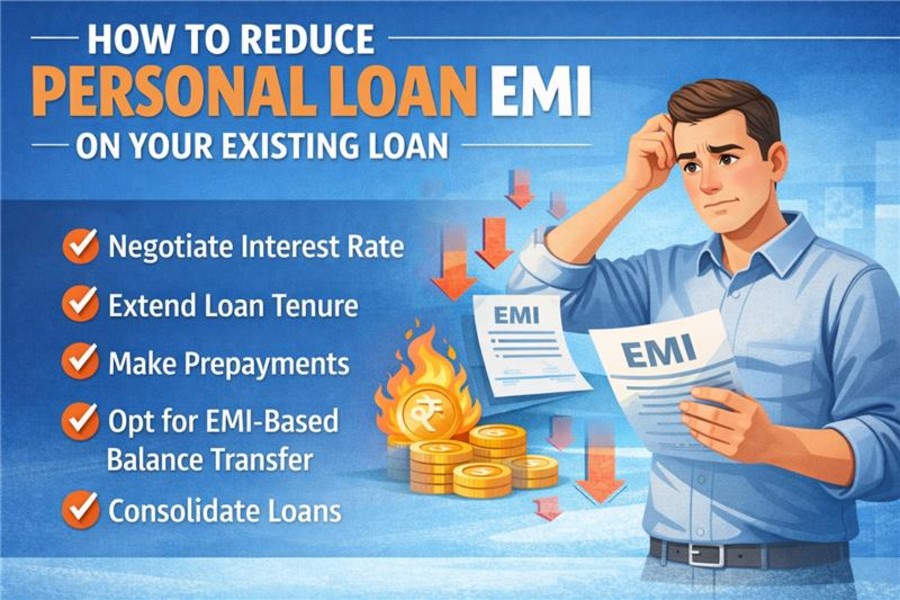
How to Reduce Personal Loan EMI on Your Existing Loan
Managing your personal loan EMI can sometimes become challenging when monthly expenses increase or income changes. Many borrowers seek ways to reduce their monthly payments without compromising their financial stability. The good news is that several practical strategies can help lower your monthly EMI while allowing you to repay the loan comfortably. Before choosing any strategy, it is important to understand how personal loan EMI works and whether you meet the loan eligibility requirements for options such as refinancing or restructuring. Many borrowers also use online tools to estimate their monthly payments and compare different repayment options before making a decision. In this blog, we will discuss simple and effective ways to reduce your personal loan EMI, explain how loan planning tools can help you understand your repayment structure, and explore strategies such as balance transfer, prepayment, and better loan management to make your monthly payments more manageable. 9 Effective Tips to Reduce Personal Loan EMI and Interest Managing a personal loan becomes easier when you know how to reduce both the EMI and the total interest cost. Many borrowers pay higher monthly installments simply because they are clueless about strategies that can lower their EMI burden. Factors such as maintaining a good CIBIL score, making part-prepayments, negotiating a lower interest rate with your lender, or opting for a balance transfer to a lender offering better terms can significantly reduce the overall cost of borrowing. Here are the 9 effective ways to reduce existing personal loan EMI and interest, helping you manage your loan more efficiently and improve your overall financial planning. 1. Transfer Your Loan to a Lower Interest Rate A balance transfer is one of the most common ways to reduce personal loan EMI. In this method, you transfer your outstanding loan to another lender offering a lower interest rate. When the interest rate decreases, your monthly personal loan EMI automatically becomes lower. Many borrowers compare loans from different lenders before transferring their loan. Using an online personal loan EMI calculator lets you compare your current EMI with the new EMI after the transfer. 2. Make Part-Prepayment to Reduce Principal If you receive extra funds from savings, bonuses, or additional income, you can make a lump-sum payment toward your loan principal. Reducing the principal amount decreases the interest charged and lowers future EMIs. Many borrowers use a personal loan calculator with a prepayment option to see how their EMI can be reduced after a partial payment. Example: 10 Lakhs Personal Loan EMI To understand how EMI works, consider an example. Suppose you take a ₹10 lakh personal loan at an interest rate of 11% per year for 5 years (60 months). Your approximate 10 lakh personal loan EMI would be around ₹21,700 per month. If you extend the tenure to 6 years, the EMI reduces to around ₹19,200 per month, but the total interest paid becomes higher. This example shows how tenure and interest rate directly impact your personal loan EMI. Using a personal loan EMI calculator helps you test different scenarios before choosing a repayment strategy. Recent blog: Top 10 Mistakes to Avoid When Applying for a Personal Loan 3. Extend the Loan Tenure Extending the loan tenure spreads the repayment over a longer period, reducing the monthly EMI. Borrowers often use a personal loan EMI calculator in months to test different tenure options and check how the EMI changes. However, while this method reduces monthly payments, the total interest paid over time may increase. 4. Negotiate a Lower Interest Rate If your financial profile has improved, you can negotiate a lower interest rate with your lender. A strong repayment history, stable income, and good credit behavior improve your chances of getting a reduced rate. However, borrowers with a low CIBIL score may find it difficult to negotiate better terms, so maintaining a good credit score is important. Even a small reduction in interest rates can significantly lower your personal loan EMI. 5. Consolidate Multiple Debts If you are paying multiple EMIs on different loans or credit cards, consider consolidating your debt. Debt consolidation combines multiple debts into one single loan with a lower interest rate. This reduces the number of payments and can result in a low EMI personal loan with better repayment terms. Before choosing this option, a proper loan comparison can help you find the most affordable loan. Related blog: What Are the Eligibility Criteria for a Personal Loan? 6. Consider a Flexi Personal Loan A flexi personal loan allows borrowers to withdraw funds as needed and pay interest only on the amount used. This type of loan offers flexible repayment terms and can reduce the monthly EMI burden. It is useful for individuals who require financial flexibility while managing their loan repayments. 7. Use Pre-Approved Personal Loan Options If you have a strong banking history and good repayment track record, lenders may offer a pre-approved personal loan. These loans often come with faster approval, lower interest rates, and flexible repayment options. Borrowers sometimes use a pre approved personal loan to refinance their existing loan and reduce their EMI. 8. Increase EMI When Your Income Increases While the goal is often to reduce EMI, increasing your EMI when your income grows can help you repay the loan faster. Paying higher installments reduces the loan tenure and lowers the total interest cost. A personal loan EMI chart can help you understand how increasing EMI reduces the overall repayment period. Things to Check Before Reducing Your EMI Before applying any EMI reduction strategy, consider the following: Verify your loan eligibility for refinancing or a balance transfer Check if the lender charges a prepayment penalty Compare loan options using loan comparison tools Calculate new EMIs using a personal loan calculator Review your credit score, especially if you have a low CIBIL score These steps ensure that the chosen method actually reduces your financial burden. Related blog: What is the EMI for a 12 Lakh Personal Loan for 5 Years? Conclusion Reducing your personal loan EMI requires careful planning and the right financial strategy. Options such as balance transfer, part-prepayment, tenure extension, debt consolidation, and choosing a flexi personal loan can help lower your monthly payments. Using tools like a personal loan calculator, analyzing a personal loan EMI chart, and checking different scenarios through a personal loan EMI calculator online can help you make informed decisions. By evaluating your loan eligibility, comparing lenders, and exploring options like pre-approved personal loan offers, you can effectively reduce your EMI and manage your loan repayments more efficiently. Plan your loan repayment smarter with LoanQuantum by checking your EMI, interest cost, and tenure options in seconds. Frequently Asked Questions Does increasing the loan tenure reduce personal loan EMI? Yes, increasing the loan tenure can reduce your monthly EMI by spreading the repayment amount over a longer period. However, this may increase the total interest paid during the loan tenure. How does loan comparison help in reducing EMI? Loan comparison lets you compare different lenders, interest rates, processing fees, and repayment terms. Choosing a loan with better terms can help you secure a lower EMI and reduce your total borrowing costs. Is it possible to convert an existing loan into a low EMI personal loan? Yes, borrowers can sometimes convert their loan into a lower EMI option by extending the tenure, refinancing with another lender, or restructuring the loan based on their repayment capacity. How can I repay a 5-year personal loan in 3 years? You can repay a 5-year loan faster by increasing your EMI amount, making regular prepayments, or using extra income such as bonuses to reduce the principal. Paying more than the required EMI reduces the overall interest cost. Is it possible to skip EMI for a few months? Some lenders may offer a temporary EMI moratorium or restructuring option during financial difficulties. However, interest may continue to accrue during this period, potentially increasing the total loan cost.

Flexi Personal Loan: Meaning, Benefits, and How It Works
Managing finances today often requires quick access to funds and flexible repayment options. Traditional personal loans usually provide a fixed amount with fixed EMIs, but modern lending products offer more flexibility. One such option is a flexi personal loan, which allows borrowers to withdraw funds as needed and repay them with flexible payment options. This guide explains the flexi personal loan meaning, how it works, its benefits, repayment process, and important factors such as interest rates, eligibility, and potential drawbacks. What is a Flexi Personal Loan? The flexi personal loan meaning refers to a loan facility where a lender approves a maximum borrowing amount, known as the flexi loan limit. Instead of receiving the full amount at once, the borrower can withdraw money whenever needed within the approved limit. This credit system is often referred to as flexi credit or a flexible credit loan because it allows borrowers to access funds multiple times during the loan tenure. What Is Flexi Loan and How Does It Work? Many borrowers ask what a flexi loan is and how it functions in practice. A flexi loan works like a revolving credit facility. Once approved, the lender provides a fixed borrowing limit. The borrower can withdraw funds multiple times as long as the total amount stays within the flexi limit. The process typically works like this: Loan Approval – The lender approves a maximum credit limit after evaluating the applicant’s financial profile. Withdrawal – Borrowers can make a flexi loan withdrawal whenever funds are required. Interest Calculation – Interest is applied only to the withdrawn amount. Repayment – The borrower repays through flexi EMI options or scheduled instalments. Many lenders also offer instant personal loan approvals for eligible applicants, allowing faster access to funds. Example of Flexi Personal Loan Understanding a loan becomes easier with a simple example. Suppose a lender approves a flexi personal loan of ₹5,00,000. Details Amount Approved Flexi Loan Limit ₹5,00,000 First Withdrawal ₹1,50,000 First Withdrawal Estimate EMI Second Withdrawal ₹50,000 Total Used Amount ₹2,00,000 Interest Charged On ₹2,00,000 In this situation, even though the sanctioned amount is ₹5 lakh, the borrower pays interest only on ₹2 lakh.Borrowers can estimate monthly payments using a personal loan calculator or a flexi loan EMI calculator for accurate personal loan EMI calculation. Types of Flexi Loan Options Different lenders provide variations of flexi loans depending on the repayment structure and withdrawal flexibility. Flexi Term Loan: A flexi term loan allows borrowers to receive a lump sum loan while still maintaining the flexibility to repay and redraw funds within the approved limit. Flexi Credit Loan: A flexible credit loan works similarly to a credit line. Borrowers can withdraw and repay funds repeatedly during the loan tenure. Hybrid Flexi Loan: A hybrid flexi loan combines features of a traditional loan and flexible credit. It may start with regular EMIs and later allow flexible withdrawals. These lending models fall under the broader category of flexi finance, which focuses on providing adaptable financing options to borrowers. Recent blog: Salary-Based Personal Loans: Benefits, EMI Tips & Approval Flexi Loan vs Traditional Personal Loan Understanding the difference helps borrowers decide which option suits them best. Features Flexi Personal Loan Traditional Personal Loan First Withdrawal Withdraw as needed Lump sum amount Interest Charged On Used amount only Full loan amount Repayment Flexible flexi EMI Fixed EMIs Credit Access Multiple withdrawals allowed Single disbursement Best For Ongoing expenses One-time expense Flexi EMI and Personal Loan EMI Calculation One of the most useful features of flexi loans is the flexi EMI. Instead of paying fixed instalments immediately, borrowers may have options such as paying interest-only payments initially or choosing flexible EMIs later. Before applying for a loan, borrowers often estimate their monthly payments using a personal loan calculator. This tool helps perform personal loan EMI calculation based on loan amount, interest rate, and tenure. A flexi loan EMI calculator works similarly, but calculates EMIs based on the withdrawn amount instead of the full loan limit. Flexi Loan Benefits Several advantages make flexi loans attractive to borrowers. Access to Funds Anytime: Once the lender approves the flexi loan limit, borrowers can withdraw funds whenever needed without applying for another loan. Interest on Used Amount Only: Interest is charged only on the amount withdrawn, making it more cost-effective than traditional loans. Flexible Repayment Options: A flexible repayment loan allows borrowers to adjust their repayments according to their financial situation. Quick Loan Availability: Some lenders provide instant personal loan approvals, making funds available quickly for urgent financial needs. Useful Multiple Expenses: Flexi loans are useful for handling medical expenses, travel, education, or home renovation costs. Related blog: Top Benefits of Applying for a Personal Loan Online Flexi Loan Interest Rate and its Factors The flexi loan interest rate varies from lender to lender. In many cases, these rates may be slightly higher than regular personal loans because of the flexibility provided. However, borrowers with a strong financial profile may still qualify for the lowest interest rates offered by lenders. Factors affecting the interest rate include: Credit score Monthly income Loan tenure Employer or business stability Existing financial obligations Borrowers with a Low CIBIL score may still get loan approval from some lenders, although interest rates could be higher. Flexi Loan Withdrawal Process The flexi loan withdrawal process is simple and often available through online banking or mobile apps. Typical steps include: Log in to the lender’s portal or mobile app Select the withdrawal option Enter the required amount Confirm the transaction The amount is then transferred to the borrower’s bank account quickly. Recent blog: The Hidden Costs of Loans: Processing Fees, and Foreclosure Charges Loan Eligibility Criteria for Flexi Personal Loans Every lender has specific loan eligibility criteria, but some common requirements include: Age between 21 and 60 years Stable income source Minimum credit score requirement Valid identification and income documents Meeting these criteria increases the chances of approval and helps borrowers access better loan terms. Disadvantages of Flexi Loan Although flexi loans offer flexibility, borrowers should also consider the disadvantages of a flexi loan. Higher Interest Rates: Some lenders may charge higher interest rates compared to standard loans. Risk of Overspending: Since funds are easily available within the flexi limit, borrowers may withdraw more than necessary. Additional Charges: Certain lenders may charge maintenance or withdrawal fees depending on the loan structure. Understanding these limitations helps borrowers use flexi loans responsibly. Might you have missed: What is the EMI for a 12 Lakh Personal Loan for 5 Years? Popular Flexi Loan Providers Several lenders offer flexi loan facilities in India. One well-known option is the Bajaj Finance Flexi Loan, which allows borrowers to withdraw funds multiple times within the approved limit while paying interest only on the used amount. Another digital lending platform is FlexiLoans, which provides quick business financing solutions. Checking out a flexiloans review before applying can help borrowers understand the platform’s features, interest rates, and customer feedback. Conclusion A flexi personal loan offers a convenient and flexible borrowing option compared to traditional personal loans. Instead of borrowing a fixed amount and paying interest on the entire sum, borrowers can withdraw funds as needed and pay interest only on the amount used. Understanding the flexi loan meaning, repayment structure, and eligibility requirements helps borrowers choose the right financing option. When used responsibly, flexi loans can be an effective financial tool for managing expenses and maintaining cash flow. Need a flexible loan option? Visit LoanQuantum to compare lenders, check eligibility, and find the best flexi personal loan with competitive interest rates. Frequently Asked Questions What is the difference between a flexi loan and a personal loan? The main difference is flexibility. In a traditional personal loan, borrowers receive the full amount at once and pay EMIs on the total amount. In a flexi personal loan, borrowers withdraw money as needed, and interest is charged only on the used amount. What is a flexi loan repayment? Flexi loan repayment allows borrowers to repay through flexible EMIs, interest-only payments, or regular instalments, depending on the lender’s terms. Can I get an instant personal loan with a flexi facility? Yes, many lenders now offer instant personal loan approvals with flexible withdrawal options for eligible applicants. How do I calculate EMI for a flexi loan? Borrowers can estimate their repayments using a personal loan calculator or a flexi loan EMI calculator, which helps perform an accurate personal loan EMI calculation. Can I get a flexible loan with a low CIBIL score? Some lenders may approve applications even with a Low CIBIL score, but the flexi loan interest rate may be higher compared to borrowers with strong credit profiles.

Top 10 Mistakes to Avoid When Applying for a Personal Loan (Complete Guide)
A personal loan is one of the most suitable ways to manage unpredictable expenses, reduce debt, or fund major life events. Since personal loans are unsecured, lenders carefully evaluate borrowers before approving a loan. Factors like credit score, income stability, existing debt, and repayment history play a major role in determining loan eligibility. However, many borrowers rush into the application process without proper research. These mistakes can lead to loan rejection, higher interest rates, or financial stress during repayment. If you plan to apply for a personal loan, understanding these common mistakes can help you avoid unnecessary complications and secure better loan terms. This detailed guide explains the top common mistakes borrowers make and practical solutions to avoid them. Why Avoiding Personal Loan Mistakes Is Important Applying for a personal loan without utilizing a personal loan calculator can lead to: Loan rejection Higher interest rates Financial strain due to high personal loan EMI Damage to your credit score Understanding the right process and evaluating your personal loan eligibility before applying can improve your chances of approval and help you borrow responsibly. Mistake 1. Not Checking Personal Loan Eligibility Before Applying One of the most common mistakes borrowers make is applying for a loan without verifying their loan eligibility. Every lender has different eligibility requirements based on income, credit score, employment stability, and debt-to-income ratio. Applying unthinkingly, without checking eligibility, increases the risk of rejection. Key Factors That Affect Loan Eligibility 1. Credit Score2. Monthly Income3. Employment Stability4. Existing EMIs5. Age Solution Before you apply for a personal loan, check your eligibility by reviewing the lender requirements. Using a personal loan calculator can also help you estimate your EMI based on the loan amount and tenure. This helps you understand whether the loan fits within your financial capacity. Related blog: Top Benefits of Applying for a Personal Loan Online Mistake 2. Ignoring Your Credit Score Your credit score is one of the most important factors lenders consider before approving personal loans. Many borrowers apply without reviewing their credit score and later discover that their score is too low for approval. A low credit score may result in: Loan rejection Higher interest rates Lower approved loan amount Solution Check your credit score before applying. If your score is low, take steps to improve it: Pay credit card bills on time Avoid missing EMIs Reduce credit utilization Clear outstanding debts Small improvements in your credit score can significantly improve your loan eligibility. Related blog: Get an Instant Personal Loan with a Low CIBIL Score Mistake 3. Applying to Multiple Lenders at the Same Time Many borrowers think applying to multiple lenders increases the chances of approval. However, this can have the opposite consequences. Each loan application creates a hard inquiry on your credit report. Multiple inquiries within a short period may indicate financial distress and reduce your chances of approval. Solution Instead of applying everywhere, perform a proper loan comparison. Compare: Interest rates Processing fees Loan tenure EMI amount Prepayment charges After comparing lenders, apply to the one offering the best loan terms. Mistake 4. Not Using a Personal Loan Calculator The biggest mistake for first-time personal loan borrowers is applying for a loan without EMI calculation in advance. This often leads to selecting a loan amount or tenure that results in high monthly payments. Without proper EMI planning, borrowers may struggle to manage repayments. Solution A personal loan calculator helps estimate: Monthly EMI Total interest payable Total loan repayment amount Example EMI Calculation Loan Amount Interest Rate Tenure Personal Loan EMI ₹3,00,000 12% 3 Years ₹9,964 ₹5,00,000 12% 5 Years ₹11,122 ₹7,00,000 12% 5 Years ₹15,932 Using a personal loan calculator before applying allows you to choose a comfortable EMI based on your monthly income. Mistake 5. Borrowing More Than Necessary Since personal loans are flexible, lenders may offer higher loan amounts than what you actually need. Many borrowers accept the full amount without considering the repayment burden. Higher loan amounts lead to: Higher personal loan EMI Increased interest cost Longer repayment period Solution Borrow only the amount you truly need. A smaller loan amount reduces financial stress and lowers the overall interest paid. Financial experts recommend that total EMI payments should not exceed 35–40% of your monthly income. Mistake 6. Ignoring the Total Cost of the Loan Interest rates are important, but it is not the only cost associated with a loan. Many borrowers focus just on lowest interest rates and neglect other fees. These charges may include: Processing fees Documentation charges Late payment penalties Prepayment charges Foreclosure fees Solution Perform a detailed loan comparison that includes both interest rates and additional charges before choosing a lender. Recent blog: How to Save Money with a Personal Loan EMI Calculator Mistake 7. Choosing the Wrong Loan Tenure Loan tenure plays a critical role in determining your personal loan EMI and total interest cost. Short tenure → Higher EMI but less interest Longer tenure → Lower EMI but greater interest Many borrowers choose longer tenures to reduce their EMIs, thereby significantly increasing the total interest paid. Example Loan Amount Tenure EMI Total Interest Paid ₹5,00,000 3 Years ₹16,607 ₹97,852 ₹5,00,000 5 Years ₹11,122 ₹1,67,320 Solution Use a personal loan calculator to test different tenure options and choose one that balances EMI affordability and total interest cost. Mistake 8. Ignoring Pre-Approved Personal Loan Offers Many banks offer pre-approved personal loan options to existing customers based on their credit history and banking relationships. Borrowers often overlook these offers and apply elsewhere. Benefits of Pre-Approved Loans Faster approval process Minimal documentation Higher approval chances Sometimes, better interest rates Solution Before applying elsewhere, check whether your bank offers a pre-approved personal loan through: Mobile banking app Net banking account Email or SMS notifications This can speed up and simplify the application process. Mistake 9. Submitting Incorrect or Incomplete Documents Documentation errors are a common cause of loan delays or rejections. Many borrowers submit incomplete or inconsistent information. Common Documentation Mistakes Incorrect income proof Missing bank statements Address mismatch Outdated documents Solution Prepare the required documents before you apply for a personal loan. Typical documents required include: PAN card Aadhaar card Salary slips or income proof Bank statements (last 3–6 months) Employment details Providing accurate documentation ensures faster approval. Mistake 10. Not Planning EMI Repayment Properly Loan approval is only the first step. Many borrowers fail to plan their personal loan EMI repayment properly. Missing EMI payments can result in: Late payment penalties Lower credit score Difficulty getting future loans Solution Before applying for a loan: Ensure EMI fits comfortably in your budget Maintain emergency savings Set automatic EMI payments Proper planning ensures smooth repayment throughout the loan tenure. Smart Checklist Before Applying for a Personal Loan Steps What You Should Do Check credit score Ensure score above 700 Review personal loan eligibility Confirm income and job stability Use personal loan calculator Estimate EMI Perform loan comparison Compare lenders carefully Choose suitable tenure Balance EMI and interest cost Check pre-approved personal loan offers Faster approval Prepare documents Avoid delays Final Thoughts Applying for a personal loan is simple, but making the wrong decisions can create long-term financial stress. Understanding your personal loan eligibility, calculating EMI using a personal loan calculator by LoanQuantum, and conducting a detailed loan comparison are essential steps before applying. Borrow responsibly, choose the right tenure, and ensure your personal loan EMI fits comfortably within your monthly budget. By avoiding these common mistakes, you can secure the best personal loans while maintaining financial stability. Don’t let common mistakes delay your approval. Compare lenders, calculate your EMI with the LoanQuantum, and apply for a personal loan confidently. Frequently Asked Questions What is the ideal credit score to apply for a personal loan? Most lenders prefer a credit score of 700 or above for approving personal loans with competitive interest rates. Can I apply for a personal loan without income proof? Some lenders offer loans with minimal documentation, but income proof is usually required to determine loan eligibility and repayment capacity. How does a personal loan calculator help borrowers? A personal loan calculator helps estimate personal loan EMI, total interest payable, and total repayment amount before applying. Is a pre-approved personal loan better than a regular loan? A pre-approved personal loan usually offers faster approval, minimal documentation, and higher chances of approval for existing customers. Can I increase my personal loan eligibility? Yes. You can improve personal loan eligibility by increasing income, reducing existing debts, improving your credit score, or applying with a co-applicant.

How to Apply for a Personal Loan as a Student in 2026: A Complete Guide
From tuition and study materials to accommodation and daily living expenses, students often face financial pressure. While education loans continue to help cover academic costs, personal loans for students 2026 offer a faster, more flexible way to access instant cash for urgent needs. With the rise of digital lending platforms, students can now apply online and receive quick, collateral-free approval—often without needing a co-signer. Many lenders provide student personal loans with flexible repayment options and minimal documentation, making the borrowing process simple and convenient. In this blog, we will discuss students' personal loan eligibility requirements, step-by-step application procedures online, and practical tips for responsible borrowing to manage tuition, travel, or living expenses effectively. Why Students Sometimes Need Personal Loans Students may require financial support for many reasons beyond tuition fees. Some of the most typical situations are: Paying college or course fees Purchasing laptops or study equipment Covering rent or hostel costs Managing emergency medical expenses Paying for certification programs or skill courses In such situations, an instant personal loan for students can provide quick financial support without lengthy approval procedures. Some lenders also provide small loans for students, which are suitable for short-term financial needs. Can a Student Get a Personal Loan? A common question many students ask is: Can a student get a personal loan without income? The answer depends on the lender’s requirements. In most cases, students can apply for loans if they meet certain basic conditions, such as: Minimum age requirement Valid identification documents Bank account details Enrollment in a recognised institution Some lenders even offer personal loans for students with no job, especially when a parent or guardian is added as a co-applicant. Students who need quick financial support may also explore instant loans for students through digital lending platforms. Related blog: Why Every Student Should Use a Study Loan Calculator Before Borrowing Understanding Student Loan Requirements Before applying for any loan, it is important to understand the basic student loan requirements set by lenders. Most lenders typically ask for: Identity proof (Aadhaar, PAN, Passport) Address proof Student ID or admission letter Bank account details Co-applicant information (if required) These documents help lenders evaluate your loan eligibility and verify your identity. Age Requirements and Loan Eligibility for a Student Age plays an important role when applying for a loan. In many cases, age affects personal loan approval because lenders consider financial maturity and repayment capacity. Typical requirements include: Minimum age: 18 or 21 years Maximum age: usually between 60 and 65 Students below 18 usually cannot borrow loan independently. For loans under 18, a parent or guardian typically applies as the primary borrower. Difference Between Personal Loan and Education Loan for Students Features Personal Loan for Students Education Loan for Students Purpose Can be used for any personal expense such as laptop purchase, rent, travel, or small emergencies. Used strictly for education-related expenses like tuition fees, books, hostel fees, and study abroad costs. Eligibility Some lenders offer personal loans for students with no job, but a co-applicant may be required. Requires confirmed admission to a recognized college or university and usually a co-borrower (parent/guardian). Interest Rate Usually higher because it is an unsecured multipurpose loan. Generally lower since it is designed specifically for education. Loan Amount Usually, smaller loan amounts are suitable for urgent or short-term needs. Larger loan amounts that can cover full course fees and other education expenses. Repayment Start EMI repayment usually starts immediately after the loan is disbursed. Offers a moratorium period; repayment starts after course completion or after getting a job. Approval Time Faster approval, especially through instant personal loan apps. Slower approval due to documentation and verification of admission. Documentation Minimal documentation compared to education loans. Requires more documents like admission letter, academic records, and fee structure. Government Benefits No government subsidies or schemes. Some education loans may include government subsidies or special student schemes. Best For Small loans, urgent financial needs, or short-term expenses. Funding higher education, professional courses, or studying abroad. How to Apply for a Personal Loan as a Student If you are trying to understand how to get a personal loan for a student, the process is usually straightforward when done online. 1. Determine Your Financial Need: First, calculate how much money you require. Borrowing responsibly helps reduce repayment stress later. 2. Compare Lenders Carefully: Before applying, perform a proper loan comparison. Look at: Interest rates Processing fees Repayment tenure Customer reviews Choosing lenders that offer the lowest interest rates can significantly reduce the total cost of borrowing. 3. Choose a Reliable Loan Platform: Students can apply through banks, NBFCs, or digital platforms. Many fintech companies provide an instant personal loan app for students designed specifically for young borrowers. Selecting the best loan app can make the process smoother and faster. 4. Apply Online: Most lenders now allow applicants to apply for a personal loan online by filling out a digital application form and uploading the required documents. 5. Complete Verification: After submission, lenders verify your information and evaluate your loan eligibility. 6. Loan Approval and Disbursement: Once accepted, the funds are paid instantly to your bank account. Some lenders offering urgent loans for students may disburse funds within a few hours. Benefits of Personal Loans for Students Personal loans for students provide a flexible and convenient way to access funds for education and daily expenses. These loans are usually unsecured, meaning students do not need to provide collateral to borrow money. With the growth of digital lending platforms, students can receive quick approval and fast disbursement, helping them manage tuition fees, accommodation, study materials, and other urgent expenses without delay. Fast Approval: Many lenders offer fast approval and quick disbursement through digital applications. Compared to traditional bank loans, the process is faster, and students can receive funds within a short period after verification. Flexible Usage: One of the biggest advantages of personal loans for students is flexible usage. Unlike education loans that are limited to academic expenses, these loans can be used for tuition, accommodation, travel, study materials, or other living costs. Online Convenience: Students can easily apply for a personal loan online using digital platforms or loan apps. The entire process—from application to document submission and verification—can be completed digitally, making borrowing faster and more convenient. Smaller Loan Options: Students who require limited funds can choose small loans for students, which usually come with shorter repayment tenures and manageable monthly payments. Flexible Repayment: Most lenders offer flexible repayment options, typically ranging from 12 to 60 months, allowing students to choose a tenure that suits their financial situation. Credit Score Benefits: Timely repayment of student personal loans can help build a positive credit score, which can be beneficial for future financial needs. Related blog: Calculate Your Loan Amount Easily Online Important Things to Consider Before Borrowing While personal loans can be helpful, students should also consider the risks involved. Interest Rates: Short-term loans may carry higher interest rates compared to traditional student loans. Repayment Responsibility: Unlike many education loans, personal loans typically require immediate monthly repayments. Impact on Credit Score: Missing payments can negatively affect your credit history, making future borrowing more difficult. Borrowing responsibly and planning repayments carefully is essential. Tips for Students Applying for Loans Students can increase their chances of instant personal loan approval by following a few important steps before applying. Considering these points can help students get better loan terms and a smoother borrowing experience. Research and Compare Lenders: Always compare multiple lenders to check interest rates, processing fees, and repayment options before applying. Understand Loan Options: Choose between secured and unsecured personal loans depending on your financial situation and eligibility. Apply with a Co-applicant: If you do not have a steady income, applying with a co-applicant or co-signer can improve approval chances. Maintain Good Banking History: A strong banking record and credit profile help lenders assess your repayment ability. Prepare Required Documents: Keep essential documents ready, such as identity proof, address proof, income proof, and admission letters. Borrow Only What You Need: Apply only for the required loan amount to avoid unnecessary financial burden. Check Eligibility Before Applying: Ensure you meet the age, income, and credit requirements set by lenders. Choose Reliable Digital Lenders: Select trusted digital lending platforms that offer transparent terms and faster processing. Plan Your Repayment: Understand the repayment tenure or grace period and plan your payments to avoid defaults. Following these tips can help students secure better loan approval chances and more favourable repayment terms. Recent blog: What is the EMI for 12 Lakh Personal Loan for 5 Years? Final Thoughts Financial challenges are common during student life, but modern lending options have made it easier to access funds when needed. Whether you need help covering academic expenses or managing urgent costs, personal loans for students can provide a flexible solution. If you are exploring how to apply for student loans or considering alternatives like personal loans, taking time to research and compare options will help you make the right decision. Looking for the best personal loan calculator? Explore LoanQuantum for loan eligibility checks, interest rates, comparing loans, and hassle-free digital applications. Frequently Asked Questions Can students apply through urgent loan apps? Yes, some digital platforms offer an urgent loan app for students, designed for emergency financial needs. These apps focus on faster processing and may provide small loan amounts with shorter repayment periods. Can a student get a personal loan in India? Yes, students can apply for personal loans if they meet basic lender requirements such as minimum age, valid ID proof, and a bank account. Some lenders may also require a co-applicant, especially if the student does not have a stable income. Do students need a credit score to get a loan? Not always. Some lenders offer personal loans for students with no job or limited credit history by evaluating other factors such as bank transactions, academic enrollment, or a co-applicant’s credit profile. Is a personal loan a good option for higher education? A personal loan for higher education can help cover expenses if other funding options are unavailable. However, students should carefully review interest rates and repayment terms before applying. How do lenders decide the interest rate for student personal loans? Lenders calculate interest rates based on factors such as credit profile, repayment ability, loan amount, and tenure. Students should always compare lenders to find loans offering the lowest interest rates.

Pay Off Your Personal Loan Early: Foreclosure Charges, Steps & Benefits
Many borrowers take a personal loan to manage urgent expenses such as medical bills, travel, education, or debt consolidation. Before applying for a loan, it is always advisable to check your loan eligibility, compare lenders, and use a Personal loan calculator to understand your EMI obligations. Today, many lenders also offer pre-approved loan options and salary-based personal loan offers that allow for faster approvals. However, once your financial situation improves, you should pay off the loan early to save on interest. This process is called loan foreclosure or personal loan closure before the tenure ends. But before you decide to preclose your loan, it is important to understand the foreclosure charges on a personal loan, the process involved, and how it affects your finances. In this guide, we explain what loan foreclosure is, what foreclosure fees mean, and how to close a personal loan early, with practical examples. What Is Loan Foreclosure? Many borrowers ask what a foreclosure is in a loan. Loan foreclosure means repaying the entire outstanding loan amount before the loan tenure ends. Once the remaining principal and applicable charges are paid, the lender completes the loan closing and closes the loan account. In short, a foreclosed loan means clearing your loan early instead of continuing with monthly EMIs. For example, if you took a 5-year personal loan but repaid the remaining balance in 3 years, that process is called loan foreclosure. Borrowers who improve their income or receive a pre-approved loan offer with better interest rates sometimes choose foreclosures to reduce their financial burden. What Are Foreclosure Charges? Before opting for early repayment, it is important to understand foreclosure charges. These are fees charged by lenders when a borrower decides to repay the entire loan amount before the agreed loan tenure ends. When you take a loan, lenders expect to earn interest throughout the loan period. However, if you choose to close a personal loan earlier than scheduled, the lender loses the interest they would have earned on the remaining tenure. To compensate for this loss, lenders apply foreclosure charges on personal loans. These charges are usually calculated as a percentage of the outstanding loan principal at loan closing. Foreclosure Fees Meaning Foreclosure fees are penalties or processing fees charged by lenders when a borrower closes a loan before its maturity date. Most banks and NBFCs in India typically charge 2% to 5% of the outstanding principal amount as foreclosure charges when you decide to preclose or foreclose your personal loan. Understanding these charges in advance helps borrowers make better decisions when planning a loan closing. Related blog: What Are the Eligibility Criteria for a Personal Loan? Example: Understanding Personal Loan Foreclosure Charges Suppose you took a personal loan of ₹5,00,000 for 5 years at 12% interest. Before taking the loan, you checked your loan eligibility, compared lenders using loan comparison tools, and selected a lender offering a salary-based personal loan. After 3 years, your outstanding balance becomes ₹2,00,000. If your lender charges 3% personal loan foreclosure charges, then: Outstanding loan amount: ₹2,00,000 Foreclosure charges (3%): ₹6,000 Total amount to pay for loan closing: ₹2,06,000 After paying this amount, your personal loan closure will be processed. Steps to Close a Personal Loan Early If you are planning to close your personal loan early, follow these steps. 1. Check Loan Terms Read the loan agreement to understand: Pre closure charges for personal loan Lock-in period Eligibility for EMI foreclosure Many lenders allow foreclosure only after 6–12 months of repayment. Borrowers with a low CIBIL score may sometimes receive loans with stricter foreclosure conditions. 2. Calculate Outstanding Amount Use a personal loan closure calculator to determine: Remaining principal Interest payable Foreclosure charges This helps you understand the exact loan closing amount. 3. Submit a Loan Close Application You must submit a loan close application to the lender. This can be done through: Bank branch Online banking portal Customer support request Once submitted, the lender will generate a loan foreclosure statement. 4. Pay Outstanding Amount The loan foreclosure statement will include: Outstanding principal Interest till date Pre closure charges Taxes (if applicable) After payment, the lender processes the personal loan closure. 5. Collect Loan Closure Documents After the loan closing, collect the following documents: No Objection Certificate (NOC) Loan closure confirmation Updated credit report status This ensures that the loan foreclosure is properly recorded in your credit history. Related blog: Top Reasons Why Your Loan Application Might Get Rejected Example: EMI Foreclosure Savings Let’s see how EMI foreclosures can help you save money. You took: Personal Loan: ₹3,00,000 Interest Rate: 13% Tenure: 4 years Total interest payable during the tenure = approx. ₹86,000. After 2 years, you decide to preclose the loan. Remaining principal = ₹1,40,000 If foreclosure charges on personal loan are 3%: Foreclosure charges = ₹4,200 Total payment = ₹1,44,200 But by closing the loan early, you save nearly ₹35,000 in future interest. This is why many borrowers choose to foreclose their loans when their financial situation improves. Benefits of Personal Loan Foreclosure 1. Save Interest Cost: By choosing loan foreclosure, you avoid paying interest for the remaining tenure. 2. Become Debt-Free Faster: Completing personal loan closure reduces financial burden and improves cash flow. 3. Improve Credit Profile: A properly completed loan closing with timely payments can improve your creditworthiness. Even borrowers with a low CIBIL score can gradually improve their credit profile by responsibly managing their loans. 4. Better Financial Planning: Once the loan is closed, you can redirect your EMI amount toward savings, investments, or other financial goals. Recent blog: Top Benefits of Applying for a Personal Loan Online Things to Check Before Pre-Closing a Loan Before choosing pre closure, evaluate these factors: Pre closure charges for personal loan Remaining tenure Savings on interest Impact on your liquidity Sometimes, if the foreclosure charges are high and the loan tenure is almost over, foreclosure may not be beneficial. Using a Personal loan calculator can help you make the right decision. When Should You Consider Loan Foreclosure? You should consider loan foreclosure when: You receive a bonus or lump sum income Interest savings are significant Your financial goals require lower liabilities Foreclosure charges on personal loans are minimal Before deciding, comparing loans and considering alternative options, such as refinancing or switching lenders, can also help optimize your financial strategy. Recent blog: NBFC vs Bank Personal Loan: Which Is Better for Quick Approval? Conclusion Loan foreclosure can help you save interest and become debt-free faster by completing your personal loan closure before the tenure ends. However, before proceeding with loan closing, it is important to check the foreclosure charges on personal loans, including pre-closure charges, as these may affect your total savings. Using tools like a personal loan closure calculator can help you estimate the outstanding amount and EMI foreclosure cost. If the interest savings exceed the foreclosure costs, preforeclosing on your loan can be a smart financial decision that improves your overall financial stability. Planning to close your loan early? Use the Personal Loan Calculator on LoanQuantum to estimate foreclosure charges and make smarter financial decisions. Frequently Asked Questions Can I foreclose my personal loan before the tenure ends? Yes, most lenders allow you to foreclose a personal loan after paying a certain number of EMIs. However, the lender may charge a fee foreclosure depending on their policy. When is the best time to foreclose a personal loan? The best time to foreclose a personal loan is after you have paid a significant portion of the EMIs, as this reduces the interest burden and makes the foreclosure charges more manageable. Does closing a personal loan early improve my credit score? Yes, responsible repayment and early closure can positively impact your credit history reported by agencies like TransUnion and CIBIL, provided there are no missed EMIs. How long does it take to complete a personal loan foreclosure? Once you submit the foreclosure request and pay the outstanding amount, the loan closure process usually takes 3–7 working days. Can I close my personal loan online? Yes, many lenders allow borrowers to request personal loan closure online or via mobile banking.
Personal Loan Interest Rate vs Gold Loan Interest Rate: Which Loan Is Better?
When individuals need quick financial support for expenses such as medical emergencies, travel, education, or home repairs, choosing the right loan option becomes important. Two common borrowing options are personal loans and gold loans, both offering fast access to funds but with different interest rates, loan terms, and requirements. One of the most common comparisons borrowers make is the personal loan interest rate vs gold loan interest rate. Gold loans usually come with lower interest rates because they are secured by gold as collateral. In comparison, personal loans typically have higher interest rates since they are unsecured and depend on factors such as credit score and income. In this guide, we will discuss the personal loan vs gold loan interest rate, the key differences between gold loans and personal loans, typical interest rate ranges, processing speed, tenure, credit score requirements, and risks. We will also explain how borrowers can estimate repayments using tools such as a personal loan calculator and a gold loan calculator to better understand monthly EMI and overall loan costs before choosing the most suitable loan option. What is meant by personal loan? A personal loan is an unsecured loan offered by banks and other financial institutions that do not require collateral. Approval is typically based on your income, credit score, and repayment ability. Before approving a personal loan, lenders consider your loan eligibility based on several factors, including income level, employment stability, and existing financial obligations. Key Features of Personal Loan No collateral required Funds can be used for almost any purpose Fixed EMI repayments Flexible loan tenure Online application and quick processing Borrowers often seek lenders offering the lowest interest rates to reduce their overall repayment burden. Using a personal loan EMI calculator help estimate the monthly payment and total interest payable before applying. Example Suppose Rahul needs ₹4,00,000 for medical expenses. He applies for a personal loan because he does not want to sell his assets. After checking his personal loan eligibility, the bank approves a 4-year loan. If the interest rate offered is 13% per year, Rahul can estimate his EMI using a personal loan EMI calculator before accepting the loan. Many borrowers search for lenders offering the lowest interest rates, so their monthly repayments remain affordable. Related blog: Top Benefits of Applying for a Personal Loan Online What is a Gold loan in simple words? A gold loan is a secured loan where you pledge gold jewellery or coins as collateral to get funds. The lender provides a loan based on the gold’s value, weight, and purity. Since its secured, quick loan approval, and interest rates are lower. You retain ownership of your gold, which is returned after repaying the loan with interest. Key Features of a Gold Loan Gold jewellery used as collateral Quick loan approval Lower interest rates compared to many unsecured loans Minimal documentation Flexible repayment options To apply for this type of loan, borrowers must meet gold loan eligibility criteria, which usually include owning gold jewellery of acceptable purity and providing basic identification documents. Example Suppose Anita owns 60 grams of gold jewellery and needs ₹2,50,000 for business requirements. Instead of applying for a personal loan, she pledges her gold to a lender. Based on the gold value and purity, the lender approves a loan of ₹2,50,000 at 9% interest. Anita can estimate the interest payable using a gold loan interest calculator before finalizing the loan. Related blog: How to Get the Lowest Gold Loan Interest Rates? Difference: Personal Loan vs Gold Loan Interest Rates Interest rates are one of the most important factors when choosing between these two loan options. Features Personal Loan Gold Loan Loan Type Unsecured Secured Collateral Not required Gold jewellery Interest Rate Usually higher Often lower Approval Process Based on credit profile Based on gold value Documentation Moderate Minimal When you compare the loan options carefully, you may notice that gold loans often have lower interest rates because they are backed by collateral. However, personal loans provide greater flexibility since they do not require pledging any assets. How Personal Loan Interest is Calculated in India? In India, personal loan interest is usually calculated using the Reducing Balance Method, which means interest is charged only on the outstanding principal rather than the full loan amount. This helps reduce the overall interest burden as the principal decreases with each EMI. Each EMI (Equated Monthly Instalment) includes both the principal and interest, with the interest portion decreasing and the principal portion increasing over time. The formula for EMI calculation depends on the loan amount (principal), the monthly interest rate, and the loan tenure in months. Interest rates on personal loans typically range from 10% to 20% per annum, influenced by factors like credit score, income, and repayment history. Besides interest, personal loans may include processing fees, GST, and prepayment charges. Using a personal loan EMI calculator, borrowers can easily estimate their monthly repayment amount and total interest payable, helping them plan their finances before taking a loan. Key factors that influence the EMI amount: Loan amount Interest rate Loan tenure Borrowers often use a personal loan interest rate calculator to estimate their monthly payments. This tool simplifies the calculation of personal loan interest rates and helps borrowers plan their budgets more effectively. Related blog: Personal Loan EMI Calculated Guide How Gold Loan Interest Is Calculated Gold loan interest is calculated based on the loan amount sanctioned against the pledged gold and the lender's interest rate. Borrowers often use a gold loan interest calculator to estimate the cost of borrowing before taking a loan. A gold loan interest rate calculator helps determine: Interest paid during the loan's term Total repayment amount Different repayment options are available Many lenders also offer gold loan interest rates, so borrowers can easily compare offers from different lenders. Related blog: How to Calculate Gold Loan Interest Rates Can You Get a Loan with a Low Credit Score? One major advantage of gold loans is that they can be a good option for borrowers with a Low CIBIL Score. Since gold loans are secured, lenders focus more on the value of the pledged gold rather than the borrower's credit history. This makes gold loans accessible to individuals who may struggle to qualify for unsecured loans. On the other hand, personal loans usually require a stronger credit profile to qualify for better interest rates and higher loan amounts. Advantages of Personal Loans No Collateral Requirement: Borrowers do not need to pledge assets such as gold or property. Flexible Usage: Funds can be used for medical emergencies, education, travel, or home renovation. Higher Loan Amounts: Depending on income and credit profile, lenders may offer larger loan amounts. Structured Repayment: Monthly EMIs make long-term repayment planning easier. Related blog: NBFC vs Bank Personal Loan: Which Is Better for Quick Approval? Advantages of Gold Loans Lower Interest Rates: Gold loans often offer more competitive rates compared to unsecured loans. Faster Processing: Approval and disbursement can happen quickly because the loan is secured. Minimal Documentation: Most lenders require only basic identity and address proof. Easier Approval: Meeting gold loan eligibility requirements is usually simpler than meeting personal loan eligibility requirements. Which Loan Is Best for You: Personal Loan or Gold Loan? Choosing between these two options depends on your financial needs and available assets. Personal Loan May Be Better If You do not want to pledge gold You meet the personal loan eligibility criteria You require a greater borrowing amount. You want flexible use of money. Gold Loan May Be Better If You need funds urgently You want a lower interest cost You have idle gold jewellery You want easier approval, even with a limited credit history Before applying, it is always helpful to compare the loan offers using calculators and lender comparisons. Conclusion Personal loans and gold loans both provide fast access to funds, but they serve different financial needs. Personal loans offer flexibility and do not require collateral, while gold loans provide quicker approval and often lower interest rates. Understanding your loan eligibility, checking repayment affordability, and comparing lender offers can help you choose the right borrowing option. Using LoanQuantum's loan calculators and carefully reviewing interest rates ensures you select a loan that fits your financial situation without creating unnecessary repayment pressure. Make smarter borrowing decisions with LoanQuantum. Compare loan options, check eligibility, and calculate your EMI before you apply. Frequently Asked Questions What Documents Do You Need for a Personal Loan Application? Most lenders require identity proof, address proof, income proof (salary slips or bank statements), and employment details when applying for a personal loan. What documents are needed for a gold loan? To apply for a gold loan, borrowers usually need basic identity and address proof, as well as gold jewellery for valuation. The documentation process is generally simpler than that of unsecured loans. Is it possible to renew or extend a gold loan? Yes. Many lenders allow borrowers to renew or extend the tenure of a gold loan by paying the interest due or restructuring the repayment plan. Is gold loan interest calculated monthly or yearly? Gold loan interest is typically calculated annually but charged monthly, depending on the repayment plan chosen by the borrower. How quickly can a personal loan or gold loan be approved? Gold loans are usually approved much faster than personal loans. Since gold loans are secured collateral, lenders only need to verify the gold purity and value. Personal loans may take longer because lenders check credit score, income proof, and loan eligibility before approval.
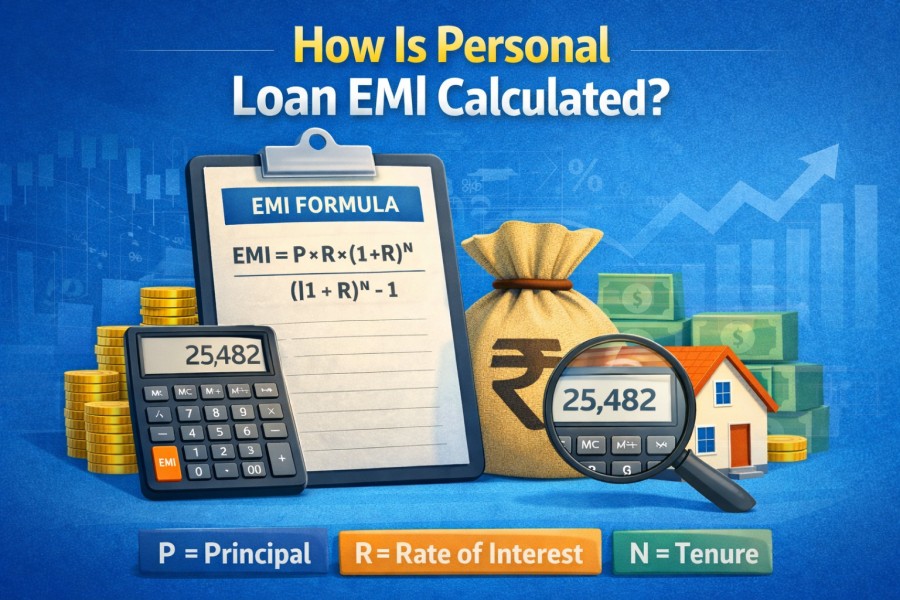
How Is Personal Loan EMI Calculated?
Personal Loan EMI is calculated using a standard mathematical formula that considers the loan amount, interest rate, and repayment tenure. The formula distributes the total payable amount (principal + interest) into equal monthly installments over the selected loan period. Calculating the EMI for a personal loan can be complex because it depends on several factors such as loan amount, interest rate, and tenure. For individuals who are not familiar with the detailed EMI calculation process, manual computation can be confusing and time-consuming. In such cases, a personal loan interest rate calculator is highly useful. It performs advanced monthly installment estimations instantly, helping save valuable time. It reduces the risk of calculation errors and ensures accurate results. It helps borrowers plan their repayment strategy in advance by providing precise and reliable figures. What Is Personal Loan EMI? A Personal Loan EMI (Equated Monthly Installment) is the fixed monthly payment a borrower makes to repay a personal loan over the selected repayment period. Each EMI consists of two parts: a portion of the principal amount and the applicable interest. The EMI amount is determined using a standard calculation formula based on the total loan amount, interest rate, and loan tenure. Because the installment remains consistent throughout the repayment term, borrowers can plan their monthly budget with confidence, knowing the exact amount payable until the loan is completely repaid. Must Read: Personal Loan vs Credit Card Which One You Choose What Is the Formula to Calculate EMI? Calculating the EMI for a personal loan involves applying a standard formula that is commonly used across all online EMI calculators. Loan Quantum personal loan EMI calculator follows this widely accepted calculation method to provide an accurate estimate of the monthly installment payable on your loan. Meaning of P, R, and N in EMI Formula The interest rate (R) must be converted into a monthly rate by dividing the annual rate by 12 before applying the formula. EMI = [P × R × (1+R)^N] / [(1+R)^N − 1] EMI, Equated Monthly Payment P - Principal amount R - Rate of interest N - Tenure This personal loan EMI calculator formula can be used to obtain the EMI for any loan amount. Example of Personal Loan EMI Calculation For a ₹5 lakh personal loan at 11% interest for 60 months, the EMI is calculated using the standard EMI formula, resulting in a monthly installment of ₹10,871 and a total interest payable of ₹1,52,273 over the loan tenure. Loan Amount (P) Annual Interest Rate Tenure (N) Monthly EMI Total Interest Payable ₹1 Lakh 10.75% 12 months ₹ 8,827 ₹ 5,924 ₹1 Lakh 10% 60 months ₹ 2,124 ₹ 27,440 ₹5 Lakhs 11% 60 months ₹ 10,871 ₹ 1,52,273 ₹10 Lakhs 12% 60 months ₹ 22,244 ₹ 3,34,640 ₹15 Lakhs 13% 60 months ₹ 34,130 ₹ 5,47,800 ₹5 Lakh Loan Example A ₹5 lakh personal loan is suitable for individuals who have clear financial requirements and the repayment capacity to manage monthly installments comfortably. Since it is a considerable loan amount, it should be taken after careful financial planning. Below are the categories of borrowers for whom it is most appropriate: Salaried individuals with consistent income: Those earning ₹50,000 or more per month with stable employment can use a ₹5 lakh loan to manage significant expenses without disturbing their long-term savings. It works well for borrowers who can easily accommodate EMIs within their monthly budget. Families preparing major expenses: Costs related to weddings, medical emergencies, overseas travel, or higher education may exceed available savings. A ₹5 lakh personal loan can help meet these large financial commitments while offering flexible repayment options. Self-employed individuals for personal expenses: Although business loans are more suitable for professional requirements, self-employed applicants may choose a ₹5 lakh personal loan to fund personal needs such as home renovation, debt consolidation, or high-value purchases. Must Read: What is the EMI For 12 Lakh Personal Loan For 5 Year Factors That Affect Personal Loan EMI Several factors influence a personal loan EMI, including the loan amount, interest rate, and repayment tenure. In addition, lenders assess multiple financial parameters before determining loan eligibility and applicable interest rates. Income: Banks evaluate a borrower’s repayment capacity based on monthly income. The approved loan amount depends on income level, age, and selected tenure. Employment Details: The lender considers whether the applicant is employed in the public sector, private sector, or is self-employed. Job stability, employment type, and total years of work experience play an important role in loan approval and EMI terms. Credit Score: Financial institutions review your creditworthiness through your credit score. A score above 800 generally qualifies borrowers for lower and more competitive interest rates. Debt-to-Income (DTI) Ratio: Ideally, your total EMIs should not exceed 40–50% of your net monthly income. For example, if you earn ₹80,000 per month and pay ₹45,000 toward EMIs, your DTI ratio is close to 60%. In such cases, lenders may apply a higher interest rate. A lower DTI ratio, however, improves your chances of securing better loan terms. Must Read: Pre - Approved Personal Loan Guide EMI Calculation Table for Different Loan Amounts The EMI (Equated Monthly Installment) on a loan is determined by three primary factors: the principal amount, the applicable interest rate, and the repayment tenure. For loan amounts ranging from ₹10 lakh to ₹50 lakh with interest rates between 9% and 15% over a tenure of 5 to 20 years, the monthly EMI can vary from approximately ₹9,000 to more than ₹45,000. EMI Calculation Table Loan Amount(₹) Interest Rate(p.a.) Tenure(Years) Estimated EMI(₹) 1,00,000 12% 1 8,885 5,00,000 12% 3 16,607 10,00,000 10% 5 21,247 10,00,000 15% 5 23,790 25,00,000 9% (Home) 15 25,343 25,00,000 9% (Home) 20 22,493 50,00,000 9% (Home) 20 44,986 25,00,000 12% 10 71,735 Must Read: What is Instant Personal Loan and How Does it Work Why Calculating EMI in Advance Is Important Calculating your personal loan EMI in advance provides a clear financial roadmap for managing repayments throughout the loan tenure. It prevents unexpected financial strain and helps you plan your monthly budget more effectively. By understanding your EMI amount beforehand, you can choose the right loan amount and repayment tenure based on your income and financial capacity. This lowers the risk of payment defaults and helps maintain a healthy credit score. With LoanQuantum’s easy-to-use Personal Loan EMI Calculator, you can accurately compute your monthly EMI based on the selected loan amount and preferred tenure, ensuring better financial planning. Must Read: Calculate Loan Amount Online Conclusion Understanding how Personal Loan EMI is calculated helps borrowers make informed and responsible financial decisions. Since EMI computation depends on the loan amount, interest rate, and repayment tenure, evaluating these factors carefully ensures better budget planning and repayment management. By calculating your EMI in advance, you can choose a suitable loan structure that aligns with your income and financial capacity while avoiding unnecessary repayment stress. To simplify the process, you can use the LoanQuantum Personal Loan EMI Calculator to instantly estimate your monthly installment and plan your loan repayment with clarity and confidence. Calculate your Personal Loan EMI instantly with the LoanQuantum EMI Calculator and plan your repayments with confidence. Frequently Asked Questions What is the rate of interest in a Personal Loan? The interest rate on Personal Loans may vary based on revisions made by the Bank or regulatory changes introduced by the RBI from time to time. How can I make repayment of Personal Loan? Personal loan repayment is made through Equated Monthly Installments (EMIs), which are paid every month until the loan is fully settled. What are the factors affecting personal loan EMI? The EMI of a personal loan depends on the following key factors: Principal Amount: This is the total loan amount borrowed from the bank. A lower principal results in a lower EMI, while a higher principal increases the EMI. Interest Rate: This is the rate at which the bank offers the personal loan. A higher interest rate leads to a higher EMI, and a lower rate reduces the EMI amount. Loan Tenure: Tenure refers to the repayment period of the loan. A longer tenure lowers the monthly EMI but increases total interest paid, whereas a shorter tenure increases EMI but reduces overall interest cost. How Is EMI Deducted from a Credit Card? When you purchase a product using the EMI option on a credit card, your available credit limit is immediately reduced by the total purchase value. Similar to a home loan or personal loan EMI, you repay the amount in monthly installments that include both principal and interest. Over time, the outstanding balance reduces gradually until the full amount is repaid. Credit card EMI is calculated using the reducing balance method. What happens if I miss my personal loan EMI? If you skip your EMI, the lender may charge a late payment penalty and additional interest. Your personal loan EMI will remain unpaid and will be added to your outstanding loan balance.
Pre-Approved Personal Loan Guide
Access to quick funds can make a big difference when you face urgent expenses such as medical emergencies, travel plans, home renovations, or debt consolidation. In such situations, a pre approved personal loan can be a helpful option. A pre approved personal loan is an instant, unsecured loan offer provided by lenders to selected customers based on their credit history, income stability, and existing banking relationship. Since lenders have already evaluated your financial profile, a pre approved personal loan offer usually comes with minimal documentation, quick approval, and fast disbursal through internet banking or mobile apps. This makes it a convenient option for salaried individuals and existing customers who need funds quickly. However, before accepting a pre approved personal loan, it is important to understand how it works, check your loan eligibility using a personal loan calculator, and review the charges and repayment terms. This guide explains the key aspects you should know before choosing a pre-approved loan. What is a Pre-Approved Personal Loan? If you’re wondering what a pre approved personal loan is, it is a loan offer provided by banks and NBFCs to select customers based on their past financial behaviour. Lenders review factors such as your credit score, income pattern, repayment history, and existing relationship with the lender to evaluate your creditworthiness. Customers with a strong financial profile are often considered low risk and may receive a pre approved personal loan offer. In simple terms, a pre approved personal loan means the lender has already assessed your eligibility in advance. Because of this pre-verification, these loans usually involve minimal documentation, quick approval, and fast disbursal, making the process faster compared to a regular personal loan application. Key highlights: Offered to existing or creditworthy customers No lengthy verification Faster approval than regular personal loans Ready-to-use credit facility This makes borrowing quicker and more convenient. Related blog: NBFC vs Bank Personal Loan How Does a Pre-Approved Personal Loan Work? The process of a pre approved personal loan is usually simple and automated. Lenders evaluate your credit score, income pattern, repayment history, and banking relationship using internal records and credit bureau data. Based on this assessment, they determine your loan eligibility and may extend a pre approved personal loan offer with a fixed loan limit, interest rate, and tenure. Step-by-step process: Lender checks your credit profile Pre-approval is generated Offer is shared digitally You accept the terms online Funds credited to your account Example: Suppose your salary is ₹60,000 and your credit score is 780. The lender may offer: Loan amount: ₹3 lakh Interest rate: 11.5% Tenure: 36 months After acceptance, the money can reach your account within hours. Related blog: What Are the Eligibility Criteria for a Personal Loan? How to Apply for a Pre-Approved Personal Loan Applying for an instant pre-approved personal loan is easier than applying for a traditional loan. The entire loan process is usually digital and paperless. Follow these steps: Log in to your bank or lender app Check available offers Use a Personal loan calculator to estimate EMI Choose the amount and tenure Confirm details Receive instant disbursal There is no need to visit a branch or wait for manual verification. Tips to Improve Your Chances of Pre-Approval Although lenders pre-select customers, maintaining strong finances helps you get better limits and lower interest rates. Practical tips: Keep your credit score above 750 Pay EMIs and bills on time Maintain stable job or business income Avoid multiple loan applications Reduce outstanding debts Use credit cards responsibly These habits improve your financial credibility and increase your chances of receiving higher pre approved personal loan offers. For deeper insights, you can also check Best Tips for Getting Approved for a Personal Loan. Documents Required for a Pre-Approved Personal Loan Documentation requirements are minimal compared to those for regular loans. Since lenders already have your details, the process is quick. Common documents include: PAN card Aadhaar or address proof Salary slips or bank statement Basic KYC In many cases, existing customers may not need to upload anything again. Can You Get a Pre-Approved Personal Loan Without Documents? Yes, you can sometimes get a pre approved personal loan without documents. If your KYC and salary details are already registered with the bank, approval can be completely paperless. When this happens: You are an existing customer Salary is credited to the same bank Your profile is digitally verified Example: A customer with regular salary credits for 2 years may get ₹2 lakh instantly without submitting any fresh documents. However, new customers may still need basic verification. Benefits of a Pre-Approved Personal Loan Pre-approved loans provide several advantages that make them attractive. Major benefits: Instant approval and fast disbursal Less paperwork High approval chances Online convenience Flexible tenure options Useful during emergencies Borrowers also prefer the digital process highlighted in Top Benefits of Applying for a Personal Loan Online. Things to Consider Before Accepting a Pre-Approved Loan Offer Before accepting a pre approved personal loan offer, it is important to review several key factors carefully. Although these offers provide quick access to funds with minimal documentation, they may not always provide the best terms. Checking the interest rate, processing fees, and overall repayment terms can help you understand the true cost of the loan. Always check: Interest rate Processing fees Prepayment penalties Late payment charges Total repayment amount EMI affordability Use a Personal loan calculator to plan your EMI before accepting a personal loan. Example EMI planning: Loan amount: ₹2,50,000 Interest: 12% Tenure: 24 months EMI ≈ ₹11,800 Make sure this fits your monthly budget. Always compare the loan options from multiple lenders to get the lowest rate. Disadvantages of Pre-Approved Personal Loans Despite the convenience, there are some drawbacks. Possible disadvantages: Higher interest rates for some borrowers Easy availability may lead to overspending Limited scope to negotiate Hidden charges if terms aren’t reviewed carefully If your credit score is low, consider alternatives such as an Instant Personal Loan with a Low CIBIL Score or a Salary-Based Personal Loan, which may offer greater flexibility. Common Mistakes to Avoid Borrowers often make avoidable errors that increase financial burden. Avoid these mistakes: Accepting the first offer without comparison Borrowing more than necessary Ignoring EMI calculations Not reading the terms and conditions Missing repayment dates Smart borrowing keeps your finances stable. Conclusion A pre approved personal loan is a fast and hassle-free way to get funds when you need them most. With quick approval, minimal documentation, and easy online access, it offers unmatched convenience. However, responsible planning is essential. Always check your loan eligibility with LoanQunatum, calculate your personal loan EMI, and compare the loan offers before committing. When used wisely, pre-approved loans can be a helpful financial solution rather than a burden. Use our Personal Loan Calculator to plan your EMI and choose the right loan amount today. Frequently Asked Questions Does a Pre-Approved Personal Loan guarantee approval? Not always. While pre-approval indicates a high chance of approval, the lender may still verify your current financial status before final disbursement. How do pre approved personal loan offers work? Lenders analyze your financial profile and send pre-approved personal loan offers via SMS, email, or mobile apps. These offers include the loan amount, interest rate, tenure, and EMI details. You simply accept the offer online, and the funds are credited directly to your account. Can I foreclose a Pre-Approved Personal Loan early? Yes, most lenders allow foreclosure or prepayment of the loan after a certain period, but they may charge a prepayment fee. How fast can I get an instant pre approved personal loan? An instant, pre-approved personal loan is usually disbursed within minutes to a few hours of acceptance. Since the lender has already verified your details, there is no long approval process, making it ideal for urgent financial needs. Who is eligible for a pre approved personal loan? Eligibility depends on factors such as: Credit score (usually 750 or above), Stable income or employment, Good repayment history, Low existing debt, Customers who meet these criteria are more likely to receive higher pre-approved personal loan offers with better interest rates.
NBFC vs Bank Personal Loan: Which Is Better for Quick Approval?
Unexpected expenses like medical emergencies, weddings, home repairs, travel plans, or urgent bill payments can arise anytime. In such cases, waiting weeks for funds is not practical, which is why a personal loan is often the fastest borrowing option. However, borrowers usually choose between a bank personal loan and an NBFC personal loan. Both provide unsecured credit without collateral, but their approval speed, eligibility criteria, interest rates, and documentation can differ. While banks are often preferred for lower interest rates, NBFCs are known for faster approval, minimal paperwork, and a digital loan process. In this guide, we will compare NBFC vs bank personal loan options based on approval speed, cost, and eligibility to help you choose the right option. What Is a Bank Personal Loan? A bank personal loan is an unsecured loan offered by traditional banks that does not require collateral such as property or gold. Approval is usually based on factors like income, job stability, credit score, and repayment capacity. These loans are commonly used for expenses such as medical emergencies, weddings, travel, home renovation, or other personal financial needs. Most bank personal loans come with fixed interest rates and a set repayment tenure, allowing borrowers to repay the loan through monthly EMIs. Before applying, borrowers often check their expected monthly payments using a personal loan calculator to plan their repayments better. How bank loans work After applying to banks: Verify your documents Check your salary slips Review bank statements Assess your credit score Sometimes, conduct employer verification Only after these steps do they approve the loan and disburse the loan. Key features Lower interest rates Lower personal loan EMI High loan limits (up to several lakhs) Longer tenure options Strong credibility Slower approval process Banks are ideal for borrowers with strong financial profiles who can wait for processing. What Is an NBFC Personal Loan? An NBFC personal loan is an unsecured loan offered by a Non-Banking Financial Company (NBFC) that provides credit services similar to banks. These financial institutions are regulated by the Reserve Bank of India (RBI) and follow established financial and regulatory guidelines. NBFCs are known for faster loan approval, digital-first processes, and minimal documentation. Many lenders allow borrowers to apply online, complete identity verification, and receive funds quickly, often without visiting a physical branch. Because of their flexible eligibility criteria and quick disbursal process, NBFC personal loans are commonly chosen by borrowers who need fast access to funds with a simple application process. How NBFC loans work Fill an online form Upload Aadhaar and PAN Complete eKYC Get instant approval Money credited quickly Key features Same-day or instant approval Less paperwork Flexible loan eligibility Suitable for low/average credit scores Slightly higher interest rates NBFC loans prioritize speed and accessibility over strict checks. Blog might you have missed: Personal Loan vs. Credit Card: Which One Should You Choose? Bank vs NBFC Personal Loan Rates 2026 (India) Personal loan interest rates in India vary significantly between traditional banks and NBFC lenders due to differences in funding costs, risk appetite, and approval processes. Banks regulated by the Reserve Bank of India typically offer lower starting rates to borrowers with strong credit profiles. In comparison, NBFCs offer faster approvals and flexible eligibility but often charge slightly higher interest rates to compensate for higher risk. Choosing between the two depends on your credit score, urgency, and repayment of comfort. Loan Provider Type Typical Interest Rate Range (p.a.) Best For Banks 9.9% – 18% (prime borrowers) Up to 22–24% (mid/high risk) Lower EMI, stable income borrowers, high credit score NBFCs 12% – 20% (standard cases) 20% – 30%+ (instant/high risk loans) Faster approval, flexible eligibility, thin credit file Strong Credit (750+ score) 9.9% – 14% Lowest cost borrowing Moderate/Low Credit 15% – 30%+ Quick disbursal, easier approval Key Differences Between NBFC and Bank Personal Loans Features Bank Personal Loan NBFC Loan Approval Speed 2–5 working days due to detailed checks Same day or within 24 hours in most cases Eligibility Criteria Strict rules, high income and good credit score required Flexible criteria, accepts average or low credit scores Documentation Salary slips, bank statements, employment proof, full KYC Basic KYC with minimal documents Interest Rates Usually lower Slightly higher than banks Personal Loan EMI Lower EMI because of lower interest EMI may be slightly higher Loan Amount Higher loan limits available Small to medium loan amounts common Loan Tenure Longer tenure options available Moderate tenure options Approval Chances Lower if credit profile is weak Higher even with limited credit history When to Choose a Bank Personal Loan? (With Example) A Bank Personal Loan is better when cost savings are your priority. Choose a bank if: You have a high credit score (750+) Stable job and income No urgent need for funds Want a lower personal loan EMI Need a large amount Example Amit plans to renovate his home and needs ₹6 lakh. He compares options using a loan comparison calculator. The bank offers a lower interest rate, resulting in smaller EMI and total savings. Since the project isn’t urgent, he waits a few days and chooses a bank loan. Here, saving interest matters more than speed. Related blog: What Are the Eligibility Criteria for a Personal Loan? When to Choose NBFC? (With Example) An NBFC loan is ideal for emergencies and quick cash requirements. Choose NBFC if: You need money urgently Your CIBIL score is average or low You prefer a paperless process You want fast online approval Loan amount is small or medium Example Pooja faces an unexpected hospital bill of ₹40,000. She cannot wait for the bank verification. She applies through an NBFC app and gets approval within 30 minutes. The funds are credited the same day. Here, speed is more important than cost. Which Offers Quick Approval? If we compare only speed, NBFC clearly wins. Bank loan timeline: Application → Verification → Checks → Approval → Disbursal NBFC loan timeline: Apply online → eKYC → Instant decision → Disbursal For urgent needs such as medical expenses or travel emergencies, NBFCs offer faster access to funds. Pros and Cons of NBFC and Bank Bank Personal Loan – Pros Lower interest Lower EMI Higher loan limits Trusted brands Bank Personal Loan – Cons Slower process Strict approval rules More paperwork NBFC – Pros Fast approval Easy eligibility Online application Minimal documents NBFC – Cons Higher interest Processing charges Slightly costlier overall Tips to Get Faster Approval Whether you apply for a personal loan, a traditional Bank Personal Loan, or an NBFC loan, a few smart steps can significantly improve your approval of chances and reduce waiting time. Lenders check your financial discipline, documents, and repayment capacity before approving any loan. Preparing in advance helps you make faster decisions and disburse funds more quickly. Follow these practical steps to strengthen your profile, improve loan eligibility, and speed up your loan approval process: Maintain a good credit score: Pay all EMIs and bills on time to show lenders you are a reliable borrower. Use a personal loan calculator: Estimate your personal loan EMI in advance to choose an affordable amount and tenure. Keep documents ready: Arrange PAN, Aadhaar, salary slips, and bank statements to avoid verification delays. Apply for realistic amounts: Borrow within your repayment capacity to improve approval opportunities. Avoid multiple applications: Too many loan requests can lower your credit score and signal financial stress. Choose digital KYC: Complete online verification to speed up approval and disbursal. Check eligibility first: Apply only where you meet income and credit requirements to reduce rejection risk. Reduce existing debts: Lower outstanding loans or credit card balances to strengthen your profile. Provide accurate details: Ensure correct personal and income information for faster processing. Look for pre-approved offers: Select instant offers from your bank or NBFC for quicker approval. Related blog: What is an Instant Personal Loan and How Does it Work? Conclusion Choosing between an NBFC and a Bank Personal Loan ultimately depends on your urgency, credit profile, and repayment comfort. If your goal is to save money with lower interest rates and smaller personal loan EMI, a traditional bank loan from lenders like State Bank of India, HDFC Bank, or ICICI Bank can be a smart and economical choice. However, if you need funds immediately, with minimal paperwork and flexible eligibility, an NBFC loan from providers such as Bajaj Finserv or Tata Capital offers faster approval and quicker disbursement. In short, banks are ideal for affordability and higher loan amounts, while NBFCs are better for speed and convenience. Before applying, compare interest rates, check your eligibility, and use a personal loan calculator to estimate your EMI, then choose the option that best fits your financial situation. Smart planning ensures you get the funds you need without unnecessary stress or extra cost. Compare offers today, calculate your EMI, and apply for the right personal loan to get quick approval with confidence. Frequently Asked Questions Which is better for quick approval: an NBFC loan or a bank loan? If speed is your priority, NBFC lenders generally approve and disburse loans faster than banks. Many NBFCs offer same-day or instant approvals, while bank loans can take a few working days. Are NBFC loans safe to take? Yes. NBFCs are regulated by the Reserve Bank of India, which ensures they follow legal and financial guidelines. Always choose a registered and trusted NBFC before applying. Should I choose an NBFC or a bank loan for emergencies? For urgent situations such as medical bills or sudden travel needs, an NBFC loan is often the better option due to quicker approval and faster disbursement. Do banks and NBFCs require collateral for personal loans? No. Both personal loans from banks and NBFCs are unsecured, meaning you don’t need to pledge assets like property or gold. Which option is better for a low credit score: NBFC or Bank loan? An NBFC loan is usually better for a low credit score because NBFCs have more flexible eligibility criteria and higher approval rates. In comparison, a Bank Personal Loan may be harder to get approved.
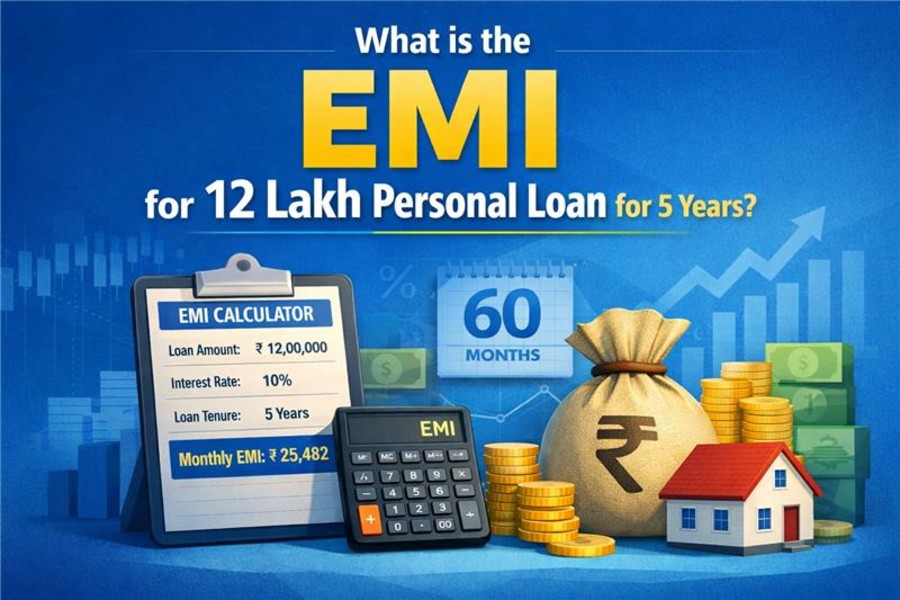
What is the EMI for 12 Lakh Personal Loan for 5 Years?
EMI for ₹12 Lakh Personal Loan for 5 Years at Different Interest Rates If you're planning to take a ₹12 lakh personal loan for 5 years, your EMI will typically range between ₹24,900 and ₹28,500 depending on the interest rate offered by the lender. Even a small rate difference can impact your total repayment by lakhs over time. EMI Formula: EMI = P × r × (1+r)^n / ((1+r)^n − 1) Where: P = Loan amount r = Monthly interest rate n = Number of months Here’s an EMI comparison table for a ₹12 lakh personal loan for 5 years, showing monthly installments, total repayment amount, and total interest payable at different interest rates. Interest Rate EMI (Approx) Total Repayment Total Interest 9% ₹ 24,900 ₹14.9 Lakh ₹2.9 Lakh 10% ₹ 25,500 ₹15.3 Lakh ₹3.3 Lakh 12% ₹ 26,700 ₹16 Lakh ₹4 Lakh 15% ₹ 28,500 ₹17.1 Lakh ₹5.1 Lakh Here’s a detailed breakdown of EMI calculation, total interest payable, eligibility criteria, and ways to reduce your loan burden. Recent blog: Best Tips for Getting Approved for a Personal Loan How Interest Rates Affect Your ₹12 Lakh Personal Loan Interest rate is the biggest factor that determines your monthly EMI and total repayment amount. Even a small difference of 1–2% can significantly impact your total cost of loan over 5 years. For example: At 9% interest, EMI will be approximately ₹24,900 per month. At 10% interest, EMI increases to around ₹25,500. At 12% interest, EMI goes up to roughly ₹26,700. At 15% interest, EMI can reach around ₹28,500. That’s a difference of nearly ₹3,500 per month between 9% and 15%. Higher interest rates mean: Higher EMI Higher total repayment Increased financial burden Lower interest rates mean: Lower EMI Better affordability Reduced overall loan cost Your interest rate is influenced by: Credit score Monthly income Employment stability Existing debts Lender policies Borrowers with a credit score above 750 usually get better rates, while lower scores may result in higher interest charges. Recent blog: Get an Instant Personal Loan with a Low CIBIL Score Total Interest Payable on a ₹12 Lakh Loan Over 5 Years Many borrowers focus only on EMI but ignore the total cost of borrowing. Over 5 years, you will repay much more than ₹12 lakh due to accumulated interest. Here’s an approximate idea: At 9% interest → Total repayment around ₹14.9 lakh At 10% interest → Total repayment around ₹15.3 lakh At 12% interest → Total repayment around ₹16 lakh At 15% interest → Total repayment around ₹17.1 lakh This means you may pay ₹2.9 lakh to ₹5.1 lakh purely in interest over 5 years. Apart from interest, lenders may also charge: Processing fees (1–3%) Prepayment or foreclosure charges Late payment penalties GST on applicable charges Always calculate the total repayment amount before finalizing your loan to understand the real cost. Recent blog: How Does Age Affect Personal Loan Eligibility? Tips to Reduce Your Loan Burden A ₹12 lakh loan is manageable if planned properly. Here are smart ways to reduce financial stress: Maintain a Strong Credit Score: A higher credit score can help you secure a lower interest rate, directly reducing EMI and total interest paid. Compare Multiple Lenders: Don’t accept the first offer. Compare interest rates, processing fees, and hidden charges before deciding. Choose the Right Tenure: A longer tenure reduces EMI but increases total interest. A shorter tenure increases EMI but reduces total cost. Choose what suits your income stability. Avoid Over-Borrowing: Borrow only what you need. Higher principal means higher EMI and more interest. Consider Prepayment: If your lender allows partial loan prepayment without heavy charges, paying extra during bonus months can reduce interest burden significantly. Smart planning can save you lakhs over the loan duration. You can also use a ₹12 lakh personal loan EMI calculator to get exact monthly installment figures based on your credit profile. Eligibility Criteria for ₹12 Lakh Personal Loan Before applying, make sure you meet basic lender requirements. Though criteria vary by institution, general eligibility includes: Age Requirement: Typically, between 21 and 60 years. Income Requirement: Most lenders prefer a minimum monthly income of ₹25,000 to ₹30,000 for a ₹12 lakh loan. Higher income improves approval opportunities. Credit Score: A score above 700 is usually preferred. For best interest rates, aim for 750+. Employment Type: Salaried individuals with at least 6–12 months of job stability Self-employed individuals with consistent business income Documents Required: Aadhaar & PAN card Salary slips (last 3 months) Bank statements (last 6 months) Income proof for self-employed applicants Meeting eligibility criteria not only increases approval chances but also helps secure better interest rates. Related blog: Personal Loan vs. Credit Card: Which One Should You Choose? How to Reduce EMI on a ₹12 Lakh Personal Loan? If EMI feels high, there are ways to bring it down: Opt for Longer Tenure: Increasing tenure spreads repayment over more months, reducing EMI amount. However, remember this increases total interest. Improve Your Credit Score Before Applying: If your score is low, take 3–6 months to improve it before applying. Paying credit card dues on time and reducing outstanding balances helps. Apply with a Co-Applicant: Adding a co-applicant with stable income can improve loan eligibility and sometimes reduce interest rate. Negotiate with Lender: If you have strong financials, you may negotiate interest rates or processing fees. Refinance Later: If interest rates drop in the future, consider refinancing your loan to reduce EMI. Even a small EMI reduction of ₹1,000 per month saves ₹60,000 over 5 years. Blog might you have missed: Salary-Based Personal Loans: Benefits, EMI Tips & Approval Why Choose LoanQuantum for a 12 Lakh Personal Loan for 5 Years Choosing the right platform is as important as choosing the right lender. LoanQuantum simplifies the borrowing process by helping you compare multiple loan options in one place. With LoanQuantum, you get: Competitive interest rate comparisons Access to multiple lender offers Fast online process with minimal paperwork Transparent charges Time-saving application experience Related blog: Top Benefits of Applying for a Personal Loan Online Whether you are planning a medical emergency, home renovation, debt consolidation, or personal expenses, understanding your EMI and total repayment is the first step toward smart borrowing. A ₹12 lakh personal loan over 5 years can be manageable if you secure a good interest rate, plan your EMI wisely, and choose the right financial partner. Make informed decisions, compare loan rates and options carefully, and ensure the loan fits comfortably within your monthly budget before applying. Interest rates and EMIs are indicative and may vary based on lender policies and borrower profile. Use LoanQuantum’s smart comparison tool to calculate your exact ₹12 lakh loan EMI, compare real-time lender offers, and secure the lowest interest rate today. Frequently Asked Questions What is the EMI for a ₹12 lakh personal loan for 5 years? The EMI for a ₹12 lakh personal loan for 5 years typically ranges between ₹24,900 and ₹28,500 per month, depending on the interest rate. At 12% interest, the EMI is approximately ₹26,700 per month. How much total interest will I pay on a ₹12 lakh loan over 5 years? The total interest payable on a ₹12 lakh loan for 5 years can range from ₹2.9 lakh to ₹5 lakh, depending on the interest rate. Higher interest rates significantly increase the total repayment amount. What salary is required for a ₹12 lakh personal loan? Most lenders prefer a minimum monthly salary of ₹25,000 to ₹30,000 for a ₹12 lakh personal loan. Higher income and a strong credit score improve approval chances and help secure better interest rates. Can I get a ₹12 lakh personal loan with a low credit score? Yes, it is possible, but you may be charged a higher interest rate. A credit score above 700 is generally preferred for better approval chances and lower EMI. How can I reduce EMI on a ₹12 lakh personal loan? You can reduce EMI by choosing a longer tenure, improving your credit score before applying, comparing lenders, or negotiating a lower interest rate. Even a small rate reduction can significantly lower your monthly payment.

Salary-Based Personal Loans: Benefits, EMI Tips & Approval
A personal loan for salaried employees is an unsecured loan that provides fast access to funds without collateral. Designed specifically for working professionals, salary-based personal loans help cover expenses like medical emergencies, travel, home improvements, or urgent financial needs. With instant approval options available online, these loans come with minimal documentation, flexible EMIs, and competitive interest rates, making them one of the most convenient borrowing solutions for salaried individuals. In this guide, we’ll explore how salary-based personal loans work, eligibility criteria for salaried professionals, required documents, and smart EMI planning using a personal loan calculator. Understanding these key factors ensures you can apply for a personal loan confidently, get quick approvals, and manage repayments efficiently. What Is Salary-Based Personal Loans? A salaried personal loan is an unsecured loan designed specifically for working professionals with a fixed monthly income. Like other loans, it does not require collateral, but approval is primarily based on your salary, employment stability, and repayment capacity. With digital lending platforms, you can apply for a loan and even get an instant personal loan, making the process quick, paperless, and convenient for urgent financial needs. In salary-based loans, lenders evaluate your monthly income, company profile, and work history to determine how much you can comfortably repay. This helps them offer faster approvals, better terms, and even an instant salaried loan option, compared to regular loans that rely heavily on broader credit factors. Because salaried borrowers have predictable income and lower risk, they often have a higher approval rate and more competitive interest rates. Key Benefits of Salary-Based Personal Loans A loan on a salary basis offers multiple benefits of personal loans, including quick approvals, competitive interest rates, flexible EMIs, and no collateral requirement. Quick approvals: A salaried loan is processed faster because lenders rely on your stable income and employment history, and many offer instant salaried loan facilities. Lower interest rates: Compared to regular personal loans, salary-based loans often offer competitive interest rates because they involve lower risk and more predictable repayment capacity. Flexible tenure: Choose repayment periods that suit your monthly budget, making EMIs affordable and easier to manage. No collateral required: A loan on a salary basis is unsecured, so you don’t need to pledge assets or provide a guarantor. Easy digital process: You can apply for a loan online, upload documents, and receive an instant loan with minimal paperwork and quick disbursal. Suitable for all needs: Ideal for both emergencies and planned expenses like medical bills, travel, weddings, education, or home improvements. Related blog: How to Save Money with a Personal Loan EMI Calculator Comparison Table: Salary-Based Personal Loan vs Regular Personal Loan Feature Salary-Based Personal Loan Regular Personal Loan Eligibility Based on salary, job stability, and employment profile Based on credit score, income, and overall financial history Approval Speed Faster, often instant for eligible salaried applicants Slower, depends on detailed credit checks Interest Rates Generally lower due to predictable income Usually higher, varies with credit risk Collateral Unsecured – no collateral required Mostly unsecured, some lenders may ask for collateral for high amounts EMI Flexibility Flexible EMIs based on salary and repayment capacity Standard EMI structure, less tailored to income Disbursal Time Quick, can be same-day or within 24 hours (instant personal loan online) Can take several days depending on lender verification Ideal For Salaried professionals needing quick funds Individuals with variable income or self-employed borrowers Application Process Digital-friendly, easy to personal loan apply online Can be digital but may require more documentation Who Can Apply? Understanding Personal Loan Eligibility Before applying for a personal loan online, it is important to check the basic personal loan eligibility criteria set by lenders. A personal loan for salaried employees is usually approved based on factors like income stability, employment profile, age, credit score, and repayment capacity. Most lenders prefer applicants aged 21 to 60 years, earning a minimum monthly income of ₹10,000 to ₹30,000 or more. A CIBIL score of 700 or higher is generally considered good for approval and better interest rates. Meeting these requirements can improve your chances of approval and help you qualify for a higher loan amount with competitive interest rates. Using a Personal Loan Eligibility Calculator Before You Apply A personal loan eligibility calculator helps you quickly estimate how much loan you can borrow based on your salary and financial profile. Checking eligibility in advance reduces the risk of rejection and allows you to apply confidently for an instant personal loan online with a low CIBIL score. Salary requirements: Minimum monthly income as defined by the lender to ensure you can repay EMIs comfortably. Age criteria: Typically, between 21 and 60 years at the time of loan maturity. Work experience: At least 6–12 months of continuous employment or stable job history. Employer type: Working for a private company, government organization, or a reputable MNC often increases approval chances. Better planning: Using a loan eligibility calculator helps you choose the right loan amount and tenure, improving your approval chances and speeding up processing. Example: Calculating Personal Loan Eligibility for a Salary of ₹25,000 Suppose you earn a monthly salary of ₹25,000 and want to estimate your eligibility for a personal loan. Using typical lender criteria, here’s a realistic range of loan options: Parameter Example Range Loan Amount ₹2,00,000 – ₹5,00,000 Interest Rate 11% – 14% per annum Tenure 12 – 36 months Processing Fee 1% – 2% of loan amount EMI Estimate: For a loan of ₹3,00,000 at 12% interest over 24 months, your monthly EMI would be approximately ₹14,200. For a loan of ₹5,00,000 at 13% interest over 36 months, your monthly EMI would be around ₹16,900. By using a loan eligibility calculator, you can choose a loan amount and tenure that fits your salary, plan EMIs effectively, and increase the chances of quick loan approval. Step-by-Step Guide to Personal Loan Application for Salaried Employees Applying for a personal loan for salaried employees is simple, fast, and mostly digital. Many lenders offer an online process that allows salaried individuals to apply from home and receive quicker approvals. By understanding the personal loan eligibility criteria and keeping the required documents ready, borrowers can speed up the process and improve their chances of quick disbursal. How to Apply for an Online Personal Loan Compare lenders: Review interest rates, tenure options, processing fees, and loan offers to find the best personal loan for salaried employees. Fill out the application form: Apply for a personal loan online by entering your basic details, employment information, and monthly income. Upload documents: Submit required documents such as PAN or Aadhaar, recent salary slips, and bank statements for verification. Income and employment verification: The lender evaluates your salary, job stability, and credit profile to determine loan eligibility and repayment capacity. Approval and disbursal: After successful verification, approval may be granted quickly, and the loan amount is disbursed to your account, often within a short time. Related blog: How to Get a Personal Loan at the Lowest Interest Rate in 2026 EMI Planning Made Easy with a Personal Loan EMI Calculator Proper EMI planning is essential before applying for a loan, especially when opting for an instant loan. A personal loan EMI calculator helps you estimate monthly repayments in advance, so you can choose a comfortable plan that fits your income. Whether you’re taking a salary-based loan EMI or checking out the loan EMI for salaried borrowers, this tool ensures better budgeting and smarter borrowing decisions. How to Use a Personal Loan EMI Calculator Calculate monthly EMI: Enter the loan amount, interest rate, and tenure to check your personal loan EMI instantly. Loan comparison: Compare the loan offers by multiple lenders and repayment options to find the most affordable loan before finalizing. Compare tenure options: Test different tenures to see how EMIs change over time. Understand total interest cost: Evaluate the overall repayment amount, not just the monthly EMI. Choose an affordable plan: Select a personal loan EMI for a salaried individual that matches your monthly cash flow. Low Credit Score? Options for Low Credit Score Personal Loans A low credit score doesn’t always mean loan rejection. Many lenders now offer low credit score personal loans designed specifically for salaried individuals with stable income but past credit challenges. With the right strategy and proper documentation, you can still qualify for funding and even secure an online loan with manageable terms. The key is to prove your repayment capacity and choose lenders that focus more on salary strength than just your credit history. Personal Loan for Salaried with Low CIBIL Score – What You Can Do Apply with strong salary proof: Submit recent salary slips and bank statements to show steady income and repayment ability. Choose NBFCs/fintech lenders: These lenders are often more flexible and open to approving personal loans for borrowers with low credit scores. Opt for smaller loan amounts: Applying for a lower amount improves approval chances and reduces lender risk. Add a co-applicant: A co-borrower with a good credit profile can strengthen your application. Demonstrate repayment capacity: Maintain low debts and stable employment to qualify for a personal loan for a salaried individual with a low CIBIL score more easily. Related blog: Personal Loan vs Credit Card: Which One Should You Choose? Common Mistakes Salaried Borrowers Should Avoid While personal loans for salaried employees offer quick and convenient access to funds, small mistakes during the application process can lead to rejection, higher interest costs, or repayment stress. Salaried borrowers should carefully plan before applying for a loan and ensure the loan amount and EMI fit comfortably within their monthly income. Avoiding common mistakes can help salaried applicants secure a personal loan smoothly, get better interest rates, and manage EMIs without financial strain. Over-borrowing: Taking a loan amount higher than necessary increases your EMI burden and overall interest costs. Ignoring EMI affordability: Not checking your personal loan EMI in advance can disrupt your monthly finances. Applying multiple lenders at once: Multiple applications can hurt your credit score and reduce approval chances. Skipping eligibility checks: Failing to review criteria or using an eligibility tool may lead to rejection. Not reading terms & charges: Processing fees, prepayment penalties, and other hidden expenditures might increase the loan cost beyond what was expected. When Should You Choose an Instant Personal Loan Online? An instant personal loan online is the right choice when you need quick funds without lengthy paperwork or branch visits. With a fully digital process, faster verification, and same-day approval, an online loan ensures that money reaches your account exactly when you need it most. These loans are especially useful for salaried individuals seeking quick disbursement and flexible repayment options for urgent or planned financial needs. Medical emergencies: Get immediate funds for hospital bills, treatments, or unexpected healthcare expenses. Travel or wedding expenses: Manage last-minute bookings or event costs without disturbing your savings. Debt consolidation: Combine multiple debts into one personal loan with a single, manageable EMI. Urgent home repairs: Handle sudden maintenance or renovation costs quickly. Salary gap situations: Cover short-term cash shortages between pay cycles with fast disbursal options. With minimal documentation and quick approvals, an instant personal loan online helps you stay financially prepared without delays or stress. Conclusion Salary-based personal loans are a smart and convenient financing option for working professionals, offering quick approvals, lower interest rates, flexible tenures, and zero collateral requirements. With easy access to online personal loans and the option of an instant loan, salaried borrowers can handle both urgent and planned expenses without lengthy paperwork or delays. However, borrowing wisely is just as important as quick access. Always plan your personal loan EMI, review the eligibility criteria, and use tools like Loan Quantum to choose the right loan amount. Compare lenders, review offers carefully and apply for a personal loan online only after evaluating your options to secure faster approval and better terms. Compare top lenders and calculate your EMI in minutes with Loan Quantum, your smart partner for faster approvals, better rates, and instant loan disbursement. Frequently Asked Questions What is a salary-based personal loan? A loan on salary basis is an unsecured loan designed for salaried employees, in which lenders assess your monthly income, job stability, and repayment capacity rather than requiring collateral. It offers faster approvals, competitive interest rates, and easy access to funds through an online application process. How can one apply for a personal loan online? You can apply for a loan online by visiting a lender’s website or app, filling out the application form, uploading KYC and income documents, and completing verification. Many lenders offer instant approvals and quick disbursal for eligible salaried borrowers. How does a loan EMI calculator help? A loan EMI calculator helps you estimate your monthly EMI, compare tenures, and understand the total interest cost before borrowing. It helps you plan repayments more effectively and choose an affordable loan amount that fits your salary. Can I receive a personal loan with a poor CIBIL score? Yes, some lenders provide options for salaried individuals with low credit scores. By showing stable income, applying for smaller loan amounts, or choosing flexible lenders, you can still qualify for a personal loan even with a low CIBIL score. When should you choose an instant personal loan online? An instant loan online is ideal for urgent needs like medical emergencies, travel bookings, home repairs, or short-term cash gaps. With minimal paperwork and fast processing, funds are usually disbursed to your bank account within a few days.
What is an Instant Personal Loan and How Does it Work?
What Is an Instant Personal Loan? An instant personal loan is a type of unsecured loan that allows borrowers to receive funds quickly, often within minutes or a few hours after approval. Unlike traditional bank loans that involve lengthy paperwork and processing time, instant loans are designed for fast approval, minimal documentation, and a fully online application process. These loans are ideal for urgent financial needs such as emergency medical expenses, sudden bills, or unexpected cash shortages. Since an instant personal loan does not require any collateral or security, you don’t have to pledge assets like property or gold. This makes the borrowing process simple, convenient, and accessible for eligible applicants. With quick disbursal, easy eligibility criteria, and a hassle-free approval system, instant personal loans provide immediate financial support when you need funds without delay. How does an Instant Personal Loan Work? Instant personal loans use advanced digital technology to make the borrowing process fast, simple, and completely online. From application to disbursal, everything is designed for speed and convenience. 1. Online Application: Applicants fill out a short form on the lender’s website or mobile app. You typically need to provide basic details such as personal information, income details, employment status, and bank account information. 2. Instant Eligibility Check: The lender evaluates your application based on factors like monthly income, credit score, repayment history, and overall financial stability. This automated assessment takes only a few minutes. 3. Quick Approval: If you meet the eligibility criteria, the system generates instant approval using AI-based algorithms and digital verification. This removes the delays usually seen with traditional loan processing. 4. Fast Loan Disbursal: After approval, the sanctioned loan amount is transferred directly to your registered bank account often within a few hours. Related Blog – Personal Loan Eligibility Criteria Key Features of Instant Personal Loans Instant personal loans are designed to provide fast and convenient financial support with minimal formalities. Here are the main features: 1. Fast Approval and Quick Disbursal One of the biggest advantages of an instant personal loan is speed. The approval process is completed within minutes, and the loan amount is usually credited to your bank account within a few hours. This makes it a reliable option during financial emergencies. 2. No Collateral Required An instant personal loan is unsecured, meaning you do not need to pledge any assets such as property, gold, or investments. This reduces documentation requirements and eliminates the risk of losing valuable assets. 3. Flexible Repayment Tenure Borrowers can select a repayment period that suits their income and financial commitments. Flexible EMI options help manage monthly budgets more effectively. 4. 100% Online and Hassle-Free Process The entire application process is digital from form of submission to approval and disbursal. There is no need to visit a branch or complete lengthy paperwork, making the process smooth and convenient. Related Blog – Get an Instant Personal Loan with a Low CIBIL Score Benefits of Availing a Personal Loan Knowing the advantages of a personal loan can help you choose the right financial solution based on your needs and repayment capacity. 1. Fast Access to Funds: Personal loans offer quick financial support, especially during emergencies. With minimal documentation and a simple approval process, borrowers can receive funds without long waiting periods. 2. No Usage Restrictions: Unlike home loans or car loans that are meant for specific purposes, a personal loan can be used for any legitimate expense such as medical bills, travel, education, weddings, or urgent household needs. 3. Helps Build Your Credit Score: Timely repayment of EMIs improves your credit history and strengthens your credit score. A strong credit profile increases your chances of securing loans at better interest rates in the future. 4. Ideal for Debt Consolidation: A personal loan allows you to combine multiple high-interest debts, such as credit card balances, into a single loan with a structured repayment plan. This can reduce your overall interest burden and simplify monthly payments. 5. Competitive Interest Rates: Personal loan interest rates are generally affordable and typically range between 9% and 24% per annum, depending on factors such as credit score, income level, and lender policies. Related Blog – Personal Loan Lowest Interest Rate 2026 Instant Personal Loan vs Credit Card – Which Is Better? Both personal loans and credit cards serve different financial purposes and can be useful depending on your situation. The right choice ultimately depends on your specific needs and repayment capacity. A credit card offers a revolving credit limit, allowing you to reuse the available limit once you clear your monthly outstanding amount. It is generally suitable for everyday expenses and smaller purchases. In addition, credit cards often provide reward points, cashbacks, or other benefits on transactions. On the other hand, you should consider checking your personal loan eligibility when planning significant or high-value expenses. A personal loan provides a fixed lump sum amount and usually comes with a longer repayment tenure, which can extend up to five years. This makes it more suitable for managing large financial commitments through structured EMIs. When it comes to debt consolidation, choosing between a personal loan and a credit card depends on factors such as interest rates, fees, and repayment terms. Comparing the overall cost of both options will help you determine the most financially beneficial solution. Related Blog – Personal Loan vs Credit Card Which One Should You Choose How Loan Quantum Can Help Loan Quantum makes applying for an instant personal loan simple, fast, and completely digital. From application to disbursal, the entire process is designed to save time and reduce paperwork, allowing borrowers to access funds without visiting a branch. With a user-friendly platform and minimal documentation requirements, Loan Quantum ensures a smooth borrowing experience for individuals facing urgent financial needs. A key advantage of choosing Loan Quantum is understanding loan eligibility before applying. The platform clearly outlines eligibility criteria based on factors such as income, credit score, employment status, and repayment capacity. This transparency helps applicants assess their qualification in advance, improving approval of chances, and avoiding unnecessary rejections. Once eligibility is confirmed, Loan Quantum uses advanced verification systems to provide quick approval and fast fund disbursal directly to your bank account. With transparent terms, competitive interest rates, and structured EMI options, Loan Quantum offers a reliable and convenient solution for anyone seeking an instant personal loan. Related Blog – How Does Age Affect Personal Loan Eligibility Conclusion An instant personal loan is a fast and convenient financial solution designed to help you manage urgent expenses without lengthy procedures or collateral requirements. With quick approval, minimal documentation, and flexible repayment options, it provides immediate access to funds when you need them most. However, before applying, it is important to compare the loan options available in the market to ensure you choose the most suitable interest rate, tenure, and repayment terms. While a personal loan is ideal for short- to medium-term financial needs, it differs significantly from a home loan, which is specifically meant for property purchase and usually involves longer tenures and secured borrowing. Understanding these differences helps you make smarter financial decisions based on your goals. By evaluating your eligibility, repayment capacity, and purpose of borrowing, you can select the right loan product with confidence and financial clarity. Make the right financial choice—check your eligibility and get transparent, fast loan approval with Loan Quantum. Frequently Asked Questions Are personal loans considered risky? Personal loans do involve certain risks. Since they are usually unsecured, they often come up with higher interest rates than secured loans. Borrowers may also need to pay charges such as processing fees (generally 1% to 5%) and, in some cases, prepayment or foreclosure penalties. What is the disbursement time after personal loan approval? Once your personal loan is approved, the lender issues a sanction letter via email. The loan amount is typically disbursed within one to two working days. You may either collect a cheque from the branch or have the funds credited directly to your bank account. With online applications, approval can be instant, and the amount may be credited within 24 hours. Who may not qualify for a personal loan? Individuals with a low credit score, weak repayment history, or a high debt-to-income (DTI) ratio may not qualify. Most lenders prefer a DTI below 40% and consistent, timely repayments. Unstable or insufficient income can also reduce the chances of approval. What CIBIL score is needed to apply for a personal loan? Most lenders prefer a CIBIL score of 750 or above for personal loan approval. However, some financial institutions may consider applicants with scores around 650, depending on their internal policies and risk assessment criteria. What is the highest loan amount available under a personal loan? The maximum loan amount depends on the lender and the applicant’s eligibility. Generally, self-employed individuals may be eligible for amounts ranging from ₹20 lakh to ₹30 lakh. However, income level, repayment capacity, and credit profile can influence the final approved amount.
Get an Instant Personal Loan with a Low CIBIL Score
Financial emergencies can arise anytime, from medical bills and urgent travel to unexpected home repairs. An instant personal loan can provide quick financial support, and digital platforms make the process simple by allowing you to check eligibility, compare lenders, and use a personal loan calculator to estimate EMIs before applying online with minimal paperwork and fast disbursal. However, your credit score remains an important factor in approval. Even with a low TransUnion CIBIL score, many NBFCs and online lenders offer flexible options. In this blog, we will discuss how you can improve your chances, understand eligibility, and secure an instant personal loan despite a low credit score. What Is a CIBIL Score and Why Does It Matter? Before applying for any loan, it’s important to understand how your credit score works. Your CIBIL score is provided by TransUnion CIBIL, India’s leading credit bureau. It reflects your creditworthiness and repayment behavior. CIBIL Score Ranges Breakdown 750 – 900: Excellent (high approval chances) 700 – 749: Good 650 – 699: Fair Below 650: Low or risky Most traditional banks prefer CIBIL scores above 700 if you want instant personal loan. But online lenders and NBFCs may still consider applications below this range. What Is an Instant Personal Loan? An instant personal loan is a quick, unsecured loan that requires minimal paperwork and offers fast loan approval and disbursal often within minutes or hours. You don’t need collateral, and the entire process happens digitally. With personal loan apply online options, you can: Submit documents digitally Get quick verification Receive funds directly in your bank account Avoid branch visits This makes instant personal loan online services ideal for medical emergencies, travel, education, or urgent expenses. Related blog: Personal Loan Guide Can You Get a Personal Loan with a Low CIBIL Score? Yes, it is possible to get a personal loan with a low CIBIL score, but there may be certain conditions. A low CIBIL score does not always lead to automatic rejection today. Many lenders offering personal loans now look beyond just your credit score when reviewing a personal loan application. Instead, they evaluate multiple financial factors to determine your loan eligibility, especially for borrowers looking for a loan with a low CIBIL score. These factors may include: Monthly income Job stability and employment history Bank transaction history Overall repayment capacity Employer or company profile Alternative credit scoring models Because of these additional evaluation methods, borrowers with a low credit score may still qualify for personal loan approval. Some lenders also use alternative credit assessment methods when evaluating applications for an instant personal loan with a low CIBIL score. If your income and financial stability are strong, lenders may consider your overall financial profile rather than relying only on the CIBIL score, making it possible to access a personal loan for low-CIBIL-score applicants. Related Blog: How Does Age Affect Personal Loan Eligibility? Why Online Lenders Approve Low CIBIL Borrowers? Traditional banks rely heavily on credit scores. However, fintech lenders use advanced data analysis and AI-based risk assessment. They check: Salary credits Spending behavior EMI repayment pattern Cash flow consistency Digital transaction history This broader evaluation increases the chances of personal loan approval for people who may have had past credit issues. That’s why many borrowers prefer online instant personal loan platforms to banks. Personal Loan Eligibility with Low CIBIL Scores Applicants The personal loan eligibility for low CIBIL score applicants may vary from lender to lender. However, most lenders consider a few common requirements when reviewing a personal loan application with a low credit score. Basic Personal Loan Eligibility Age: 21–60 years Indian resident Salaried or self-employed Minimum monthly income (₹15,000–₹25,000) Active bank account Valid PAN & Aadhaar Additional Eligibility for Low CIBIL Score Applicants For a personal loan with a low CIBIL score, lenders may also evaluate additional financial factors such as: Stable job history Low existing debt or a healthy debt-to-income ratio Good banking behaviour and transaction history Smaller loan amount request If you meet these personal loan eligibility criteria, you may still be able to apply for a personal loan online with a low CIBIL score, especially if you can demonstrate stable income and responsible financial behaviour. How to Check Personal Loan Eligibility First Before you apply for a personal loan, it’s smart to check your loan eligibility. This helps avoid rejection and protects your credit score from multiple hard inquiries. Most lenders evaluate: Age (21–60 years) Minimum income requirement Employment type (salaried/self-employed) Work experience Credit history Many websites provide an instant eligibility checker, so you can apply for a personal loan online with confidence. Related blog: What Are the Eligibility Criteria for a Personal Loan? Steps to Apply for a Quick Personal Loan Online Easily: Here’s how the process typically works: Step 1: Compare Lenders: Check interest rates, tenure, processing fees, and approval time. Step 2: Use a Personal Loan Calculator: A Personal loan calculator helps estimate your EMI and repayment plan before applying. Step 3: Check EMI with Interest Tool: Use a personal loan interest rate calculator to compare costs and choose affordable options. Step 4: Submit Application: Complete the personal loan application form with documents like: Aadhaar/PAN Salary slips Bank statements Step 5: Get Approval: Many platforms offer instant approval for personal loans, with funds disbursed within hours. Blog might you have missed: How to Save Money with a Personal Loan EMI Calculator Advantages and Disadvantages of a Personal Loan with Low CIBIL Score Getting a personal loan with a low CIBIL score can be helpful during urgent financial situations, such as medical emergencies, travel, or other immediate expenses. Many lenders and digital platforms now offer flexible eligibility checks and faster loan approval, even for applicants with a low credit score. However, applying for a personal loan with a low credit score comes with certain trade-offs. Lenders consider borrowers with low scores as higher risk, which often leads to higher interest rates, stricter terms, and sometimes smaller loan amounts. Understanding both the advantages and disadvantages can help you make a smarter borrowing decision and avoid unnecessary financial strain. Comparison Table of CIBIL Score Advantages Disadvantages Quick access to funds during emergencies Higher interest rates compared to good-score borrowers Easier approval from NBFCs and online lenders Lower loan amounts offered Minimal paperwork and fast online process Shorter repayment tenures Helps rebuild credit score with timely EMI payments Higher processing fees or extra charges No collateral required (unsecured loan) Greater risk of rejection from traditional banks How to Get a Loan Despite a Low CIBIL Score? Here’s how: 1. Choose NBFCs or Loan Apps: They are more flexible than banks and often offer instant personal loans online with relaxed criteria. 2. Opt for a Smaller Amount: Lower loan amounts reduce lenders' risk and increase approval chances. 3. Show Stable Income: Consistent salary or business income improves trust. 4. Apply for Pre-Approved Offers: If your bank or lender offers a pre-approved personal loan, you can get faster approvals regardless of minor credit issues. 5. Add a Co-Applicant: A co-borrower with a good score boosts eligibility. Ways to Improve Your CIBIL Score for Prospective Loans Even if you get approved today, improving your credit score is essential for better rates in the future. Follow these habits: Pay EMIs on time Don’t miss credit card payments Keep credit utilization below 30% Avoid unnecessary loans Keep old credit accounts active Monitor your credit report regularly Within 6–12 months, you can significantly improve your score. Personal Loan Interest Rates for Low CIBIL Score Interest rates depend on risk level. Typical Range Good score: 10%–14% Average score: 14%–18% Low score: 18%–28% Using a personal loan interest rate calculator helps you choose the best option and avoid expensive lenders. Final Thoughts A low credit score doesn’t automatically disqualify you anymore. With digital lending platforms and flexible criteria, you can still secure an instant personal loan, provided you meet income and eligibility requirements. Always check your personal loan eligibility, compare the loan offers using a personal loan interest rate calculator, and then apply for a personal loan online through a trusted lender. If available, take advantage of a pre-approved personal loan or an instant approval personal loan to get funds quickly. With the right approach, even borrowers with low CIBIL scores can access instant personal loan online options safely and responsibly. Verify your personal loan eligibility, estimate your EMIs using the personal loan calculator from Loan Quantum, and apply for an instant personal loan online to enjoy quick approval and swift disbursal directly to your bank account. Frequently Asked Questions Can I get an instant personal loan without a CIBIL? Yes,Some lenders use alternative checks, but most still review your credit history. What is the minimum score required? Many NBFCs accept scores above 600, but eligibility varies. How fast is disbursal? Some lenders transfer funds within 10–30 minutes after approval. Will applying affect my credit score? Yes, every application creates a hard inquiry. Apply carefully. Can I improve my score after taking a loan? Yes. Timely EMI payments boost your score.
What Are the Eligibility Criteria for a Personal Loan?
Before applying for a personal loan, many borrowers overlook one critical step—checking eligibility. This often leads to rejection and unnecessary credit score damage. Understanding the eligibility criteria in advance can significantly improve approval chances. A personal loan is one of the most flexible financial products available today. Whether you need funds for medical emergencies, travel, education, home renovation, or debt consolidation, a personal loan can help you manage immediate financial requirements. However, before applying, it is essential to understand the loan eligibility criteria set by lenders. Knowing your loan eligibility in advance not only saves time but also improves your chances of approval and ensures you borrow responsibly. Many applicants apply without checking their financial standing, which can lead to rejection and negatively impact their credit score. Understanding the eligibility requirements, repayment capacity, and associated costs allows you to make informed decisions and apply confidently. Personal Loan Eligibility: Key Factors Lenders Consider When assessing your loan eligibility, lenders evaluate multiple financial and personal factors to determine whether you can repay the loan comfortably. 1. Income and Repayment Capacity: Your monthly income plays a major role in determining loan eligibility. Higher and stable income increases approval chances and may qualify you for a larger loan amount. 2. Employment Stability: Stable employment reassures lenders about repayment reliability and improves loan eligibility. 3. Credit Score: A strong credit score improves your loan eligibility and may help secure better interest rates. 4. Age Criteria: Applicants usually need to meet the age criteria defined by lenders. 5. Existing Financial Obligations: Multiple ongoing EMIs can reduce your loan eligibility, as lenders assess your repayment burden. Related Blog – Personal Loan Lowest Interest Rate 2026 Personal Loan Calculator: Smart Way to Check Loan Eligibility Before applying, using a personal loan calculator is a smart financial move. A personal loan calculator allows you to estimate how much loan amount you may qualify for based on income and repayment capacity. Instead of applying blindly, you can calculate approximate loan eligibility and plan accordingly. A personal loan calculator helps you: Estimate maximum loan amount Adjust repayment tenure Compare different interest rates Plan a monthly budget effectively Avoid financial overburden By checking your loan eligibility beforehand, you reduce the chances of rejection and protect your credit profile. Related Blog – How to Save Money with Personal Loan EMI Calculator Personal Loan EMI Calculator: Understanding EMI Before Borrowing A personal loan EMI calculator helps you determine your monthly repayment obligation before taking a loan. Understanding EMI is important because it directly impacts your monthly expenses and savings. By adjusting the loan amount and tenure in the calculator, you can select an EMI that aligns with your financial capacity and avoid repayment stress in the future. Understanding EMI EMI (Equated Monthly Installment) is the fixed monthly amount you pay toward your loan. Understanding EMI is important because it directly impacts your monthly expenses and savings. EMI consists of: Principal amount Interest component When you use a personal loan EMI calculator, you can instantly see how different tenures affect your monthly payments. A longer tenure reduces EMI but increases total interest. A shorter tenure increases EMI but reduces total interest cost. A proper understanding of EMI ensures you select a repayment plan that fits comfortably within your financial limits. Related Blog – Benefits of Applying for a Personal Loan Personal Loan Payment Calculator: Plan Total Repayment Smartly A personal loan payment calculator helps you evaluate the complete repayment structure. While EMI calculators focus on monthly payments, a personal loan payment calculator shows the total repayment amount over the loan tenure, including total interest payable. This tool helps you: Compare repayment options Evaluate affordability Estimate total interest outflow Make better financial decisions Using a personal loan payment calculator prevents financial surprises later. Related Blog – How Does Age Affect Personal Loan Eligibility Hidden Costs of Personal Loan You Should Not Ignore Many borrowers focus only on interest rates and EMI amounts but forget to evaluate the hidden costs of a personal loan. These may include: Processing fees Documentation charges Prepayment penalties Late payment charges Administrative costs Understanding the hidden costs of a personal loan ensures you calculate the true borrowing expense before finalizing your application. Guide for Using Loan Calculator Effectively Using a loan calculator correctly helps you make informed financial decisions before applying for a loan. By entering accurate details such as loan amount, interest rate, and tenure, you can estimate your monthly EMI and total repayment amount. A proper guide for using loan calculator tools ensures you compare different repayment options and choose a plan that fits comfortably within your budget. Here is a simple guide for using loan calculator tools: Enter your desired loan amount. Add the interest rate offered. Select repayment tenure. Review EMI and total repayment. Adjust input until EMI suits your budget. Following these steps helps you make smarter borrowing decisions. Tips to Improve Loan Eligibility If your loan eligibility is lower than expected, follow these practical tips to improve loan eligibility: Pay all EMIs and credit card bills on time. Maintain a high credit score. Reduce outstanding debts. Avoid multiple loan applications at once. Increase income stability. Applying these tips to improve loan eligibility can significantly improve your approval chances. Conclusion Before applying, always check your eligibility, calculate your EMI, and review all charges carefully. Smart planning today can prevent financial stress tomorrow. Use Loan Quantum’s calculator tools to make confident and informed borrowing decisions. Check your loan eligibility now with Loan Quantum and make smarter financial decisions today. Frequently Asked Questions What is loan eligibility for a personal loan? Loan eligibility refers to the criteria lenders use to determine whether you qualify for a personal loan. It depends on factors such as income, credit score, employment stability, age, and existing financial obligations. How can I check my personal loan eligibility online? You can check your loan eligibility online by using a personal loan calculator. Simply enter your income, interest rate, and tenure to estimate your eligible loan amount and EMI before applying. How does a personal loan EMI calculator help before applying? A personal loan EMI calculator helps you calculate your monthly installment based on loan amount, interest rate, and tenure. It allows you to understand EMI in advance and plan your budget accordingly. What factors affect personal loan eligibility the most? The most important factors affecting loan eligibility include your monthly income, credit score, debt-to-income ratio, employment type, and repayment history. How can I improve my loan eligibility quickly? You can improve loan eligibility by maintaining a high credit score, paying EMIs on time, reducing outstanding debts, and avoiding multiple loan applications within a short period.
Home Loan Processing Time: Tips to Speed Up Approval
Applying for a home loan is often one of the most significant financial decisions a person makes. While securing a property is exciting, obtaining a loan can feel daunting, especially the wait for approval. Understanding the home loan processing time is essential for planning your finances and avoiding unnecessary stress. Delays in home loan approval are a common concern for loan borrowers. Many factors, from incomplete documentation to verification delays, can prolong the process, leaving applicants unsure when they will finally receive funds. Knowing what to expect and taking proactive steps can make a substantial difference. One of the most effective ways to prepare before applying is to use a home loan calculator. This tool allows borrowers to estimate EMIs, interest, and tenure based on their loan amount and income. Planning your repayment not only helps manage monthly budgets but also demonstrates preparedness to the lender, which can sometimes help in quicker approval. In this article, we will explore the key factors that influence home loan processing time and provide actionable tips for achieving quick home loan approval, ensuring a smoother journey from application to disbursement. Home Loan Process Timeline (Step-by-Step) Understanding the home loan process timeline is essential for anyone looking to secure a property. From the moment you submit your application to the final disbursement of funds, several steps are involved, each playing a crucial role in determining the overall time for the home loan process. Knowing these steps in advance not only helps you plan your finances and reduce unnecessary delays in home loan approval but also allows you to use a home loan calculator to estimate EMIs, interest, and tenure while the application is being processed. The typical home loan process can be broken down into the following stages: Application Submission: Complete the application form and submit it along with all required documents to the lender. Document Verification: The bank verifies identity, income proof, employment details, credit history, and property-related documents. Credit Appraisal: The lender assesses your financial profile, including income, liabilities, and credit score, to decide the eligible loan amount. Property Valuation: Technical and legal checks are carried out to confirm property ownership, value, and compliance with regulations. Loan Sanction: Upon successful verification, the bank issues a sanction letter outlining the approved amount, interest rate, and tenure. Loan Agreement Signing: Borrower signs the loan agreement and other necessary security documents or mortgages. Disbursement: The sanctioned amount is released, either to the borrower or directly to the property seller. Repayment Planning: Begin paying the home loan EMI as scheduled. Using a home loan EMI calculation can help plan EMIs, interest, and tenure efficiently. By following these steps and keeping all documents ready, you can significantly reduce the home loan process time and move closer to quick home loan approval. Top 5 Reasons for Delays in Home Loan Approval Even after submitting a home loan application, delays in verification are a frequent concern for borrowers. Understanding why these delays occur, including factors related to your loan eligibility, can help you take preventive measures and move closer to quick home loan approval. Several factors can slow down the home loan process, most of which relate to documentation, credit history, or property verification. Here are the top 5 reasons: Incomplete or Incorrect Documents: Missing or inaccurate paperwork is a leading cause of delays. Banks require complete identity, income, employment, and property documents to process your loan. Any gap or error can stall the application and extend the home loan verification delay time. Low or Unclear Credit Score: Lenders closely examine your credit history to assess repayment capacity. A low score or inconsistencies in your credit report can lead to additional checks, slowing down the home loan verification process. Property Verification Issues: Technical, legal, or ownership-related concerns with the property can significantly delay approval. Disputed titles, incomplete property records, or pending legal clearances are common property verification issues that banks flag before sanctioning a loan. High Demand or Internal Bank Backlog: During peak property-buying seasons, banks often face high application volumes. Even with complete documents, internal processing queues can increase the time required for home loan verification. Miscommunication Between Borrower and Bank: Delays can also occur if the borrower fails to respond promptly to queries or if important information is misunderstood. Maintaining clear communication can prevent unnecessary issues with the home loan verification process. Planning a home loan, organizing documents, and staying proactive during verification can reduce delays and help you manage your home loan EMI effectively once the loan is sanctioned. Best Tips to Speed Up Home Loan Approval Securing a home loan can be a lengthy process, but with proper preparation, you can significantly speed up home loan approval. Understanding what banks look for and staying proactive throughout the process makes a noticeable difference. 1. Prepare All Documents in Advance One of the simplest ways to avoid delays is to keep all home loan property documents and financial documents ready before applying. This includes: Identity proofs Income statements and salary slips Bank statements Property-related documents like title deeds, sale agreements, and tax receipts Having everything organized ensures that the lender doesn’t have to request repeated documents, which can extend the approval process. 2. Maintain a Good Credit Score A strong credit score reflects financial discipline and repayment capacity. Borrowers with high credit scores usually experience faster home loan approval because banks consider lower risk. Regularly checking your credit report and clearing outstanding dues before applying can speed things up. 3. Choose the Right Bank or Loan Not all lenders operate at the same pace. Research banks are known for faster processing and check whether they offer online applications or digital document submission. Opting for a lender with efficient procedures can reduce unnecessary waiting during the home loan verification process. 4. Use a Home Loan Calculator Before applying, using a home loan calculator helps you estimate: Your home loan EMI Home loan tenure Total interest payable using a home loan interest calculator This preparation allows you to plan your finances accurately and demonstrates to the bank that you are serious and ready, which can help expedite approval. 5. Clear All Financial Dues Pending EMIs, outstanding loans, or credit card dues can delay your application. Clearing existing liabilities shows financial stability and prevents unnecessary verification of hurdles. 6. Respond Promptly to Bank Queries During verification, banks may request additional details or clarifications. Quick responses to these queries keep the process moving and reduce the time to home loan verification. 7. Consider Pre-Approved Home Loan Offers A home loan pre-approval provides conditional approval before you finalize your property purchase. Pre-approved loans reduce paperwork and verification steps, speeding up overall approval. Additionally, it helps in budgeting as you already know your eligible loan amount and EMIs. Related blog: Understanding the Repo Rate and its Impact on Home Loan How to Track Your Home Loan Application Once your home loan application has been submitted, staying informed about its progress is crucial. Knowing the status of the home loan process not only keeps you updated but also helps you compare the loan with other offers, ensuring you make the best financial decision and plan your finances more efficiently. Most banks and lenders offer online tools or mobile apps that let you check your home loan application status in real time. By logging in with your application ID or registered details, you can see whether your documents have been verified, your property assessment has been completed, or if the loan has been sanctioned. Regularly checking these updates ensures you catch any issues early, reducing the risk of delays. In addition to online portals, maintaining periodic follow-ups with bank officials can speed up clarification of any pending queries. A simple call or email to the relationship manager can resolve bottlenecks that might otherwise delay your home loan verification. Read also: Home Loan LTV Ratio calculation - Formula, Guidelines & Complete Guide While tracking your loan, it’s also a good time to plan your repayment strategy. Using a home loan calculator, you can estimate your home loan EMI, adjust home loan tenure, and project total interest payable. This allows you to align your monthly budget and financial planning with the anticipated approval timeline. By combining regular updates on your home loan status with proactive financial planning, you can ensure a smoother journey from application to disbursement and maintain control over your loan repayment. Conclusion Speeding up your home loan approval largely comes down to preparation and proactive planning. By keeping all home loan property papers ready, maintaining a strong credit score, responding promptly to bank queries, and choosing the right lender, you can significantly reduce delays in the home loan process. Leveraging digital tools like online portals, mobile apps, and pre-approved offers also contributes to faster processing and smoother communication. Using a loan calculator is essential for planning your home loan EMI, estimating interest, and selecting the right home loan tenure. This not only helps you budget effectively but also avoids surprises once the loan is disbursed. Combining careful preparation, timely follow-ups, and smart financial planning ensures a stress-free journey from home loan application to disbursement. Staying organized and informed gives your greater control over your loan and helps secure quick home loan approval, making your dream of owning a home a reality without unnecessary delays. Ready to secure your dream home? Use our Home Loan Calculator today, check your loan eligibility, and take the first step toward quick home loan approval! Frequently Asked Questions How long does the home loan process typically take? The home loan process timeline varies depending on the bank, loan amount, and borrower profile. On average, it takes 2–4 weeks from application submission to disbursement, assuming all documents are complete and there are no verification issues. How can I check my home loan application status? Most banks offer online portals or mobile apps to track the status of your home loan. You can also follow up with your relationship manager to ensure your home loan verification process is on track. What are the common reasons for delays in home loan approval? Delays often occur due to incomplete home loan property papers, low credit scores, discrepancies in documents, property verification issues, or high bank workload. Staying proactive can help prevent these delays. How can I speed up my home loan approval? To speed up home loan approval, ensure all documents are ready, maintain a good credit score, respond quickly to bank queries, choose a lender with faster processing, and consider a home loan pre-approval. Using a home loan calculator to plan EMIs also demonstrates preparedness. Why should I use a home loan calculator before applying? A home loan calculator helps estimate your monthly home loan EMI, interest payable, and home loan tenure. This allows you to budget effectively and plan your repayments, making it easier to manage your finances once the loan is disbursed.

Is Prepayment of Your Home Loan a Good Idea?
Paying off your home loan early is something most homeowners dream about - but is it really the smart move financially? Home loans come with unique benefits like tax breaks and long-term liquidity that you might give up if you rush to pay them off. You could reduce your EMIs sooner, but at the same time risk losing related incentives and sometimes incur charges. Before deciding, you may also want to explore related topics such as home loan EMI calculation, compare loan interest rates, and understand your loan's eligibility to make a well-informed repayment decision. What Are the Charges for Prepaying a Home Loan? Prepaying a home loan means clearing either part or all of your outstanding amount before the original loan term ends. Lenders can levy a prepayment fee or foreclosure charges, depending on your loan type and interest structure. Here’s how these charges generally work: Floating Rate Loans: Under current RBI rules, most floating rate home loans (for individuals) do not attract prepayment penalties. Fixed Rate Loans: If you’ve taken a fixed interest loan, lenders may charge a percentage of the prepaid principal as a fee if it’s being transferred to another bank or financial institution. However, if you prepay from your own funds, charges may not apply. Non-Individual Borrowers: Businesses or companies borrowing on residential property may face charges even on floating loan rates. Always read your loan agreement or schedule of charges carefully to understand applicable fees before deciding on prepayment. Benefits of Prepaying a Home Loan Prepaying your home loan in advance can unlock multiple financial benefits from reducing your total interest burden and shortening your repayment tenure to improving your overall loan eligibility for future borrowing. When you compare loan options and evaluate your financial position, loan prepayment can become a strategic step toward faster debt freedom. Key Benefits of Prepaying a Home Loan 1. Lower Interest Outgo: By reducing the principal outstanding early, you decrease the total interest you pay over the loan tenure. The earlier you make a part or full prepayment, the more interest you save. 2. Shorter Loan Duration: Prepayment can shorten your loan term, meaning you become debt-free faster. This also reduces your total financial liability over time. 3. Less Financial Stress: Clearing or reducing your home loan early can free up cash flow and lower stress related to long-term debt obligations. 4. Improved Credit Utilization: Reducing your loan balance can improve your credit utilization ratio, which may support better loan eligibility for future loans or credit products.Related blog: Tax Benefits on Second Home Loan – How to Claim Them? Demerits of Prepaying Your Home Loan While paying off your home loan early has perks, there are also drawbacks you should consider: 1. Loss of Tax Incentives: One of the biggest advantages of a home loan is the tax relief it offers under sections like 80C (principal repayment) and 24(b) (interest payment). Prepaying early means you may lose these ongoing tax benefits. 2. Reduced Emergency Funds: If you use most of your savings to prepay your home loan, you may have less cash available for emergencies or other financial priorities. 3. Opportunity Cost: Money used for prepayment could sometimes earn higher returns if invested elsewhere. If your investment returns exceed your home loan interest rate after tax, it may be wiser to invest instead of prepaying. Conclusion Prepayment of your home loan can be a smart financial step, especially if you want to reduce interest expense, shorten your loan tenure, or improve your credit profile, but it’s not necessarily the right choice for everyone. Weigh the interest savings, liquidity needs, tax advantages, and potential foreclosure fees before moving ahead. Additionally, consider checking related insights like home loan balance transfer tips or how to calculate your remaining loan quantum before deciding. With careful planning and the help of tools like loanquantum, you can choose the prepayment strategy that best aligns with your long-term financial goals. Want to know if prepaying your home loan is the right move for you? Use loanquantum to calculate your savings, compare repayment strategies, and make smarter home loan decisions today. Frequently Asked Questions Is it good to prepay a home loan early? Yes, prepaying a home loan early can be beneficial because it reduces your outstanding principal and lowers the total interest paid over the loan tenure. However, before making a decision, compare loan interest rates, check for prepayment charges, and ensure you maintain sufficient emergency funds. Does prepaying a home loan affect loan eligibility in the future? Yes, prepaying your home loan may improve your future loan eligibility because it reduces your debt-to-income ratio and strengthens your credit profile. A lower outstanding balance can make lenders more confident in approving new credit applications. Are there any charges for home loan prepayment? Prepayment charges depend on the loan type and lender policy. Floating-rate home loans for individuals usually have no penalty, while fixed-rate loans or loans transferred to another lender may involve foreclosure or part-prepayment fees. Always review your loan agreement before proceeding. Should I prepay my home loan or invest my surplus money? The right choice depends on your financial goals and expected investment returns. If your investment returns are higher than your home loan interest rate after taxes, investing might be better. Otherwise, prepayment can help you become debt-free faster and reduce interest costs. How much prepayment is allowed on a home loan? Most lenders allow partial prepayment multiple times during the loan tenure, but the minimum amount and frequency vary. Check your lender’s policy or use a loan eligibility or compare loan calculator to understand how prepayment will impact your EMI or loan tenure.

Tax Benefits on Second Home Loan – How to Claim Them?
Purchasing a second residential property is a common financial step for individuals looking to expand investments or generate rental income. Along with property ownership benefits, borrowers can also reduce their tax burden through deductions available on second home loans. Before applying, many homebuyers review their loan eligibility and use financial tools to estimate repayment capacity. Proper planning helps you understand EMIs, interest payments, and potential tax savings. Knowing how tax benefits work ensures you make the most of your housing investment while staying financially secure. This article explains the tax advantages available on a second home loan in India and how you can claim deductions under applicable tax rules. What is a Second Home Loan? A second home loan refers to a housing loan taken for purchasing another residential property when you already own one home. People usually invest in a second property for long-term appreciation, rental income, or future personal use. Before applying, it is important to focus on understanding loan eligibility because lenders evaluate several financial factors before approving a second housing loan. These may include: Income level and employment status Current loan obligations Credit history and repayment behavior Property value and documents Many borrowers also compare the loan options offered by different lenders to select suitable interest rates and repayment terms before finalizing the application. Related Blog – Mistake to Avoid Using a Home Loan EMI Calculator How Can You Get Tax Benefits on a Second Home Loan in India? Tax deductions on housing loans are available under different sections of the Income Tax Act. Borrowers can claim benefits on both principal repayment and interest payments for their second property loan. The primary tax provisions include: Deduction on principal repayment Deduction on interest paid Whether your second property is self-occupied or rented may influence the total deductions available. Maintaining proper loan documents and interest certificates is necessary while filing tax returns. Before applying for deductions, borrowers often review their repayment structure, loan eligibility, and loan terms to ensure that their financial planning aligns with tax-saving opportunities. Here is a quick overview of the tax benefits available on a second home loan for easier understanding. Type of Tax Benefit Applicable Section What You Can Claim Limit Conditions Principal Repayment Section 80C Principal amount paid towards the home loan Up to ₹1.5 lakh per year (combined limit) Property possession must be completed; selling early may reverse benefits Interest Payment (Self-Occupied Property) Section 24 Interest paid on second home loan Up to ₹2 lakh per year Property must be completed and ownership established Interest Payment (Rented Property) Section 24 Full interest paid on housing loan (subject to tax rules) As per applicable income tax provisions Rental income must be declared while filing returns Stamp Duty & Registration Charges Section 80C One-time property purchase expenses Within ₹1.5 lakh overall limit Claim allowed only in the year of payment Tax rules mentioned are based on current income tax provisions and may change as per government updates. Related Blog – Home Loan Calculator Guide Tax Benefits on Second Home Loan According to Section 80C Section 80C allows taxpayers to claim deductions on the principal repayment portion of their housing loan. This benefit applies to second home loans as well. Key Points: Principal repayment is eligible for deductions within the overall Section 80C limit. Property possession must be completed to claim benefits. Selling the property within a specific period may reverse earlier deductions. Additional expenses such as stamp duty and registration charges may also qualify within the same limit. Planning repayments carefully and selecting a suitable loan structure after you compare the loan options can help optimize these deductions. Related Blog – How to Get Home Loan Approval Fast Tax Benefits on Second Home Loan According to Section 24 Interest paid on a second home loan qualifies for tax deductions under Section 24 of the Income Tax Act. Important Considerations: Interest deductions vary depending on whether the property is self-occupied or rented. Rental income may impact the total deduction calculation. Maintaining accurate EMI records and interest certificates is important during tax filing. Borrowers who focus on loan eligibility criteria and repayment planning can structure their loan efficiently to make better use of interest deductions. Related Blog - How to Simplify Your Home Loan Planning with Our Free Calculator Conclusion A second home loan can provide valuable tax-saving benefits when managed correctly. By claiming deductions on principal repayment and interest payments, borrowers can reduce their taxable income while building long-term property assets. Before choosing a lender, it is helpful to review your loan eligibility, carefully compare the loan options available, and focus on understanding loan eligibility requirements to ensure smooth approval and efficient financial planning. With the right strategy, a second home loan can become both a strong investment and a practical tax-saving tool. Related Blog - A beginners guide for using Loan Calculator Ready to Plan Your Second Home Loan Smartly? Take the next step with Loan Quantum to check your loan eligibility, compare the loan options from multiple lenders, and start understanding loan eligibility requirements with easy tools designed to simplify your home financing journey. Use Loan Quantum’s smart calculators and comparison feature today to make confident borrowing decisions and maximize your tax-saving benefits. Explore Loan Options Now with Loan Quantum and Make Your Second Property Investment Smarter! Frequently Asked Questions What tax deductions are available on a second home loan? Taxpayers can claim deductions on a second housing loan under key provisions of the Income Tax Act. Principal repayment may qualify for deductions up to ₹1.5 lakh per year under Section 80C, while interest payments may be eligible for deductions up to ₹2 lakh under Section 24, subject to applicable conditions. These tax advantages can be claimed whether the second property is used for personal purposes or rented out. Can I get tax deductions on a second home loan if the property is still being built? Yes, tax benefits on a second home loan for an under-construction property can be claimed, but only after the construction is completed. The total interest paid during the construction period can usually be claimed in five equal portions starting from the year of completion. No tax deductions are generally allowed during the construction phase itself according to current tax guidelines. Is principal repayment on a second home loan eligible for tax benefits? Yes, borrowers can claim deductions on the principal portion of a second home loan under Section 80C. The maximum deduction allowed is ₹1.5 lakh per financial year, combined with other eligible investments. This benefit applies regardless of whether the second property is self-occupied or rented, helping reduce overall tax liability while managing loan repayments. Can I claim tax benefits on two home loans at the same time? Yes, taxpayers can claim deductions on multiple housing loans if they meet eligibility requirements. Tax benefits on principal repayment and interest payments may be available for more than one property, depending on applicable tax rules and limits under the Income Tax Act. Proper documentation and repayment records are important when filing returns. Does rental income from a second property affect tax deductions? Yes, if your second property is rented out, the rental income must be declared while filing income tax returns. However, interest paid on the home loan may still qualify for deductions, which can help offset taxable income. The total deduction amount may vary depending on rental income and applicable tax regulations.
Understanding the Repo Rate and its Impact on Home Loan
Repo rate movements play a major role in determining home loan interest rates, EMIs, and the overall borrowing cost for customers. By understanding repo rate changes and how they influence lending, borrowers can plan repayments wisely, compare loan options, and use tools like a home loan calculator or home loan EMI calculator to manage affordability effectively. Let’s explore what the repo rate is, How Does the Repo Rate Affect home loans, and how borrowers can prepare for interest rate fluctuations. What is the Repo Rate? The repo rate refers to the interest rate at which a country’s central bank in India; the Reserve Bank of India (RBI) lends short-term funds to commercial banks during liquidity shortages. It is one of the RBI’s primary monetary tools used to manage inflation and regulate money supply within the economy. When the repo rate increases, borrowing becomes more expensive for banks, which helps slow down inflation. When the repo rate decreases, banks can borrow at lower costs, encouraging lending and economic growth. Since banks rely on this borrowing mechanism, repo rate movements eventually influence consumer loans, including home loans. Related Blog – Home Loan Calculator Guide How Does the Repo Rate Affect Home Loan Interest Rates? Many borrowers ask, How Does the Repo Rate Affect their home loan? While the repo rate does not directly determine your loan interest, it significantly influences how banks set their lending rates. Here’s how it works: Banks borrow funds from the RBI at the repo rate. If the repo rate rises, banks face higher borrowing costs. To maintain margins, lenders may increase home loan interest rates. If the repo rate falls, banks may reduce lending rates, making home loans more affordable. Floating-rate home loans are particularly sensitive to repo rate changes, whereas fixed-rate loans remain constant until refinancing. For new borrowers: Higher repo rate → higher interest and EMIs Lower repo rate → reduced loan cost and improved affordability Before taking out a loan, using a home loan calculator helps estimate repayment capacity under changing interest scenarios. Related Blog – How to Get Home Loan Approval Fast How to Change in Repo Rate Impacts Your EMI? Repo Rate Impacts Your EMI most directly when you have a floating-rate home loan. Whenever the RBI adjusts the repo rate, banks revise their lending rates accordingly. Example scenario: Loan Amount: ₹60 lakh Tenure: 20 years Interest Rate: 8.5% EMI: approx. ₹52,000 If the interest rate increases to 9% due to a repo rate hike, the EMI may rise to around ₹54,000 increasing monthly expenses. In some cases, lenders may extend the tenure instead of increasing EMIs. While this keeps payments manageable, it increases the total interest paid overtime. A home loan EMI calculator can help borrowers estimate EMI changes before making financial decisions. Financial institutions usually notify borrowers about changes in EMI or tenure, allowing better repayment planning. Related Blog – Mistake to Avoid Using a Home Loan Calculator The Impact of Repo Rate on Home Loan Approvals Repo rate changes also influence loan approval processes and loan eligibility. Credit Availability: Higher repo rates increase funding costs for banks, making them more cautious in approving loans. Borrower Eligibility: Higher interest rates may increase EMIs, affecting income eligibility and debt-to-income ratios. Economic Environment: Higher rates may slow economic growth, which can influence job stability and repayment capacity factors lenders consider during approval. Understanding these aspects helps borrowers prepare strong loan applications during volatile rate cycles. Related Blog – Applying for a Home Loan Long-Term Effects of Repo Rate on Home Loans Over the life of a long-term home loan, repo rate changes can significantly affect total repayment. A sustained rise in repo rate may increase EMIs or extend tenure, raising overall interest costs. A declining repo rate can lower borrowing expenses and reduce repayment burden. Even small interest changes, when applied over 15–30 years, can result in substantial financial differences. Monitoring repo rate updates and reviewing repayment strategies periodically can help borrowers minimize long-term costs. Related Blog – How to Simplify Your Home Loan Planning How to Protect Yourself from Repo Rate Fluctuations? Here are practical strategies to manage interest rate changes: Choose Fixed-Rate Loans: Provides EMI stability regardless of repo rate movements. Make Regular Prepayments: Reduces principal and lowers total interest. Extend Loan Tenure Carefully: Helps manage EMIs during rate hikes. Refinance When Rates Drop: Switch to better loan terms when favorable rates are available. Track Repo Rate Announcements: Stay informed to make timely financial decisions. Maintain a Strong Credit Score: Helps secure better interest rates from lenders. Using a home loan calculator before refinancing or prepaying can help assess savings accurately. Related Blog – Calculate Home Loan EMI Like Pro Repo Rate Trends in India Repo Rate Trends in India have seen considerable changes in recent years: Repo rate rose from around 4.40% in May 2022 to 6.50% by early 2023 as the RBI focused on controlling inflation. Through 2024, the rate remained stable at nearly 6.50%. In 2025, the RBI gradually reduced the repo rate from 6.25% in February to 6.00% in April and eventually to 5.50% by June 2025 reflecting a shift toward supporting economic growth. Repo rate adjustments influence not only home loans but also fixed deposits, personal loans, and overall financial market liquidity. Related Blog – Calculate Your Loan Amount Online Conclusion Having a clear understanding of repo rate movements helps borrowers make smarter home loan decisions. Changes in the repo rate influence interest rates, EMIs, loan approvals, and long-term repayment costs. By tracking trends, using tools like a home loan EMI calculator, and planning finances proactively, borrowers can better manage interest rate changes. At Loan Quantum, we aim to simplify borrowing by helping customers compare loan options, evaluate EMIs, and find competitive home loan solutions tailored to their financial goals. Frequently Asked Questions What happens to my existing home loan when the repo rate changes? If your loan has a floating interest rate, your EMI or tenure may change based on repo rate adjustments. Why does the RBI change the repo rate? The RBI modifies the repo rate to control inflation, manage liquidity, and stabilise economic growth. How does a repo rate hike affect new homebuyers? Higher repo rates usually increase interest rates, resulting in higher EMIs and increased loan costs. How is the repo rate connected to home loan interest rates? When the repo rate rises, banks’ borrowing costs increase, often leading to higher lending rates. When it decreases, loans may become cheaper. How does repo rate impact EMIs? A higher repo rate may increase EMIs or extend tenure, while a lower repo rate can reduce EMIs or shorten repayment duration.

How to Calculate Education Loan Interest: Step-by-Step Guide
Understanding how to calculate education loan interest is essential before you apply for or repay a student loan. Many borrowers focus only on EMI amounts without knowing how lenders calculate interest or how it affects total repayment. In this step-by-step guide, you’ll learn the education loan interest calculation process, formulas used by banks, and practical tips to reduce your loan burden. Whether you’re a student planning higher education or someone already repaying a loan, learning education loan interest rate calculation helps you make better financial decisions and avoid surprises during repayment. What Is Education Loan Interest Rate? An education loan interest rate is the percentage a lender charges on the borrowed amount (principal). It determines how much extra money you’ll pay in addition to the original loan. When learning how is education loan interest calculated, remember that lenders consider factors like: Loan amount Repayment tenure Credit history or co-applicant profile Fixed vs floating interest rates The education loan interest calculation usually starts from the loan disbursement date or after a moratorium period depending on the lender. Understanding this early helps you estimate the total repayment cost accurately. Related Blog – Understanding EMI and How its Calculated Simple vs Compound Interest on Education Loans Before you dive into formulas, it’s important to understand the difference between simple and compound interest because both affect student loan interest calculation. Simple Interest Calculated only on the principal amount Common during the moratorium period Easier to calculate manually Compound Interest Calculated on principal plus accumulated interest Used during repayment by many lenders Increases the total repayment amount over time Knowing the difference is key to accurate loan interest calculation formula usage and helps you understand your repayment schedule clearly. Related Blog – Tips to Improve your Loan Eligibility How to Calculate Simple Interest on Education Loans Simple interest is calculated using a straightforward formula. This is often the first step in understanding how to calculate education loan interest step by step. Simple Interest Formula: Simple Interest = (Principal × Interest Rate × Time) ÷ 100 Example: Loan Amount = ₹5,00,000 Interest Rate = 10% Time = 1 year Interest = (5,00,000 × 10 × 1) ÷ 100 = ₹50,000 This type of education loan interest rate calculation is easy to understand and useful when lenders apply simple interest during study periods or grace periods. Using a simple loan interest calculation formula like this helps borrowers quickly estimate costs before taking out a loan. Related Blog – Understanding Loan Eligibility Calculator How to Calculate Compound Interest on Education Loans Compound interest is more complex because it adds accumulated interest back to the principal. Most lenders use this method during repayment. Compound Interest Formula: A = P (1 + r/n) ^(nt) Where: P = Principal amount r = Annual interest rate n = Number of times interest is compounded per year t = Loan tenure in years Example: If you borrow ₹5,00,000 at 10% interest compounded yearly for 2 years: A = 5,00,000 (1 + 0.10) ^2 A = ₹6,05,000 approximately This demonstrates how education loan interest calculation changes when compound interest is applied. Understanding this method is essential for accurate student loan interest calculation and long-term repayment planning. How is Education Loan EMI Calculated? EMI (Equated Monthly Installment) includes both principal and interest. Lenders use a standard loan interest calculation formula to determine your monthly payment. EMI Formula: EMI = [P × r × (1+r)^n] ÷ [(1+r)^n – 1] Where: P = Principal amount r = Monthly interest rate n = Number of monthly installments Knowing how education loan interest is calculated within EMI helps you understand how much goes toward interest versus principal every month. Early EMIs usually contain a higher interest portion, which gradually reduces over time. Accurate education loan interest rate calculation helps borrowers compare different lenders and repayment plans effectively. Related Blog – The Hidden Costs of Loans What Impacts Your Education Loan Interest & EMI? Several factors influence your education loan interest calculation and monthly EMI: Interest Rate Type – Fixed or floating rates change repayment costs. Loan Tenure – Longer tenure reduces EMI but increases total interest. Loan Amount – Higher principal increases overall repayment. Moratorium Period – Interest accumulation during study years affects total cost. Credit Profile – Better credit scores may result in lower interest rates. Understanding these factors helps you manage student loan interest calculation better and choose repayment terms that suit your financial goals. Tips to Reduce Your Education Loan Interest Burden Managing your loan wisely can reduce the total interest you pay. Here are practical strategies: Pay Interest During Moratorium: Reduces compound interest later. Choose Shorter Tenure: Lowers total interest cost. Make Part Payments: Helps reduce principal quickly. Compare Lenders: Always check different education loan interest rate calculation offers. Automate Payments: Avoid penalties and additional interest. By understanding how to calculate education loan interest, you can apply these strategies effectively and save money over time. Related Blog – Beginners Guide for Using Loan Calculator Conclusion Learning how to calculate education loan interest empowers you to manage your finances confidently and plan repayments effectively. By understanding the difference between simple and compound interest, applying the correct loan interest calculation formula, and knowing how education loan interest is calculated within EMIs, you can estimate your total repayment with greater accuracy. It’s also important to consider factors like interest rates, tenure, and your overall loan quantum, as these directly impact your total interest burden. A clear understanding of education loan interest calculation helps you compare lenders, reduce long-term costs, and make smarter borrowing decisions. Whether you are planning to apply for a student loan or already repaying one, following this step-by-step guide will help you stay financially prepared and avoid unnecessary debt stress. Use this step-by-step guide to calculate your education loan interest, evaluate your total loan quantum, and make smarter repayment decisions starting today. Frequently Asked Questions Why is education loan interest rate calculation different for each borrower? Education loan interest rate calculation varies because lenders assess factors like credit profile, co-applicant income, repayment tenure, and loan amount. Even when two borrowers take similar loans, the final interest rate and repayment cost may differ based on risk assessment and lender policies. Can I do an education loan interest calculation before applying for a loan? Yes, you can perform an education loan interest calculation in advance using basic loan details such as principal amount, tenure, and expected interest rate. Doing this helps you compare loan offers, estimate EMIs, and choose a repayment plan that fits your budget. How does loan tenure influence the loan interest calculation formula? Loan tenure plays a major role in the loan interest calculation formula. A longer tenure may reduce monthly EMI amounts but increase the total interest paid overtime. A shorter tenure increases monthly payments but lowers the overall interest burden on your education loan. What mistakes should you avoid when learning how to calculate education loan interest? When learning how to calculate education loan interest, avoid ignoring compounding frequency, repayment start dates, and lender-specific terms. Many borrowers only calculate basic interest and forget additional costs, which can lead to underestimating the total repayment amount. Is student loan interest calculation affected by partial prepayments? Yes, student loan interest calculation changes when you make partial prepayments. Reducing the principal amount early lowers future interest charges and may shorten your loan tenure, ultimately decreasing the total repayment cost.
Mistakes to Avoid When Using a Home Loan EMI Calculator
Buying a home is one of the biggest financial decisions in life, and planning your loan repayment correctly is just as important as choosing the right property. This is where a home loan EMI calculator becomes an essential tool for every homebuyer. Whether you are a first-time buyer or planning to refinance, understanding your monthly EMI in advance helps you stay financially prepared. In this blog, we will explore the top 5 benefits of using a home loan EMI calculator, explain how to calculate EMI, and show how tools like a monthly EMI calculator or home loan EMI calculator online can simplify your home loan journey. This guide is designed with an AI overview–friendly structure, clear headings, and practical insights for easy understanding. What Is a Home Loan EMI Calculator? A home loan EMI calculator is an online tool that helps borrowers estimate their Equated Monthly Installment (EMI) based on three key factors: Loan amount (principal) Interest rate Loan tenure Using a home loan EMI calculator online, you can instantly know how much you need to pay every month without doing complex manual calculations. This makes EMI planning faster, more accurate, and stress-free. How to Calculate EMI Using a Home Loan EMI Calculator Many borrowers still wonder how to calculate EMI correctly. Traditionally, EMI calculation involved a complex mathematical formula. Today, a monthly EMI calculator does this automatically within seconds. When you enter your loan details into a home loan monthly EMI calculator, the tool applies the standard EMI formula and gives you an accurate monthly repayment amount. This saves time and eliminates calculation errors. Using an EMI calculator online home loan, you can also experiment with different interest rates and tenures to see how they impact your EMI. Benefits of using a home loan EMI calculator Accurate Home Loan EMI Calculation One of the biggest benefits of using a home loan EMI calculator is accuracy. Manual calculations can easily lead to mistakes, especially when interest rates and tenure are involved. A home loan EMI calculation done through an online tool ensures: Precise EMI values Correct interest calculations Reliable monthly repayment estimates Whether you use a home loan EMI calculator month wise or a standard calculator, accuracy helps you avoid financial surprises later. Better Financial Planning with Monthly EMI Calculator Financial planning becomes much easier when you know your EMI in advance. A monthly EMI calculator allows you to check whether the EMI fits comfortably into your monthly budget. With a home loan monthly EMI calculator, you can: Plan your monthly expenses better Avoid over-borrowing Maintain a healthy savings ratio Using a home loan EMI calculator online gives you a clear picture of your long-term financial commitment before you apply for the loan. Compare Loan Options Using Home Loan EMI Calculator Online Different banks and lenders offer different interest rates and tenures. A home loan EMI calculator online helps you compare multiple loan options quickly. By adjusting loan values in an EMI calculator online home loan, you can: Compare EMIs from different lenders Choose the most affordable loan option Understand the impact of interest rate changes This comparison feature makes the home loan EMI calculator an essential decision-making tool for smart borrowers. Understand Month-Wise Repayment with Home Loan EMI Calculator Month Wise Many advanced tools offer a home loan EMI calculator month wise, which provides a detailed repayment schedule. This breakdown shows how much of your EMI goes toward principal and interest each month. Using a home loan EMI calculator month wise helps you: Track loan progress over time Understand interest outflow Plan prepayments effectively This insight is especially useful if you plan to make part-prepayments to reduce your loan burden faster. Easy and Convenient EMI Calculator Online Home Loan Convenience is another major benefit. An EMI calculator online home loan is available 24/7 and can be accessed from anywhere. With a home loan EMI calculator online, you can: Calculate EMI instantly Avoid visiting bank branches Make informed decisions anytime This ease of use makes online EMI tools ideal for today’s digital-first borrowers. Why Home Loan EMI Calculator Is Essential for Homebuyers A home loan EMI calculator is not just a calculation tool—it’s a financial planning assistant. It helps borrowers understand affordability, compare options, and avoid future repayment stress. Whether you are using a monthly EMI calculator or a detailed home loan EMI calculator month wise, the insights gained help you choose the right loan confidently. Common Mistakes to Avoid While Using Home Loan EMI Calculator While a home loan EMI calculator is simple to use, borrowers should avoid these common mistakes: Entering incorrect interest rates Ignoring additional charges Choosing unrealistic loan tenures Always double-check inputs when using a home loan EMI calculator online to ensure accurate results. Final Thoughts: Use Home Loan EMI Calculator for Smarter Decisions In today’s competitive lending market, using a home loan EMI calculator is no longer optional—it’s essential. From understanding how to calculate EMI to comparing loan offers and planning repayments, this tool empowers borrowers to make smarter financial choices. Whether you rely on a home loan monthly EMI calculator, a monthly EMI calculator, or an EMI calculator online home loan, using the right tool helps you assess the right loan quantum, ensures transparency, control, and peace of mind throughout your home loan journey. If you are planning to buy your dream home, start with a home loan EMI calculator online and take the first step toward confident homeownership. Frequently Asked Questions What is a home loan EMI calculator and how does it work? A home loan EMI calculator is an online tool that helps borrowers estimate their monthly loan repayment amount based on loan amount, interest rate, and tenure. By entering these details, the calculator instantly performs an accurate home loan EMI calculation, helping users understand affordability before applying for a loan. How to calculate EMI using a home loan EMI calculator online? To understand how to calculate EMI, simply enter the loan amount, interest rate, and repayment tenure into a home loan EMI calculator online. The tool automatically applies the standard EMI formula and displays the monthly installment, saving time and eliminating manual calculation errors. Why should I use a monthly EMI calculator before taking a home loan? Using a monthly EMI calculator helps you plan your finances better by showing how much you need to pay every month. It allows you to evaluate the right loan quantum, avoid over-borrowing, and ensure that your EMI comfortably fits within your monthly budget. What is the benefit of using a home loan EMI calculator month wise? A home loan EMI calculator month wise provides a detailed repayment schedule that breaks each EMI into principal and interest components. This helps borrowers track loan progress, understand interest outflow, and plan part-prepayments effectively to reduce the overall loan burden. Is an EMI calculator online home loan tool accurate for loan planning? Yes, an EMI calculator online home loan tool is highly accurate as it uses standard financial formulas for EMI computation. While it provides reliable estimates, borrowers should ensure correct input values such as interest rate and tenure for precise results during home loan planning.
Home Loan Calculator: Features, Benefits & How to Use It
Buying a home is one of the biggest financial decisions you’ll ever make. Before applying for a loan, it’s crucial to understand how much you’ll pay every month and whether it fits your budget. This is where a home loan calculator becomes an essential tool. At Loan quantum, we help borrowers make informed decisions by offering an accurate home loan calculator that instantly estimates EMIs, interest payable, and total loan cost. In this guide, you’ll learn what a home loan calculator is, its key features and benefits, and how to calculate home loan EMI online with confidence. What Is a Home Loan Calculator? A home loan calculator is an online financial tool that helps you estimate your Equated Monthly Installment (EMI) based on three key factors: Loan amount Interest rate Loan tenure Using a housing loan calculator, borrowers can instantly see how different loan scenarios affect their monthly payments—without manual calculations or guesswork. Whether you’re a first-time buyer or refinancing an existing loan, an online home loan calculator simplifies financial planning and helps you choose the right loan structure. Related Blog - Simplify Home Loan Calculator Why Use a Home Loan EMI Calculator? A home loan EMI calculator gives you clarity before you commit to a long-term loan. Instead of relying on rough estimates, you get precise numbers in seconds. Key Advantages: Eliminates calculation errors Saves time Helps compare loan options Improves budgeting and financial discipline With Loan quantum’s home loan EMI calculator online, you can test multiple scenarios and choose the EMI that aligns with your income and lifestyle. Related Blog – How to Get Home Loan Approval Fast Features of Loan quantum’s Accurate Home Loan Calculator Loan quantum’s accurate home loan calculator is designed to deliver fast, reliable, and user-friendly results for borrowers at every stage of their home-buying journey. The calculator allows users to enter the loan amount, interest rate, and tenure to instantly view EMI details without any manual effort. Its real-time calculation engine ensures precision by using standard banking formulas, making it a dependable home loan EMI calculator online. The tool also offers flexibility to modify inputs and compare different loan scenarios, helping users choose an EMI structure that aligns with their financial goals. With a clean interface and mobile-friendly design, Loan quantum’s online home loan calculator provides a seamless experience across all devices. 1. Instant EMI Calculation: The home loan EMI calculation happens in real time as you adjust loan amount, interest rate, or tenure. 2. User-Friendly Interface: No technical knowledge needed. Our online home loan calculator is simple and intuitive. 3. Flexible Inputs: Experiment with different loan tenures to reduce EMI or interest burden. 4. Accurate Results: Our accurate home loan calculator uses standard financial formulas followed by banks and NBFCs. 5. Mobile-Friendly Design: Access the home loan calculator online anytime, anywhere—desktop or mobile. Related Blog – Applying for a Home Loan Do This Before You Start How to Calculate Home Loan EMI Online (Step-by-Step Guide) If you’re wondering how to calculate home loan EMI, follow these simple steps using Loan quantum’s calculator: Step 1: Enter Loan Amount: Input the amount you wish to borrow. Step 2: Select Interest Rate: Enter the applicable interest rate offered by your lender. Step 3: Choose Loan Tenure: Select the repayment period in years or months. Step 4: View Results Instantly: The calculator will instantly display the monthly EMI, total interest payable, and total loan amount payable, making it the easiest way to calculate home loan EMI online without complex formulas. Home Loan EMI Calculation Formula (For Better Understanding) Although calculators do the work instantly, understanding the formula builds confidence. EMI Formula: EMI = P × R × (1+R)^N / [(1+R)^N – 1] Where: P = Loan amount R = Monthly interest rate N = Loan tenure in months Using a home loan EMI calculator online saves you from doing this manually every time. Related Blog – Understanding EMI and How its Calculated Benefits of Using an Online Home Loan Calculator Using an online home loan calculator before applying for a loan offers long-term benefits: 1. Better Financial Planning: Know your EMI in advance and plan savings accordingly. 2. Loan Comparison Made Easy: Compare different lenders using the same inputs. 3. EMI Optimization: Adjust tenure to find the most affordable EMI. 4. Transparency: Avoid surprises related to interest costs or over-borrowing. With Loan quantum, you stay in control of your home loan decisions. Related Blog – Home Loan EMI Calculator Benefits Housing Loan Calculator vs Home Loan Calculator Many users search for both terms, but they serve the same purpose. A housing loan calculator is simply another name for a home loan calculator. Both help estimate EMIs, interest payable, and repayment schedules. At Loan quantum, our tool covers both use cases seamlessly. Who Should Use a Home Loan EMI Calculator? A home loan EMI calculator is useful for: First-time home buyers Salaried professionals Self-employed individuals Real estate investors Borrowers planning balance transfer If you’re exploring loan options, using a home loan EMI calculator online should be your first step. Related Blog – Calculate Home Loan EMI Like a Pro Common Mistakes to Avoid While Calculating Home Loan EMI Ignoring interest rate changes Choosing a longer tenure without checking total interest Not accounting for processing fees Relying on rough estimates instead of an accurate home loan calculator Using Loan quantum’s home loan calculator helps you avoid these costly mistakes. Why Choose Loan quantum’s Home Loan Calculator? At Loan quantum, we focus on accuracy, clarity, and user experience. What You Get: Reliable EMI estimates Clean and distraction-free interface Fast calculations SEO-backed financial insights Our home loan calculator online is built to support smarter borrowing and long-term financial stability. Final Thoughts A home loan calculator is more than just a tool—it’s your first step toward responsible home ownership. By using an online home loan calculator, you gain clarity, confidence, and control over your financial future. Whether you want to calculate home loan EMI online, compare the loan options, or plan your budget, Loan quantum’s accurate home loan calculator is designed to guide you every step of the way. Start calculating today and take a smarter step toward your dream home. Frequently Asked Questions What is the difference between a home loan calculator and a home loan EMI calculator? A home loan EMI calculator calculates only the monthly EMI amount, while a home loan calculator also shows total interest payable, loan cost, and repayment breakup. Both tools help borrowers plan housing loans more effectively. Why should I use a home loan EMI calculator online before applying for a loan? Using a home loan EMI calculator online helps you estimate your monthly repayment in advance. It allows you to check affordability, avoid financial strain, and choose the right loan tenure before submitting a home loan application. How does an online home loan calculator help in choosing the right loan tenure? An online home loan calculator lets you adjust the loan tenure and instantly see changes in EMI and total interest. This helps you balance monthly affordability with long-term interest savings when selecting the best tenure. Is an online home loan calculator accurate for EMI calculation? Yes, an accurate home loan calculator uses standard EMI formulas followed by banks and financial institutions. While final EMIs may vary slightly due to lender charges, the calculator gives a reliable estimate for planning purposes. Can a housing loan calculator help compare different home loan offers? Yes, a housing loan calculator allows you to compare EMIs by changing interest rates and tenure. This makes it easier to evaluate multiple home loan options and choose the most cost-effective one.

How to Get Home Loan Approval Fast
Getting home loan approval quickly is a dream for every homebuyer, especially in today’s competitive real estate market. With increasing demand for housing and stricter lending policies, banks now follow a detailed verification process before approving any home loan. However, the good news is that with proper financial planning, documentation readiness, and awareness of lender expectations, you can significantly speed up your approval process. This blog will guide you step by step on how to secure fast home loan approval, understand eligibility criteria, manage EMIs smartly, and choose the right lender while improving your chances of success. Understanding the Home Loan Approval Process The home loan approval process begins when you submit your application along with necessary documents. Banks evaluate your financial profile to assess repayment capability and risk level. This includes income stability, credit score, employment history, and current financial liabilities. The property you plan to purchase is also assessed to ensure it meets legal and valuation standards. Many loan applications get delayed due to incomplete documentation or unclear financial records. Understanding how the process works allows you to prepare in advance, reducing unnecessary delays and increasing approval speed. Importance of Checking Home Loan Eligibility in Advance Before approaching any lender, it is essential to assess you home loan eligibility. Eligibility determines the maximum loan amount you can avail based on your income, age, employment type, and ongoing financial commitments. Banks prefer applicants with stable income and predictable cash flow, as it reduces default risk. By checking eligibility early, you can plan your property budget realistically and avoid applying for a higher loan amount than what lenders are willing to offer. This step alone can save time and protect your credit profile from multiple rejections. Related Blog – Home Loan Eligibility 40000 salary Compare Loan Options Before Making a Decision Every bank has different lending policies, interest rates, and repayment structures. Instead of applying blindly, it is always beneficial to compare the loan options available in the market. When you compare the loan offerings, you gain clarity on interest rates, processing fees, prepayment penalties, and customer service quality. A well-researched comparison helps you choose a lender that suits your financial profile and long-term goals. This step not only improves approval chances but also helps you save a significant amount over the loan tenure. Applying for a Home Loan with Proper Documentation While applying for a home loan, documentation plays a crucial role in determining approval speed. Banks require identity proof, address proof, income documents, bank statements, and property papers for verification. Any mismatch or missing document can delay the process. Applying online has made the process faster, but accuracy is critical. Ensure all information provided during applying for a home loan is correct and consistent across documents. Proper preparation can reduce approval time from weeks to just a few days. Related Blog – Home Loan EMI Calculation Understanding the Impact of Interest Rates on Your Loan Staying updated with home loan interest rates India is extremely important before locking in a loan. Interest rates directly affect your monthly EMI and the total interest payable over the loan period. Even a slight difference in interest rates can result in large savings or additional costs over time.Some lenders offer floating rates linked to market conditions, while others provide fixed rates for a specific period. Understanding these options allows you to choose a loan that remains affordable even during interest rate fluctuations. Planning EMIs for Long-Term Financial Comfort One of the most important aspects of a home loan is EMI planning. Monthly installments should not strain your finances or affect essential expenses. Before finalizing your loan amount, you should calculate you home loan EMI like a pro to understand how it fits into your monthly budget. EMI calculators help estimate payments based on loan amount, interest rate, and tenure. This allows you to plan savings, investments, and expenses effectively without compromising financial stability. Choosing the Right Loan Tenure Wisely Loan tenure plays a major role in determining EMI affordability and total interest paid. Many borrowers fail to understand how loan tenure affects your EMI and end up choosing an unsuitable repayment period. Longer tenures reduce EMI amounts but increase overall interest costs, while shorter tenures result in higher EMIs but lower interest burden. Selecting the right tenure requires balancing affordability with long-term savings. A tenure aligned with your income growth and financial goals ensures stress-free repayment. Related Blog – Smart Loan Prepayment Guide Understanding EMI and Its Financial Impact Understanding EMI is essential for every borrower. An EMI consists of both principal and interest components. During the initial years of the loan, a larger portion goes towards interest, while the principal repayment increases gradually over time. Proper EMI management helps maintain financial discipline and ensures uninterrupted loan repayment. Regular and timely EMI payments also improve your credit score, benefiting you for future financial needs. Proven Tips to Improve Loan Eligibility Strengthening your financial profile before applying can dramatically increase approval speed. Following proven tips to improve your loan eligibility such as reducing outstanding debts, maintaining consistent income, and avoiding job changes close to application time can create a positive impression on lenders. Additionally, maintaining a low debt-to-income ratio and filing regular income tax returns signal financial responsibility. These steps collectively boost your eligibility and make lenders more confident in approving your loan. Selecting the Best Banks for Home Loans Choosing the best banks for home loans can make the entire borrowing experience smoother. Leading banks offer competitive interest rates, faster approvals, flexible repayment options, and transparent processes. Some lenders also provide exclusive benefits for salaried employees, women borrowers, or first-time homebuyers. Researching lender reputation, customer reviews, and service quality ensures you partner with a bank that supports you throughout the loan tenure. Related Blog – How to Use Loan Calculators for Financial Planning Managing Home Loan EMIs After Approval Once you receive home loan approval, your responsibility shifts to timely repayment. Managing home loan EMIs efficiently is crucial for maintaining financial health. Setting up auto-debit instructions helps avoid missed payments and penalties. If your income increases over time, consider partial prepayments to reduce the outstanding principal. This strategy shortens the loan tenure and significantly reduces interest costs. Conclusion Fast home loan approval is achievable with the right preparation and financial awareness. By checking eligibility early, maintaining a strong credit score, comparing loan options, understanding EMIs, and choosing the right lender, you can simplify the approval process and secure the best possible deal. A home loan is a long-term commitment, but with smart planning and informed decisions, it becomes a powerful step toward building a secure and comfortable future. Ready to get fast home loan approval without stress? Compare top home loan offers now, check your eligibility instantly, and apply with confidence to secure the best interest rates today. Frequently Asked Questions How long does home loan approval usually take? Home loan approval typically takes 3 to 10 working days, depending on the lender, documentation accuracy, and property verification. If your documents are complete and your credit profile is strong, some banks may even provide instant or pre-approved home loan approval. What is the minimum CIBIL score required for home loan approval? Most banks prefer a CIBIL score of 750 or above for quick home loan approval. However, borrowers with scores between 650–749 may still get approval, though interest rates could be higher and processing time longer. How can I improve my home loan eligibility quickly? You can improve your home loan eligibility by clearing existing debts, maintaining stable income, avoiding multiple loan applications, and paying EMIs on time. Following practical tips to improve your loan eligibility can significantly increase approval chances. How are home loan EMIs calculated? Home loan EMIs are calculated based on the loan amount, interest rate, and tenure. Using an EMI calculator helps you calculate your home loan EMI like a pro and choose a repayment plan that fits your monthly budget comfortably. Which are the best banks for home loans in India? The best banks for home loans are those that offer competitive interest rates, quick approval processes, flexible repayment options, and transparent charges. Popular choices often include both public and private sector banks, depending on your financial profile and eligibility.

How to Get a Personal Loan at the Lowest Interest Rate in 2026
To get the lowest personal loan interest rate in 2026, maintain a credit score above 750, compare lenders, choose shorter tenures, and plan prepayments early. Getting a personal loan at the lowest interest rate in 2026 requires more than just filling out an application. With lenders becoming more data-driven and borrowers having more options than ever, understanding how interest rates work and how lenders evaluate you can save you a significant amount of money over time. This guide breaks down exactly how you can secure the best possible personal loan deal while planning repayments smartly and avoiding common mistakes. How Do Personal Loan Interest Rates Work in 2026? A personal loan interest rate is the cost you pay for borrowing money, expressed as a percentage of the loan amount. In 2026, lenders calculate this rate based on multiple risk factors, not just your income. Interest rates generally fall into two categories: Fixed interest rates, where the rate remains constant throughout the loan tenure Reducing balance interest rates, where interest is calculated on the outstanding balance Most modern lenders now use reducing balance methods, which are more borrower friendly. To understand how this affects your monthly obligation, tools like a personal loan calculator help estimate repayments accurately before you commit. Related Blog – Personal Loan vs Credit Card – Which One You Choose Why Does Your Credit Profile Affect Personal Loan Interest Rates? Your credit profile is one of the strongest signals lenders use to determine your interest rate. A higher credit score typically translates to lower risk, which results in better loan terms. Lenders evaluate: Credit score and repayment history Number of active loans Credit utilization ratio Past defaults or late payments If you’re unsure how this impacts your repayment structure, using a personal loan EMI calculator allows you to see how even a small interest rate change can affect your monthly outflow. Related Blog - How to Save Money with a Personal Loan EMI Calculator How Does Loan Amount and Tenure Affect Interest Costs? Borrowing more than you need or choosing an unnecessarily long tenure often increases the total interest paid. While a longer tenure may reduce monthly EMIs, it significantly raises the overall cost of the loan. This is where a personal loan payment calculator becomes useful—it helps balance affordability and interest savings. By testing different loan amounts and tenures, you can identify the most cost-effective structure. Understanding EMI calculations is essential here, as it directly influences your cash flow planning and long-term financial health. Compare Lenders Before You Apply Interest rates can vary widely between banks, NBFCs, and digital lenders. Applying blindly can lead to higher rates or unnecessary rejections, which may negatively impact your credit profile. Before applying: Compare interest rates across at least 3–5 lenders Check processing fees and hidden charges Review prepayment and foreclosure terms Taking time to compare the loan options ensures you don’t overpay. This approach is similar to how borrowers evaluate financing tools such as a business loan calculator data-backed decisions always lead to better outcomes. Check Loan Eligibility Before Applying Many borrowers make the mistake of applying without assessing eligibility, leading to rejection or unfavorable terms. Lenders consider income stability, employment type, and existing obligations when determining eligibility. Improving loan eligibility before applying can significantly reduce your interest rate. Simple steps such as reducing outstanding debt or correcting credit report errors can make a measurable difference. The following proven tips to improve loan eligibility helps position you as a low-risk borrower in the eyes of lenders. Timing Matters More Than You Think Interest rates fluctuate based on economic conditions, inflation, and central bank policies. In 2026, lenders are expected to adjust rates dynamically based on market stability and borrower demand. Applying when rates are stable or during promotional periods can result in better deals. Monitoring rate trends and lender offers allows you to apply at the right time instead of rushing into a loan. Related blog - Benefits of Applying for a Personal Loan Online Plan Repayments Strategically from Day One Getting a low interest rate is only part of the equation. How you repay the loan matters just as much. Borrowers who plan repayments strategically often save thousands over the loan tenure. Early planning includes: Choosing an EMI, you can comfortably afford Maintaining repayment discipline Exploring partial prepayments when income increases Smart ways to plan loan prepayment help reduce interest burden without disrupting monthly finances. An Ultimate EMI guide can also help borrowers understand repayment structures in depth. Avoid Common Mistakes That Increase Interest Costs Even borrowers with good profiles sometimes end up paying higher interest due to avoidable errors, such as: Applying to multiple lenders simultaneously Ignoring processing fees Choosing tenure based only on EMI affordability Using calculators and understanding EMI structures before applying reduces these risks significantly. Related Blog – How Does Age Affect Personal Loan Eligibility Final Thoughts: Borrow Smart, Not Just Fast Securing a personal loan at the lowest interest rate in 2026 is about preparation, comparison, and strategic planning. Borrowers who understand how interest rates work, assess eligibility beforehand, and use calculation tools make far better financial decisions. Before applying, always: Evaluate repayment capacity Compare multiple lenders Use reliable calculators to forecast EMIs Plan prepayments intelligently A well-planned loan doesn’t just meet your immediate needs; it protects your long-term financial stability. Use Loan Quantum to check loan eligibility, estimate EMIs, and plan your personal loan with confidence before applying. Frequently Asked Questions What is the lowest personal loan interest rate in 2026? The lowest personal loan interest rate in 2026 typically starts from 9%–10% per annum, depending on your credit score, income, lender type, and repayment history. Borrowers with strong financial profiles get the best rates. How can I get a personal loan at the lowest interest rate in 2026? To secure the lowest rate, maintain a credit score above 750, compare lenders online, choose a shorter tenure, avoid multiple loan applications, and negotiate with banks if you have a strong repayment history. Does credit score affect personal loan interest rates in 2026? Yes. In 2026, a higher credit score significantly lowers your personal loan interest rate. Borrowers with scores above 750 may receive rates up to 3–5% lower than those with poor or average credit. Which lenders offer the lowest personal loan interest rates in 2026? Public sector banks, digital banks, and NBFCs offering pre-approved loans often provide the lowest rates in 2026. Salaried professionals with stable income usually get better offers from banks they already have accounts with. Is it better to take a personal loan in 2026 or wait for lower interest rates? If you have a high credit score and stable income, 2026 is a good time to take a personal loan. Waiting may not guarantee lower rates, but improving eligibility can help you secure better terms anytime.

Applying for a Home Loan? Do This Before You Start Today
Applying for a home loan is one of the biggest financial decisions most people make, yet many borrowers begin the process without proper planning. Before speaking to a lender, using a home loan calculator can help you understand how much you can realistically borrow, what your monthly EMI may look like, and how long-term repayment will impact your finances. This early clarity helps avoid over-borrowing, improves approval of chances, and sets the foundation for smarter financial decisions. Preparing before you apply can significantly reduce stress, cost, and future repayment risk. Understand Your Financial Readiness First Lenders don’t just look at how much you earn; they evaluate how stable and predictable your finances are. Monthly income, existing obligations, savings habits, and repayment history all play a role. Before moving forward, calculate how much you can comfortably repay each month without stretching your budget. This clarity helps you choose a loan amount that aligns with your lifestyle and future goals, rather than just the maximum amount offered. Using a home loan calculator at this stage helps simulate different loan amounts and repayment scenarios, giving you a realistic picture of affordability before you commit. Related Blog – Calculate Loan Amount Online Know How EMI Works (It’s More Than a Monthly Number) Many borrowers focus only on whether they can afford the EMI today but ignore how it behaves over time. Understanding EMI structure is crucial because it affects cash flow, savings, and long-term interest outgoes. A solid grasp of Understanding EMI helps you see how interest and principal components change over the years, especially in the early stages of repayment when interest dominates. When you calculate home loan EMI, consider future changes such as salary growth, lifestyle expenses, and emergency needs. This ensures your loan remains manageable throughout its tenure. Loan Tenure Can Make or Break Your Financial Comfort Choosing the right tenure is just as important as selecting the loan amount. A longer tenure reduces monthly burden but increases total interest paid. A shorter tenure saves interest but raises monthly commitment. Knowing How loan tenure affect EMI allows you to strike the right balance between affordability and cost efficiency. Many financially savvy borrowers start with a comfortable tenure and prepay later as income grows. Using Home loan EMI calculation tools to compare different tenures side by side helps you make informed decisions instead of emotional ones. Related Blog – How Loan EMI Calculation – Step by Step Guide Check Your Eligibility Before the Bank Does One of the most common reasons for loan rejection is overestimating eligibility. Banks assess eligibility based on income stability, credit behavior, age, employment type, and existing liabilities. Before applying, review Tips to improve loan eligibility, such as reducing outstanding debts, correcting credit report errors, and maintaining consistent income documentation. These steps improve approval odds and may even help you secure better interest rates. Eligibility awareness also prevents unnecessary credit inquiries, which can temporarily impact your credit profile. Don’t Ignore Credit Health Your credit profile is a silent decision-maker in loan approvals. Even with good income, inconsistent repayment history or high credit utilization can affect lender confidence. Make sure all existing loans, whether it’s a personal loan or credit card balance, are being serviced on time. Clearing smaller debts before applying for a home loan can significantly strengthen your application. A clean, stable credit profile signals financial discipline, which lenders reward with smoother approvals and competitive terms. Related Blog – Compare Loan Offer Using Loan Calculators Compare Loan Types and Financial Commitments Many applicants already carry out other financial responsibilities. Whether it’s a business loan or personal credit obligation, lenders consider your total repayment burden before approving a home loan. Understanding how your existing commitments interact with a home loan EMI helps prevent over-leverage. The goal is not just approval, but long-term financial sustainability. A well-planned loan structure allows you to meet multiple goals without compromising financial peace. Use Calculators as Planning Tools, Not Just Estimators Most borrowers use calculators only after selecting a property. Smart borrowers use them much earlier during planning. By experimenting with different interest rates, loan amounts, and tenures using a home loan calculator, you gain clarity on: Monthly repayment comfort Interest sensitivity Long-term cost implications This preparation positions you as a confident, informed borrower rather than a reactive one. Related Blog - Smart Ways to Plan Your Loan Prepayment Think Beyond Approval - Think Long Term Loan approval is just the beginning. The real journey lasts 15–30 years. Decisions made today impact savings, lifestyle, and even retirement planning. Planning for prepayments, interest fluctuations, and income changes ensures your loan supports your life not controls it. Borrowers who understand EMI behavior, eligibility factors, and repayment flexibility experience fewer financial surprises and more peace of mind. Related Blog – Home Loan LTV Ratio Calculation Final Thoughts Applying for a home loan is not just about getting approval; it’s about choosing the right loan quantum that fits your income, lifestyle, and long-term financial goals. Borrowers who take time to understand EMI behavior, eligibility factors, interest impact, and tenure flexibility are far better positioned to manage repayments comfortably over the years. Using planning tools early and evaluating different scenarios helps you avoid over-borrowing and ensures your home loan supports financial stability rather than creating pressure. Before you apply, use a home loan calculator today to assess your ideal loan quantum, estimate EMI accurately, and make a confident, well-informed home loan decision. Frequently Asked Questions How does a home loan calculator help before applying for a loan? A home loan calculator helps you estimate monthly EMI, total interest payable, and repayment duration before you apply. It allows borrowers to assess affordability, choose the right loan quantum, and avoid over-borrowing. Using a calculator early also improves financial planning and reduces the risk of EMI stress later. What factors affect home loan EMI the most? Home loan EMI is mainly affected by the loan amount, interest rate, and loan tenure. Even a small change in interest rate or tenure can significantly impact monthly repayments and total interest cost. Understanding how these factors interact helps borrowers select an EMI that fits their income and long-term budget. Can using a home loan calculator improve loan approval chances? Yes, using a home loan calculator can indirectly improve approval of chances by helping borrowers apply for a realistic loan amount. When the requested loan quantum aligns with income, existing liabilities, and repayment capacity, lenders are more likely to approve the application smoothly. Why is loan tenure important when calculating EMI? Loan tenure determines how long you will repay the home loan and directly influences EMI and total interest paid. A longer tenure lowers EMI but increases interest outflow, while a shorter tenure reduces interest but raises monthly burden. Calculating EMI for different tenures helps borrowers strike the right balance. Should I calculate EMI before or after checking loan eligibility? It is better to calculate EMI before checking eligibility. Estimating EMI first helps you understand affordability and repayment comfort, while eligibility checks confirm how much lenders may approve. Combining both steps leads to smarter borrowing decisions and long-term financial stability.

How to Simplify Your Home Loan Planning with Our Free Calculator
Planning a home loan can feel overwhelming, especially when you’re dealing with multiple numbers, interest rates, and long repayment periods. Many homebuyers rush into decisions without fully understanding how their monthly payments, total interest, or affordability will impact their long-term finances. This is where a reliable home loan calculator becomes essential, helping you simplify calculations, visualize repayments clearly, and plan your borrowing with confidence from the very beginning. Using a reliable home loan calculator allows you to make informed decisions before you even speak to a lender. Instead of relying on assumptions or rough estimates, you can clearly see how your loan behaves over time and how small changes affect your finances. A home loan is not just about borrowing money; it’s about choosing a repayment structure that fits comfortably within your income and lifestyle. Why Smart Loan Planning Matters Today In recent years, loan structures have become more dynamic. Interest rates can change, lending criteria are stricter, and borrowers are expected to be more financially aware. Without proper planning, borrowers often end up committing to EMIs that strain their monthly budget. This is why using tools to calculate home loan EMI early in the process is essential. A calculator instantly shows how much you’ll pay every month, how much interest you’ll pay overall, and whether the loan is realistically affordable. Planning early also helps prevent rejection later due to misjudging income limits or borrowing beyond eligibility. Making Sense of Loan Affordability One of the biggest mistakes borrowers make is applying for a loan without understanding loan eligibility properly. Eligibility depends on multiple factors such as income, age, employment type, existing liabilities, and credit history. When borrowers skip this step, they risk rejection or being offered unfavorable terms. Understanding loan eligibility before applying helps you: Set realistic expectations Choose the right loan amount Avoid unnecessary credit checks Strengthen your approval chances Many borrowers first check eligibility using quick digital tools before proceeding further. This allows them to plan more confidently and reduces uncertainty. Related Blog – Tips to Improve Your Loan Eligibility How a Home Loan Calculator Simplifies Decisions A home loan calculator works by using a standard EMI formula that considers three main inputs: loan amount, interest rate, and tenure. Once these values are entered, the calculator instantly provides an EMI estimate along with the total interest payable over the loan period. This clarity is extremely helpful when planning long-term finances. Borrowers can adjust the tenure or loan amount to see how it affects monthly payments. This flexibility makes it easier to align the loan with income growth, lifestyle expenses, and future goals. Instead of guessing, you get accurate projections in seconds. Related Blog – Home Loan Eligibility 40000 Salary Planning Beyond Just the EMI Smart home loan planning goes beyond monthly payments. Borrowers should also think about: Emergency savings after EMI commitment Future interest rate changes Prepayment options Long-term financial stability Using a calculator allows borrowers to test different scenarios before locking into a loan. This level of preparation improves financial confidence and reduces stress during repayment years. It also encourages responsible borrowing rather than emotional decision-making. Don’t Miss This - Make Smarter Loan and Finance Decisions with QuantumCopilot AI Why Eligibility Awareness Improves Approval Chances Banks and lenders carefully assess borrower profiles before approving loans. This is where understanding loan eligibility becomes critical. When borrowers already know their approximate eligibility, they are less likely to apply for unrealistic loan amounts. Eligibility awareness also helps borrowers improve their profile by: Reducing existing debt Improving credit score Adjusting loan tenure Increasing down payment These steps significantly improve approval odds and often lead to better interest rates. Related Blog – Loan Interest Calculator vs Loan Eligibility Calculator Using Calculators as a Long-Term Planning Tool Loan calculators are not just for first-time homebuyers. Even existing borrowers use them to evaluate refinancing, prepayment benefits, or tenure changes. They also help borrowers plan future upgrades or investments without disrupting financial stability. Some borrowers explore other loan tools alongside home loan calculators to understand how different credit options work together. For example, checking affordability using a personal loan calculator or estimating cash flow needs with a business loan calculator provides broader financial clarity. This holistic approach leads to better financial decisions. The Importance of Reliable Financial Tools Accuracy matters when dealing with long-term loans. Even a small miscalculation can cost thousands over time. Reliable calculators use standard formulas and provide transparent results without hidden assumptions. A good calculator should: Be easy to use Show instant results Allow scenario testing Work on all devices Require no personal data These factors build trust and encourage informed decision-making. Related Blog - Instantly Calculate Home Loan EMI & Interest Final Thoughts Home loan planning doesn’t have to be complicated. With the right approach and the right tools, borrowers can gain full clarity before making one of the biggest financial commitments of their lives. Using a free home loan calculator helps simplify calculations, improves financial awareness, and supports smarter borrowing decisions. When combined with a clear understanding of loan eligibility, repayment structure, and long-term affordability, it becomes a powerful planning tool. Take the next step with Loan Quantum - use our intelligent loan calculators to explore EMI options, compare scenarios, and plan your home loan with confidence. Start making informed decisions today and move closer to your homeownership goals with clarity and control. Frequently Asked Questions How does a home loan calculator help in financial planning? A home loan calculator helps you estimate your monthly EMI, total interest payable, and overall loan cost based on the loan amount, interest rate, and tenure. It allows borrowers to test different scenarios, plan affordability in advance, and avoid borrowing beyond their comfort level, making long-term financial planning more accurate and stress-free. Can a home loan calculator show accurate EMI amounts? A home loan calculator provides highly accurate EMI estimates using standard loan formulas. While the final EMI may vary slightly due to lender-specific charges or processing fees, calculators are reliable for planning, budgeting, and comparing different loan options before applying. How does a home loan calculator help in understanding loan eligibility? Using a home loan calculator helps borrowers better understand loan eligibility by showing whether the estimated EMI fits within their income range. By adjusting the loan amount and tenure, borrowers can assess affordability and align their application with lender eligibility criteria, reducing the chances of rejection. Is it possible to compare different loan options using a home loan calculator? Yes, a home loan calculator allows users to compare loan scenarios by changing interest rates, tenures, or loan amounts. This makes it easier to evaluate different lenders, assess interest savings, and choose the most suitable repayment structure without manual calculations. Why should I use an online home loan calculator instead of manual calculations? An online home loan calculator eliminates errors that often occur in manual calculations and provides instant results. It helps users calculate home loan EMI, understand interest impact over time, and make informed borrowing decisions quickly, especially when planning long-term loans.

How Loan Tenure Affects Your EMI – A Complete Guide
Choosing the right home loan tenure is one of the most important decisions when applying for a loan. Your tenure directly impacts your EMI, total interest payable, and overall financial planning. Many borrowers focus solely on interest rates but understanding how loan tenure affects your EMI can help you plan your repayments smartly. You can use our home loan EMI calculator to instantly see how different tenures affect your monthly payment and total interest. Understanding EMI and Its Impact EMI (Equated Monthly Installment) is the fixed monthly amount you pay to repay your loan, which includes both principal and interest. The EMI depends on three key factors: loan amount, interest rate, and loan tenure. A shorter tenure increases your EMI but reduces the total interest paid, whereas a longer tenure lowers EMI but increases interest. For beginners, it’s essential to have a clear understanding of EMI to plan loan repayment effectively. By experimenting with different tenures in a guide for using loan calculator tool, you can quickly compare your monthly payments and total interest. Related Blog – Calculate Home Loan EMI Like a Pro How Loan Tenure Affects Your EMI The tenure of your home loan has a direct impact on your monthly EMI and the total interest payable over the loan period. Simply put, the longer your loan tenure, the lower your monthly EMI, but the higher the total interest paid. Conversely, a shorter tenure means higher EMI payments each month, but you pay less interest overall. Choosing the right loan tenure is not just about affordability; it’s about financial planning and future security. By adjusting your loan tenure, you can balance between manageable monthly payments and the total cost of the loan. Related Blog – Calculate Loan Amount Online Short Tenure – Higher EMI, Lower Interest Opting for a shorter loan tenure results in higher monthly EMIs, but the total interest paid is significantly lower. Borrowers with stable incomes often choose shorter tenures to save money over time. If you want to see how different short tenures compare, use our personal loan calculator or business loan calculator for similar scenarios. Long Tenure – Lower EMI, Higher Interest Choosing a longer tenure reduces your monthly EMI, easing cash flow. However, it increases the total interest payable, making the loan more expensive. Using our calculators, you can compare the loan option for long vs. short tenures and select the one that fits your budget and financial goals. Loan Eligibility – Know Before You Apply Before finalizing your tenure, check your loan eligibility to understand how much you can borrow. Factors affecting eligibility include monthly income, existing debts, and credit score. Tips to improve loan eligibility includes reducing outstanding debts, maintaining a high credit score, and showing stable income. These simple steps can significantly increase the amount you’re eligible for. Related Blog – Loan Interest Calculator vs Loan Eligibility Calculator Guide for Using a Loan Calculator A guide for using loan calculator is essential for planning. To get started: Enter your loan amount and interest rate Adjust loan tenure to see changes in your monthly EMI Compare results to find the best repayment plan You can also try a personal loan calculator for personal borrowings or a business loan calculator for commercial needs. These tools make it easier to plan repayment and avoid financial stress. Hidden Costs of Loans Many borrowers overlook hidden costs of loans, which can increase the total repayment: Processing fees Prepayment charges Late payment penalties Always read your loan agreement carefully and factor in these costs to calculate the true cost of borrowing. Comparing Loans Before Finalizing Before choosing a lender, it’s crucial to compare the loan options based on: Interest rates (fixed vs floating) Processing fees EMI flexibility Loan tenure This ensures you select a loan that suits your financial situation while minimizing costs. Using a comparison tool along with a loan eligibility check helps in making an informed decision. Related Blog – How to Compare Loan Rates and Save Money Conclusion – Plan Your Home Loan Smartly Choosing the right loan tenure and understanding EMI calculation are essential steps in smart financial planning. A well-planned tenure ensures that your monthly EMI remains manageable while helping you save significantly on total interest. At LoanQuantum, we provide easy-to-use tools like the Home Loan EMI Calculator, Personal Loan Calculator, and Business Loan Calculator to help you make informed decisions. By using these calculators, you can compare different loan options, factor in hidden costs of loans, and check your loan eligibility to ensure you select the best possible loan for your needs. Don’t wait! Use LoanQuantum’s Home Loan EMI Calculator today to compare tenures, calculate EMIs instantly, and plan your dream home with confidence. Frequently Asked Questions Does longer loan tenure reduce EMI? Yes, a longer loan tenure reduces your monthly EMI but increases the total interest payable. Is it better to choose short or long tenure? It depends on your income, expenses, and financial goals. A balanced tenure offers affordability with reasonable interest savings. Can I change my loan tenure later? Yes, most banks allow you to change tenure through prepayment or refinancing options. How can I find the best tenure for my loan? The easiest way is to use a home loan EMI calculator and compare different tenure options. Can I switch my home loan tenure after approval? Yes, many banks allow borrowers to modify their loan tenure through prepayment or refinancing options. Shortening the tenure can help you save on interest, while extending it can reduce monthly EMI for better cash flow. Always check your lender’s terms and use a home loan EMI calculator to see the impact before making changes.

How Much Home Loan Can I Get on ₹40,000 Salary in India?
Buying a home on a ₹40,000 monthly salary is a common goal for many salaried and self-employed individuals in India. The good news is that most banks and NBFCs do offer home loans at this income level, provided you meet certain eligibility criteria. In this guide, we’ll break down home loan eligibility, EMI affordability, lender comparison, hidden costs, and smart ways to increase approval chances, so you can make an informed decision. Home Loan Eligibility on ₹40,000 Monthly Salary (Quick Summary) If you earn ₹40,000 per month, lenders generally allow 40%–50% of your net income as EMI. Based on this, your affordable EMI usually falls between ₹16,000 and ₹20,000 per month. With a loan tenure of 20 to 30 years and prevailing interest rates, the home loan eligibility on ₹40,000 salary typically ranges between ₹18 lakh and ₹30 lakh. However, this amount can vary depending on your credit score, existing EMIs, loan tenure, and lender policies. This quick estimate helps users instantly understand what they can expect, while detailed calculations are explained below. Related Blog – Loan Interest Calculator vs Loan Eligibility Calculator How Lenders Calculate Home Loan Amount Banks and NBFCs do not approve loans based on salary alone. They use multiple financial parameters to assess risk and repayment capacity. Understanding these factors will also help you use any loan eligibility calculator more effectively. What Is FOIR and How It Impacts Eligibility FOIR (Fixed Obligation to Income Ratio) is one of the most important metrics lenders use. It represents the percentage of your monthly income that goes toward fixed obligations like existing EMIs and credit card dues. For a ₹40,000 salary: Acceptable FOIR: 40%–50% Maximum EMI allowed: ₹16,000–₹20,000 If you already have a personal loan, car loan, or even a business loan EMI, it will directly reduce your home loan eligibility. Related Blog – Calculate Loan Amount Online EMI to Income Ratio Explained The EMI to income ratio ensures that borrowers are not financially stressed after loan approval. Lenders prefer borrowers who can comfortably manage EMIs along with household expenses. Keeping your EMI within safe limits also helps you compare loan options realistically and avoid repayment issues later. Why Tenure Matters For example: 20-year tenure - lower loan eligibility 30-year tenure - higher loan eligibility but more interest paid This is why understanding EMI over different tenures is essential before finalizing a loan. Impact of Interest Rates on Loan Amount Even a small difference in interest rate can significantly change your eligibility and EMI. When you compare loan rates, always consider long-term impact instead of just the starting rate. Lower interest rates - higher loan eligibility Higher interest rates - lower eligibility & higher EMI Related Blog – Calculate Home Loan EMI Like a Pro Loan Amount You Can Expect on ₹40,000 Salary Based on standard lending norms, here’s what most borrowers can expect: ₹18–22 lakh with a 20-year tenure ₹22–26 lakh with a 25-year tenure ₹25–30 lakh with a 30-year tenure These figures assume: No major existing liabilities Stable income Good credit score (750+) Using an online loan eligibility calculator can help you get a personalized estimate based on your financial profile. Related Blog – Home Loan EMI Calculation Document Checklist for Home Loan Application Having complete and accurate documentation plays a crucial role in faster home loan approval and better negotiation power with lenders. Banks and NBFCs verify your income stability, repayment capacity, creditworthiness, and property details before sanctioning a loan. Submitting all required documents upfront not only reduces processing delays but also increases your chances of getting favorable interest rates and flexible terms. Whether you are salaried or self-employed, keeping financial records, identity proofs, and property documents ready helps lenders assess risk efficiently and ensures a smooth loan approval process. For Salaried Individuals Last 3–6 months’ salary slips Bank statements (6 months) Form 16 or IT returns Aadhaar, PAN, and address proof Employment proof For Self-Employed Applicants IT returns (2–3 years) Business financial statements Bank statements Business registration proof Self-employed applicants may also use a business loan calculator earlier in their journey, but home loan assessment focuses more on income stability and cash flow. Additional Proofs That Lenders May Ask Property documents Sale agreement Down payment proof Existing loan statements Compare: Banks vs NBFCs for ₹40,000 Salary Loan Choosing between banks and NBFCs is an important step when you compare loan options. Banks Lower interest rates Strict eligibility norms Best for borrowers with strong credit profiles NBFCs Flexible eligibility Faster approvals Slightly higher interest rates When you compare the loan, don’t just look at EMI—factor in processing fees, prepayment charges, and long-term costs. Tips to Increase Home Loan Eligibility on ₹40,000 Salary If your eligibility is lower than expected, these strategies can help: Improve your credit score before applying Close small loans or reduce credit card balances Add a co-applicant with stable income Opt for longer tenure initially Choose lenders with flexible FOIR norms These steps can significantly improve results when using a loan eligibility calculator. Home Loan Benefits You Should Know About Home loans are among the most affordable credit options in India. Some key advantages include: Lower interest rates compared to personal or business loans Tax benefits on principal and interest Long repayment tenure Flexible repayment and part-prepayment options However, borrowers should also be aware of the hidden cost of loans, such as processing fees, legal charges, valuation fees, and late payment penalties. Conclusion & Next Steps A monthly income of ₹40,000 can comfortably qualify you for a home loan in India if you plan wisely. Your final loan amount depends on factors such as FOIR, loan tenure, interest rates, credit score, and existing financial obligations. Understanding EMI affordability, comparing lenders carefully, and being aware of the hidden cost of loans can help you avoid future financial stress. At Loan Quantum, we believe smart borrowing starts with the right information. Whether you are checking eligibility, understanding EMI impact, or planning long-term repayments, making data-backed decisions will help you secure the best possible home loan offer. Check your exact home loan eligibility now with Loan Quantum and compare the best loan rates in minutes to make a confident, informed decision. Frequently Asked Questions How much home loan can I get on a ₹40,000 salary in India? On a ₹40,000 monthly salary, most banks and NBFCs can offer a home loan of ₹18 lakh to ₹30 lakh. The exact amount depends on your EMI affordability, loan tenure, interest rate, credit score, and existing financial obligations. What EMI can I afford on a ₹40,000 monthly income? Lenders generally allow 40% to 50% of your monthly income as EMI. For a ₹40,000 salary, this means an affordable EMI of around ₹16,000 to ₹20,000, depending on your existing liabilities and lender policy. What credit score is required to get a home loan on ₹40,000 salary? A credit score of 750 or above is considered ideal for home loan approval on a ₹40,000 salary. A higher score improves approval chances, helps secure lower interest rates, and may increase the loan amount you qualify for. Can adding a co-applicant increase my home loan eligibility? Yes, adding a working spouse or earning family member as a co-applicant can significantly increase home loan eligibility. The combined income improves repayment capacity, allowing lenders to approve a higher loan amount at better terms. How can I increase my home loan eligibility on a ₹40,000 salary? You can improve eligibility by choosing a longer loan tenure, maintaining a strong credit score, reducing existing EMIs, avoiding new debts, and comparing loan offers carefully to select lenders with flexible eligibility norms.
Calculate Your Home Loan EMI Like a Pro
Buying a home is one of the most significant financial milestones in life. While choosing the right property is important, understanding and planning your Home Loan EMI is what truly determines long-term financial comfort. A well-calculated EMI helps you manage monthly expenses, maintain savings, and avoid unnecessary financial stress throughout the loan tenure. This guide will help you understand how Home Loan EMI works, how it is calculated, and how you can plan repayments smartly to save money over time. Introduction to Home Loan EMI A home loan usually spans 15 to 30 years, making it a long-term commitment. During this period, your EMI becomes a fixed monthly obligation that directly impacts your lifestyle and financial planning. If your EMI is too high, it may strain your monthly budget. If it is too low due to an extended tenure, you may end up paying significantly more interest. This is why calculating and planning your EMI in advance is essential before applying for a home loan. What Is Home Loan EMI and How Does It Work? Home Loan EMI is the fixed amount you pay every month to your lender until the loan is fully repaid. It consists of two components: principal repayment and interest payment. Components of Home Loan EMI In the early years of the loan, a larger portion of the EMI goes toward interest. As time passes, the principal component increases while the interest portion decreases. This repayment structure ensures predictable monthly payments while gradually reducing the outstanding loan balance. Related Blog – Home Loan EMI Calculation Importance of Calculating Home Loan EMI Before Applying Many borrowers focus only on loan approval and property value, ignoring EMI affordability. This can lead to long-term financial pressure. Monthly Budget Planning Calculating your EMI in advance allows you to balance household expenses, insurance, savings, and investments. It ensures that your home loan does not compromise your quality of life. Understanding Loan Eligibility Banks and financial institutions assess income stability, age, liabilities, and credit profile while determining loan eligibility. A realistic EMI aligned with your income improves approval of chances and repayment comfort. Key Factors That Affect Your Home Loan EMI Several variables influence the EMI amount you will pay every month. Loan Amount and Interest Rate A higher loan amount naturally increases EMI. Similarly, even a small increase in interest rate can significantly raise the total repayment amount over the loan tenure. Loan Tenure and Repayment Period Longer tenures reduce monthly EMI but increase the cost of loan, as interest is paid over a longer period. Shorter tenures increase EMI but help save on interest in the long run. Home Loan EMI Calculation Explained Knowing how lenders calculate EMI gives you better control over loan planning. Home Loan EMI Calculation Formula EMI is calculated using a standard formula that factors in the principal amount, interest rate, and tenure. While manual calculation is possible, online tools simplify this process. Example of EMI Calculation For instance, a ₹40 lakh home loan at an interest rate of 8.5% for 20 years will have a significantly higher EMI compared to the same loan for 30 years. This highlights the importance of choosing the right tenure. Related Blog – Calculate Loan Amount Online Smart Ways to Plan Your Prepayment Prepayment is an effective strategy to reduce loan burden if done correctly. When Prepayment Makes Sense Using annual bonuses, incentives, or surplus income for partial repayments early in the loan tenure is one of the smart ways to plan your prepayment. This reduces outstanding principal and saves a substantial amount of interest. How to Compare Loan Rates Before Choosing a Home Loan Choosing the first loan offer you receive can be costly. Comparing lenders helps you secure better terms. How to Compare Loan Rates When learning how to compare loan rates, look beyond interest rates. Consider processing fees, prepayment charges, interest type (fixed or floating), and flexibility in tenure changes before making a decision. Home Loan vs Other Loan Options Understanding how a home loan differs from other borrowing options helps you choose wisely. Home Loan vs Personal Loan A personal loan is usually unsecured and offers quick disbursal, but interest rates are much higher compared to home loans. Home Loan vs Business Loan A business loan is suitable for entrepreneurs and business expansion, whereas home loans are specifically designed for property purchases with longer tenures and lower interest rates. Home Loan vs Car Loan A car loan typically has a shorter tenure and higher EMI, while home loans offer long repayment periods and lower interest costs. Tips to Improve Loan Eligibility Improving eligibility not only increases approval chances but also helps you secure better interest rates. Maintaining a good credit score, reducing existing debts, ensuring stable income, and avoiding missed payments are proven tips to improve loan eligibility. Applying with a co-applicant can also enhance approval of chances. Related Blog – Make Smarter Loan and Finance Decisions with Quantumcopilot AI Common Mistakes to Avoid While Managing Home Loan EMI Many borrowers choose longer tenures without evaluating long-term interest costs, ignore floating rate risks, or fail to plan for future expenses. Avoiding these mistakes helps maintain financial stability throughout the loan tenure. Conclusion – Plan Your Home Loan EMI Smartly Planning your Home Loan EMI is not just about affordability—it’s about long-term financial discipline. By calculating EMIs accurately, understanding key factors, comparing lenders, planning prepayments, and improving eligibility, you can reduce financial stress and save significantly over time. Tools like LoanQuantum make it easier to calculate your Home Loan EMI with precision and clarity, helping you make informed borrowing decisions. A well-planned home loan turns your dream home into a blessing rather than a burden. Use Loan Quantum today to calculate your Home Loan EMI, compare the loan options, and take the first confident step toward owning your dream home. Frequently Asked Questions How can I calculate my home loan EMI accurately? You can calculate your home loan EMI by using an online EMI calculator that considers loan amount, interest rate, and tenure. Tools like LoanQuantum provide instant and accurate EMI calculations. What factors affect home loan EMI the most? The key factors affecting home loan EMI are the loan amount, interest rate, repayment tenure, and type of interest (fixed or floating). Is an EMI calculator better than manual calculation? Yes, an EMI calculator is faster, error-free, and allows you to compare multiple loan scenarios instantly, unlike manual calculations which are time-consuming and complex. Can home loan EMI change over time? Yes, EMIs can change if you have a floating interest rate or if you make prepayments that reduce the principal or tenure. Why should I use LoanQuantum to calculate my home loan EMI? LoanQuantum helps you calculate EMIs precisely, compare loan options, and plan repayments efficiently, enabling smarter and stress-free home loan decisions.
How to Calculate Your Business Loan EMI
Before applying for a business loan, it is important to understand how much EMI you will pay every month. This guide explains how to calculate EMI manually, how to use an EMI calculator, how repo rate changes affect your EMI, how to compare loan offer options, and how to use smart ways to plan your prepayment. It also includes internal linking keywords such as calculate your loan amount, compare the loan, loan eligibility, and more all highlighted for your internal linking needs. What Is a Business Loan EMI? A Business Loan EMI (Equated Monthly Instalment) is a combination of principal and interest that you pay every month. Before calculating EMI, you must understand your loan eligibility, because it determines the loan amount, tenure, and interest rate you qualify for. Your Loan Eligibility Depends On: Business age and stability Annual turnover and profit Credit score Existing liabilities Banking history How to Calculate EMI Manually Knowing how to calculate EMI manually gives you full clarity about your repayment structure. Formula to Calculate EMI EMI=(1+R)N−1P×R×(1+R)N Where: P = Loan Amount R = Monthly Interest Rate N = Loan Tenure in Months Example Calculation Loan Amount: ₹10,00,000 Interest Rate: 14% annually (converted monthly = 0.01166) Tenure: 36 months Approx EMI = ₹34,160 Manual calculation is especially useful when you want to calculate your loan amount based on your monthly affordability. Using a Business Loan EMI Calculator An EMI calculator gives instant and accurate results. Benefits of Using an EMI Calculator Fast and accurate Helps you compare the loan offers Allows multiple combinations of amount, interest & tenure Helps maintain smooth business cash flow It is also the easiest way to calculate your loan amount based on a fixed monthly budget. Repo Rate Changes and EMI Impact Your EMI can increase or decrease depending on RBI’s repo rate changes. How Repo Rate Affects EMI When repo rate increases: Loan interest rates rise → Higher EMI When repo rate decreases: Loan interest falls → EMI reduces This is why understanding repo rate movements helps you better compare loan offer options before applying. How to Calculate Your Loan Amount Based on EMI Many business owners first fix a comfortable EMI and then calculate the possible loan amount. How This Helps You Prevents over-borrowing Aligns debt with cash flow Gives clear repayment capacity Using this approach, you can easily calculate your loan amount using any reverse EMI calculator. How to Compare Loan Offers Choosing the right lender is important for long-term savings. Here’s how to compare the loan and pick the best one. Key Factors to Compare Loan Offer Options Interest rate Processing fees Loan tenure flexibility Prepayment and foreclosure charges Customer reviews Approval time Comparing these parameters helps you select the most cost-effective and convenient business loan. Related Blog: Compare Loan Offers Using Loan Calculators Smart Ways to Plan Your Prepayment Prepayment helps you reduce your overall interest burden. Smart Ways to Plan Your Prepayment Choose loans with zero prepayment charges Make prepayment in early tenure for maximum interest savings Use seasonal profits for part-payments Avoid multiple small prepayments—go for strategic lump-sum payments Recalculate EMI after prepayment These smart ways to plan your prepayment can significantly reduce your total loan cost. Factors Affecting Business Loan EMI Your EMI is influenced by various elements such as loan amount, interest rate, tenure, credit score, and repo rate changes. Longer tenure reduces EMI but increases total interest. Shorter tenure increases EMI but reduces interest cost. Related Blog: How RBI Repo Rate Impacts Your Home Loan EMI Sample EMI Table Below is a sample EMI comparison for different loan amounts at 14% interest rate. Loan Amount Tenure (Months) Interest Rate Approx EMI (₹) ₹ 5,00,000 24 14% ₹ 24,000 ₹ 10,00,000 36 14% ₹ 34,160 ₹ 15,00,000 60 14% ₹ 34,875 This table helps you compare the loan amounts and plan your repayment better. Tips to Reduce Your EMI If you want your EMI to remain manageable, here are simple tips: Opt for a longer tenure Maintain a high credit score Borrow only what your business requires Apply when repo rate changes are favourable Follow smart ways to plan your prepayment Compare interest rates from multiple lenders Related Blog: Tips to Improve Loan Eligibility Conclusion Calculating your EMI before applying for a business loan is an essential step for effective financial planning. When you clearly understand how to calculate EMI manually, use digital calculators wisely, track repo rate changes, and know exactly how to compare loan offer options, you make smarter borrowing decisions. It also helps you determine the right loan quantum—the ideal loan amount your business actually needs—without putting unnecessary pressure on your cash flow. By improving your loan eligibility, using smart ways to plan your prepayment, and learning how to calculate your loan amount based on your financial capacity, you transform your business loan EMI calculator into a strategic tool for growth rather than a financial burden. Ready to take the next step? Apply now and get a business loan with flexible EMIs, quick approval, and a repayment plan tailored to your business needs! Frequently Asked Questions How do I calculate my business loan EMI? You can calculate your business loan EMI using the formula: EMI = [P × R × (1+R)^N] / [(1+R)^N – 1], where P is the loan amount, R is the monthly interest rate, and N is the tenure in months. Online EMI calculators make this faster and more accurate. What is the easiest way to calculate EMI for a business loan? The easiest way is to use an online business loan EMI calculator. Enter your loan amount, interest rate, and tenure to instantly get the EMI, total interest, and repayment schedule, helping you plan your loan quantum effectively. Why should I calculate EMI before taking a business loan? Calculating EMI beforehand helps you plan your cash flow, choose the right loan quantum, avoid financial stress, and select a suitable tenure. It ensures that your monthly repayment fits your business budget. Can repo rate changes affect my business loan EMI? Yes. For floating-rate loans, repo rate changes can increase or decrease your EMI. A rise in repo rate may increase your monthly payment, while a fall can reduce EMI, affecting your repayment planning and overall interest cost. How can I reduce my business loan EMI? You can reduce EMI by increasing tenure, improving credit score, refinancing at a lower interest rate, or using smart ways to plan your prepayment. Choosing the right loan quantum and lender also helps keep EMIs manageable.
Top Benefits of Applying for a Personal Loan Online
Need funds quickly? Applying for a personal loan online is now fast, simple, and hassle-free. In the past, getting a personal loan meant visiting a bank branch, submitting stacks of documents, and waiting for days. Today, digital banking has made the process faster, simpler, and more convenient. Whether it’s for an emergency, home renovation, wedding, education, or travel, you can access funds quickly online. Just like a home loan or business loan, the online process offers transparency, speed, and flexibility. You can also use a personal loan calculator to estimate your EMI, calculate the loan amount, and plan repayments before applying, making borrowing easier and more informed. 1. Get Funds Fast During Emergencies Life is unpredictable, and sometimes urgent financial needs arise such as medical emergencies, sudden repairs, or travel. Online personal loans make it possible to get funds quickly without leaving your home. With automated verification, many lenders offer instant approvals and same-day disbursal, ensuring that your emergency needs are met promptly. This speed is comparable to emergency financial options like business loans or home loan top-ups, but with simpler requirements. 2. Minimal Documentation and Hassle-Free Process Traditional loan applications involve heavy paperwork and multiple branch visits. Online applications reduce this significantly. You typically need only basic documents such as Aadhaar, PAN, salary slips, and bank statements, which can be uploaded digitally. The process is secure, fast, and eliminates the need for physical verification. The documentation is like what is required for home loans and business loans, but the online process is much faster and more convenient. 3. Check Your Loan Eligibility in Minutes Before You Apply One of the biggest advantages of applying online is the ability to check your loan eligibility instantly. Most lenders provide tools that allow you to determine how much you can borrow based on income, credit score, and existing obligations. Understanding loan eligibility helps you choose the right loan amount and prevents unnecessary rejections. With these tools, you can also calculate loan amount and assess your repayment capability in advance. Related Blog: Smart Loan Prepayment Guide 4. Transparent Terms and Understanding EMI Online personal loan portals clearly display all interest rates, processing fees, and repayment terms. This transparency ensures borrowers understand their financial commitments. Using online calculators, you can check EMI amounts, explore different tenures, and select a plan that fits your budget. This makes it easier to plan finances compared to traditional loans. Learning and understanding EMI beforehand reduces the chance of overburdening yourself with repayments. 5. Easily Compare Loans to Find the Best Option Applying online allows you to compare the loan offers from multiple lenders quickly. You can review interest rates, fees, tenures, and special offers without visiting multiple branches. This comparison ensures that you select the best deal available and can also be applied when evaluating other loan products like home loans or business loans. Comparing loans online saves time and helps make an informed borrowing decision. Related Blog: How Does Age Affect Personal Loan Eligibility 6. Flexible Usage for Multiple Needs Unlike home loans or business loans, which are purpose-specific, personal loans offer flexibility. You can use funds for education, travel, wedding expenses, medical emergencies, or home improvement. This flexibility makes online personal loans a preferred choice for planned or urgent financial needs. 7. Convenient, 24×7 Accessible Platforms Another advantage of online personal loans is convenience. You can apply anytime, from anywhere, and track your application online. The process is secure, user-friendly, and designed for seamless navigation, giving you complete control over your loan journey. Related Blog: Save Money Personal Loan EMI Calculator Conclusion Use our personal loan calculator now to see how much you can borrow instantly. Applying for a personal loan online is fast, convenient, and flexible. By understanding your loan eligibility, calculating loan amount, and understanding EMI, you can make informed decisions and select the best option. Additionally, the ability to compare the loan offers ensures you get the most suitable deal. Whether it’s for emergencies, planned expenses, or special occasions, online personal loans are a smart and efficient choice as convenient as applying for a home loan or business loan, but with faster processing and fewer hassles. Ready to get started? Apply for your personal loan today with LoanQuantum and experience a seamless, secure, and fast borrowing process that meets your financial needs. Frequently Asked Questions What are the main advantages of applying for a personal loan online? Applying online offers faster approvals, minimal paperwork, and the convenience of completing the entire process from home. You can compare lenders, check loan eligibility instantly, and use tools like a personal loan calculator to estimate EMIs before applying. How fast can I get a personal loan if I apply online? Online personal loans are processed much faster than traditional methods. Many lenders offer instant approval and same-day disbursal, especially for eligible applicants with good credit scores. Is applying for a personal loan online safe and secure? Yes. Reputable lenders use encrypted platforms, secure servers, and multi-factor authentication to protect your data. As long as you apply through an official website or trusted financial platform, online applications are highly secure. Can I check my loan eligibility before applying online? Absolutely! Most lenders allow you to check loan eligibility instantly based on salary, credit score, and existing EMIs. This helps you avoid rejection and choose the right loan amount. You can also calculate EMI in advance to plan your repayments easily. Is it easier to compare personal loan options online? Yes. Online platforms allow you to compare interest rates, processing fees, tenures, and features across multiple lenders in minutes. This ensures you pick the best personal loan deal without visiting branches or filling multiple forms.
Calculate Your Loan Amount Easily Online
What Is a Loan Amount Calculator? A Loan Amount Calculator is an online financial tool that helps you estimate your monthly loan payments (EMIs) and total interest by inputting key details like the principal amount, interest rate, and loan tenure, allowing for easy comparison of different loan scenarios and better financial planning before borrowing. It saves time and prevents manual calculation errors by instantly showing the breakdown of principal vs. interest, helping you find a repayment plan that fits your budget. How a Loan Amount Calculator Works A loan amount calculator works by using a specific formula to determine your fixed monthly payment (EMI) based on three key inputs: the Principal (loan amount), Rate (monthly interest), and Tenure (months). It applies the formula: EMI = P x R x (1+R)^N / [(1+R)^N-1], breaking down the total cost of borrowing (principal + interest) into predictable, equal installments, making it easy to budget and understand your loan's financial commitment. 1. Inputs Provided: You enter the desired Loan Amount (P), Annual Interest Rate (%), and Loan Tenure (years/months). 2. Calculations Performed: Monthly Rate (R): The annual rate is divided by 12 (e.g., 10% annual becomes 0.10/12 per month). Tenure (N): The tenure is converted into months. Compound Interest: The formula uses exponents (^) to factor in how interest accrues on the remaining principal over time, showing exponential growth in cost. 3. Output: The result is your EMI – a fixed payment covering both principal and interest, allowing lenders to amortize the loan over the set period. Related Blog: Make Smarter Loan and Finance Decisions With Quantumcopilot AI Steps to Calculate Your Loan Amount Easily 1. Identify Your Variables: P (Principal): The total amount you need to borrow. Annual Interest Rate: The percentage charged yearly (e.g., 9.6%). Tenure (N): The loan duration in months (e.g., 10 years = 120 months). 2. Calculate Monthly Interest Rate (R): Divide the annual rate by 12, then by 100 to get the monthly decimal rate. Example: For a 9.6% annual rate, R = (9.6 / 12) / 100 = 0.008. 3. Apply the EMI Formula: EMI = [P x R x (1+R)^N] / [(1+R)^N - 1]. How Does the EMI Calculator Work? An EMI (Equated Monthly Instalment) is a fixed monthly payment you make toward repaying your loan. Understanding EMI is important because it helps you plan your finances, compare lenders, and choose the right loan amount. An EMI calculator simplifies this process by showing your monthly repayment based on the loan amount, tenure, and interest rate. It gives instant results and helps you make well-informed borrowing decisions without manual calculations. EMI Calculation for Personal Loans A personal loan EMI calculator helps you estimate your monthly instalments based on factors like your income, credit score, loan amount, and interest rate. Personal loans usually come with slightly higher interest rates because they are unsecured. The calculator shows how changing the loan tenure or amount impacts your EMI, helping you choose an affordable repayment plan. Related Blog: Personal Loan vs Credit Card Which One Should You Choose EMI Calculation for Home Loans Home loans typically have longer tenures and lower interest rates. An EMI calculator for home loans helps you understand how even a small change in interest rate can impact your monthly budget. Since home loans often span 10–30 years, understanding EMI becomes crucial for long-term financial planning. The calculator also helps you compare different lenders and pick the most cost-effective option. Related Blog: Use Home Loan Calculator EMI Planning EMI Calculation for Car Loans Car loan EMI calculators help you estimate EMIs for both new and used vehicles. These loans usually have medium-range tenures and moderate interest rates. By entering the car loan amount, interest rate, and tenure, you can instantly see how much you will pay each month. This helps you choose a car loan that fits your financial capacity without stretching your budget. Related Blog: Ultimate Guide to Using Car Loan Calculator How Loan Prepayment Affects Your EMI Payments Loan prepayment directly reduces your outstanding principal balance, which in turn gives you two main options for your EMI payments: you can either keep your EMI amount the same to significantly shorten your loan prepayment tenure and save on total interest, or you can reduce your EMI amount while keeping the original tenure to lower your monthly financial burden. When you make a lump-sum payment or a series of partial payments in addition to your regular EMIs, that extra money goes directly toward reducing the principal (the amount you originally borrowed). Because interest is calculated on the remaining principal balance, a lower principal means less interest accrues over time. This effectively alters your loan's amortization schedule. Factors Affecting Your EMI and Loan Amount Both your Equated Monthly Instalment (EMI) and the maximum loan amount you can borrow are primarily determined by key financial parameters, your personal creditworthiness, and broader market conditions. The EMI formula is based on three core variables, which directly determine the amount of your monthly payment: Principal Loan Amount (P): This is the total amount of money you borrow. A higher loan amount results in a higher EMI. The maximum amount a lender is willing to offer depends on several individual factors (see below). Interest Rate (r): This is the cost charged by the lender for borrowing the money. A higher interest rate increases the EMI. Interest rates can be fixed (staying the same throughout the tenure) or floating (fluctuating with market conditions). Loan Tenure (n): This is the duration, in months, over which you agree to repay the loan. A longer tenure reduces the EMI amount but increases the total interest paid over the life of the loan. Conversely, a shorter tenure increases the EMI but saves on total interest cost. Related Blog: Our Newest AI Product to Simplify Your Loans: Quantum Copilot Benefits of Calculating Your Loan Amount Online Provides a single window payables picture of monthly loan servicing Free of human and advisor bias and allows agnostic comparisons Due to digital footprint, loan EMI calculator online is less prone to errors Allows simulation of alternate scenarios with EMI target in mind Permits user to adjust different loans and even repay loans, if necessary Even persons not familiar with mathematics can use loan EMI calculator online It acts as an advance warning system It is the basis for long term financial planning and goal seeking Allows comparison of competing products in the market to get best deals. Being digital and simple, the loan EMI calculator surely adds value to the borrower. You can use the reducing interest calculator or the reducing EMI calculator for your calculations. Above all, it can be used to simulate how to reduce loan tenure, explore ways to reduce loan interest, and also how the bank will recover loan interest. Related Blog: Home Loan EMI Calculator Benefits Conclusion Calculating your loan amount and EMI in advance is one of the smartest steps you can take before borrowing. With tools like the Loan Quantum loan amount calculator, you can easily understand your repayment capacity, compare the loan options, and make confident financial decisions. Whether you're planning a personal loan, home loan, or car loan, having a clear estimation of your monthly instalments helps you stay financially prepared and avoid unnecessary debt. Using a reliable Loan EMI calculator not only saves time but also gives you complete transparency about interest costs and overall loan structure. By understanding EMI and how different factors influence your repayment, you can choose the loan that best matches your goals and budget. Ready to calculate your loan amount with ease? Try the Loan Quantum EMI & Loan Amount Calculator today! Frequently Asked Questions How can I calculate my loan amount online? You can quickly calculate your loan amount online using our free calculator. Just enter your loan type, amount, interest rate, and tenure to see instant results. Can I calculate EMI for personal, home, and car loans? Yes! Our calculator works for personal loans, home loans, and car loans, helping you plan your monthly payments accurately. Is using an online loan calculator safe and free? Absolutely. No personal information or registration is required, and you can use it safely and free of charge anytime. How accurate are online loan and EMI calculations? The calculator gives precise estimates based on current interest rates and loan terms. Final amounts may vary slightly depending on the lender. Can I compare multiple loan options before applying? Yes, you can adjust loan amounts, interest rates, and tenures to compare different options and choose the best plan for your needs.
How to Save Money with a Personal Loan EMI Calculator
Taking a personal loan can be a smart way to meet financial needs, but it’s crucial to plan your repayment wisely. Using a personal loan EMI calculator can help you save money, avoid overborrowing, and choose the best loan option. In this guide, we’ll explain how an EMI calculator works, why it’s useful, and practical tips to maximize your savings. What Is a Personal Loan EMI Calculator? A personal loan EMI calculator is an online tool that helps you estimate your monthly installment (EMI) based on the loan amount, interest rate, and tenure. Instead of manually calculating your EMI, which can be time-consuming, the calculator provides instant results and allows you to experiment with different scenarios. How an EMI Calculator Works The EMI calculator takes three inputs: Principal Loan Amount – the amount you borrow Interest Rate – the rate charged by the lender Tenure – the duration for repayment Using these inputs, it calculates your monthly EMI and shows the total interest and total amount repayable. This helps you plan your finances better and avoid surprises during repayment. Related Blog: Make Smarter Loan and Finance Decisions with QuantumCopilot AI Why Using an EMI Calculator Helps You Save Money Using an EMI calculator before taking a personal loan can save you money in several ways. Helps Compare Loan Options Instantly Different lenders offer different interest rates and tenure options. By entering multiple scenarios into the calculator, you can easily compare EMIs and total costs to select the most cost-effective loan. Prevents Overborrowing & High EMI Burden Calculating your EMI upfront ensures that you borrow only what you can afford. Avoiding high EMIs prevents unnecessary financial stress and helps maintain a healthy credit score. Reveals the Impact of Interest Rate Changes Even a small difference in interest rate can significantly affect your total repayment. The calculator helps you visualize how interest rate changes influence your EMI and total loan cost. Shows the Total Cost of Borrowing Upfront Many borrowers focus only on monthly EMIs. An EMI calculator shows both monthly EMI and total interest payable, helping you make smarter financial decisions. Read our Tips for Getting approved for a Personal Loan to discover more ways to save. How to Use a Personal Loan EMI Calculator Step-by-Step Using an EMI calculator is simple and fast. Follow these steps: Entering Loan Amount Enter the principal amount you plan to borrow. Be realistic borrow only what you truly need. Choosing the Right Tenure Select a loan tenure that balances your EMI affordability and interest savings. Shorter tenure reduces total interest but increases monthly EMI, while longer tenure lowers EMI but increases total interest. Adjusting Interest Rates Input the interest rate offered by your lender. You can experiment with multiple rates from different banks to find the most economical option. Evaluating Monthly EMI vs Total Interest After calculation, review both EMI and total interest payable. This allows you to make informed decisions and choose a plan that saves the most money. Related Blog: Smart Loan Prepayment Guide Common Mistakes to Avoid When Using EMI Calculators Even with an EMI calculator, borrowers sometimes make errors that cost money. Ignoring Processing Fees & Additional Charges Many calculators only show principal and interest. Remember to account for processing fees, prepayment charges, and other costs to get the true loan cost. Focusing Only on EMI Instead of Total Cost Low EMI may look appealing, but longer tenures increase total interest. Always consider both monthly affordability and total repayment. Not Checking for Prepayment Penalties Some banks charge penalties for early repayment. Using the calculator to plan prepayments can save interest but always verify any applicable fees. Avoid mistakes by reading our Top Reason Why Your Loan Application Rejected blog. Conclusion A personal loan EMI calculator is more than just a number generator — it’s a powerful tool to help you save money, plan your finances, and select the best loan option. By using it before borrowing, you can avoid overborrowing, compare lenders, and visualize the total cost of your loan. At LoanQuantum, we make it easy for you to calculate your EMI, explore different loan options, and find the best personal loan rates tailored to your needs. Always use the EMI calculator as part of your loan decision process and experiment with different scenarios to maximize savings. Visit Loan Quantum’s personal loan section to compare the loan rates, check offers and make an informed choice today. Take control of your finances today! Use LoanQuantum’s Personal Loan EMI Calculator to compare options, plan your EMIs, and save money on your next personal loan. Calculate Your EMI Now. Frequently Asked Questions What is a Personal Loan EMI Calculator? A personal loan EMI calculator is a free online tool that lets you quickly determine your monthly loan repayment. It calculates your EMI based on the loan amount, interest rate, and repayment period, helping you plan your finances better. How does it help me save money? By testing different loan amounts, interest rates, and repayment durations, an EMI calculator allows you to identify the most cost-effective loan option, helping reduce your total interest and monthly payments. Will using an EMI calculator affect my credit score? No. Using an EMI calculator is completely safe and does not involve any credit checks. It’s purely a planning tool to help you manage your personal loan repayment efficiently. What information do I need to use a Personal Loan EMI Calculator? To calculate your EMI, you only need three details: the loan amount, the annual interest rate, and the repayment tenure (in months or years). Once entered, the calculator gives you an instant monthly EMI and total repayment estimate. What are the factors that can affect personal loan EMI? Your EMI mainly depends on three factors: the loan amount, interest rate, and repayment period. A larger loan or higher interest rate increases your EMI. Choosing a shorter tenure raises your EMI but lowers total interest, while a longer tenure reduces monthly payments but increases overall interest.
How Does Age Affect Personal Loan Eligibility?
Understanding how age influences personal loan eligibility is essential before applying for any borrowing option. When lenders assess your personal loan application, they analyze various factors such as income, credit score, employment stability, and financial behavior—but age plays a major role in determining your personal loan eligibility. Your age reflects earning potential, repayment capacity, and long-term financial stability, helping lenders estimate the level of risk involved. Knowing how age affects loan approval can help you choose the right loan amount, plan repayments better, and improve your overall chances of qualifying for a personal loan. Why Does Age Matter in Personal Loan Approval? Age plays a crucial role in determining personal loan eligibility. Every lender sets a specific age range that applicants must fall within to qualify for a personal loan. Most banks and Non-Banking Financial Companies (NBFCs) have clearly defined age requirements for borrowers. For example, DMI Finance considers applicants eligible only if they fall between 23 and 52 years of age. Young Borrowers: Individuals who are at the early stage of their professional journey often lack a well-established credit history. Because of this, lenders may find it difficult to accurately assess their creditworthiness. Middle-aged Borrowers: Applicants in their middle years generally have stable jobs, consistent income, and a stronger financial profile, making them more likely to receive attractive loan offers and better terms. Older Borrowers: Many borrowers nearing retirement may have limited or fixed income sources, which can reduce their ability to comfortably manage long-term EMIs. Lenders also evaluate factors such as health risks and life expectancy, as these may impact timely loan repayment. For better clarity on how loan comparisons work, you can explore: Compare Loan Offers Using Loan Calculators. Minimum and Maximum Age Criteria for Personal Loans Although every lender has unique eligibility rules, the commonly accepted age range is: Minimum age: 21 to 23 years Maximum age: 58 to 65 years This helps financial institutions evaluate the borrower’s stability and repayment assurance. To understand how lenders determine loan affordability, you may also explore: How to Compare Loan Rates and Save Money. Personal Loan Eligibility for Young Applicants 1. Limited Credit Profile Individuals in their early 20s usually have a minimal credit history, which may lead to moderate loan amounts or higher interest rates. 2. Early Career Stage Young professionals often have fewer years of work experience, affecting perceived income stability. 3. Lower Loan Amount Approval Since their credit profile is still developing, the approved loan amount may be lower initially If you're young and planning to calculate possible EMI amounts, this beginner-friendly guide might help: A Beginner’s Guide for Using Loan Calculator. Personal Loan Eligibility for Middle-Aged Applicants People aged 30–45 are often seen as the most financially stable group. 1. Steady Income Flow This age group generally has stable jobs or established businesses. 2. Strong Credit Background Borrowers often have credit cards, previous loans, or EMI histories that build trust. 3. Better Loan Terms Lenders typically offer higher loan amounts and lower interest rates. If you're planning to apply, check these top approval tips: Best Tips for Getting Approved for a Personal Loan. Personal Loan Eligibility for Older Applicants As individuals approach retirement, lenders may consider them higher risk. 1. Limited Working Years Ahead Shorter earning years may restrict loan tenure options. 2. Relatively Lower Post-retirement Income Reduced income after retirement increases the lender’s risk of exposure. 3. Need for a Co-applicant A younger co-borrower might be required for additional security. Older applicants looking to lower EMI burden often explore prepayment strategies. Here’s a guide that can help: Smart Loan Prepayment Guide. How Age Impacts Loan Amount, Interest Rate & Repayment Tenure Age Group Loan Amount Eligibility Interest Rate Impact Repayment Tenure Young Adults (21–30) Medium Slightly Higher Long Tenures Middle Age (30–45) High Lowest Rates Most Flexible Older Applicants (45–60+) Low Higher Rates Short Tenures Borrowers can use a loan calculator to estimate EMIs before applying: Loan Calculator for Comparison. Tips to Improve Personal Loan Eligibility at Any Age You can enhance your personal loan approval chances by: Maintaining a credit score above 700 Lowering your ongoing debt burden Applying for a practical loan amount Adding a reliable co-applicant if necessary Demonstrating stable employment Comparing loan rates to choose the best lender Here’s how to save more by comparing rates effectively: Compare Loan Rates & Save Money. Conclusion Age significantly affects your personal loan eligibility because it reflects your earning stability, repayment capacity, and overall financial reliability. Whether you're a young professional, a middle-aged borrower, or someone nearing retirement, understanding how age influences loan approval helps you make better borrowing decisions. By evaluating your eligibility early and comparing lenders smartly, you can secure the right loan with ease. For guidance, tools, and smarter financial decisions, platforms like LoanQuantum can help you navigate the loan process more confidently. Ready to find the best personal loan for your needs? Visit Loan Quantum today and make informed financial choices with ease. Frequently Asked Questions What is the Age Limit for a Personal Loan? In India, most lenders accept personal loan applicants who fall within the age bracket of 18 to 65 years. While 18 is generally the minimum qualifying age, the maximum limit—usually between 60 and 65—ensures that borrowers can finish repaying the loan before they retire. Different banks and NBFCs may have slight variations in their age criteria. What is the minimum CIBIL score required for a personal loan? Typically, lenders look for a CIBIL score of at least 650 to evaluate a personal loan application. A higher score not only boosts your approval chances but can also help you secure more favorable interest rates and terms. How can I improve my loan eligibility if it is affected due to age? You can strengthen your eligibility by maintaining a good credit score and demonstrating stable income. Adding a co-borrower or guarantor to your application can also help compensate for age-related limitations. Can I get a personal loan with a low credit score? Yes, getting a personal loan with a lower credit score is possible, but it depends entirely on the lender’s risk policy. You may qualify for a smaller loan amount or may have to accept a higher interest rate compared to borrowers with a strong credit profile. What is a credit score and why does it matter for personal loan eligibility? A credit score represents your financial behavior, including repayment habits and past credit usage. A strong credit score improves your chances of getting approved for a personal loan and helps you secure better loan terms and interest rates.

Home Loan EMI Calculation: Simple Step-by-Step Guide
What is a Home Loan EMI? Buying a home is one of the biggest financial decisions, and understanding your Home Loan EMI Calculation is essential for effective budget planning. EMI, or Equated Monthly Installment, is the fixed monthly payment you make toward your home loan, covering both the principal and interest components. By calculating your EMI in advance, you can plan your finances better, compare loan options, and ensure your monthly obligations fit comfortably within your budget. Components of Home Loan EMI A Home Loan EMI (Equated Monthly Instalment) is the fixed amount a borrower pays every month to repay the loan. It consists of two parts – principal repayment and interest payment. In the early years of repayment, the interest component is higher, while the principal component gradually increases as the loan progresses. This repayment pattern follows the amortization principle, ensuring the loan is cleared by the end of the tenure. Related Blog – Home Loan LTV Ratio Calculation Why Use a Home Loan EMI Calculator? There are many reasons to use a home loan EMI calculator: 1. Financial Planning: You can plan your monthly budget accordingly, knowing your EMI. You can know how much you can afford to borrow without straining your finances. 2. Comparing Loan Offers: Different lenders offer different interest rates and have different loan tenures. A home loan EMI calculator will help you compare various loan offers to get the best deal that matches your financial condition. 3. Understanding Loan Terms: The calculator reveals the effect of changing the loan amount, rate of interest, and tenure upon your EMI. This would help you make wiser judgments. 4. Avoid Borrowing Beyond Payability: By calculating your EMI earlier than the time, you will not be able to borrow beyond what you can repay, and this protects you from financial strain later on. Related Blog - Make Smarter Loan and Finance Decisions with QuantumCopilot AI How to Calculate Home Loan EMI (Step-by-Step Guide) Calculating your Home Loan EMI (Equated Monthly Installment) is one of the most important steps in planning your home purchase, managing your monthly budget, and evaluating different loan offers. A clear understanding of how EMI is calculated helps you compare lenders, negotiate better interest rates, and avoid long-term financial stress. This step-by-step guide breaks down the entire process in a simple, beginner-friendly way so you can make confident decisions. If you want to run quick numbers, you can also use our tool to Instantly Calculate Your EMI & Interest. Step 1 – Know Your Loan Amount The first step in calculating your EMI is understanding your principal loan amount, which is the actual money you need to borrow from the lender. This amount depends on the total property cost, your down payment, and any additional charges such as registration fees, processing charges, or taxes included by the bank. Make sure you factor in the amount you plan to pay upfront, because even a small increase in the down payment can significantly reduce your EMIs. Your chosen principal amount becomes the “P” in the EMI formula and serves as the foundation for the entire calculation. Step 2 – Determine the Interest Rate Next, identify the interest rate offered by your bank or financial institution. Home loans generally come with either fixed or floating interest rates, and even a small difference of 0.25% can impact your EMI over long tenures like 20–30 years. To apply the EMI formula correctly, convert the annual interest rate into a monthly interest rate by dividing it by 12 and then by 100. This ensures that your EMI calculation reflects the actual monthly cost of borrowing. This converted value becomes “R”, one of the key components in the EMI formula. Step 3 – Choose the Loan Tenure Your loan tenure is the total time you will take to repay the home loan, and it plays a major role in determining the EMI amount. Most lenders offer tenures ranging from 5 to 30 years, allowing borrowers to pick a duration that aligns with their income, future plans, and repayment capacity. A longer tenure reduces the monthly EMI but increases the total interest paid, while a shorter tenure increases EMIs but saves you a substantial amount in interest. Convert your chosen tenure into months—for example, 20 years equals 240 months—because your EMI calculation requires the duration in monthly terms. This monthly figure becomes “N” in the formula. Step 4 – Apply the EMI Calculation Formula Once you have the principal amount (P), monthly interest rate (R), and total tenure in months (N), you can apply the standard and universally accepted Home Loan EMI formula. This formula helps you accurately compute the exact amount you will pay every month. EMI Formula: EMI = [P × R × (1 + R)ᴺ] / [(1 + R)ᴺ – 1] By substituting the values into the formula, you can compute your expected EMI and understand how much interest you will pay over the entire tenure. This calculation not only helps you plan better but also enables you to compare the loan options. For easier and faster results, you can use our online EMI calculator to Instantly Calculate Your EMI & Interest with just a few inputs. EMI Calculation Formula Explained To calculate your house loan EMI amount, you need to use the following home loan EMI calculation formula: P x R x (1+R)^N / [(1+R)^N-1] Where, P = Principal amount N = Loan tenure in months R = Monthly rate of interest You can understand the above formula with a simple example. Suppose you have taken a loan of ₹ 50,00,000 at an annual interest rate of 7.8% per annum for a tenure of 20 years (240 months). You can calculate the EMI amount using the above home loan EMI formula in the following way: EMI = 50,00,000 x 0.0065 x (1+0.0065) ^ 240 / [(1+0.0065) ^ 240-1] EMI = ₹ 41,202 Therefore, after taking a loan of ₹ 50 lakhs at 7.8%, you will have to repay the same in monthly instalments of ₹ 41,202 over 20 years. That sums up to ₹ 98,88,480. Therefore, the total interest component throughout the loan tenure is ₹ 48,88,480. However, the above formula for calculating home loan EMI can be difficult for most people, making a home loan calculator essential. Related Blog – Ultimate EMI Guide 2025 Calculate EMI: Manual vs EMI Calculator When planning to borrow money—especially for urgent needs or big expenses—understanding EMI is essential. EMI (Equated Monthly Installment) is the fixed amount you repay every month and knowing it beforehand helps you manage your budget effectively. There are two ways to calculate your EMI: Manual calculation using the mathematical EMI formula Using a home loan calculator or EMI calculator for quick results While manual calculations help you understand the math behind EMIs, using an online home loan calculator is much faster, more accurate, and highly convenient—especially when you want to use a home loan calculator for EMI planning and make confident borrowing decisions. Benefits of Using an EMI Calculator Using an EMI calculator offers several advantages for borrowers: 1. Quick and Accurate EMI Results Instead of working through complex formulas, the calculator gives precise EMI values instantly, making understanding EMI easier for everyone. 2. Helps Compare Loan Options You can try different loan amounts, interest rates, and tenures to see how each combination affects your EMI. This makes choosing the right personal loan simple and stress-free. 3. Better Financial Planning A personal loan calculator clearly shows your: Monthly EMI Total interest payable Total repayment amount This helps you plan your finances with confidence. 4. Avoids Manual Errors Manual calculations can be time-consuming and prone to mistakes. An EMI calculator delivers error-free results every time. 5. Easy to Use for Everyone No financial background or mathematical skills needed—just enter numbers and get results. It simplifies understanding EMI structure for first-time borrowers. 6. Saves Time What might take several minutes manually is done in seconds with an EMI calculator, allowing faster decision-making. Conclusion Calculating your Home Loan EMI doesn’t have to be complicated. By breaking the process into simple steps and understanding how interest rates, tenure, and your loan quantum influence the final EMI, you can make smarter and more confident financial decisions. Whether you choose to compute EMIs manually or rely on an online home loan calculator, the key is to compare options, plan, and choose a repayment structure that aligns with your long-term financial comfort. Ready to make your home loan planning effortless? Try our Home Loan EMI Calculator now and take the first step toward confident homeownership! Frequently Asked Questions How does EMI calculation help in planning the home purchase? Calculating your EMI helps you estimate the monthly repayment for your home loan. This lets you gauge whether the loan fits comfortably within your income and expenses. By knowing the financial commitment upfront, you can plan your home purchase wisely and ensure it aligns with your budget. What does the 20-30-40 rule mean for home loans? The 20-30-40 rule is a handy financial guideline for homebuyers. It suggests putting 20% of the property’s cost as a down payment, keeping EMIs within 30% of your monthly earnings, and saving the remaining 40% for future financial goals. Following this rule helps maintain a balanced and manageable financial plan. Is there a specific formula used to calculate EMI on home loans? Yes, EMIs are calculated using the formula: EMI = [P × R × (1+R)^N] / [(1+R)^N – 1] Where P is the principal loan amount, R is the monthly interest rate, and N is the number of monthly installments. This formula ensures accurate calculation of your monthly payments. Can I change my EMI amount after taking a loan? Absolutely. Many lenders provide flexible options such as part-prepayment, which reduces your outstanding principal. This allows you to either lower your future EMIs or shorten your loan tenure, giving you more control over your finances. How much of my income should go towards EMIs? Financial experts generally recommend keeping your total EMIs, including your home loan, under 30% of your monthly income. This approach, aligned with the 20-30-40 rule, ensures you maintain financial stability while meeting other life goals.

Home Loan LTV Ratio calculation - Formula, Guidelines & Complete Guide
Understanding the Loan-to-Value (LTV) ratio is essential before applying for any home loan, as it directly influences your loan eligibility, interest rate, and down payment requirements. Whether you're a first-time homebuyer or planning to refinance, knowing how the LTV ratio is calculated for your home loan can help you make smarter financial decisions and secure better loan terms. In this guide, we break down the LTV formula, RBI guidelines, calculation methods, and practical examples to help you confidently plan your home purchase and maximize your loan approval chances. What is Home Loan LTV Ratio? The Loan-to-Value (LTV) ratio indicates how much of a property’s market value a lender is willing to fund. For instance, if the LTV limit is set at 80% and the property price is ₹50 lakh, the highest loan amount you can qualify for is ₹40 lakh. The remaining amount must be paid by you from your own funds—this is known as the down payment. You can think of the LTV ratio as a financial split: the bank finances the larger portion of the property cost, while your contribution demonstrates your financial involvement and reliability. Why LTV Ratio Matters in Home Loans The LTV (Loan-to-Value) ratio plays a crucial role in shaping your home loan eligibility, interest rate, and the overall amount you can borrow. Lenders use this ratio to assess their level of risk— a lower LTV means lower risk, which often results in better interest rates, faster approvals, and more flexible loan terms. On the other hand, a higher LTV indicates that the lender is financing a larger portion of the property’s value, which may lead to stricter verification, higher interest rates, or a need for additional documentation. Your LTV ratio also impacts your minimum down payment, as the difference between the property price and the approved loan amount must be paid from your own funds. This makes understanding the LTV ratio essential for planning your finances, comparing loan offers, and ensuring your repayment capacity aligns with your long-term goals. Since lenders evaluate your overall financial health, the LTV ratio is often considered alongside other important factors—such as your credit score, income stability, and even your debt-to-income levels. If you also want to understand how to calculate debt to income ratio, this can further help you estimate your borrowing power and prepare for a smoother loan approval process. LTV Ratio Formula & Guidelines The Loan-to-Value (LTV) ratio helps lenders determine how much of a property’s value they can safely finance. It is a key metric that affects your loan eligibility, down payment amount, and interest rate. Understanding the formula and official guidelines makes it easier to plan your finances before applying for a home loan. The formula for LTV Ratio: The Loan to Value Ratio formula is as follows - LTV Ratio = (Loan Amount ÷ Property Value) × 100 In simple terms, the LTV ratio is obtained by dividing the amount you plan to borrow by the market value of the property and then multiplying the result by 100 to convert it into a percentage. For home loans, the loan amount refers to the sum you request from the lender, while the property value represents the price of the house or apartment you intend to purchase. For instance, if your lender allows a maximum LTV of 75% and you're looking to buy a property priced at ₹1.5 crore, the highest loan you can receive will be ₹1,12,50,000, based on the LTV calculation. Generally, loans with a higher LTV ratio pose more risk to lenders. Because of this increased risk, such loans may attract higher interest rates and, in some cases, may even require mortgage insurance or additional financial safeguards. Related Blog – Repo Rate Change: Effect on Loan EMI and Home Loans LTV limits as per RBI guidelines The RBI has revised its guidelines by introducing a tiered Loan-to-Value (LTV) structure for consumption loans secured against approved collateral, replacing the earlier uniform 75% cap. Under the new rules: For loan amounts up to ₹2.5 lakh, lenders can extend financing up to an 85% LTV. For loans above ₹2.5 lakh and up to ₹5 lakh, the maximum allowable LTV is 80%. For loan values over ₹5 lakh, the LTV limit remains at 75%. This tiered approach helps small-ticket borrowers access higher funding while ensuring better risk control for larger loans. Understanding these LTV limits is especially useful when evaluating overall borrowing costs—similar to knowing How RBI Repo Rate Impacts Your Home Loan EMI, which also plays a crucial role in shaping your monthly repayment burden. How does the LTV ratio impact your loan? This is how LTV influences your loan dynamics: Down Payment Contribution: A lower LTV means you’ll need to put in a higher upfront amount from your own pocket. For example, with an LTV of 80%, you must pay the remaining 20% of the property price as your down payment. Loan Approval & Eligibility: When the LTV is on the higher side, lenders may evaluate applications more strictly—especially if your credit score or repayment capacity isn’t strong. This can reduce your loan eligibility. Interest Rate Benefits: Although LTV isn’t the sole factor in setting interest rates, borrowers with a lower LTV often get more favorable terms because the lender’s risk is reduced. Insurance Obligations: Loans with a high LTV percentage may require compulsory home loan insurance or risk cover, which can increase your upfront borrowing cost. Related Blog: Understanding Loan Eligibility Utilizing a Loan To Value calculator Using a Loan-to-Value (LTV) calculator is one of the quickest ways to understand how much financing you can receive for a property and how much down payment you’ll need to arrange. An LTV calculator simplifies the entire process by instantly comparing your intended loan amount with the property’s market value, giving you a clear percentage of the LTV ratio. All you need to do is enter basic details such as the property value and the loan amount you wish to borrow. The calculator then displays the LTV ratio, helping you assess whether your loan request aligns with lender guidelines and RBI norms. This tool is especially helpful when planning your budget, estimating your upfront costs, and checking your eligibility before applying for a home loan. By using an LTV calculator early in your decision-making process, you can adjust your loan amount, explore better loan offers, and make informed choices that improve your chances of approval and favorable terms. Factors That Affect Your Home Loan LTV Ratio The Loan-to-Value (LTV) ratio on a home loan is shaped by several key factors, mainly the loan amount, the current market value of the property, and the borrower’s overall financial strength. Factors Related to the Property and Loan Property Value: The LTV ratio is calculated using the formula: (Loan Amount ÷ Property Value) × 100. If the property’s appraised value is higher while the loan amount remains the same, the resulting LTV will be lower—making it more favorable for the borrower. Loan Amount and Down Payment: How much you choose to borrow directly affects the LTV. A higher down payment reduces the required loan amount, which naturally brings down the LTV percentage and strengthens your loan profile. Property Type and Location: Lenders also assess the resale potential and market stability of the property. Homes in well-established, high-demand areas usually come with better LTV allowances, whereas luxury, commercial, or less stable market locations may have stricter LTV caps due to higher perceived risk. Regulatory Rules: Financial regulators—such as the Reserve Bank of India—set upper limits on LTV ratios based on loan slabs. Typically, smaller loan amounts qualify for higher LTV caps (sometimes up to 90%), while high-value loans receive lower maximum LTV limits to minimize lending risk. Market Trends: Real estate market fluctuations, appreciation, depreciation, and broader economic conditions can influence the effective LTV during refinancing or property reassessment. As property values change, so does the LTV ratio over time. Related Blog: Make Smarter Loan and Finance Decisions with Quantumcopilot AI How to Improve Your LTV Ratio to Get Better Loan Offers A stronger Loan-to-Value (LTV) ratio can help you secure more favorable loan conditions, lower interest rates, and even increase your borrowing capacity. Consider these effective strategies to optimize your LTV: Get a professional valuation: Getting a detailed and credible appraisal can raise your property’s assessed value, which directly lowers your LTV ratio. Request a smaller loan: Reducing the loan you request naturally decreases the LTV, making your loan profile more attractive to lenders. Offer additional collateral: Adding more collateral can help bring down your LTV ratio and improve lender confidence. Improve your credit score: A higher credit score can make lenders more willing to approve a higher loan amount at a lower perceived risk, indirectly enhancing your effective LTV. Choose the right lender: Some financial institutions specialize in lending for higher-risk or higher-LTV loans. Choosing the right lender can help you access better terms. Monitor market conditions: Keep an eye on property market trends. If your property’s value appreciates, your LTV ratio automatically improves, potentially giving you better financing options. Related Blog: Our Newest AI Product to Simplify Your Loans: Quantum Copilot Understanding and managing your Loan-to-Value (LTV) ratio is crucial for making informed home loan decisions. A favorable LTV can help you secure better interest rates, lower EMI burdens, and increase your borrowing capacity. Tools like LoanQuantum can help you quickly calculate and visualize your LTV ratio, making it easier to plan your finances and optimize your home loan strategy. Take control of your home loan today – use LoanQuantum to check your LTV and start planning your dream home smarter! Frequently Asked Questions What is the LTV full form in banking? In banking, LTV refers to the Loan-to-Value ratio. It indicates the share of the property’s price that a bank or lender is willing to offer as a home loan. For example, if your property is worth ₹40 lakh and the lender approves ₹32 lakh, the LTV works out to 80%. How important is the loan-to-value ratio? The loan-to-value (LTV) ratio plays a major role in how lenders assess your home loan application. It influences approval decisions, interest charges, and whether additional mortgage insurance is required. Borrowers with a lower LTV often receive more favourable loan terms and reduced overall costs. How does the LTV ratio affect my home loan eligibility? Your LTV ratio helps determine the maximum loan amount you can secure. A higher LTV indicates you are relying more on borrowed funds, which may make lenders more cautious. A lower LTV shows a higher down payment contribution, improving your eligibility and potentially helping you secure better home loan interest rates. What Does a 70% LTV Ratio Mean? A 70% LTV means the bank is financing 70% of the property’s current value, while you must arrange the remaining 30%. For example, if the property is valued at ₹50 lakh, the lender will provide ₹35 lakh, and the buyer must pay ₹15 lakh as the down payment. How does loan-to-value affect interest rates? The LTV ratio has a direct relationship with the interest rate offered on a home loan. A lower LTV reduces the lender’s risk, which usually results in more competitive interest rates. Conversely, a higher LTV often leads to higher interest rates because the risk to the lender increases.

Smart Ways to Plan Your Loan Prepayment
What Is Loan Prepayment? Loan prepayment is the act of paying off a loan principal, either partially or in full, before the scheduled maturity date. This reduces the total interest you pay and can lead to either a lower Equated Monthly Installment (EMI) or a shorter loan tenure. You can make a partial prepayment by paying extra money toward your principal, or a full prepayment (foreclosure) by paying off the entire remaining balance to close the loan early. Reasons to Consider Prepaying Your Loan? Prepaying your home loan can significantly reduce your long-term interest burden and help you close your loan years earlier than planned. Since home loans typically run for 15–30 years, even small prepayments in the early years can save you lakhs in interest and strengthen your financial position. It also lowers your debt-to-income ratio, improves your creditworthiness, and gives you more flexibility to plan future investments or life goals with reduced EMI pressure. If you’re servicing a personal loan, prepayment becomes even more beneficial because personal loans come with higher interest rates and shorter tenures. Paying off a portion of your personal loan early instantly reduces your overall interest outflow, lowers your debt-to-income ratio, and helps you manage your finances more efficiently. This move not only decreases financial stress but also frees up cash flow that you can redirect toward savings, emergencies, or new opportunities. The following are the most important reasons for repaying your loan ahead of time, Lower Interest Costs: Paying off your loan early helps you cut down a significant portion of the interest you would have paid over the remaining tenure. The earlier you prepay, the bigger the savings. Faster Loan Closure: Making prepayments shortens your repayment period, helping you become debt-free much sooner than originally planned. Improved Credit Profile: Clearing your dues ahead of time reflects strong financial discipline, which can positively influence your credit score. Reduced Money Stress: Early repayment lightens your overall financial load, giving you more room to focus on other priorities such as investments, emergencies or future goals. Planning Loan Prepayment Smartly 1. Review Prepayment Fees Carefully Some lenders may charge a small prepayment penalty, especially on fixed-rate loans. Before you make any additional payment, go through your loan agreement or ask your lender to reconfirm the charges. This helps you avoid unexpected costs and plan your repayment better. 2. Choose the Right Time to Prepay Prepaying during the early phase of your loan can make a major difference because most EMIs consist of higher interest in the beginning. If possible, try to make lump-sum payments within the first half of the tenure, as this maximizes your savings and helps you better understand EMI behavior. 3. Put Bonuses and Extra Income to Work If you receive a bonus, incentive, or tax refund, consider using a portion of it to reduce your loan balance. Even small prepayments made annually can translate into substantial interest savings over time. It’s a smart way to use windfall income without affecting your regular budget. 4. Target High-Interest Loans First Focus on clearing expensive debt like personal loans or credit card balances before moving to low-cost loans such as home loans. Using methods like the debt avalanche or snowball strategy can speed up repayment while reducing the total interest outgo. 5. Balance Prepayment with Investments Don’t divert all your savings into prepayment. Maintain an emergency fund, continue investing, and compare your loan interest rate with the expected investment returns. A practical way to plan this is to use a loan calculator for financial planning, help you visualize savings, cash flow, and long-term growth. Factors to Consider Before Prepaying Before making a prepayment, use a Loan Prepayment Calculator to assess key factors such as: Emergency Fund Availability: Confirm that you have adequate emergency savings before diverting money toward prepayment. Financial safety should always come first. Prepayment Terms and Fees: Review Aavas’ guidelines to understand if any prepayment charges apply based on your loan type and repayment mode. Impact on Tax Deductions: Check how reducing your outstanding loan will affect tax benefits you claim under Section 80C and Section 24(b), especially for interest and principal components. Related Blog – Why Use Loan Prepayment Save Loan Interest Calculating the Real Cost of Prepayment Before opting for an early repayment, it’s crucial to evaluate whether the prepayment penalty outweighs the potential interest savings: Outstanding Loan Balance: Loans with larger remaining principal can attract higher prepayment charges in percentage-based systems. Time Left on the Loan: If your loan has only 1–2 years remaining, the interest saved through early repayment may be minimal compared to the penalty. Alternative Investment Opportunities: Always compare the loan interest rate with possible returns from other investment options to decide if prepayment is the smarter choice. Tips for Effective Prepayment Planning Align Repayments with Your Financial PrioritiesDecide whether to lower your EMI for immediate cash flow benefits or reduce the loan tenure to save on interest and become debt-free faster. Use Bonuses and Extra Income WiselyConsider putting one-time bonuses, salary increments, or unexpected windfalls toward your loan. Even occasional extra payments can make a noticeable difference in the total repayment. Maintain a Safety NetWhile prepayment is a great way to reduce debt, always keep sufficient emergency funds for unforeseen expenses or financial surprises. Plan According to Your EligibilityBefore scheduling prepayments, focus on understanding loan eligibility and your repayment capacity. This ensures your strategy is practical and sustainable, without affecting other financial goals. Conclusion Loan prepayment is one of the smartest financial strategies, especially when executed with careful planning. By choosing the right timing, understanding all applicable fees, and maintaining a balanced approach toward your investments, you can clear debts faster while improving your overall financial health. Tools like LoanQuantum can help you visualize your repayment options, calculate interest savings, and plan prepayments effectively. Prepaying your loan not only reduces interest costs significantly but also gives you greater control over your financial future. When done thoughtfully, loan prepayment can bring peace of mind and open doors to new financial opportunities. If you want to save money, reduce stress, and close your loan years earlier, loan prepayment is your smartest financial move. Frequently Asked Questions Are there situations when prepayment is not ideal? Prepayment may not make sense if your loan has penalties, if you can earn higher returns by investing your money elsewhere, if it leaves you without emergency funds, or if the loan is almost fully repaid, as the interest saved would be minimal. How much can I save by prepaying my loan? Even a small prepayment can reduce your interest and shorten the loan term. For example, a partial prepayment on a home loan of ₹50 lakh can save several lakhs in interest and cut the loan tenure by a few years, depending on the amount and timing. Is it better to prepay early in the tenure or later? Prepaying your loan early in the tenure is more advantageous because the interest component of your EMI is higher during the initial years. Can partial prepayment really reduce my loan burden? Yes, even partial prepayments can make a noticeable difference. Paying extra toward the principal reduces the outstanding loan, which lowers future interest and can shorten your loan tenure, helping you save money in the long run. Do all loans allow prepayment without penalties? Not all loans are prepayment-friendly. Some loans, especially fixed-rate ones, may charge a prepayment penalty. It’s important to check your loan terms before making extra payments to avoid unexpected fees.

How to Compare Loan Offers Using Loan Calculators
Quick Summary: What You’ll Learn In this guide, you’ll discover how to compare loan offers like a pro using loan calculators. We’ll cover the types of calculators, step-by-step instructions, tips to analyse interest rates, and even a real-life example. By the end, you’ll know exactly how to pick the most affordable loan and save thousands in interest. If you want, you can also check our post on Top Tips to Reduce Loan Interest to learn how to maximise savings further. What Is a Loan Calculator and Why It Matter When Comparing Loans? A loan calculator is a powerful tool that helps you estimate monthly payments, total interest, and the overall cost of a loan. It becomes especially useful when you need to compare the loan option offered by different lenders because it shows you exactly how each loan will impact your finances. Instead of guessing or relying on advertised rates, a loan calculator lets you see how different interest rates, loan terms, and fees affect your monthly budget in real time. By entering the loan amount, tenure, and rate, you get an accurate breakdown of EMIs and total repayment. This makes it easier to evaluate multiple lenders and choose the option that gives you the best value while avoiding hidden charges or costly mistakes. Why it matters: Allows quick comparison between multiple loan offers. Highlights hidden fees that could cost you more. Helps you plan your monthly cash flow better. If you want to dive deeper into calculating EMIs, our EMI Calculator for Home Loans guide can help you understand the math behind monthly payments. Why Comparing Loan Offers Saves You Money Comparing loan offers is one of the smartest financial habits you can adopt because even small differences in interest rates, fees, or tenures can lead to savings of thousands of rupees over the life of a loan. Many borrowers make the mistake of choosing the first offer that looks convenient or has a slightly lower EMI, but EMI alone does not reflect the real cost of a loan. A loan with a lower EMI may come with a longer tenure or higher interest, resulting in much higher total interest paid. This is why using tools like an EMI Calculator or Loan Comparison Calculator is essential they show you the total cost, not just the monthly impact. When you compare multiple lenders, you also become aware of hidden charges such as processing fees or prepayment penalties, which can significantly influence affordability. Our blog on Step-by-Step Guide to Compare Home Loan Offers dives deeper into this idea and explains how comparing offers leads to long-term savings and more sustainable repayment planning. Understanding Loan Costs The true cost of a loan isn’t just the interest rate. Processing fees, prepayment penalties, and insurance costs can make a “low interest” loan expensive. Comparing loans ensures you know the real cost, which is something we explain in detail in Tips for Getting Approved for a Personal Loan. Importance of Comparing Interest Rates Even a small difference in interest rates can save hundreds or thousands over time. Use a loan calculator to see how 0.5% difference affects your EMI and total interest. How Comparison Reduces Long-Term Debt By selecting the most cost-effective loan, you avoid paying unnecessary interest and reduce your long-term financial burden. For more tips, check the Step-by-Step Guide to Compare Home Loan Offers. Types of Loan Calculators to Help You Compare the Market There are several types of loan calculators designed to help borrowers compare options and understand the full cost of loans. The EMI Calculator is the most common, providing a quick estimate of your monthly payments based on the principal, interest rate, and tenure. For a more detailed view, a Loan Comparison Calculator allows you to compare multiple loans side by side, highlighting differences in EMIs, total interest, and repayment terms. Another useful tool is the Total Interest & Total Payment Calculator, which focuses on showing the cumulative cost of borrowing, helping you avoid loans that appear cheap initially but are expensive over time. EMI Calculator Calculates monthly EMI based on principal, interest rate, and tenure. Useful to quickly see how much you’ll pay each month. Our EMI Calculator is perfect for personal loans and home loans alike. Loan Comparison Calculator Allows side-by-side comparison of multiple loans based on EMI, total interest, and tenure. Perfect for quick decision-making. Learn more in the Loan Comparison Tool. Compare the Market Loan Calculator Shows how different banks’ offers compare in one place, highlighting lowest EMI and total cost. Total Interest & Total Payment Calculator Focuses on the overall cost of a loan, making it easier to pick the cheapest option in the long run. This calculator is explained in our Benefits of Using an Online Loan Calculator post. Step-by-Step Guide to Compare Loan Offers Using a Loan Calculator Gather Loan Details From Lenders: Collect interest rates, tenure, processing fees, and other charges for all your loan options. Enter Data Into the Loan Calculator: Input your details in a reliable loan calculator like our [EMI Calculator] or Loan Comparison Calculator. Compare the Interest Rates & EMI Amounts: Look at monthly payments and see which loan fits your budget. Check Total Cost of Loan: Check total interest and overall repayment amount to avoid surprises later. Evaluate Processing Fees & Hidden Charges: Low EMI may not always be cheap. Include processing fees, insurance, and prepayment charges. Select the Most Affordable Option: Choose the loan that balances affordable EMI, lowest total interest, and minimal hidden costs. If you want guidance, read Smart Tips to Reduce Loan Burden Quickly. Related Blog - Understanding Loan Eligibility Calculator How to Compare Interest Rates Like A Pro To compare interest rates effectively, it’s important to go beyond the basic EMI figure and understand how different rate types and loan structures affect the total repayment amount. Many borrowers assume the lowest advertised rate is the best offer, but factors such as reducing balance vs. flat-rate interest calculations, tenure variations, and additional fees can change the real cost dramatically. A flat-rate loan might appear to have a lower EMI, but a reducing balance loan typically results in lower total interest because interest is calculated on the outstanding principal. This is where tools like a Loan Comparison Tool or EMI calculator become invaluable—they show you the actual total interest payable for each loan so you’re not misled by marketing numbers. Understanding Reducing Balance vs Flat Rate Reducing balance: Interest calculated on remaining principal; generally cheaper. Flat rate: Interest calculated on total principal; EMI may look lower but costlier. Why Lower EMI Doesn’t Always Mean Cheaper Loan A smaller EMI might mean longer tenure and higher total interest. Always check total repayment. Using Loan Calculators to Compare Real Interest Costs Loan calculators show the actual interest you’ll pay, helping you make informed decisions instead of relying on advertised EMI. You can also see detailed examples in Flat Rate vs Reducing Balance Loans Explained. Related Blog - How to Use Loan Calculators for Accurate Financial Planning Real Example: Loan Comparison Breakdown Imagine two personal loan offers that seem almost identical: Loan A has an EMI of ₹15,000 at 7% interest over five years, while Loan B has an EMI of ₹14,500 at 8% interest for the same duration. At first glance, many borrowers choose the lower EMI option, assuming it's cheaper, but a closer look using a loan calculator reveals the truth. Loan A results in a total interest payment of around ₹90,000, while Loan B results in approximately ₹100,000 in interest. Despite Loan B’s lower EMI, it costs more in the long run. This simple comparison shows how relying on EMI alone can lead to costly mistakes. Tools like our EMI Calculator for Home Loans make it easy to visualise the total cost difference and identify the most affordable option. If you want to learn how to assess similar cases more effectively, our guide How to Make the Smart Choice Between Two Loans walks you through practical examples that show why total cost matters more than EMI when choosing the right loan. Loan A vs Loan B: EMI Breakdown Loan A: ₹15,000/month, 7% interest, 5-year tenure Loan B: ₹14,500/month, 8% interest, 5-year tenure Total Interest Comparison Loan A total interest: ₹90,000 Loan B total interest: ₹100,000 Conclusion Although Loan B has a slightly lower EMI, Loan A is cheaper in the long run. Always consider total interest before choosing. For a full guide, see How to Make the Smart Choice Between Two Loans. Using a loan calculator makes comparing offers easy, fast, and accurate. By analysing EMIs, total interest, and hidden costs, you can confidently choose the most affordable loan and save money in the long term. Don’t forget to explore Apply for Personal Loans for options tailored to your needs. Frequently Asked Questions How do I compare the loan offers using a loan comparison calculator? You can compare the loan offers by entering each lender’s interest rate, loan amount, and repayment term into a loan comparison calculator. The tool shows monthly payments, total interest, and overall loan cost, helping you identify the most affordable option quickly. Why is it important to compare interest rates before choosing a loan? It's important to compare interest rates because even a small rate difference can significantly change your monthly payment and the total cost of the loan. By comparing rates using a loan comparison calculator, you can identify which lender provides the best value and lowest long-term cost. What is a compare the market loan calculator, and how does it help? A compare the market loan calculator is an online tool that gathers rates from multiple lenders and shows side-by-side results. It simplifies loan comparison by calculating payments, terms, and interest costs, allowing you to find the most competitive loan quickly. What information do I need to use a loan comparison calculator effectively? To use a loan comparison calculator effectively, you need the loan amount, interest rate, loan term, and any additional fees. Entering the same details for each lender helps you compare the loan options fairly and choose the most cost-effective one. How does a loan comparison help me save money? A loan comparison helps you save money by showing differences in interest rates, fees, and loan terms across lenders. When you compare interest rates using tools like a loan comparison calculator, you can choose the loan with the lowest overall cost and best repayment terms.

How to Calculate Your EMI Manually: Step-by-Step Guide
Calculating your EMI (Equated Monthly Installment) manually can seem intimidating at first, but once you understand the formula and steps, it becomes straightforward. Whether you’re planning a home loan, car loan, personal loan, or business loan, knowing how to calculate EMI manually helps you make informed financial decisions, verify bank quotes, and compare different loan options. If you want to skip manual calculations, you can use our Loan EMI Calculator to get instant results for any type of loan. You can also check out our Beginner’s Guide for Using Loan Calculators to learn how to use loan calculators efficiently. What Is EMI? EMI is the fixed amount you pay every month to repay a loan, which includes both the principal and interest. Over time, this structured repayment ensures that the loan is fully repaid by the end of the tenure. For example, if you are taking a home loan, your EMI will consist of a portion of the principal plus interest, calculated according to the reducing balance method. You can also check your EMI directly using our Home Loan Calculator. Why You Should Calculate EMI Manually Transparency: Understand exactly how much interest you will pay over the loan tenure. Comparison: Compare multiple loan offers critically. Verification: Check that online calculators or bank quotes are accurate. Financial Planning: Helps you budget for monthly repayments without surprises. If you’re considering a car loan, you can estimate your EMI easily using our Car Loan Calculator. For more advanced tips on simplifying loan processes, read our AI Loan Tool Guide. EMI Calculation Formula The standard formula for calculating EMI using the reducing balance method is: EMI=P×R×(1+R)N/(1+R)N-1 Where: P = Principal (loan amount) R = Monthly interest rate = Annual rate ÷ 12 ÷ 100 N = Loan tenure in months For personal loans, this formula works the same way. You can verify your calculations using our Personal Loan Calculator. Step-by-Step Manual EMI Calculation Step 1: Define Your Variables Principal (P): The loan amount you want to borrow. Annual Interest Rate: For example, 10.5% per year. Tenure (Years): The total duration of the loan in years. Step 2: Convert Annual Rate to Monthly R=Annual Rate/12*100=0.00875(0.875%) Convert the loan tenure to months: N=5 years×12=60 months Step 3: Compute (1+R)N(1 + R)^N(1+R)N (1+0.00875)60≈1.647 Step 4: Apply the EMI Formula EMI=10,00,000*0.00875*1.647/1.647-1=22,270 Step 5: Interpret the Result EMI: ₹22,270 per month Total Payment: ₹22,270 × 60 = ₹13,36,200 Total Interest: ₹13,36,200 − ₹10,00,000 = ₹3,36,200 For business loans, you can calculate your EMI directly using our Business Loan Calculator Guide. Practical Tips for Manual EMI Calculation Use a scientific calculator or spreadsheet to avoid errors in (1+R)N(1+R)^N(1+R)N. Remember that this formula is for fixed interest loans; floating interest loans may vary. Prepayments reduce your principal, which lowers interest and may shorten tenure — you can model this using our Home Loan Calculator. Consider other costs like processing fees, insurance, or prepayment penalties. Common Mistakes to Avoid Incorrect interest rate conversion: Always divide annual rate by 12 and then by 100. Rounding too early: Rounding intermediate steps may give wrong EMI. Ignoring tenure units: Ensure months, not years, are used in calculations. Overlooking additional fees: EMI formula doesn’t include fees; factor them in separately. Why Manual EMI Calculation Still Matters Even though online calculators make life easy, manual calculation helps you: Verify the accuracy of online tools. Understand amortization and interest-principal split. Plan for prepayments to reduce interest burden. For quick calculations across different types of loans, use our Loan EMI Calculator. Conclusion Calculating your EMI manually gives you control, transparency, and better financial planning. Whether it’s a home loan, car loan, personal loan, or business loan, knowing the exact numbers helps you make smarter choices. Start now: Use our Loan EMI Calculator or check out the Home Loan Calculator and Car Loan Calculator to see instant results for your specific loan. Frequently Asked Questions How to calculate EMI manually without a formula? You can work out an EMI without applying any mathematical formula by either estimating it yourself or using an online tool. To get a rough idea, simply add the total interest amount to the main loan amount and divide that figure by the number of months in the repayment period. For an exact EMI, the simplest method is to use a free EMI calculator. Just enter the loan amount, interest rate, and loan tenure, and the tool instantly shows your monthly payment. How to use Loanquantum online EMI calculator? The Loanquantum EMI calculator is straightforward and takes only a few moments to use. All you need to do is fill in the required details such as the loan amount, interest rate, and repayment tenure. Once these values are entered, your EMI is calculated automatically and displayed right away. How is loan interest calculated? Loan interest can be determined through simple interest or, more commonly, through compound interest. Simple interest follows the formula I = P × r × t, where interest is applied only on the principal. Many loans—like personal or home loans—use compound interest, where interest builds on both the principal and past interest. These typically use the standard EMI calculation formula: EMI = [P × r × (1 + r)ⁿ] ÷ [(1 + r)ⁿ – 1]. What is the EMI for a 4 lakh loan for 5 years? For a ₹4 lakh loan taken for a 5-year period, the EMI generally falls between ₹8,500 and ₹9,100 depending on the interest rate charged. For example, at a 10% interest rate, the monthly EMI is around ₹8,499, whereas at a 13% rate, it comes to about ₹9,101. How much is 30 lakh EMI for 20 years? The EMI for a ₹30 lakh loan spread over 20 years varies with the interest rate. At a 7.90% rate, the approximate EMI is ₹24,907, with total interest costing around ₹29,77,636. If the interest rate is 9.00%, the EMI increases to roughly ₹26,992.

How to Calculate Your Gold Loan Eligibility
You can quickly check your gold loan eligibility by entering the weight, purity, and type of your gold into a reliable online gold loan calculator. You can also calculate it manually using the current market gold rate and the lender’s Loan-to-Value (LTV) ratio, which generally goes up to 75%. These simple methods help you understand the exact loan amount you can receive against your gold, allowing for faster approval and smarter financial planning. Gold loans have become one of the most convenient ways to access funds during urgent financial situations. They let you use your gold jewellery, coins, or bars as collateral to secure quick financing. A common question borrowers ask is how much loan they can actually receive for their gold items. This makes knowing your gold loan eligibility essential. Let’s break down how you can determine the real value of your gold and maximize the loan amount you are eligible for. What is a Gold Loan Eligibility Calculator? A gold loan eligibility calculator helps you determine the approximate loan amount you can secure based on the current value of your gold. It is especially helpful for borrowers who want to understand their loan potential before submitting an application. Our platform offers an easy-to-use online Gold Loan Eligibility Calculator that provides fast and accurate loan estimates. By entering the weight and purity of your gold, the calculator instantly shows how much financing you may qualify for. Using a gold loan eligibility calculator also allows you to compare various loan possibilities, helping you plan better and make confident borrowing decisions. Process to Use the Gold Loan Eligibility Calculator To use a gold loan eligibility calculator, start by accurately weighing your gold—making sure to exclude any stones or non-gold elements and identify its purity level (such as 22K). Once you have these details, enter the weight, purity, current gold market price, and preferred loan tenure into the calculator. Based on the lender’s Loan-to-Value (LTV) ratio, the tool will display the maximum loan amount you may qualify for. Calculating your gold loan eligibility involves a few steps: Check the purity of your gold: Most lenders accept gold with a purity of 22 karats or higher. Weigh your gold: The heavier the gold, the higher the eligible loan amount. Use the online calculator: Enter the purity and weight to instantly estimate the potential loan value. Steps to Calculate Your Gold Loan Eligibility Amount To find out your gold loan eligibility amount, you must first identify the current value of your gold and understand the maximum percentage a lender is willing to offer against it. This can be calculated manually using a simple formula or instantly through an online gold loan calculator available on most lender websites. There are three easy ways to calculate your gold loan eligibility amount. You can use our Gold Loan Calculator, which is quick and simple, or visit our nearest branch. Using Our Gold Loan Calculator Loanquantum provides an easy-to-use Gold Loan Calculator on our website. This smart tool helps you estimate the loan amount for both Online Gold Loans and traditional gold loans. By entering basic details, you’ll get a quick and accurate idea of how much financing you can receive against your pledged gold. The calculator’s results are generated based on your gold’s weight, purity, and type. Most lenders typically require gold of at least 18-karat purity to determine eligibility and process the loan amount. Steps to use an online gold loan calculator Find an online calculator: Visit a lender’s website that provides a dedicated gold loan calculator tool. Enter gold details: Add the weight of your gold and its purity level (such as 22K or 24K). Some calculators may also ask for the current market gold price. Calculate eligibility: Select the “Calculate” button to view the estimated maximum loan amount you may qualify for. This value is determined using the prevailing gold rate and the lender’s Loan-to-Value (LTV) ratio. Add loan details: If you want to calculate gold loan interest rates, EMIs, enter the desired loan amount, applicable interest rate, and preferred repayment tenure. Calculate your EMI: Click “Calculate” to get your approximate monthly installment. Compare options: Adjust the interest rate or loan tenure to see how your EMI changes. This helps you evaluate various borrowing options and choose the most suitable one. Calculating Gold Loan Eligibility Amount Manually Suppose you own 50 grams of 22-karat gold, and the current gold rate is ₹4,500 per gram. Here’s how you can calculate your gold loan eligibility amount using the traditional manual method: Gold Loan Eligibility Formula:Gold Weight × Current Gold Price × LTV Ratio Example Calculation:50 grams × ₹4,500 = ₹2,25,000 This amount represents the approximate value you can expect based on the prevailing gold price and the lender’s Loan-to-Value (LTV) guidelines. Visiting the Lender’s Branch Visiting a lender’s branch can be helpful when you need personalized assistance, especially for tasks such as checking your loan status, closing your loan, or resolving more detailed queries. While many services are available online, an in-person visit can sometimes speed up the process and ensure you receive essential documents like the No Objection Certificate (NOC) after loan closure. Before you go, make sure to carry your reference number, a valid ID proof, and any relevant loan-related documents. Being prepared helps the lender address your request quickly and ensures a smooth, hassle-free experience. Read Also: Is Gold Loan Right For You? Let a Calculator Help Decide How to Calculate Gold Loan Eligibility? To calculate your gold loan eligibility, first calculate the total value of your gold by multiplying its weight and purity by the prevailing market gold rate. Once you know the value, apply the lender’s Loan-to-Value (LTV) percentage, usually capped at 75% to determine the maximum loan amount you can receive. This can be done manually or instantly through an online gold loan eligibility calculator provided by banks and NBFCs. Calculating your gold loan eligibility involves a few critical factors. Here's how to do it: Understand the LTV ratio: As per RBI guidelines, the maximum LTV for gold loans is set at 75%, meaning lenders can finance up to three-fourths of the gold’s assessed value. Check gold weight and purity: The weight of your gold plays a major role in deciding eligibility, and its purity is equally important. Lenders evaluate only the pure gold content of your jewellery or coins when calculating the eligible loan amount. Consider current gold prices: Gold prices change frequently, and these fluctuations directly impact how much loan you qualify for. Lenders always use the latest market rate to estimate your loan value. Calculate gold loan eligibility online: Tools like the Shriram gold loan eligibility calculator simplify the entire process. Just enter your gold’s weight and purity, and the calculator will instantly show an estimated loan amount based on current rates and LTV guidelines. Benefits of Gold Loan Eligibility Calculator A gold loan eligibility calculator is a highly useful tool that helps you quickly determine the loan amount you can borrow against your gold. Here’s how it adds value: Instant results: The calculator provides results within seconds. Simply enter your gold’s weight and purity, and it will immediately display an estimated loan amount you may qualify for. Comparison: You can compare different loan possibilities by adjusting factors such as tenure, gold weight, and purity. This helps you understand how each change influences your eligibility. User-friendly and accurate: Built with precise algorithms and a simple interface, the tool offers a fast and dependable way to estimate your gold loan amount without any confusion. Hassle-free loan estimation: The Loanquantum's gold loan eligibility calculator requires only basic details to deliver accurate EMI estimates and an interest tool, helping you save time and simplifying the entire loan evaluation process. Read Also: Why Should Use a Gold Loan Interest Rate Calculator Before Taking a Loan Conclusion Calculating your gold loan eligibility is an essential step before applying for a loan, as it helps you understand how much funding you can secure against your gold assets. By knowing your gold’s weight, purity, and current market value and applying the lender’s Loan-to-Value (LTV) ratio—you can accurately estimate the maximum loan amount available to you. Whether you use an online gold loan eligibility calculator, calculate the value manually, or visit a lender’s branch for a professional assessment, each method offers a clear picture of your borrowing potential. Using a gold loan eligibility calculator is the most convenient and reliable option because it provides instant results, helps you compare the loan scenarios, and simplifies the overall decision-making process. With the right information and tools, you can make confident financial decisions and unlock the best value from your gold assets. If you're planning to apply for a gold loan, start by checking your eligibility today—it's the simplest way to ensure faster approvals, better loan planning, and a smoother borrowing experience. Frequently Asked Questions Can I use the calculator for jewellery with precious stones? The calculator works only on the pure gold weight, not on the total weight of jewellery with stones. Ensure you enter the net gold weight after removing stones or other non-gold elements to get an accurate estimate. Can I estimate a loan for different gold purities? Yes, the calculator can provide estimates for various gold purity levels. It automatically adjusts the value based on the karat (such as 18K, 22K, or 24K) and shows the eligible amount according to the pure gold content. Can I check my gold loan eligibility using the calculator? No. This tool is designed to calculate EMIs and interest payable using the loan amount, tenure, and interest rate. It does not determine your gold loan eligibility, which requires assessing gold value, purity, and the lender’s LTV ratio. Can I calculate the gold loan amount for any gold purity? The gold loan EMI calculator helps you check the monthly EMI by entering the loan amount, interest rate, and repayment period. However, it does not include a feature to input the gold purity, so it cannot calculate the loan amount based on karat levels. When should you apply for a Gold Loan? You can apply for a Gold Loan whenever you need funds for a specific purpose. Since HDFC Bank typically disburses the loan within 45 minutes at the nearest branch, it is also an excellent option during financial emergencies due to its quick processing.

How to Get the Lowest Gold Loan Interest Rates?
Gold loans have become one of the most trusted and accessible financial solutions. By pledging gold ornaments or coins, individuals can quickly secure funds for personal or business needs. However, the gold loan EMI plays a vital role in determining how much you ultimately pay back. Understanding the gold loan rate today, factors affecting it, and how to use a gold loan interest rate calculator can help you secure the best deal. This guide explains how to get the lowest gold loan interest rates from banks on a gold loan, how lenders calculate the gold rate of interest, and what borrowers should keep in mind before applying. What is the Gold Loan Interest Rate? The gold loan interest rate is the percentage charged by the lender on the borrowed amount. It is calculated based on the value and purity of the gold you pledge, the loan tenure, and your credit profile by gold loan interest rate calculator. The gold interest rate usually ranges from 7% to 25% per annum, depending on the financial institution. The interest rate directly affects your repayment amount and monthly EMI. Hence, comparing the gold interest offered by various lenders helps you choose the most affordable option. How to Calculate Gold Loan Interest Per Month (Simple Explanation) The monthly interest on a gold loan depends on three elements — the loan amount you borrow, the interest rate offered by the lender, and the tenure you select. Lenders apply the interest rate to the borrowed amount and divide it across the chosen months. If you select a shorter tenure, the total interest on gold paid will be lower. When the tenure is longer, the monthly EMI may be reduced, but the overall interest becomes higher. This is why borrowers use a gold loan interest rate calculator to estimate the monthly EMI and total repayment before applying for a gold loan. Checking the gold loan rate today also helps you understand how the lender calculates the value of your pledged gold. Importance of Checking the Gold Loan Rate Today The gold loan rate today depends on the current market price of gold. As the gold price changes daily, the eligible loan amount of gold also fluctuates. Lenders determine your loan eligibility based on the purity of the gold (generally 18 to 24 karats) and its market rate. Monitoring the daily gold loan rate ensures you pledge your gold when prices are high, allowing you to receive a higher loan value at a lower gold rate of interest. When Is the Best Time to Take a Gold Loan? The best time to apply for a gold loan is when market gold prices are high. A higher market value increases your eligible loan amount, which means you receive more funds for the same gold weight. Borrowers also prefer to apply during festive seasons or special discount periods, when many lenders reduce gold loan interest rates and waive processing fees. If you urgently need funds but want to keep EMI low, choosing a time when lenders are offering promotional schemes helps you secure the lowest gold loan interest rates. Regularly tracking the gold loan rate today enables you to pick the right moment to take a gold loan. Which Factors Affect Gold Interest Rates? Several factors influence the gold interest rate offered by banks and NBFCs. Knowing these can help you prepare better and negotiate favorable terms: Loan-to-Value Ratio (LTV): The Reserve Bank of India (RBI) allows lenders to offer up to 75% of the gold’s value. A lower LTV may help you secure the lowest gold loan interest rate. Gold Purity: Higher purity gold earns better loan terms since it offers higher collateral security. Credit Score: A good credit score assures lenders of repayment capability, often leading to reduced gold loan interest. Loan Amount and Tenure: Shorter tenures and smaller loan amounts generally attract lower rates. Relationship with the Lender: Existing customers or those with multiple accounts often receive better rates and reduced loan charges. Related blog: Is a Gold Loan Right for You? Who Should Choose a Gold Loan Calculator? A gold loan calculator is helpful for anyone planning to apply for a loan by pledging gold ornaments or coins. First-time borrowers can use it to understand their gold loan EMI, monthly repayment schedule, and interest outflow. It also helps individuals seeking the lowest gold loan interest rates quickly compare lenders. Business owners, salaried individuals, and self-employed professionals often use the jewel loan interest rate calculator to plan budgets, select the right loan tenure, and match EMIs with their monthly income. Anyone wanting clarity on gold interest, repayment options, or total loan cost should use the calculator before applying. How to Avail the Lowest Gold Loan Interest Rates? Getting the lowest gold loan interest rates requires careful planning and smart comparison. Here are essential steps to follow: 1. Compare Across Lenders: Each bank or financial institution has its own pricing model for gold interest. Compare loan offers using an online jewel loan interest rate calculator to find the most affordable lender. 2. Choose a Shorter Tenure: While longer durations reduce monthly EMI, they increase overall interest. Shorter tenures help save money and qualify for the lowest interest rates on gold loans. 3. Maintain a Strong Credit Score: A credit score above 750 gives lenders confidence in your repayment discipline, allowing you to negotiate a lower interest rate. 4. Leverage Festive Offers: Many banks introduce limited-time schemes with reduced gold interest rates and waived processing fees. Taking advantage of such offers can significantly reduce your loan charge. 5. Pledge High-Purity Gold: Gold of 22–24 karats are considered ideal for valuation. Pledging purer gold helps lenders offer a higher amount at a lower gold interest. Fixed or Floating Gold Loan Interest Rate: Which Is Better? Both fixed and floating interest rates offer different benefits depending on your financial plan. A fixed interest rate keeps your EMI stable throughout the term. This option is ideal for short-term borrowers who prefer predictable repayments, free from market fluctuations. A floating interest rate, on the other hand, changes according to market trends. This option works well when the overall gold interest rate is expected to drop in the coming months. Borrowers who are comfortable with slight EMI changes often choose floating rates to take advantage of possible rate reductions. Before selecting, compare both using a gold loan interest rate calculator to understand how they affect the monthly EMI. Using a Gold Loan Interest Rate Calculator A gold loan interest rate calculator is a simple online tool that helps you estimate your loan repayment amount. By entering the loan amount, interest rate, and tenure, you can find out your: Monthly EMI Total interest payable Total repayment amount Using this calculator allows you to compare the gold interest rates of different lenders and select the most affordable option before applying. It also helps in managing your budget and planning repayments efficiently. You can also check other calculators by Loan Quantum for business loan, personal loan, education loan and so on. How to Avoid Common Mistakes While Taking a Gold Loan? Borrowers often make simple mistakes that increase the overall cost of the loan. One common mistake is not checking the gold loan rate today, which may result in receiving a lower loan amount. Another mistake is choosing a long tenure just to reduce EMI — this usually results in higher interest outflows. Some borrowers skip comparing lenders and end up paying higher interest on gold loans. Ignoring processing fees, valuation charges, and foreclosure rules can also lead to unexpected costs. Using a gold loan EMI calculator before applying helps avoid miscalculations. Always check the purity of gold, the loan-to-value (LTV) ratio, and repayment flexibility before finalizing your lender. What is Gold Loan Charges and Other Costs Apart from the gold loan interest, borrowers should be aware of additional loan costs such as: Processing Fees: Charged by the lender for handling the loan application. Valuation Fees: Covers the cost of assessing the purity and value of the pledged gold. Foreclosure or Prepayment Charges: Some lenders impose a loan charge if you decide to close the loan early. Late Payment Fees: Applicable if EMI payments are delayed. Always read the terms and conditions carefully before signing the loan agreement to avoid hidden costs of loans. What Benefits of Lower Interest-rate Help Gold Loan Borrower? Securing the lowest gold loan interest rate offers multiple advantages to jewel loan borrowers: Reduced Repayment Burden: Lower interest rates on loan lead to smaller EMIs and manageable monthly outflow. Improved Financial Flexibility: Saves funds for other essential expenses or investments. Quicker Debt Clearance: Paying less interest allows faster repayment. Better Credit Record: Consistent EMI payments at affordable rates improve your credit score. How you can Clear a Gold Loan Faster Clearing a gold loan early can help reduce interest and help you regain your gold ornaments quickly. Choosing a shorter tenure from the beginning is the simplest way to close the loan faster. Making part-payments whenever possible reduces the outstanding principal, lowering the interest charged each month. Avoiding late payments prevents penalties. Some borrowers choose to switch to lenders offering lower gold loan interest rates via a balance transfer. Regularly checking your gold EMI schedule using a gold loan calculator helps you plan early closure. Paying a lump sum amount during bonus periods, salary hikes, or seasonal income is also an effective strategy to clear the loan sooner. Conclusion Securing the lowest gold loan EMI is not just about comparing banks—it’s about understanding how rates work, using digital tools wisely, and maintaining good financial discipline. Regularly checking the gold loan rate today and using a loan calculator ensures you always make informed decisions. A lower gold interest rate can save you significant money, reduce your EMIs, and strengthen your overall financial health. Always verify the loan charges, select trusted lenders, and stay updated with market trends to get the best value for your gold. Frequently Asked Questions How do you reduce the interest rate of your gold loan? You can reduce your gold loan interest rate by comparing lenders, choosing a shorter tenure, maintaining a high credit score, and pledging high-purity gold. Borrowers with strong banking relationships can negotiate better rates. Using festive offers and repaying EMIs on time also improves your chances of securing the lowest gold loan interest rate. What are the different gold loan repayment methods? Gold loan repayment options include EMI-based repayment, bullet repayment, interest-only payments, part-payment, and full foreclosure. You can choose the method that best fits your income flow and repayment capacity. Why do gold loan interest rates vary between lenders? Gold loan interest rates vary due to differences in each lender’s loan-to-value ratio (LTV) policies, internal risk assessment, customer relationship, gold purity requirements, and overall market conditions. Some lenders offer reduced rates or lower loan charges to attract customers. How does the gold loan interest rate calculator help borrowers? A gold loan interest rate calculator helps you estimate EMI, total interest payable, and the overall repayment amount. It also allows you to compare rates from multiple lenders so you can identify the lowest gold loan interest rate before applying. What factors influence the gold rate of interest? Your credit score, loan tenure, loan amount, gold purity, LTV ratio, and market trends influence the interest rate on gold. Lenders may also adjust rates based on internal policies, customer profile, and repayment history.

Make Smarter Loan and Finance Decisions with QuantumCopilot AI
The Role of AI in Modern Financial Management Artificial Intelligence (AI) is transforming how individuals and businesses manage their finances. From automating budgeting to optimizing loan repayment strategies, AI tools are making financial decisions faster, smarter, and more accurate. In today’s fast-paced world, handling multiple loans and tracking expenses manually can be overwhelming. That’s where advanced AI-driven solutions like QuantumCopilot step in to simplify your financial journey. AI-powered financial tools analyze your data, detect spending patterns, and generate actionable insights to help you make better financial choices. Whether you’re managing personal loans, business loans, or home loans, integrating AI into your financial planning ensures precision and confidence in every decision. Why You Should Use Quantum Copilot for Loans and Finances QuantumCopilot AI isn’t just another digital tool — it’s your personal AI loan assistant that helps you make sense of complex financial data. Built to simplify everything from loan planning to financial analysis, QuantumCopilot uses machine learning to deliver tailored insights based on your unique financial profile. You can explore more about how this tool works in our detailed post on QuantumCopilot AI Loan Tool — a complete guide to its core features and benefits. Simplified Loan Planning Loan management often involves multiple calculations — EMIs, interest rates, and repayment schedules. QuantumCopilot AI takes the guesswork out by acting as an intelligent AI loan calculator. It automatically analyzes your loan amount, tenure, and rate of interest to create a repayment plan that fits your financial capacity. Whether you’re evaluating a personal loan or a business loan, QuantumCopilot simplifies comparisons, helping you understand total costs and choose the most affordable option. Smarter Financial Insights One of the standout features of QuantumCopilot is its ability to deliver data-driven financial insights. Instead of just showing numbers, it interprets trends — such as your monthly spending behavior, payment history, and income flow — to suggest ways to improve financial health. This AI financial assistant learns continuously, ensuring its recommendations evolve with your habits. It empowers users to make informed decisions about savings, loan refinancing, and future investments. Personalized AI Assistance Every borrower’s needs are different. QuantumCopilot’s AI-driven algorithms customize its analysis for each user, offering personalized loan and finance guidance. It understands your credit profile, repayment capacity, and goals to recommend smarter paths — whether it’s reducing EMI pressure, paying off high-interest debt first, or improving creditworthiness. This tailored approach not only saves time but also helps you gain financial control without needing complex spreadsheets or manual tracking. Your Trusted AI Guide for Smarter Loans. Contact Us Today Benefits of Using AI Tools Like QuantumCopilot AI-driven financial tools are reshaping how people manage loans, track expenses, and plan their financial future. QuantumCopilot by Loan Quantum stands out as an advanced AI loan tool that not only calculates numbers but also interprets your financial patterns to deliver meaningful insights. With its built-in loan eligibility checker, you can instantly assess your borrowing capacity and find the right loan options that fit your financial goals. QuantumCopilot also helps you compare loans from different banks and financial institutions, ensuring you choose the most cost-effective option with the lowest interest and best repayment terms. By combining the power of automation with deep learning, it helps users save time, reduce human errors, and make informed, data-driven decisions. Whether you’re a first-time borrower or a seasoned investor, leveraging an AI financial assistant like QuantumCopilot ensures that every step of your loan and finance journey is accurate, insightful, and customized to your needs. Improved Accuracy and Time Efficiency AI eliminates human error in loan planning. QuantumCopilot AI tool processes thousands of data points in seconds, offering quick and accurate calculations. It ensures you always have real-time updates on your financial standing and can adjust your loan plans as conditions change. The automation reduces manual effort, saving hours of research and data entry. For lenders, it also speeds up the loan approval and verification process, making finance management seamless on both ends. Better Loan Comparison and Decision Making Before taking a loan, comparing multiple offers is crucial. QuantumCopilot makes this effortless with its AI-powered loan comparison feature. It evaluates interest rates, EMIs, and total repayment costs across banks and NBFCs to highlight the best available options. This helps borrowers choose wisely and avoid hidden costs. With the ability to access precise financial insights, users gain clarity and confidence — key factors that influence smarter decision-making. How to Get Started with QuantumCopilot Getting started with QuantumCopilot is quick and beginner-friendly. You don’t need advanced financial knowledge to use it effectively. The platform is designed with a simple interface and intelligent automation to assist users from day one. Step-by-Step Guide to Using QuantumCopilot Visit the QuantumCopilot Tool: Go to the QuantumCopilot AI Loan Tool to learn about features and benefits. Input Your Loan Details: Enter your loan amount, tenure, and interest rate to get instant results. Analyze Your Insights: QuantumCopilot will generate visual insights, repayment forecasts, and financial improvement tips. Adjust Your Plan: Modify parameters to explore different repayment strategies or compare new loan offers. Make Informed Decisions: Use QuantumCopilot’s AI-driven analysis to finalize the best plan for your needs. By integrating QuantumCopilot into your financial planning, you turn complex calculations into easy, actionable strategies. Conclusion: Empower Your Financial Journey with AI The future of financial management lies in intelligent automation. Tools like QuantumCopilot AI, powered by Loan Quantum, make it easier than ever to manage loans and finances efficiently. By combining precision, personalization, and predictive insights, this AI-driven solution helps users make smarter financial decisions with confidence. Whether you’re looking to optimize EMI payments, track multiple loans, or plan future investments, Loan Quantum’s QuantumCopilot AI simplifies the entire process. It gives you real-time insights, personalized recommendations, and complete control over your financial goals. To dive deeper into how this AI-powered solution from Loan Quantum can transform your financial decision-making, check out our detailed post on QuantumCopilot AI Loan Tool. Take control today — with QuantumCopilot AI by Loan Quantum, your path to smarter, stress-free financial management starts now. Frequently Asked Questions How is AI used in financial management? Artificial Intelligence is transforming financial management by automating complex tasks, enhancing decision-making, detecting fraud in real-time, and offering predictive insights for better risk control and financial planning. What are the benefits of AI in finance? AI in finance improves accuracy, speeds up decision-making, minimizes human errors, delivers personalized financial solutions, and strengthens risk management through data-driven insights./p> Can AI improve financial forecasting? Yes, AI-powered forecasting tools analyze both past and real-time financial data to deliver precise predictions, helping businesses make smarter investment and budgeting decisions. What is the role of predictive analytics in finance? Predictive analytics uses AI and machine learning to identify upcoming market trends and customer behaviors, enabling financial institutions to take proactive, data-backed decisions. How does AI improve operational efficiency in banking? AI increases banking efficiency by automating repetitive processes such as transaction verification, compliance checks, and data entry—allowing teams to focus on strategic, high-value activities while cutting operational costs.

Our Newest AI Product to Simplify Your Loans: Quantum Copilot
What is Quantum Copilot? QuantumCopilot is the newest AI-powered tool designed to revolutionize the way you manage your loans. In today’s fast-paced financial world, keeping track of multiple loans, whether personal, home, business, or education, can be overwhelming. Traditional methods like manual calculations or spreadsheets are time-consuming and prone to errors. QuantumCopilot leverages advanced artificial intelligence and machine learning to automate these processes, providing accurate, personalized, and real-time insights to help you make smarter financial decisions. Unlike conventional loan calculators, QuantumCopilot is more than just a tool for calculating EMIs or interest rates. It acts as a comprehensive AI loan assistant, analyzing your loan portfolio, suggesting optimal repayment strategies, and helping you identify the most cost-effective options. Whether you’re managing a personal loan, planning to pay off a home loan faster, or comparing business loan options, QuantumCopilot adapts to your unique financial situation. AI-Powered Loan Assistance AI-powered loan assistance uses artificial intelligence and machine learning to streamline the entire lending process, from application and risk assessment to servicing and collections. By automating manual tasks and analyzing vast datasets it makes lending faster, more accurate, and more accessible for both lenders and borrowers. Beyond efficiency, AI-powered loan assistance also enhances decision-making and personalization. By analyzing a borrower’s financial history, spending patterns, and credit behavior, AI can provide tailored loan recommendations, predict repayment challenges, and suggest optimal repayment plans. This not only reduces the risk for lenders but also empowers borrowers to make informed choices, avoid unnecessary debt, and manage multiple loans with ease. Why Quantum Copilot is Unique QuantumCopilot stands out as a revolutionary AI-powered tool designed specifically for the lending and financial sector. Unlike conventional solutions, it combines cutting-edge artificial intelligence, machine learning, and advanced analytics to simplify the complex world of loans and finance. Here’s what makes it unique: 1. Intelligent Loan Assistance: QuantumCopilot leverages AI to guide users through the entire lending process from loan application and eligibility checks to repayment planning. It provides personalized recommendations, helping borrowers find the best options quickly without relying solely on manual research. 2. Automated Data Analysis: With QuantumCopilot, vast amounts of financial data are analyzed instantly. It evaluates factors such as credit scores, income, loan type, and interest rates to deliver accurate, real-time insights. This automation not only saves time but also reduces errors that often occur in traditional manual processes. 3. Seamless Integration: Unlike generic financial tools, QuantumCopilot integrates effortlessly with existing banking platforms, loan calculators, and management systems. Whether it’s a personal loan, home loan, business loan, or education loan, the tool adapts to your workflows for a smooth, connected experience. 4. User-Friendly Experience: Complex financial jargon and calculations can be overwhelming, but QuantumCopilot simplifies them. Its intuitive interface allows users to easily navigate, input data, and understand their loan options. The AI presents results in clear, actionable insights that anyone can use. 5. Proactive Financial Guidance: What truly sets QuantumCopilot apart is its predictive capabilities. It doesn’t just respond to user queries; it anticipates needs. For instance, it can suggest better repayment strategies, highlight cost-saving opportunities, or identify loan offers before they expire, empowering users to make smarter decisions. 6. Secure and Compliant: Security and privacy are at the core of QuantumCopilot. It adheres to industry-standard encryption protocols and regulatory compliance, ensuring that sensitive financial data is always protected. Users can trust that their information remains confidential while benefiting from advanced AI insights. How Quantum Copilot Benefits You Save Time and Effort: Finding the right loan can be overwhelming. QuantumCopilot analyzes your financial profile and loan requirements in seconds, providing personalized recommendations so you don’t waste time comparing multiple offers manually. Accurate Calculations Every Time: Manual loan calculations can be error-prone. QuantumCopilot automatically computes EMIs, interest amounts, and repayment schedules, ensuring you have accurate numbers to plan your finances effectively. Enhanced Financial Planning: By predicting future scenarios and highlighting potential risks, QuantumCopilot helps you plan your finances better, making it easier to manage multiple loans or large repayments without stress. Secure and Trustworthy: Your data is safe with QuantumCopilot. It uses industry-standard security protocols and adheres to financial compliance rules, so you can confidently use the platform without worrying about privacy breaches. Supports Multiple Loan Types: Whether it’s a personal loan, business loan, home loan, or education loan, QuantumCopilot is versatile. It provides accurate calculations and guidance across all types of loans, giving you a complete financial overview. Stay Updated in Real-Time: With real-time updates, you are always informed about interest rate changes, new offers, and repayment reminders, ensuring you never miss an opportunity to save or optimize your loans. How to Get Started with Quantum Copilot Getting started with QuantumCopilot is simple, fast, and extremely user-friendly. Whether you’re an individual borrower searching for the best loan options, a small business owner managing multiple financing needs, or a financial professional looking for smarter, AI-powered tools, QuantumCopilot makes the process seamless. In just a few easy steps, you can set up your account, connect your existing loan accounts, and gain access to personalized recommendations, advanced loan calculators, and actionable insights. The platform is designed to save you time, reduce manual effort, and empower you to make informed decisions with confidence, ensuring you always stay ahead in managing your finances effectively. Step 1: Sign Up or Log In: Start by creating your QuantumCopilot account using your email, phone number, or social media login. If you already have an account, simply log in. The process is quick, secure, and ensures your financial data is protected. Step 2: Connect Your Loan Accounts: Link your existing loan accounts, including personal, home, business, or education loans. This allows QuantumCopilot to analyze your financial profile accurately and provide personalized insights tailored to your current obligations and borrowing needs. Step 3: Explore Features and Get Recommendations: Once your accounts are connected, you can explore QuantumCopilot’s AI-powered tools, including loan calculators, repayment planners, and interest rate comparisons. The platform will then provide personalized loan recommendations, helping you make smarter financial decisions effortlessly. Experience the future of loan analysis — with Quantum Copilot Contact Us Today Why Choose Quantum Copilot Over Other Loan Tools? Faster calculations: QuantumCopilot delivers instant, accurate calculations for EMIs, interest rates, and repayment schedules. Unlike manual tools that require multiple inputs and complex formulas, it processes your financial data within seconds, helping you make faster decisions. AI-driven personalization: Every user’s financial situation is unique, and QuantumCopilot adapts accordingly. Its AI-driven engine analyzes your income, credit score, and existing loans to provide tailored recommendations, ensuring you find the most suitable loan options for your needs. Integration with multiple loan types: Whether it’s a personal loan, home loan, business loan, or education loan, QuantumCopilot handles them all seamlessly. Its integrated approach allows you to view, manage, and compare different loans in one platform, saving time and simplifying financial planning. 24/7 accessibility: QuantumCopilot is available anytime, anywhere, giving you the freedom to explore loan options, calculate repayments, and get insights whenever you need them. Its user-friendly interface ensures that managing your finances is convenient, whether on desktop or mobile. Conclusion QuantumCopilot, powered by Loan Quantum, is redefining the way users approach loans and financial planning. By combining AI-driven insights, instant calculations, and multi-loan integration, it simplifies complex financial decisions and empowers users to take control of their finances. Whether you’re seeking the best personal loan, managing a business loan, or planning for education or home financing, QuantumCopilot provides accurate, personalized, and actionable guidance. Take the stress out of borrowing and make smarter financial choices today. Try QuantumCopilot by Loan Quantum now and experience the future of loan management! Frequently Asked Questions What is Quantum Copilot by Loan Quantum? QuantumCopilot by Loan Quantum is an AI-powered loan assistant that helps users calculate EMIs, compare loan offers, and make smarter financial decisions using real-time data and machine learning. Can Quantum Copilot calculate EMIs for all loan types? Yes, QuantumCopilot supports personal, home, business, and education loans, providing instant and accurate EMI calculations for every loan type./p> Why is Quantum Copilot better than other loan tools? QuantumCopilot offers faster AI-driven calculations, multi-loan integration, and 24/7 access, making it smarter, quicker, and more reliable than traditional loan calculators. Does QuantumCopilot work in real time? Absolutely. QuantumCopilot delivers real-time updates and calculations, helping users track changing interest rates, loan offers, and repayment schedules instantly. Can businesses use QuantumCopilot, too? Yes. Small and medium businesses can use QuantumCopilot to analyze loan eligibility, forecast EMIs, and optimize business financing strategies with AI-powered accuracy.

Ultimate EMI Guide 2025: How EMIs Work and How to Calculate Yours
Managing your monthly finances becomes much easier when you understand how EMIs work. Whether you are applying for an education loan, home loan, personal loan, or car loan, knowing your monthly repayment amount helps you plan your budget effectively. An EMI, or Equated Monthly Installment, is the fixed Amount you pay every month toward repaying your loan, including both principal and interest components. With changing lending trends and competitive interest rates in 2025, borrowers are increasingly using an EMI calculator to estimate their monthly obligations before applying for a loan. Understanding factors such as loan tenure, education loan interest rate, principal Amount, and EMI calculation methods can help you make smarter borrowing decisions. A reliable loan EMI calculator not only helps you compare different loan options but also allows you to evaluate affordability and repayment flexibility. Whether you are calculating a study loan EMI or planning repayments for a business or personal loan, learning the basics of EMI calculation is essential for financial stability. In this ultimate EMI guide for 2025, we will explain how EMIs work, how lenders calculate them, the factors affecting your monthly installments, and how you can use an online EMI calculator to plan your repayments efficiently. What Is EMI and How Does It Work? EMI stands for Equated Monthly Installment, which is a fixed monthly payment made to a lender to repay a loan or debt. This repayment method is commonly used for loans like home loans, car loans, or personal loans. EMIs are popular because they allow borrowers to manage expensive purchases by splitting the total cost into affordable monthly payments. For example, if you want to purchase a new car but don’t have enough funds upfront, you can take a car loan and repay it through EMIs. To get started, you will typically need to make a down payment, which is an initial lump sum paid from your own savings. EMI Full Form and Basic Concept The full form of EMI is Equated Monthly Instalment. It represents a fixed monthly payment plan used to repay money borrowed from a lender. Each instalment is made up of two key components: Principal – the portion that gradually decreases the remaining loan amount. Interest – the cost of borrowing, applied on the outstanding balance. EMIs are an important aspect of personal financial management, as they help individuals repay loans in a structured and manageable manner. Since the repayment includes interest over time, having a clear understanding of EMIs and how they work can assist borrowers in planning their finances efficiently. How Does EMI Work in Loans? An EMI is a fixed monthly installment that covers both the principal and the interest. Borrowers agree to pay these EMIs over a predetermined loan duration, which can span from several months to a few years. As time passes, the portion of the EMI that goes toward interest gradually decreases, while the amount applied to repaying the principal grows. This gradual reallocation helps borrowers systematically lower their remaining loan balance over the course of the tenure. Understanding the EMI Formula and Its Key Components An EMI (Equated Monthly Installment) is the fixed monthly payment a borrower makes to repay a loan within a specific tenure. Every EMI consists of two important parts: the principal amount and the interest amount. Understanding these components helps borrowers manage repayments efficiently and make smarter financial decisions before applying for any type of loan, including education loans, home loans, personal loans, or business loans. Lenders calculate EMIs based on the loan amount, loan tenure, and applicable interest rate. In the early stage of repayment, a larger portion of the EMI goes toward paying interest. As the loan balance decreases over time, the principal repayment portion gradually increases. This repayment structure helps borrowers clear the loan systematically over the chosen tenure. Principal Component in EMI The principal component is the actual loan amount borrowed from the lender. A part of every monthly EMI goes toward reducing this outstanding principal balance. Initially, the principal share is smaller because interest charges are higher on the remaining loan amount. However, as the loan progresses, the principal repayment increases steadily, helping reduce the total outstanding balance faster. For example, in an education loan or study loan EMI, regular repayment reduces the borrowed amount month by month until the loan is fully repaid. Interest Component in EMI The interest component is the borrowing cost charged by the lender for providing the loan. It is calculated on the remaining outstanding principal amount. During the initial repayment period, the interest portion remains higher because the unpaid loan balance is large. Over time, as the principal reduces, the interest amount also decreases. The total interest payable depends on factors such as the education loan interest rate, repayment tenure, and loan amount. Borrowers can use an EMI calculator to estimate both the monthly installment and total interest payable before choosing a loan. Why Understanding EMI Components Matters Knowing how EMI calculation works helps borrowers compare loan offers, select suitable repayment tenures, and avoid financial stress. Using a loan EMI calculator can help you estimate monthly payments accurately and understand the long-term impact of interest rates on your finances. Whether you are planning a home loan, personal loan, or education loan EMI, understanding the EMI formula allows you to borrow responsibly and plan repayments effectively. EMI Calculation Formula Explained EMI Amount = P x R x (1+R)^N / [(1+R)^N-1] P = Loan Amount N = Tenure of Loan R = Monthly interest rate To calculate R, the rate of interest is divided by 12. e.g. if the annual rate of interest is 9.6%, then R = (0.096 / 12) = 0.008 = 0.8% per month The formula mentioned above is meant only for conceptual understanding. The loan EMI calculator is created for everyday users, enabling them to easily compute their EMI by inputting the loan amount, interest rate, and tenure. How to Use Loan Quantum Loan Calculator Using loan calculator is simple and convenient. To calculate your EMI online, just follow these steps on the Angel One platform: Enter the loan amount Enter the interest rate Enter the loan tenure That’s all! The online EMI calculator by Loan Quantum instantly provides the EMI amount, along with a detailed breakdown of the principal, interest, and total payable amount. Here’s an example to demonstrate how the EMI Calculator Online on Loan Quantum works: Suppose you plan to take a loan of ₹1,20,000 for a wedding. The loan has an interest rate of 7% and a tenure of 3 years. By entering these details into the calculator, you get: EMI: ₹3,705/month Principal Amount: ₹1,20,000 Interest: ₹13,389 Total Payable: ₹1,33,389 Factors That Affect Your EMI Amount Your EMI (Equated Monthly Installment) depends on several important factors that determine how much you need to repay every month. Understanding these factors helps borrowers choose the right loan and manage repayments efficiently. Loan Amount The total loan amount directly affects your EMI. A higher loan amount increases your monthly installment, while a smaller loan reduces the EMI burden. Before borrowing, using an EMI calculator can help estimate affordable repayment amounts. Loan Tenure Loan tenure is the repayment period selected for the loan. A longer tenure lowers the monthly EMI because the repayment is spread over more months. However, it also increases the total interest payable. A shorter tenure results in higher EMIs but reduces overall interest costs. Interest Rate The loan interest rate plays a major role in EMI calculation. Higher interest rates increase the EMI, while lower rates make repayments more affordable. Fixed Interest Rate: EMI remains constant throughout the loan period. Floating Interest Rate: EMI or tenure may change depending on market conditions. Comparing lenders and choosing the best education loan interest rate or personal loan rate can help reduce repayment stress. Credit Score A good credit score improves loan eligibility and helps borrowers get lower interest rates. Better interest rates often lead to lower EMIs and easier repayment management. Compare EMIs: Personal Loan vs Car Loan 1. Purpose of the Loan Personal Loan: Provides flexibility, allowing the borrowed funds to be used for a variety of personal needs. Car Loan: Specifically intended for purchasing a vehicle, ensuring the financing is focused on that purpose. 2. Interest Rates Personal Loan: Generally comes with higher interest rates compared to other loan types. Car Loan: Usually has lower interest rates, which can reduce the total cost of borrowing. 3. Loan Tenure Personal Loan: Often features shorter repayment periods, resulting in higher monthly installments. Car Loan: Typically offers longer tenures, allowing repayments to be spread out over time and lowering the monthly EMI. 4. EMI Calculation Personal Loan: EMIs are determined by the loan amount, interest rate, and repayment period. Using a personal loan EMI calculator helps you estimate your monthly payments under different interest rates and tenure scenarios. Car Loan: The EMI is calculated based on the loan principal, interest rate, and tenure. A car EMI calculator provides quick estimates of monthly payments, helping you understand how various loan terms affect your budget. 5. Collateral Requirement Personal Loan: Typically does not require any collateral. Car Loan: The vehicle itself acts as collateral, which can make loan approval easier and potentially secure better interest rates. Which Loan Has the Lowest EMI in 2025? When evaluating a personal loan versus a car loan for the lowest EMI in 2025, a car loan usually comes out ahead due to its much lower interest rates. Since car loans are secured by the vehicle, they pose less risk for lenders, enabling them to offer more favorable interest rates and longer repayment tenures compared to unsecured personal loans. Additionally, the lower EMI of a car loan makes it easier for borrowers to manage their monthly budget without straining their finances. In contrast, personal loans, which are generally unsecured, tend to have higher EMIs and shorter repayment periods, making careful financial planning essential before taking one. Conclusion Understanding EMIs is essential for managing your loans effectively, whether it’s a personal loan, car loan, home loan, or any other type of credit. By knowing how EMIs are structured and calculated, you can plan your monthly budget, compare loan options, and make informed financial decisions. At Loan Quantum, we provide easy-to-use EMI calculators and expert guidance to help you estimate your monthly payments accurately and choose the loan that best fits your needs. Ready to take control of your loan repayments? Contact us today and let Loan Quantum guide you toward smarter financial planning. Frequently Asked Questions What is EMI in simple words? EMI, or Equated Monthly Instalment, is the fixed monthly amount you pay to repay a loan. It consists of both the principal and the interest. How is EMI calculated? EMI is worked out based on the loan amount, interest rate, and loan tenure. Most lenders also provide online EMI calculators to make this process easier./p> Does a longer tenure mean lower EMI? Yes. Extending the repayment period reduces the monthly EMI, but it increases the total interest paid over the loan term. A shorter period results in a higher EMI but allows you to close the loan faster. Can I reduce my EMI amount after taking a loan? Yes, you can lower your EMI by making partial prepayments, increasing the tenure, or refinancing with a lender that offers a lower interest rate. Why should I use an EMI calculator before applying for a loan? Using an EMI calculator helps you plan your finances smartly before taking a loan. It allows you to estimate your monthly repayments based on loan amount, tenure, and interest rate. This way, you can compare different loan offers, choose a suitable repayment period, and avoid financial stress. Tools like the Loan Quantum loan EMI calculator make this process quick, accurate, and hassle-free.

How to Use Loan Calculators for Accurate Financial Planning
Planning a loan is no longer just about guessing an EMI or checking a rough interest rate. Today, financial decisions need precision, clarity, and foresight, especially when you’re dealing with education loans, personal loans, or home loans. This is where a loan calculator becomes an essential financial planning tool. Whether you are evaluating your loan eligibility, comparing multiple lenders, or trying to understand your monthly repayment burden, a loan calculator helps you break down complex numbers into simple, actionable insights. It allows you to estimate your EMI, total interest payable, and repayment schedule within seconds, helping you make smarter, more informed decisions. In this blog, we will explore how to use loan calculators effectively for accurate financial planning, how they improve your loan comparison process, and why they are essential for better money management in today’s fast-moving financial world. How Loan Calculators Help You Plan Your Loan Effectively A loan calculator is a simple, free, and highly useful online financial tool that helps borrowers estimate their monthly loan repayments, commonly known as EMIs (Equated Monthly Instalments). Instead of manually calculating complex figures, users can quickly input key details such as the loan amount, interest rate, and loan tenure to get instant and accurate results. These tools play an important role in financial planning by helping users understand their repayment structure in advance. A loan calculator not only shows your monthly EMI but also provides a clear breakdown of the principal and interest components, giving you a complete picture of your total repayment obligation. By using a loan calculator, borrowers can easily evaluate their loan affordability, compare offers from different banks and NBFCs, and make informed decisions based on real numbers rather than assumptions. This makes it an essential tool for anyone planning to take a loan and manage their finances more effectively. Why Loan Calculators Are Important for Financial Planning Using a loan calculator is a smart way to manage your finances and plan your budget effectively. These tools allow you to estimate your monthly payments (EMIs) before committing to a loan, helping you avoid surprises later. By providing a clear picture of your total repayment amount, including both principal and interest, loan calculators help you understand how much you can afford without straining your budget. Moreover, loan calculators make it easy to compare different loan options from multiple lenders, enabling you to choose the most cost-effective solution. They are especially useful when evaluating home loans, personal loans, car loans, or education loans, as you can quickly see how different interest rates or loan tenures impact your payments. Ultimately, using a loan calculator helps you plan your finances better, avoid unnecessary debt, and make informed decisions tailored to your financial goals. Types of Loan Calculators You Should Use You can use loan calculators, such as the EMI (Equated Monthly Instalment) calculator, to determine monthly payments, total interest, and repayment schedules for home, car, personal, and education loans. Other useful calculators include: Borrowing Power Calculator: Helps you understand how much you can comfortably borrow based on your income and expenses. Simple Interest Calculator: Ideal for basic loans where interest is calculated simply. Amortisation Schedule Calculator: Shows a detailed breakdown of principal and interest payments over the entire loan tenure. Common Types of Loan Calculators Loan calculators are designed in different forms to match specific borrowing needs. Each type helps you understand your repayment structure more clearly and plan your finances with greater accuracy. EMI Calculator The EMI calculator is the most commonly used loan calculator across all financial products. It helps you estimate your monthly repayment (EMI) based on three key inputs: loan amount, interest rate, and loan tenure. Instead of manually calculating complex interest formulas, it provides instant results showing how much you will pay each month throughout the repayment period. This calculator is extremely useful for financial planning because it helps you understand whether a loan fits within your monthly budget. It also allows you to compare different repayment scenarios by adjusting tenure or loan amount, helping you choose a more affordable repayment structure. EMI calculators are widely used before applying for loans such as home, personal, car, and education loans, making them a core tool for smarter financial decision-making. Home Loan EMI Calculator A Home Loan EMI Calculator is specifically designed for individuals planning to buy or construct a house. Since home loans usually involve high loan amounts and long repayment tenures, this calculator helps you understand long-term financial commitment in advance. It allows you to estimate monthly instalments and plan your household budget accordingly. You can also test different combinations of interest rates and tenure to see how your EMI changes over time. This helps in choosing a home loan that aligns with your income stability and future financial goals. Personal Loan EMI Calculator The Personal Loan EMI Calculator is used for unsecured loans taken for personal needs such as medical emergencies, weddings, travel, or debt consolidation. Since personal loans often have higher interest rates compared to secured loans, EMI planning becomes even more important. This calculator helps you quickly understand how much you need to pay every month and whether the repayment will impact your existing financial obligations. It also supports better loan comparison by allowing you to evaluate offers from different banks and NBFCs before making a decision. Car Loan EMI Calculator A Car Loan EMI Calculator helps you estimate monthly repayments when financing a vehicle purchase. Whether you are buying a new or used car, this calculator ensures you understand the exact monthly burden before finalising your purchase. It is particularly useful for comparing different car models and loan offers. By adjusting the loan amount, interest rate, and tenure, you can find a repayment plan that fits comfortably within your monthly income while avoiding financial strain. Education Loan EMI Calculator The Education Loan EMI Calculator is designed for students and parents planning higher education funding in India or abroad. It helps estimate repayment obligations after the moratorium or study period, depending on the loan structure. This calculator is especially useful for long-term financial planning, as education loans often have flexible repayment terms. It helps families understand future EMI commitments and choose the right loan amount based on expected income after graduation. How to Use a Loan Calculator Effectively Using a loan calculator effectively can make your financial planning much easier. Start by selecting the right type of calculator, such as EMI calculators for monthly payments or loan eligibility calculators to know how much you can borrow. Enter accurate loan details, including the loan amount, interest rate, and repayment tenure, to get precise results. Use the calculator to compare different loan options, test various tenures, and assess how interest rates affect your monthly payments. Finally, use these insights to plan your budget, ensuring your EMI fits comfortably within your income and helps you make informed borrowing decisions. Tips for Accurate Loan Calculations Accurate loan calculations are crucial for making informed financial decisions and avoiding surprises during repayment. Here are some key tips to ensure precision: 1. Enter Correct Loan Details: Always input the exact loan amount, interest rate, and repayment tenure. Even small errors in these numbers can lead to misleading results. For variable-rate loans, consider the possibility of rate changes over time. 2. Include All Charges and Fees: Many loans have additional costs like processing fees, insurance, or prepayment penalties. Including these in your calculations gives a realistic estimate of your total financial obligation. 3. Use a Reliable Loan Calculator: Choose online calculators that are updated and trustworthy. Reputable calculators for home loans, car loans, personal loans, or education loans often include EMI, interest, and amortization breakdowns for accuracy. 4. Compare Multiple Scenarios: Test different loan tenures, interest rates, or down payment options. Comparing multiple scenarios helps you choose a loan plan that fits your budget while minimizing total interest. 5. Consider Prepayment and Early Closure: If your loan allows prepayment or early closure, factor it into your calculation. This can significantly reduce your interest burden and shorten the loan term. 6. Double-Check Results: Always review the results from multiple calculators or with your lender to ensure accuracy. Cross-checking helps prevent mistakes and ensures your financial plan is reliable. Benefits of Using Loan Calculators for Financial Planning Using a loan calculator can transform how you plan and manage your finances. Here are the key benefits: 1. Accurate EMI Estimation: Loan calculators help you determine your Equated Monthly Installments (EMIs) based on loan amount, interest rate, and tenure. This allows you to plan your monthly budget effectively without surprises. 2. Compare Multiple Loan Options: By adjusting parameters like interest rates, loan amounts, and repayment periods, you can easily compare different loan options. This helps you choose the most cost-effective and suitable plan for your financial situation. 3. Understand Total Interest Payable: A loan calculator provides a clear view of the total interest you’ll pay over the loan term. Knowing this helps you make informed decisions about prepayments or shorter tenures to save money. 4. Evaluate Loan Eligibility: Many calculators include a loan eligibility feature to determine how much you can borrow based on your income and existing liabilities. This ensures you don’t apply for a loan beyond your repayment capacity. 5. Financial Planning and Budgeting: With accurate EMI and interest estimates, you can plan your finances better. Loan calculators help you balance your income, expenses, and savings, reducing the risk of overborrowing. 6. Quick and Convenient: Online loan calculators are fast, easy to use, and accessible from any device. They save time compared to manual calculations and provide instant insights for informed decision-making. Common Mistakes to Avoid While Using Loan Calculators Using a loan calculator can simplify your financial planning, but certain mistakes can lead to inaccurate results. One common error is entering incorrect loan details, such as the wrong loan amount, interest rate, or repayment tenure, which can significantly affect EMI and total interest calculations. Many users also overlook additional charges like processing fees, insurance, or prepayment penalties, which can make the loan appear cheaper than it actually is. Another mistake is using outdated calculators that don’t reflect current interest rates or lending norms. For loans with variable interest rates, assuming a fixed rate can lead to misleading results, so it’s important to consider potential rate changes. Additionally, ignoring prepayment or early closure options may cause you to miss out on potential interest savings. Finally, relying solely on one calculator without cross-checking results can result in errors, so it’s always best to verify calculations with multiple tools or consult your lender. Avoiding these mistakes ensures more accurate loan calculations, better financial planning, and smarter borrowing decisions. Conclusion Using a loan calculator effectively is essential for accurate financial planning and smarter borrowing decisions. By avoiding common mistakes such as entering incorrect details, ignoring additional charges, or overlooking prepayment options, you can get precise estimates of your EMIs, interest, and repayment schedules. Tools like LoanQuantum provide reliable online calculators that help you plan your loans, compare options, and manage your budget efficiently. Leveraging such calculators ensures you stay in control of your finances and make informed borrowing choices. Try LoanQuantum today and calculate your loan effortlessly! Frequently Asked Questions How can I use the LoanQuantum online EMI calculator? The LoanQuantum EMI calculator is designed for simplicity and speed. Just enter your loan amount, interest rate, and repayment tenure. The tool will instantly display your monthly EMI, making it easy to plan and manage your loan repayments. Why is an EMI calculator important for home loan financial planning? An EMI calculator plays a crucial role in home loan planning. It delivers instant and accurate EMI estimates, helping borrowers set a clear budget, evaluate repayment capacity, and make informed financial decisions. This ensures smoother and more secure home-buying experiences./p> How does an EMI calculator function? An EMI calculator works by applying a standard formula to the values you enter — loan amount, rate of interest, and loan tenure. It quickly computes your monthly EMI, giving you a clear repayment schedule. Can I rely on an EMI calculator for home loan budgeting? Yes, an EMI calculator is a reliable tool for creating a home loan budget. It offers precise results, allows you to adjust parameters, and ensures complete transparency in financial planning. What factors determine the EMI amount for a home loan? Several elements affect home loan EMI, including the loan amount, interest rate, loan tenure, and whether the interest rate is fixed or floating. Can I compare different lenders using a loan calculator? Yes, a loan calculator is an excellent tool to compare lenders. By entering each lender’s interest rate, tenure, and loan terms, you can analyze EMIs side by side and choose the most cost-effective option. Does the EMI amount remain fixed during the entire loan term? No, while the EMI you pay each month stays constant, the composition of principal and interest within the EMI changes. In the initial years, a larger share goes toward interest, and later, more is applied to principal repayment.
Business Loan EMI Calculator: Calculate Your EMI in Minutes
What is a Business Loan EMI? A Business Loan EMI Calculator is a smart online tool that allows you to quickly estimate your monthly repayments before applying for a loan. EMI, or Equated Monthly Instalment, refers to the fixed amount you pay each month toward repaying the borrowed amount, which includes both the principal and the interest. By calculating your EMI in advance, you can plan your budget more effectively, compare loan options from different lenders, and select a loan amount and tenure that align with your business cash flow. Whether you’re a startup founder, self-employed professional, or managing a growing enterprise, using an EMI calculator ensures complete clarity in just seconds. Business loans are repaid through Equated Monthly Instalments (EMIs). An EMI is a set monthly payment made to the lender on a specific date, covering both interest and principal. Over the repayment period, these instalments gradually clear the entire loan amount. This repayment method makes it easier to manage loans without putting extra pressure on your finances. Since EMIs are spread over months or years, and come with a fixed due date, you can plan ahead, stay consistent with payments, and avoid missing deadlines. Why Calculating Business Loan EMI is Important Calculating your business loan EMI is essential for smart financial planning. It shows you exactly how much you need to pay each month, helping maintain stable cash flow while repaying your loan. With a clear EMI estimate, you can compare lenders, interest rates, and loan tenures to pick the most cost-effective option. Knowing your repayment schedule in advance prevents surprises, avoids over-borrowing, and reduces the risk of defaults. Whether you use a business loan EMI calculator or calculate manually, understanding your EMI empowers you to make informed borrowing decisions and keep your business finances well-organized. How to Calculate Business Loan EMI Manually Using the business loan EMI calculator is quick and easy. Simply enter a few key details: Principal Amount: The total loan you want to borrow. Business loans can go up to ₹50 Lakhs, depending on your eligibility and requirements. Interest Rate: The annual rate charged by the lender on the borrowed amount. Tenure: The repayment period, typically ranging from 12 to 96 months. After entering these details, the calculator will instantly show your EMI, along with the total interest payable and overall repayment cost. This makes planning your business finances faster, simpler, and more accurate, similar to using a home loan calculator or personal loan calculator. Using Our Business Loan EMI Calculator Using our Business Loan EMI Calculator is quick, simple, and highly accurate. Just enter the loan amount, interest rate, and repayment tenure, and the tool will instantly display your monthly EMI along with the total interest payable. Unlike manual calculations, the calculator saves time and eliminates errors, allowing you to try different combinations of loan amounts and tenures to see which option best fits your budget. With this easy-to-use business loan EMI calculator, you can plan your finances more confidently and make informed borrowing decisions before applying for a loan. Benefits of Using a Business Loan EMI Calculator An EMI calculator saves you time, effort, and stress when planning your business finances. Here’s why using one before applying for a business loan is essential: Instant and Accurate Results: Manual calculations can be prone to errors, but an EMI calculator provides precise results instantly, eliminating all guesswork. Flexible Scenario Testing: Unsure whether to choose a shorter or longer tenure? The calculator allows you to try different combinations of loan amounts, interest rates, and tenures to find what works best for your business. Better Financial Planning: Knowing your EMI in advance helps you allocate funds efficiently, forecast expenses, and maintain smooth cash flow without putting a strain on your operations. Easy Comparison of Loan Offers: When comparing multiple lenders, simply input different loan details into the calculator. You’ll quickly see which option is most affordable and aligns with your budget. For a detailed guide on using a business loan calculator effectively and maximizing its benefits, check out our Business Loan Calculator Guide. Who Should Use a Business Loan EMI Calculator You Own a Small or Medium Business: Planning to expand operations, purchase equipment, or manage working capital? Using a business loan EMI calculator can give you a clear picture of your monthly repayment schedule, helping you plan finances more effectively. You’re Expanding an Established Enterprise: If you’re considering growth for your established business, an EMI calculator allows you to see how the loan fits into your current cash flow, enabling smarter decision-making. You’re a Retail Shop Owner: Whether running a physical store or an online shop, funds may be needed to stock inventory, upgrade technology, or expand your store. An EMI calculator helps assess if the loan is manageable within your budget. You’re a Sole Proprietor: As a self-employed individual, careful budgeting is essential. The EMI calculator ensures your loan repayments don’t overstrain your personal or business finances. Tips to Reduce Your Business Loan EMI Once you have calculated your business loan EMI, the next step is to optimize it to manage your monthly outflow efficiently. Here’s how you can reduce or better manage your EMI and consider tips to improve loan eligibility. Make a Higher Down Payment: If your loan allows, consider paying a larger upfront amount. This lowers the principal, which directly reduces your monthly EMI. Opt for a Longer Tenure: Extending your repayment period can decrease your monthly EMI, making it easier to manage cash flow during months with lower profits. Negotiate with Your Lender: With a strong credit score and good loan eligibility, you can request better terms, such as a lower interest rate or more flexible repayment tenure, both of which can reduce your EMI. Refinance to a Better Rate: If another lender offers a lower interest rate, consider refinancing. Transferring your loan balance can help lower your EMI and overall repayment cost. Conclusion Calculating your EMI before applying for a business loan is the smartest way to plan repayments and manage cash flow effectively. With the Business Loan EMI Calculator from Loan Quantum, you can instantly get accurate results, compare different loan options, and make well-informed financial decisions. Whether you are a small business owner or running a large enterprise, using this tool ensures that you borrow responsibly and stay financially prepared. Start calculating with Loan Quantum today and make your business loan journey simple and stress-free! Frequently Asked Questions Can my business loan EMI be reduced after taking the loan? Yes. You can reduce your EMI by extending your loan tenure, making a partial prepayment, refinancing with a lender offering a lower interest rate, or negotiating better terms based on improved credit eligibility. Who should use a Business Loan EMI Calculator? The calculator is helpful for business owners, startup founders, shop owners, freelancers, and self-employed professionals. Anyone planning to borrow for expansion, working capital, machinery purchase, or inventory stocking can use it to plan repayments efficiently. Can a Business Loan EMI Calculator help avoid over-borrowing? Yes. Knowing the exact EMI in advance lets you assess whether the loan fits your current cash flow. It prevents financial stress, avoids unnecessary borrowing, and helps maintain healthy repayment habits. Why is calculating EMI important for small businesses? Small businesses often operate on tight budgets. Knowing the EMI beforehand helps them maintain consistent cash flow, plan monthly expenses, prepare for future commitments, and avoid missed payments or late charges. How does prepayment help in reducing EMI? Making a partial prepayment reduces your outstanding principal amount. This can either lower your EMI or shorten your loan tenure, depending on your choice. It also decreases your total interest burden.
Loan Interest Calculator vs. Loan Eligibility Calculator – What’s the Difference
What Is a Loan Interest Calculator? A loan interest calculator is an online financial tool that helps you estimate the cost of borrowing money from a bank or financial institution. By entering key details such as the loan amount, interest rate, and repayment tenure, the calculator quickly shows how much interest you’ll pay over the loan period. It also provides a breakdown of your monthly EMI (Equated Monthly Installment) and the total repayment amount. Using a loan interest calculator saves time, removes the risk of manual calculation errors, and allows you to compare different loan offers with ease. This makes it a valuable tool for budgeting and planning your finances before applying for a loan. How a Loan Interest Calculator Works A loan interest calculator helps borrowers quickly estimate the total cost of taking a loan. By entering key details such as loan amount, repayment tenure, and applicable interest rate, the calculator shows how much interest you’ll pay over the loan period. Along with this, an EMI calculator also breaks down the monthly installment amount and the overall repayment value, making it easier to plan your finances in advance. Benefits of Using a Loan Interest Calculator in India Fast and accurate calculations: Delivers instant and reliable EMI results, removing the hassle of manual computations. Better financial planning: Provides a clear breakdown of monthly payments, helping borrowers manage their budgets more efficiently. Smarter decision-making: Allows easy comparison of loan options so borrowers can choose repayment terms that match their financial goals. Why Borrowers Prefer Loan Calculator India Tools Borrowers often choose loan calculators in India because they deliver quick, simple, and precise estimates of loan expenses. These tools support smarter financial decisions by helping users plan budgets, compare the loan costs, adjust repayment tenures, and clearly understand interest and total repayment schedules. By offering flexibility to test different loan scenarios, loan calculators prevent over-borrowing and reduce financial stress, giving borrowers confidence with clear and predictable repayment figures. What Is a Loan Eligibility Calculator? A loan eligibility calculator is an online tool offered by banks and financial institutions that helps you instantly check the maximum loan amount you may qualify for. It considers key factors like income, age, existing liabilities, and credit score to provide an accurate estimate. By giving you a clear idea of your borrowing capacity upfront, this tool streamlines loan planning, saves time, and supports smarter financial decisions before submitting a formal loan application. How a Loan Eligibility Calculator Works A loan eligibility calculator works by analyzing your personal and financial details—such as income, monthly obligations, credit score, and existing debts—to estimate the maximum loan amount you can borrow. It evaluates your repayment capacity by applying measures like the Fixed Obligation to Income (FOI) ratio and compares it with the lender’s criteria. Based on this assessment, the calculator provides an instant estimate of your eligible loan amount along with potential monthly installments, helping you plan your finances more effectively. How the Calculation Process Works Personal Details: Enter basic information such as your age, monthly income, and employment type. Current Obligations: Add details of your ongoing financial commitments, including loans or credit card dues. Lender’s Criteria: The calculator evaluates your inputs against the bank’s lending policies and credit score requirements. Eligibility Result: It then provides an estimate of the loan amount you may qualify for, along with the likely EMI (Equated Monthly Installment). Factors That Impact Your Loan Eligibility Several key factors determine your loan eligibility when applying to banks or financial institutions: Income Level – A higher and stable income improves your chances of qualifying for a larger loan amount. Credit Score – A good credit score (typically 700+) reflects responsible borrowing and repayment history, increasing approval chances. Existing Liabilities – Ongoing EMIs or debts reduce your repayment capacity and may lower your eligible loan amount. Employment Type & Stability – Salaried individuals with steady jobs or self-employed borrowers with consistent income records are viewed as lower risk. Age – Younger applicants usually get longer repayment tenures, while older borrowers may face restrictions. Loan Tenure – Longer tenures can increase eligibility by lowering EMI amounts, but may result in higher overall interest. Lender Policies – Each bank or financial institution has its own criteria, which may affect your final loan eligibility. By understanding loan eligibility, borrowers can improve their eligibility and increase the likelihood of securing a loan on favorable terms. Advantages of Using a Loan Eligibility Calculator Online Using a loan eligibility calculator online gives you quick and customized insights into how much you can borrow, without the hassle of manual calculations or visiting multiple lenders. It helps you gauge your borrowing capacity, reduces the risk of loan rejection by aligning your expectations with the lender’s criteria, and supports better financial planning by helping you manage debt wisely. These tools also make it simple to compare loan offers, empowering you to make informed choices and improving your chances of securing approval on favorable terms. Loan Interest Calculator vs Loan Eligibility Calculator: Key Differences A loan interest calculator (EMI calculator) is designed to compute your monthly installment (EMI) based on the loan amount, interest rate, and repayment tenure. On the other hand, a loan eligibility calculator estimates the maximum loan amount you can qualify for by analyzing your income, liabilities, and financial profile. While the interest calculator helps you plan your budget and compare loan offers, the eligibility calculator ensures you understand how much you can realistically borrow. Key Differences Between Loan Interest Calculator and Loan Eligibility Calculator Loan Interest Calculator Purpose: Calculates the EMI for a loan you plan to take. Inputs: Loan amount, interest rate, and loan tenure. Outputs: Monthly EMI, total interest payable, and overall repayment amount. Use Case: Useful for budgeting and comparing different loan options. Loan Eligibility Calculator Purpose: Estimates the maximum loan amount you may qualify for. Inputs: Monthly income, existing EMIs, financial commitments, credit score, and sometimes age. Outputs: Displays an approximate loan amount you are eligible to borrow. Use Case: Helps you understand your borrowing capacity and avoid rejection by aligning with lender criteria. Role of EMI Calculators in Loan Planning Effective loan planning is essential for managing personal finances, and an EMI (Equated Monthly Installment) calculator plays a vital role in this process. It helps borrowers determine the exact monthly repayment amount for any loan based on the principal, interest rate, and tenure. By understanding an EMI calculator, you can accurately plan your budget, ensuring that your monthly obligations do not strain your finances. It also allows you to compare different loan options by adjusting interest rates and repayment tenures, helping you choose the most suitable and cost-effective option. Additionally, EMI calculators provide insight into how interest rates impact both your monthly payments and the total loan cost, empowering you to make informed borrowing decisions. Many calculators also allow you to factor in prepayments or part-payments, showing how extra payments can reduce the loan tenure and interest burden. With the convenience of instant online calculations, EMI calculators save time, reduce errors, and ensure that your loan commitments align with your overall financial goals. In summary, an EMI calculator is an indispensable tool for responsible borrowing and effective loan planning. Why Every Borrower Should Use a Loan Calculator Borrowers can benefit greatly from using a loan calculator as it helps them plan their finances with accuracy and clarity. It provides a clear picture of the actual cost of borrowing—covering EMIs, total interest, and overall repayment amount. By comparing loan offers from different lenders, users can identify the most affordable terms and choose options that fit their budget and long-term goals. A loan calculator also ensures transparency by letting you adjust key inputs like loan amount, interest rate, and tenure, instantly showing how these changes affect your monthly payments. This eliminates guesswork and enables confident, well-informed borrowing decisions. How Loan Calculators Improve Financial Planning Loan calculators have transformed financial planning by giving borrowers accurate insights and easy-to-use comparison tools for smarter debt management. By adjusting variables like loan amount, interest rate, and repayment tenure, users can clearly see the long-term impact of borrowing, helping them make confident and well-informed decisions before committing to a loan. Combining Loan Interest Calculator, the Eligibility Calculator, and EMI Calculator for Better Results A comprehensive loan calculator brings together eligibility, interest, and EMI calculations in one place, giving you a complete view of your financial commitment. Relying on separate calculators may provide only partial insights and, in some cases, lead to multiple credit inquiries that could temporarily affect your credit score. Choosing the Right Loan Calculator for Your Needs Choosing the right loan calculator depends on the type of loan you’re evaluating and the information you want to calculate. The most widely used calculators include EMI calculators, loan eligibility calculators, and amortization calculators. Many lenders provide these tools online for free, making it easy to estimate repayments, check borrowing capacity, and understand the overall cost of a loan. Frequently Asked Questions What is the difference between a loan interest calculator and a loan eligibility calculator? A loan interest calculator computes your EMI, total interest, and repayment amount based on the loan amount and term. A loan eligibility calculator estimates the maximum loan amount you can borrow based on income, liabilities, and credit score. Which calculator should I use first—interest or eligibility? Start with the loan eligibility calculator to know how much you can borrow, then use the loan interest calculator to plan EMIs based on that amount. Are loan calculators helpful for first-time borrowers? Absolutely. Loan calculators help first-time borrowers understand EMI, eligibility, and repayment planning without financial expertise. Can I use a loan calculator for several sorts of loans? Yes. Loan calculators work for personal loans, home loans, auto loans, business loans, and education loans by adjusting the inputs. Can I use a loan interest calculator with fluctuating interest rates? Yes, but the results are estimates. Actual EMI may change depending on market rate fluctuations.

Top 5 Benefits of Using a Home Loan EMI Calculator
Buying a home is a dream for many, but managing finances effectively is the key to making it a reality. A home loan EMI calculator makes this process simple, accurate, and stress-free. Whether you are applying for your first loan or comparing options from different banks, using an EMI calculator online for a home loan can help you plan better. Below are the top 5 benefits of using a home loan EMI calculator online before applying for a loan in India. 1. Accurate EMI Estimation One of the biggest advantages of using a home loan EMI calculator is the accuracy it provides. Manual calculations often lead to errors, especially when you factor in different interest rates, compounding, or varying tenures. With the calculator, you can get precise monthly EMI figures instantly. For example, if you’re planning to take a ₹30 lakh home loan at 8% interest for 20 years, the calculator will instantly show your monthly EMI. This eliminates guesswork and allows you to confidently plan your monthly budget. Accurate EMI calculation also helps you avoid underestimating your expenses, which is crucial for long-term financial stability. If you’re new to housing finance, you may also explore our how to use home loan calculator that explains how lenders calculate EMIs. 2. Easy Comparison of Loan Options A home loan EMI calculator online makes it simple to compare loan offers from different banks and NBFCs. Since lenders provide varying interest rates and repayment terms, choosing the best deal without a calculator can be overwhelming. With a few clicks, you can check how even a 0.5% difference in interest rate changes your EMI. For instance, comparing two banks, one offering 7.8% and the other 8.2% can reveal significant savings over the tenure. Instead of relying on assumptions, the calculator gives you a clear picture, ensuring you select the most cost-effective loan option. Don’t forget to check our insights on hidden charges and loan application rejections before finalizing your choice. 3. Saves Time and Effort Without an EMI calculator, you would have to calculate using complex formulas, which is not only time-consuming but also confusing. An EMI calculator online for home loans eliminates this hassle by giving you results in seconds. This speed is especially useful when you’re considering multiple scenarios, like changing the loan amount, tenure, or interest rate. You can try unlimited combinations and instantly see how your EMI changes. Instead of visiting banks repeatedly or waiting for loan officers, you can do the math yourself at home or even on your mobile. For a deeper understanding of repayment patterns, explore our content on Instantly Calculate Your EMI & Interest. 4. Helps Check Loan Eligibility Some calculators also act as a home loan EMI eligibility calculator, giving you a clearer idea of how much you can borrow. Lenders generally approve loans based on your income, existing debts, and repayment capacity. By entering your income and expected EMI, you can check whether the loan amount you’re applying for is realistic. This not only improves your chances of approval but also helps you avoid loan rejections, which can affect your credit score. For example, if your monthly income is ₹50,000, and your chosen EMI exceeds 50% of that, lenders may reject your application. Using an eligibility calculator beforehand prevents such issues. You can also read our guides on understanding loan eligibility for better approval chances. 5. Better Financial Planning A home loan EMI calculator isn’t just about numbers; it’s about long-term financial planning. Knowing your monthly obligations helps you manage other expenses such as education, medical bills, or investments. It also prevents over-borrowing, ensuring you maintain a healthy balance between income and expenses. By planning your EMIs early, you can align your repayment schedule with your financial goals. For example, if you’re planning future investments or saving for your child’s education, the calculator helps you decide the ideal tenure and EMI amount. This level of foresight makes your loan journey stress-free. You may also find our blog on loan myths and repayment tips helpful while planning. Why Choose LoanQuantum’s Home Loan EMI Calculator? When it comes to reliability and ease of use, LoanQuantum’s home loan EMI calculator stands out. Designed specifically for Indian borrowers, it provides instant, accurate, and transparent results. The tool allows you to calculate EMIs, compare loan offers, and check eligibility in a few seconds. What makes LoanQuantum unique is its focus on user convenience and accuracy. Unlike generic calculators, our tool is tailored to Indian lending conditions, ensuring you get relevant results for local banks and NBFCs. With features like flexible input options and clear EMI breakdowns, LoanQuantum empowers you to make smarter loan decisions. Additionally, LoanQuantum values transparency; there are no hidden costs or confusing terms. Borrowers can use the calculator anytime, anywhere, and make confident choices before approaching a lender. Whether you’re a first-time homebuyer or refinancing an existing loan, our tool makes financial planning simple and stress-free. Frequently Asked Questions What is a home loan EMI calculator? A home loan EMI calculator is an online tool that helps you calculate your monthly loan repayment (EMI) based on the loan amount, interest rate, and tenure. It simplifies loan planning by giving accurate results instantly. How does an EMI calculator online for home loan work? An EMI calculator online home loan works by using the loan formula: EMI = [P x R x (1+R)^N] / [(1+R)^N – 1]where P is loan amount, R is interest rate, and N is loan tenure. You just enter the values, and the calculator gives your exact monthly EMI./p> Why should I use a home loan EMI calculator online before applying? Using a home loan EMI calculator online helps you estimate repayments, compare loan offers, and adjust tenure or amount before applying. It prevents financial stress and ensures better budgeting. What is a home loan EMI eligibility calculator? A home loan EMI eligibility calculator checks how much loan you can borrow based on your income, expenses, and repayment capacity. It helps you understand your loan eligibility before submitting an application. Why use LoanQuantum’s home loan EMI calculator? LoanQuantum’s home loan EMI calculator is accurate, user-friendly, and tailored for Indian borrowers. It not only calculates EMIs but also lets you test different scenarios, helping you choose the best loan option confidently.
Why Should You Use Loan Prepayment? A Smart Way to Save on Loan Interest
Taking a loan is often necessary to fulfill financial goals such as buying a home, car, or funding education. However, long-term EMIs can burden your finances due to high interest payments. This is where loan prepayment becomes a smart strategy. By paying a portion of your loan earlier than scheduled, you can significantly reduce interest costs and become debt-free faster. In this blog, we will explore what is prepayment of a loan is, its benefits, and why using a loan prepayment calculator is the smartest way to plan your repayments. What is Prepayment of Loan? Many borrowers often wonder, “what is prepayment of loan?”Simply put, loan prepayment means repaying your loan amount—partially or fully—before the actual tenure ends. It helps reduce either the outstanding principal or the overall tenure of the loan, thus lowering your total interest outflow. For example, if you get a bonus or salary hike, you can use that surplus to prepay your loan and save thousands on interest. Why Should You Consider Loan Prepayment? Prepayment of loan comes with multiple benefits, including: Reduced Interest Burden: Paying early reduces the principal, leading to lower interest charges. Faster Debt-Free Life: With fewer EMIs, you can achieve financial freedom sooner. Improved Credit Score: Lenders see prepayment as a sign of financial discipline. Better Liquidity in the Long Run: Instead of paying prolonged EMIs, you can redirect your money toward savings or investments. Whether it’s a home loan, personal loan, or car loan, prepayment works as a smart money-saving option. Using a Loan Prepayment Calculator A loan prepayment calculator is a digital tool that helps you estimate how much interest you can save by making an early repayment. By entering details like loan amount, interest rate, tenure, and prepayment amount, you can see the revised EMI schedule instantly. How Does a Loan Prepayment Calculator Work? Enter your outstanding loan details. Add the prepayment amount you plan to make. Instantly see how much interest and time you can save. This makes financial planning easier and ensures you make informed decisions about your repayment strategy. EMI Calculator with Prepayment: A Smarter Approach Apart from a simple EMI calculator, an EMI calculator with prepayment helps you simulate different scenarios. For instance: Prepaying ₹1,00,000 in year 3 can reduce your loan tenure by 2 years. Regular partial prepayments can drastically cut down your total interest payout. This tool is especially useful for borrowers who plan to make multiple prepayments over time. It gives a clear picture of how every extra payment impacts your loan journey. Prepayment of Loan vs Regular EMI Payments While regular EMIs are fixed, prepayment of loan allows you to gain flexibility. Here’s a quick comparison: Regular EMI: Keeps your loan schedule unchanged. Prepayment: Cuts down tenure and reduces interest burden significantly. Thus, prepayment is a powerful strategy to fast-track your financial freedom. Prepayment of Loan Calculator – Why It Matters A prepayment of loan calculator is an essential tool for borrowers who want to understand the financial benefits of repaying their loan early. Instead of guessing how much interest you might save, this calculator provides a clear breakdown of the revised loan tenure, reduced EMI schedule, and total savings after prepayment. By entering details such as loan amount, tenure, interest rate, and the prepayment value, you can instantly see how much faster you can become debt-free. This is especially useful for those considering loan prepayment for home loans, personal loans, or car loans, where even a small prepayment can make a big difference in reducing the interest burden. Using a loan prepayment calculator ensures smarter financial planning, helping you compare different repayment strategies and choose the most effective one. Whether you are exploring a one-time lump sum payment or multiple partial prepayments, the calculator shows how each decision impacts your overall loan cost. In short, a prepayment of loan calculator empowers borrowers to make informed choices and save more in the long run. Things to Check Before Prepayment of a Loan Before making a prepayment on a loan, it is important to evaluate a few factors to ensure it truly benefits your finances. The first thing to check is whether your lender charges any prepayment fees or penalties, as some banks and financial institutions apply charges for early repayment. You should also compare the potential interest savings with other investment opportunities. Sometimes investing extra funds can yield better returns than prepaying the loan. Another important factor is the type of loan you hold, as the benefits of loan prepayment may vary for home loans, personal loans, or car loans. Using a loan prepayment calculator or an EMI calculator with prepayment can help you analyze these scenarios accurately and decide if prepaying is the right financial move for you. Final Thought Prepayment is one of the smartest ways to cut down on interest costs and close your loans early. Using tools like a loan prepayment calculator or an EMI calculator with prepayment ensures that you plan repayments strategically. Whether you are exploring what is prepayment of loan or actively using a prepayment of loan calculator, the key is to stay financially disciplined and maximize savings. At LoanQuantum, we empower you with the right tools and insights to make smarter financial decisions. Start using our calculators today and take the first step toward a debt-free future. Frequently Asked Questions How does loan prepayment save interest? When you prepay, your principal amount decreases, lowering future interest calculations. This directly cuts down your total interest outflow. How does an EMI calculator with prepayment work? You enter your loan details, add the prepayment amount, and the calculator instantly shows the reduced EMI, the revised tenure, and the total interest savings. Which loans benefit the most from prepayment? Home loans, personal loans, and car loans benefit significantly from prepayments, especially when done during the initial years of the tenure. Is prepayment allowed for fixed-rate loans? Yes, but some lenders charge a penalty on fixed-rate loans. Always review the terms before prepaying. Is there a minimum prepayment amount? Some lenders set a minimum prepayment limit, such as 10% or 20% of the outstanding loan amount.
Repo Rate Change: Effect on Loan EMI and Home Loans
What is Repo Rate? The repo rate is the interest rate at which the Reserve Bank of India (RBI) lends money to commercial banks. In simpler terms, it is the cost of borrowing for banks. A lower repo rate allows banks to borrow funds at a cheaper rate, which often translates to lower interest rates on loans for consumers. Conversely, a higher repo rate increases borrowing costs, which may lead banks to hike interest rates on loans. Understanding what is repo rate is crucial for borrowers because it directly influences loan interest rates, including home loans, personal loans, and business loans. It also plays a significant role in controlling inflation and regulating the economy. Repo Rate Change and Its Impact The repo rate change is a tool used by the RBI to manage liquidity in the banking system and influence borrowing behavior. Whenever the RBI changes the repo rate, it can impact loan interest rates, savings, and even investment decisions. Historically, repo rate changes are announced during the RBI’s monetary policy reviews, usually held bi-monthly. For example, in response to economic slowdowns, the RBI may lower the repo rate to make borrowing cheaper and encourage spending. On the other hand, to curb inflation, the RBI may increase the repo rate. A repo rate change doesn’t just affect banks; it directly impacts borrowers, especially those with loans linked to floating interest rates. Understanding Repo Rate Cut Impact A repo rate cut impact can be significant for borrowers. When the RBI reduces the repo rate, banks often lower the interest rates on loans such as home loans, personal loans, and business loans. This reduction lowers the EMI (Equated Monthly Installment) for existing borrowers. For instance, if you have a home loan of ₹50 lakh at 8% interest, a 0.25% reduction in interest rate due to a repo rate cut could reduce your monthly EMI by several hundred or even thousand rupees, depending on the loan tenure. Lower EMIs not only make monthly repayment easier but also help borrowers save money over the long term. Impact of Repo Rate Cut on Borrowers The impact of repo rate cut is felt most by borrowers with floating-rate loans. These are loans where the interest rate is not fixed and can fluctuate based on changes in the repo rate. Home loan borrowers are prime beneficiaries of a repo rate cut. When interest rates decrease, the EMI becomes lower, which reduces the financial burden. Businesses and small entrepreneurs also benefit because cheaper loans mean reduced operational costs. For example, consider a ₹30 lakh home loan over 20 years: Interest Rate before Repo Rate Cut: 8% → EMI: ₹26,880 Interest Rate after Repo Rate Cut: 7.75% → EMI: ₹26,450 Even a small reduction in interest rates can lead to significant long-term savings. How Repo Rate Affects Loan EMI and Home Loans The repo rate is a benchmark that influences lending rates across banks. When the repo rate changes, banks adjust their lending rates, which in turn affects your loan EMIs. Let’s break it down step by step: Repo Rate Decreases → Banks borrow cheaper → Banks reduce interest rates → Lower EMIs for borrowers. Repo Rate Increases → Banks borrow costlier → Banks increase interest rates → Higher EMIs for borrowers. For example, if a borrower has a home loan linked to the bank’s floating interest rate, a repo rate cut can reduce the monthly EMI by hundreds of rupees. This is why staying updated with RBI announcements is important for anyone with a loan. Additionally, borrowers can plan their finances better and even consider options like loan prepayment or refinancing to maximize savings. Tips to Manage Your Home Loan EMI Monitor Repo Rate Announcements: Keep an eye on the RBI’s monetary policy updates to anticipate changes in EMIs. Consider Prepayment: Whenever the repo rate decreases, prepaying part of your loan can save interest over the tenure. Refinance Loans: If a cheaper interest rate is offered by another bank due to a repo rate cut, consider refinancing your home loan. Flexible EMI Options: Opt for flexible EMI loans where you can adjust EMIs when the repo rate changes. By actively managing your loans in line with repo rate changes, borrowers can reduce financial stress and save significant amounts over time. Conclusion Understanding what is repo rate and its implications is crucial for borrowers. A repo rate change affects banks’ lending rates, which in turn influences loan EMIs and home loan affordability. The repo rate cut impact can significantly benefit borrowers by lowering EMIs and reducing overall interest costs. At Loan Quantum, we provide tools like the home loan calculator and loan EMI calculator to help you understand how repo rate changes affect your loans. Using these tools, you can make informed decisions about prepayment, refinancing, or managing your monthly EMIs efficiently. By staying updated on repo rate changes and leveraging Loan Quantum’s calculators, borrowers can optimize their loan repayments, save money, and plan their finances wisely over the long term. Frequently Asked Questions How Does the Repo Rate Affect Home Loan Interest Rates? The repo rate has an indirect impact on home loan interest rates, as it represents the rate at which banks borrow funds from the Reserve Bank of India (RBI). When the RBI increases the repo rate, banks often revise their lending rates to match the higher borrowing costs. This can lead to fluctuations in home loan EMIs, especially for borrowers with floating interest rate loans. How does the repo rate work? When you take a loan from a bank, you not only repay the principal amount but also pay extra as interest, which is known as the cost of borrowing. In a similar way, banks also need funds from time to time. When they face a shortage of money, they borrow from the Reserve Bank of India (RBI) and pay interest on that borrowing. This rate of interest is called the repo rate. The term repo stands for Repurchase Option or Repurchase Agreement. In this arrangement, banks pledge approved securities like Treasury Bills to the RBI in exchange for short-term funds, usually overnight. Along with this, there is an agreement that the bank will repurchase those securities later at a fixed price. In simple terms, the RBI provides liquidity to banks, while banks provide securities as collateral./p> Why Does the RBI Cut the Repo Rate? The Reserve Bank of India (RBI) uses the repo rate as a key tool to manage inflation and ensure that borrowing remains affordable when needed. A reduction in the repo rate allows banks to borrow more funds from the RBI at a lower cost. In turn, banks often pass on this benefit to customers by reducing loan interest rates, which makes borrowing cheaper and lowers EMIs. This move encourages individuals and businesses to take more loans, thereby boosting economic activity. By cutting the repo rate, the RBI aims to stimulate growth, support both consumers and enterprises, keep inflation under control, and make loans such as home loans, personal loans, and education loans more affordable. How Does Repo Rate Affect Personal Loan Rates? Yes, the repo rate does have a direct impact on personal loan rates, especially after the implementation of the External Benchmark Linked Rates (EBLR) system. Under this framework, many banks and financial institutions link their lending rates to the repo rate, making the process more transparent for borrowers. For floating-rate personal loans, any change in the repo rate is passed on to customers, which means your EMI will increase or decrease depending on rate movements. However, in the case of fixed-rate personal loans, the EMI remains unchanged throughout the tenure, as these loans are not affected by repo rate fluctuations. What impact does an increase in the repo rate have on consumer loans like home loans and auto loans? When the Reserve Bank of India (RBI) raises the repo rate, banks have to borrow funds at a higher cost. To balance this, they usually increase the interest rates on loans such as home loans, car loans, and personal loans. This makes borrowing costlier for customers, as EMIs go up and overall loan repayment becomes more expensive. Borrowers with floating-rate loans feel the impact immediately, since their EMIs are directly linked to changes in the repo rate. However, those with fixed-rate loans are not affected, as their interest rate and EMI remain locked in for the entire loan period.

How to Use a Home Loan Calculator to Plan Your EMI Efficiently
Buying a home is a major milestone in anyone’s life, but it comes with long-term financial responsibilities. One of the most important aspects of planning your home purchase is understanding your Equated Monthly Installments (EMIs). That’s where a home loan calculator becomes your best friend. This simple yet powerful tool helps homebuyers, salaried professionals, first-time buyers, and real estate investors in India make informed decisions and plan their finances smartly. In this blog, we’ll cover everything you need to know about using a home loan calculator efficiently to plan your EMI, stay within budget, and choose the best home loan deal. What Is a Home Loan EMI Calculator? A home loan EMI calculator is an online tool that helps you determine the fixed amount you need to pay every month towards your home loan. By inputting a few variables—loan amount, interest rate, and loan tenure—you can instantly get: Monthly EMI Total Interest Payable Total Amount Payable This tool provides clarity and empowers you to plan your finances effectively, even before applying for a home loan. Key Benefits of Using a Home Loan EMI Calculator Instant and Accurate Calculations: No need to use complex formulas or guesswork. Budget Planning: Understand your affordability and avoid over-borrowing. Loan Comparison: Compare multiple loan offers with different rates and tenures. Saves Time: No need to manually calculate EMIs for each loan scenario. How to Use a Home Loan EMI Calculator Effectively Using a home loan EMI calculator is straightforward. You only need to enter the following details: Loan Amount: The total amount you plan to borrow. Tenure: The period over which you’ll repay the loan, usually in months or years. Interest Rate: The annual interest rate charged by the lender. Once you input these values, the calculator instantly displays: EMI per month Total interest payable Total repayment amount (principal + interest) Example: Let’s say you want a home loan of ₹50 lakhs for 20 years at an interest rate of 8% p.a. The EMI calculator will show: EMI: ₹41,822 Total interest: ₹50.37 lakhs Total repayment: ₹100.37 lakhs Why Interest Rates Matter in EMI Planning The home loan interest rate has a significant impact on your monthly EMI. Even a minor difference of 0.25% in the rate can result in a noticeable change in the total repayment. Factors Affecting Home Loan Interest Rates. RBI policy and repo rate Applicant’s credit score Type of interest (fixed or floating) Loan amount and tenure Tip: Use the home loan calculator with different interest rates to see how sensitive your EMI is to rate changes. Use a Loan Eligibility Calculator Before EMI Planning Before using the Loan EMI calculator, it’s smart to check how much loan amount you are eligible for. LoanQuantum’s loan eligibility calculator considers: Monthly salary or income Existing EMIs or debts Age and job stability Credit history Knowing your eligibility prevents you from planning for a loan amount that you may not qualify for. Pro Tip: Pair the home loan calculator with the eligibility calculator to get a full picture. Compare The Loan Offers for Better EMI Planning Every bank or lender has different loan offers. Use the home loan calculator to compare: Loan tenure options Varying interest rates EMI differences Prepayment impacts Why Compare the Loans? To find the most affordable option To reduce the overall interest burden To check if a fixed or floating rate suits your profile Related Blog: Top 5 Tips to Improve Your Loan Eligibility How to Reduce Your EMI If your EMI seems high, here are ways to reduce it: Choose a longer tenure – Lowers EMI but increases total interest. Higher down payment – Reduces the loan amount. Negotiate a better interest rate – Especially if you have a good credit score. Use a business loan calculator if you're purchasing a property for commercial purposes. Bonus Tip: Opt for part-prepayment if your lender allows it to reduce the loan tenure and interest outflow. Final Thoughts Planning a home loan doesn’t have to be overwhelming. With the home loan calculator from LoanQuantum, you can get clarity on your monthly repayments, understand the impact of interest rates, and make smart, informed decisions. Whether you're buying your first home or investing in real estate, using the home loan calculator ensures that your financial future remains stable and stress-free. Ready to calculate your EMI and plan your dream home? 👉 Try our Home Loan Calculator now. Frequently Asked Questions How does EMI calculation help in planning home purchase? Calculating your EMI in advance gives you a clear picture of your future financial commitment before applying for a loan. A home loan calculator lets you preview your monthly payments based on the loan amount, tenure, and interest rate. It also allows you to compare loan offers from different lenders. This way, you can choose the best fit for your budget, decide how much to borrow, and determine the right down payment. Best of all, you can use the tool anytime, right from your mobile or laptop. What are the advantages of using the LoanQuantum Home Loan EMI Calculator? The EMI calculator at LoanQuantum offers several user benefits. It is completely free to use and does not require any sign-up. Designed with user convenience in mind, it allows you to simply enter your loan amount, interest rate, and tenure. You can use it as many times as needed to explore different loan scenarios. This makes it easy to plan and compare multiple home loan options quickly and efficiently. How does a Home Loan EMI Calculator work? A home loan EMI calculator works by using three basic inputs — the principal amount, the interest rate, and the loan duration. It applies a mathematical formula to estimate your monthly repayment. This simplifies financial planning by giving you a clear idea of how much you’ll need to pay every month. Can a Home Loan EMI Calculator show me the total interest payable? Yes, the calculator doesn’t just show your monthly EMI — it also displays the total interest you'll pay over the loan period along with the total repayment amount. This helps you understand the full cost of borrowing and plan accordingly. How can I use the results from a Home Loan EMI Calculator effectively? You can get the most value by adjusting variables like the loan amount, tenure, or interest rate to test different repayment options. This lets you see how each change impacts your EMI and choose a plan that aligns best with your income and financial goals. Is there a specific formula used to calculate EMI on home loans? Most home loan EMI calculators use a standard formula to ensure accurate results: EMI = [P × R × (1+R)^N] ÷ [(1+R)^N – 1], where P stands for the principal loan amount, R is the monthly interest rate, and N represents the number of monthly installments. This formula ensures that your EMI is calculated precisely based on the specific terms of your loan.

How to Calculate Your Debt-to-Income Ratio Using a Home Loan Calculator
What Is a Debt-to-Income (DTI) Ratio? The Debt-to-Income Ratio (DTI) is an important financial indicator that measures the portion of your monthly income that goes toward paying debts. It’s calculated as a percentage and is commonly used by lenders to evaluate how well you can handle additional loan payments. A lower DTI suggests stronger financial health and better loan eligibility, making it a key factor when applying for any type of credit or loan. Why Lenders Consider DTI Before Sanctioning a Home Loan Lenders evaluate the Debt-to-Income (DTI) ratio when assessing a home loan application because it reflects a borrower's ability to handle current debts along with new loan payments. A lower DTI indicates that the borrower has sufficient disposable income to manage monthly installments, making them a lower risk for default. In contrast, a high DTI may suggest financial stress, raising concerns about the borrower’s ability to repay the loan. Using a home loan calculator can help estimate your DTI and monthly payments, giving you a clearer picture of your loan eligibility before applying. Understanding Debt-to-Income Ratio Your debt-to-income ratio (DTI) indicates the percentage of your gross monthly income that goes toward repaying existing debts. For instance, a DTI of 25% means that one-fourth of your monthly income is used to pay off debt. Lenders rely on this ratio to assess your financial ability to take on and repay new loans. It’s a critical factor in decisions related to mortgages, car loans, personal loans, and credit cards. A high DTI can signal a higher risk, potentially leading to a loan rejection. Before applying, you can use a home loan calculator or a loan eligibility calculator to check how your DTI might impact your chances of approval. What Counts as Debt? When calculating your Debt-to-Income (DTI) ratio, lenders look at all your regular monthly debt obligations. This includes payments toward your home loan or mortgage, car loans, personal loans, student loans, and credit card minimum payments. It also includes any home equity loans, lines of credit, or other installment debts. Even if these debts are being paid on time, they still count because they affect your ability to take on new financial commitments. Understanding what counts as debt is important when using tools like a home loan calculator or a loan eligibility calculator to estimate your chances of getting approved for a new loan. What Counts as Income? Your income is the total amount of money you earn each month before taxes and deductions, and it plays a key role in determining your loan eligibility. Lenders usually consider income from various sources such as your salary or wages, bonuses, commissions, freelance or self-employment earnings, and rental income. Other acceptable income sources can include pensions, retirement benefits, alimony, child support, and investment income like interest or dividends, as long as they are documented. Accurate income reporting helps lenders assess how comfortably you can handle loan payments. To get a better idea of your borrowing power, you can use a loan calculator or a home loan calculator to see how your income influences your DTI ratio. How to Calculate Your DTI Ratio Manually To calculate your Debt-to-Income (DTI) ratio, add up all your fixed monthly debt payments and divide that total by your gross monthly household income. For example, if your monthly income is ₹1,00,000 and you pay ₹5,000 towards credit card bills, ₹5,000 for insurance premiums, ₹10,000 for property taxes, and ₹5,000 as an auto loan EMI, your total monthly debt amounts to ₹25,000. Now, divide ₹25,000 by ₹1,00,000. The result is 0.25. Multiply that by 100 to get the percentage. In this case, your DTI ratio is 25%, which is generally considered healthy. A lower DTI increases your chances of getting approved for a home loan or other forms of housing finance. If your DTI is too high, lenders may consider you a risky borrower, which can make it difficult to qualify for a loan. In such cases, it's recommended to reduce your existing debts before applying. To simplify the process, you can use a free DTI calculator or a home loan calculator online to quickly assess your financial readiness. Using a Home Loan Calculator to Check Your DTI Ratio Understanding your Debt-to-Income (DTI) ratio is a crucial step before applying for a home loan, as it directly impacts your loan eligibility. One of the most effective and user-friendly ways to assess your DTI is by using a home loan calculator. This digital tool helps you estimate how much of your monthly income goes toward existing debts and how much you can comfortably allocate toward new loan payments. When you enter your income, existing monthly obligations (such as credit card bills, personal loans, or auto loans), and desired loan details, the calculator instantly shows your DTI ratio in percentage format. This allows you to adjust your loan amount or tenure accordingly. The best part is that you can use this information to compare the loan offers from different banks and financial institutions and choose the one that suits your financial situation. By calculating your DTI with the help of a home loan EMI calculator, you can avoid unnecessary rejections and increase your chances of loan approval. What Is a Home Loan Calculator? A home loan calculator is a digital tool designed to simplify the process of estimating your monthly EMI (Equated Monthly Installment) based on the loan amount, interest rate, and loan tenure. It eliminates the need for manual calculations and helps you plan your finances more efficiently. By entering just a few basic details, the calculator gives you a clear picture of your repayment obligations. This not only helps you plan your budget but also allows you to compare the loan offers from various lenders to find the best deal. You can test multiple scenarios by changing the tenure, interest rate, or loan amount to see how it affects your monthly EMI. Using a home loan EMI calculator also helps you avoid over-borrowing, ensuring your EMIs remain within a comfortable range. Overall, it’s an essential tool for any borrower looking to make informed and confident home loan decisions. How a DTI Tool Works Inside a Home Loan Calculator Many modern home loan payment calculators now come with integrated DTI (Debt-to-Income) ratio tools, allowing borrowers to assess their financial standing in real time. When using this feature, you input your total gross monthly income along with all your recurring monthly debt obligations, such as personal loan EMIs, car loan repayments, and credit card dues. The tool then calculates your DTI ratio by dividing your total monthly debt by your monthly income and expressing the result as a percentage. This percentage helps you understand how much of your income is already committed to debt payments and how much room you have left for new EMIs. A lower DTI ratio indicates that you’re more financially stable and better positioned to handle additional debt, which positively influences your loan eligibility. This built-in DTI feature is particularly useful when you want to compare the loan options across lenders based on how much you can afford. Using a home loan calculator with DTI functionality empowers borrowers to make smarter, data-driven decisions before approaching lenders. Ideal DTI Ratio for Home Loan Approval The ideal DTI ratio for home loan approval typically falls below 40%, though many lenders prefer applicants with a DTI of 30% or less. A lower ratio indicates that you have sufficient income left after paying off your existing debts, making you a lower risk for lenders. For example, if your DTI is 25%, it means only a quarter of your income is tied up in debt repayment, which gives lenders confidence in your ability to handle new loan obligations. Before applying for a loan, it’s wise to calculate your DTI using a home loan EMI calculator or home loan payment calculator, as this allows you to adjust your loan amount or tenure to improve your ratio. If your DTI is too high, you may face rejection or receive less favorable loan terms. To improve your chances of approval, you can work on reducing your debt or increasing your income, and then reassess your ratio. Knowing and maintaining an ideal DTI not only improves your loan eligibility but also helps you compare the loan options more effectively. Benefits of Calculating Your DTI Before Applying for a Home Loan Calculating your Debt-to-Income (DTI) ratio before applying for a home loan offers several key advantages that can significantly improve your loan experience. Firstly, it enhances your loan eligibility by giving you a clear understanding of your current financial health. If your DTI is too high, you can take corrective measures—such as paying down existing debt—before submitting your application, which can prevent rejection. Secondly, knowing your DTI in advance allows you to compare the loan offers more accurately based on what you can realistically afford. It also helps you fine-tune the loan amount and tenure using tools like a home loan EMI calculator or a home loan payment calculator, ensuring that your monthly installments stay within a manageable range. Additionally, it empowers you to negotiate better interest rates and terms since you have a clear picture of your repayment capacity. In short, calculating your DTI early is a proactive step that leads to smarter borrowing, reduced financial stress, and a smoother home loan approval process. Conclusion Calculating your Debt-to-Income (DTI) ratio is one of the most important steps you can take before applying for a home loan. It helps you understand your financial readiness and improves your chances of getting approved with favorable terms. By using a smart tool like a home loan EMI calculator or a home loan payment calculator, you can accurately estimate your monthly outflows and ensure your loan fits comfortably within your budget. It also allows you to confidently compare the loan options available in the market based on your DTI and repayment capacity. At Loan Quantum, we make your loan planning easier with powerful, user-friendly tools and expert insights. Whether you're checking your loan eligibility or exploring various home loan options, our calculators are designed to give you clarity and control. Take the guesswork out of your home loan journey—start by calculating your DTI today with Loan Quantum and move one step closer to securing your dream home. Frequently Asked Questions What DTI ratio is suitable for home loan approval? Most lenders prefer a DTI below 40%. A lower ratio shows better repayment capacity and improves your home loan eligibility. Can I reduce my DTI ratio before applying for a home loan? You can lower your DTI by paying off small loans, reducing credit card balances, or increasing your income before applying. Why is a low DTI important for large loans, such as home loans? A low DTI shows strong financial stability, making it easier to manage large EMIs and qualify for higher loan amounts. Does a high DTI reduce the maximum loan amount I can get? Yes. A higher DTI usually means lenders approve a lower home loan amount. Are insurance premiums included in DTI? Yes. Regular monthly insurance premiums are counted as fixed debts and increase your total monthly obligations.
Home Loan Calculator: Instantly Calculate Your EMI & Interest
Planning to buy a home? Understanding your monthly payments is a key step before taking a home loan. A home loan calculator helps you quickly find out your EMI (Equated Monthly Installment) and the total interest you’ll pay, based on the loan amount, interest rate, and loan tenure. This financial tool is fast, free, and easy to use, making it perfect for first-time buyers or anyone looking to better manage their home. With just a few details, you can compare different loan options, adjust your budget, and make smarter financial decisions. Use our home loan EMI calculator to calculate your home loan interest rate and stay ahead in planning your home purchase with confidence. What Is a Home Loan Interest Rate Calculator? A home loan interest rate calculator is a simple yet powerful tool that helps you compute your monthly home EMI (Equated Monthly Installment) based on the loan amount, interest rate, and repayment tenure. It eliminates the need for complex manual calculations, delivering accurate results within seconds. Whether you’re planning to buy your first home or considering refinancing options, this home loan EMI calculator can help you make informed financial decisions. Read also: Home Loan LTV Ratio calculation - Formula, Guidelines & Complete Guide How Does a Home Loan EMI Calculator Work? A home loan interest rate calculator uses a mathematical formula to calculate the monthly EMI based on the home loan amount, interest rate, and repayment period. It provides a clear picture of your monthly payments and the loan's overall cost, including interest. A home loan calculator allows individuals to borrow funds from a lender to purchase a house or apartment. The borrower agrees to repay the loan amount, along with interest, in monthly installments over a fixed period. The home you purchase acts as collateral until the loan is fully repaid. Want to understand loan options beyond just home loans? Read our blog on Personal Loan vs Credit Card: Which One Should You Choose? to compare flexible financing options. How an EMI Is Calculated in Home Loans The home loan EMI calculator uses the formula EMI = [P x R x (1+R)^N]/[(1+R)^N-1] to compute the EMI amount. Where: P is the principal loan amount R is the monthly interest rate N is the loan tenure in months Components: Principal, Tenure, Interest Rate Principal: This is the base loan amount borrowed. Tenure: The duration over which the loan is to be repaid. Interest Rate: The percentage charged by the lender on the principal. Understanding these components helps you choose the best loan plan and keep your EMIs manageable. Benefits of Using a Home Loan EMI Calculator Online Before applying for a home loan, it is important to understand how your monthly EMIs will affect your finances. A home loan interest rate calculator helps borrowers estimate their monthly payments accurately and plan repayments with confidence. Whether you are searching for the lowest home loan interest rate or comparing different lenders, an EMI calculator simplifies the decision-making process and ensures better financial planning. Accurate EMI Estimations: A home loan interest rate calculator provides precise EMI estimates based on your loan amount, repayment tenure, and applicable home loan interest rate in India. This helps you clearly understand your monthly obligations and avoid unexpected financial pressure in the future. Compare Loan Tenure and Interest Rates: One of the biggest advantages of using an EMI calculator is the ability to compare multiple repayment options. You can test different loan tenures and check how changes in the home loan interest rate in India affect your monthly EMI. This makes it easier to identify low-interest home loans that fit your budget and long-term financial goals. Better Financial Planning: Knowing your EMI amount in advance allows you to plan your monthly expenses more effectively. By selecting the lowest home loan interest rate, borrowers can reduce repayment burden and maintain better financial stability throughout the loan tenure. Understand Tax Benefits on Home Loans: An EMI calculator also helps you estimate the interest component of your repayments, which is useful for understanding potential home loan interest tax deduction benefits available under Indian income tax laws. Proper planning can help borrowers maximize savings while repaying their loans. Easy Comparison of Low-Interest Home Loans: Different lenders offer varying interest rates and repayment terms. Using a calculator lets you quickly compare multiple low-interest home loans, helping you choose the most affordable and suitable option without complicated manual calculations. Also, explore our loan eligibility calculator to check the maximum loan amount you can qualify for. How to Use the Home Loan Payment Calculator Effectively Understanding how to use the calculator for your home loan properly can help you make more confident financial decisions. This tool doesn't just estimate your house loan EMI—it also allows you to experiment with various loan structures, ensuring your loan plan is tailored to your financial health. Step-by-Step Guide to Input Your Loan Details Enter the desired loan amount. Input the applicable interest rate. Choose your loan repayment tenure. Hit "Calculate" to get instant results. Interpreting the EMI Results Once you enter your data, the tool shows: Monthly EMI Total interest payable Total repayment amount This helps in making realistic decisions based on your income and lifestyle. Related blog: Home Loan EMI Calculation: Simple Step-by-Step Guide Tips to Adjust Loan Tenure and Save Interest Shorter tenures reduce the interest burden but result in higher monthly interest rates. Longer tenures ease the EMI pressure but increase interest payments. Adjust wisely based on your cash flow. Understanding Home Loan Interest Rates in 2025 Interest rates directly influence your total loan repayment. In 2025, it’s even more critical to understand how different interest types and rate fluctuations can affect your EMI. Staying updated helps you time your loan application better and reduce your borrowing costs. Fixed vs Floating Interest Rates Fixed Rate: Remains constant during the loan tenure. Floating Rate: Fluctuates based on market trends and repo rate changes. Choosing between the two depends on your financial stability and risk appetite. Current Average Home Loan Interest Rates in India: In 2025, home loan interest rates in India range between 8.5% and 10.5%, depending on the borrower's credit score, income profile, and lender policies. How Interest Rate Impacts Your EMI: Higher interest rates directly increase your EMI and total loan repayment. Use the Business loan calculator to estimate payments if you're considering a commercial loan option. Factors That Affect Your Home Loan EMI Calculation Several dynamic factors influence your EMI calculation. Knowing these parameters in advance can empower you to negotiate better loan terms and align your repayment plan with long-term financial goals. Credit Score: Your credit score is a crucial factor. A score above 750 can help you negotiate better interest rates and save money. Loan Tenure: A longer tenure reduces your monthly EMI but increases your overall interest payments. Down Payment and Loan Amount: A higher down payment reduces the principal loan amount, resulting in lower EMIs. Check out our detailed blog: Tips to Improve Your Loan Eligibility. Why Choose Loanquantum For a Home Loan Calculator? With numerous calculators available online, what makes ours stand out? It's not just about calculation; it’s about empowering users with insights. Our tool is specifically optimized for Indian borrowers and delivers fast, intuitive, and transparent results. 100% Free, Fast, and Accurate: You can calculate your EMI within seconds without sharing any personal details. Easy Comparison of Different Loan Scenarios: Compare different combinations of loan amounts, interest rates, and tenures to find what suits your needs best. Mobile-Friendly and Real-Time Results: Our calculator is fully responsive and delivers instant results on mobile and desktop. Also, try our Personal Loan Calculator to evaluate unsecured loan EMIs quickly. Conclusion Choosing the right home loan involves more than just interest rates—it requires a complete understanding of your EMI, tenure, and total repayment. With the help of Loan Quantum’s home loan calculator, you can confidently evaluate different loan options and make decisions that match your financial goals. By integrating tools like the loan eligibility calculator and by reading our expert blogs, you ensure your path to homeownership is informed, strategic, and stress-free. Take the first step today. Use the Home Loan Calculator and plan your future with confidence. Ready to plan your home loan smarter? Contact us today and let Loan Quantum guide you. Frequently Asked Questions What is a Home Loan Interest Rate? A home loan interest rate is the percentage charged by the lender on the borrowed loan amount. It determines the cost of borrowing and directly influences how much you’ll pay each month in EMI as well as the total repayment over your loan tenure. What is a Home Loan EMI Calculator? A Home Loan EMI Calculator is a free online tool designed to help you estimate your monthly loan repayments. Just enter your loan amount, interest rate, and tenure to instantly get the estimated EMI, total interest payable, and full repayment value. It simplifies financial planning and saves time on manual calculations. What is EMI, and How to Calculate EMIs for Home Loans? EMI (Equated Monthly Installment) is the fixed amount you repay every month for your home loan. It includes both the principal (loan amount) and the interest charged by your lender. The EMI remains consistent throughout the tenure and is calculated using a specific formula that factors in the loan amount, interest rate, and duration. How many times can I prepay a Home Loan? Most lenders have an initial lock-in period during which prepayment is not allowed. After this period, you can usually prepay your home loan as many times as you like, depending on your lender’s policies. Prepaying can reduce both your interest burden and loan tenure.
Business Loan Calculator: How It Works, Benefits & Smart Usage Guide
A business loan can help companies manage cash flow, expand operations, purchase equipment, hire staff, or invest in growth opportunities. However, before applying for any loan, it is important to understand how much you can borrow, your monthly EMI, and the total repayment cost over time. A business loan calculator helps borrowers estimate loan EMIs, interest payments, and repayment schedules based on factors like loan amount, interest rate, and tenure. Instead of relying on guesswork, businesses can use the calculator to compare multiple loan options and choose the most affordable financing solution. Whether you are a startup owner, small business entrepreneur, or established company, understanding how a business loan calculator works can help you make smarter borrowing decisions. In this guide, we will explain how the calculator works, its key benefits, and the best ways to use it for effective financial planning and loan management. What is a Business Loan Calculator? A business loan calculator is an online finance tool that helps business owners estimate their monthly Equated Monthly Installments (EMIs), total repayment amount, and total interest payable. It’s designed to provide clarity on loan repayment obligations before applying for a loan. Whether you’re looking at a small business loan calculator, a business property loan calculator, or any commercial financing, this tool authorizes you to make well-informed borrowing decisions. How Does a Business Loan Calculator Work? Key Inputs Required To generate accurate results, you’ll need to input: Loan Amount - The total funds you plan to borrow. Interest Rate - The annual interest rate charged by the lender. Loan Tenure - The repayment duration in months or years. Repayment Frequency - Whether you will repay monthly, quarterly, or annually. EMI Calculation Formula A standard business loan EMI is calculated using the formula: EMI = [P x R x (1+R)^N] / [(1+R)^N – 1] Where: P = Principal loan amount R = Monthly interest rate (Annual rate ÷ 12 ÷ 100) N = Number of EMIs Understanding this formula provides insight into how each input affects your repayment. It also helps you better understand EMI, so you don’t face surprises during the loan tenure. Read also: Business Loan EMI Calculator: Calculate Your EMI in Minutes Instant Results Once you enter the above details, the business loan calculator will instantly display: Monthly EMI Total Interest Payable Total Repayment Amount This allows you to compare loan rates offered by different banks or NBFCs and choose the most cost-effective option. Benefits of Using a Business Loan Calculator Accurate Financial Planning: By using a business loan payment calculator, you can forecast your monthly cash outflows, assess affordability, and plan your budget accordingly. Saves Time and Reduces Errors: Manual EMI calculations are tedious and error-prone. The calculator offers instant, reliable results, ensuring accurate financial planning. Easy Loan Comparisons: You can compare loan rates, tenures, and EMIs across different lenders. This gives you the power to negotiate better terms or switch to a lender offering better value. Why Every Entrepreneur Should Use a Business Loan Calculator Every business owner should use a business loan calculator before applying for a loan. It not only helps evaluate repayment capacity but also helps understand loan eligibility. If you're unsure how much loan you qualify for, the calculator provides a quick overview based on desired EMI and interest rates. Additionally, it helps identify the reasons a loan application might be rejected, such as opting for an unaffordable EMI or an unrealistic tenure. Avoiding such mistakes improves your chances of loan approval. Read also: Top Reasons Why Your Loan Application Might Get Rejected Business Scenarios Where a Loan Calculator is Essential Startup Capital Planning: When launching a startup, capital is crucial. A small business loan calculator can help you plan how much to borrow and estimate EMIs based on your projected revenue. Equipment Financing: Purchasing machinery or office equipment? Use a business property loan calculator to determine if the investment is financially feasible over time. Working Capital Loans: Short-term loans for operational expenses can impact cash flow. The calculator helps ensure your repayment fits within your profit margins, reducing financial stress. How to Use Our Business Loan Calculator Online Using our business loan calculator online is simple: Enter the loan amount you need. Input the expected interest rate. Select your repayment tenure. Choose repayment frequency (monthly/quarterly). Click “Calculate” to view your EMI, total interest, and total repayment amount. This tool also works as a business loan payment calculator, helping you decide the best time and loan amount to borrow without hurting your finances. Plan Smarter with a Business Loan Calculator Planning your business finances begins with understanding your repayment obligations. A business loan calculator helps you estimate EMIs, total interest, and repayment amounts, ensuring you're never caught off guard. With the Loan Quantum business loan calculator, you can quickly input your loan amount, interest rate, and tenure to get accurate results. This allows you to make informed decisions, avoid overborrowing, and stay financially prepared. Whether you’re using a small business loan calculator, a business property loan calculator, or a business loan payment calculator, Loan Quantum makes it easy to compare the loan rates and choose the best option. It also helps in understanding loan eligibility and reduces the risk of application rejection. Make smarter borrowing decisions with Loan Quantum and grow your business with confidence. Frequently Asked Questions How do I know if I qualify for a business loan? To check your business loan eligibility, you need to meet a few basic criteria set by most lenders. Typically, your business should have a minimum annual turnover of ₹1.5 lakh. The applicant must be at least 21 years old at the time of applying, and not older than 65 years by the end of the loan tenure. Meeting these criteria improves your chances of approval and smoothens the application process. How does the business loan EMI calculator work? A business loan EMI calculator is a handy digital tool that helps you estimate the monthly payments you’ll need to make toward your loan. By simply entering the loan amount, interest rate, and tenure, the calculator shows your estimated EMI. It’s available for free on most banks’ and NBFCs’ websites and apps, helping you plan repayments more accurately before you apply. When is my first business loan EMI due? Once your loan is approved and the funds are credited to your account, your first EMI is usually due one month later, on the same calendar date. For example, if the loan is disbursed on the 10th, your EMI will be due every month on the 10th. It's important to prepare for your first payment in advance to avoid any delays or penalties. What happens if I fail to make an Equated Monthly Instalment payment? Missing a business loan EMI can lead to late payment penalties from your lender. It also affects your credit score, as the missed payment is reported to credit bureaus. Continuous delays in repayment can reduce your chances of loan approval in the future and may lead to higher interest rates on future credit. What Happens If I Don't Make My Five-Star Business Finance Loan Repayment on Time? If you fail to make your loan repayment on time, it can have serious consequences. Late or missed EMIs are reported to credit agencies and may damage your credit history. A poor credit score can make it more difficult to obtain future loans or credit cards and may result in higher interest rates. Timely repayments help maintain a healthy financial profile and build lender trust. What is a Business Loan EMI? A Business Loan EMI (Equated Monthly Instalment) is a fixed monthly payment that includes both the principal amount and the interest on your loan. It allows you to repay the loan in equal portions over a set tenure, making budgeting easier. Using a business loan calculator can help you understand your monthly EMI in advance.

Gold Loan Calculator: Plan Your Loan Smartly with Accurate EMI & Interest Tools
Looking for a reliable way to calculate your gold loan amount and EMIs? A gold loan calculator is a powerful online tool that helps you estimate your loan eligibility, EMI (Equated Monthly Installment), and interest payments with just a few inputs. Whether you're pledging gold for emergency funds or planning short-term borrowing, these calculators simplify your financial planning. In this blog, we will guide you on using the gold loan EMI calculator, gold loan per gram calculator, gold loan interest rate calculator, and more. You will also discover why it’s crucial to use a gold loan interest rate calculator before applying for a loan. What is a Gold Loan Calculator and Why Do You Need One? A gold loan calculator is an online financial tool that allows borrowers to estimate how much loan they can get against their gold and what their EMI will be, based on the loan amount, interest rate, and tenure. Key Benefits of Gold Loan Calculator: Instant and accurate EMI calculations Easy comparison of lenders Helps plan repayment strategies Saves time during the loan application Want to know how gold loan interest rates are calculated? Explore this blog for a step-by-step explanation. Additionally, a gold loan calculator helps eliminate guesswork when dealing with various financial institutions. Each lender may offer different interest rates, processing fees, and tenure options. With a calculator, you can quickly input multiple combinations and determine which lender gives you the best deal, empowering you to make smarter, data-backed borrowing decisions. How to Use a Gold Loan EMI Calculator Effectively? The gold loan EMI calculator helps you know your monthly repayment amount in advance. Here’s how it works: Steps to Use: Enter your loan amount Choose the interest rate offered by your lender Select loan tenure Click "Calculate" You’ll instantly see: Your monthly EMI Total interest payable Total payment over the loan tenure For deeper insight on comparing loan offers, check out this guide on how to compare gold loan rates and save money. What makes this tool effective is that you can try different loan scenarios without affecting your credit score or interacting with a lender. You can increase or decrease the loan tenure to find an EMI that fits your monthly budget. This flexibility gives you complete control over your repayment planning and helps avoid loan default risks in the future. Gold Loan Per Gram Calculator: Know Your Loan Eligibility A gold loan per gram calculator helps you determine how much loan you’ll get for each gram of gold you pledge. Example: If the bank offers ₹4,500 per gram and you have 50 grams: Loan Amount = 50 x ₹4,500 = ₹2,25,000 Factors that Affect This: Purity of gold (22k/24k) Market gold rate Lender's LTV (Loan-to-Value) ratio Gold Loan Interest Rate Calculator: Estimate Your Interest Payable Interest rate plays a crucial role in your total loan cost. A gold loan interest rate calculator helps you calculate the total interest payable on the principal amount based on the rate and tenure. What You’ll Know: Total interest to be paid Effective interest rate for different tenures Impact of interest rate variations on EMI Why Use a Gold Loan Calculator Online? Using a gold loan calculator online is fast, user-friendly, and available 24/7. You don’t need to visit a branch or contact a bank representative to know your EMI or loan eligibility. Gold Loan Benefits of Online Tools: Instant results Mobile and desktop friendly Compare multiple banks and NBFCs Helps with loan decision making in minutes Use Gold Loan Calculators to Make Smarter Financial Decisions A gold loan calculator is not just a tool—it’s a financial planning partner. Whether you're looking to understand your EMI, check loan per gram, or calculate interest rates, these calculators save time and help you borrow wisely. Before you pledge your gold, compare all options using: Gold loan EMI calculator Gold loan per gram calculator Gold loan interest rate calculator Gold loan calculator online By using tools like a gold loan calculator, EMI calculator, per gram calculator, and interest rate calculator, you can make informed borrowing decisions and avoid financial surprises. These calculators empower you to evaluate loan offers, understand repayment structures, and select the most cost-effective option. At Loan Quantum, we’re committed to providing user-friendly, accurate, and efficient financial tools that simplify your loan journey and help you choose the right gold loan with confidence. Frequently Asked Questions How does a Gold Loan Calculator Work? Using an online gold loan calculator is quick and hassle-free. Simply enter details such as the number of gold items you wish to pledge, their weight, and the purity (measured in carats). Based on this input, the calculator evaluates the current market gold rate and provides an instant estimate of the loan amount you can secure. Process to Use the Gold Loan Eligibility Calculator. Calculating your gold loan eligibility is simple and involves just a few key steps. First, assess the purity of your gold — most lenders require a minimum of 22 karats to qualify for a loan. Next, weigh your gold accurately, as the total weight plays a crucial role in determining how much loan you can receive. Once you have the purity and weight details, you can use a gold loan calculator to quickly estimate your eligible loan amount based on current gold rates and lender policies. Does the gold have to be of a certain quality to get a loan? Most financial institutions require gold to have a minimum purity of 18 carats to qualify for a gold loan. However, this standard can vary by lender. Typically, gold with higher purity, like 22k or 24k, allows you to access a higher Loan-to-Value (LTV) ratio and more favorable loan terms. Note that heavily designed or studded jewellery might fetch a slightly lower loan value. 24k, 22k, or 18k gold- Which one should you go for? Yes, banks and NBFCs generally prefer 22k or 24k gold as collateral, especially for emergency funding. That said, several lenders — including popular options like SahiBandhu Gold Loans — accept gold with a purity ranging from 18k to 24k and often offer competitive gold loan interest rates even at the lower end of that range. Can I use the calculator before I apply for a loan? Yes, gold loan calculators are specifically designed to provide a loan estimate in advance, allowing you to plan your finances more effectively before applying.
How to Use an Education Loan Calculator to Plan Your Student Loan EMIs
What Is an Education Loan Calculator? An Education Loan EMI Calculator is a smart financial tool designed to help you calculate your monthly repayment amount for an education loan. By entering key details such as the loan principal, interest rate, and repayment period, it quickly generates an estimated EMI, allowing you to plan your finances more effectively. Purpose of an Education Loan Calculator An Education Loan Calculator is designed to help students and their families plan their finances by providing a clear estimate of the monthly loan repayments, also known as EMIs (Equated Monthly Instalments). The primary purpose of this tool is to simplify complex loan calculations by considering key factors such as the loan amount, interest rate, and repayment tenure. By using this calculator along with an education loan interest rate calculator or education loan interest calculator, borrowers can better understand how varying interest rates impact their monthly payments. These tools enable users to quickly determine how much they will need to pay each month, which helps in budgeting effectively and avoiding unexpected financial strain during their studies. Additionally, the education loan calculator helps in comparing different loan options by showing how changes in interest rates or loan tenures affect the EMI amount. This allows students to make well-informed decisions about their borrowing. Why It Matters for Students and Parents One key advantage of student loans is that they allow students to start building a strong credit history early. After completing their education and securing a job, your child can begin repaying the EMIs, which contributes positively to their credit score. A healthy credit profile not only improves their chances of getting approved for future loans—such as a home loan but also encourages responsible financial habits from a young age. In addition, managing a student loan helps young borrowers understand the value of budgeting and timely payments. It sets the foundation for long-term financial success by instilling money management skills that are crucial throughout life. As they repay their loan consistently, they demonstrate financial reliability—an important factor for banks and lenders when offering credit in the future. What is an Education Loan EMI Calculator? An Education Loan EMI Calculator is a practical online tool that helps you manage your finances by estimating your monthly repayments for an education loan. By inputting key details like the total loan amount, applicable interest rate, and loan duration, the calculator provides an accurate EMI estimate along with a detailed amortization schedule, giving you a clear view of your repayment timeline. This calculator works on the reducing balance method, where interest is calculated on the outstanding loan amount after each EMI is paid. In the early stages of repayment, a larger portion of your EMI goes toward interest, while a smaller part reduces the principal. Over time, as the outstanding balance decreases, the interest component reduces, and a bigger share of the EMI contributes to paying off the principal. This structure helps borrowers understand how their loan repayment evolves month by month. Key Features of an Education Loan EMI Calculator An Education Loan EMI Calculator is a valuable financial tool that helps students and their families manage loan repayments with ease. Here are the key features that make this calculator essential for planning your student loan EMIs effectively: Simple Input ParametersThe calculator requires basic inputs such as the loan amount, interest rate, and loan tenure. These straightforward details make it easy for anyone to use without needing complex financial knowledge. Accurate EMI CalculationIt calculates the monthly EMI based on the reducing balance method, where interest is charged only on the outstanding loan balance. This method provides a precise estimate of your monthly payment throughout the loan period. Interest Rate VariationsUsers can adjust the interest rate to see how different rates affect their EMIs. This feature works hand-in-hand with an education loan interest rate calculator or education loan interest calculator to help borrowers understand the impact of changing interest rates. Amortization ScheduleThe calculator provides a detailed amortization table breaking down each EMI into principal and interest components. This helps you track how much of your loan has been repaid and how much is still outstanding over time. Flexible Tenure AdjustmentYou can modify the loan tenure to see how shorter or longer repayment periods affect your monthly EMIs and total interest paid, enabling you to choose the repayment plan that best suits your budget. Instant ResultsThe calculator delivers immediate EMI results, helping you plan your monthly finances without delay. Free and AccessibleMost education loan EMI calculators are available online for free, making them convenient and accessible anytime, anywhere. By using an education loan EMI calculator with these features, students can plan their loan repayments effectively, avoid financial surprises, and make informed borrowing decisions. How to Use the Education Loan Calculator Online This Education Loan EMI Calculator is completely free to use and designed with simplicity in mind, allowing you to quickly estimate your monthly payments by entering just a few key details: Loan Amount : Enter the amount you wish to borrow for your education. You can easily adjust the value using the calculator slider or input field to match your financial needs. Loan Tenure : Select the repayment duration that suits you best. This is the period over which you plan to repay your education loan in EMIs. Remember, a longer tenure results in lower monthly EMIs, while a shorter tenure will increase your EMI but reduce the total interest paid. Interest Rate : Input the interest rate offered by your chosen bank or lender. Interest rates may vary depending on the financial institution, so be sure to use the most accurate rate for precise EMI estimates. Once you fill in these details, the tool instantly calculates your monthly EMI and displays a breakdown. You can adjust any of the inputs to compare different loan scenarios and find an EMI that comfortably fits your monthly budget. This flexibility helps you make informed decisions before applying for an education loan. Read Blog: https://www.loanquantum.com/blogs/how-to-compare-the-loan-rates-and-save-money/ Benefits of Using an Education Loan Calculator Using an Education Loan EMI Calculator offers multiple advantages that simplify financial planning and enhance decision-making. Here's how it helps: Instant EMI Estimation : The calculator delivers quick results—just enter your loan amount, interest rate, and tenure, and it will generate your estimated monthly EMI in seconds. Financial Clarity : It offers a clear and detailed view of your expected monthly repayments, helping you make informed choices and plan your educational expenses with confidence. Smart Budgeting : With an accurate EMI estimate, you can structure your monthly budget efficiently, knowing exactly how much you need to allocate for loan repayment without straining your finances. Detailed Amortization Schedule : The tool also provides an amortization chart that outlines your repayment progress. It shows how much of your loan has been repaid and how much is still outstanding, giving you transparency throughout the tenure. Improved Fund Management : By displaying the remaining principal balance, the calculator helps you better manage your resources and plan for part-prepayments or early loan closure if needed. Convenient & Cost-Free : This online EMI calculator is accessible from any device, anytime—completely free of charge. It’s a hassle-free and cost-effective way to evaluate loan options without any manual calculations. Easy to Use: The tool is designed for simplicity. Just input four key values—loan amount, interest rate, repayment period, and processing fee (if any)—and let the calculator do the rest. It’s beginner-friendly and perfect for quick comparisons. Common Mistakes to Avoid When Using Loan Calculators Using an education loan calculator is a smart way to plan your student loan EMIs, but it’s important to avoid some common pitfalls to get accurate results and make informed decisions. Here are key mistakes to watch out for when using any loan calculator: Entering Incorrect Loan DetailsOne of the biggest errors is inputting wrong data such as an inaccurate loan amount, interest rate, or tenure. Always verify these figures from your lender or loan documents to ensure the calculator provides precise EMI estimates. Ignoring Processing Fees and Other ChargesMany loan calculators don’t automatically factor in processing fees, prepayment penalties, or other charges. Make sure to account for these costs separately as they impact your overall loan expense and monthly budgeting. Not Considering Interest Rate TypeEducation loans can have fixed or floating interest rates. Some calculators assume a fixed rate, which might not reflect your loan’s actual terms. Always confirm whether the interest rate is variable and use an education loan interest rate calculator to explore how rate changes affect your EMI. Failing to Compare Multiple Loan OffersRelying on a single loan calculator result without comparing other loan options can lead to missing better deals. Use a compare the loan approach by plugging different interest rates and tenures into the calculator to find the most affordable option. Overlooking the Impact of Loan TenureLonger tenures lower your EMI but increase total interest paid, while shorter tenures raise your monthly payment but reduce overall interest. Make sure to test different tenure options to balance affordability and total cost effectively. Not Updating Calculator With New Loan InformationIf your loan terms change or you make prepayments, remember to update the calculator inputs. This keeps your repayment plan accurate and helps you track your progress with an up-to-date amortization schedule. By avoiding these common mistakes, you can use loan calculators more effectively to plan your student loan repayments, manage your budget better, and make smarter financial decisions. Why Use an Education Loan Eligibility Calculator? Your eligibility for an education loan is primarily determined by factors such as your family’s current income, existing financial commitments, chosen loan tenure, and applicable interest rate. Lenders assess these details to evaluate your repayment capacity and determine whether you’ll be able to repay the loan within the agreed timeframe. To simplify this process, you can use an online loan eligibility calculator. This tool quickly analyzes your financial profile and gives you an estimate of how much loan amount you may qualify for. By entering basic details like income, liabilities, and loan preferences, the loan eligibility calculator helps you plan better and improves your chances of getting approved without delays. It’s also important to compare the loan options offered by different banks and financial institutions before applying. Factors such as interest rates, repayment flexibility, processing fees, and additional charges can vary widely. Using a loan comparison tool alongside an eligibility calculator allows you to make a more informed decision and choose the most suitable loan for your education needs. Read Blog : https://www.loanquantum.com/blogs/understanding-loan-eligibility-calculators-a-complete-guide/ Final Thought Using an Education Loan Calculator is an essential step in effectively planning your student loan EMIs. It helps you gain clarity on your monthly repayment amounts, understand the impact of interest rates, and choose a loan tenure that fits your financial situation. By accurately entering your loan quantum and leveraging tools like the education loan interest rate calculator and education loan interest calculator, you can make well-informed borrowing decisions and avoid surprises during your repayment journey. At the end of the day, smart financial planning with the right loan calculators can ease the burden of student loans and set you on the path to financial success. Always double-check your loan quantum and other loan details, and consider multiple scenarios to find the best repayment plan tailored to your needs. Frequently Asked Questions If not using this education loan calculator, how do I calculate my applicable EMIs? You can manually calculate your EMI using this formula: EMI = [P × R × (1+R)^n] / [(1+R)^n – 1], where P is the principal loan amount, R is the monthly interest rate, and n is the total number of monthly installments. Is the education loan interest rate calculator and EMI calculator the same? No, they serve different purposes. The education loan EMI calculator estimates your monthly EMI payments, including principal and interest. Meanwhile, the education loan interest rate calculator specifically calculates the total interest amount payable over the loan tenure. What is covered in an educational loan? Education loans generally cover tuition fees, accommodation costs, and other related expenses such as study materials and examination fees. If I do not utilize the educational loan EMI calculator, which formula do I need to calculate the EMI? You will have to use "[P*R*(1+R)^n]/[(1+R)^n-1]. How does this calculator help me compare educational loan offers? By entering varying interest rates from multiple lenders into the calculator, you can easily compare which loan option offers the most affordable EMI and suits your financial needs best.

How RBI Repo Rate Impacts Your Home Loan EMI – Explained with Examples
The Reserve Bank of India (RBI) uses the Repo Rate as a key tool to control inflation and manage liquidity in the economy. But what does this mean for you as a homebuyer? Quite a lot, actually. Even a small change in the repo rate can impact your monthly EMI and total loan cost significantly. What is the Repo Rate? The Repo Rate is the interest rate at which the RBI lends money to commercial banks. When the repo rate increases, borrowing becomes expensive for banks and they pass this cost on to customers. Conversely, a reduction in the repo rate can make loans cheaper for consumers, reducing EMIs. How Does Repo Rate Work? The repo rate, short for repurchase rate, refers to the interest rate at which the Reserve Bank of India (RBI) lends money to commercial banks against government securities. It plays a vital role in regulating liquidity, controlling inflation, and supporting economic growth.When the RBI changes the repo rate, it directly impacts the cost of borrowing for banks. This, in turn, affects the loan and deposit interest rates offered to consumers. By increasing or decreasing the repo rate, the central bank aims to stabilize the economy, keep inflation in check, and encourage sustainable growth. Why is Repo Rate Important? The repo rate, determined by the Reserve Bank of India (RBI), plays a pivotal role in shaping the country’s monetary policy. It directly influences the cost of borrowing and the overall liquidity in the financial system. When the repo rate is increased, it becomes more expensive for commercial banks to borrow from the RBI. As a result, banks raise their lending rates, making loans costlier for consumers. This discourages excessive borrowing, reduces spending, and helps control inflation. Conversely, a lower repo rate makes borrowing cheaper, encouraging business investments and consumer spending, which stimulates economic growth. As interest rates fluctuate with changes in the repo rate, using a loan calculator becomes essential for individuals to estimate their EMIs and understand the impact of rate changes on their loan repayment plans.The Monetary Policy Committee (MPC) of the RBI is responsible for setting the repo rate. It serves as a key instrument to regulate inflation, manage liquidity, and ensure economic stability. How Repo Rate Affects Home Loan EMI Most home loans today are linked to external benchmarks such as the RBI’s Repo Rate, which means changes in the repo rate directly affect the interest rate on your loan. Formula for EMI: EMI = \frac{P \times r \times (1 + r)^n}{(1 + r)^n - 1} Where:• P = Loan Amount• r = Monthly Interest Rate• n = Loan Tenure in Months Example 1: Repo Rate Cut by 0.25% Let’s say the RBI cuts the repo rate by 0.25%. Here’s the impact on a ₹75 lakh home loan over 20 years: Parameter Before (9%) After (8.75%) Loan Amount ₹75,00,000 ₹75,00,000 Tenure 20 years 20 years EMI ₹67,478 ₹66,278 Monthly EMI Savings — ₹1,200 Total Interest Saved — ₹2.81 lakh approx. Example 2: Repo Rate Cut by 0.50% Now suppose RBI reduces the rate by 0.50%: Parameter Before (9%) After (8.5%) EMI ₹67,478 ₹65,096 Monthly EMI Savings — ₹2,382 Total Interest Saved — ₹5.71 lakh approx. Example 3: Repo Rate Increase by 0.25% Now let’s see the reverse situation. If RBI increases the repo rate: Parameter Before (9%) After (9.25%) EMI ₹67,478 ₹68,692 Monthly EMI Increase — ₹1,214 Total Extra Interest Paid — ₹2.91 lakh approx. How Quickly Does the Change Reflect in Your EMI? Since October 2019, most banks offer repo rate-linked loans, which are revised at least once every 3 months. So, if RBI changes the rate, your loan’s interest rate could be revised within the same quarter. Final Thoughts In conclusion, the Repo Rate plays a vital role in the Reserve Bank of India’s strategy to control inflation and ensure overall economic stability. By adjusting the rate, the RBI either tightens or eases monetary policy in response to inflationary trends. These changes directly influence borrowing costs, including interest rates on loans such as home loans. At Loan Quantum, we help users stay informed about these fluctuations, empowering smarter financial decisions based on current Repo Rate trends. Even a 0.25% change in the repo rate can have a significant impact on your finances over the long term. It’s wise to stay updated on RBI’s announcements and review your home loan options regularly. If the repo rate drops, consider refinancing your loan to enjoy lower EMIs or reduce your tenure. Would you like this converted into a blog post with visuals (charts or infographics), or published to your company’s website like LoanQuantum? Frequently Asked Questions Does the repo rate cut affect fixed-rate home loans? No, fixed-rate loans stay the same even if the repo rate changes. However, you could get a better deal by refinancing at a lower interest rate. Will this rate cut make home loans more affordable for first-time buyers? Yes, a drop in interest rates lowers borrowing costs, making home loans more affordable and attractive for first-time buyers. How long does it take for banks to pass on the rate cut? The timeline depends on the lender, but most banks usually take anywhere from a few weeks to a couple of months to revise their lending rates. How much can I save on my home loan EMI? When the interest rate drops from 8.75% to 8.50%, the EMI on a ₹50 lakh loan over 20 years can reduce by nearly ₹795 each month. Should I refinance my home loan after this rate cut? If your current loan carries a much higher interest rate, switching to a lower-rate loan through refinancing can lead to significant long-term savings. Will my existing home loan EMI reduce immediately? If your loan has a floating interest rate tied to the repo rate, your EMI could reduce in the near future—subject to your lender’s terms and conditions. Does a repo rate cut always lead to lower home loan rates? Although rate changes usually follow, banks also evaluate factors such as their cost of funds before revising interest rates.

The Ultimate Guide to Auto Loan Calculators for Smart Car Buyers
Buying a car is a major financial decision, and understanding your loan commitments before applying can save you from future financial stress. Whether you are purchasing your first vehicle or upgrading to a new one, using an auto loan calculator can help you estimate your monthly payments, compare repayment options, and plan your budget more effectively. Today, many borrowers rely on tools like an auto loan EMI calculator or a monthly auto loan calculator to make smarter borrowing decisions before choosing a lender. In India, borrowers often compare multiple lenders using a bank auto loan calculator to check estimated EMIs, repayment tenure, and total interest payable. A reliable auto loan calculator India tool can also help you understand how changing loan tenure or down payment affects your monthly budget. Since auto loan interest rates vary across banks and financial institutions, calculating your EMI in advance becomes an important step in selecting the right loan option. Before applying, it is equally important to understand the auto loan meaning and how different loan structures work. Factors such as credit score, repayment tenure, and lender policies directly influence auto loan rates offered to borrowers. Many car buyers also search for the lowest auto loan rates to reduce their overall borrowing cost and make repayment more affordable over time. This guide will help you understand how auto loan calculator work, why they are important for smart car buyers, and how you can use them to compare loans, estimate EMIs, and choose the best financing option for your next vehicle purchase. What Is an Auto Loan Calculator and How Does It Work? An auto loan calculator is a useful online tool that helps borrowers estimate their monthly loan repayments before purchasing a car. By entering details such as the loan amount, repayment tenure, and interest rate, an auto loan EMI calculator quickly calculates the estimated EMI, making it easier to plan your finances. Many banks and financial institutions also provide a bank auto loan calculator to help customers compare repayment options and understand the total borrowing cost. Using an auto loan calculator India tool can help car buyers compare different lenders, check affordability, and find the lowest auto loan rates available in the market. A monthly loan calculator also allows users to adjust repayment tenure and loan amount to see how changes impact monthly payments. Since auto loan interest rates and auto loan rates vary between lenders, understanding the auto loan meaning and calculating EMIs in advance can help borrowers make smarter and more informed financial decisions. How Does Auto Loan Calculator Work? Purpose : This tool calculates your Equated Monthly Installment (EMI), the fixed monthly payment that covers both the loan principal and interest, helping you plan your repayments effectively. Input : You usually enter the loan amount, interest rate, and repayment tenure—the duration over which you’ll pay off the loan. Calculation : The EMI calculator applies a standard formula to estimate your monthly payment: EMI = [P × R × (1+R)ⁿ] / [(1+R)ⁿ - 1]. Here, 'P' represents the loan amount, 'R' is the interest rate, and 'N' stands for the total number of installments. EMI Calculation : The calculator provides an estimated monthly EMI, helping you compare various loan options and select one that aligns with your budget. Benefits : This tool gives you a clear understanding of your car loan’s financial impact, allowing you to make well-informed choices and avoid unnecessary expenses. Flexibility : Modify loan details such as amount, interest rate, and tenure to see how they influence your EMI, ensuring you choose the best repayment plan. Benefits of Using an Auto Loan EMI Calculator Before Buying a Car Using an auto loan EMI (Equated Monthly Installment) calculator lets you estimate monthly payments and the total loan cost before purchasing a car. It helps you plan your budget effectively and choose the right loan terms. Benefit of Using Auto Loan EMI Calculators Budget Planning : Gives you a clear estimate of your monthly repayments, helping you manage your finances efficiently. Loan Comparison : Allows you to compare the loan options by adjusting the loan amount, interest rate, and tenure to find the most suitable choice. Smart Financial Decisions : Empowers you to make well-informed choices about car financing, ensuring better financial management. How to Calculate Auto Loan Payments Accurately To Easily calculate your auto loan payments with a standard EMI formula to plan your finances effectively. The formula: EMI = [P × R × (1+R)ⁿ] / [(1+R)ⁿ - 1], where 'P' is the loan amount, 'R' is the monthly interest rate, and 'N' is the loan tenure in months. This helps you estimate your monthly payments accurately and choose the right loan terms for a hassle-free car purchase. Understanding the of the formula and how to use it: P (Principal) : The total loan amount you borrow. R (Monthly Interest Rate) : The annual interest rate divided by 12. For example, if the annual rate is 5%, the monthly rate is 5% ÷ 12 = 0.004167. N (Loan Term in Months) : The total number of months for loan repayment. EMI (Equated Monthly Installment) : The fixed monthly payment covering both principal and interest. Key Factors That Affect Your Auto Loan Calculation Key factors that impact your auto loan calculation include your credit score, repayment tenure, initial down payment, total loan amount, interest rate, and whether you’re financing a new or used vehicle. Using a reliable tool to calculate auto loan payments can help you estimate costs and make informed financial decisions. Essential Factors to Calculate Auto Loan 1. Credit Score : A strong credit score helps secure lower interest rates and higher loan eligibility. Lenders consider a high credit score a sign of financial reliability, leading to better loan terms. A low credit score can result in higher interest rates or even loan rejection. 2. Loan Tenure : The repayment period affects both monthly payments and overall loan costs. Shorter terms lead to higher EMIs but lower interest paid over time. Longer terms reduce monthly payments but increase the total interest burden. 3. Down Payment : A higher down payment lowers the loan amount, reducing EMIs and possibly securing better interest rates. A substantial upfront payment reassures lenders, minimizing their financial risk. 4. Loan Amount : The total borrowed sum directly influences both monthly installments and the overall cost of the loan. A higher loan amount leads to increased EMIs and greater interest expenses. 5. Interest Rate : The rate at which interest accrues determines monthly payments and total loan costs. Lower interest rates reduce EMIs and overall repayment expenses. 6. Vehicle Type : New cars typically come with lower interest rates than used vehicles. Lenders assess a used car’s age and condition before finalizing loan terms. Make Smarter Car Financing Decisions with an Auto Loan Calculator Loan Quantum’s auto loan payment calculator is a powerful tool that helps you estimate monthly EMIs, compare different loan options, and choose the most cost-effective repayment plan. By factoring in key elements such as interest rates, loan tenure, down payment, and credit score, you can make well-informed financial decisions and avoid unnecessary debt. Using an auto loan payment calculator before financing a car allows you to plan your budget effectively and secure the best loan terms. Whether you're purchasing a new or used vehicle, Loan Quantum ensures transparency and helps you stay financially prepared. For a detailed guide, check out our blog on using a Car Loan Calculator for Smart Financing to maximize your savings and make informed decisions. Start using an auto loan payment calculator today to find the best loan options and drive away with confidence! Frequently Asked Questions What is the advantage of the Auto Car Loan EMI Calculator? An Auto Car Loan EMI Calculator allows you to plan your finances effectively before applying for a car loan. By entering the loan amount, tenure, and interest rate, you can instantly determine your monthly EMI. This tool eliminates the hassle of manual calculations, ensuring a quick and accurate estimate of your repayment amount, making loan planning simpler and more convenient. What is an Auto Car Loan EMI Calculator? An Auto Car Loan EMI (Equated Monthly Installment) Calculator is a useful tool that helps you estimate your monthly loan payments. By entering the loan amount, interest rate, and tenure, you can instantly determine your EMI, covering both principal and interest. This tool simplifies loan planning, allowing you to budget effectively and understand the total cost of financing your car before making a purchase. How to Use an Auto Loan EMI Calculator? An Auto Car Loan Repayment Table outlines the scheduled payments for your car loan. It provides a detailed breakdown, including the principal amount, monthly EMI, interest paid, and the remaining balance after each installment. This helps borrowers track their repayment progress and manage their finances efficiently. What is an Auto Car Loan Repayment table? An Auto Car Loan Repayment Table outlines the scheduled payments for your car loan. It provides a detailed breakdown, including the principal amount, monthly EMI, interest paid, and the remaining balance after each installment. This helps borrowers track their repayment progress and manage their finances efficiently. Do Auto Loan EMI Calculators Include Taxes and Fees? Yes, most Auto Loan EMI Calculators focus on calculating the EMI based on the loan amount, interest rate, and tenure, but they may not always include additional charges like taxes, processing fees, or insurance costs. Some advanced calculators provide an option to factor in these expenses for a more accurate estimate. To get a complete picture of your total loan cost, it's advisable to check with your lender about applicable taxes and fees.

Business Loan Calculator vs. Business Property Loan Calculator: Which One is Right for You?
When considering a business loan, understanding the various loan calculators available will help you save time and money. Two commonly used tools are the business loan calculator and the business property loan calculator. But which one is the best fit for your financial needs? This blog will break down their differences, benefits, and how they can help you make informed decisions. What is a Business Loan Calculator? A business loan calculator is an essential financial tool that helps entrepreneurs and companies estimate the true cost of borrowing before applying for a loan. It provides quick, accurate insights into monthly EMI (Equated Monthly Installments), total interest payable, and the overall repayment amount, making financial planning easier and more transparent. Features of a Business Loan Calculator Explore the key features and benefits of Loan Quantum’s Business Loan EMI Calculator that simplify loan planning: This tool is available online 24/7, making it convenient for users at any time. Designed for simplicity, requiring no technical or mathematical expertise. Automatic calculations eliminate the need to remember complex formulas. Saves time and effort compared to manual EMI computation. Provides an accurate estimate of monthly installments to help with budget planning. Helps you compare different loan options and select the best repayment plan. When Should You Use a Business Loan Calculator? You should use a business loan calculator before applying for any business financing to get a clear picture of your repayment obligations. It helps you make informed decisions by estimating your monthly EMI, total interest cost, and overall repayment amount in advance. By simply entering key details such as the loan amount, interest rate, and repayment tenure, you can quickly see how the loan will affect your cash flow. The tool also provides a detailed breakup of principal and interest, helping you see how your repayment is structured over time. Another useful feature is the ability to adjust the loan tenure. By increasing or decreasing the repayment period, you can customize your EMI according to your business’s financial capacity. You can also use the “View Repayment Schedule” option to analyze your EMIs on a monthly or yearly basis, which gives better clarity for long-term planning. Who Should Use a Business Loan Calculator? A business loan calculator is useful for a wide range of business owners and professionals who want to plan their finances effectively. It is especially helpful for: Businesses that require immediate working capital to manage daily operations and cash flow. Entrepreneurs exploring unsecured business loan options without collateral. Companies planning to fund equipment purchase, payroll, inventory, or operational expenses. Small business owners seeking short-term financing solutions with manageable EMIs. Using a calculator in these situations helps businesses choose the right loan structure, avoid repayment stress, and ensure financial stability before committing to any borrowing decision. Understanding the Business Property Loan Calculator A business property loan calculator is a financial tool used to estimate repayments for loans secured against commercial or industrial property. If you own business property and want to raise funds by leveraging its value, this calculator helps you understand your EMI structure, interest cost, and repayment timeline based on the loan amount, tenure, and interest rate. It is especially useful for businesses planning long-term funding, as it provides clarity on how property-backed borrowing can support expansion, operations, or large-scale investments without creating financial uncertainty. Read also: Business Loan Calculator: How It Works, Benefits & Smart Usage Guide Features of a Business Property Loan Calculator A business property loan calculator offers several important features that help business owners make informed financial decisions: Assesses loan eligibility based on property value. It gives an estimated borrowing capacity by evaluating the market value of your commercial or industrial property. Lower interest rates compared to unsecured business loans Since the loan is collateralized, lenders typically offer more competitive interest rates, thereby reducing overall borrowing costs. Suitable for large loan amounts with longer repayment tenures Ideal for businesses requiring significant capital and flexible repayment schedules spread over several years. Helps in long-term financial planning Provides a clear breakdown of EMI, principal, and interest, making it easier to plan future investments and cash flow. Enables leveraging property assets for growth Allows business owners to unlock the value of their property for expansion, working capital, or operational needs without selling assets. When Should You Use a Business Property Loan Calculator? A business property loan calculator is best suited for: Businesses are seeking larger loan amounts at lower interest rates. Companies that own commercial or industrial properties and want to leverage them for funding. Entrepreneurs seeking long-term financial assistance with structured repayment plans. Key Differences Between Business Loan and Business Property Loan Calculators Feature Business Loan Calculator Business Property Loan Calculator Loan Type Unsecured Secured (Against Property) Interest Rate Higher Lower Loan Amount Lower Higher Suitable for Working capital, expansion Purchasing property, large investments Collateral Not required Required (property) How to Use These Calculators Effectively Step 1: Gather Loan Details Loan amount required Interest rate (check with banks or financial institutions) Loan tenure (number of years to repay) Collateral information (for business property loans) Step 2: Use the Calculator Enter the tenure, interest rate, and loan amount. The calculator will generate your EMI (Equated Monthly Installment). Adjust values to compare different loan options. Step 3: Make an Informed Decision If you require a small, quick loan, use the business loan calculator. If you need a large loan and have property to pledge, use the business property loan calculator. Compare different loan repayment structures to choose the most feasible option for your business. Business Loan Interest Rate: A Crucial Factor Interest rates play a key role in deciding the affordability of a business loan. The lower the interest rate, the lower the EMI, making the loan more manageable for business owners. It is always advisable to compare interest rates from different lenders before applying for a loan. Business Loan Calculator India: If you are searching for financing options in India, using a business loan calculator India helps compare loan options from banks and NBFCs. Business Loan Interest Rate: Before applying for a loan, always compare the business loan interest rate offered by different lenders. A lower interest rate means lower EMIs and reduced repayment burden. SBI Business Loan Calculator: The SBI business loan calculator is a great tool for those looking to apply for a business loan with the State Bank of India. It helps determine EMI amounts and repayment schedules. Business Loan EMI Calculator SBI: The business loan EMI calculator SBI helps businesses understand their monthly payments when applying for loans from SBI. It is useful for planning financial commitments efficiently. Factors That Affect Business Loan Interest Rates Credit Score: A higher credit score leads to lower interest rates. Loan Amount & Tenure: Longer tenure loans may have different interest rate structures. Type of Business Loan: Secured loans have lower interest rates compared to unsecured loans. Lender’s Policies: Different banks and NBFCs offer varying interest rates. Choosing the Right Business Loan Calculator for Your Needs If your goal is short-term financial assistance, a business loan calculator will be your best choice. However, if you are planning a long-term investment using property as collateral, go for the business property loan calculator. Additional Tips: Use a small business loan calculator if you run a small business and require funding tailored to your needs. A business loan payment calculator helps you plan repayment schedules effectively. Always review lender policies and eligibility criteria before applying for a business loan. For more detailed insights on loan-related topics, check out: Understanding Loan Eligibility Calculators Hidden Costs of Loans Understanding EMI Final Thoughts Both tools are essential for business owners looking to plan their finances efficiently. Always compare multiple options, analyse interest rates, and choose a loan calculator that aligns with your financial goals. Whether you need a small business loan calculator, or business loan EMI calculator using these tools ensures you get the best deal available. Frequently Asked Questions What is the difference between a business loan calculator and a business property loan calculator? A business loan calculator estimates EMIs for unsecured loans, while a business property loan calculator calculates repayments for loans secured against commercial property. What factors influence business loan interest rates? Credit score, loan amount, tenure, loan type, and lender policies all impact interest rates. Is a small business loan calculator helpful for MSMEs? Yes, it helps small business owners estimate affordable EMIs and choose the right repayment plan. Why are secured business loans cheaper than unsecured loans? Secured loans use property as collateral, resulting in lower business loan interest rates. Are business loan EMI calculators helpful for start-ups? Yes, they help start-ups estimate EMI commitments for working capital or expansion.

Gold Loan Calculator – Calculate EMI & Interest Instantly
Gold loans are one of the easiest and fastest ways to secure funds for emergencies, business needs, or personal expenses. By pledging gold jewelry or ornaments, you can avail of a loan instantly without extensive documentation. However, before applying, it is essential to estimate your EMI (Equated Monthly Installment) and interest payable to plan your repayment better. This is where a gold loan calculator comes in handy. It helps borrowers calculate their EMI, compare interest rates, and make informed decisions regarding their loans. What is a Gold Loan Calculator? A gold loan calculator is an online tool that allows users to estimate their EMI based on the loan amount, interest rate, and tenure. Instead of manually calculating the repayment amount, this tool provides instant and accurate results. Key Features of a Gold Loan Calculator: Instant EMI Calculation: Quickly estimate your monthly installment. Interest Rate Comparison: Adjust rates to find the best lender. Flexible Loan Tenure: Compare different repayment periods. Gold Loan Per Gram Estimation: Check how much loan you can get for your gold. Accurate Results: No manual errors in calculations. How to Use a Gold Loan Calculator Online? Using a gold loan calculator is simple and user-friendly. Follow these steps: Enter Loan Amount: Input the amount you need. Select Interest Rate: Choose the rate applicable. Pick Loan Tenure: Set the duration of repayment. Click Calculate: Get instant EMI results, total interest payable, and repayment schedule. Example Calculation: If you borrow ₹1,00,000 at 10% interest for 24 months: EMI = ₹4,614 Total Interest Payable = ₹10,736 Total Repayment Amount = ₹1,10,736 Use our Gold Loan EMI Calculator for accurate calculations. How to Calculate Gold Loan Interest Rates? Interest rates for gold loans vary based on lender policies, loan amount, and repayment tenure. Knowing how to calculate gold loan interest rates helps you choose the best deal. Formula for Gold Loan Interest Calculation: The standard formula used for EMI calculation is: EMI = [P x R x (1+R)^N] / [(1+R)^N-1] Where: P = Principal loan amount R = Monthly interest rate N = Loan tenure in months Factors Affecting Gold Loan Interest Rates: Loan-to-Value Ratio (LTV): Higher LTV means a higher interest rate. Gold Purity: Loans are based on gold quality (22K or 24K preferred). Loan Tenure: Shorter tenures usually have lower interest. Credit Score: Some lenders consider creditworthiness for interest rates. Market Fluctuations: Gold price variations can influence loan amounts. Read more: Why you Should Use a Gold Loan Interest Rate Calculator Benefits of Using a Gold Loan Calculator Accurate Loan Planning: Get precise EMI, interest, and tenure estimates. Saves Time: Instant results instead of manual calculations. Better Financial Planning: Helps manage repayment effectively. Compare Loan Offers: Evaluate different lenders and choose the best. Avoid Overborrowing: Know how much you can afford to repay. Common Mistakes to Avoid When Taking a Gold Loan Gold loans are convenient, but borrowers must avoid common pitfalls. Here are five mistakes to avoid when taking a gold loan: Not Comparing Interest Rates: Different lenders offer varying rates; comparing them ensures the best deal. Ignoring Repayment Terms: Always check for hidden charges, foreclosure penalties, and late payment fees. Pledging Low-Purity Gold: Gold of lesser purity yields lower loan amounts. Choosing Longer Tenure Without Need: While lower EMIs may seem appealing, they result in higher overall interest payments. Skipping a Gold Loan Calculator: Not estimating EMIs beforehand can lead to financial strain. Read more: Understanding EMI How it's Calculated and Why it Matters Understanding Loan Eligibility for Gold Loans Loan eligibility checker plays a crucial role in determining how much you can borrow against your gold. Lenders assess factors such as gold purity, loan-to-value ratio, and repayment capability. How to Check Your Loan Eligibility? Gold Purity & Weight: Higher purity gold fetches a better loan amount. Loan-to-Value Ratio: RBI allows up to 75% LTV on gold loans. Credit History: Though not always required, a good credit score can help. Income & Repayment Capacity: Some lenders may check income sources for large loans. Read more: Understanding Loan Eligibility Calculators FAQs on Gold Loan Calculator 1. How accurate is a gold loan calculator? A gold loan calculator provides precise estimates based on your entered parameters and real-time interest rates. 2. Can I use the gold loan EMI calculator for different banks? Yes, you can adjust the interest rate and tenure to compare different lenders' offers. 3. What is the maximum tenure for a gold loan? Most lenders offer tenure between 3 months to 36 months, depending on the loan amount. 4. Does the gold loan per gram calculator consider gold purity? Yes, the loan amount depends on the purity and weight of the pledged gold. 5. Can I prepay my gold loan without extra charges? Some lenders allow prepayment without charges, but others may impose a foreclosure fee. Always check the terms before borrowing. Conclusion A gold loan calculator is a must-use tool for borrowers, enabling them to estimate EMIs, compare interest rates, and plan their finances effectively. Before applying for a loan, make sure to analyze your repayment capacity and choose a lender offering competitive interest rates. Start using our Gold Loan Calculator today and make informed borrowing decisions!

Understanding How to Calculate Gold Loan Interest Rates
Gold loans are a popular financial product for people who need quick access to cash but don't want to sell their gold. These loans are secured by your gold, which makes them less risky for lenders and usually results in lower interest rates compared to unsecured loans. However, understanding how gold loan interest rates are calculated is key to making informed borrowing decisions. In this blog, we'll dive into the factors that affect gold loan interest rates, how to calculate them, and how you can minimize your costs. What is a Gold Loan? A gold loan is a type of secured loan where you pledge your gold as collateral. The loan amount is determined based on the value of the gold you offer, typically ranging from 60% to 75% of the gold's market value. Gold loans offer a quick solution to financial needs, with minimal documentation required. However, understanding the interest rates and loan eligibility criteria associated with these loans is crucial to ensure you're getting the best deal. Why Gold Loan Interest Rates Matter Gold loan interest rates directly influence the total cost of your loan. A higher interest rate means higher repayments and more interest paid over the loan tenure, while a lower interest rate can make your loan more affordable. Being aware of how these rates work helps you manage your finances better and choose the right loan product that fits your budget and financial situation. Factors Affecting Gold Loan Interest Rates Loan-to-Value (LTV) Ratio Gold Purity Market Conditions Loan Tenure Loan-to-Value (LTV) Ratio The Loan-to-Value (LTV) ratio is the percentage of the gold's value that a lender is willing to lend. A higher LTV ratio means the lender is willing to provide more money against the same amount of gold, but this could lead to higher interest rates. Lower LTV ratios may result in more favorable interest rates, as lenders perceive a lower risk. Compare the loan offers from different lenders to assess how the LTV ratio affects the rate they offer you. Gold Purity Gold purity is another factor that can influence your interest rate. Lenders generally prefer 22-carat gold or higher because it has a better resale value and is less volatile in terms of price. If your gold is lower in purity, you may face higher interest rates or get a lower loan amount since it is considered riskier for the lender. Market Conditions Gold prices fluctuate based on global economic conditions. When the price of gold is high, lenders may offer lower interest rates because the gold is more valuable. Conversely, if gold prices drop, interest rates may increase to offset potential losses for the lender. Always keep an eye on gold prices before taking a gold loan to see if you can secure a better rate. Compare the loan offers during favorable market conditions to maximize the loan amount and reduce the interest rate. Loan Tenure The duration for which you borrow the loan can also affect the interest rate. Shorter loan tenures usually come with lower interest rates, as lenders face less risk over a shorter period. On the other hand, longer tenures may attract higher interest rates due to the extended risk period for the lender. Types of Gold Loan Interest Rates Fixed Interest Rates Floating Interest Rates Simple vs. Compound Interest Fixed Interest Rates With fixed interest rates, the rate stays the same throughout the tenure of the loan. This offers predictability, as your monthly payments remain constant, making it easier to plan your finances. Fixed rates are generally preferred by borrowers who prefer stability in their repayment schedules. Floating Interest Rates Floating interest rates change according to market conditions. These rates are linked to benchmarks like the bank's base rate or the prime lending rate, so they can go up or down over time. While floating rates can be lower at the beginning, they carry the risk of increasing interest rates, making the total repayment cost unpredictable. It’s essential to understand your loan eligibility and financial stability when considering a floating rate loan. Simple vs. Compound Interest Gold loan interest rates can either be calculated on a simple interest or compound interest basis. Simple interest is calculated only on the principal loan amount, while compound interest is calculated on the principal plus accumulated interest. The latter tends to be more expensive over the loan’s duration, so make sure you understand how the interest will be calculated when you apply for a loan. A better understanding of your loan eligibility and the type of interest calculation can help you make the most cost-effective decision. How to Calculate Gold Loan Interest Rates Calculating gold loan interest is relatively simple. Here's a step-by-step guide: Determine the Loan Amount: The loan amount is usually a percentage of the gold’s market value. Identify the Interest Rate: Check with your lender for the rate, which can either be fixed or floating. Choose the Loan Tenure: Decide the duration for which you want to take the loan. Calculate the Interest: · For simple interest, use the formula: Interest=P×R×T/100 Where P is the principal loan amount, R is the annual interest rate, and T is the time period in years · For compound interest, use the formula: A=P(1+R/100)T Where A is the amount after interest, P is the principal, R is the rate, and T is the time in years. Example Calculation: Let’s say you borrow ₹100,000 at an interest rate of 12% per annum for 2 years with simple interest: Interest=100,000×12×2/100=₹24,000 Your total repayment would be ₹100,000 (principal) + ₹24,000 (interest) = ₹124,000. Benefits of Knowing Gold Loan Interest Rates Understanding the gold loan interest rates allows you to: Make Informed Decisions : Compare offers from different lenders to find the most competitive rate. Plan Repayments Effectively : Knowing your monthly payments upfront helps in budgeting and avoiding financial stress. Choose the Right Loan Type : Whether you opt for fixed or floating rates, understanding the pros and cons helps in selecting the best option. Tips to Lower Gold Loan Interest Rates Here are a few strategies to get better interest rates: Increase the Purity of Gold : Lenders prefer higher purity gold, so try to pledge higher quality gold. Reduce the Loan Tenure : Shorter loan durations usually result in lower interest rates. Negotiate with Lenders : Don’t hesitate to negotiate the interest rate with your lender, especially if you have a good credit score or offer high-quality gold. Maintain a Good Credit Score : Some lenders may offer preferential rates to borrowers with strong credit scores. Understanding your loan eligibility calculator and ensuring you meet the criteria can also help you secure better interest rates. Conclusion Gold loans offer a quick and easy way to access funds by leveraging the value of your gold. However, understanding how gold loan interest rates are calculated and knowing your loan eligibility can help you secure the best deal and avoid overpaying. By considering the various factors that influence interest rates, choosing the right loan type, and applying smart strategies, you can ensure a cost-effective borrowing experience. Always take the time to compare the loan offers from different lenders to get the most favorable terms for your financial needs. Frequently Asked Questions What is the difference between simple and compound interest in gold loans? Simple interest applies only to the principal amount, while compound interest is calculated on the principal plus accumulated interest. Simple interest usually results in lower repayment. Can my credit score influence gold loan rates? Yes. Although a gold loan is secured, some lenders still reward borrowers with a good credit score by offering lower interest rates or flexible repayment options. Which tenure should I choose to get a lower gold loan interest rate? Shorter tenures usually offer better rates and lower overall interest costs. Longer tenures increase the repayment amount due to higher total interest charged. Is there a benefit to comparing gold loan offers? Yes. Comparing offers from different lenders helps you find better LTV ratios, more affordable interest rates, and repayment options that suit your needs. What happens if gold prices drop after taking a loan? If gold prices decline significantly, the lender may ask for additional security or partial repayment to maintain the LTV ratio. This protects the lender from fluctuations in value.

How to Compare the Loan Rates and Save Money
When considering a loan, finding the best rates can save you significant money over time. Loans, whether for a home, car, business, or education, are long-term financial commitments. Even a seemingly small difference in interest rates can translate to thousands of dollars saved or spent over the life of the loan. With the multitude of lenders and loan products available, making an informed choice is critical. This blog will guide you on how to compare loan rates effectively, avoid common mistakes, and make decisions that align with your financial goals. Why should you compare loan rates? Comparing loan rates is important because the interest rate has a direct impact on how much you will repay over the entire loan tenure. Even a small difference in interest rates can lead to substantial savings or extra costs over time. By comparing multiple loan options, you can choose the one with the most favorable terms, helping you reduce your overall financial burden and make a smarter borrowing decision. Steps to Compare Loan Interest Rates Easily 1. Use a Loan Comparison Calculator A loan comparison calculator simplifies the process of analyzing different loan options by displaying the potential costs and benefits side by side. Tools like the loan comparison calculator on our loan quantum website can help you assess the best options based on interest rates, loan tenure, and EMIs. 2. Check Interest Rates Across Lenders To compare interest rates, research various lenders and their offerings. Many lenders publish their rates online, or you can request quotes directly. Comparing these rates allows you to identify the most affordable loan. 3. Factor in Additional Costs The interest rate is only one part of the picture. Be sure to consider processing fees, prepayment penalties, and foreclosure charges. Read our blog on the hidden costs of loans to understand these costs better. 4. Understand EMI Calculation Understanding how EMIs are calculated helps you make an informed decision. For a detailed guide, check out our blog on Understanding EMI. 5. Consider Your Loan Eligibility Before comparing loans, assess your eligibility. Factors like income, credit score, and repayment history play a role. You can learn more in our guide on tips to improve your loan eligibility. Key Features to Compare Interest Rates: Fixed or variable rates can significantly impact your costs. Loan Terms: The tenure of the loan affects your monthly EMI. Flexibility: Check if the lender allows prepayment or foreclosure without heavy penalties. Eligibility Criteria: Understand the lender’s requirements. Recent blog: Top Myths About Loans Debunked Tools to Aid Comparison Using tools like the compare the market loan calculator or loan comparison calculator ensures you’re not just looking at headline rates but also at the overall affordability of the loan. Additional Tips for Loan Comparison Before diving into specific loan options, it’s important to approach the loan comparison process with a clear understanding of your financial goals and repayment capacity. A well-informed comparison goes beyond just looking at interest rates; it includes evaluating loan tenure, fees, flexibility, and overall affordability. Taking the time to assess these factors can help you avoid hidden costs and choose a loan that aligns with your long-term financial stability. Look Beyond the Advertised Rate: Sometimes, the lowest advertised rate might come with hidden costs or strict eligibility criteria. Ensure you read the fine print to avoid surprises later. Compare Loans for Specific Purposes: Different loans cater to different needs, whether it's for a home, car, business, or education. Using a targeted calculator like our home loan calculator or car loan calculator can make the comparison more relevant. Consider Credit Score Requirements: Your credit score is a major factor in determining your interest rate. Lenders typically offer lower rates to borrowers with higher credit scores. Compare Prepayment and Foreclosure Options: Lenders have varying rules for prepayment or foreclosure. Some allow it without penalties, while others charge fees. Real-Life Impact of Comparing Loans Imagine two borrowers, A and B, taking loans of $100,000 for 5 years. Borrower A secures an interest rate of 6.5%, while Borrower B gets 7.5%. Borrower A’s monthly EMI would be $1,951, while Borrower B’s would be $2,018. Over 5 years, Borrower A would save $4,020 compared to Borrower B. Related blog: Top 5 Tips to Improve Your Loan Eligibility Common Mistakes When Comparing Loan Rates When comparing loan rates, many borrowers focus only on the surface details and overlook important factors that can significantly affect the total cost of the loan. A proper comparison requires careful attention to all terms and conditions, not just the advertised interest rate. Being aware of common mistakes can help you make a more informed decision and avoid unnecessary financial stress in the future. Ignoring Additional Fees: Many borrowers focus solely on the interest rate, neglecting processing fees, administrative costs, and insurance charges. These can add up and make a low-interest loan more expensive than anticipated. Not Considering Loan Tenure: A shorter loan tenure typically results in higher monthly EMIs but lower overall interest payments. Conversely, longer tenures reduce EMIs but increase total interest costs. Use a loan comparison calculator to evaluate the best balance for your needs. Overlooking Loan Flexibility: Some lenders offer flexible loan repayment options, allowing you to adjust your EMIs based on income changes. This flexibility can be invaluable during financial uncertainty. Leveraging Financial Tools for Smarter Decisions Understanding APR The Annual Percentage Rate (APR) includes the interest rate and other charges, providing a more comprehensive view of loan costs. Comparing APRs can help you identify the true cost of borrowing. Using Specialized Calculators Specific calculators like the education loan calculator or business loan calculator can provide tailored insights, helping you make informed decisions. Benefits of Comparing Loans Thoroughly Maximizing Savings: By choosing the right loan, you can save thousands in interest payments and fees. This allows you to allocate funds toward other financial goals. Avoiding Financial Pitfalls: Thorough comparisons reduce the risk of hidden costs or unfavorable terms that could strain your finances. Improving Loan Approval Odds: Understanding lender requirements and tailoring your application increases your chances of approval, even for competitive loans. Related blog: Make Smarter Loan and Finance Decisions with QuantumCopilot AI Final Thoughts Taking the time to compare loan rates can make a significant difference in your financial health. By using tools, researching lenders, and understanding the key factors involved, you can ensure you’re making the best decision. Explore our resources and calculators to navigate the complexities of loans and save money in the long run. Make smarter borrowing decisions with confidence. Compare, calculate, and choose the best loan for your needs with Loan Quantum. Frequently Asked Questions Why is it important to compare loan rates before applying? Comparing loan rates helps you identify the most affordable option by analyzing interest rates, loan tenure, EMI amounts, and extra fees. This ensures you choose a loan that fits your budget and reduces long-term repayment costs. What factors should I check while comparing loan rates? Key factors include the interest rate, loan tenure, EMI amount, processing charges, foreclosure fees, and repayment flexibility. Reviewing all these sections provides a clear picture of the loan's actual cost. Should I compare APRs instead of interest rates? Yes. The Annual Percentage Rate (APR) includes the interest rate plus additional loan charges, giving a clearer picture of the actual borrowing cost. Should I compare fixed and variable interest rates? Yes. Fixed rates keep EMIs steady throughout the tenure, while variable rates may fluctuate with market conditions. Comparing both options helps you understand long-term affordability. What common mistakes should be avoided while comparing loans? Mistakes include ignoring extra fees, focusing only on the interest rate, overlooking tenure, and failing to check repayment flexibility. These errors can lead to higher overall costs.

Why Every Student Should Use a Study Loan Calculator Before Borrowing
Introduction to Study Loan Calculators Education is one of the most significant investments students and their families make. With the rising costs of higher education, many students turn to study loans, such as education loans, to finance their dreams. However, borrowing money without understanding the long-term financial implications can lead to challenges. This is where a study loan calculator becomes a critical tool. It helps students and their families make informed decisions by providing a clear picture of the costs associated with a loan. What Is a Study Loan Calculator? A study loan calculator is a digital tool that helps estimate monthly installments (EMIs) and the overall expenses of a education loan. By inputting information like the loan amount, interest rate, and repayment tenure and loan eligibility students can quickly determine their financial commitment. How Study Loan Calculators Work An study loan Calculator is a financial tool that helps you to calculate your monthly payments towards your education loan. The EMI calculator takes into account the principal loan amount, the interest rate, and the loan tenure to calculate the monthly payments. Understanding your loan eligibility is essential before using the calculator, as it ensures that you apply for the right loan amount within your means. These calculators use a standard formula to determine EMIs based on the following inputs:EMI = P×r×(1+r)n(1+r)n−1\frac{P \times r \times (1 + r)^n}{(1 + r)^n - 1}(1+r)n−1P×r×(1+r)nWhere: P represents the principal loan amount r denotes the monthly interest rate n is the total number of monthly installments This formula delivers a accurate estimate of the monthly payments, enabling students to plan and manage their finances effectively. The Importance of Financial Planning for Students The expenses for tuition, books, and living costs can accumulate rapidly, potentially leading students to take on significant debt if unprepared. Developing a budget and adhering to it can help students manage their education costs effectively and avoid excessive borrowing, including home loans, personal loans, and business loans for educational expenses. Challenges Students Face When Borrowing Loans Students often lack financial experience, which can make loan management overwhelming. Common challenges include: Underestimating the total cost of borrowing, including interest and hidden fees. Choosing loans with unfavourable terms due to a lack of research. Struggling with repayment due to insufficient financial planning. Why Budgeting Matters for Education Expenses Budgeting is a critical skill for students, especially when dealing with education expenses. With tuition fees, accommodation, books, and other living costs adding up quickly, having a clear financial plan ensures students can manage their resources effectively. Budgeting helps to align the amount borrowed with actual needs, preventing over-borrowing and minimizing unnecessary debt. By creating a detailed budget, students can identify all potential expenses and allocate their loan funds wisely. This approach not only helps cover essential costs but also reduces the likelihood of financial stress during their studies. Additionally, budgeting encourages financial discipline, enabling students to prioritize spending and avoid unnecessary expenditures. Using tools like a study loan calculator further simplifies this process. The calculator provides precise EMI details, helping students estimate their monthly financial commitments and incorporate them into their overall budget. This ensures that loans remain manageable and aligned with future earning potential, empowering students to focus on their academic goals without constant financial worry. Creating a budget allows students to: Align their loan amount with actual educational needs. Avoid borrowing more than necessary, reducing long-term debt. Plan for additional expenses, such as accommodation, books, and living costs. A study loan calculator plays a crucial role in crafting an effective budget, as it offers clarity on loan-related costs. Advantages of using an education loan calculator Using an education loan calculator offers several significant advantages, making it an essential tool for students and parents navigating the complexities of financing education. One of the key benefits is the ability to estimate loan amounts accurately. You can easily calculate your EMI by simply entering the loan amount, interest rate, and loan tenure and loan eligibility. It also gives you the flexibility to assess how changes in loan terms, such as tenure or prepayments, affect your EMI and overall loan repayment. · It will help you plan your expenses and save towards your financial objectives. · The amortization schedule displays the education loan EMIs you have already paid. · It will also give you an overview of the remaining principal balance on the loan. Accurate EMI Estimation A study loan calculator provides precise EMI amounts based on loan details. This helps students: Understand the affordability of the loan. Avoid surprises during repayment. Understanding Loan Repayment Terms Loan repayment is the process of returning the money you borrowed from a lender within a set timeframe. This includes both the principal amount (the amount borrowed) and the interest charged by the lender. Repayments are typically made in regular installments, which could be monthly, quarterly, or annually, depending on your loan agreement. It’s important to fully understand the terms of your loan repayment, especially for home loans, personal loans, and education loans to avoid financial stress and ensure you can meet your repayment responsibilities. Comparing Different Loan Options With multiple lenders offering varying terms, comparing loans is essential. A study loan calculator enables students to: Evaluate interest rates from different lenders. Determine which loan option offers the best overall value. How to Use a Study Loan Calculator Effectively Using a study loan calculator effectively can simplify the process of understanding your financial commitments and planning your loan repayment. Start by gathering accurate details about your loan, such as the loan amount, interest rate, and repayment tenure. Input these details into the calculator's respective fields to generate precise estimates of your monthly EMIs and total repayment amount. To get the most value, consider factors like the type of interest rate whether it’s fixed or variable as this can significantly impact your EMIs. Including additional costs, such as processing fees or penalties for late payments, ensures you get a complete picture of the loan's cost. For variable-rate loans, recalculating periodically can help you adjust your budget to account for fluctuating interest rates. An effective way to use the calculator is to compare different loan options. By entering the terms offered by various lenders, you can identify the most affordable loan and negotiate better terms. This tool also helps you evaluate how different repayment tenures affect your EMIs and overall interest, enabling you to choose a plan that best fits your financial capabilities. Step-by-Step Guide to Entering Loan Details Step-by-Step Guide to Entering Loan Details Input the Loan Amount: Enter the total amount you plan to borrow. Specify the Interest Rate: Use the interest rate provided by your lender. Set the Repayment Tenure: Choose the duration in months or years. Calculate: Click the calculate button to see the EMI and total repayment details. Factors to Consider When Calculating EMIs The principal amount borrowed, interest rate, and loan tenure are primary factors. A higher principal or interest rate leads to larger EMIs, while longer tenures result in smaller instalments, but higher total interest paid. Interest rate Loan tenure Loan amount Real-Life Examples of Loan Calculations Understanding loan calculations through real-life scenarios can help students grasp the practical implications of borrowing. Here are two examples that illustrate how a study loan calculator simplifies decision-making and highlights the costs associated with loans. Case Study: A Student Borrowing for Undergraduate Studies Imagine a student planning to borrow ₹10,00,000 for an undergraduate degree with an interest rate of 8% per annum and a repayment tenure of 10 years. Using a study loan calculator: Scenario: Loan Amount: ₹10,00,000 Interest Rate: 8% Repayment Tenure: 10 years Using a study loan calculator: EMI: ₹12,133 Total Interest: ₹4,55,960 Total Repayment: ₹14,55,960 This breakdown shows how much the student needs to budget monthly and highlights the significant impact of interest over the loan tenure. Scenario Comparison: Fixed vs. Variable Interest Rates Fixed interest rates stay the same for the entire duration of the loan. This means they are not affected by fluctuations in the economy. For example, if you have a mortgage with a fixed rate of 6%, it will remain at that rate until the loan is paid off. In contrast, variable interest rates can change depending on the current interest rate environment. When interest rates go up or down, the rate on your loan will adjust accordingly, meaning your loan could become more expensive or cheaper depending on whether rates increase or decrease. Tips for Maximizing the Benefits of a Study Loan Calculator A study loan calculator is an invaluable tool for students and parents planning higher education finances. To maximize its benefits, it’s essential to input accurate details such as loan amount, interest rate, repayment tenure, and any additional fees. Experimenting with different loan amounts and tenures helps identify a balance between affordable EMIs and manageable repayment terms. Comparing interest rates from multiple lenders can guide you toward the most competitive loan option. Additionally, factoring in processing fees or potential prepayment charges ensures a clear understanding of the total loan cost. Using the calculator, you can also plan for early repayment by analyzing how partial or full prepayments impact the overall interest and principal balance. It’s a great tool for budgeting as well, allowing you to align your monthly expenses with the expected EMI. Regularly reassessing your loan plan is equally important, especially if your financial situation changes or interest rates fluctuate. Ultimately, a study loan calculator empowers you to make informed decisions and take control of your educational financing. Input Accurate Data Ensure that all loan details, such as interest rate and tenure, are accurate. Incorrect inputs can lead to misleading results. Recalculate Based on Changing Interest Rates For loans with variable interest rates, regularly update the calculator to stay informed about potential changes in EMIs. Use It to Negotiate Better Loan Terms You can use a loan calculator to negotiate better loan terms by having a clear understanding of your repayment schedule and how different interest rates or loan tenures affect your EMI. This knowledge empowers you to discuss more favourable conditions with lenders, ensuring that you secure a loan that fits your financial situation. When negotiating, concentrate on important factors such as interest rates, repayment terms, and fees. Here’s what to consider: Interest Rates: Emphasize your excellent credit score and financial background. You could also propose offering collateral for a secured loan, which often results in lower interest rates. Repayment Terms: Request flexible repayment options, such as bi-weekly installments or the option to defer payments during financial difficulties. Fees and Penalties: Try to negotiate lower or waived fees, including origination fees, late payment charges, and penalties for early repayment. Conclusion A study loan calculator is an essential tool for students to make informed decisions about financing their education. By providing clear estimates of monthly payments and total repayment amounts, it helps students understand their financial commitment and avoid unnecessary debt. Using the calculator empowers students to compare the loan options, plan their budget, and manage their loans effectively. With the right financial planning, students can confidently navigate their educational journey and make smart borrowing choices that set them up for long-term success. At Loan Quantum, we’re here to help you make those smart financial decisions for a brighter future. Empowering Students Through Financial Awareness In addition to teaching fundamental financial skills and habits, many educators in our network have observed that financial education can help build a sense of empowerment, boost self-confidence, encourage teamwork, and expand students' outlook on what’s possible. Make Informed Decisions Before Borrowing Borrowing money responsibly isn’t just about getting a loan; it’s about making smart choices to reach your goals while keeping your finances stable. Being a responsible borrower is an important skill that can help improve your financial health, and it starts with understanding the basic principles. Frequently Asked Questions How is EMI calculated on an Education Loan? The loan amount, interest rate, and tenure determine EMI for an education loan. The calculation provides a predictable monthly amount that students can plan around. A study loan EMI calculator makes this process quick and gives a clear idea of future repayment. How to calculate repayment of a student loan? Repayment is calculated by combining the principal amount with the interest charged over the chosen tenure. A student loan repayment calculator helps estimate the total payable and breaks down repayment into manageable monthly amounts. This gives clarity and supports better financial planning before borrowing. How do EMI options work for student fee payments? EMI options for student fee payments allow the total fee to be converted into smaller monthly instalments. These instalments depend on the selected tenure and interest rate. It helps reduce the immediate financial burden and offers flexibility for students and parents. What is an EMI calculator for an education loan with a moratorium period? This type of calculator considers the moratorium period offered by lenders, allowing repayment to begin after the course completion. It shows the EMI after the moratorium and helps students understand how the deferred period affects interest and future repayment. Can EMI change during the loan period? EMI can change if the lender modifies the interest structure or if the borrower chooses to adjust tenure. Some lenders offer flexible repayment options, allowing students to adjust their schedules based on their financial comfort. How does a moratorium period affect student loan EMI? A moratorium period delays EMI payments until after the studies, but interest may continue to accrue during this time. Using a study loan calculator with moratorium settings helps students see the revised EMI, the total repayment amount, and the long-term impact on borrowing.

General Question About Auto car, Loan Eligibility, Loan Application Process, Refinancing Auto Loans & many more
1. General Questions About Auto Loans What is an auto loan? An auto loan is a financing option that allows you to purchase a car by borrowing money from a lender and repaying it in monthly installments with interest. How do auto loans work? The lender pays the dealer for the car upfront, and you repay the lender through fixed monthly payments (EMIs) over the agreed loan tenure, which includes the principal and interest. What are the benefits of taking an auto loan? Benefits include spreading the cost of the car over time, improved credit score with timely payments, and access to a better vehicle than you might afford upfront. What types of auto loans are available? Auto loans are categorized as secured loans (car as collateral) or unsecured loans (no collateral). They can also be new car loans, used car loans, or refinancing loans. What is the difference between a secured and unsecured auto loan? Secured loans require the car as collateral and generally offer lower interest rates. Unsecured loans don’t require collateral but typically come with higher interest rates. What is the typical loan tenure for auto loans? Loan tenures range from 12 to 84 months. Shorter tenures mean higher monthly payments but less total interest, while longer tenures lower monthly payments but increase total interest. How do I choose between a new car loan and a used car loan? Consider factors like car cost, interest rates (new car loans often have lower rates), and vehicle depreciation. A used car loan is better for a tighter budget but may have higher rates. Can I apply for an auto loan if I already have an existing loan? Yes, as long as your income and credit score support the repayment of multiple loans. Lenders will assess your debt-to-income ratio before approval. What happens if I default on an auto loan? Defaulting can lead to late fees, damage to your credit score, or repossession of the car by the lender. Is there an age limit for borrowers applying for an auto loan? Most lenders require borrowers to be at least 18 years old. The maximum age often depends on the lender but is typically around 60-65 years for salaried individuals. 2. General Questions About New Car Buyers What is the process for getting a loan for a new car? The process involves choosing a car, applying for a loan with a lender, submitting required documents, getting loan approval, and making the down payment. The lender then disburses the loan amount. How much down payment is required for a new car loan? Most lenders require 10-20% of the car’s value as a down payment. Some lenders offer zero down payment loans for eligible buyers. What is the maximum loan amount I can get for a new car? The loan amount depends on your income, creditworthiness, and the car’s value. Lenders typically finance up to 90-100% of the on-road price of the car. What interest rates are typically offered for new car loans? Interest rates vary by lender and credit score but generally range between 3% and 15%. Can I negotiate the interest rate on a new car loan? Yes, you can negotiate with lenders if you have a good credit score or a long-standing relationship with the lender. What factors affect my eligibility for a new car loan? Factors include credit score, income, employment stability, age, debt-to-income ratio, and the cost of the car. Are there specific benefits for first-time car buyers? Some lenders offer special schemes for first-time buyers, such as lower interest rates or relaxed eligibility criteria. What is the best time to apply for a new car loan? The best time is often during festive seasons or year-end sales when dealerships and lenders offer discounts and promotional financing. Do new car loans include additional charges or hidden fees? Additional fees may include processing fees, documentation charges, late payment fees, or prepayment penalties. Always ask for a detailed fee structure. Are there specific loans for electric or hybrid vehicles? Many lenders offer green car loans with lower interest rates or additional incentives for purchasing eco-friendly vehicles. 3. General Question About Used Car Buyers Can I finance a used car? Yes, many lenders offer loans for used cars. However, interest rates may be slightly higher than for new car loans. What are the differences between a new car loan and a used car loan? Used car loans typically have higher interest rates, shorter loan tenures, and stricter conditions regarding the car’s age and mileage. Are interest rates higher for used car loans? Yes, due to the depreciation and higher risk associated with used cars, lenders charge slightly higher interest rates. What is the maximum age of a used car I can finance? Most lenders finance cars that are 7-10 years old at the time of loan application. How do lenders determine the loan amount for a used car? The loan amount is based on the car’s current market value, age, mileage, and your credit profile. What factors should I consider when financing a used car? Consider the car’s condition, age, mileage, market value, loan interest rates, and tenure before financing. Can I get a loan for a certified pre-owned (CPO) car? Yes, certified pre-owned cars are often easier to finance as they undergo thorough inspections and come with warranties. Are there special loan programs for used cars? Some lenders and dealerships offer programs tailored for used cars, including lower down payments or longer tenures. What documents are required to finance a used car? You need proof of identity, address, income, vehicle details, and sometimes the car’s ownership or certification history. What are the risks of taking a loan for a used car? Risks include higher interest rates, shorter tenures, and potential repair costs if the car has undisclosed issues. 4. General Question About Loan Eligibility What are the basic eligibility criteria for an auto loan? Eligibility depends on factors like age (typically 18-65 years), stable income, good credit score, employment status, and a debt-to-income ratio within acceptable limits. Can I get an auto loan with a low credit score? Yes, but you may face higher interest rates. Some lenders specialize in loans for low-credit borrowers but might require a co-signer or higher down payment. Is a co-signer required for an auto loan? A co-signer is usually not mandatory unless your credit score or income is insufficient. A co-signer improves your chances of approval and may secure better rates. How does my income affect my loan eligibility? Lenders assess your income to ensure you can manage monthly repayments. Higher income improves eligibility and borrowing limits. What is the minimum salary required to apply for an auto loan? This varies by lender but is usually around $1,500-$2,500 per month. Some lenders may consider household income if applying jointly. Can I apply for an auto loan if I am self-employed? Yes, you must provide proof of income, such as tax returns or bank statements, for at least the last 2-3 years. Are there auto loan options for students or military personnel? Yes, many lenders offer special programs with flexible terms or discounts for students or military members. A co-signer may still be required for students without income. Can I apply for a joint auto loan with my spouse? Yes, joint loans can combine incomes for higher eligibility, but both parties share equal repayment responsibility. What credit score is considered good for an auto loan? A credit score of 670 and above is generally considered good for securing favorable loan terms. Does the lender verify my employment before approving the loan? Yes, most lenders verify employment status through documents like pay stubs, employment letters, or direct employer contact. 5. General Question About Loan Application Process What documents do I need to apply for an auto loan? Common documents include proof of identity (ID or passport), address, income (pay stubs or tax returns), employment details, and vehicle information. How can I apply for an auto loan online? Visit the lender's website, fill out the application form, upload necessary documents, and submit the application for review. What is the difference between pre-approval and pre-qualification? Pre-qualification provides an estimate of loan eligibility without a hard credit check, while pre-approval is a more formal process with a credit inquiry and sets a borrowing limit How long does it take to get an auto loan approved? Approval times vary but usually take 1-3 business days for most lenders. Some offer same-day approvals. Can I get a loan without visiting the bank or dealership? Yes, many lenders offer fully online processes, from application to disbursement. What is the importance of pre-approval in car buying? Pre-approval helps you understand your budget, improves negotiation power with dealers, and streamlines the buying process. Do I need to submit proof of income for an auto loan? Yes, lenders require proof of consistent income to assess your repayment ability. Can I change my loan terms after the loan is approved? Loan terms are typically fixed once approved, but you may refinance later to adjust terms. Are there any fees for applying for an auto loan? Yes, lenders may charge processing fees, which typically range from 1-3% of the loan amount. What happens if my loan application is rejected? If your loan application rejected you can reapply with another lender, improve your credit score, increase your down payment, or consider a co-signer. 6. General Question About Repayment Options What is an EMI, and how is it calculated? EMI (Equated Monthly Installment) is a fixed monthly payment that includes both principal and interest, calculated using the loan amount, interest rate, and tenure. How do I choose the right loan tenure? Choose a tenure that balances monthly payments with total interest. Shorter tenures save interest, while longer ones reduce EMI. Can I pay off my auto loan early? Yes, but some lenders charge a prepayment penalty. Confirm this before prepaying. What is a partial prepayment, and how does it work? Partial prepayment allows you to pay a portion of the outstanding principal before the term ends, reducing the remaining EMIs or tenure. What happens if I miss an EMI payment? Missing an EMI can lead to penalties, a negative impact on your credit score, or even repossession if defaults continue. What is a balloon payment in auto loans? A balloon payment is a large one-time payment made at the end of the loan term, reducing monthly EMI amounts during the loan period. Are there penalties for late payments on an auto loan? Yes, lenders typically charge late fees and report missed payments to credit bureaus, affecting your credit score. Can I change the EMI amount during the loan tenure? You cannot directly change the EMI, but refinancing or prepayments can reduce your EMI amount. How does the interest rate type affect my repayment? Fixed rates offer consistent EMIs, while floating rates can increase or decrease your EMI based on market conditions. What happens if I fail to repay my loan entirely? Failing to repay can lead to repossession of the car, legal action, and long-term credit score damage. 7. General Question About Refinancing Auto Loans What does it mean to refinance an auto loan? Refinancing involves replacing your existing auto loan with a new one from the same or a different lender, usually to secure a lower interest rate or adjust loan terms. When should I consider refinancing my auto loan? Consider refinancing if interest rates drop, your credit score improves, or you want lower monthly payments or a shorter loan term. How can I refinance my car loan? Contact a lender, provide details about your current loan and vehicle, submit required documents, and finalize the new loan agreement upon approval. What are the benefits of refinancing an auto loan? Benefits include reduced interest rates, lower monthly payments, shorter loan tenure, or improved cash flow. Are there any risks involved in refinancing? Risks include refinancing fees, potential penalties for prepayment, and resetting the loan term, which might increase total interest paid. What documents are required for refinancing? You’ll need proof of identity, income, the original loan agreement, vehicle details, and potentially a credit report. Can I refinance my loan with the same lender? Yes, some lenders allow refinancing, though terms might not be as competitive as switching to a new lender. Does refinancing affect my credit score? Applying for refinancing may cause a temporary dip in your credit score due to a hard inquiry, but timely payments on the new loan can improve your score. How much can I save by refinancing my auto loan? Savings depend on the new interest rate and loan term. Use an online refinancing calculator to estimate savings. What are the fees associated with refinancing an auto loan? Fees may include processing charges, prepayment penalties on the old loan, and administrative fees for the new loan. 8. General Question About Comparing Loan Options How do I compare interest rates for auto loans? Compare rates across multiple lenders, factoring in fixed vs. floating rates and the overall Annual Percentage Rate (APR). What is the difference between fixed and floating interest rates? Fixed rates remain constant throughout the loan term, while floating rates fluctuate based on market conditions. How does the Annual Percentage Rate (APR) affect my loan? APR reflects the total cost of the loan, including interest and fees. A lower APR reduces overall loan expenses. What are zero-interest auto loans, and are they beneficial? These loans have no interest but may have shorter tenures or higher down payments. Confirm no hidden fees before choosing this option. How do I know which loan tenure is best for me? Choose a tenure based on your financial stability. Longer terms mean lower EMIs but more total interest, while shorter terms save interest but have higher EMIs. Are there hidden fees I should be aware of? Common hidden fees include processing fees, late payment charges, and prepayment penalties. Ask for a detailed fee structure from the lender. What are the benefits of getting pre-approved by multiple lenders? Pre-approvals let you compare offers, negotiate better terms, and determine your budget before car shopping. How do I calculate the total cost of the loan? Add the total EMIs, down payment, and fees. Use loan calculators to estimate the overall cost accurately. Can I negotiate loan terms with the lender? Yes, if you have a strong credit profile, you can negotiate interest rates, loan tenure, and fees. What factors should I prioritize when comparing auto loans? Prioritize the interest rate, APR, loan tenure, lender reputation, and additional benefits like flexible repayment options. 9. General Question About Exchange and Trade-In Buyers Can I trade in my car while buying a new one on loan? Yes, the trade-in value of your old car can be applied toward the down payment for your new car loan. How is the value of my trade-in car calculated? The trade-in value is based on the car’s age, mileage, condition, and market demand. Dealerships typically assess this value. What happens to my existing loan if I trade in my financed car? The dealership or new lender pays off the existing loan balance, and any remaining amount is adjusted against your trade-in value. Can I exchange a car purchased in cash for a new one on loan? Yes, you can trade in a car purchased in cash and use the trade-in value toward the new loan’s down payment. Are there any fees for trading in a car with an outstanding loan? Fees may include loan prepayment penalties or administrative charges, depending on your current loan terms. How do dealerships handle trade-ins with existing loans? The dealership settles the outstanding loan with the lender and subtracts any shortfall or adds any surplus to the new deal. Do trade-ins affect my down payment amount? Yes, the trade-in value reduces the amount you need to pay as a down payment. What are the risks of trading in a financed car? Risks include negative equity (owing more than the car’s value) and lower trade-in offers compared to private sales. Can I trade in multiple cars for one loan? Some dealerships allow multiple trade-ins, and the combined value is applied toward the new purchase. Are there special trade-in deals for electric or hybrid vehicles? Yes, many dealerships offer incentives or discounts for trading in gas-powered cars to buy electric or hybrid vehicles. 10. General Question About Special Loan Scenarios Can I get an auto loan if I recently started a new job? Yes, but you may need to provide proof of steady income or a probationary employment letter. What happens if my car is totaled while I’m still paying off the loan? Insurance typically covers the car’s current value. If the payout doesn’t cover the remaining loan, you’ll be responsible for the difference unless you have gap insurance. Can I transfer my auto loan to someone else? Some lenders allow loan transfers, but the new borrower must meet eligibility criteria. What are the options for financing luxury cars? Luxury car loans often have higher eligibility requirements, larger down payments, and shorter loan terms. Are there auto loans for people with no credit history? Yes, but lenders may require a co-signer, higher down payment, or higher interest rates. Can I buy a car in another state with an auto loan? Yes, but the lender may require additional documentation for out-of-state purchases. What are the financing options for antique or collector cars? Specialized lenders or classic car financing programs are available, often requiring higher down payments. Can I get an auto loan for a car purchased at an auction? Yes, but lenders might need a pre-approved loan or proof of the car’s value and condition. What happens to my loan if I sell my car before paying it off? The outstanding loan balance must be settled before transferring ownership to the buyer. Are there special loans for electric or eco-friendly vehicles? Yes, many lenders offer green car loans with lower interest rates or government incentives for eco-friendly vehicles.

Is a Gold Loan Right for You? Let a Calculator Help Decide
Navigating the world of finance can be daunting. Especially when it comes to choosing the right loan for your needs, enter the gold loan, a popular secured loan option. It uses your gold as collateral, offering a host of benefits over other loan types. But how do you know if it's the right choice for you? This is where a gold loan calculator comes in handy. It's a finance tool designed to help you understand the ins and outs of a gold loan. From calculating your loan eligibility to comparing different loan offers, a gold loan calculator can be your guide. It can help you make an informed decision and secure the best deal possible. So, is a gold loan right for you? Let's delve deeper and let a finance calculator help decide. What is a Gold Loan? A gold loan (also known as a jewel loan) is a secured loan where you pledge your gold ornaments as collateral to borrow money. Instead of relying heavily on your income or credit score, the lender evaluates the value of your gold to determine how much you can borrow. This makes it one of the fastest and most accessible financing options, especially when you need funds urgently. Gold has always held strong financial and cultural value, which is why a jewel loan is widely trusted. Since a physical asset backs the loan, lenders face lower risk, allowing them to offer lower interest rates than with unsecured loans like personal loans or credit cards. How Does a Gold Loan Work? When you apply for a gold loan, the lender assesses your gold based on: Purity (karat value) Weight of the gold Current market price of gold Based on this evaluation, the lender determines your loan eligibility. A key factor here is the Loan-to-Value (LTV) ratio, which defines how much loan you can get against your gold. Most lenders offer 75% to 90% of the gold’s market value. For example, if your gold is valued at ₹1,00,000, you may be eligible for a loan between ₹75,000 and ₹90,000. Related blog: Understanding How to Calculate Gold Loan Interest Rates What are the Advantages of Gold Loans? A gold loan (also known as a jewel loan) offers a simple and efficient way to access funds, especially during urgent financial situations. Since it is a secured loan backed by your gold, lenders take on lower risk, allowing them to offer better terms than many unsecured borrowing options. This makes gold loans a practical choice for borrowers looking for speed, convenience, and affordability. One of the key benefits of a gold loan is the relatively lower interest rate. Because the loan is secured against a valuable asset, lenders can offer more competitive rates, reducing the overall financial burden on the borrower. This makes it a cost-effective alternative to personal loans or credit cards. Another major advantage is the quick disbursal process. A jewel loan is known for its fast approval, often allowing borrowers to access funds within a few hours. This is particularly helpful in emergencies where immediate cash is required. The application process is straightforward and requires minimal documentation. Unlike other loans that involve extensive paperwork, a gold loan typically requires only basic identity and address proof, along with a gold appraisal. This simplicity saves both time and effort. Additionally, gold loans are highly accessible. Your credit score plays a minor role in approval, making it easier for individuals with limited or low credit history to qualify. This widens access to credit for many borrowers who may otherwise face challenges. Flexible repayment options further add to the appeal. With the help of a Gold loan EMI calculator, you can estimate your monthly payments (gold loan EMI) in advance and choose a repayment plan that suits your financial situation. How to Assess Your Gold Loan Eligibility? Before applying for a gold loan, it’s important to understand the factors that determine how much you can borrow and at what cost. Unlike unsecured loans, eligibility here is mainly based on the value of your gold and the lender's gold loan interest rate. A clear understanding of these elements helps you make smarter borrowing decisions. The most important factor is the value of your gold, which is determined by its purity and weight. Lenders also consider the gold loan per gram rate, which is derived from the current market price of gold. Higher purity (like 22K or 24K) and greater weight generally increase your loan eligibility. Another key aspect is the interest rates on gold loans. Different lenders offer different rates, and even a small variation in the gold loan rate of interest can significantly impact your total repayment. Borrowers should always compare lenders to find the lowest available gold loan interest rate, as this reduces the overall cost of borrowing. The Loan-to-Value (LTV) ratio also plays a major role. Most lenders offer around 75% to 90% of the gold’s value, which directly affects your loan amount. Keeping track of gold prices can help you apply at the right time and maximize your loan eligibility. While your credit score is not the primary factor, it can still influence the gold loan interest rate you receive. A better credit profile may help you secure more favorable terms, though even borrowers with low credit scores can easily qualify for a gold loan. To make the process smoother, ensure you have basic documents ready, such as identity proof and address proof. This helps speed up approval and disbursal. Recent blog: Gold Loan Calculator: Plan Your Loan Smartly with Accurate EMI & Interest Tools How to Use a Gold Loan Calculator? Understanding how to use a gold loan calculator is key to planning your financial strategy. These tools simplify the process of estimating your potential loan details. They can save you significant time and effort in figuring out costs. Start by entering essential information about the gold you intend to pledge. This includes the weight and purity, as these factors directly affect loan eligibility. Accurate inputs will lead to a more precise estimate. A crucial aspect of the calculator is the ability to estimate monthly repayments (EMIs). Enter the desired loan amount and tenure to see the projected EMI. This helps in budgeting for monthly expenses without straining your finances. The gold loan interest rate calculator plays a crucial role in determining the total cost of your gold loan. Use the calculator to assess how varying rates affect your EMIs. Even a small difference can significantly impact what you ultimately pay. In determining how much you can borrow, the calculator assists with calculating the loan quantum. This depends on the market value of your gold and the lender's loan-to-value ratio. Knowing this can set realistic expectations for your borrowing capacity. To find the best gold loan offer, use the calculator to compare different lenders' terms. Look at variables like interest rates, loan tenure, and EMIs. This comparison helps you choose the offer that best suits your financial situation. While Comparing Gold Loan Offers: What to consider When comparing gold loan offers, interest rates and terms are essential. Lower interest rates on lower-jewel loans can lead to significant savings over the life of the loan. Check whether the rate is fixed or variable, as this affects long-term costs. Lender reputation and customer service are crucial as well. A reputable lender ensures a smoother loan process and better support. Look for customer reviews and testimonials as they provide insights into the lender’s trustworthiness and service quality. Be aware of processing fees and other potential charges that can increase your loan's overall cost. Upfront fees, annual charges, or early repayment penalties can catch borrowers off guard. Understanding these helps prevent unexpected expenses. Repayment flexibility is another important factor to consider. Some lenders offer more lenient terms, such as the ability to make partial prepayments or extend loan tenure. These options can make managing your loan more convenient during financial shifts. Consider the security measures for your pledged gold when evaluating lenders. Trustworthy lenders often provide insurance and safe storage solutions. Ensuring your gold is protected minimizes risks associated with pledging assets. Read also: Top Reasons Why Your Loan Application Might Get Rejected To simplify your decision process, keep these factors in mind: Interest rates, whether fixed or variable Lender's market reputation and customer feedback All additional fees are involved Availability of flexible repayment options Security measures implemented for safeguarding pledged gold By considering these aspects, you can choose a gold loan that aligns with your financial goals and priorities. Proper comparison can make a significant difference in your borrowing experience and financial health. What role does loan tenure play in a gold loan? Choosing between short-term and long-term gold loans is a key decision. Short-term loans usually have higher monthly EMIs but lower overall interest costs. In contrast, long-term loans reduce EMIs but accumulate more interest over time. Loan tenure significantly impacts your monthly payment obligations. A longer tenure results in lower EMIs, easing immediate financial pressure. However, this also results in paying more interest, affecting the total repayment amount. Understanding prepayment and foreclosure options can provide financial flexibility. Some lenders allow loan prepayments without penalties, reducing the loan's cost. Foreclosure options can also be beneficial if your financial situation improves, enabling you to repay the loan in full and save on interest. Always verify the terms for prepayment and foreclosure before committing to a lender to optimize cost efficiency. Potential Pitfalls and How to Avoid Them Defaulting on a gold loan can have serious consequences. If you fail to repay, the lender can seize and sell the pledged gold to recover the loan amount. This results in the permanent loss of your gold and can impact your future borrowing ability. Reading and understanding the fine print in loan agreements is crucial. Many borrowers overlook hidden fees and terms that can affect overall repayment. Take the time to review all conditions thoroughly, or consult a financial advisor if needed. Gold prices fluctuate regularly, influencing the loan's value and potential repayment costs. Keeping track of these changes during the loan tenure is important to ensure you can manage payments efficiently. This caution helps avoid unexpected financial stress caused by market fluctuations. Insurance for your pledged gold offers added security, safeguarding against risks such as theft or damage at the lender's facility. Verify that your lender provides adequate insurance coverage. This precaution protects your valued asset until the loan is fully repaid and the gold is returned. Making an Informed Decision with a Gold Loan Interest Calculator Budget planning is essential when considering a gold loan. Using a gold loan EMI calculator can provide clarity on monthly repayments, helping you better manage your finances. These calculators take into account the loan amount, tenure, and interest rate, giving you a precise idea of your monthly obligations. Interest rates play a significant role in determining the cost of your loan. A gold loan interest calculator can illustrate how different rates affect overall repayments. Comparing these rates can reveal potential savings and guide you toward the most cost-effective option. Prepayment of a gold loan can reduce interest costs, but it's crucial to plan for this in advance. Using a calculator can help assess the financial implications of early repayment and ensure you remain within budget. This foresight can help minimize the total interest paid over time. Transparency in loan terms is vital to avoid surprises later. A loan calculator reveals important details such as processing fees and other potential charges. Understanding these factors upfront helps ensure that you are fully aware of all financial commitments and can make a well-informed decision. This clarity can also empower you to negotiate more favorable terms with your lender. Read also: How to Get the Lowest Gold Loan Interest Rates? Conclusion Gold loans offer a compelling financing option, with benefits such as quick disbursement and favorable interest rates. However, understanding key considerations such as loan eligibility, interest rates, and repayment terms is essential. Each of these factors can significantly influence the true cost of borrowing. Using gold loan calculators helps clarify complex aspects, from estimating monthly EMIs to comparing loan offers. These tools empower you to make informed decisions with confidence. Evaluating all aspects and utilizing technology will help you decide if a gold loan aligns with your financial goals. Take Action: Explore Gold Loan Options Start by exploring gold loan calculators online to assess various scenarios. Understanding your financial commitment is crucial, so dive into research and compare the loan options available. Make well-informed choices to meet your financial needs today. Take control and make smart financial decisions with the right tools at your disposal. Frequently Asked Questions How accurate is a gold loan calculator? A gold loan calculator uses inputs such as weight, purity, interest rate, and tenure to estimate the loan amount, monthly EMI, and repayment cost. It helps plan borrowing before visiting a lender. What happens if I fail to repay my gold loan on time? Missing a repayment may result in additional charges, and a prolonged delay may lead to the auction of pledged gold, per the lender's policy. Is a gold loan cheaper than a personal loan? Gold loans generally carry lower interest rates because gold serves as collateral, reducing lenders' risk. What repayment options are available in gold loans? Standard modes include monthly EMI, interest-only repayment with principal at maturity, and overdraft-linked repayment, in which interest is charged on the amount used. What is bullet repayment in gold loans? It is a repayment option in which interest and principal are paid together at the end of the loan term, rather than in monthly installments.

Best Tips for Getting Approved for a Personal Loan
This comprehensive guide has been created to provide you with helpful information and support. We aim to assist you in navigating the various topics and concepts covered. We'll break down the best tips for getting approved for a personal loan. We will explain how to use tools such as a personal loan calculator, a personal loan payment calculator, and a personal loan rate calculator. These tools can help you understand potential payments and rates. They can also help you compare different loan options. We'll also discuss strategies for improving your chances of loan approval. This includes understanding your credit score, managing your debt-to-income ratio, and compiling a strong application. By the end of this guide, you'll be better equipped to navigate the loan application process. You'll be able to make informed decisions and increase your chances of getting approved for a personal loan. Let's explore how to get a personal loan. Understanding Personal Loan in Simple Terms Before diving into a personal loan calculation application, it's important to grasp the basics. Understanding the different terms and conditions is key. This knowledge helps prevent unpleasant surprises later on. Personal loans come with various interest rates, fees, and terms. It is critical to understand these variables because they determine your final payback amount. Understand how these factors will affect your financing. Here are some personal loan basics you should be familiar with: Terms: The loan's length, which can affect monthly payments. Interest Rates: Fixed or variable rates that determine the cost of borrowing. Fees: Including origination fees, late fees, and prepayment penalties. Familiarizing yourself with these aspects ensures you're well-prepared. It empowers you to negotiate better terms and choose the right loan. This basic understanding is essential for anyone considering a personal loan. Related blog: Do Personal Loans Offer Any Tax Savings? The Role of Credit Scores in Personal Loan Approval Credit scores play a pivotal role in personal loan approval. Lenders use them to measure your creditworthiness. A higher score indicates a lower risk for lenders, increasing your chances of approval. Several factors influence your credit score. These include your payment history, credit usage, length of credit history, and types of credit used. Knowing these elements can help you maintain or improve your score over time. A good credit score can help you get better loan terms. This includes lower interest rates and fewer fees, which makes the loan more affordable. A strong credit score not only helps you get approved but also enhances your negotiating power. Being knowledgeable about your credit score and how it is created is critical during the loan application process. How to Check and Improve Your Credit Score Your credit score is key to getting better deals on personal loan EMI, instant personal loan, or pre-approved loan. A higher score improves approval chances and lowers interest rates. How to Check Your Credit Score You can check your credit score online through trusted platforms. Review your credit report regularly to understand what’s affecting your score, especially before applying for an instant personal loan. How to Improve Your Credit Score Pay EMIs and bills on time to build trust with lenders Reduce outstanding debt to lower your credit burden Avoid multiple loan applications at once Keep credit utilization low (below 30–40%) Check for errors in your credit report and fix them quickly Improving your credit score takes time, but it helps you get better personal loan EMI options and increases your chances of getting a pre-approved loan faster. Recent blog: Personal Loan EMI Calculator vs Manual Calculation: Which is Better? Debt-to-Income Ratio and Why It Matters Your debt-to-income (DTI) ratio is a key factor lenders consider when approving a loan. It compares your total monthly debt payments to your monthly income, helping lenders assess whether you can handle additional financial obligations, such as a personal loan EMI or an instant personal loan. A lower DTI ratio indicates better financial stability and higher repayment capacity. Most lenders prefer a DTI below 36%, although some may allow a slightly higher ratio depending on your profile. A healthy DTI also increases your chances of getting a pre-approved loan with better terms. How to Improve Your DTI Ratio Reduce existing debts by paying off high-interest loans first Avoid taking new loans before applying for credit Increase your income through additional sources if possible Managing your DTI ratio improves your loan eligibility and helps you secure better personal loan EMI options. Lower DTI not only increases approval chances but also ensures long-term financial stability. Compiling a Strong Loan Application Creating a robust loan application involves meticulous preparation and organization. A well-prepared application increases your chances of quick loan approval. It's essential to include comprehensive, accurate information that clearly paints a picture of your financial situation. Start by gathering essential documents, such as proof of income and employment verification. Pay stubs, tax returns, and bank statements are often required. Having these readily available demonstrates financial stability and enhances trust with lenders. Additionally, be prepared to provide details about your assets and liabilities. This includes information about savings accounts, investments, and any outstanding debts. A complete overview helps lenders understand your financial position. Here's a checklist for compiling your application: Personal identification Recent pay stubs or proof of income Bank statements Tax returns Details of current debts and liabilities Finally, ensure your contact information is up to date. Double-check for errors, as mistakes can cause delays or even rejections. A comprehensive and accurate application showcases your reliability, encouraging lenders to consider your request positively. Read also: How to Reduce Personal Loan EMI on Your Existing Loan Prequalification vs Preapproval Personal Loan Understanding prequalification and preapproval can simplify your personal loan journey. Both processes help assess your potential eligibility for a loan. However, they offer different insights and benefits. Prequalification involves a preliminary evaluation of your creditworthiness based on self-reported information. It's a quick, straightforward process that usually doesn't affect your credit score. Prequalification provides an estimated loan amount and interest rate range. Preapproval, on the other hand, is more comprehensive and requires a thorough review of your financial details. Lenders conduct a hard credit check during preapproval, which can temporarily affect your credit score. However, getting preapproved gives you a clearer picture of your borrowing limits and terms. While prequalification offers a good starting point, preapproval carries more weight when negotiating with lenders. It shows you're serious about borrowing and have the financial means to repay the loan. Understanding the differences can help streamline your application process and improve your chances of success. Secured vs Unsecured Personal Loans When considering a personal loan, understanding the difference between secured and unsecured loans is crucial. Secured loans require collateral, such as a car or a home, to secure the loan. This collateral serves as a safety net for lenders if you default on the loan. Conversely, unsecured loans do not require collateral. Lenders rely on your credit score and financial history to assess risk. Because there's no asset backing the loan, unsecured loans often carry higher interest rates than secured loans. Choosing between secured and unsecured loans depends on your financial situation and risk tolerance. If you have assets and are comfortable offering them as collateral, a secured loan might offer lower interest rates. If you prefer to keep your assets out of the equation, an unsecured loan might be a better fit, though it may cost more. Understanding these options will help you make informed loan decisions. Reading the Fine Print: Loan Agreements Understanding a loan agreement is critical before signing. Loan agreements are often filled with complex language and terminology. Taking the time to read and comprehend the details can prevent future misunderstandings and financial issues. Look for key elements in the agreement, such as interest rates, fees, and repayment terms. Pay close attention to any penalties for early repayment or missed payments. Knowing these details beforehand can help avoid unpleasant surprises later. If something is unclear, don't hesitate to ask the lender for clarification. It's better to ask questions up front than to make assumptions. Consulting with a financial advisor or legal professional can also provide additional insights. They can help you interpret complex terms and ensure you understand your obligations. Reading the fine print is important. It helps protect your money when you take out a personal loan. Read also: Overdraft (OD) vs Personal Loan: Interest, Eligibility & How It Works Using Personal Loan Calculators to Your Advantage Personal loan calculators can be pivotal in planning your financial strategy. These tools provide insight into potential monthly payments, interest rates, and overall loan costs. They allow borrowers to make informed decisions before submitting a loan application. Benefits of Loan Calculators Estimate Repayments: Understand monthly obligations in advance. Compare Loans: Evaluate different loan offers side by side Plan Finances: Align loan terms with your budget Using a calculator is not just for math enthusiasts. It simplifies complex calculations and offers a clear picture of financial responsibilities. This clarity can boost confidence when negotiating with lenders. Preparing to Use Calculators Know Your Loan Amount: Input the expected borrowed sum. Select a Term: Choose a loan duration for accurate estimates. Check Rates: Use current interest rates for precision. Avoiding Common Pitfalls Inflated Loan Expectations: Calculators assume constants; real-world variables may shift. Ignoring Fees: Be aware that calculators might not include all costs. Overestimating Savings: Always double-check the results with lenders. Personal Loan Payment Calculator A personal loan payment calculator focuses on estimating monthly payments. By entering the loan amount, interest rate, and loan term, borrowers get a projected monthly figure. This helps manage expectations and ensures payments fit within a budget. Using this tool to tweak variables also reveals how changes in interest rates or loan terms impact payments. Such foresight helps select a loan that is financially manageable. Remember, consistently missing payments can significantly damage credit scores. Personal Loan Rate Calculator Personal loan rate calculators help explore potential interest charges on loans. They demonstrate how these rates alter total repayment amounts over time. Understanding the implications of interest is vital, as it affects the overall loan cost. By varying rates, users can identify thresholds that remain affordable. The calculator serves as a guide for choosing the best lenders or loan types. Savvy borrowers leverage these insights to negotiate better terms, enhancing their loan experience. Personal Loan EMI Calculator The personal loan EMI calculator computes equated monthly installments (EMI). By considering the principal, rate, and tenure, it delivers a fixed monthly payment. This predictability helps borrowers maintain consistent financial planning. EMI calculators are valuable for long-term financial commitments. They inform users about how amortization affects payment structure. This understanding helps with both short and long-term budgeting. Knowing your EMI bolsters preparation for the responsibilities of borrowing. Choosing the Right Loan Term for a Personal Loan Selecting the appropriate loan term is crucial for managing your financial obligations effectively. Loan terms range from a few months to several years. Your choice affects both the monthly payment amount and the total interest paid over the life of the loan. A longer loan term typically results in lower monthly payments. However, it also increases the amount of interest paid over time. Conversely, a shorter loan term usually means higher monthly payments but lower overall interest costs. Balancing these factors is key to finding a term that aligns with your budgetary needs. Think about your financial goals when selecting a loan term. If low monthly payments are important, a longer term might be best. If you want to pay off the loan quickly, consider a shorter term. Assess your current and future finances to manage the loan effectively. Choosing the right term is key to your financial well-being. The Impact of Loan Shopping on Your Credit Shopping for a personal loan can affect your credit score. Lenders perform credit inquiries during your loan application process. These inquiries are recorded on your credit report and can lower your score temporarily. Hard inquiries occur when lenders check your credit for approval decisions. Each inquiry might reduce your score by a few points. Multiple inquiries for the same type of credit within a short period are often counted as a single inquiry. This practice helps consumers compare loan options without significantly impacting their credit scores. It's wise to plan your loan shopping strategically. Try to complete your loan comparisons within 2 weeks to minimize the impact on your credit. Use online tools to prequalify and check rates, which usually involve a soft inquiry instead. Soft inquiries don't affect your credit score so that you can gauge your options safely. Understanding these nuances helps preserve your credit health during the loan process. The Importance of a Clear Loan Purpose Having a clear purpose for your loan can streamline the approval process. Lenders are more likely to approve your application if they understand why you need the funds. This clarity makes your financial intentions transparent and paints you as a responsible borrower. Communicating a specific loan purpose, such as home renovations or debt consolidation, helps reassure lenders about your ability to repay. Specificity indicates you've thought thoroughly about your financial plan. It also helps customize loan terms to fit your financial needs, as various purposes may require different loan features. Moreover, a clear purpose can help choose the right loan product. If you are thinking about a personal loan for home renovations, you may choose one with longer terms or lower rates. A strategic approach can increase your chances of obtaining favorable loan conditions that align with your financial goals. Related blog: Top Reasons Why Your Personal Loan Gets Rejected Leveraging Banking Relationships Utilizing existing relationships with your bank can significantly increase your chances of approval for a personal loan. Banks are often more willing to lend to existing customers since they already have insight into your financial history. Having an established banking relationship can lead to more personalized loan terms and faster processing. When you have a long-standing relationship with your bank, it can offer you favorable interest rates. Banks may also provide reduced fees or more flexible loan conditions to loyal customers. This advantage comes from their familiarity with your financial habits, such as consistent savings or timely bill payments. Additionally, having your primary financial activities at a single institution simplifies the application process. Your bank already has access to your account details, transaction history, and financial behavior. This reduced administrative burden can expedite loan processing and increase your chances of a quick loan approval. The Significance of a Co-signer A co-signer can play a crucial role in getting your personal loan approved. They act as a backup, pledging to repay the loan if you default. This assurance reduces the lender's risk, increasing the likelihood that they will approve your application. Having a co-signer with a strong credit history can also improve your loan terms. Lenders may offer lower interest rates or higher loan amounts due to the reduced financial risk. The co-signer's financial stability strengthens your application, providing the lender with confidence. However, it's essential to remember the responsibility a co-signer assumes. Missing payments will also impact their credit score. Carefully consider the implications and ensure both parties understand the commitment involved before proceeding with this option. Shopping Around for the Best Rates Finding the best loan terms requires comparing offers from different lenders. Each lender has unique rate structures and fees, impacting the overall cost of the loan. Start by gathering quotes from at least three different sources to understand your options. Use online tools, such as a personal loan rate calculator, to estimate potential savings. These calculators consider factors such as loan amount and interest rates. By inputting various scenarios, you can see how different rates affect total repayment. This information will help you select the most cost-effective option. Remember to consider the reputation and customer service of potential lenders. Read reviews or ask trusted contacts for recommendations. A supportive lender can make the loan process smoother, providing valuable assistance when needed. Prioritizing both competitive rates and reliable service will ensure a positive borrowing experience. Avoiding Common Mistakes in Loan Applications Applying for a personal loan can be daunting. Avoiding common pitfalls can significantly improve approval chances. Many applicants overlook simple details that lead to unnecessary delays or rejection. One common mistake is failing to check the credit report for errors. Errors may lead to higher interest rates or loan denial. Regularly reviewing your credit report can help catch and dispute inaccuracies before applying. Another common oversight is submitting incomplete applications. Ensure all requested documents and information are accurate and up to date. Double-check your application to ensure nothing is missing that could delay approval. It's crucial to avoid overborrowing. Borrow only what you need to meet your financial goals. Consider the impact of larger loans on your financial situation. To help, consider these key tips: Verify credit reports for errors before applying. Complete all sections of the application accurately. Borrow only the amount necessary. Review loan terms and fees thoroughly. By following these steps, you can increase your chances of obtaining loan approval. This reduces unnecessary stress and helps achieve financial objectives efficiently. Conclusion Securing a personal loan doesn't have to be overwhelming. With the right approach, it becomes manageable. By implementing the tips shared, you significantly increase your chances of approval. Focus on maintaining a strong credit profile. Regularly check your credit score and work to improve it if necessary. Understanding the terms and conditions of the loan agreement is equally important for avoiding future surprises. It is important to keep in mind that both patience and persistence are essential qualities that contribute significantly to achieving our goals. Patience allows us to endure challenges and setbacks without losing hope, while persistence encourages us to continue striving forward, even when the path seems difficult. Together, these two traits can make a substantial difference in our success. The process may take time, but thorough preparation can make a difference. Stay informed, use tools like loan calculators, and seek professional advice if needed. Taking these steps will help you navigate the loan application process with confidence. Whether you’re consolidating debt, managing an emergency, or making a large purchase, securing the right loan can support your financial goals. Frequently Asked Questions Do lenders check employment history or work tenure before approving? Often yes. Lenders prefer borrowers with a consistent employment history and may expect a particular minimum duration with the current employer or stable income records. Is a Self-Employed Individual Eligible for a Personal Loan? Yes. Self-employed applicants can get loans with adequate income evidence, such as bank statements or tax returns; lenders consider consistency and stability. What mistakes lead to personal loan rejection? Common reasons: low or unstable income, poor credit history, high existing debt, incomplete documents, and requesting an excessive loan amount beyond repayment capacity. How can I improve my chances of getting a personal loan approved? Ensure stable income, settle existing debts, maintain a clean credit record, apply for a realistic loan amount, or add a co-applicant or guarantor if needed. What Steps Can Help Improve Personal Loan Approval Chances? Maintaining clean repayment behaviour, lowering existing dues, and keeping credit utilisation under control strengthen approval chances. Submitting accurate documents and choosing a suitable loan tenure also support a smoother process.

The Ultimate Guide to Using a Car Loan Calculator for Smart Financing
This guide is here to help you understand and use a car loan calculator effectively. It's a tool that can simplify the process, making it easier for you to make smart financing decisions. A car loan calculator can help you determine your monthly payments, or Equated Monthly Installment (EMI), and understand how different factors affect these payments. By the end of this guide, you'll be able to confidently use a car loan calculator to plan your car financing, compare different loan offers, and make informed decisions that suit your financial situation. Let's get started. Understanding the Car Loan Calculator A car loan calculator is an essential tool for financial planning. It helps potential buyers better understand their loan options. A good car loan calculator can demystify complex terms and conditions. It helps you easily and quickly assess different financing scenarios. You can use loan calculators to project your monthly payments, estimate the total interest cost, and determine the loan duration. This way, you are better prepared for negotiations with lenders. What is a Car Loan Calculator in Simple Terms? A car loan calculator is a digital tool that estimates your potential car loan EMI payments. It accounts for the loan amount, interest rate, and loan term. With inputs like down payment and loan duration, the calculator provides an EMI estimate. This helps you evaluate different financing options and find one that fits your budget. Using a car loan calculator simplifies the financing process, giving you a clearer picture of your financial expectations. It enables informed decision-making when purchasing a car. What is the Importance of EMI in Car Financing? The Equated Monthly Installment (EMI) is a crucial component of car financing. It determines your monthly financial commitment toward repaying the car loan. Understanding EMI is vital as it affects your budgeting and overall financial planning. A manageable EMI ensures you can comfortably meet your financial obligations. Knowing your EMI allows you to compare loan options. It's important to choose an option that suits your financial capability, minimizing stress while ensuring timely payments. Key Components of a Car Loan: Principal, Interest Rate, and Tenure When you take a car loan, the principal is the amount you borrow. It's the base figure that determines your EMI and total interest payments. Interest rate plays a crucial role in calculating the EMI. A higher rate means higher interest costs, significantly impacting your monthly payments. Loan tenure or duration is another important factor. It affects both your EMI and the total interest. A longer term reduces EMI but increases total interest paid. Understanding these components helps you navigate loan offers wisely. You can adjust each variable to create a financing plan that aligns with your financial goals. How to Calculate EMI for Your Car Loan Calculating your EMI is crucial for planning your car loan. It helps you understand the financial commitment you are about to undertake. The EMI can be calculated using a simple formula involving the principal, interest rate, and tenure. Mastering this formula empowers you to estimate your monthly payments accurately. It’s important to focus on all the involved parameters. Understanding these can make a significant difference in your car financing choices. By using a car loan EMI calculator, you can easily compare the loan scenarios. This helps you select the best option for your budget and financial goals. The EMI Calculation Formula Explained The EMI formula is a mathematical expression that computes your monthly loan payments. It takes into account principal, interest rate, and tenure. The standard formula is: EMI = [P x R x (1+R)^N] / [(1+R)^N-1]. Here, P is the principal amount, R is the monthly interest rate, and N is the number of installments. Understanding this formula is key to successful car loan planning. It allows you to anticipate how changes in interest rate or loan term will affect your payments. Step-by-Step Guide to Using the EMI Formula Using the EMI formula involves a few systematic steps. These ensure accurate calculation and better financial comprehension. Determine the Principal Amount (P): This is the sum borrowed from the lender after the down payment. Find the Interest Rate (R): Convert the annual rate into a monthly rate by dividing by 12 and converting into decimals. Calculate the Loan Term (N) and express it in months for use in the formula. Once you have these values, plug them into the formula. This helps you quickly estimate your monthly payments. Experiment with different values in a car loan payment calculator. This shows how modifications to terms can impact your finances. Understanding these adjustments can lead to savvy loan decisions and a more cost-effective car purchase. Factors Affecting Your Car Loan EMI Several factors influence the EMI amount on your car loan. Understanding these elements can help you make informed decisions. Interest rates, loan terms, and down payments are crucial components. Each has a unique impact on your monthly payments and total interest costs. Knowing how to navigate and manipulate these factors can enhance your financial planning. It's essential to analyze each element individually for a comprehensive view. Let's explore these factors in more detail. They offer insights into effective car loan management. Key factors affecting your Car EMI include: Interest rates Loan term (tenure) Down payment size Principal amount borrowed Interest Rates and How They Impact Your Payments Interest rates substantially affect your car loan payments. A higher rate increases your EMI and total loan cost. Lenders determine interest based on credit scores, market conditions, and financial history. Maintaining a good credit score can secure more favorable rates. It's beneficial to compare rates from different lenders. Even a small reduction can result in significant savings over the life of the loan. The Role of Loan Term in Financing The loan term defines the duration over which you'll repay your car loan. Shorter terms lead to higher EMIs but lower total interest costs. Longer terms reduce EMIs by spreading payments over more months. However, they often increase the total interest paid to lenders. Consider your budget and future financial plans when choosing a loan term. Balancing EMI affordability and total interest cost is crucial. Down Payment and Its Effect on the Loan A substantial down payment reduces the principal amount borrowed. This, in turn, decreases your EMI and overall loan interest. Larger down payments can also secure better loan terms. Lenders tend to offer lower rates on reduced loans. Evaluate your finances to determine a comfortable down payment. This can optimize your loan terms and potentially save money. Smart Financing: Tips and Strategies for Car Loan Smart financing ensures you get the most value from your car loan. By considering various strategies, you can reduce costs and enhance loan efficiency. One essential aspect is negotiating loan terms. Skilled negotiation can lower interest rates and improve other conditions. Equally important is understanding the total cost of ownership. This helps you anticipate all expenses beyond EMI payments. Finally, consider strategies for early loan repayment. Early payoff can result in significant interest savings, benefiting your overall financial health. Key financing strategies include: Negotiating better terms Assessing total ownership costs Planning for early repayment Regularly reviewing loan conditions Negotiating Better Loan Terms Successful negotiation begins with thorough research. Compare offers from different lenders to identify competitive rates. Use your credit score to secure lower interest rates. Lenders often reward responsible financial behavior with better terms. Prepare to discuss all loan elements, not just interest rates. Flexibility in repayment schedules and fees can also enhance loan conditions. Understanding Total Cost of Ownership Total cost of ownership extends beyond the loan itself. It includes insurance, maintenance, registration, and other associated expenses. Estimating these costs beforehand helps prevent surprise expenses. It can also influence your decision on the car and loan choice. By understanding full ownership costs, you'll create a realistic budget. This foresight allows for a smoother financial journey. Paying Off Your Car Loan Early Paying off a car loan early can be a wise move. It reduces the interest amount you pay over the loan term. Before proceeding, check for prepayment penalties. Some lenders charge fees for early loan closures, which could offset savings. Consider budgeting for periodic extra payments. Even small additional amounts can accumulate to significant savings over time. Using Online Car Loan Calculators Online car loan calculators simplify the loan planning process. They provide instant insights into potential EMIs and total loan costs. Accessible and user-friendly, these tools can improve your decision-making. These calculators require basic inputs like loan amount, interest rate, and tenure. Once filled, they produce quick estimates, allowing you to compare different scenarios. One major benefit is the flexibility to adjust variables. You can explore how changes in interest rate or loan tenure affect your finances. With a clear view of possible loans, you'll be better equipped to choose the most suitable option. It's important to familiarize yourself with these tools to maximize their benefits. Advantages of online car loan calculators: Immediate loan calculations Easy comparison of options Adaptable to various loan scenarios How to Get Quick Estimates with Online Tools Online tools provide quick estimates by simplifying complex calculations. To start, gather basic loan details, including principal, interest rate, and term length. Enter these numbers into a reputable online calculator. In moments, you'll receive an estimated EMI and total loan cost. This rapid feedback helps streamline your decision-making process. Using these online tools often reveals potential loan issues. Perhaps a longer term reduces the monthly burden, or a lower rate cuts overall costs. Comparing Different Loan Offers with a Calculator Comparing loan offers becomes simpler with a calculator. Input varying loan conditions to see how each affects the EMI and total payments. Consider experimenting with different interest rates from various lenders. This practice helps identify offers with the lowest potential costs over time. Adjusting the loan tenure can also affect monthly payments. These insights ensure you choose a loan plan that suits both your budget and financial goals. Interpreting the Results and Next Steps Interpreting the results from an online car loan calculator is straightforward. Focus on how changes in inputs impact the EMI and total payment. After understanding the results, compare them with your current financial situation. This helps gauge the practicality of each loan option. Once comfortable with a scenario, consider consulting lenders to secure the desired loan terms. Leverage this information to negotiate better rates or explore refinancing if needed. Advanced Car Loan Calculator Usage Using a car loan calculator goes beyond simple EMI assessments. It can incorporate additional costs and help with complex financial decisions. When utilized to its full potential, it becomes a powerful financial tool. With more detailed input, a calculator provides a comprehensive financial picture. This includes total cost estimation, amortization schedules, and scenario planning. These aspects enhance your understanding of car financing. An advanced approach involves considering add-ons like taxes and insurance. These elements impact overall loan affordability. Calculators that account for these factors provide a clearer view of the real financial commitment. When deciding whether to lease or buy, a calculator can simplify the complexities. It allows you to compare the financial implications of each option in detail. Additionally, future financial changes, like job shifts or income variability, can be incorporated. This prepares you for potential adjustments to payment plans. Advanced uses of car loan calculators: Incorporating additional cost elements Comparing leasing and buying options Planning for financial changes or uncertainties Factoring in Additional Costs: Taxes, Insurance, and More Beyond the basic loan amount, consider additional costs such as taxes, insurance, and registration fees. These often overlooked elements can significantly increase the total cost of your car loan. Many advanced calculators allow you to input these costs to see their impact on your monthly payments and overall loan expenses. Understanding these additional costs helps avoid financial surprises and plan better. Lease vs. Buy Decisions Using a Calculator Choosing between leasing and buying can be daunting. A calculator helps clarify this decision by comparing the financial outcomes of both. Input lease terms such as period and mileage limits, along with potential purchase terms. The calculator then provides a side-by-side loan comparison, highlighting which option is more cost-effective based on your situation. Planning for Future Financial Changes Life is unpredictable, and planning for financial changes can save time and stress. Car loan calculators can simulate various scenarios, helping you prepare for future changes. Consider potential increases in interest rates or shifts in income. Modify these parameters in the calculator to see how they affect your loan. Being prepared for these changes ensures you remain financially stable throughout the loan duration. Conclusion: Making Informed Car Financing Decisions Smart car financing hinges on understanding all elements of a loan. A car loan calculator is an essential tool in this process. It helps break complex financial structures into manageable pieces. By using these calculators, you can evaluate different scenarios and prepare for financial changes. This allows you to make informed decisions, ensuring the loan fits comfortably within your budget. Make the most of these tools to navigate your car financing journey with confidence and clarity. This careful planning can lead to substantial savings over the life of the loan. Frequently Asked Questions Why should you use a car loan EMI calculator before applying? Using a calculator provides clarity on the monthly financial commitment, helps compare different loan offers and tenures, and helps avoid over-borrowing. It supports thoughtful auto loan planning and budget management. Can car loan calculators help when buying a used car? Absolutely. Whether buying a new or used car, the calculator helps estimate EMI based on loan amount, interest rate, and tenure — aiding decision-making for both new-car finance and used-car loans. Is using a calculator time-saving compared to manual calculation? Yes. The calculator delivers instant results online, eliminating the need for manual computation and saving time and effort. Can a car loan calculator help avoid over-borrowing? Yes. It shows how EMI increases with a higher loan amount, helping you decide the right loan size that fits your budget without stretching it. Can I adjust the down payment to see how EMI changes? Yes. You can increase or decrease the down payment to see how it impacts the EMI and total interest payable, making it easier to plan contributions.

Navigating Home Loan Calculations: How to Estimate Your EMI and Interest Rates
Buying a home is one of the most significant financial decisions you’ll ever make, and understanding how your loan works is essential before you commit. From choosing the right loan tenure to evaluating interest rates, every factor plays a role in determining how much you’ll ultimately pay. One of the most important aspects of this process is calculating your Equated Monthly Installment (EMI), as it directly impacts your monthly budget and long-term financial stability. A home loan EMI calculator simplifies this process by giving you a clear estimate of your monthly payments based on the loan amount, interest rate, and tenure. Instead of relying on guesswork, you can use this tool to compare different loan options, adjust variables, and find a repayment plan that fits your financial goals. In this guide, we’ll walk you through how EMI calculations work, how to use a home loan EMI calculator effectively, and the key factors that influence home loan interest rates so you can make smarter, more confident borrowing decisions. What is EMI, and why is it Important for Home Loans? EMI stands for Equated Monthly Installment. It's a fixed monthly payment made by a borrower to a lender on a specified date. In the context of home loans, EMI plays a pivotal role. Understanding Loan EMI is essential for potential homeowners. It determines how much you pay every month towards repaying your loan. This amount is the combination of principal and accrued interest. The importance of EMI in home loans cannot be understated. It helps in financial planning by giving a clear picture of monthly financial commitments. Additionally, understanding EMI can help compare different loan offers. Here's why EMI is crucial: Budget Planning: Knowing your EMI helps in setting a monthly budget. Financial Commitment: It represents your long-term financial responsibility. Loan Comparison: Helps compare different home loan offers effectively. Ultimately, a clear grasp of EMI helps you determine whether you can afford the loan. A well-calculated Loan EMI can maintain your financial health and prevent overcommitment. As you proceed, understanding your EMI becomes foundational in any home loan decision. Related blog: How RBI Repo Rate Impacts Your Home Loan EMI Key Components of Principal and Interest Loan EMI EMI calculations are based on two main components: principal and interest. Understanding these two elements is crucial for grasping how your monthly payments are determined. The principal is the amount you borrow to purchase your home. This is the base amount on which interest is calculated. The principal amount reduces over time as you repay your loan. Interest, on the other hand, is the cost of borrowing money. It's a percentage of the outstanding principal that the lender charges as a fee for lending you money. This percentage determines how much extra you pay over the life of the loan. Here’s a quick breakdown of these components: Principal: The original loan amount borrowed. Interest: The charge for borrowing, expressed as a rate. EMI: A combination of principal repayment and interest. By paying your EMI, you gradually reduce the principal while covering the interest charged for that period. Understanding these components can help you estimate the total cost of your loan. It also helps you recognize how different loan terms affect your monthly payments. Knowing how principal and interest interact helps make informed financial decisions. How Do Interest Rates Affect Your Home Loan Interest rates significantly influence the total cost of your home loan. They determine how much extra money you pay over the life of the loan. Even a small difference in interest rates can lead to substantial changes in your monthly EMI and overall expenses. Fixed interest rates remain constant throughout the loan tenure. This stability allows you to plan your finances more effectively. However, they may be slightly higher than floating rates at times of interest rate cuts. Floating rates vary with market conditions, often influenced by economic factors and banking policies. While they can offer benefits during rate declines, they also carry the risk of increasing unexpectedly. Understanding these fluctuations helps in choosing the right type for your financial situation. Ultimately, understanding how interest rates affect your loan can help you assess various loan offers. This knowledge helps you select a loan that best aligns with your long-term financial goals. Related blog: Home Loan Calculator: Instantly Calculate Your EMI & Interest Understanding the Role of Loan Tenure in EMI Calculation Loan tenure plays a crucial role in determining the EMI amount for your home loan. It refers to the period over which the loan is scheduled to be repaid. The length of this period directly affects your monthly payments and the total interest you pay. Longer tenures typically result in smaller monthly EMIs, making them appear more manageable for borrowers. However, they also increase the total interest payable over the life of the loan. This means that while your monthly outflow is reduced, the overall cost of the loan escalates. Conversely, shorter tenures lead to higher EMIs but lower total interest costs. This option requires a robust financial plan to handle larger monthly payments. It's essential to strike a balance between a comfortable EMI and a feasible repayment period. Assessing your financial stability and future income prospects can help you choose the appropriate loan tenure. Understanding these dynamics helps tailor the loan to fit your financial goals. Using an EMI Calculator for Home Loans: A Step-by-Step Guide An EMI calculator for home loans is a valuable tool for prospective borrowers. It makes predicting monthly payments easier and helps you better manage your finances. You can calculate the EMI for any home loan using a few simple steps. First, gather the necessary details: loan amount, interest rate, and loan tenure. These elements are essential inputs for the EMI calculator. Providing accurate data ensures calculations reflect realistic monthly obligations. Next, enter the loan details into the home loan EMI calculator. Most online platforms provide intuitive interfaces that make this process straightforward. Begin with the principal amount, then select the appropriate interest rate and tenure. Once you input all the required values, the calculator will compute the EMI instantly. It will provide a clear breakdown of how much you need to set aside each month. Some calculators also display the total interest and principal amount paid over the loan period. Using a home loan calculator empowers you to experiment with different scenarios. Try adjusting the loan tenure or interest rate to see how they affect your EMI. This flexibility helps you make an informed decision about which loan terms best align with your financial situation. By understanding how to use an EMI calculator effectively, you enhance your home loan planning. It allows you to visualize repayment structures, making it easier to choose an affordable option. Above all, it prepares you to manage your financial responsibilities confidently. Recent blog: Top 5 Benefits of Using a Home Loan EMI Calculator Fixed vs Floating Interest Rates: What You Need to Know When choosing a home loan, understanding the difference between fixed and floating interest rates is crucial. Fixed interest rates remain constant throughout the loan tenure, providing predictability in monthly EMIs. This stability is ideal if you prefer certainty in your budgeting. Conversely, floating interest rates fluctuate with market conditions. They can go up or down based on changes in benchmark rates. Opting for a floating rate can be advantageous when market rates are expected to fall, potentially reducing your EMI over time. Choosing between fixed and floating rates involves weighing personal preferences and economic outlook. Fixed rates offer security, whereas floating rates can lead to cost savings in favorable conditions. Assessing your risk tolerance and financial goals will help you choose the appropriate home loan option. Understanding these nuances helps you secure a loan that best meets your needs and expectations. The Impact of Down Payment on Your Home Loan EMI The down payment significantly influences your home loan EMI. Paying a higher down payment reduces the loan amount, leading to lower EMIs. This reduction means you pay less interest over the loan term, offering substantial savings. A larger down payment can also improve your loan eligibility and negotiation leverage. Lenders may offer more favorable interest rates, acknowledging the reduced risk. Before deciding on a down payment amount, consider your financial situation and plans. Balancing immediate cash flow needs with long-term financial benefits is key when planning your home purchase. Explained Loan Amortization Loan amortization refers to the process of paying off a home loan in fixed installments over time. Each EMI includes both principal and interest, ensuring gradual repayment. Initially, a larger portion of the EMI goes towards interest payments. As the loan progresses, more of each payment is applied to the principal. Understanding this shift can help you make informed decisions about prepayments and refinancing, potentially saving on interest expenses. Mastering loan amortization can boost your financial planning for home ownership. Related blog: Home Loan Calculator: Instantly Calculate Your EMI & Interest The Influence of Credit Score on Home Loan Interest Rates Your credit score is a crucial factor that lenders consider when determining home loan interest rates. A higher credit score often indicates responsible financial behavior, which can lead lenders to offer lower interest rates. Conversely, a lower credit score might lead to higher interest rates, increasing the overall cost of the loan. Monitoring and improving your credit score can enhance your loan eligibility and reduce financial burdens. Aim to maintain a healthy credit history by paying bills on time and managing debts efficiently. This strategy can result in more favorable terms for your home loan. Prepayment and Its Effects on Loan Tenure and Interest Prepayment allows you to pay off part of your home loan before the due date. This can significantly decrease the loan tenure and the total interest paid over time. By reducing the principal amount, prepayments lower the interest amount you owe, leading to substantial long-term savings. However, it's essential to consider any prepayment penalties that might apply. Some lenders charge a fee for early payments, so it's crucial to read the loan agreement carefully. Despite potential fees, the overall benefits of reducing your loan balance often outweigh the costs. Additional Costs to Consider When Calculating Home Loan Affordability When planning for a home loan, it's vital to account for more than just the EMI. Additional costs, such as property taxes, insurance, and maintenance, can affect your overall budget. Neglecting these costs may affect your financial planning and loan affordability. Property taxes vary based on the location and value of your home. They are ongoing expenses that require careful consideration. Additionally, homeowners' insurance is crucial for protecting your investment against unforeseen events, and its cost can vary widely. Maintenance expenses are another important factor in homeownership. Regular upkeep and repairs ensure your property retains its value. Allocating funds for these costs in your budget helps prevent financial strain. By considering these additional costs, you can make more informed decisions about your home loan and overall home affordability. Conclusion: Empowering Your Home Loan Decisions In conclusion, understanding how home loan calculations work is key to making confident and financially sound decisions. Your EMI is not just a monthly obligation; it reflects the total cost of your loan over time. By carefully evaluating factors like loan amount, interest rate, and tenure, you can strike the right balance between affordability and long-term savings. Using a home loan EMI calculator gives you clarity and control. It allows you to plan, compare different loan scenarios, and avoid unexpected financial strain in the future. Additionally, being aware of factors that influence interest rates, such as your credit profile, market conditions, and lender policies, can help you secure better loan terms. Before finalizing any home loan, take the time to calculate, compare, and plan. A well-informed decision today can lead to greater financial stability and peace of mind in the years ahead. Frequently Asked Questions What is a home loan EMI, and how does it affect my monthly budget? A home loan EMI is the fixed monthly amount you repay towards your loan. It directly influences your monthly cash flow, helping you understand how much you can comfortably afford without straining your finances. Knowing your EMI in advance enables you to plan better and avoid financial stress. What factors influence my home loan EMI? Your EMI depends on your loan amount, interest rate, and loan tenure. Even small changes in these factors can impact your monthly payment. A higher loan amount or interest rate increases the EMI, while a longer tenure reduces the monthly burden but increases total interest paid. How does my loan tenure impact my EMI? A longer tenure lowers the EMI while increasing the total interest paid. A shorter tenure increases your monthly EMI but reduces the overall loan cost. Selecting the right tenure depends on your income, budget, and repayment capacity. What is loan amortization in home loans? Loan amortization is the process through which your EMI gradually pays off both the principal and interest. In the early years, a larger share of EMI goes toward interest; later, more of it repays principal. Understanding amortization helps in planning prepayments. Can changing the interest rate type affect my EMI? Switching from fixed to floating, or vice versa, can affect your EMI depending on current market conditions. Floating rates may reduce your EMI when market rates drop, while fixed rates protect you from sudden increases.

A beginners guide for using Loan Calculator
Navigating the world of loans can be daunting, especially for beginners. Understanding the terms, calculating the interest, and determining your eligibility can seem like a complex task. That's where loan calculators come in. These handy tools simplify the process, helping you make informed decisions about your borrowing needs. Whether it's for a car, a home, education, or even gold, a loan calculator can be your best guide. In this article, we'll walk you through the basics of using various types of loan calculators. From understanding the principal amount and interest rates to calculating your loan eligibility, we've got you covered. Understanding Loan Calculators A loan calculator is a digital tool that helps you understand the cost of a loan. It calculates your monthly payments based on the loan amount (principal), interest rate, and loan tenure. But why is it important to use a loan calculator before applying for a loan? Here are a few reasons: Clarity: It gives you a clear idea of how much you'll be paying each month. This helps in budgeting and ensures you don't borrow more than you can afford. Comparison: It allows you to compare different loan offers. You can adjust the interest rates and tenure to see how it affects your monthly payments. Planning: It helps you plan your finances better. By knowing your monthly payments, you can manage your income and expenses more effectively. Savings: It shows you how making extra payments can reduce your total interest. This can lead to significant savings over the life of the loan. The Basics: Principal, Interest Rate, and Tenure The principal is the amount of money you borrow. It's the base amount upon which interest is calculated. The interest rate is the cost of borrowing. It's usually expressed as a percentage of the principal. The tenure is the length of time you have to repay the loan. It's usually expressed in months or years. Understanding these three components is crucial for using a loan calculator effectively. The principal, interest rate, and tenure together determine your monthly payments and the total cost of the loan. In the next section, we'll guide you through using a basic loan calculator step-by-step. Step-by-Step: Using a Basic Loan Calculator Using a basic loan calculator is straightforward. It's a tool designed to help you understand your potential loan payments and total interest paid over the loan term. Here's a step-by-step guide on how to use a basic loan calculator: Enter the loan amount (principal) you wish to borrow. Input the interest rate offered by your lender. Specify the loan tenure, usually in months or years. Click on the 'Calculate' button to get your results. The calculator will provide you with the monthly payment amount. This is the amount you'll need to pay each month to repay the loan within the specified tenure. It will also show you the total interest you'll pay over the loan term. Remember, the results are estimates. They're based on the data you input and the calculator's formulas. Actual loan terms may vary based on additional factors considered by your lender. In the next section, we'll explore different types of loan calculators and their uses. Home Loan Calculator A home loan calculator is essential when you're considering buying a house. It helps you estimate your monthly mortgage payments, including principal and interest. By inputting the loan amount, interest rate, and loan tenure, you can gain insights into your potential monthly costs. Key Features: Input Loan Details: Enter essential loan information, including the loan amount, interest rate and loan tenure . EMI Calculation: The calculator computes the EMI based on the specified loan details and interest rate. Loan Payment Schedule: Generate a month-by-month breakdown of the loan repayment schedule, including: Monthly EMI amounts Interest and principal components for each payment Remaining principal and accumulated interest Total amounts paid up to each date. Yearly Summaries: The calculator aggregates payments by year, providing a summary of total EMIs, interest payments, principal repayments, and remaining balances at the end of each year. Overall Summary: Gain insights into the total interest paid over the loan term and the overall cost of the loan. This calculator empowers users to make informed financial decisions by offering clarity and insight into their home loan obligations. Personal Loan Calculator A personal loan calculator is a valuable tool for estimating your monthly loan payments and understanding the total cost of borrowing. Whether you’re planning for a big purchase, consolidating debt, or covering unexpected expenses, this calculator helps you make informed financial decisions. By entering key loan details such as loan amount, interest rate, and loan tenure, you can get a clear picture of your financial obligations. Key Features: Input Loan Details: Enter essential loan information, including the loan amount, interest rate and loan tenure . EMI Calculation: The calculator computes the EMI based on the specified loan details and interest rate. Loan Payment Schedule: Generate a month-by-month breakdown of the loan repayment schedule, including: Monthly EMI amounts Interest and principal components for each payment Remaining principal and accumulated interest Total amounts paid up to each date. Yearly Summaries: The calculator aggregates payments by year, providing a summary of total EMIs, interest payments, principal repayments, and remaining balances at the end of each year. Overall Summary: Gain insights into the total interest paid over the loan term and the overall cost of the loan. This tool empowers you with a clear and comprehensive understanding of your personal loan commitments, helping you plan your finances effectively and make smart borrowing decisions. Car Loan Calculator A car loan calculator is a handy tool when you're planning to buy a car on finance. It helps you understand how much you can afford to borrow and what your monthly payments would be. By inputting the loan amount, interest rate, and loan tenure, you can see your estimated monthly payments. This can help you budget for your new car and avoid overstretching your finances. Key Features: Input Loan Details: Enter essential loan information, including the loan amount, interest rate, and loan tenure. EMI Calculation: The calculator computes the EMI based on the specified loan details, payment frequency, and interest rates. Loan Payment Schedule: Generate a month-by-month breakdown of the loan repayment schedule, including: Monthly EMI amounts Interest and principal components for each payment Remaining principal and accumulated interest Total amounts paid up to each date. Yearly Summaries: The calculator aggregates payments by year, providing a summary of total EMIs, interest payments, principal repayments, and remaining balances at the end of each year. Overall Summary: Gain insights into the total interest paid over the loan term and the overall cost of the loan. This calculator empowers users to make informed financial decisions by providing clarity and insight into their loan repayment obligations. Education Loan Calculator The Education Loan EMI Calculator is a powerful tool designed to help you effectively manage your education loan repayments by providing detailed calculations and a comprehensive payment schedule. Key Features: Input Loan Details: Enter essential loan information, including the loan amount, interest rate, loan tenure, course duration, moratorium period, and payment type. Payment Type Options: Select from various payment plans to customize how you manage loan repayments during your study period and beyond. Depending on your choice, your payments during the study period will vary, impacting the overall loan cost and EMI after the moratorium. The available options are: No Payment During Study: No EMIs during the study period; interest accrues. Simple Interest Payment: Pay only simple interest during the study period; principal repayments start afterward. Full EMI Payment: Pay both principal and interest from the beginning. EMI Calculations: The calculator computes the EMI based on the loan amount, interest rate, tenure, and selected payment type, providing a clear understanding of your repayment obligations. During Study and Moratorium: Calculate EMIs based on your selected payment type, track accrued interest, and monitor remaining principal. After Study Period: Calculate adjusted EMIs after the moratorium, including any accrued interest. Loan Payment Schedule: Generate a month-by-month breakdown of the loan repayment schedule, including: Monthly EMI amounts Interest and principal components for each payment Remaining principal and accumulated interest Total amounts paid up to each date. Yearly Summaries: The calculator aggregates payments by year, providing a summary of total EMIs, interest payments, principal repayments, and remaining balances at the end of each year. Overall Summary: Gain insights into the total interest paid over the loan term and the overall cost of the loan. This calculator empowers you to make informed financial decisions for your education journey, providing clarity and insight into your loan repayment process. Business Loan Calculator The Business Loan Calculator is a comprehensive tool designed to help businesses effectively manage their loan repayments. It provides precise calculations for EMIs and generates a detailed payment schedule based on user inputs. Key Features: Input Loan Details: Enter essential loan information, including loan amount, interest rate, no. of payments, and payment frequency (Monthly, Bi-Weekly, Weekly, or Daily). EMI Calculation: The calculator computes the EMI based on the specified loan details, payment frequency, and interest rate. Loan Payment Schedule: Generate a month-by-month breakdown of the loan repayment schedule, including: Monthly EMI amounts. Interest and principal components for each payment. Remaining principal and accumulated interest. Total amounts paid up to each date. Yearly Summaries: The calculator aggregates payments by year, providing a summary of total EMIs, interest payments, principal repayments, and remaining balances at the end of each year. Overall Summary: Gain insights into the total interest paid over the loan term and the overall cost of the loan. This calculator empowers businesses to make informed financial decisions by providing clarity and insight into their loan repayment obligations. Gold Loan Calculator The Gold Loan Calculator is a comprehensive tool designed to assist users in understanding their gold loan options, including interest calculations and repayment schedules. Key Features: Input Loan Details: Enter essential information, including loan amount, interest rate, loan tenure, Loan-to-Value (LTV) ratio, and ornament details. Eligible Loan Amount Calculation: The calculator assesses the eligible loan amount based on the LTV ratio, reflecting the maximum loan amount you can secure against your gold assets. Ornament Valuation: Users can input details regarding their gold ornaments, including carat weight and grams. The calculator determines the value of the ornaments based on current gold rates, ensuring accurate loan amount assessments. EMI and Interest Calculation: Calculate monthly interest payments and total interest over the loan tenure based on the principal amount and annual interest rate. Loan Payment Schedule: Generate a detailed schedule that includes: Monthly interest amounts Payment dates Total amounts paid up to each date Yearly Summaries: View annual totals for interest payments and cumulative amounts to track loan progress. Overall Summary: Gain insights into the total interest paid over the loan term and the overall cost of the loan. This calculator empowers users to make informed decisions regarding their gold loans, providing insights into potential borrowing limits and repayment structures. Loan Eligibility and How to Calculate It Loan eligibility refers to the maximum amount of loan you can get from a lender. It's based on several factors including your income, credit score, existing debts, and the lender's policies. Understanding your loan eligibility can help you plan your finances and avoid applying for loans you can't afford. A loan eligibility calculator is a tool that can help you estimate your borrowing capacity. You input your income, expenses, existing loans, and the desired loan term. The calculator then estimates the maximum loan amount you can get. It's a useful tool to use before you start applying for loans. However, remember that the results from a loan eligibility calculator are only estimates. Lenders may use different criteria to assess your loan application. Therefore, it's always a good idea to speak to a lender directly to understand your actual borrowing capacity. Interpreting Loan Calculator Results Once you input your details into a loan calculator, it will provide you with an estimate of your monthly payments, total interest paid, and the total amount repaid over the loan term. Understanding these results is crucial to making informed borrowing decisions. The monthly payment is the amount you'll need to pay each month to repay the loan within the specified term. It's important to ensure this amount is affordable based on your monthly income and expenses. The total interest paid is the cost of borrowing the money, and the total repayment is the sum of the principal and the total interest. Remember, the results from a loan calculator are estimates. The actual loan terms you receive may vary based on the lender's policies and your creditworthiness. Always consult with a lender or financial advisor for personalized advice. Tips for Choosing the Right Loan Term Choosing the right loan term is a crucial part of the loan process. A longer term means lower monthly payments, but you'll end up paying more in interest over the life of the loan. On the other hand, a shorter term means higher monthly payments, but you'll pay less in interest overall. It's important to balance affordability with the total cost of the loan. Use a loan calculator to experiment with different loan terms and see how they affect your monthly payments and total interest paid. This will help you choose a term that fits your budget and financial goals. The Impact of Extra Payments and Amortization Schedules Making extra payments on your loan can significantly reduce the amount of interest you pay over time. Even small additional payments can make a big difference in the long run. Use a loan calculator to see how extra payments can affect your loan term and total interest paid. An amortization schedule is a table that shows how each payment is split between principal and interest. It also shows how your loan balance decreases over time. Understanding your amortization schedule can help you plan your payments and see the impact of making extra payments. Common Mistakes to Avoid When Using Loan Calculators Loan calculators are a great tool, but they're not foolproof. It's important to use them correctly to get accurate results. Here are some common mistakes to avoid: Not including all costs: Many people forget to include costs like insurance, taxes, and maintenance when calculating a loan. These costs can significantly affect your monthly payments and total loan cost. Relying solely on the calculator: Loan calculators are a great starting point, but they can't account for everything. Always consult with a financial advisor or lender to get a complete picture of your loan options and costs. Conclusion and Additional Resources Loan calculators are a powerful tool for anyone considering a loan. They can help you understand your potential monthly payments, total loan cost, and how different factors can affect these numbers. However, they are just one piece of the puzzle. It's important to also consider your personal financial situation, loan options, and consult with a financial advisor or lender. For more information on loans and financial planning, consider resources like the Consumer Financial Protection Bureau or the National Foundation for Credit Counseling. These organizations offer free resources and advice to help you make informed financial decisions. Frequently Asked Questions What types of loans can be calculated using online loan calculators? Tools like Loan Quantum support multiple loan types, including home loans, personal loans, car loans, education loans, business loans, and gold loans. Each calculator is designed with features specific to that loan type, making the results more accurate and relevant. Can using a loan calculator improve my chances of loan approval? Indirectly, yes. A loan calculator helps you choose realistic loan amounts and tenures based on your financial capacity. When you apply for a loan with a well-planned EMI, your approval chances increase because lenders see you as a low-risk borrower. Are loan calculators helpful for people with unstable income? Absolutely. If your income fluctuates, a loan calculator helps you find a safe EMI amount that doesn’t waste your budget. You can simulate higher- and lower-income months to choose a comfortable repayment plan. Is it necessary to use different calculators for different types of loans? Yes. Each loan type, such as home, personal, car, education, business, and gold loans, has unique rules, charges, and interest structures. Using the correct specialized loan calculator gives you more accurate results and a clearer understanding of the loan you are planning to take. Is a loan calculator useful for short-term loans? Yes. Whether it’s a short-term personal loan, a payday loan, or a small business loan, the loan calculator helps you quickly estimate the EMI and interest costs so you can decide whether the loan is worth taking.

Why You Should Use a Gold Loan Interest Rate Calculator Before Taking a Loan
Navigating the world of gold loans can be complex. Understanding the interest rates and their impact on your loan is crucial. This is where a gold loan interest rate calculator comes into play. It's a tool designed to help you make informed decisions about your loan. By using a gold loan calculator, you can estimate the cost of your loan, plan your repayments, and compare different loan offers. In this article, we'll delve into why you should use this tool before taking a gold loan. We'll also guide you on how to use one effectively. So, whether you're a first-time borrower or an experienced one, this guide will provide valuable insights to help you navigate your gold loan journey. Why Are Gold Loans So Popular Today? Gold loans have become one of the most preferred secured borrowing options. They allow individuals to access funds quickly by pledging gold jewellery or coins as collateral. One of the biggest reasons behind their popularity is their simplicity. Unlike many traditional loans, they involve minimal documentation and do not heavily depend on your credit score. This makes them accessible to a wider range of borrowers. Additionally, gold is a commonly held asset in many households, making it easy for people to leverage it to meet financial needs. The fast approval process and quick disbursal further add to their appeal, especially in urgent situations where immediate funds are required. Related blog: Is a Gold Loan Right for You? Let a Calculator Help Decide How Do Gold Loans Actually Work? When you apply for a loan against gold, the lender first assesses the value of your jewellery or coins. This evaluation is primarily based on factors like weight and purity. Based on this valuation, the lender offers a loan amount, which is usually a percentage of your gold’s total market value. Once approved, your gold is securely stored with the lender for the duration of the loan. After you repay the borrowed amount, including the applicable interest, your gold is returned to you. However, if the loan is not repaid within the agreed timeframe, the lender has the right to auction the pledged asset to recover the outstanding dues. The Critical Role of Interest Rates in Gold Loans Interest rates play a crucial role in gold loans. They determine the cost of your loan over its tenure. The higher the interest rate, the more you pay back to the lender. This is why it's essential to find a loan with a competitive interest rate. However, interest rates can vary greatly between lenders. They can also change based on the loan amount, tenure, and the value of your gold. By using a gold loan interest rate calculator, you can understand how these rates affect your loan EMI. This tool can help you make an informed decision about your gold loan. The Advantages of Using a Gold Loan Interest Rate Calculator A gold loan interest rate calculator is a powerful tool. It can provide you with a wealth of information about your potential loan. One of the main advantages is its ability to provide quick and accurate estimates. You can input your loan details and get an instant calculation of your interest payments. This calculator can also help you compare different loan offers. By inputting the details of various loan offers, you can see which one is the most cost-effective. Another advantage is that it can help you plan your repayments. Understanding how much you'll need to repay each month helps you budget accordingly. Recent blog: Understanding How to Calculate Gold Loan Interest Rates Here are some key benefits of using a gold loan interest rate calculator: Quick and accurate interest rate calculations Ability to compare different loan offers Helps in planning and budgeting for loan repayments Provides a clear understanding of the total cost of the loan Assists in making informed financial decisions How to Use a Gold Loan Interest Rate Calculator: A Step-by-Step Guide Using a gold loan interest rate calculator is straightforward. It involves entering specific details about your loan, then letting the calculator handle the rest. The first step is to input the amount of gold you plan to pledge. This is usually measured in grams. The calculator will use this information to estimate the loan amount you can get. Next, enter the interest rate. The lender usually provides this. It's important to note that different lenders may offer different interest rates. The third step involves entering the loan tenure. This is the period over which you plan to repay the loan. It's usually measured in months or years. Once you've entered all these details, the calculator will provide an estimate of your monthly repayments. This is also known as the EMI. Here's a step-by-step guide on how to use a gold loan interest rate calculator: Enter the amount of gold you plan to pledge (in grams) Input the interest rate provided by the lender Enter the loan tenure (in months or years) Click on 'Calculate' to get an estimate of your monthly repayments Remember, the calculator's results are estimates. They are based on the details you've entered and may vary slightly from the actual loan terms. Always confirm the details with your lender before taking out a loan. Factors Influencing Gold Loan Interest Rates Several factors can influence the interest rates on gold loans. Understanding these factors can help you negotiate better terms with your lender. The first factor is the amount of gold you plan to pledge. Generally, the more gold you pledge, the lower the interest rate. This is because the lender has more collateral to secure the loan. The second factor is the loan tenure. Longer tenures usually come with higher interest rates. This is because the lender is taking on more risk by lending money over a longer period. The third factor is the current market price of gold. If gold prices are high, lenders may offer lower interest rates. Conversely, if gold prices are low, lenders may charge higher interest rates to compensate for the increased risk. Remember, different lenders may offer different interest rates. It's always a good idea to compare offers from several lenders before deciding on a loan. Read also: Gold Loan Calculator: Plan Your Loan Smartly with Accurate EMI & Interest Tools Gold Loan Per Gram: Estimating Your Loan Amount The amount you can borrow with a gold loan is determined by the value of the gold you pledge. This is often referred to as the 'gold loan per gram' value. Lenders typically have a set rate per gram of gold. This rate is multiplied by your gold's weight to determine your maximum loan amount. For example, if the lender's rate is $40 per gram and you pledge 50 grams of gold, you could borrow up to $2000. Keep in mind that the gold loan per gram rate can vary between lenders. The current market price of gold also influences it. Therefore, it's crucial to use a gold loan calculator to get an accurate estimate of your potential loan amount. Planning Your Repayments with a Gold Loan EMI Calculator Once you've estimated your loan amount, the next step is to plan your repayments. This is where a gold loan EMI calculator comes in handy. An EMI calculator helps you understand how much you'll need to repay each month. You simply input your loan amount, interest rate, and loan tenure. The calculator then provides an estimate of your monthly EMI. Knowing your EMI in advance can help you budget effectively. It ensures you can comfortably meet your repayment obligations without straining your finances. Remember, defaulting on your loan can lead to the loss of your gold. Therefore, using a gold loan EMI calculator is a crucial step in responsible borrowing. Comparing Gold Loan Offers: Why Calculators Are Essential Different lenders offer varying gold loan interest rates. This is where a gold loan calculator becomes essential. It allows you to compare different loan offers side by side. By inputting the loan terms of different lenders into the calculator, you can see which offer is most cost-effective. This can save you a significant amount of money over the life of the loan. In conclusion, a gold loan calculator is a powerful tool for comparison shopping. It helps you make an informed decision and get the best deal on your gold loan. Avoiding Overborrowing: The Importance of Accurate Calculations A gold loan calculator can help you avoid overborrowing. Providing an accurate estimate of your loan costs allows you to borrow only what you can afford to repay. Overborrowing can lead to financial stress and potential default. It's crucial to avoid this situation. A gold loan calculator can help you stay within your financial limits. In conclusion, using a gold loan calculator can help you maintain financial health. It ensures that you borrow responsibly and avoid unnecessary financial risks. Conclusion A gold loan interest rate calculator is a powerful tool. It empowers you to make informed decisions about your gold loan. It helps you understand the cost implications and plan your repayments effectively. Using a gold loan calculator lets you compare different loan offers. You can choose the one that best suits your financial needs and repayment capacity. In essence, a gold loan calculator is an essential tool for anyone considering a gold loan. It promotes financial literacy and empowers borrowers to make informed decisions. Make smarter borrowing decisions with accurate calculations. Try Loan Quantum today and take control of your loan planning. Frequently Asked Questions Can I calculate the loan amount based on the gold’s per-gram value? Yes. A Gold Loan Calculator often includes the option to estimate your loan amount using the lender’s gold loan per-gram rate. By entering the gold weight and purity, you can instantly check how much of a loan you are eligible for. How does loan tenure affect EMI in a Gold Loan Interest Rate Calculator? In a Gold Loan Interest Rate Calculator, a longer tenure reduces your monthly EMI but increases your total interest cost. A shorter tenure results in a higher EMI but significantly lowers your overall repayment. Do Gold Loan Interest Rate Calculators work for all gold purity levels? Yes. LoanQuantum's Gold Loan Calculator accurately calculates loans for 18K, 20K, 22K, and 24K gold. By entering the gold weight and the lender’s per-gram value, you’ll get an accurate loan estimate based on purity. Are online Gold Loan EMI Calculators safe to use? Yes. Gold Loan EMI Rate Calculators only require basic numerical inputs and do not store personal or private information. They are safe tools for planning your gold loan EMI and comparing interest rates.

Understanding Loan Eligibility Calculators: A Complete Guide
Navigating the world of loans can be complex. Understanding your loan eligibility is a crucial step in this journey. Enter the loan eligibility calculator. This tool can help you estimate how much you might be eligible to borrow before you apply for a loan. Whether you're a first-time homebuyer, planning to apply for a personal or auto loan, or simply curious about your loan options, this guide is for you. We'll delve into what loan eligibility calculators are, how they work, and how to use them effectively. By the end of this guide, you'll have a comprehensive understanding of these calculators and be better prepared for your loan application process. What is a Loan Eligibility Calculator? A loan eligibility calculator is an online tool. It helps you estimate the maximum loan amount you may be eligible for. This is based on factors like your income, credit score, employment status, and existing debts. It's a handy tool for potential borrowers. It gives you an idea of how much you might be able to borrow before you apply for a loan. How Loan Eligibility Calculators Differ from Other Loan Calculators Loan eligibility calculators are not the same as mortgage or general loan calculators. While a loan calculator tells you how much your monthly payments might be for a given loan amount, a loan eligibility calculator tells you how much you might be eligible to borrow in the first place. In other words, a loan eligibility calculator helps you understand your borrowing power. It's a crucial first step in the loan application process. The Importance of Knowing Your Loan Eligibility Knowing your loan eligibility is crucial before applying for a loan. It gives you a clear idea of how much you can borrow. This helps you plan your finances better. It also saves you from the disappointment of a rejected loan application. Lastly, it helps you negotiate better loan terms with your lender. Factors Affecting Your Loan Eligibility Several factors can affect your loan eligibility. The first is your income. Lenders need to know that you have a steady income to repay the loan. Your credit score is another crucial factor. A high credit score indicates that you are a responsible borrower. Your employment status also matters. If you are self-employed or have a temporary job, lenders might see you as a risk. Existing debts can also affect your eligibility. If you already have many loans, lenders might be hesitant to lend you more money. Here are the main factors affecting your loan eligibility: Income Credit score Employment status Existing debts Step-by-Step Guide to Using a Loan Eligibility Calculator Using a loan eligibility calculator is simple. First, you need to select the type of loan you are interested in. This could be a personal loan, a mortgage, or an auto loan. Next, you need to input your income details. This includes your monthly income and any other sources of income. You also need to provide information about your existing debts. This includes credit card debts, student loans, and any other loans. Finally, you need to input your credit score. Once you have provided all this information, the calculator will estimate your loan eligibility. Here are the steps to using a loan eligibility calculator: 1. Select the type of loan 2. Input your income details 3. Provide information about your existing debts 4. Input your credit score Understanding Debt-to-Income Ratio and Its Impact on Loan Eligibility Your debt-to-income ratio is a key factor in loan eligibility. It's the percentage of your monthly income that goes towards paying your debts. Lenders use this ratio to assess your ability to manage your debts. A high ratio may indicate that you are overburdened with debt. On the other hand, a low ratio suggests that you have a good balance between income and debt. This makes you a more attractive borrower. Common Misconceptions About Loan Eligibility There are several misconceptions about loan eligibility. One common myth is that a high income guarantees loan approval. However, lenders consider other factors like your debt-to-income ratio and credit score. Another misconception is that past financial mistakes permanently ruin your chances of getting a loan. While a poor credit history can affect your eligibility, many lenders consider recent financial behavior more heavily. Lastly, some people believe that being pre-qualified means they are guaranteed to get the loan. Pre-qualification is only an initial assessment of your eligibility. It doesn't guarantee loan approval. The Role of Interest Rates in Loan Eligibility Calculations Interest rates play a crucial role in loan eligibility calculations. A lower interest rate can increase your loan eligibility as it reduces the total loan cost. However, interest rates can fluctuate. They depend on various factors like the lender's policy, market conditions, and your credit score. Understanding how interest rates affect your loan eligibility can help you make informed decisions. It's essential to consider potential rate changes when using a loan eligibility calculator. Different Types of Loans and Their Eligibility Criteria Different types of loans have different eligibility criteria. For instance, a mortgage loan may require a down payment and a good credit score. On the other hand, personal loans might focus more on your income and employment status. Auto loans may consider the vehicle's value and your ability to make monthly payments. Loan eligibility calculators can help you understand these different criteria. They can provide a clear picture of your eligibility for various loan types. Benefits of Using a Loan Eligibility Calculator for Financial Planning A loan eligibility calculator can be a powerful tool for financial planning. It can help you understand how much you can borrow. This knowledge can guide your budgeting and saving efforts. It can also help you set realistic financial goals. Moreover, it can help you compare different loan offers. This can ensure you make the most informed decision possible. Tips for Improving Your Loan Eligibility Improving your loan eligibility is possible with a few key steps. First, focus on maintaining a good credit score. Timely payment of bills and debts can help. Avoiding excessive credit card usage is also beneficial. Second, maintain a stable employment status. Lenders prefer borrowers with a steady income. Lastly, reduce your existing debts. A lower debt-to-income ratio can increase your loan eligibility. Interpreting Results and Next Steps After Using a Loan Eligibility Calculator Once you get the results from the loan eligibility calculator, it's time to interpret them. Remember, these results are estimates, not guarantees. The next step is to compare different loan offers. Use the results to negotiate better terms with lenders. Finally, consider consulting with a financial advisor. They can provide personalized advice based on your financial situation. Frequently Asked Questions Does using a Loan Eligibility Calculator affect my credit score? No, using an online loan eligibility calculator does not affect your credit score because it's a preliminary, informational tool that doesn't involve a hard credit inquiry or an actual loan application; it just estimates borrowing power based on your inputs, unlike a formal loan application, which triggers a hard inquiry and can lower your score. It helps you avoid multiple rejected applications, which can hurt your score, by giving you an idea of what you might qualify for. How does my debt-to-income ratio impact the results of a Loan Eligibility Calculator? Your debt-to-income (DTI) ratio significantly affects the calculation. A lower DTI increases your borrowing capacity, while a higher DTI reduces the amount shown by the Loan Eligibility Calculator. Can I improve my eligibility shown in a Loan Eligibility Calculator? Yes, you can significantly improve your loan eligibility in a calculator by reducing existing debts, boosting your credit score, adding a strong co-applicant, showing a stable income, and considering a longer tenure or larger down payment, all of which signal better repayment capacity to lenders. Is a Loan Eligibility Calculator useful for all loan types? Absolutely. A Loan Eligibility Calculator can be used for personal, home, auto, and business loans, though each loan type may require slightly different eligibility inputs. How to calculate home loan eligibility for the self-employed? Home loan eligibility for self-employed individuals is calculated based on your average income (as per the last 2–3 years’ ITR), business stability, credit score, and existing EMIs. To estimate it, enter your monthly income, current debts, loan tenure, and interest rate into a Loan Eligibility Calculator. Lenders typically use the FOIR method (Fixed Obligations to Income Ratio), allowing 40%–60% of your income to go toward EMIs. Your final eligibility depends on consistent earnings, strong financial records, and a good credit score.

The Hidden Costs of Loans: Processing Fees, Foreclosure Charges, and More
When applying for a loan, most people focus on the interest rate and EMI (Equated Monthly Installment), assuming that these are the main costs involved. However, loans often come with several hidden charges that can significantly increase the overall cost of borrowing. Understanding these hidden fees will help you make a more informed decision and prevent any unpleasant surprises during your loan repayment process. In this blog, we’ll break down the most common hidden costs of loans, including processing fees, foreclosure charges, late payment penalties, and more, so that you can be fully aware of the actual cost of borrowing. 1. Processing Fees What Are Processing Fees? Processing fees are one-th2ime charges that lenders impose to cover the administrative costs of processing your loan application. This fee is typically a percentage of the loan amount and is charged at the time of disbursement. The percentage varies between lenders but usually ranges from 0.5% to 3% of the loan amount. How It Affects You: While it may seem like a small percentage, processing fees can significantly increase the cost of borrowing, especially for larger loans. For example, on a ₹10,00,000 loan, a 2% processing fee amounts to ₹20,000. Processing fees are usually non-refundable, even if the loan is not disbursed for some reason. Tip: Before applying for a loan, ask your lender about the exact processing fee and see if it can be negotiated or waived, especially if you have a good credit score or a long-standing relationship with the bank. 2. Prepayment or Foreclosure Charges What Are Foreclosure Charges? Foreclosure charges, also known as prepayment penalties, are fees imposed by lenders if you decide to pay off your loan before the end of the loan tenure. While paying off your loan early may seem like a smart financial move, lenders can charge up to 4% of the outstanding loan amount as a penalty for doing so. The reason is that lenders lose the interest they would have earned if you had continued with the loan for the full term. How It Affects You: Foreclosure penalties can significantly offset the savings you expect from repaying the loan early. For example, if you have ₹5,00,000 outstanding on a personal loan and the foreclosure charge is 3%, you’ll have to pay ₹15,000 just to close the loan early. Tip: Before applying for a loan, check whether the lender imposes any foreclosure charges and how much they are. Some lenders offer loans without prepayment penalties or with reduced penalties after a certain period (e.g., after one or two years of loan repayment). 3. Late Payment Penalties What Are Late Payment Penalties? Lenders charge a penalty if you miss your EMI payment or make a payment after the due date. This late payment fee is typically a percentage of the EMI amount, ranging from 1% to 3%. In addition to the penalty, missing payments can also affect your credit score, which may impact your ability to secure future loans. How It Affects You: Late payment penalties can quickly add up, especially if you miss multiple payments. For example, if your EMI is ₹20,000 and the late fee is 2%, you’ll have to pay ₹400 for each missed payment, in addition to the interest on the outstanding amount. Tip: Set up automatic payments for your EMIs to avoid late payments. If you anticipate missing a payment due to financial difficulties, contact your lender in advance to discuss alternatives, such as deferring the payment. 4. Tax on Loan Services What Are Taxes on Loan Services? In many countries, lenders are required to charge taxes on loan-related services such as processing fees, foreclosure charges, and late payment penalties. Depending on your location, this tax may be referred to as Value-Added Tax (VAT), Goods and Services Tax (GST), or other applicable service taxes. The tax rate varies by country and region, and it is typically added to the loan charges. How It Affects You: Taxes can increase the cost of all loan-related fees. For example, if your loan processing fee is ₹10,000 and a 10% tax is applied, an additional ₹1,000 will be charged, making the total fee ₹11,000. The exact tax rate and amount will depend on the tax regulations in your country. Tip: When calculating the total cost of your loan, make sure to factor in any taxes on applicable fees, such as processing fees and penalties. Understanding the impact of these taxes will help you better estimate the overall cost of borrowing, depending on your local tax laws. 5. Loan Insurance Premiums What Are Loan Insurance Premiums? Some lenders offer (or even mandate) loan insurance as part of their loan offerings. This insurance covers the outstanding loan balance in case of events like the borrower’s death, disability, or loss of employment. While loan insurance provides a safety net, it also comes at a cost, with the premium either added to the loan amount or charged separately. How It Affects You: Loan insurance premiums can significantly increase the overall cost of borrowing, especially for large loans like home loans. For example, on a ₹50,00,000 home loan, the insurance premium might range from ₹20,000 to ₹50,000, depending on the loan tenure and the coverage. Tip: Carefully review the terms and conditions of any loan insurance policy before agreeing to it. In some cases, you may be able to opt out of loan insurance or purchase a policy separately at a lower cost. 6. Documentation Charges What Are Documentation Charges? Some lenders charge a documentation fee for preparing the legal and financial documents required to process your loan. This fee is often a flat charge, though it can vary depending on the loan type and the lender’s policy. How It Affects You: While documentation charges are typically smaller compared to other fees, they are still an additional cost to consider. For example, a documentation fee of ₹1,000 or more may apply to personal loans, car loans, or home loans. Tip: Ask your lender upfront about any documentation fees and factor them into your overall loan cost. If possible, try to negotiate these fees or look for lenders that offer lower or no documentation charges. 7. Balance Transfer Fees What Are Balance Transfer Fees? A loan balance transfer allows you to transfer your existing loan from one lender to another, typically to take advantage of a lower interest rate. However, the new lender may charge a balance transfer fee, which is a percentage of the outstanding loan amount. How It Affects You: While a balance transfer can save you money on interest, the transfer fee might reduce those savings. For instance, if you transfer a loan balance of ₹5,00,000 and the transfer fee is 1%, you’ll have to pay ₹5,000 as a fee to the new lender. Tip: Before opting for a balance transfer, calculate whether the potential savings from a lower interest rate outweigh the balance transfer fee. Some lenders offer zero-fee balance transfers during promotional periods, so keep an eye out for such offers. Conclusion While loans can be a valuable financial tool, it’s essential to be aware of the hidden costs that come with borrowing. Processing fees, foreclosure charges, late payment penalties, and other charges can add up quickly, significantly increasing the total cost of your loan. By understanding these fees and asking the right questions upfront, you can better plan for the overall cost and make informed financial decisions. At LoanQuantum, we help you compare loans and break down all the associated costs, so you can choose the right loan without any surprises. Use our platform to explore loan options, understand hidden fees, and calculate the total cost of borrowing to make the best decision for your financial future. Frequently Asked Questions What are the hidden charges in a loan? Hidden loan charges include processing fees, foreclosure charges, late payment penalties, documentation charges, loan insurance premiums, taxes on loan services, and balance transfer fees. These costs increase the total amount you pay over the life of the loan. Are loan processing fees negotiable? Yes. Some lenders may reduce or waive processing fees if you have a strong credit profile, a high credit score, or an existing relationship with the bank. What are foreclosure charges? Foreclosure charges, also called prepayment penalties, are fees imposed when you repay your entire loan before the scheduled tenure. These charges compensate lenders for the loss of future interest. What happens if I miss my EMI payment? If you miss an EMI, lenders charge a late payment penalty, usually 1%–3% of the EMI amount. Your credit score may also drop, affecting future borrowing eligibility. How can I calculate the total cost of borrowing? Include interest, processing fees, taxes, insurance premiums, documentation charges, foreclosure charges, and any penalty fees. Using an online loan cost calculator helps you get an accurate estimate. What is loan insurance, and is it mandatory? Loan insurance protects the outstanding loan amount in the event of death, disability, or job loss. Some lenders make it mandatory, while others allow you to opt out. Always check the terms before agreeing.

Personal Loan vs. Credit Card: Which One Should You Choose?
In today’s fast-paced financial world, both personal loans and credit cards offer flexibility and access to funds when you need them. Whether it’s to finance a large purchase, manage an emergency expense, or consolidate debt, both financial products can be helpful. However, deciding between a personal loan calculator and a credit card depends on various factors such as your financial needs, interest rates, repayment terms, and spending habits. In this blog, we’ll break down the key differences between personal loans and credit cards to help you make an informed decision on which option is best for you. 1. Understanding Personal Loans A personal loan is a type of installment loan that provides you with a lump sum of money, which you repay over a fixed period (loan tenure) with a predetermined interest rate. Personal loans are typically unsecured, meaning you don’t need to provide collateral like your house or car to qualify. Key Features of Personal Loans: Fixed Repayment Schedule: You repay the loan in equal monthly installments (EMIs) over a specified period, usually ranging from 1 to 7 years. Fixed Interest Rates: Most personal loans come with a fixed interest rate, meaning your monthly payments stay the same throughout the loan term. One-Time Lump Sum: You receive a one-time payment of the full loan amount, and repayment begins immediately or within a short grace period. When to Consider a Personal Loan: Large, one-time expenses: If you need to finance a large purchase like home renovations, medical bills, or a wedding, a personal loan provides the lump sum you need upfront. Debt consolidation: Personal loans can be used to consolidate high-interest debt, such as credit card balances, into a single loan with a lower interest rate. Fixed repayment structure: If you prefer a predictable repayment schedule with a clear end date, a personal loan is ideal. 2. Understanding Credit Cards A credit card is a revolving line of credit, meaning you have access to a set credit limit that you can use repeatedly, as long as you pay off your balance. Unlike personal loans, credit cards do not provide a lump sum of money upfront but allow you to borrow as needed, up to your credit limit. Key Features of Credit Cards: Flexible Spending: You can borrow as much or as little as you need, as long as it doesn’t exceed your credit limit. Revolving Credit: When you pay off your balance, your credit line is replenished, allowing you to borrow again without reapplying. Variable Interest Rates: Credit card interest rates tend to be higher and can vary, especially if you carry a balance month to month. Rewards and Cashback: Many credit cards offer rewards, points, or cashback for spending, which can be beneficial if you regularly use the card and pay it off each month. When to Consider a Credit Card: Smaller, ongoing expenses: Credit cards are perfect for smaller or recurring expenses like groceries, utilities, or dining out. Emergency expenses: Having a credit card available can be helpful in emergency situations where you need quick access to funds. Rewards and perks: If you’re looking for travel rewards, cashback, or other perks, using a credit card responsibly can offer these benefits. Short-term borrowing: If you can repay the balance in full each month, credit cards offer interest-free borrowing during the grace period (typically 25-30 days). 3. Interest Rates: Personal Loan vs. Credit Card Personal Loans: Personal loans often have lower interest rates than credit cards, especially if you have a good credit score. Interest rates on personal loans typically range from 8% to 20%, depending on your creditworthiness, loan amount, and tenure. Since personal loans come with a fixed interest rate, your monthly payments are predictable, and the total interest cost is clear from the beginning. Credit Cards: Credit cards generally come with higher interest rates, often ranging from 15% to 35%, especially if you carry a balance month to month. While credit cards offer a grace period where no interest is charged if the balance is paid off in full, carrying a balance can lead to significant interest costs, especially on large purchases. 4. Repayment Terms: Personal Loan vs. Credit Card Personal Loans: Personal loans have fixed repayment terms, usually ranging from 1 to 7 years. You repay the loan in fixed EMIs over the agreed period, which provides a clear repayment structure and end date. Early repayment may incur a prepayment penalty, so it's important to understand the terms of your loan before paying it off early. Credit Cards: Credit cards offer flexible repayment terms but with the risk of accumulating high-interest debt. You can choose to pay off the full balance each month, make the minimum payment, or pay any amount in between. Making only the minimum payment on your credit card can lead to long-term debt, as it prolongs repayment and increases the interest you pay. 5. Loan Amount and Credit Limit: Personal Loan vs. Credit Card Personal Loans: With personal loans, the loan amount is fixed, and you receive the entire sum upfront. This makes it ideal for large, one-time expenses like a home renovation or medical bills. Loan amounts typically range from a few thousand to several lakhs, depending on your loan eligibility and the lender’s criteria. Credit Cards: Credit cards come with a credit limit, which is the maximum amount you can borrow at any given time. This limit is usually much lower than a personal loan, making it suitable for smaller purchases. Credit limits vary based on your income, credit score, and relationship with the lender. 6. Fees and Additional Costs Personal Loans: Personal loans may come with processing fees (typically 1-3% of the loan amount) and, in some cases, prepayment penalties for paying off the loan early. However, personal loans tend to have fewer ongoing fees once the loan is disbursed. Credit Cards: Credit cards may have annual fees and late payment fees. Additionally, cash advances taken from a credit card usually incur higher fees and interest rates. If you carry a balance month to month, you’ll also incur interest charges on the outstanding balance. To understand how fees impact borrowing decisions, visit our guide on Hidden Costs of Loans. Worried about how borrowing affects your credit? Our blog on Top 5 Tips to Improve Loan Eligibility covers credit score strategies. 7. Impact on Credit Score Personal Loans: A personal loan can positively impact your credit score if you make regular, on-time payments. It also adds to your credit mix (the variety of credit types you hold), which can improve your score. Credit Cards: Credit cards can have a more immediate impact on your credit score depending on how you use them. High credit utilization (using a large portion of your credit limit) can negatively impact your score, while paying off your balance in full can help boost it. Consistently making only the minimum payment and carrying a balance can hurt your score in the long term. Which Should You Choose? Choose a Personal Loan if you need a large sum of money upfront for a specific purpose, such as consolidating debt, paying for a wedding, or covering a medical emergency. Personal loans provide the benefit of predictable repayment schedules and lower interest rates. Choose a Credit Card if you need flexibility for smaller, ongoing purchases, want to earn rewards or cashback, and can pay off the balance in full each month to avoid interest charges. Credit cards are ideal for short-term borrowing, provided they are managed responsibly. Conclusion Both personal loans and credit cards can be valuable financial tools, depending on your specific needs and financial habits. If you’re looking to finance a large purchase or consolidate high-interest debt, a personal loan may be the right option due to its lower interest rates and structured repayment plan. On the other hand, if you need flexible access to credit for smaller purchases and can manage to pay off the balance in full each month, a credit card could be more suitable. At LoanQuantum, we help you compare loan options, assess your financial needs, and find the right product—whether it’s a personal loan or a credit card—based on your unique situation. Let us guide you in making the best financial decision for your future. Frequently Asked Questions How is a personal loan different from using a credit card? A personal loan gives you a lump sum with fixed EMIs and a set tenure, while a credit card offers revolving credit that you can use repeatedly up to a limit. Personal loans are ideal for large expenses, while credit cards are ideal for smaller, ongoing purchases. Which has a lower interest rate: a personal loan or a credit card? Personal loans usually have lower interest rates, typically 8%–20%. Credit cards often charge much higher rates, usually 15%–35%, especially when balances are carried month to month. Which option is better for debt consolidation? A personal loan is better for debt consolidation because it offers a lower interest rate and structured EMIs, helping you pay off high-interest credit card debt more efficiently. Do personal loans affect my credit score? Yes. A personal loan can improve your credit score if you make timely payments. It also enhances your credit mix, which is a positive factor in credit scoring models. Which is more suitable for emergencies: a personal loan or a credit card? A credit card is more suitable for emergencies because it provides immediate access to funds. However, if the emergency requires a large amount, a personal loan may be more affordable due to lower interest rates. Do credit cards affect my credit score? Yes. Credit cards strongly impact your score based on your credit utilization, payment history, and overall management. High utilization or missed payments can lower your score, while full, on-time payments can improve it.

Top Myths About Loans Debunked: What You Need to Know Before Applying
Loans can be an excellent financial tool when used wisely. Whether you need to finance a home, car, education, or personal project, loans provide the opportunity to access funds that might not otherwise be available. However, there are many misconceptions about loans that can lead to confusion and poor financial decisions. In this blog, we’ll debunk the top myths about loans so that you can approach your loan applications with confidence and clarity. 1. Myth: A High Income Guarantees Loan Approval One of the most common misconceptions is that having a high income automatically means you will get approved for a loan. While a steady and strong income is certainly important, it’s not the only factor lenders consider. Your credit score, existing debts, and employment stability also play crucial roles in determining loan approval. Fact: Lenders evaluate a variety of factors beyond your income, including your credit history, debt-to-income ratio (DTI), and overall financial health. Even if you earn a high salary, having too much existing debt or a poor credit score can lead to rejection. A balanced financial profile is key. 2. Myth: A Perfect Credit Score is Necessary to Get a Loan Many believe that only those with perfect or near-perfect credit scores can get approved for loans, especially larger loans like mortgages. While having a high credit score can certainly help you get better terms, it’s not necessary to have a perfect score to secure a loan. Fact: You don’t need a perfect credit score to get a loan. Most lenders are willing to work with borrowers who have good, fair, or even average credit scores. While a higher credit score might secure better interest rates, lenders often consider other factors like your income, employment history, and ability to repay the loan. You can still find options if your credit score isn’t ideal. 3. Myth: Loans are Only for Emergencies Many people believe that loans should only be taken out in emergency situations, such as medical crises or urgent home repairs. While loans can certainly help in emergencies, they are also useful for planned expenses like buying a car, funding education, or consolidating debts. Fact: Loans are versatile financial tools that can be used for both planned and unplanned expenses. Personal loans, for example, are commonly used for debt consolidation, home improvements, weddings, and even vacations. The key is to ensure that the loan aligns with your financial goals and that you have a solid plan to repay it. 4. Myth: It's Better to Save Than to Borrow Some people believe that it's always better to save for major purchases rather than taking out a loan. While saving is an excellent habit, there are situations where borrowing may be a more practical solution—especially for big-ticket items like a house or car, or when you’re consolidating high-interest debt. Fact: In some cases, taking out a loan can actually save you money. For instance, if you’re paying off high-interest credit card debt, consolidating that debt into a lower-interest personal loan calculator can reduce the overall interest you pay. Additionally, borrowing can help you access assets like a home or a car much sooner than saving for years would allow. It’s all about finding the right balance between borrowing and saving. 5. Myth: All Loans Have High Interest Rates Many people are hesitant to apply for loans because they assume that all loans come with high-interest rates. This myth stems from misconceptions about personal loans and credit cards, but it doesn’t apply across the board. Fact: Not all loans come with high interest rates. Interest rates vary depending on the type of loan, the lender, and your creditworthiness. Secured loans, like home and auto loans, often have lower interest rates because the loan is backed by collateral. Even unsecured loans can have competitive rates if you have a strong credit score and financial profile. Shopping around and comparing loan offers can help you secure the best rates. 6. Myth: Multiple Loan Applications Hurt Your Credit It's true that applying for multiple loans in a short period can impact your credit score, but this doesn’t mean you should never compare loan offers. Many people avoid applying for more than one loan at a time out of fear that it will ruin their credit. Fact: While a “hard inquiry” on your credit report may temporarily lower your score, the effect is usually minimal unless you apply for many loans in a short time. Additionally, many lenders offer pre-qualification options that only result in a “soft inquiry,” which doesn’t affect your credit score. This allows you to compare offers without damaging your credit. 7. Myth: You Can’t Pay Off a Loan Early Some borrowers think that once they’ve taken out a loan, they are locked into the repayment schedule and cannot pay it off early without facing penalties. While some loans do come with prepayment penalties, this is not always the case. Fact: Many loans do allow you to pay off your balance early without any penalties. Paying off a loan early can help you save on interest payments, so it’s worth checking the terms of your loan agreement to see if prepayment is allowed. If you’re able to make extra payments, you can significantly reduce your overall loan cost. 8. Myth: Personal Loans Should Only Be Used for Specific Purposes Some people believe that personal loans can only be used for specific purposes, such as medical bills, home repairs, or debt consolidation. This misconception can limit people’s understanding of the flexibility that personal loans provide. Fact: Personal loans are highly flexible and can be used for almost any purpose, from home improvements and weddings to vacations or even starting a small business. As long as you have a legitimate use for the loan and the lender does not impose any restrictions, personal loans can be tailored to meet your individual needs. 9. Myth: You Need Collateral for Every Loan There’s a widespread belief that all loans require collateral, such as business property loan or a car, which makes people hesitant to apply for loans if they don’t own significant assets. Fact: Not all loans require collateral. Unsecured loans, such as personal loans, do not require you to pledge any assets. The approval for these loans is based on your creditworthiness and ability to repay, rather than collateral. However, secured loans, like auto or home loans, do require collateral, which helps lower the interest rate. 10. Myth: All Lenders are the Same Some borrowers believe that it doesn’t matter which lender they choose because all lenders offer similar terms. This assumption can lead to missing out on better deals. Fact: Lenders vary significantly in terms of interest rates, fees, loan conditions, and customer service. Comparing different lenders can help you find the best deal for your financial situation. Some lenders may specialize in certain types of loans, such as personal loans for debt consolidation or home loans for first-time buyers, and may offer more favorable terms in those areas. Conclusion Understanding the truth behind these common loan myths can help you make more informed decisions when it comes to borrowing money. Whether you’re looking for a personal loan, home loan, or auto loan, knowing how loans really work will empower you to secure the best deal and avoid unnecessary pitfalls. At LoanQuantum, we make it easy to compare loan options, understand your financial choices, and find the perfect loan to meet your needs. By debunking these myths, we hope you’ll feel more confident about navigating the loan process and securing the right loan for your financial situation. Frequently Asked Questions Does having a high income guarantee loan approval? No. A high income does not guarantee loan approval. Lenders also assess your credit score, debt-to-income ratio, employment stability, and repayment history before approving a loan. Do all loans come with high interest rates? No. Interest rates vary based on loan type, lender, and creditworthiness. Secured loans usually offer lower rates, and even unsecured loans can be affordable if you have a strong financial profile. Can personal loans only be used for specific purposes? No. Personal loans are flexible and can be used for almost any purpose unless the lender has specific restrictions. They are suitable for home repairs, travel, weddings, education, and more. Can you get a loan without income proof? Rarely. Most lenders require proof of stable income. Only a few offer loans on alternative checks such as bank statements or collateral. Is it risky to apply for a loan online? Not if you use trusted platforms. Reputed lenders use secure systems, encrypted data, and verified login methods to protect your information.

Top Reasons Why Your Loan Application Might Get Rejected
Applying for a loan can be a stressful process, and nothing is more frustrating than having your application rejected. Whether you're looking for a personal loan, home loan, or car loan, several factors can influence the lender’s decision. Knowing the reasons behind loan rejections can help you prepare better and improve your chances of approval. In this blog, we will explore the top reasons why your loan application might get rejected and how to avoid them. 1. Low Credit Score Your credit score is one of the most important factors that lenders consider when evaluating a loan application. A low credit score suggests that you have a history of poor financial management, which makes you a higher risk for the lender. If your credit score falls below the lender’s threshold, your loan application is likely to be rejected. How to Avoid This: Check your credit score regularly. Pay off outstanding debts and avoid late payments. Keep your credit utilization ratio (the percentage of credit used vs. available) low, ideally under 30%. If your score is low, consider waiting and working on improving it before applying for a loan. 2. High Debt-to-Income Ratio The debt-to-income ratio (DTI) is another crucial factor that lenders use to assess your ability to repay the loan. This ratio measures the percentage of your monthly income that goes toward paying existing debts. A high DTI indicates that you have too much existing debt compared to your income, making lenders skeptical about your ability to manage additional debt. How to Avoid This: Pay off existing debts before applying for a new loan. Avoid taking on new credit cards or loans right before applying. Increase your income by considering a part-time job or additional sources of income, which can help lower your DTI ratio. 3. Incomplete or Incorrect Application One of the simplest yet most common reasons for loan rejection is submitting an incomplete or incorrect loan application. Missing out on crucial information such as employment history, income details, or necessary identification documents can delay the process or lead to outright rejection. How to Avoid This: Double-check your application before submission to ensure that all required fields are completed. Make sure all documents (ID proof, income proof, etc.) are attached. If you’re unsure about certain sections, don’t hesitate to contact the lender for clarification. 4. Unstable Employment History Lenders prefer to see a stable employment history when reviewing your loan application. Frequent job changes, long gaps in employment, or recent employment may raise red flags. Stability suggests that you have a steady source of income, which increases your ability to repay the loan. How to Avoid This: If possible, avoid applying for a loan immediately after changing jobs. If you’ve recently switched jobs, provide additional documents that highlight your job stability, such as a letter from your employer or previous employment records. Show a consistent income flow from either employment or other sources, such as a side business. 5. Insufficient Income Lenders often have minimum income criteria that borrowers must meet to be eligible for a loan. If your income is below this threshold, the lender may determine that you don’t have sufficient means to repay the loan. This is particularly true for large loans like home loans or car loans. How to Avoid This: If your income is below the lender’s requirement, consider applying for a smaller loan amount. You could also explore applying for a loan with a co-applicant who has a higher income, as this can increase the chances of approval. Submit proof of additional sources of income, such as rental income, bonuses, or part-time work. 6. Too Many Loan Applications in a Short Period Each time you apply for a loan, the lender performs a “hard inquiry” on your credit report, which temporarily reduces your credit score. If you apply for multiple loans in a short period, it can make you appear desperate for credit and signal to lenders that you’re in financial trouble, leading to rejection. How to Avoid This: Space out your loan applications over time to avoid multiple hard inquiries. Use pre-qualification services offered by lenders, which involve a “soft inquiry” and do not affect your credit score. Only apply for a loan when you are sure about your eligibility and preparedness. 7. Inconsistent or Insufficient Documentation Lenders require various documents to verify your identity, income, and employment status. Submitting inconsistent, outdated, or insufficient documentation can raise doubts about the legitimacy of your loan application, leading to rejection. How to Avoid This: Gather all necessary documents before starting the loan application process. Ensure your documents, such as your income proof, address proof, and identification, are up to date and reflect your current situation. If you’re self-employed or have irregular income, provide additional documentation, such as bank statements or tax returns, to prove financial stability. 8. Negative Banking or Financial History If you’ve had a history of defaulting on loans, bounced checks, or bankruptcy, it could severely impact your chances of getting a loan. Lenders are reluctant to extend credit to individuals with a poor track record in managing finances, even if the incident occurred years ago. How to Avoid This: If possible, wait until any negative marks on your credit history are resolved or removed before applying for a loan. Demonstrate that you’ve improved your financial habits since the negative event occurred by maintaining a clean record for a certain period. Consider applying for a secured loan if you have a poor credit history, as this may be easier to get approved. 9. Ineligible Loan Purpose Some lenders have restrictions on the types of loans they approve. For example, you may be applying for a personal loan to fund a business, but the lender does not offer loans for such purposes. In this case, your application may be rejected outright. How to Avoid This: Make sure you understand the lender’s loan policies and ensure that your loan purpose aligns with what they offer. Be transparent about your loan purpose and choose lenders that cater to your specific needs. Conclusion Understanding why your loan application might get rejected can help you avoid common pitfalls and increase your chances of approval. By maintaining a strong credit scohre, managing your debt responsibly, and submitting a complete and accurate loan application, you can put yourself in the best position for loan approval. At LoanQuantum, we help you compare loans and navigate the application process with ease, ensuring that you make informed decisions every step of the way. If you’ve been rejected before, don’t lose hope. Work on addressing the factors that led to the rejection, and you’ll be well on your way to securing the loan you need. Frequently Asked Questions Why do most loan applications get rejected? Loan applications are commonly rejected due to a low credit score, high debt-to-income ratio, unstable job history, insufficient income, or incomplete documentation. Lenders need strong financial proof before approving any loan request. What credit score is required for a loan? Most lenders prefer applicants with a good credit score, typically above the bank or financial institution's recommended threshold. A higher score increases approval chances and helps you secure better loan rates. Does applying for multiple loans affect my chances of approval? Applying for multiple loans within a short period results in various hard inquiries on your credit report, which can lower your credit score and signal financial stress. This can result in rejection. How can I improve my chances of loan approval? Maintain a strong credit score, reduce existing debt, ensure stable employment, prepare accurate documents, and avoid multiple loan applications. Checking loan eligibility in advance also helps. Why was my loan rejected even though I have a good credit score? A good credit score alone doesn’t guarantee approval. Your loan may still be rejected due to high debt, unstable employment, insufficient income, incorrect documents, or a mismatched loan purpose.

Top 5 Tips to Improve Your Loan Eligibility
When you apply for a loan, lenders don’t just look at your income—they evaluate your overall financial behavior. Your loan eligibility decides not only whether your application gets approved but also the interest rate and loan amount you receive. If you're planning to take a personal loan, home loan, or car loan, improving your eligibility beforehand can save you money and increase your chances of approval. Here are five practical ways to strengthen your loan eligibility. 1. Focus on Your Credit Score Your credit score represents how responsibly you have used credit in the past. It is one of the first things lenders check before approving any loan. A higher score increases your chances of approval and helps you secure better interest rates. To maintain a healthy credit score, consider: Pay all EMIs and credit card bills on time Don't exceed your credit limit. Do not apply for multiple loans at once Regularly review your credit report for errors Even small improvements in your score can make a noticeable difference when applying for a loan. Related blog: How to Compare the Loan Rates and Save Money 2. Reduce Existing Financial Obligations Lenders always check how much of your income is already committed to existing loans. This is measured through your debt-to-income ratio. If a large portion of your income is going toward repayments, lenders may hesitate to approve another loan. To improve this: Clear high-interest debts first Avoid taking new loans before applying Consider consolidating multiple loans into one Lowering your existing financial burden shows lenders that you have enough capacity to manage a new loan. 3. Select the Right Loan Tenure Loan tenure plays a key role in determining your monthly EMI. A longer tenure reduces your EMI, making it easier to qualify for a loan. However, it also increases the total interest you pay over time. Before deciding: Choose a longer loan tenure if you want lower EMIs Choose a shorter tenure if you can afford higher payments and want to save on interest Use a personal loan EMI calculator to understand your repayment capacity Finding the right balance between affordability and total cost is important. 4. Maintain Stable Income and Employment Lenders want borrowers with consistent income. A consistent job or business history gives them confidence that you will repay the loan on time. Frequent job changes or irregular income can reduce your chances of approval. To strengthen your financial profile: Stay at your current employment for a reasonable period before applying Keep all income documents updated Include any extra sources of income that are applicable A stable income makes your application more reliable in the eyes of lenders. Read also: Ultimate EMI Guide 2025: How EMIs Work and How to Calculate Yours 5. Consider Applying with a Co-Applicant If your income or credit score is not strong enough, adding a co-applicant can improve your eligibility. A co-applicant could be your spouse, parent, or another earning family member. Their income and credit profile are considered along with yours. This can help you: Qualify for a higher loan amount Improve approval chances Get better loan terms However, both applicants are equally responsible for repayment, so it’s important to plan carefully. Conclusion Improving your loan eligibility doesn’t have to be a daunting task. By taking steps to maintain a good credit score, reduce your debt, select the right loan tenure, show stable income, and, if necessary, apply with a co-applicant, you can significantly increase your chances of getting approved for a loan with favorable terms. At LoanQuantum, we provide tools and insights to help you compare loan options, calculate your EMIs, and make the best financial decisions for your situation. Understanding your eligibility is the first step toward securing the loan that best suits your needs. Frequently Asked Questions How can I improve my loan eligibility quickly? You can boost your loan eligibility by improving your credit score, paying down existing debt, maintaining a stable income, choosing a suitable loan tenure, and avoiding multiple loan applications within a short period. How important is income stability for loan approval? Income stability is crucial. Lenders prefer borrowers with steady employment and predictable monthly income. A consistent job history increases trust and boosts approval chances. What documents help improve loan eligibility? Updated salary slips, bank statements, tax returns, and proof of additional income strengthen your financial profile and improve the lender’s confidence during the assessment. How does job type (salaried vs. self-employed) affect loan eligibility? Self-employed applicants may undergo stricter checks due to fluctuating income, while salaried individuals usually have more predictable earnings. Documentation requirements differ for both. Can I improve my home loan eligibility specifically? Yes. Clearing existing loans, increasing your down payment, improving your credit score, and opting for a longer tenure can significantly boost home loan eligibility.

Understanding EMI: How It's Calculated and Why It Matters
When you take out a loan, whether it’s for a home, car, or personal needs, you often hear about EMI, which is called Equated Monthly Installment. The concept might sound simple but understanding how EMI is calculated can help you make better financial decisions. This blog breaks down the EMI calculation, its components, and why it matters for loan borrowers. What is EMI in Simple Terms? EMI, or Equated Monthly Installment, is the fixed amount you repay to the lender every month until the loan is fully repaid. EMI consists of both the principal (the loan amount you borrowed) and the interest (the cost of borrowing the loan). The EMI ensures that the borrower repays the loan over a specific period in equal, predictable amounts. The Formula for EMI Calculation The EMI for any loan is calculated using the following formula: EMI = (P × r × (1 + r)n) / ((1 + r)n - 1) Where: P = Principal amount (the loan amount) r = Monthly interest rate (annual interest rate divided by 12) n = Loan tenure in months (number of EMIs) Let’s break down each part: 1. Principal (P): The total amount of money you borrow from the lender. 2. Interest Rate (r): The annual interest rate is divided by 12 to get the monthly interest rate. For example, if the annual interest rate is 12%, the monthly interest rate will be 1% (12/12). 3. Loan Tenure (n): The total number of months over which you plan to repay the loan. Related blog: How EMIs Work and How to Calculate Yours Example of EMI Calculation Let’s calculate an EMI with an example. Loan amount (Principal, P) = ₹500,000 Annual interest rate = 12% Loan tenure = 5 years (60 months) First, convert the annual interest rate into a monthly rate: r = (12 / 100) / 12 = 0.01 Next, plug the values into the EMI formula: EMI = 500,000 × 0.01 × (1 + 0.01)60 / (1 + 0.01)60 - 1 By solving this, you’ll find that the EMI comes out to approximately ₹11,122 per month. Components of EMI: Principal and Interest Each EMI payment has two components: Principal Repayment: The portion of the EMI that goes toward repaying the loan principal. Interest Payment: The portion that covers the cost of borrowing. In the initial months, a higher portion of the EMI goes toward interest. As you continue making payments, more of the EMI is applied to repaying the principal. This is due to how loan amortization works, in which interest is calculated on the outstanding loan balance. Recent blog: How to Calculate Your EMI Manually: Step-by-Step Guide How Loan Tenure Affects EMI One of the main factors that affects your EMI is the loan tenure. A longer tenure results in lower monthly payments but increases the total interest paid over the life of the loan. On the other hand, a shorter tenure means higher EMI payments but reduces the total interest paid. For example, for a ₹500,000 loan at 12% interest: 5-year tenure: EMI = ₹11,122, Total interest = ₹167,305 3-year tenure: EMI = ₹16,606, Total interest = ₹97,793 As you can see, a shorter tenure results in lower overall interest payments but requires higher monthly payments. How Interest Rate Affects EMI The interest rate is the cost you pay to borrow. A higher interest rate results in higher EMIs, while a lower interest rate reduces EMIs. Even a slight difference in the interest rate can significantly impact the EMI and the total cost of the loan. For example, for a ₹500,000 loan with a 5-year tenure: 12% interest rate: EMI = ₹11,122 10% interest rate: EMI = ₹10,624 In this case, reducing the interest rate by 2% lowers the monthly EMI by ₹498, saving you ₹29,880 over the loan term. Why Understanding EMI Matters Knowing how EMI is calculated is crucial for effective financial planning. It helps you: Compare Loans: You can calculate EMIs for different loan options and choose one that suits your budget. Budgeting: Knowing your monthly EMI helps you plan your expenses and ensure you have enough to cover the payment each month. Avoid Over-Borrowing: By understanding EMI, you can avoid taking loans that may strain your finances. Optimize Repayment: Experiment with different loan tenures and interest rates to find the best combination that minimizes the overall loan cost while keeping your EMI manageable. EMI Calculators: Your Best Friend To simplify the calculation process, most lenders and financial websites offer free EMI calculators. Enter the loan amount, interest rate, and tenure to see your EMI instantly. This helps you make quick comparisons and informed decisions. Might you have missed: The Hidden Costs of Loans: Processing Fees, Foreclosure Charges, and More Conclusion EMI calculation is at the core of every loan you take, affecting your finances and repayment strategy. By understanding the factors that influence EMI loan amount, interest rate, and tenure, you can make smarter borrowing decisions and ensure your repayments fit within your financial means. Using tools like EMI calculators can further enhance your planning, making it easier to manage your loan efficiently. At LoanQuantum, we provide tools and loan calculators to help you compare loan options and EMI payments, empowering you to make informed financial decisions. Recommended Links Home Loan Calculator Personal Loan Calculator Car Loan Calculator Education Loan Calculator Gold Loan Calculator Frequently Asked Questions What is EMI in a loan? EMI, or Equated Monthly Installment, is the fixed monthly payment made to repay a loan. It includes both principal and interest, paid over a selected tenure. Why does EMI include both principal and interest? EMI combines principal repayment and interest charges, allowing the borrower to repay the total loan amount in equal monthly installments rather than paying interest separately. Can EMI change during the loan tenure? EMI remains fixed for fixed-rate loans. However, if the loan has a floating or variable interest rate, the EMI may increase or decrease depending on rate changes. How can I calculate EMI before applying for a loan? You can use an online EMI calculator. Enter the loan amount, interest rate, and tenure to instantly get the EMI, total interest, and repayment schedule. Does EMI depend on credit score? Indirectly, yes. A higher credit score helps you secure a lower interest rate, which results in a lower EMI.